Elaine Mercer stood in her kitchen outside Columbus with a coffee mug warming both hands, watching snow drift past the window like the world was trying to look peaceful. The house was already dressed for Christmas, with garland over the cream cabinets, tiny lights glowing above the pantry, and a tree sparkling in the living room beyond the doorway. For nearly thirty years, this house had been the place where Christmas happened because Elaine made it happen. No one in the family ever said it that way, but everyone behaved as if it were true.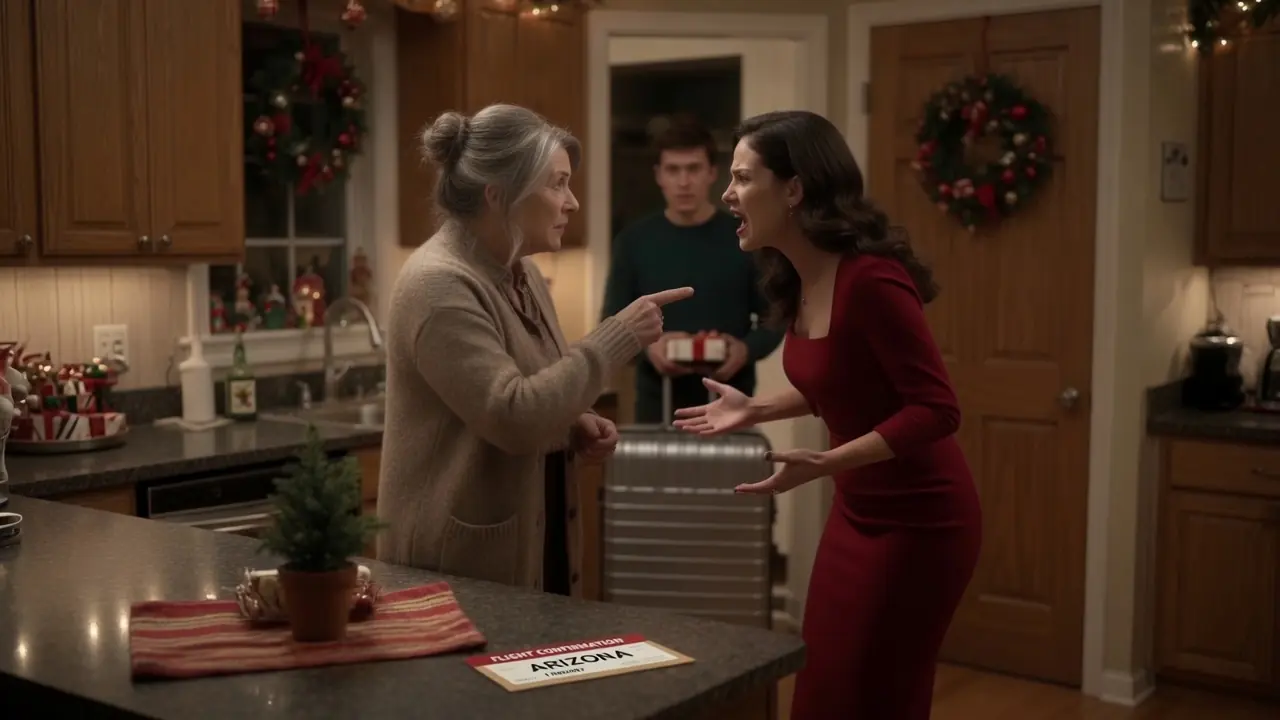
She had already written the grocery list on a yellow notepad beside the fruit bowl. Turkey, ham, potatoes, green beans, rolls, cranberries, three pies, two casseroles, and the special peppermint cookies her grandchildren asked for every year. The list looked ordinary to anyone else, but Elaine saw the hours inside it. She saw the shopping, chopping, baking, cleaning, washing, lifting, and smiling.
Then Vanessa walked in without knocking.
Elaine’s daughter-in-law moved through the kitchen in a fitted red dress and red heels, her cream handbag swinging from one arm as if she had arrived at a holiday luncheon instead of another woman’s home. Her makeup was flawless, her hair curled perfectly, and her smile carried that familiar confidence Elaine had come to recognize. It was the smile Vanessa wore when she was about to announce something that should have been a request. The kind of smile that expected obedience before the first word was spoken.
“My whole family is spending Christmas here,” Vanessa said, dropping her handbag on the island. “It’s only twenty-five people.”
Elaine said nothing at first. She simply looked at Vanessa across the marble countertop and let the sentence settle. Only twenty-five people. Only twenty-five plates, twenty-five chairs, twenty-five sets of silverware, twenty-five opinions, twenty-five stomachs, and twenty-five people walking into Elaine’s home expecting Christmas to appear around them like weather.
“You invited them here?” Elaine asked.
Vanessa waved one manicured hand. “Well, yes. My mother’s house is being renovated, and everyone already knows your place is perfect for Christmas. You have the kitchen, the tree, the dining room, all the serving things.” She glanced at the notepad. “You already make too much food anyway.”
Elaine’s fingers tightened around the mug. For years, she had tried to believe Vanessa simply lacked tact. She told herself Vanessa had grown up differently, that perhaps her own family showed love by arranging things forcefully and calling it tradition. But Elaine was sixty-eight now, and grief had made her honest in ways age alone could not. Her husband, Paul, had been gone for seven Christmases, and with him had gone the last person who noticed when Elaine sat down last and ate cold food.
Vanessa leaned against the island, smiling brighter. “Don’t look like that, Elaine. It’s Christmas. Family should be together.”
Elaine looked toward the living room, where the Christmas tree glowed beside the window. She had decorated it alone the night before, climbing carefully onto a step stool while her knees complained and her back stiffened. Mark, her only son, had said he might come help, but then Vanessa needed him to run errands. Elaine had hung every ornament herself, including the clay angel Mark made in kindergarten.
Family should be together. Vanessa said it like a principle, but used it like a tool.
Elaine set down her mug slowly. “And who will shop for twenty-five people?”
Vanessa laughed lightly. “You always know what to buy.”
“Who will cook?”
“Well, you love cooking.”
“Who will serve?”
“Elaine, no one is asking you to serve. Everyone helps.”
Elaine almost smiled. Everyone helped the way guests helped after being asked three times. Someone carried rolls to the table. Someone opened a bottle of wine. Someone stacked two plates near the sink and called it cleaning. Then Elaine washed roasting pans at midnight while Vanessa posted photos captioned, “Hosted the most beautiful family Christmas.”
The memory came with a sting, but not surprise. Elaine had watched the pattern for years. Easter brunch had moved to her house because “it was easier.” Fourth of July had become her grill, her yard, her electric bill, her cleanup. Thanksgiving was always her kitchen, even when Vanessa announced the menu and accepted the praise.
“My back has been hurting,” Elaine said quietly.
Vanessa tilted her head with polite impatience. “Then we’ll keep it simple. No one needs anything fancy.”
But Vanessa did need fancy. She needed candles, matching napkins, photos in front of the tree, a perfect table, and guests leaving with the belief that she had orchestrated it all. Elaine knew because she had watched Vanessa inspect place settings like a director while Elaine’s hands were raw from washing dishes. She knew because Vanessa’s praise always came in public, while her demands came in private.
Before Elaine could answer, the front door opened. Mark came in from work, brushing snow from his coat, his face already tired. He was forty-three now, but Elaine still sometimes saw the boy who used to run into this same kitchen smelling of winter and school glue. Vanessa turned toward him immediately, as if she had been waiting for backup.
“Mark, tell your mother Christmas here makes the most sense,” Vanessa said.
Mark paused in the doorway. He looked from his wife to his mother and knew, Elaine could tell, that he had walked into a fight he would rather not enter. That was Mark’s gift and flaw. He could sense conflict early and avoid courage even earlier. He gave Elaine a careful smile.
“Mom, it’s just one day,” he said.
Elaine nodded once. “One day for you.”
His expression tightened. “We’ll help.”
“You say that every year.”
Vanessa let out a sharp little breath. “This is becoming dramatic.”
Elaine looked at her. “No, Vanessa. This is becoming accurate.”
For a moment, the kitchen went quiet. Outside, snow pressed softly against the windows. Inside, the Christmas lights glowed above the cabinets, warm and pretty, decorating a room where Elaine suddenly felt very tired.
Vanessa folded her arms. “Fine. What exactly do you want? A thank-you speech? Flowers? Do you want everyone to bow before you for making mashed potatoes?”
Mark’s eyes flickered, but he said nothing.
Elaine felt the old pain rise. It was not just Vanessa’s words. It was Mark’s silence, the familiar emptiness where her son’s defense should have been. She looked at him and remembered the years she had worked double shifts after Paul’s heart surgery, the college tuition she had helped cover, the down payment she quietly contributed when Mark and Vanessa bought their first house. She had never wanted repayment, but she had expected respect.
Vanessa looked at the grocery list, then at Elaine. “People are already coming. We can’t cancel now.”
Elaine’s anger should have grown. Instead, calm moved through her, deep and cold. It came from a secret Vanessa did not know Elaine had discovered three weeks earlier. It came from bank statements, withdrawal records, and a folded receipt Elaine had found in Mark’s coat pocket after he helped clean her garage.
The holiday account.
Elaine had opened it years ago when Paul was alive. Every month, she deposited a small amount for Christmas groceries, gifts, emergency repairs, and travel if needed. After Elaine’s knee surgery two years earlier, Mark had been given limited access to help pay bills while she recovered. Elaine forgot to remove that access because she trusted her son.
Trust, she had learned, could be more expensive than any gift.
Three weeks earlier, she noticed the balance was wrong. At first, she assumed a banking error. Then Samuel at the bank printed the transactions. Eight hundred dollars for a new television. Six hundred for designer luggage. A cabin deposit for Vanessa’s cousin’s holiday cruise. Smaller withdrawals too, scattered like crumbs meant to go unnoticed.
Elaine had stared at the statement for a long time that day. Not crying. Not shaking. Just reading. By the time she folded the paper and put it in her purse, some part of her had quietly packed its bags.
Now, with Vanessa standing in red beside the island, Elaine finally understood why the Christmas announcement felt so confident. They had spent the money meant to fund the holiday and still expected Elaine to perform the labor that made the theft invisible.
Elaine placed both hands around her mug again. “I’m too tired to make Christmas for people who only remember me when they need serving.”
Mark looked startled. “Mom.”
Vanessa’s mouth tightened. “That is unfair.”
“Is it?”
“You always say you like doing this.”
“I liked loving my family,” Elaine said. “I never liked being used.”
Vanessa’s eyes flashed. “No one is using you.”
Elaine looked at the notepad, then at the suitcase sitting near the hallway closet. It was navy blue, already packed, with a tag from an airline Mark had not noticed. Her flight confirmation to Arizona rested inside her purse. Her sister Ruth had been asking her to come for Christmas for five years, promising sunshine, a quiet hotel dinner, and no dishes.
This year, Elaine had said yes.
Vanessa followed Elaine’s gaze and finally noticed the suitcase. “What is that?”
“My luggage.”
Mark stepped forward. “Where are you going?”
“Arizona.”
“For what?”
Elaine looked at him. “Christmas.”
Vanessa’s laugh came out too high. “You’re not serious.”
“I am.”
“But everyone is coming here.”
“That was your decision.”
“You can’t just leave.”
Elaine set her mug down. This time her hands did tremble, not from fear, but from the sadness of finally saying aloud what years had taught her. “I can, Vanessa. And I will.”
Mark’s face paled. “Mom, please. We’ve already told people. Vanessa’s parents, her sisters, the cousins, everyone. They’re expecting Christmas here.”
Elaine nodded. “Then you should tell them you volunteered a house you did not own, a kitchen you did not work in, and a woman you did not respect.”
Vanessa’s face sharpened. “You’re embarrassing us.”
“No,” Elaine said. “I am no longer protecting you from your own choices.”
That was when Vanessa made her mistake. She turned toward Mark, frustrated and careless, and snapped, “This is ridiculous. We already spent the money from her holiday account.”
The kitchen went silent.
Mark closed his eyes.
Vanessa realized what she had said a second too late. Her mouth opened, but the words had already escaped and stood there between them, ugly and clear. Elaine did not move. She simply looked at her daughter-in-law, then at her son.
“My holiday account,” Elaine said.
Vanessa swallowed. “Elaine, I didn’t mean it like that.”
“How did you mean it?”
Mark rubbed his forehead. “Mom, I was going to put it back.”
“When?”
He did not answer.
Elaine opened the drawer beneath the island and pulled out the folded bank statement. She placed it on the counter and slid it toward them. “The television. The luggage. The cruise deposit. The little withdrawals you thought I would not notice.”
Vanessa glanced at the paper and then looked away. “We were under pressure.”
Elaine stared at her. “So you stole from an old woman’s Christmas fund?”
Mark flinched. “Mom, don’t call it stealing.”
“What would you prefer? Borrowing without asking? Spending without permission? Taking from your mother and expecting her to cook for the people who benefited?”
His face reddened. “I said I was going to put it back.”
Elaine’s voice broke just enough to reveal the hurt beneath the calm. “Mark, you were going to let me stand in this kitchen for three days, feeding twenty-five people, with money you had already taken from me.”
Mark looked down.
Vanessa stepped in, defensive again. “It wasn’t only for us. Some of that was for family expenses.”
“Your luggage was a family expense?”
“I needed it for the trip.”
“A trip paid for with money meant for Christmas groceries.”
Vanessa’s jaw tightened. “You’re making it sound worse than it was.”
Elaine picked up her mug, then set it down again because she no longer wanted the comfort of holding it. “No, Vanessa. I am making it sound exactly like it was.”
Mark moved closer. “Mom, please. We made a mistake. But canceling Christmas over this is too much.”
Elaine looked at her son. “I am not canceling Christmas. I am canceling my unpaid position in it.”
His eyes filled with panic. “What are we supposed to do?”
“Shop. Cook. Serve. Clean. Explain. Apologize. Choose any order you like.”
Vanessa’s face changed from panic to anger. “You want us to fail.”
Elaine shook her head. “No. I want you to feel the weight I carried while you called it tradition.”
For the first time, Mark seemed to truly hear her. His shoulders dropped, and the defensiveness faded into something closer to shame. Vanessa, however, was not finished. She grabbed her handbag from the island and looked toward the hallway suitcase.
“If you leave, don’t expect things to be normal when you come back.”
Elaine smiled sadly. “Vanessa, normal is exactly what I am leaving behind.”
The next morning, Elaine woke early. The house was quiet, and the kitchen still smelled faintly of coffee and pine. Her suitcase waited by the door. She walked through each room slowly, turning off lamps, checking windows, and looking at the Christmas tree she had decorated alone.
For a moment, sadness washed over her. She imagined the house full of noise, grandchildren running, food warming, music playing, and herself moving between rooms with practiced efficiency. She loved Christmas. That was the cruelest part. They had not only taken her labor; they had almost taken the joy from something she once cherished.
Her phone buzzed.
Mark.
She let it ring.
Then Vanessa.
She let that ring too.
Then a text appeared from Mark.
Mom, please don’t get on the plane. We need to talk.
Elaine typed back one sentence.
We talked last night. Now you need to act.
At the airport, Elaine felt strangely nervous. She had flown many times with Paul, but never alone on Christmas week. As she sat by the gate, watching families drag suitcases and children toward boarding lines, she almost felt guilty. Then she opened her phone and saw the newest message from Vanessa.
My family is asking what time dinner is. This is humiliating.
Elaine turned the phone off.
Ruth met her in Arizona with open arms and a sunhat, even though it was December. “You look ten years younger already,” her sister said.
“I left twenty-five guests in Ohio,” Elaine replied.
Ruth hugged her tighter. “Then you deserve a medal.”
Christmas in Arizona was not the Christmas Elaine knew. There was no snow, no overloaded oven, no relatives calling from another room. Ruth took her to a small hotel restaurant where someone else cooked dinner and cleared the plates afterward. Elaine ate slowly, tasting food while it was still hot for the first time in years.
After dinner, she walked with Ruth beneath palm trees wrapped in white lights. The air felt cool and clean, and Elaine realized she had not checked her phone for six hours. When she finally turned it on, there were dozens of messages. Some angry. Some confused. Some from Vanessa’s relatives asking if Christmas dinner was still happening. One from Mark simply said: I am sorry.
Elaine did not answer until the next morning.
When she finally called, Mark picked up on the first ring. His voice sounded exhausted.
“Mom.”
“Hello, Mark.”
There was a pause. “Christmas was a disaster.”
Elaine looked out at the Arizona sunrise. “Was it?”
“Vanessa tried to order food, but everywhere was booked or closed. Her mother was furious. The kids cried because the cookies weren’t made. The turkey didn’t thaw in time. We ended up eating pasta and frozen rolls.”
Elaine closed her eyes. She did not feel victory, exactly. Only sadness and a strange sense of balance returning. “I see.”
“I didn’t know,” Mark said softly.
Elaine’s voice cooled. “Yes, you did.”
He inhaled shakily. “No, I mean I didn’t know how much you did. I saw pieces of it, but I never put it together. The shopping, the timing, the cleaning, the way you remembered everyone’s needs. I thought Christmas just happened at your house because you were good at it.”
Elaine turned from the window. “I was good at it because I worked very hard.”
“I know that now.”
“Do you?”
“Yes.” His voice broke. “And I know I took the money. I told myself I would replace it before you noticed, but that was a lie I used to feel less ashamed.”
Elaine sat down slowly. That was the first honest sentence he had given her. Not complete enough to heal, but honest enough to matter.
“What about Vanessa?” Elaine asked.
Mark was quiet.
“Mark.”
“She’s angry. She says you wanted to make her look bad.”
“She did that herself.”
“I know.”
Elaine heard the difference in his voice. For years, Mark had softened Vanessa’s behavior, translated it, excused it. This time he did not defend her. It did not erase the hurt, but it marked a beginning.
“I am changing the locks,” Elaine said.
He went silent.
“And Samuel Price has removed your access to every account.”
“I understand.”
“You will repay the holiday account in full.”
“I will.”
“And you will do it before we discuss future holidays.”
“Yes.”
Elaine breathed out slowly. “I love you, Mark. But I will not be used by you again.”
His answer came quiet. “I know.”
When Elaine returned to Ohio three days after Christmas, her house was still standing, still decorated, still peaceful. There were no dishes piled in the sink, no wrapping paper across the floor, no exhausted guests waiting to be served. The tree lights glowed softly when she plugged them in, and for once the quiet did not feel lonely.
It felt earned.
Two days later, Mark came over alone. He stood at the front door holding an envelope, looking nervous in a way Elaine had not seen since he was a teenager. She opened the door but did not step aside immediately.
“Vanessa isn’t here,” he said.
“I can see that.”
“I brought the first repayment.” He handed her the envelope. “It’s not all of it, but it’s a start.”
Elaine took it without opening it. “Thank you.”
He looked past her into the house. “Can I come in?”
Elaine studied her son’s face. There was shame there. Fatigue. Something softer too. She stepped aside.
They sat at the kitchen island where the argument had happened. Mark looked around at the garland, the fruit bowl, the folded grocery ad still on the counter. He touched the edge of the yellow notepad.
“I never noticed the list,” he said.
“You were not looking for it.”
“No.” He swallowed. “I’m sorry, Mom.”
Elaine waited.
“I’m sorry for the money. I’m sorry for letting Vanessa speak to you like your house was ours to offer. I’m sorry for every time I said, ‘You know how she is,’ when I should have said, ‘You don’t get to treat my mother like that.’”
Elaine looked down at her hands. Those words reached places anger had protected all week. She did not forgive him instantly, because instant forgiveness would teach the wrong lesson. But she let herself receive the apology.
“Thank you,” she said.
Mark’s eyes reddened. “Can I fix it?”
“You can begin.”
“How?”
“By telling the truth. To Vanessa. To your children. To her family, if necessary. Tell them Christmas did not happen because I abandoned anyone. It did not happen because you and Vanessa volunteered what was not yours and spent what was not yours.”
He winced, but nodded. “Okay.”
“And next year,” Elaine said, “I am not hosting Christmas.”
Mark looked up.
“I may attend Christmas. I may bring a dish. I may sit in a chair and drink coffee while someone else washes dishes. But I am not creating the holiday alone again.”
A small, painful smile touched his face. “That sounds fair.”
“It should have sounded fair years ago.”
“Yes,” he said. “It should have.”
Vanessa came one week later. Elaine almost did not open the door, but when she saw Vanessa standing on the porch without makeup, without the red dress, and without her usual armor, she unlocked it. Vanessa held a small box wrapped in plain brown paper.
“I brought back the luggage,” Vanessa said.
Elaine looked at the box. “That is not luggage.”
“No. I returned it.” Vanessa’s voice was stiff, but not rude. “This is the refund receipt and some cash toward the account.”
Elaine accepted the box. “Thank you.”
Vanessa looked miserable saying the next words. “I was wrong.”
Elaine waited, because Vanessa had often used short apologies as bridges back to comfort.
“I volunteered your house because I was embarrassed mine wasn’t ready,” Vanessa continued. “I wanted my family to think I had Christmas handled. I told myself you liked doing it because it was easier than admitting I was using you.”
Elaine’s expression softened only slightly. “And the account?”
Vanessa looked down. “We should never have touched it.”
“No.”
“I’m sorry.”
Elaine heard the words, but she also heard how difficult they were for Vanessa. That did not make them complete. It made them real enough to begin with.
“You hurt me,” Elaine said.
“I know.”
“You treated me like staff in my own house.”
Vanessa’s eyes filled. “I know.”
“And you let people praise you for work I did.”
A tear slipped down Vanessa’s cheek. “I know.”
Elaine nodded slowly. “Then you know enough to change.”
Vanessa looked up. “Can I?”
“That depends on what you do after the apology.”
Over the next year, things changed in small, imperfect ways. Mark repaid the holiday account in monthly installments. Vanessa stopped volunteering Elaine’s home and began asking before making plans. The grandchildren learned to clear plates, fold napkins, and say thank you for food before running away from the table.
Elaine still loved them. She still baked cookies with the children and invited Mark for Sunday soup. But she no longer confused love with exhaustion. She no longer allowed gratitude to be optional.
The following Christmas, dinner was held at Mark and Vanessa’s smaller rented house after they sold the oversized place they could not afford. Elaine arrived at three in the afternoon carrying one pie and a small poinsettia. Vanessa opened the door in a green sweater, face flushed from cooking, hair pinned messily, kitchen towel over one shoulder.
For a moment, they simply looked at each other.
Then Vanessa said, “I understand now.”
Elaine glanced past her. The kitchen was chaos. Pots steamed. Children argued over forks. Mark was carving ham badly. Vanessa’s mother was asking too many questions from the dining room. Nothing looked perfect.
Elaine smiled gently. “Do you need help?”
Vanessa’s eyes filled, but she shook her head. “No. Sit down. Coffee?”
Elaine stepped inside and removed her coat. “Coffee would be lovely.”
She sat in a chair near the window while the family moved around her. It felt strange at first, being still while others worked. Strange, but not wrong. Her grandson brought her a cup of coffee with too much cream. Her granddaughter placed a napkin beside her and said, “Dad said Grandma gets served first this year.”
Elaine looked at Mark. He smiled from the kitchen, embarrassed but sincere.
Dinner was late. The potatoes were lumpy. The green beans were overcooked. Someone forgot the cranberry sauce until dessert. But when everyone sat down, Vanessa stood and lifted her glass.
“I want to say something,” she said.
The room quieted.
“For years, Christmas happened because Elaine worked herself tired while the rest of us enjoyed it. Last year, I treated her house, her money, and her labor like they belonged to me.” Vanessa’s voice shook, but she continued. “I was wrong. This year is not perfect, but it is honest. And Elaine, thank you for all the years you carried what we did not see.”
Elaine looked down at her plate, blinking away tears.
Mark reached for her hand. “Merry Christmas, Mom.”
She squeezed his fingers. “Merry Christmas.”
That night, after dinner, Elaine did not wash dishes. She sat by the tree with coffee and watched the children play. In the kitchen, Mark and Vanessa argued softly over how to load the dishwasher. Vanessa’s mother dried plates. Someone laughed when a pan slipped loudly in the sink.
Elaine listened to the noise and felt something return to her, not the old Christmas, but something better. A Christmas where she was present, not consumed. Loved, not used. Seen, not simply needed.
When she went home later, snow had begun falling again. Her own house was quiet when she unlocked the door. The garland still hung above the cabinets, and the tree glowed in the living room because she had decorated it for herself this year, not for twenty-five guests.
Elaine made tea and sat in her kitchen.
She thought of the woman she had been, standing with a cold mug while Vanessa announced that her house had been volunteered. She thought of the trembling sentence that had saved her: I’m too tired to make Christmas for people who only remember me when they need serving.
That sentence had not ended her family.
It had ended the lie that love required her disappearance.
Elaine lifted her mug toward the quiet room, toward Paul’s memory, toward the woman she was still becoming.
Christmas had not been stolen from her.
She had taken it back.