Rain had a way of making failure feel louder.
Danielle Mercer learned that on a Thursday night in October, somewhere along a lonely stretch of highway in western Pennsylvania, with her windshield wipers dragging tired half-circles across the glass and her whole life packed into one cardboard box on the passenger seat.
The box held a framed certificate from the first year her company made a profit, a cracked coffee mug with her business logo on it, three folders of unpaid invoices, a tape measure, a small walnut sample from a dining table she never got to finish, and a photograph of six employees standing outside a workshop that no longer belonged to her.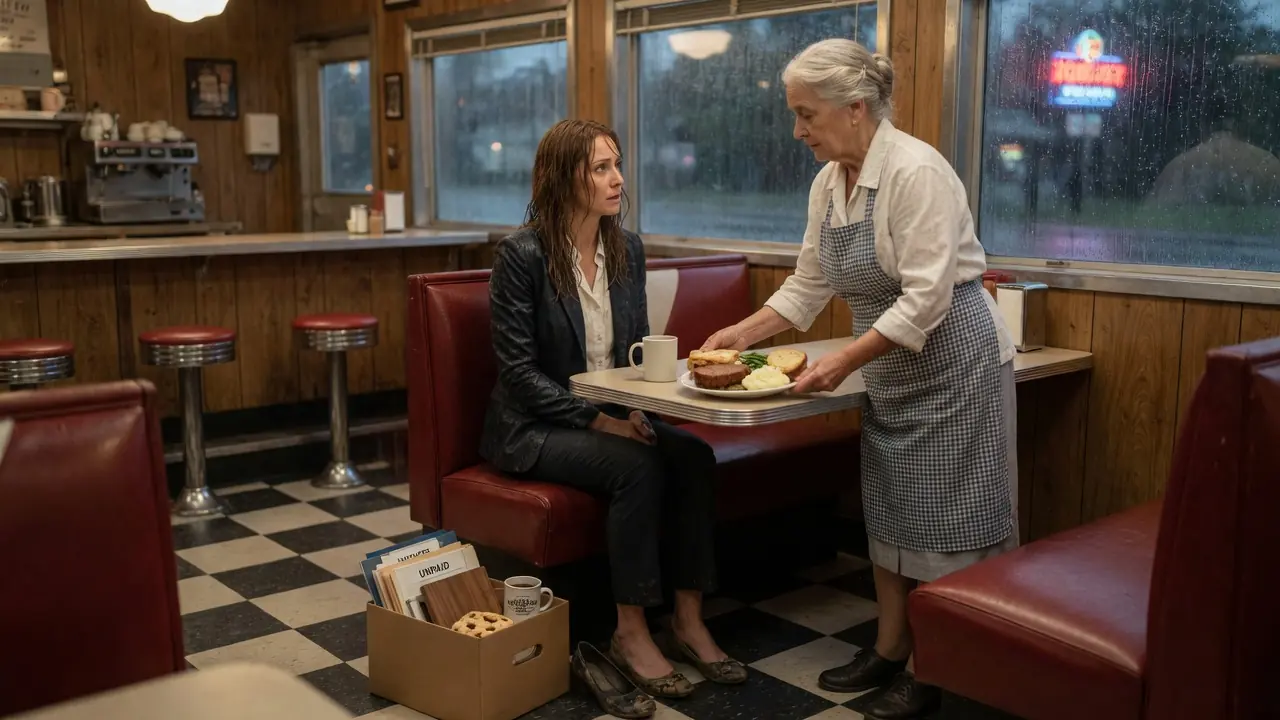
Her phone sat in the cup holder at three percent battery, buzzing every few minutes with calls she did not have the courage to answer.
The rain thickened as she drove, turning the road into a black ribbon that reflected every passing headlight. Danielle’s navy blazer was damp from running across the parking lot outside the bank, and her white blouse clung uncomfortably at the collar.
She had taken off her heels an hour ago and was driving in stocking feet because the backs of her shoes had cut into her skin. Her hair, once pinned neatly for the meeting, had loosened around her face in damp strands.
Every mile she drove took her farther from the building where she had just signed away the last pieces of Mercer Custom Furniture.
It had not always been like that.
Three years earlier, Danielle had believed she was building something that would outlive her.
Mercer Custom Furniture started in a rented warehouse on the edge of Pittsburgh, with secondhand tools, one delivery van, and three workers who trusted her because she spoke honestly and paid on time.
She built dining tables, cabinets, bookshelves, benches, and kitchen islands from real wood, with careful joinery and finishes that made people run their hands across the surface before they said anything.
Customers loved the work because it felt human.
Danielle loved the work because it made sense.
Wood had rules.
Grain had direction.
A board could warp, split, cup, or bow, but it never pretended to be something else. If you forced it, it fought you. If you listened to it, it told you how it wanted to become useful.
Danielle had always been better with wood than with people, but running a business meant learning both.
For a while, she succeeded.
She hired more workers. She moved into a bigger workshop. She bought better machines. She took larger contracts from restaurants, hotels, and developers who wanted custom interiors with a handmade look.
She became the kind of woman other people called successful, and for a while she believed them.
Her husband, Evan, had been proud at first.
He brought lunch to the workshop on Saturdays, took photos of finished pieces, and told customers that Danielle built furniture as if every table might host someone’s best memory.
But success came with longer hours, more pressure, and less of Danielle at home.
The more the company grew, the more she disappeared into estimates, orders, payroll, supplier delays, and late-night calls.
Then came the contract that broke everything.
A regional hotel group ordered custom furniture for six locations. It was the largest job Danielle had ever accepted.
The deposit looked strong. The timeline looked tight but possible. Her business partner, Mark, convinced her it was the kind of opportunity that turned a small company into a serious one.
Danielle signed.
She borrowed money for materials. She hired temporary help. She expanded faster than her instincts wanted.
The first supplier delay cost her two weeks.
The second cost her a month.
Then Mark disappeared.
Not dramatically.
No note on the desk. No confession. No shouting match.
He simply stopped answering calls.
By the time Danielle learned that company funds had been moved, invoices had gone unpaid, and several deposits had been mishandled, the hotel deadline was already impossible.
The client canceled the remaining contract and demanded penalties.
Danielle fought for six months.
She sold equipment. She took personal loans. She stopped paying herself. She laid off the temporary workers first, then the newest hires, then people who had been with her since the early days.
She promised each person she would make things right, though she no longer knew what right meant.
Every promise cost her sleep.
Evan left in February.
He did not leave angrily.
That almost made it worse.
He stood in the kitchen of their rented townhouse, holding a suitcase, and said, “Dani, I know you’re trying to save the company. But I don’t think you understand that you’re losing everything else.”
She wanted to argue.
But she had been standing there with a phone in one hand and a payroll spreadsheet in the other, and there was nothing convincing about her.
By October, the bank had stopped using gentle language.
That Thursday, she went in wearing her best blazer because some part of her still believed looking respectable might help.
She asked for an extension, a restructuring, a temporary line of credit, anything that would give her thirty more days.
The loan officer listened with a kind face and folded hands, then told her what Danielle already knew.
There would be no extension.
When Danielle left the bank, it was raining.
By nine o’clock, she had emptied her desk.
By ten, she was driving with no destination.
She had thirty-eight dollars in her wallet, half a tank of gas, and a heart so heavy she wondered if it had become a physical object pressing against her ribs.
She thought about calling Evan, then hated herself for wanting comfort from someone she had already exhausted.
She thought about calling her foreman, Reggie, to apologize again, but she had apologized so many times the word had lost all shape.
So she drove.
The highway carried her past closed gas stations, dark farmhouses, and fields flattened by rain. She did not know the name of the town she entered near eleven-thirty. She only knew she was hungry in a way that felt shameful, like hunger was another bill she had failed to pay.
Then a small yellow sign appeared at the edge of her headlights.
Maggie’s Roadside Diner
Open Late
Coffee, Pie, Supper
Danielle almost passed it.
Then her stomach twisted hard enough to make her slow down.
The diner sat beside an old two-pump gas station that looked long closed, with a gravel lot full of puddles and weeds. A red neon sign buzzed above the door, but the letter G in Maggie’s flickered on and off, so from the road it looked like Ma ie’s if the rain hit at the wrong angle.
Warm light glowed behind the windows.
There were only two vehicles in the lot: a faded blue sedan and a pickup truck with mud on the tires.
Danielle parked near the side, shut off the engine, and sat without moving.
She looked at herself in the rearview mirror.
Her face seemed older than it had that morning. Her eyes were bloodshot. Her lipstick had faded unevenly. Her hair was damp and flattened around her cheeks.
She looked like a woman who had walked out of her own life and forgotten to bring a map.
For one moment, she considered starting the car again.
Then her stomach growled.
She stepped into the rain and hurried to the door.
The bell above the diner entrance rang with a small, bright sound that felt too cheerful for the hour. Inside, the diner smelled of coffee, gravy, frying onions, old wood, lemon cleaner, and something sweet cooling somewhere unseen.
There were red vinyl booths along the windows, a long counter with round stools, a pie case near the register, and framed photographs on the wall. The floor was worn but clean.
A woman behind the counter looked up from refilling napkin holders.
She was in her early seventies, maybe older, with silver hair pinned into a bun and a blue apron tied over a white blouse. She was small, but nothing about her seemed fragile. Her face had the strong lines of someone who had spent a lifetime waking before sunrise and not asking permission to continue.
Her name tag read Maggie.
“Evening,” she said. “You look like the storm dragged you in by the collar.”
Danielle gave a tired laugh because she had no better response.
“It might have.”
“You want a booth or the counter?”
“Counter is fine.”
She sat on a stool near the end, setting her wet cardboard box carefully on the floor by her feet.
Maggie looked at the box, then at her blazer, then at her face.
She did not stare long enough to embarrass her.
Just long enough to understand there was more wrong than rain.
“Coffee?” Maggie asked.
“Yes, please.”
“Cream?”
“No, thank you.”
Maggie poured from a glass pot into a thick white mug and set it in front of her. The coffee was hot, strong, and not fancy in the slightest.
Danielle wrapped both hands around the mug like she had been cold for years.
Maggie leaned one hip against the counter.
“You passing through?”
Danielle looked down at the coffee.
“Something like that.”
“That means no.”
Danielle looked up, surprised.
Maggie shrugged. “People passing through know where they’re going.”
Danielle almost smiled.
“I suppose that’s true.”
“You hungry?”
“No,” she said automatically.
Her stomach growled so loudly that Maggie raised one eyebrow.
“That was a rude interruption from your insides.”
Danielle flushed.
“I’m fine.”
“People who are fine don’t usually look at coffee like it’s holding them together.”
Danielle looked away.
“I don’t have much money.”
Maggie did not soften in a way that made her feel pitied. She simply reached for a menu and slid it toward her.
“Meatloaf special is still warm. Mashed potatoes, green beans, bread. Apple pie if you behave.”
“I can pay for coffee.”
“Coffee is one dollar tonight.”
Danielle glanced at the menu.
“It says two-fifty.”
“Storm discount.”
“That’s not a real discount.”
“It is if I own the coffee pot.”
Danielle looked at her.
“I don’t want charity.”
“Good,” Maggie said immediately. “Charity makes people stiff. I prefer supper.”
That answer confused Danielle enough that she did not know how to argue.
Maggie pointed toward the corner booth near the heater.
“Sit there. Your blazer is dripping on my stool.”
Danielle looked down.
She was dripping.
“Sorry.”
“Don’t apologize to furniture. It gets ideas.”
Danielle picked up her mug and moved to the booth. The red vinyl seat was cracked in the corner, but the heater beneath the window pushed out warm air.
Rain streaked the glass beside her, turning the neon sign outside into red rivers. The whole world felt far away, and that frightened her because distance felt too much like relief.
Maggie brought the plate five minutes later.
Meatloaf with brown gravy.
Mashed potatoes with butter melting into the top.
Green beans cooked with onions.
Two slices of bread.
A small cup of applesauce.
It was not restaurant food.
It was the kind of food someone made because they expected hunger to be honest.
Danielle stared at it.
“Maggie, I really can’t pay for all this.”
Maggie set down a fork and napkin.
“You can pay what you can. And before your pride starts performing, listen carefully. I have thrown away more food this week than I like to admit. If you eat this, you are helping me with a waste problem.”
“That sounds like a generous lie.”
“It is a practical arrangement with emotional benefits.”
Danielle laughed once, but her throat tightened.
Maggie stepped back.
“Eat before it cools.”
Danielle picked up the fork.
At first, she ate slowly, as if manners could prove she was not as desperate as she felt.
Then hunger took over.
The first bite of meatloaf nearly undid her.
Not because it was extraordinary, although it was good, but because it was warm and real and given without a lecture.
She had spent months being measured by numbers, contracts, balances, deadlines, and failures.
A plate of food asked nothing except that she eat.
Halfway through, her eyes blurred.
She put down the fork and covered her face with one hand.
Maggie was wiping the counter. She saw her, but she did not rush over. She did not ask, “Are you okay?” which would have required Danielle to lie.
She simply turned slightly, giving her the dignity of privacy in a public room.
That kindness broke Danielle more deeply than questions would have.
After a minute, Danielle lowered her hand.
“I lost everything today,” she said, her voice barely above the rain.
Maggie came over with the coffee pot and refilled her mug.
“Business?”
Danielle nodded.
“What kind?”
“Furniture. Custom furniture.”
“Woodworker?”
“Business owner. I used to build more than I managed. Lately, I mostly failed at managing.”
Maggie sat across from her without asking.
“Did you love it?”
Danielle looked at the plate.
“Yes.”
“Then it hurt worse.”
She let out a breath that almost became a laugh.
“That simple?”
“Most complicated pain has simple bones.”
Danielle looked at her properly for the first time.
“My company is gone. My employees lost their jobs because I made bad decisions. My partner stole from the business. My marriage ended because I kept trying to save something that kept sinking. The bank said no today. I don’t even know where I’m sleeping tonight.”
Maggie listened without interrupting.
Danielle had expected shame to rise higher as she spoke, but instead she felt something loosen.
Not enough to heal.
Just enough to breathe.
The words had been trapped inside her for so long that saying them to a stranger felt less dangerous than saying them to someone she loved.
Maggie folded her hands on the table.
“My husband, Frank, lost his repair shop thirty-two years ago.”
Danielle looked up.
“He fixed farm equipment, trucks, anything with wheels and an attitude. Took on too much debt, trusted the wrong man, got caught in a bad season. One day he came home and sat at our kitchen table without taking off his coat. I asked if he wanted coffee, and he said, ‘I don’t think I’m a man anymore.’”
Danielle swallowed.
“What happened?”
“I told him he was being dramatic and made him soup.”
Despite herself, Danielle laughed.
Maggie smiled faintly.
“Then, after he calmed down enough to stop insulting himself, we started smaller. He fixed lawn mowers from our garage. Then snowblowers. Then old trucks again. Never became rich. But he became useful again, and that saved him more than money did.”
Danielle stared at her plate.
“I don’t know how to start smaller. Everything is debt and failure and people I disappointed.”
“You don’t start with everything,” Maggie said. “That will crush you. You start with tomorrow morning.”
“Tomorrow morning I have to tell my remaining employees the company is finished.”
“Then tell them the truth.”
“That I failed them?”
“That you fought, lost, and are sorry. Don’t decorate pain just to protect your pride. People can survive hard truth better than false hope.”
Danielle’s mouth tightened.
“I don’t know if they’ll forgive me.”
“They might not tomorrow.”
“That’s comforting.”
“Truth isn’t always soft.”
Danielle looked at her.
Maggie leaned forward slightly.
“After that, you ask yourself one question. What skill still belongs to you after the building, the loan, the contracts, and the title are gone?”
Danielle looked at her hands.
They were rough, though less rough than when she built every day. There was a small scar near her thumb from a chisel slip when she was twenty-two. Her palms knew weight, grain, sanding, measuring, finishing.
She had not thought of them as assets in months.
“I know wood,” she said quietly.
Maggie nodded.
“Then you are not empty-handed.”
“I lost the workshop.”
“Find a smaller table.”
The sentence landed strangely.
Danielle looked at her.
“What?”
“Find a smaller table,” Maggie repeated. “If you can’t build a whole company tomorrow, build one honest thing. Then build the next.”
Danielle stared at her for a long moment.
“That sounds too simple.”
“Simple and easy are not cousins.”
Maggie stood and returned with a slice of apple pie.
Danielle shook her head weakly.
“I didn’t order that.”
“The top cracked.”
“It looks perfect.”
“Emotionally cracked.”
Danielle laughed again, and this time the laugh did not break.
The pie was warm, with cinnamon and butter in the crust. Danielle ate it slowly, feeling ashamed of how much it comforted her and grateful anyway.
When she finished, she took twenty dollars from her wallet and placed it on the table.
Maggie picked up the money, removed one ten, and pushed the other ten back.
“No.”
“Maggie.”
“No,” she said. “Gas money.”
“I can’t take that.”
“You are not taking. You are leaving with enough to reach whatever tomorrow morning looks like.”
“I don’t deserve this.”
“That is not how food works.”
Danielle pressed her fingers against the bill.
“Why are you helping me?”
Maggie glanced toward the old photographs near the register. One showed her younger, standing beside a man with dark hair and a wide smile.
Frank.
“Because someone once fed Frank when he thought shame was the same thing as death. He came home because of that meal. Not because food solved the problem, but because it reminded him he was still alive inside it.”
Danielle lowered her eyes.
Maggie took a receipt pad from her apron pocket and wrote something on the back. She slid it across the table.
Danielle read it.
Find a smaller table. Build one honest thing. Then build the next. - Maggie
She folded the receipt carefully and placed it in her wallet.
“I’ll come back,” she said.
“People say that on hard nights.”
“I mean it.”
“I believe you might.”
When Danielle stepped outside, the rain had softened but not stopped. She sat in the car and watched Maggie move behind the counter, refilling napkins, turning off one light, wiping a surface that was already clean.
Danielle looked at the receipt again beneath the dim dome light.
Then she started the car and drove toward the cheapest motel she could find.
The next morning hurt.
It hurt worse than the bank.
Danielle stood in the emptying warehouse in front of Reggie, Melissa, Omar, Chris, and two part-time finishers who already knew from her face what had happened.
She told them the truth.
No extension.
No buyer.
No miracle.
She told them they would receive their final checks from the last available funds and that she would help them find work however she could.
Reggie, her foreman, crossed his arms and looked away.
Melissa cried silently.
Omar asked whether there was any chance of reopening under another name, and Danielle had to say no.
Chris, the youngest, just stared at the floor.
Danielle did not blame Mark out loud, though everyone knew Mark had destroyed them. She did not blame the bank, though she wanted to. She did not make speeches about future opportunities or “family” or resilience.
She said, “I am sorry. I made decisions that put too much weight on this company, and all of you paid for it. I will spend the next weeks helping each of you land somewhere stable.”
Nobody applauded honesty.
That was not what honesty was for.
Reggie stayed after everyone else left.
“You should have told us earlier,” he said.
Danielle nodded.
“Yes.”
“I might have helped.”
“I know.”
“That makes it worse.”
Danielle looked down.
“Yes.”
Reggie sighed, then picked up his tool bag.
“You were a good craftswoman before you tried to become a big boss.”
That sentence cut deeper than an insult.
Reggie continued, “Don’t lose the part that knew how to build.”
Then he left.
Danielle spent the next month closing the company properly.
She called contacts, begged for job openings, wrote reference letters, sold machines, returned materials where possible, and answered creditors with as much honesty as she could.
She slept poorly in a rented room above a mechanic’s garage that smelled faintly of motor oil and cold concrete.
When the warehouse was finally empty, she stood alone in the middle of it.
The floor still showed pale rectangles where machines had been. Sawdust remained in corners. The air held the ghost of work.
Danielle took the small walnut sample from her cardboard box and placed it in her coat pocket.
Then she locked the door.
For three days, she did nothing useful.
She slept badly, ate little, ignored calls that were not urgent, and stared at Maggie’s receipt until the words almost became irritating.
Find a smaller table.
On the fourth day, the mechanic downstairs knocked on her door.
“You still work with wood?”
Danielle almost said no.
Instead, she said, “I used to.”
The mechanic, a man named Vince, held up a broken stool.
“My shop stool finally gave up. Can you fix it?”
Danielle looked at it.
Cheap pine, cracked joint, loose leg, ugly finish.
It was not worth fixing.
Then she heard Maggie’s voice in her head.
Build one honest thing.
“I can build you a better one,” Danielle said.
“With what shop?”
Danielle looked past him toward the garage below.
“You have clamps?”
Vince did.
They were terrible clamps, but they worked.
Danielle found scrap oak from a salvage yard, borrowed a small saw, bought sandpaper with money she should have saved, and built the stool on two sawhorses behind the garage.
It took longer than it should have because she no longer had proper equipment. Every inconvenience humbled her. Every cut reminded her of what she had lost.
But when she finished, the stool was solid.
Simple.
Strong.
Honest.
Vince paid her forty dollars and sat on it immediately.
“Feels better than the old one.”
“It should,” Danielle said. “The old one was trying to die.”
That night, Danielle wrote $40 in a notebook.
Under it, she wrote:
First smaller table. Not actually a table. Counts anyway.
The next thing she built was a porch bench for Vince’s sister. Then a shelf for a teacher. Then a cutting board set from walnut offcuts.
She photographed each piece on a clean sheet near the garage door and posted them online under a name that felt almost like a confession.
Smaller Table Woodworks
Her description was simple:
Hand-built furniture and household pieces made carefully, one order at a time. No rush jobs. No fake wood. No shortcuts.
At first, almost no one cared.
That was good for her.
Danielle learned to survive small again.
She learned to answer one inquiry without imagining a business empire. She learned to price honestly instead of desperately. She learned to say no when a job was too big or the timeline dishonest.
Every time temptation whispered that she could scale quickly if she borrowed just a little money, she took Maggie’s receipt from her wallet and read it.
Build one honest thing.
Then build the next.
Six months passed.
Danielle moved from the rented room into a small apartment behind an old storefront. The front space became her shop. It had uneven floors, poor heat, and a back door that stuck in damp weather, but it was hers without debt.
She bought tools slowly.
One planer.
One table saw.
Better clamps.
A proper workbench.
She called Reggie after eight months.
Not to offer a job.
She did not have one.
She called to apologize again, this time without asking for absolution.
Reggie listened.
Then said, “You building?”
“Yes.”
“Good.”
A month later, Reggie stopped by the small shop.
He inspected the workbench, ran his hand over a finished shelf, and nodded.
“You slowed down.”
Danielle braced for criticism.
Reggie said, “Good. You needed to.”
Eventually, Reggie began helping on weekends.
Then part-time.
Then full-time, but only after Danielle showed him the books, the contracts, the cash reserves, and the rule written in marker above the office doorway.
No growth that breaks the work.
Reggie read it and pointed.
“Keep that up there.”
“I plan to.”
“No. I mean when you get arrogant again.”
Danielle nodded.
“I deserve that.”
“Yes, you do.”
They laughed for the first time in a long while.
Danielle’s work gained attention slowly, which was the only kind of attention she trusted now.
A local café ordered six tables. A young couple ordered a dining table built from reclaimed maple. A school librarian asked for reading benches. A small restaurant group hired her to build counters and booth frames for one location, then another.
She paid her debts as she could.
She sent former employees updates when she found openings for them. Some answered. Some did not. She accepted both.
Repair did not always include reunion.
Evan called once after seeing an article about Smaller Table Woodworks in a local magazine.
“I’m glad you’re building again,” he said.
Danielle sat on the floor of her shop beside a stack of oak boards, phone against her ear.
“Me too.”
“You sound different.”
“I lost the part that wanted to sound impressive.”
He was quiet for a moment.
Then he said, “That’s probably good.”
They did not get back together.
Life was not that simple.
But they spoke with kindness, and Danielle learned that not every broken thing needed to become what it once was to be honored.
Two years after the rainy night, Smaller Table Woodworks had five employees, including Reggie.
The shop was still modest, but steady.
Danielle had no business partner. No reckless debt. No contract she could not understand with her own eyes. She built less than people wanted and more carefully than they expected.
One afternoon in October, while cleaning out her old wallet, Danielle found Maggie’s receipt tucked behind her driver’s license.
The paper was worn thin at the folds. The ink had faded slightly, but the words remained clear.
Find a smaller table. Build one honest thing. Then build the next. - Maggie
She sat at her desk for several minutes, holding it.
Then she opened a map and searched for the diner.
Maggie’s Roadside Diner still existed.
Barely.
At least online, there was one old review from three months earlier:
Food still good, but place looks like it’s falling apart. Hope Maggie hangs in there.
Danielle felt something cold move through her.
That weekend, she drove back.
Rain began just before sunset.
It felt almost too fitting, like memory had arranged the weather.
Danielle drove a work truck this time, clean but not flashy, with Smaller Table Woodworks painted simply on the door. Behind her, Reggie drove another truck loaded with wrapped furniture pieces. A third truck followed with tools, materials, and two employees who had volunteered before Danielle explained fully.
Maggie’s sign appeared through the rain.
It looked worse than Danielle remembered.
The neon barely held. The red awning sagged in the middle. One side of the building had peeling paint. The gravel lot had deep puddles and weeds growing through the cracks. A plywood patch covered the lower corner of one front window.
A handwritten sign taped to the door read:
Open. Please pull hard. Door sticks.
Danielle parked in the same place as before.
For a moment, she could not move.
She saw herself from two years earlier, soaked, ashamed, holding her last ten dollars like pride could still buy dinner.
She saw Maggie sliding the bill back to her.
She heard her say, “You are leaving with enough to reach whatever tomorrow morning looks like.”
Then Danielle stepped out.
The bell above the door rang, though weaker than before.
Inside, the diner smelled the same.
Coffee.
Gravy.
Toast.
Lemon cleaner.
Pie.
But the room looked tired in a way that hurt.
The booths were torn more deeply. Several tables wobbled on folded cardboard shims. The counter edge was chipped. One stool leaned slightly. The pie case was empty except for one lonely slice under plastic wrap.
Only two customers sat inside, both older men at the counter.
Maggie was behind the register, reading an invoice with her glasses low on her nose.
She looked up.
At first, she did not recognize Danielle.
Then her eyes narrowed.
“Well,” she said slowly. “The bank argument came back with better shoes.”
Danielle smiled.
“Hello, Maggie.”
Maggie walked around the counter, studying her with open curiosity now.
“You look alive.”
“I am.”
“That’s good. Alive people order food.”
“I will.”
Her gaze moved past Danielle to the trucks outside.
“You bring friends to eat too?”
“Something like that.”
Maggie’s smile faded slightly.
She knew.
Perhaps not the details, but enough.
People who had run diners for decades could hear help approaching and become defensive before it opened its mouth.
“Danielle,” she said carefully. “What did you do?”
Danielle looked around the diner.
“What happened?”
Maggie lifted one shoulder.
“Time happened. Rent happened. Roof happened. Equipment happened. People discovered sandwiches can be delivered by children on bicycles and forgot booths exist.”
“That’s not all.”
“No,” Maggie said. “But it’s enough for one sentence.”
Danielle saw the envelope near the register.
Thick paper.
Formal.
Maggie noticed her eyes move.
“Landlord is selling the property,” she said. “New owner wants to renovate the diner into something with plants hanging from pipes and toast that costs twelve dollars.”
Danielle’s jaw tightened.
“When?”
“My lease ends in sixty days.”
“Do you want to close?”
Maggie laughed once, but it carried no humor.
“Everyone asks if I’m tired. Nobody asks that.”
“I’m asking.”
She looked around.
At the counter.
At the booths.
At the grill window.
At a photograph of Frank near the register, smiling beside a younger Maggie in front of the diner decades ago.
“No,” she said quietly. “I don’t want to close.”
Danielle nodded.
“Then I brought the right trucks.”
Maggie’s eyes sharpened.
“No.”
“You haven’t heard the plan.”
“I hear trucks. Trucks are never subtle.”
“Maggie.”
“No, Danielle. I fed you dinner. I didn’t buy shares in your conscience.”
Danielle almost smiled, but Maggie’s eyes were wet, and she respected the seriousness of her pride.
“This is not charity.”
“That is what people say before charity enters wearing a hat.”
Danielle took a folded proposal from her coat and placed it gently on the counter.
“This is a lease partnership.”
Maggie looked suspicious.
“Those are dangerous words.”
“Smaller Table Woodworks needs a living showroom.”
“A what?”
“A real place where customers can see our diner tables, booth frames, counters, stools, and restoration work being used every day. Not staged in a showroom. Used. Coffee spills, elbows, families, truck drivers, tired people, real life. Maggie’s becomes the first Smaller Table restoration partner.”
Maggie stared at her.
Danielle continued.
“I spoke with your landlord.”
“You did what?”
“He agreed to renew the lease if repairs are completed, rent is secured for twelve months, and the property value improves. My company leases the back storage room and the far corner area as a rotating display space. We pay rent directly into the lease structure. In exchange, we restore the diner furniture, counter, booths, sign frame, and interior woodwork as leasehold improvements and showroom investment.”
Maggie said nothing.
Danielle pushed the folder slightly closer.
“You stay owner of the diner business. Your recipes stay yours. Your name stays on the sign. Your menu stays honest. We do not turn this into a place where toast needs a paragraph.”
One of the old men at the counter muttered, “Thank God.”
Maggie did not laugh.
She opened the folder.
Inside were drawings.
The diner, restored but not erased.
New red booth seats built over strong frames.
Tables made from warm oak, finished to survive coffee, syrup, and elbows.
The counter repaired, polished, and edged with wood that matched the original style.
A rebuilt pie case base.
New shelves near the entrance displaying small wooden pieces customers could order, each tagged discreetly.
The old photographs preserved.
The sign repaired but not redesigned.
Maggie turned a page.
There was the corner booth by the heater.
The one where Danielle had eaten.
Above it, a small brass plaque:
The Rainy Night Booth
For Anyone Starting Over
Maggie closed the folder.
“That is too sentimental.”
“Yes.”
“Frank would have made fun of it.”
“Would he have liked it?”
She looked at Frank’s photograph.
After a long moment, she said, “He would have sat there pretending not to cry.”
Danielle smiled softly.
“So will I, probably.”
Maggie shook her head.
“I can’t afford this.”
“You are not paying for the restoration. Smaller Table is investing in its showroom and lease partnership. The numbers are in the folder. Reggie reviewed them. My accountant reviewed them. Your landlord has a draft agreement. Your attorney should review it too.”
“I don’t have an attorney.”
“I found one who works with small businesses. First consultation is covered by us as part of the agreement.”
Maggie narrowed her eyes.
“You thought of everything.”
“No,” Danielle said. “I thought of what I wish I had thought of before losing my first company.”
That quieted her.
Danielle reached into her wallet and took out the old receipt.
Maggie went still when she saw it.
Danielle placed it beside the folder.
“I built Smaller Table from this.”
Maggie touched the edge of the receipt with one finger.
“You kept it.”
“I read it every time I wanted to become foolish again.”
“Did it work?”
“Mostly.”
The two men at the counter listened silently now.
Danielle said, “You told me to build one honest thing. This is the next one.”
Maggie’s mouth trembled, but she looked away quickly.
“I don’t like being helped.”
“I know.”
“I’m the one who feeds people.”
“I know.”
“I don’t know how to sit on the other side of that.”
Danielle’s voice softened.
“Neither did I.”
For a long moment, only the rain spoke.
Then Maggie picked up the folder again.
“You tell your people,” she said, voice firm despite the emotion in it, “that nobody replaces the coffee machine with anything that uses pods.”
Danielle let out the breath she had been holding.
“Agreed.”
“And the meatloaf recipe doesn’t get photographed for marketing.”
“Agreed.”
“And I approve the booth fabric.”
“Already planned.”
“And if anyone calls this place vintage-cute, they leave.”
Danielle smiled.
“I’ll add that to the contract.”
The restoration began the following Monday.
Maggie insisted the diner remain open as much as possible during repairs, because “closed signs teach customers bad habits.”
Danielle planned the work in phases. Booths were removed two at a time, rebuilt offsite, and returned stronger. Tables were replaced gradually. The counter was refinished overnight. Reggie supervised structural repairs with the seriousness of a man restoring a chapel.
Maggie complained daily.
She complained about sawdust.
“This is a diner, not a lumberyard.”
Danielle replied, “The lumberyard is cleaner.”
She complained about toolboxes in the walkway.
“If someone trips before coffee, I will blame you legally and spiritually.”
Reggie moved the toolbox.
She complained when Danielle removed the wobbliest table.
“That table has been here twenty-seven years.”
“It leans like it has secrets.”
“It does.”
“It’s becoming a display piece.”
“It better display loyalty.”
She complained about the repaired neon sign.
“It’s too bright.”
“It needs to be visible from the road.”
“People who need diners can smell coffee through weather.”
“People who need diners also appreciate functioning letters.”
When the sign returned, fully repaired, Maggie stood outside under a dry sky and stared at it.
Maggie’s Roadside Diner
Every letter glowed.
She crossed her arms.
“Frank would say it looks showy.”
Danielle stood beside her.
“What would you say?”
She waited a long time.
Then said, “I’d say he should hush and enjoy being seen.”
The community noticed before the local paper did.
Truck drivers who had stopped coming returned when they saw the work trucks. Farmers came for breakfast and stayed to ask Danielle about the new tables. Families drove in after someone posted a photo of the restored counter online.
Former regulars appeared with stories, opinions, and unsolicited advice.
One woman brought a photograph from 1987 of her parents sitting in booth three.
A man dropped off a box of old matchbooks with Maggie’s logo on them.
A retired sign painter insisted the restored front lettering needed a tiny line of cream paint to match the original.
He was right.
The local newspaper eventually sent a reporter.
Danielle tried to avoid the interview.
Maggie made her sit in the Rainy Night Booth while she told the story.
“She came in looking like a soaked apology,” Maggie said.
Danielle put one hand over her eyes.
The reporter laughed.
Maggie continued, “I fed her because she needed feeding. She came back because apparently she has a long memory and too many trucks.”
The headline came out two days later:
A Meal, A Receipt, And A Second Chance: Local Diner Restored By Businesswoman It Once Helped
Danielle bought five copies because Maggie insisted the photo made her look “less tragic than before.”
The reopening was set for a Thursday night in October.
Exactly two years from the storm, Maggie pointed out.
Danielle had not realized the date.
Maggie had.
Rain started at five o’clock.
By six, the diner glowed against the wet highway like a lantern.
The parking lot filled quickly. Not with fancy cars, not with influencers, not with people pretending to discover authenticity, but with the kind of people Maggie had fed for decades.
Truck drivers.
Teachers.
Farmers.
Nurses.
Mechanics.
Retirees.
Families.
Lonely men who ordered coffee and stayed too long.
Women who brought pies of their own to compare crusts.
Children who spun on the counter stools until parents told them to stop.
Inside, the diner looked like itself made whole.
The booths were red again, rich and clean, with sturdy wooden frames built by Danielle’s team. The tables were warm oak, smooth under the hand and heavy enough to last another generation. The counter gleamed but did not look new in a false way. The pie case hummed quietly, no longer angry.
Frank’s photograph sat near the register with a small wooden frame Danielle had made from salvaged trim.
The Rainy Night Booth stood near the heater.
The brass plaque caught the light softly.
Maggie pretended to dislike it.
She wiped it twice.
At seven-thirty, she brought Danielle the same meal she had eaten two years earlier.
Meatloaf.
Mashed potatoes.
Green beans.
Bread.
Applesauce.
Apple pie.
The plate shook slightly in Maggie’s hands.
Danielle stood to take it, but Maggie waved her down.
“Sit. You’re ruining the symmetry.”
Danielle sat in the booth.
Maggie placed the plate in front of her.
For a moment, neither spoke.
Then Danielle said, “You remembered everything.”
“I remember food,” Maggie said. “It’s my burden.”
Danielle picked up the fork.
The first bite brought the past back so sharply she had to stop.
Two years ago, she had sat in the same corner with failure soaked into her clothes and shame pressing her head down. Maggie had not fixed her life. She had fed her, told her the truth, handed her ten dollars, and gave her one sentence simple enough to survive the storm.
Find a smaller table.
Danielle looked around the room at the tables her company had built.
Smaller tables.
Honest ones.
Enough of them to fill a diner.
Her eyes burned.
Maggie slid into the seat across from her.
“You’re going to make the meatloaf emotional,” she said.
“Too late.”
Maggie smiled, but her own eyes were wet.
“You saved my diner.”
Danielle shook her head.
“You saved the woman who saved it.”
“I gave you supper.”
“You gave me tomorrow morning.”
Maggie looked down at her hands.
“They don’t feel like much, those little things, when you do them.”
“No,” Danielle said. “They don’t.”
Maggie looked up.
“But they come back?”
Danielle smiled.
“If you’re lucky.”
At eight o’clock, Reggie tapped a spoon against a coffee mug.
Maggie immediately said, “No speeches.”
Danielle said, “One.”
“Too many.”
“Necessary.”
The diner quieted.
Danielle stood beside the Rainy Night Booth, holding Maggie’s old receipt in one hand. She had placed it in a small clear sleeve to protect it, though she still carried it in her wallet.
The room grew still when people saw the paper.
“Two years ago,” she began, “I walked into this diner after losing my business. I had failed my employees, my family, and myself. I had thirty-eight dollars, no plan, and enough pride left to pretend I wasn’t hungry.”
Maggie looked down.
“This woman fed me anyway.”
The room stayed quiet.
“She did not give me false hope. She did not tell me everything happened for a reason. She did not treat me like a success story in disguise. She gave me meatloaf, coffee, pie, gas money, and a sentence that became the foundation of everything I built after.”
Danielle looked at the receipt.
“Find a smaller table. Build one honest thing. Then build the next.”
Maggie wiped her eye quickly with the corner of her apron.
Danielle continued.
“I thought she had fed a failed businesswoman. What she really did was hand a craftswoman back her hands.”
She looked around the diner.
“Every table in this room was built because of what Maggie taught me. Not about furniture. About beginning again without pretending you are not broken. About doing the next honest thing. About feeding people before asking them what they deserve.”
A few people wiped tears.
One of the old men at the counter blew his nose loudly and said, “Allergies.”
Nobody believed him.
Danielle turned toward Maggie.
“So tonight, this diner remains Maggie’s. The sign stays hers. The recipes stay hers. The coffee remains dangerously strong. Smaller Table Woodworks is only grateful to have a corner in the place where it began.”
Applause filled the diner.
Not polished applause.
Real applause.
Hands on tables.
Boots on floor.
People standing because they could not stay seated.
Maggie stood slowly.
For once, she seemed unsure what to do with everyone looking at her.
Then she pointed toward the kitchen.
“Food’s getting cold,” she said, voice trembling. “If you people cry into the gravy, that’s your own fault.”
Laughter broke through the emotion.
The diner came alive again.
Plates moved. Coffee poured. Pie disappeared. People told stories. Reggie argued with a farmer about wood finish durability. Maggie corrected three people who tried to help clear plates incorrectly.
Danielle spent most of the night moving between tables, answering questions, accepting thanks she did not feel she fully deserved, and watching Maggie work the room like a woman returned to her own heartbeat.
Near closing, after the last customers left and the rain slowed to a whisper, Danielle found Maggie sitting in the Rainy Night Booth.
She was not cleaning.
That alone told Danielle the night had meant something.
She brought two mugs of coffee and sat across from her.
Maggie looked around the quiet diner.
“Frank would have liked your tables,” she said.
“That matters.”
“He would have pretended to find flaws.”
“Also fair.”
“He would have said the booth plaque was too much.”
“He’d be right.”
Maggie smiled.
Then she grew quiet.
“I was scared,” she admitted.
Danielle did not interrupt.
“I didn’t tell anyone how scared. People kept saying I deserved rest. Maybe I do. But losing this place felt like losing him again. Like all those years of pancakes and bills and broken freezers and late nights would get painted over by someone selling twelve-dollar toast.”
Danielle nodded.
“I know what it feels like to lose a place that held your whole name.”
Maggie looked at her.
“You came back.”
“So did the work.”
Maggie reached across the table and touched the old receipt, which Danielle had placed between them.
“I thought it was just a line on a receipt.”
“It was.”
“No,” Maggie said softly. “It was a door.”
Danielle’s throat tightened.
For a while, they sat with the sound of rain and the hum of the repaired pie case.
Then Maggie stood, went behind the counter, and returned with a small envelope.
“What’s this?” Danielle asked.
“Don’t argue before opening it.”
She opened it.
Inside was a key.
Old, brass, worn smooth.
Attached to it was a new wooden tag made from one of the diner’s old table legs, sanded and finished beautifully. Danielle recognized the grain because Reggie must have made it secretly.
Burned into the wood were the words:
The Next Honest Thing
Danielle closed her hand around it.
“Maggie.”
“That key opens the back storage room. Your showroom corner. Your people will need it.”
Danielle looked at the tag.
“You planned this?”
“I supervise quietly.”
Danielle laughed softly.
Maggie sat back down.
“You gave me a lease agreement, restored furniture, a sign, and a building that feels like Frank might walk out of the kitchen complaining about onions. I am giving you a key. Accept it graciously.”
Danielle nodded.
“Yes, ma’am.”
“And don’t call me ma’am like I’m not going to outlive your knees.”
She laughed again.
The partnership worked.
Not because it was flashy, but because it was true.
Customers who came for meatloaf saw the tables, asked about them, and ordered furniture for their homes, cafés, porches, and shops. People who came to see Danielle’s restoration work stayed for Maggie’s pie.
The diner hosted small community suppers once a month, with sponsored meals for people who needed them but no public list of who paid and who did not. Maggie insisted dignity was part of the menu.
Smaller Table Woodworks grew, but carefully.
Danielle kept the rule above the office doorway.
No growth that breaks the work.
Whenever a contract looked too large, she drove to Maggie’s and sat in the Rainy Night Booth with coffee until the answer became clear.
Sometimes Maggie listened.
Sometimes she told her she was being dramatic.
Sometimes she fed her without asking first.
A year after the reopening, Danielle bought the old gas station beside the diner and converted it into a small finishing studio and furniture display barn.
She kept the outside weathered, repaired the roof, restored the pumps as decoration, and called it The Smaller Table Roadside Shop.
Maggie said the name was too long.
Customers loved it.
Reggie managed production.
Danielle returned to building with her hands more often.
Maggie kept running the diner, though she finally agreed to shorter hours after Caroline, her niece, came to help three days a week. Maggie claimed this was not retirement, merely “strategic bossing from a seated position.”
The Rainy Night Booth became known.
Travelers left notes under the table edge, tucked into a small wooden box Danielle installed after Maggie pretended not to like the idea.
The notes were from people starting over after divorces, lost jobs, family grief, failed businesses, illness, loneliness, and long drives with nowhere else to stop.
Maggie read them when the diner was quiet, then placed them in a binder labeled:
Storm Notes
Danielle found her reading one on a snowy evening.
“Sentimental?” she asked.
“Archival,” Maggie said.
Years passed in steady, ordinary ways.
That was the real miracle.
The diner did not become famous in a cheap way. It did not become a backdrop for strangers who wanted a story without understanding one. It remained a place where coffee was poured before questions, where pie could be emotionally cracked, where failed people and tired travelers and lonely hearts found a booth before anyone asked what they could afford.
Danielle changed too.
She stopped being afraid of smallness.
She stopped mistaking speed for success.
She stopped calling herself a failed businesswoman in her mind. Failure had been part of the story, not the whole title.
Maggie had taught her that, though she would deny using the word title because she preferred menus.
On the fifth anniversary of the rainy night, Danielle and Reggie built a new front door for the diner.
The old one had stuck for years. Maggie had insisted it had personality. Danielle insisted personality should not require shoulder force.
The new door was made from oak, with a glass window and a brass handle shaped simply and comfortably for tired hands.
Above the inside frame, Danielle carved a small line.
The storm can wait outside.
Maggie stood beneath it for a long time.
“Too much,” she said.
“You always say that.”
“I am usually right.”
“Do you want me to remove it?”
Maggie touched the wood.
“No.”
That evening, Maggie made meatloaf.
Danielle sat in the Rainy Night Booth with Reggie, Caroline, and several employees from Smaller Table. Maggie brought plates herself, even though Caroline told her to sit down.
Rain tapped softly against the windows, but inside, every table was full.
A young woman came in near closing.
She wore a cheap blazer and looked soaked through, not only by rain. She sat at the counter and ordered coffee. When Maggie asked if she wanted food, she said no too quickly.
Danielle heard it from the booth.
So did Maggie.
Maggie looked at the young woman for one second too long.
Then she poured coffee and said, “Meatloaf special is still warm.”
“I can only pay for coffee,” the young woman said quietly.
Maggie leaned both hands on the counter.
“Storm discount.”
Danielle looked down at her plate and smiled.
The story had come back around, but not closed.
It was still moving.
The young woman sat in the corner booth near the heater, not the Rainy Night Booth, because that one was occupied. Maggie brought her food. Danielle watched without interfering.
Some debts were not repaid by stopping the next act of kindness.
They were repaid by letting it continue.
When Maggie returned to the counter, Danielle stood and walked over.
“You need help closing tonight?”
Maggie looked at her suspiciously.
“With dishes or with philosophy?”
“Dishes.”
“Good. Philosophy leaves spots.”
They worked in the kitchen after the diner emptied. Maggie washed. Danielle dried. Rain softened outside. The neon sign glowed red through the wet windows, every letter still holding strong.
“You know,” Maggie said after a while, “Frank used to say diners and workshops were cousins.”
Danielle smiled.
“Why?”
“Both are places where broken things come in hoping someone knows what to do.”
Danielle dried a plate slowly.
“That sounds like Frank was smarter than you let on.”
“He was smart enough to marry me.”
“Strong evidence.”
Maggie gave her a look.
Then she said, quieter, “I’m glad you stopped that night.”
Danielle looked toward the dining room.
“I almost didn’t.”
“I know.”
“How?”
“Women carrying that much pride usually circle the parking lot in their heads before opening the door.”
Danielle laughed softly.
“I’m glad I opened it.”
Maggie placed another plate in the rack.
“So am I.”
Later, after the lights were off and the door locked, Danielle stood outside beneath the repaired sign. Maggie stood beside her in her coat, arms folded against the cold.
The rain had stopped, leaving the highway shining under the lamps.
The diner looked warm from outside.
A small, steady promise on the roadside.
Danielle thought again of the woman she had been years before, sitting in a failing car with no plan and not enough courage to call anyone. She wished she could tell that woman the future would not arrive as a grand rescue.
It would arrive as meatloaf, a receipt, a smaller table, a stool built from scrap oak, a phone call to Reggie, one honest piece after another, and a woman stubborn enough to make her eat.
She looked at Maggie.
“You ever think about what would’ve happened if you’d closed early that night?”
Maggie did not answer immediately.
Then she said, “I don’t like that question.”
“Why?”
“Because it makes kindness sound fragile.”
“Isn’t it?”
“No,” Maggie said. “People are fragile. Kindness is stubborn. If I had closed early, maybe someone else would have fed you later. Or maybe you would have remembered something your mother said. Or maybe you would have built a stool anyway. We don’t get to know.”
Danielle considered that.
“Then what did you do?”
Maggie looked at the diner.
“I was there when the road sent you.”
The answer settled between them.
Simple.
Heavy.
True.
Years later, people would tell the story in different ways.
Some said Danielle Mercer was a failed businesswoman who became successful after an old diner owner gave her free dinner. Some said Maggie saved her. Some said Danielle saved Maggie’s diner. Some said the whole thing was about second chances, small businesses, good furniture, or the importance of roadside places that kept coffee hot during storms.
Danielle never corrected all of it.
Maggie corrected most of it.
“She paid for the coffee,” Maggie would say. “And don’t call the dinner free. She’s been overpaying ever since.”
But if someone asked Danielle what really happened, she gave a quieter answer.
A failed woman stopped at a roadside diner on a rainy night.
An old woman saw hunger before pride could hide it.
She gave her food, truth, ten dollars for gas, and a sentence small enough to carry.
Two years later, Danielle walked back in with trucks, tools, tables, and a life rebuilt from that sentence.
She did not return as a hero.
She returned as proof that kindness, when given with dignity, can become work, and work can become shelter, and shelter can become a place where someone else survives the rain.
And Maggie’s Roadside Diner stayed open.
Not forever, because nothing human does.
But long enough to feed many more people.
Long enough for the sign to guide tired travelers in from the dark.
Long enough for the Rainy Night Booth to hold dozens of strangers starting over.
Long enough for Danielle to understand that the best things she built were not the tables themselves, but the room they made for people to sit down, breathe, and believe in tomorrow morning.
On the final page of the Storm Notes binder, Maggie eventually wrote one sentence in her own hand.
Danielle found it years later, after Maggie had finally agreed to let Caroline handle most late shifts and after her handwriting had grown shaky but still firm.
It said:
A meal is never just a meal when someone has forgotten they are worth feeding.
Danielle stood behind the counter reading it while rain tapped against the diner windows. The young woman from years earlier had come back by then too, wearing work boots instead of a cheap blazer, bringing her husband and baby for pie.
She had overpaid, of course.
Everyone who understood Maggie eventually did.
Danielle looked at the dining room.
At the red booths.
At the oak tables.
At the brass plaque.
At Maggie, sitting near the register, correcting Caroline’s coffee pouring from across the room.
Then she folded the binder closed and smiled.
Outside, the storm kept moving.
Inside, the coffee stayed hot.
And when the bell above the door rang again, Maggie looked up, saw another tired traveler standing there with rain on her shoulders and uncertainty in her eyes, and said what she had always said in one way or another.
“Sit down, honey. The road can wait.”