Hazel Lynon stood in her wedding dress for forty minutes while the whole town of Bonham watched her future die. The small white church had been swept clean that morning, the altar flowers tied with blue ribbon, and every wooden pew filled with neighbors who had known her since she was a girl. At first, people whispered that the groom was delayed by a wagon problem, or perhaps a sick horse, or some other harmless trouble that could still be forgiven. Hazel stood beneath the church window with her hands folded tightly around her bouquet, telling herself that love sometimes arrived late but still arrived.
Then the boy came running up the aisle with a folded note in his hand. He was only twelve, red-faced and breathless, and he would not look Hazel in the eyes when he handed it to her. The church went quiet so quickly that Hazel could hear her own pulse in her ears. She unfolded the paper and saw five short lines written in her fiancé’s careful hand.
Evan Whitlock would not be marrying her. He had chosen Clara Bell, the banker’s daughter, because Clara came with land, money, and connections Hazel could never offer. He wrote that he hoped Hazel would understand, that life required practical choices, and that she deserved someone “better suited” to her station. He did not apologize. He did not even sign it with love.
For a moment, Hazel could not move. Her wedding dress suddenly felt too white, too bright, too visible, like it belonged to a woman everyone was laughing at from behind polite hands. The preacher cleared his throat but did not speak. A few women lowered their eyes, and a few men looked at the floor as if the boards had become more interesting than a woman being publicly broken.
Hazel’s father would have stood for her if he had been alive. Samuel Lynon would have walked down that aisle, taken the note from her hand, and told every person in that church that his daughter was worth more than any banker’s field. But Samuel was gone, taken by fever the previous winter after spending his last strength worrying about debts, bees, and Hazel’s future. His beehives had been sold to pay what he owed, and Hazel had believed Evan’s proposal was the last door God had left open.
Now that door had closed in front of everyone. Hazel looked toward Evan’s empty place at the altar, then toward the church doors where sunlight fell across the aisle like a road she did not know how to walk. Her hands trembled around the note. The bouquet slipped from her fingers and fell against the floor with a soft, humiliating sound.
She walked out alone. No one stopped her, though many watched. The bridesmaids stayed frozen near the front pew, unsure whether pity would make the scene worse. Behind Hazel, the church bell stirred once in the wind, but no one rang it, because there was no wedding left to celebrate.
Outside, the town looked painfully ordinary. Horses waited at the hitching rail, dust moved along the street, and a stray dog sniffed near the church steps. Hazel crossed the yard without lifting her head. The note remained clenched in one hand, already wrinkled by the force of her grip.
Hazel kept walking until the church stood behind her and the town road stretched out ahead. She did not know where she meant to go. She only knew she could not remain where every window held a face and every face knew what had happened. The white skirt dragged in the dust, and by the time she reached the bend near the cottonwoods, the hem looked gray.
She sat beside the road when her legs finally gave out. The note lay in her lap, and she stared at the words until they stopped looking like language. A richer bride. A better opportunity. Practical choices. She almost laughed at that, but the sound broke into a sob before it could reach the air.
That was where Micah Hart found her. He was riding back from town in a buckboard with two sacks of feed, a crate of nails, and a face weathered by sun and quiet. Micah owned an orchard three miles west of Bonham, though people said the land was failing and the trees had stopped bearing properly. He was not a man who filled rooms with talk, but he noticed things others preferred to ignore.
He saw the wedding dress first, then the bowed head, then the note crushed in Hazel’s hand. He slowed the horse and climbed down without making sudden movement. Hazel looked up when his boots stopped several feet away. She knew his name, though they had never spoken more than polite greetings at the mercantile.
“Miss Lynon,” he said gently, holding his hat in both hands. “Do you have anywhere to go?”
The question broke through her harder than any insult. People inside the church had wondered what she would do, where she would go, how she would survive the shame. Micah was the first person to ask it without curiosity. Hazel swallowed, but her voice still trembled when she answered.
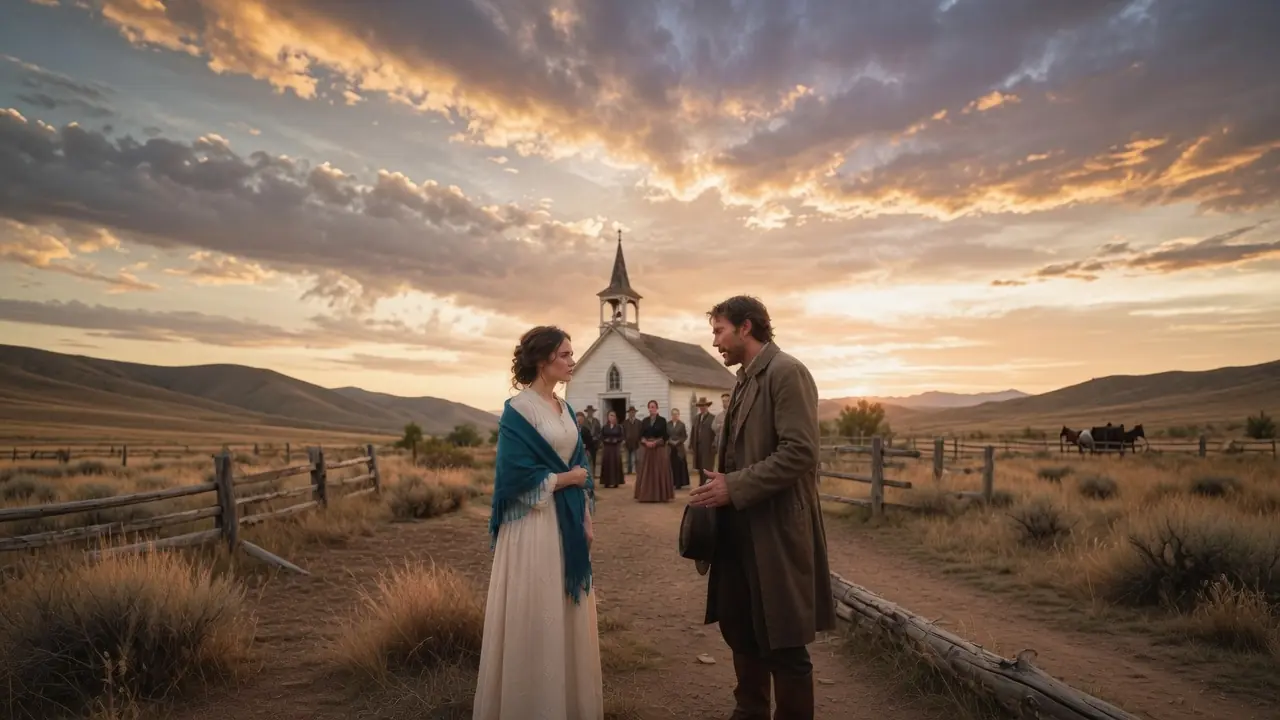
“No,” she whispered. “Not anymore.”
Micah looked down the road toward town, then back at the woman sitting in dust with a wedding dress ruined at the hem. His jaw tightened, not with pity, but with anger on her behalf. “Then now you do,” he said. Hazel blinked at him, not understanding. “I have an orchard that needs hands, a small house with a spare room, and more work than pride can finish. If you want wages and a roof until you decide what comes next, I can offer both.”
Hazel stared at him as if he had spoken in a language she had once known but forgotten. “You do not even know me.” Micah’s eyes moved to the note in her hand, then away again with respect. “I know enough to see a woman wronged in public. I know enough not to leave her beside the road.” He held out his hand, palm open, asking nothing more than her choice.
Hazel did not take it at first. She thought of gossip, of women whispering that she had run from one man to another before sunset. She thought of Evan laughing somewhere with Clara Bell’s father, already free of the poor bride he had discarded. Then she thought of sleeping behind the church with her trunk and wedding dress, and she let Micah help her stand.
They stopped at the church only long enough for Hazel to gather her trunk. Nobody dared say much when Micah Hart walked in beside her. The preacher helped carry the trunk to the buckboard, and Mrs. Hale pressed a handkerchief into Hazel’s palm without meeting her eyes. Hazel placed the wedding note inside her Bible and climbed onto the seat beside Micah.
They rode west in silence. The road passed dry fields, low stone fences, and a patch of wildflowers struggling beside the ditch. Hazel watched Bonham shrink behind them and wondered whether she had lost everything or merely been forced out of a life that would have swallowed her whole. Micah said nothing, and somehow that comforted her more than speeches would have.
The Hart orchard appeared near sunset, stretching across a shallow rise behind a weathered farmhouse. The trees were old apple and peach, their branches twisted and tired, with leaves thinner than they should have been. Several empty hive boxes sat along the far fence, gray with age and neglect. Hazel noticed them before she noticed the house.
“You had bees,” she said.
Micah looked at the hives. “My father did. After he passed, I kept the trees alive but not the bees.” He paused. “The orchard has suffered for it.” Hazel climbed down and walked toward the nearest hive box, touching the rough wood with careful fingers. The scent of old wax still lingered faintly inside, enough to make her throat tighten with memories of her father.
“My father kept bees,” she said. “He said an orchard without bees was a prayer nobody carried to heaven.” Micah stood beside her, listening with the seriousness of a man receiving something important. “Then maybe my orchard has been praying poorly,” he said. Hazel almost smiled, and the small movement surprised them both.
Micah gave her the spare room upstairs, clean and plain, with a quilt folded at the foot of the bed and a washbasin near the window. Hazel hung her wedding dress over the chair and stared at it for a long time. The dress looked like another woman’s tragedy now. She changed into a dark work dress, folded the veil away, and placed her father’s beekeeping veil on top of the trunk.
The next morning, she woke before dawn and found Micah already outside splitting wood. He looked surprised when she came to the yard with her sleeves rolled. “You do not have to prove anything today,” he said. Hazel tied her apron tighter and looked toward the orchard. “If I stop moving, I will remember too much.” Micah nodded once. “Then we work.”
Work saved her from falling apart. Hazel cleaned the kitchen, helped repair the old hive boxes, weeded beneath the fruit trees, and inspected the orchard row by row. She found signs of poor pollination, neglected pruning, and soil needing care. Micah listened when she spoke, and he did not interrupt to explain what he assumed she did not know.
By the end of the first week, he had taken her to a neighboring beekeeper willing to sell two small colonies on credit. Hazel stood before the buzzing boxes with tears in her eyes, not from fear, but from the sound of life returning to something she had thought gone forever. The beekeeper tried to speak to Micah about price and handling, but Micah nodded toward Hazel. “She’s the one who knows,” he said.
Those words spread through Hazel like warmth. She had spent months being treated like a woman to be placed, married, managed, or abandoned. Micah treated her like someone with knowledge. That difference was small only to people who had never been dismissed.
Spring deepened, and the bees settled into the orchard. Hazel moved among the hives in her father’s veil, calm and steady, speaking softly as if the bees could understand grief when carried gently. The trees began to bloom more fully than Micah had seen in years. White and pink blossoms covered the branches, and the orchard filled with the low, steady hum of work being done by creatures too small to impress anyone and too vital to ignore.
The town talked, of course. Bonham had always considered gossip a public duty. Some said Hazel had trapped Micah with tears. Others said Micah had taken advantage of a ruined bride. But when people came to buy eggs, honey, or early peaches, they found Hazel standing beside Micah with her head lifted, and the uglier whispers began to lose their pleasure.
Micah never called her broken. He never asked her to speak of Evan unless she chose to. Some evenings they sat on the porch after supper while fireflies blinked over the grass, and Hazel would tell him stories of her father’s bees. Micah would tell her about his mother’s hands making preserves, or his father’s stubborn belief that trees had temperaments. Slowly, conversation became less like shelter and more like home.
One night, Hazel finally took the wedding note from her Bible and unfolded it on the porch table. Micah looked at it but did not reach for it. “I keep thinking I should burn it,” Hazel said. “Then I think maybe I should save it to remind myself what I survived.” Micah’s voice was quiet. “A snake’s shed skin proves it changed, but it doesn’t mean the snake needs to sleep beside it.”
Hazel laughed through sudden tears. “That is the strangest comfort anyone has ever given me.” Micah looked embarrassed, and that made her laugh harder. She carried the note to the stove and burned it herself. The paper curled black, and with it went the last claim Evan Whitlock had over her future.
By harvest season, the orchard had changed. The trees bore fruit heavy enough to bend branches, and Hazel’s honey sold out every Saturday at the market. People who once pitied her began asking her advice about gardens and hives. Mrs. Hale apologized in a trembling voice for not stopping her from leaving the church alone. Hazel accepted the apology, but she no longer needed it to stand upright.
Evan Whitlock returned the following spring. By then his rich marriage had not given him the future he expected. Clara Bell’s father had lost money in a land scheme, and Evan’s business failed under debts he had been too proud to admit. He rode up to the Hart orchard in a fine coat worn thin at the cuffs, wearing the smile of a man who believed old wounds would make room for him.
Hazel saw him from the honey shed. For one second, her hands went cold. Then the bees hummed behind her, Micah’s orchard stretched bright with bloom, and she remembered who she had become after being left behind. She wiped her hands on her apron and stepped into the yard.
Evan removed his hat. “Hazel.” His voice was soft, rehearsed, and full of regret he had not earned. “You look well.” Hazel studied him, seeing no ghost now, only a man who had mistaken her devotion for something that could be set down and picked up again. Micah appeared near the barn but stayed back, close enough to protect and far enough to let Hazel speak for herself.
“What do you want, Evan?” she asked.
He looked toward the orchard, the hives, the crates of fruit, and the clean white honey jars stacked by the shed. “I heard you had done well here.” Hazel said nothing. Evan took a step closer. “I made a mistake. Clara and I are separating, and I see now that I chose security over love.”
Hazel’s face did not change. “No,” she said. “You chose money over character.” Evan flinched but pressed on. “I was frightened. I thought I needed more than you could give.” Hazel looked at the orchard, then back at him. “You were right. I could not give you greed dressed as ambition.”
His mouth tightened. “Hazel, don’t be cruel.” That almost made her smile. “Cruel?” she asked. “You left me in a church with five lines of ink and let a whole town watch me break.” Evan lowered his eyes, but whether from shame or frustration, she could not tell.
“I came to ask if we might begin again,” he said.
Behind Hazel, Micah’s hand tightened once around the fence rail. She saw it from the corner of her eye, and something tender moved through her. But she did not answer Evan for Micah’s sake. She answered for the girl in the wedding dress, the girl who sat beside the road believing she had nowhere left to go.
“No,” Hazel said.
Evan stared as if the word had never been truly spoken to him. “No?” Hazel stepped closer, her voice steady. “You came back expecting the woman you abandoned. She is not here. You left a bride at the altar, Evan, but the woman standing before you belongs to herself.”
His face reddened. “And to him?” he snapped, glancing at Micah.
Hazel’s eyes sharpened. “Micah gave me work, shelter, respect, and time. He never once asked me to belong to him before I belonged to myself.” Evan looked between them, finally understanding that he had not returned to reclaim a poor discarded woman. He had returned to find a door locked from the inside.
Micah stepped forward then, not to fight, but to stand beside Hazel. “You heard her,” he said. Evan’s jaw tightened, but there was no ground left for him to claim. He put on his hat, muttered something about pride, and rode away down the road that had once carried Hazel’s humiliation out of town.
Hazel watched until he vanished. Then her legs trembled. Micah turned toward her immediately, worry crossing his face, but she held up one hand. “I am not falling,” she said. Her voice shook, but her chin lifted. “I am only feeling how far I have come.”
Micah’s expression softened. “You walked most of that road yourself.” Hazel looked at him. “No. I walked because you gave me a place where walking did not have to be running.” He stood very still, and the bees hummed around them like a blessing.
That evening, Hazel and Micah sat beneath the orchard trees as the sun lowered beyond the fields. The branches above them were heavy with promise, and the hives glowed pale in the fading light. Hazel looked at Micah’s hands, rough and still, resting on his knees. “You once asked if I had anywhere to go,” she said.
“I remember.”
“I did not then.”
“And now?”
Hazel looked toward the house, the orchard, the hives, and the man who had never tried to own what he helped heal. “Now I do,” she said. Micah’s eyes met hers, and the quiet between them deepened into something neither needed to rush. Love had found them slowly, like bees returning to a flower after winter.
They married the next spring beneath the apple trees, not in the church where Hazel had once been abandoned. She wore no grand white dress, only a simple cream gown and a blue ribbon in her hair. The whole town came, partly from affection and partly from the human need to witness what they had once misjudged. Mrs. Hale cried openly, and even the preacher seemed relieved to bless a union built on truth instead of expectation.
When he spoke his vows, Micah did not promise to rescue her. He promised to listen, to labor beside her, and to never make her feel small in the home they shared. Hazel promised not obedience, but partnership, courage, and honey in the lean seasons. The bees hummed through the orchard as if the whole land approved.
Years later, people in Bonham still told the story of the bride abandoned at the altar who became the finest beekeeper in the county. Some liked to say Micah Hart saved her. Hazel would always correct them gently. “He gave me a door,” she would say. “I chose to walk through it.”
The orchard prospered. The honey jars bore the name Lynon-Hart Apiary, because Micah insisted her father’s name belonged there. Children came to learn about bees, widows came for work, and travelers stopped for preserves, fruit, and stories. Hazel kept Evan’s old note only in memory, and even there it no longer hurt the same way.
One evening, long after harvest, Hazel stood beside the hives while Micah repaired a fence nearby. A young bride from town had come to buy honey and whispered that she was afraid of marrying a man who made her feel small. Hazel placed a jar in her hands and said, “Any man who asks you to shrink before he loves you is only making room for himself.” The girl listened, tears bright in her eyes.
After she left, Hazel looked across the orchard at Micah. He lifted one hand, smiling softly beneath his hat. Hazel smiled back, feeling the wind move through the trees her bees had brought back to life. She had once believed being chosen by a man would save her from ruin.
Now she knew better.
A woman did not become worthy because someone chose her.
She became free when she chose herself, and then accepted only the love that knew how to honor that choice.