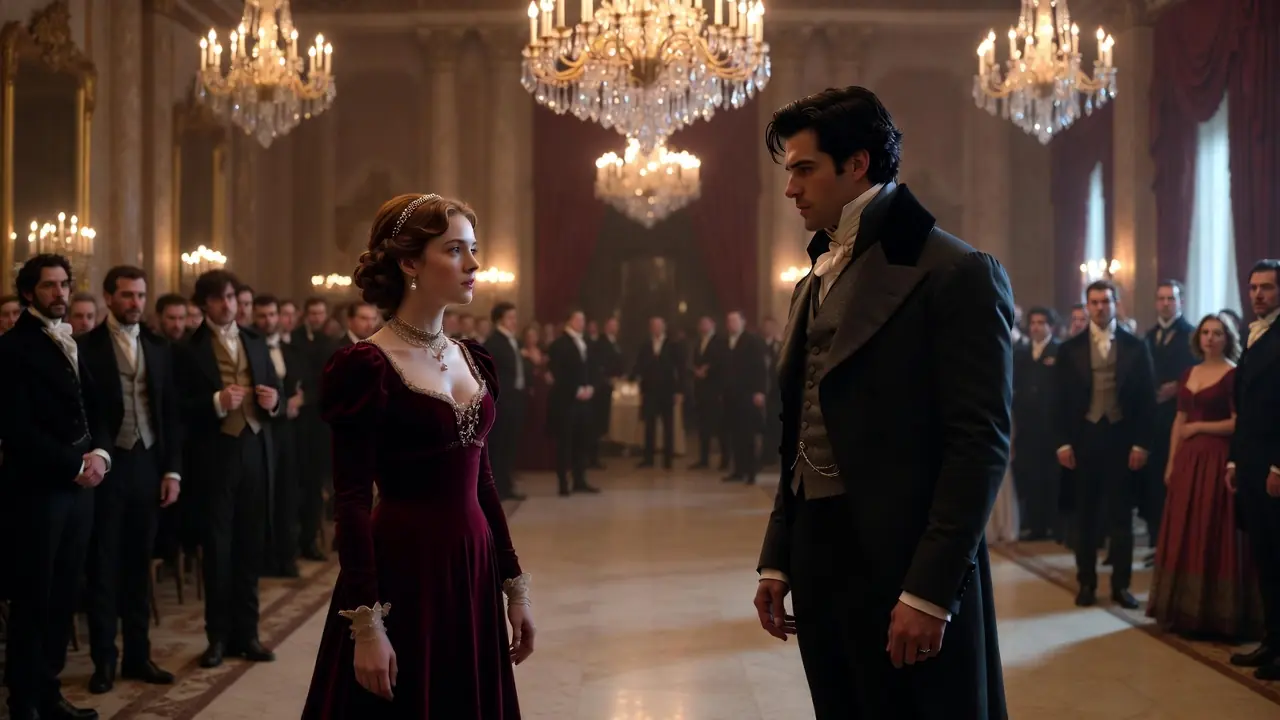
Two footmen grabbed Countess Luell Ashborne by the arms and dragged her into the grand hall of Blackthorne Manor like she was nothing more than an unwanted parcel being returned to its sender.
Her velvet slippers scraped against the marble floor.
The chandeliers above blazed with a hundred candles, and every face in that room turned to stare.
Her husband, Lord Percival Ashborne, stood at the center of it all, chest puffed, chin raised, dressed in his finest coat, as though this were a celebration.
It was not.
“She has given me nothing,” he announced, his voice bouncing off every wall, every gilded mirror, every horrified face. “Seven years, not one child, not one heir. She is useless to this family, and I will not carry the burden of a barren wife any longer.”
Luell did not cry.
She had run out of tears three years ago.
She stood straight, shoulders back, eyes forward, even as the whispers crawled around her like cold smoke.
She had been a countess.
She had managed his estates, hosted his guests, nursed his sick mother through two bitter winters, and smiled through every cruelty he called a marriage.
And now he was trading her away.
Not divorcing her.
Trading her like a horse that could no longer run.
Word had already spread through London’s drawing rooms that Lord Ashborne had offered his wife, her modest dowry lands, and a quiet agreement to three separate noblemen who needed a titled woman for appearance’s sake and nothing more.
Three men had looked at her and walked away.
But then the room went completely silent.
Not the soft silence of boredom.
The sharp, breathless silence of shock.
Because the Duke of Merith had just walked through the door, and he was looking directly at Luell.
Not past her.
Not through her.
At her.
And the expression on his face was something no one in that room had ever seen on him before.
Nobody moved.
The Duke of Merith stood in the entrance of Blackthorne Manor’s grand hall with the kind of stillness that made every other person in the room feel like they were breathing too loudly.
He was tall, broad-shouldered, and dressed in a dark coat that carried no excess decoration, no fuss, no need to impress.
He had never needed to try.
His name alone cleared rooms and silenced arguments.
Duke Kalian Merith was thirty-four years old, unmarried, and the most powerful peer in three counties.
He had been invited to this gathering under the pretense of a business discussion with Lord Ashborne regarding northern trade routes.
At least that was what the letter had said.
But the moment he stepped into that hall and saw a woman being held between two footmen while her husband announced her worthlessness to a room full of people, every thought of trade routes left his mind completely.
He had seen war.
He had buried his father and his younger brother in the same winter.
He had signed documents that altered the fates of hundreds of families without flinching.
But something about this particular scene, this specific woman standing perfectly still while the world humiliated her, reached into a part of him he thought had long gone cold.
Luell felt his gaze before she saw him.
It was strange.
In the middle of everything crushing down on her, something shifted in the air.
She turned her head slightly and found him standing there, watching her with an expression she could not name.
It was not pity.
She knew pity well.
It came with soft eyes and tilted heads and whispered prayers.
This was something else entirely.
His jaw was set.
His eyes were steady.
And he was looking at her the way a man looks at something that matters.
She looked away quickly.
She could not afford hope.
Not tonight.
Lord Percival Ashborne noticed the duke’s arrival and immediately rearranged his face into something resembling a smile.
He crossed the hall with his hand extended, completely unbothered by the scene he had just created.
“Merith, you came. Excellent. I trust the roads were kind to you.”
The duke did not take his hand right away.
He let the pause stretch just long enough to be deliberate, then shook it once, briefly.
“Ashborne,” he said.
His voice was low and unhurried.
“What exactly is happening here?”
Percival laughed.
It was the laugh of a man who had rehearsed his explanations.
“A domestic matter, nothing more. My wife and I have reached the end of our arrangement, but I am simply making the necessary transitions publicly so there can be no confusion about terms later.”
“You are auctioning her.”
The words landed like a stone dropped into still water.
Percival’s smile did not quite vanish, but it thinned.
“I would not use that word.”
“And yet,” the duke said, his eyes moving briefly to Luell and then back, “here she stands between two of your men while you address a room full of guests about her failure to produce children. What word would you prefer?”
A murmur moved through the crowd.
Several of the ladies exchanged glances.
Lord Henwick, standing near the fireplace with a glass of brandy, went very still.
He had been one of the three men who had already declined Ashborne’s offer.
He was now deeply regretting the fact that he was still in the room.
Percival’s voice dropped, though not low enough.
“This is not your concern, Merith.”
“No,” the duke agreed. “It is not.”
He walked farther into the hall.
He did not rush.
He moved the way men move when they own every second of time around them.
He stopped a few feet from Luell and looked at her directly.
Just her.
No one else.
She blinked.
In seven years of marriage, she could count on one hand the number of times anyone in a room full of people had addressed her first.
“Luell,” she said.
Her voice came out steadier than she expected.
“Countess Luell Ashborne.”
Something moved across his face.
Not quite a smile.
“Are you well?” he asked.
The question was so simple and so unexpected that she nearly lost the composure she had fought so hard to hold.
She swallowed once.
“I am standing,” she said.
He nodded slowly, as if that answer told him everything he needed to know.
Then he turned to face the room.
All of it.
Every titled, powdered, pearl-wearing witness in that hall.
“I will be taking Countess Ashborne home with me tonight,” he said. “Not as part of any arrangement your husband has proposed. As my guest, under my protection.”
The silence that followed was so complete that the candles seemed to hold their breath.
Percival took one step forward.
“You have no right to interfere in a private family matter.”
The duke looked at him with the patience of a man who had absolutely no fear of the person in front of him.
“File a complaint with the House of Lords,” he said. “I will be happy to explain to them what I witnessed here tonight.”
Percival went pale because they both knew what that meant.
Whatever legal arrangement he had been planning with Luell’s lands and her title would be dragged into the open.
And Percival Ashborne had several things he very much did not want dragged into the open.
The footmen released Luell’s arms without being told.
She suspected they had never wanted to hold them in the first place.
A woman near the back of the room, Duchess Orinthia Farewell, leaned toward the woman beside her and whispered something behind her fan.
The woman beside her, Lady Presca Dunmore, did not whisper back.
She just stared at the duke with wide eyes and the expression of someone watching history happen in real time.
The duke held out his arm to Luell.
She looked at it, then at him.
She was searching his face for the trick, for the angle, for the thing men always wanted when they offered something that looked like kindness.
She found nothing she recognized as danger.
She took his arm.
Together, they walked out of Blackthorne Manor while Lord Percival Ashborne stood in the center of his own grand hall, surrounded by his own guests, completely powerless to stop them.
Outside, the night air hit her face like cold water.
She exhaled for what felt like the first time in hours.
A carriage waited at the bottom of the stone steps.
A footman opened the door.
The duke gestured for her to enter first.
She paused on the second step and turned to look at him.
“Why?” she asked.
He met her eyes.
“Because no one else was going to,” he said simply.
She got into the carriage.
He followed.
The door closed.
The horses moved.
And Luell Ashborne, who had spent seven years learning not to want anything, felt something terrifyingly close to hope begin to stir in her chest.
She pressed it down immediately.
She had learned that lesson before.
Merith House was nothing like Blackthorne Manor.
Blackthorne had been built to impress.
Every corridor was lined with portraits of Ashborne ancestors who looked like they were judging you for existing.
Every room was arranged for appearances rather than comfort.
The flowers were always fresh and always slightly too perfect.
Like everything else in Percival’s world.
Merith House was large, yes, grand even, but it breathed differently.
The ceilings were high but not cold.
The furniture was fine, but worn in the places where people actually sat.
There were books everywhere.
Not arranged decoratively on shelves, but left open on tables, stacked near chairs, tucked beside lamps.
Someone actually read them.
Luell noticed all of this in the few minutes it took for the duke’s housekeeper to lead her to a guest room on the second floor.
The housekeeper’s name was Mrs. Tovel, a compact, sharp-eyed woman in her fifties who asked no questions and offered no opinions, which Luell found deeply refreshing.
“There is warm water already prepared,” Mrs. Tovel said, opening the door to a room that smelled faintly of cedar and dried lavender. “Supper can be brought up if you prefer privacy, or there is a place set for you in the dining room. His Grace leaves the choice entirely to you.”
Luell stood in the center of the room and looked at the bed.
It was a real bed, wide and still, and not something she had to share with a man who had long since stopped seeing her as a person.
“Privacy,” she said quietly. “Please.”
Mrs. Tovel nodded and left without another word.
Luell sat on the edge of the bed and placed her hands in her lap.
She looked at them for a long moment.
They were steady.
She had always been good at steadying.
Steady had kept her alive through seven years of a marriage that had started with false promises and ended in a public hall with her husband announcing her barrenness like it was a defect in livestock.
She did not let herself cry.
She had promised herself that much.
Instead, she thought about the duke.
She had heard of Kalian Merith.
Of course she had.
Everyone in London society had heard of him.
He was the kind of man people constructed stories around because the truth of him was too quiet and too firm to be entertaining on its own.
They said he was cold.
They said he had refused four marriage proposals in six years.
They said his estate ran with the precision of a military operation and that he never laughed at parties.
None of those things explained why he had walked into Blackthorne Manor and removed her from it like she was something worth removing.
She had no answer.
And not having answers made her uncomfortable in a way that was almost physical.
Downstairs, the duke sat alone at the long dining table with a plate he was not eating from and a letter he had written and then folded without sending.
Across the table, his cousin, Aldwin Merith, who had the unfortunate habit of appearing in Kalian’s home without warning, leaned back in his chair and watched him with the expression of a man deeply entertained by someone else’s problem.
Aldwin was twenty-nine, charming in the way pleasant weather is charming, effortlessly and without much depth.
He had been the one to accompany Kalian to Blackthorne Manor that evening before being sent home early when the situation became complicated.
He had not gone home.
“So,” Aldwin said, picking up a bread roll and tearing it apart with both hands. “You brought her here.”
“I did.”
“Just like that.”
“It appeared necessary.”
Aldwin chewed thoughtfully.
“You do understand that by morning every drawing room in London will have seventeen different versions of tonight, none of which will be particularly accurate, and all of which will involve you.”
“Yes.”
“And you are entirely unbothered by that?”
Kalian looked at him.
“What would you have had me do?”
Aldwin held up both hands.
“Nothing. I think it was the right thing. I just find it interesting that you, specifically you, who has not done a single impulsive thing in the last decade, walked into that hall and essentially declared yourself the protector of a woman you had never spoken to before tonight.”
Kalian said nothing for a moment.
He picked up his glass, looked into it, then set it back down.
“She did not flinch,” he said.
Aldwin blinked.
“Pardon?”
“When Ashborne was speaking, when the room was staring, when those men were holding her arms, she did not flinch. She stood there like she was made of something harder than anything in that room.”
He paused.
“And she was alone. Completely alone. And no one was going to do anything.”
Aldwin was quiet for a moment.
Then slowly, his expression shifted into something more serious.
“What are you going to do with her? She is still legally his wife.”
“I know.”
“He will not let the land arrangement go quietly. Her dowry properties are worth a significant sum.”
“I know that too.”
“Kalian.”
Aldwin leaned forward.
“What are you planning?”
The duke looked toward the staircase, though Aldwin suspected he was not really seeing it.
“I have not decided yet,” he said. “But she will not be returned to him.”
Aldwin sat back slowly.
He had known his cousin for his entire life.
He had seen him negotiate trade contracts, manage estate disputes, and handle political pressure with the same unreadable calm.
But there was something different in his voice tonight, something that had not been there before.
Aldwin decided not to name it.
Not yet.
He simply reached for another bread roll and kept his thoughts behind his teeth.
The next morning arrived with gray light and the smell of rain.
Luell woke before 6:00, which she always did.
In Ashborne House, the servants began moving at 6:00, and Percival required his breakfast prepared before 7:00.
The running of a household did not pause because a woman had not slept.
She lay still for a moment, remembering where she was.
The ceiling above her was unfamiliar.
The quiet was unfamiliar.
The absence of dread was so unfamiliar that it made her chest ache.
She rose, dressed herself without help because she did not want to ring for a maid she did not know, and went to sit by the window.
Outside, the garden of Merith House was large and slightly wild at the edges.
Not neglected, but allowed.
There were roses growing in directions no one had tried to correct.
There was a stone bench near an old oak tree that looked like it had been sat on many times.
She was still sitting there when a soft knock came at the door.
But it was not Mrs. Tovel.
The duke stood in the doorway, already dressed, already composed, holding two cups of tea with the slightly uncertain expression of a man who was not entirely sure this was appropriate, but had decided to do it anyway.
“I was not certain you would be awake,” he said.
“I am always awake early,” she replied.
He considered this.
Then he held out one of the cups.
She took it.
He leaned against the doorframe rather than entering the room, which she appreciated.
“I want to be honest with you,” he said.
She looked at him carefully.
“All right.”
“You are safe here. That is the first thing. The second thing is that your husband will almost certainly begin making legal inquiries within the next few days. I have a solicitor who can help protect your interests, but you will need to tell him everything about the terms of your marriage contract and the properties involved.”
She nodded slowly.
“And what do you want in return?”
He met her eyes.
“Nothing.”
She almost laughed.
Not because it was funny.
Because she had forgotten what it sounded like when someone said that word and appeared to mean it.
“Everyone wants something,” she said quietly.
“Yes,” he agreed. “I suppose they do. But what I want is not something you owe me, and I would not take it as payment, even if you offered.”
She looked down at the tea.
It was perfectly made, strong and slightly sweet, exactly how she would have asked for it if anyone had ever asked.
She did not know what to do with any of this.
With the room.
With the tea.
With the man in the doorway who had upended her entire existence in the space of one evening and was now standing there asking nothing in return.
But she was a woman who had survived seven years in a house built on silence and performance.
She could survive uncertainty.
She had become very good at it.
“Tell me about the solicitor,” she said.
And for the first time in longer than she could remember, she let someone help her.
London talked.
Of course it did.
London always talked.
But this particular conversation spread faster than most because it had everything the city’s drawing rooms required for maximum damage.
A disgraced wife.
A powerful duke.
A husband left standing in his own hall looking like a fool.
And absolutely no explanation from the man at the center of it all.
By the second morning after the incident at Blackthorne Manor, three separate versions of the story were already circulating.
The first said the duke had been secretly in love with Luell for years and had finally seized his moment.
The second said Percival Ashborne had owed Merith a gambling debt and Luell was the settlement.
The third, whispered only in the most private corners, said the duke had lost his mind entirely and would regret his decision before the week was out.
None of them were true.
All of them were dangerous.
Lady Presca Dunmore, who had been present at Blackthorne Manor that night and had stood close enough to hear every word exchanged, hosted a small breakfast gathering the following morning with six carefully selected women and proceeded to describe exactly what she had witnessed with the precision of someone who understood that accurate information was a form of power.
“He did not hesitate,” she told them, her teacup raised halfway to her lips. “Not for a single second. He walked in, assessed the situation, and removed her as though it were the most natural thing in the world.”
Duchess Orinthia Farewell, seated to her left, was quiet for a moment.
She was a woman of sixty who had outlived two husbands and three social seasons of scandal and had developed the ability to see the shape of things before they fully formed.
“Merith is not a man who acts without reason,” she said. “Whatever he is doing, it is not impulsive. He has a plan.”
“Or he has feelings,” said young Lady Temperance Colt from across the table, who was nineteen and had recently finished reading three romantic novels in succession.
Orinthia looked at her the way a mountain looks at weather.
“Those,” she said, “are not mutually exclusive.”
Meanwhile, Percival Ashborne was not having breakfast.
He was standing in his study at Blackthorne Manor with a solicitor named Mr. Griff Quelton, who was thin, cautious, and deeply unhappy about being summoned before 8:00 in the morning.
“I want her back,” Percival said.
He was not looking at Quelton.
He was looking at the window.
“I want the properties, one or the other. I am not leaving this without something.”
Quelton cleared his throat carefully.
“My lord, the situation is somewhat delicate. The Duke of Merith has significant influence with the House of Lords, and if he chooses to frame last evening’s events as a matter of your wife’s welfare…”
“She is my wife,” Percival said.
His voice was flat.
“Not his.”
“Legally, yes. But publicly, the narrative is already shifting. Several accounts of last evening describe your conduct in terms that could be used against you if this reaches a formal proceeding.”
Percival turned from the window.
His face was the face of a man who had expected to be the one with power in this situation and was only now beginning to understand that he had miscalculated.
“Find me something,” he said. “Anything. Something I can use against Merith.”
Quelton nodded slowly.
He did not say what he was thinking, which was that finding something to use against the Duke of Merith was approximately as sensible as finding something to use against the tide.
But he was being paid, so he would try.
Back at Merith House, Luell was meeting the solicitor the duke had promised.
His name was Mr. Bastian Croy, and he was nothing like Quelton.
He was broad, unhurried, with the kind of calm that came from having untangled complicated legal situations for thirty years without losing his temper or his reputation.
He spread her marriage documents across the writing desk in the duke’s library, studied them for twenty minutes without speaking, and then looked up.
“Your dowry properties,” he said, “and the three parcels in the eastern counties. Were these transferred into your husband’s name upon marriage, or did they remain in yours?”
Luell folded her hands.
“They were to remain in mine. That was the condition my father insisted upon. It is written in the original contract.”
Croy looked back at the documents.
“It is. And yet your husband has been drawing income from all three for the last four years.”
The room went quiet.
Luell had known something was wrong with the accounts.
She had asked once early on, and Percival had explained it away with the confidence of a man who assumed his wife would not press further.
She had pressed.
He had simply stopped answering.
“He has been taking money that was legally mine,” she said.
“Yes,” Croy said simply. “And that changes everything about your position in this.”
The library door was slightly open.
In the corridor outside, the duke stood with a document of his own, which he had stopped reading the moment he heard Croy begin speaking.
He did not enter.
He simply listened, and as he did, something in his expression hardened into something that was not quite anger, but was related to it.
He had suspected something like this.
He had not known the extent of it.
He walked away from the door before Luell could finish speaking because what he wanted to say at that moment was not something that would be useful to anyone.
Instead, he went to find Aldwin, who was in the east sitting room reading a newspaper with his boots up on the furniture.
“She did not know,” Kalian said without preamble.
Aldwin lowered the paper.
“Know what?”
“He has been taking income from her properties for four years. Properties that are legally hers. She did not know the full extent of it.”
Aldwin put his boots on the floor.
“That is not just cruelty. That is fraud.”
“Yes.”
“Which means she has legal standing. Real legal standing. She does not need to wait for him to release her. She can go on the offensive.”
“Croy will advise her of that.”
Aldwin studied his cousin.
“And what will you do?”
Kalian looked at the fireplace for a moment.
“I am going to write a letter to Lord Henwick.”
Aldwin frowned.
“Henwick. He was one of the men Ashborne approached about taking Luell. Why would you…”
“Because Henwick was present that night. And Henwick has his own complicated history with Ashborne that predates all of this. If he is willing to make a formal statement about what he witnessed, it supports whatever proceeding Croy initiates.”
Aldwin blinked.
Then he smiled slowly.
“You have already thought this through.”
“I think most things through.”
“You did not think of bringing her here.”
Kalian picked up a pen from the writing desk.
“No,” he said quietly. “That one I did not think through.”
He began writing, and Aldwin wisely said nothing further.
Luell spent the afternoon in the garden.
She had asked Mrs. Tovel’s permission, which had amused the housekeeper visibly, because guests at Merith House did not typically ask permission to use the garden.
But Luell was not yet comfortable moving through someone else’s space as though it belonged to her.
Old habits were stubborn things.
She sat on the stone bench near the oak tree she had noticed from her window that morning and turned her face up toward the thin gray sky.
The rain had softened to a mist.
It was cold, but not unpleasant.
She heard footsteps on the path and looked up.
It was not the duke.
It was a young woman she had not seen before, perhaps seventeen, with dark hair escaping from its pins and ink stains on three of her fingers.
She stopped when she saw Luell and looked startled, then curious, then composed, all in the space of about two seconds.
“You are her,” the girl said. “The countess.”
“I am,” Luell said. “And you are?”
“Petra Merith. Kalian is my brother.”
She said it with the casual ownership of someone who had never once been intimidated by a duke.
“I arrived this morning. I live mostly at the country estate, but I came when I heard what happened.”
She paused.
“I wanted to see you.”
Luell looked at her.
“Why?”
Petra sat down on the bench without being invited, which Luell found oddly endearing.
“Because my brother has not done anything surprising in six years,” she said. “And then he does this. And I wanted to know what kind of person made him do something surprising.”
Luell was quiet for a moment.
“I did not ask him to.”
“No,” Petra said. “That is probably why he did it.”
They sat in silence for a moment.
A bird moved through the oak above them.
The mist continued its quiet work.
“He is not what people say,” Petra said eventually. “He is not cold. He is just careful. There is a difference.”
Luell looked at her.
“You are very direct for someone your age.”
Petra shrugged.
“Kalian taught me that wasted words are wasted time.”
She paused.
“He also taught me that the people worth knowing are usually the ones who have been through something difficult and came out still kind.”
Luell looked away.
The roses at the edge of the garden were losing their petals in the damp air, one by one, without drama.
“I am not sure I am still kind,” she said softly.
It was the most honest thing she had said to anyone in years.
Petra considered this seriously, the way young people do when they decide to treat something as a real question rather than a polite remark.
“You are sitting in a garden in the rain instead of plotting revenge,” she said. “I think that counts.”
Despite everything, despite seven years and a public hall and a marriage that had stripped her down to almost nothing, Luell almost smiled.
It was small.
It was brief.
But it was real.
The letter arrived at Merith House on Thursday.
It was not from Percival.
It was from his mother, Lady Ghislaine Ashborne, a woman of seventy-one who had survived four decades of London society through a combination of sharp intelligence and complete shamelessness.
She wrote in a hand that was surprisingly firm for her age, and her message was short.
She wished to call on Countess Ashborne at Merith House on Friday at 2:00.
She hoped this would be convenient.
Mrs. Tovel brought the letter to Luell herself, which suggested even the housekeeper understood this was significant.
Luell read it twice.
Then she went to find the duke.
He was in his study, standing over a wide desk covered in correspondence, land records, and at least one map that had been unrolled and held flat at the corners with whatever objects were closest.
He looked up when she knocked on the open door.
She handed him the letter without speaking.
He read it.
His expression did not change, but she had begun to notice that when something affected him, it was his stillness that shifted rather than his features.
He went a particular kind of quiet.
“Lady Ghislaine is not her son,” he said finally.
“No,” Luell agreed. “She is considerably more dangerous.”
Something moved at the corner of his mouth.
“You know her well.”
“I lived in her son’s house for seven years. She visited twice a year. She never liked Percival’s behavior, but she liked appearances more.”
Luell paused.
“She is coming to assess whether I am an embarrassment or an asset.”
He set the letter down.
“Which do you intend to be?”
Luell met his eyes.
“I have not decided yet.”
He looked at her for a moment, longer than necessary, and then he said, “Whatever you decide, I will support it.”
She turned to go, then stopped.
“Why does this house have so many books?” she asked.
It was not the question she had meant to ask.
She was not sure what she had meant to ask.
“Because I read them,” he said.
She turned back just enough to see his face.
He did not look like he was being clever.
He looked like it was simply the answer.
She left, and he stood in his study, looking at the door she had just walked through for considerably longer than he would have admitted to anyone.
Friday came with actual sunshine, which felt almost aggressive after the gray of the previous days.
Lady Ghislaine Ashborne arrived at exactly 2:00 in a carriage that was older than it needed to be and better maintained than it had any right to be.
She was a small woman who had the posture of someone twice her size and the eyes of someone who had cataloged every person she had ever met and filed them away under useful or not useful.
She was shown into the front sitting room, where Luell waited alone because she had asked the duke not to be present.
He had accepted this without argument, which had surprised her.
Lady Ghislaine sat, arranged herself, accepted tea, and then looked at Luell the way jewelers look at stones they are not yet sure about.
“You look better than I expected,” she said.
“I feel better than I have in years,” Luell replied.
“My son is an idiot,” Lady Ghislaine said.
She did not lower her voice.
She did not soften it.
“I want that acknowledged first.”
Luell blinked.
“All right.”
“He was given a good wife, and he treated her like an inconvenience. The inability to produce children is a medical matter, not a character failure, and any man of sense knows that. My son has never had the sense I hoped he would.”
She took a sip of tea.
“I am ashamed of what was done to you in that hall.”
The sitting room was very quiet.
Luell had not expected this.
She had prepared herself for negotiation, for veiled threats wrapped in polite language, for the particular performance of concern that powerful women sometimes used as a weapon.
She had not prepared for honesty.
“Lady Ghislaine,” she said carefully.
“I am not here to bring you back to him,” the old woman said before Luell could continue. “I want to be clear about that immediately. What he did cannot be undone, and I would not ask you to return to a house where you were publicly humiliated.”
She set down her teacup.
“However, I am here because the family solicitor has informed me that Percival intends to pursue your dowry properties through a legal claim, and I am here to tell you that I will testify against that claim if it reaches a formal proceeding.”
Luell stared at her.
“You would testify against your own son.”
“I would testify for what is right,” Lady Ghislaine said. “Which is different.”
She folded her hands in her lap.
“Your father was a good man. He negotiated those property terms specifically to protect you. Percival violated that agreement. I knew he was drawing income from those parcels. I told him twice to stop. He did not.”
Her mouth thinned.
“I am seventy-one years old. I have very little patience left for men who think their comfort justifies theft.”
Outside in the corridor, completely invisible and making no sound, Petra Merith was crouched near the sitting room door with her ear approximately three inches from the wood.
She had promised her brother she would not eavesdrop.
She had broken that promise almost immediately.
She pressed her hand over her mouth to keep from making a sound.
Inside the sitting room, Luell was doing something she had genuinely not done in years.
She was sitting in front of another person and feeling seen.
Not assessed.
Not measured against her usefulness.
Actually seen.
“I do not know what to say,” she admitted.
Lady Ghislaine almost smiled.
It transformed her face briefly into something warmer.
“You do not need to say anything. You need to give your solicitor my name and tell him I am available when needed.”
She rose, which signaled the visit was ending.
“The Duke of Merith is a good man. I have known him since he was twelve years old and already more responsible than most men twice his age. Whatever he is doing, it is not for entertainment.”
She said this last part with the deliberate casualness of someone placing a significant object on a table and pretending not to notice where it lands.
Luell rose with her.
“I appreciate your coming.”
Lady Ghislaine picked up her gloves.
“One more thing.”
She looked at Luell directly.
“You have been told your whole married life that you are lacking, that you are incomplete, that something is wrong with you.”
She paused.
“There is nothing wrong with you. There never was.”
She left.
Her carriage departed at precisely 2:47.
Luell stood in the center of the sitting room for a long moment after the sound of the wheels faded.
Then she sat back down, placed her hands in her lap, and for the first time in a very long time, she let herself cry.
Not from grief.
Not from pain.
From something she did not have a clean word for.
Something that felt like a wall she had been holding up for seven years, finally, quietly coming down.
She did not hear the door open.
She did not hear his footsteps.
She only knew the duke was there when a clean handkerchief appeared on the arm of the chair beside her, placed there carefully and without comment.
She looked up.
He was already walking away, giving her the privacy of the moment while still somehow being present in it.
She picked up the handkerchief.
She pressed it to her face.
And she thought, with something that frightened her a little, that she was beginning to understand why Petra had said her brother was not cold.
He was not cold at all.
He was simply waiting.
For what, she was not yet sure.
But she was beginning to think that whatever it was, it might have something to do with her.
The news broke on a Tuesday.
Not slowly, the way most things unraveled in London society.
It broke all at once, like a window struck by something thrown hard and deliberate.
By noon, every club, every parlor, every carefully arranged afternoon visit in the city carried the same information in slightly different packaging.
Lord Percival Ashborne had filed a formal legal claim against his wife, Countess Luell Ashborne, citing abandonment of the marital home and seeking full transfer of her three dowry properties into his permanent possession.
The claim was aggressive.
It was calculated.
And it was, according to Mr. Bastian Croy, who appeared at Merith House within two hours of the filing becoming public, almost impressively stupid.
“He has filed this claim while simultaneously being on record as having publicly announced his intention to trade her away,” Croy said, spreading documents across the library desk with the focused energy of a man who had just been handed everything he needed. “He cannot claim abandonment when he was the one who attempted to remove her from the marriage arrangement entirely. The contradiction is not subtle.”
The duke stood at the window with his arms crossed and said nothing because Croy was the kind of man who thought better when not interrupted.
“Lady Ghislaine’s willingness to testify changes the financial picture significantly,” Croy continued. “If we can demonstrate that income was drawn from the countess’s properties without her consent over a period of four years, we are not simply defending against his claim. We are initiating one of our own.”
Aldwin, who had appeared again from wherever he disappeared to when things were quiet, was leaning against the bookshelf with his own copy of the filed document.
“What does she want?” he asked.
Not dismissively.
Genuinely.
“Has anyone actually asked her what outcome she wants from all of this?”
The room went slightly still.
Kalian turned from the window.
Croy looked at his documents.
Aldwin looked at his cousin.
“I ask because she is the one whose life this is. And I have noticed that a great many decisions are being made in this room about her situation without her sitting in this room while they are made.”
It was a fair point, delivered with more directness than anyone expected from a man who usually deployed charm as his primary tool.
Kalian uncrossed his arms.
“Where is she?”
“Garden,” Mrs. Tovel said from the doorway, because Mrs. Tovel had the uncanny ability to appear exactly when information was needed and disappear immediately after.
He found Luell on the stone bench under the oak tree.
She had a book open in her lap, but she was not reading it.
She was watching two sparrows argue over something in the grass with the focused attention of someone who was actually thinking about something else entirely.
She looked up when she heard him approach.
He sat down on the bench, not close enough to crowd her, close enough to be present.
“Croy is inside building a case,” he said.
“I know,” she said. “I could hear him from the corridor. He has a very projecting voice for someone so calm.”
The corner of his mouth moved.
“What do you want, Luell?”
She looked at him.
He had used her name, just her name, without the title.
And it had the effect of making the bench feel smaller than it was.
“What do I want?” she repeated softly.
“From this. From the legal proceedings. From whatever comes next.”
He paused.
“Aldwin pointed out that we have been making decisions about your life without asking you. He was correct.”
She looked back at the sparrows.
They had resolved their disagreement and departed.
“I want the properties,” she said. “They were mine. They should be mine again.”
She was quiet for a moment.
“I want a formal separation, something legal and documented that makes it impossible for him to come back and make any further claims on anything that belongs to me.”
Another pause.
“And I want to stop feeling like I am a problem someone is kindly managing.”
He turned to look at her directly.
“You are not a problem.”
“I know that here,” she said. “But knowing something and feeling it are different.”
She closed the book in her lap.
“I have been in this house for nearly two weeks, and I still knock before entering any room. I still apologize for existing in spaces. I still wait for the moment when someone’s patience with me runs out.”
She stopped.
He was quiet for a moment.
“My patience will not run out,” he said.
She looked at him.
His face was completely steady.
No performance.
No angle.
Just the plain truth of a man saying exactly what he meant.
“Why are you doing this?” she asked.
Not the way she had asked it the first night, with suspicion and self-protection.
This time the question was genuine, open, sitting between them without armor.
He looked at his hands for a moment, then at her.
“The night at Blackthorne Manor,” he said, “when I walked in and saw you standing there, not crying, not begging, not performing an apology for a room full of people who had decided your worth. I have been in rooms like that before. I know what it feels like to be the one standing still while everyone else decides what happens to you.”
He paused.
“I was not going to walk past that.”
She held very still.
“Something happened to you,” she said quietly.
Not a question.
“Yes,” he said. “When I was younger. Before my father died. Before I became the duke and acquired all the protection the title carries.”
He did not elaborate, and she did not push.
But she understood, with the particular understanding of someone who has her own quiet wounds, that his clarity about what she needed had come from somewhere personal.
“Kalian,” she said.
It was the first time she had used his name, just his name, without the title.
He went very still, the way she had learned meant he was feeling something.
“I do not know what this is,” she said honestly. “What is happening between us. I do not know if it is gratitude or something more or something I am imagining entirely. And I cannot trust my own instincts about people right now because my instincts were wrong about the last person I trusted.”
“That is fair,” he said.
“But I do not want to leave,” she said.
The words came out before she had fully decided to say them.
“And I am not saying that because I have nowhere to go. I am saying it because when I wake up in the morning in this house, there is no dread. And I had forgotten what that felt like.”
The garden was very quiet.
The mist had gone.
The light was doing something golden and soft over the roses.
He reached over and placed his hand over hers where it rested on the book in her lap.
Not gripping.
Not pulling.
Just there, warm and still.
“Then stay,” he said, “for as long as you want. Until you know what you feel. I am not going anywhere.”
She looked down at his hand over hers.
She did not move away.
“Percival will make this ugly,” she said.
“Let him try,” Kalian said.
The quietness of it was more confident than a shout.
She exhaled slowly.
For the first time in a very long time, she let herself sit inside a moment without immediately looking for the exit.
Inside the house, Petra was watching from the upstairs window with the expression of someone watching her favorite story happen in real life.
Aldwin appeared beside her, looked out, and made a small sound of satisfaction.
“Finally,” Petra whispered.
“Do not say anything to him about it,” Aldwin said.
“Obviously,” she replied.
Then, after a pause, “Not yet, anyway.”
Three days later, Lord Henwick’s formal statement arrived at Croy’s office.
It was detailed, precise, and confirmed everything that had occurred at Blackthorne Manor that evening from the perspective of an independent witness who had been present throughout.
Henwick described the footmen holding Luell’s arms.
He described Percival’s announcement word for word.
He described three men, including himself, being approached with the trade arrangement before that evening.
And he confirmed that he had declined because the situation had struck him as legally and morally indefensible.
He also mentioned in a brief addendum at the end of the statement that he had documentation of a separate financial dispute with Lord Ashborne from two years prior that he was now prepared to make available to any formal proceeding.
Croy read this addendum twice and then made a sound that was as close to delight as a solicitor ever permitted himself.
Percival’s legal position, already compromised, began to crumble in a way that was almost architectural.
Like a building that looked intact from the front while the back wall was already gone.
His own solicitor, Quelton, tendered his resignation from the case four days after Henwick’s statement became known.
Two days after that, a second witness from the Blackthorne gathering, a retired magistrate named Sir Overton Folk, who had been standing near the fireplace that night, submitted a supporting account without being asked.
The legal machinery was moving now.
And it was moving against Percival with the momentum of something that had been building for years and had finally found its proper direction.
He responded the only way a cornered man with more pride than sense tends to respond.
He went to the press.
Not directly.
Men like Percival never did things directly.
But within the week, a piece appeared in one of London’s less reputable social publications, suggesting that the Duke of Merith had acted improperly by removing a married woman from her husband’s home.
That questions about the duke’s motives were entirely reasonable.
And that the countess herself had a history of difficult behavior within the marriage.
The piece did not name its source.
It did not need to.
Kalian read it at breakfast on a Wednesday morning.
He set it down beside his plate and continued eating.
Petra, who had read it three minutes earlier and was practically vibrating with outrage, stared at him.
“That is all?” she demanded. “You are just going to sit there?”
“What would you have me do?” he said mildly.
“Something. Anything. He is lying about her in print.”
“Yes,” Kalian said. “And Croy’s proceeding will demonstrate that publicly and permanently, which is considerably more damaging to Percival than anything I could say in response to a piece in a publication that serious people stopped reading two years ago.”
Petra stared at him.
“You are infuriating when you are right.”
“I know,” he said.
Luell had also read the piece.
She came down to breakfast later than usual, after the duke had already left for a meeting with Croy.
She sat at the table with the publication in front of her and Mrs. Tovel’s excellent tea going cold beside it.
Aldwin sat across from her, which he did most mornings now because he had discovered Luell was one of the few people who could match him in conversation and beat him at chess.
“How are you?” he asked.
She looked up from the publication.
“I am angry,” she said. “Which is actually an improvement. Anger is much easier to work with than grief.”
Aldwin looked at her carefully.
“What are you going to do with the anger?”
She folded the publication precisely, stood up, and said, “I am going to go and speak to Lady Presca Dunmore.”
Aldwin blinked.
“Now?”
“She was at Blackthorne Manor. She has a breakfast gathering every week with six women who between them know everyone worth knowing in London. She told the truth once.”
Luell picked up her gloves.
“I am going to give her more truth to tell.”
Aldwin sat very still for a moment.
Then he smiled, the slow, warm smile of someone watching a person come fully back to life.
“Shall I arrange a carriage?” he said.
“Please,” she said, and walked out of the room with her chin up and her shoulders back, and the particular energy of a woman who had finished being quiet.
Lady Presca Dunmore’s breakfast gathering that Thursday was slightly larger than usual.
Word had moved quietly through certain channels that there might be something worth attending, and so the regular six had become nine, which was still intimate enough for candor, but broad enough to matter.
The women gathered around Presca’s long table included Duchess Orinthia Farewell, two wives of sitting lords, a recently widowed baroness named Lady Sephra Colt, who had her own complicated history with Percival’s social circle, and a sharp-eyed journalist named Miss Otterline Vere, who wrote a widely read column on society matters under a male pseudonym because the publication would not print women’s names above serious commentary.
Luell arrived in a carriage bearing the Merith crest, which she had not asked for, but which Mrs. Tovel had arranged because Mrs. Tovel understood symbolism.
She walked in, and the room received her the way rooms receive someone they are not entirely sure how to categorize.
She sat where Presca directed her, accepted tea, and then spoke for approximately twenty minutes without notes, without performance, and without apology.
She described her marriage.
Not all of it.
Not every private wound.
But the shape of it.
The years of being told her value was contingent on producing an heir.
The properties drawn from without her knowledge or consent.
The evening at Blackthorne Manor, experienced from the inside, which sounded very different from the outside.
The press piece that had appeared that week, attributing difficult behavior to her without a single specific example.
She spoke clearly and simply, and with the kind of controlled honesty that is more devastating than drama because it cannot be dismissed as exaggeration.
When she finished, the room was quiet.
Duchess Orinthia set her teacup down with a small, deliberate click.
“Miss Vere,” she said, looking at the journalist across the table, “I trust you are able to write something more accurate than what appeared in print this week.”
Miss Otterline Vere, who had been sitting completely still for the last twenty minutes with the focused expression of someone storing every word in an organized internal archive, smiled.
“I believe I can,” she said.
Lady Sephra, who had not spoken until that moment, said, “I can also provide Miss Vere with documentation of a financial matter Ashborne was involved in three years ago that never became public. I have been waiting for an appropriate moment.”
Presca looked at her.
“You have been sitting on that?”
“I was waiting,” Sephra said simply, “for someone worth sitting on it for.”
Luell looked at these women around the table.
Women who had spent their lives working within a system designed to limit them, finding the exact edges where their influence could move, storing their knowledge like careful currency, waiting for moments that warranted spending it.
She understood them completely.
“Thank you,” she said.
And she meant it with her whole self.
The article Miss Otterline Vere published four days later under her usual pseudonym in a publication three times the size of the one that had attacked Luell was read by nearly every person of consequence in London before the week was out.
It was precise.
It was sourced.
It named no names directly, but described events and circumstances with enough specificity that anyone paying attention knew exactly who was being discussed.
It raised pointed questions about the legal and ethical dimensions of a husband publicly trading away a wife, about the income drawn from properties that were not legally his, and about the curious pattern of a powerful man attacking a woman’s character in print the moment she acquired capable legal representation.
It did not mention the Duke of Merith at all, which was in its own way the most powerful thing about it.
Percival read it on a Friday morning and threw his breakfast plate across the room, which three of his remaining servants witnessed and would later describe to their own social circles in vivid detail.
The legal proceedings moved quickly after that.
Croy had assembled a case that was, in his own measured estimation, about as solid as legal cases came.
Lady Ghislaine’s testimony, Henwick’s statement, Sir Overton Folk’s account, and the four years of financial records from Luell’s properties created a picture that left very little room for interpretation.
Percival’s counterclaims, never particularly strong, collapsed in sequence like dominoes that had been poorly arranged from the start.
He withdrew the abandonment claim on a Wednesday.
He accepted a formal separation agreement on the Friday of the same week.
The properties were returned to Luell’s sole possession by the following Tuesday with a financial settlement attached that Croy had negotiated with the silent efficiency of a man who enjoyed his work enormously.
Percival signed everything in his solicitor’s office alone.
But because Quelton had resigned, and the replacement solicitor he had hired was still learning the extent of what he had gotten himself into, he signed with the expression of a man who had fully expected to win and was only now fully understanding that he had lost before the game properly began.
He did not attend any public events for the remainder of the season.
He did not need to.
His absence said everything his presence would have.
On the day the final documents were signed, Luell stood in the library at Merith House, with Croy’s summary in her hands and the afternoon light coming through the tall windows in long, warm lines across the floor.
She was free.
Not the approximate, provisional freedom of being housed by someone else’s kindness.
Real freedom.
Legal, documented, financial freedom.
Her name on her own properties.
Her future in her own hands.
She stood there for a long, quiet moment and let it become real inside her.
Then she went to find Kalian.
He was in the garden, not on the bench, but standing near the far roses, looking at something she could not see from the door.
He turned when he heard her footsteps on the path.
She held up the document summary without speaking.
He looked at it, then at her face.
“It is done,” she said.
He exhaled slowly.
Not with relief exactly.
With something deeper than relief.
“Good,” he said.
She walked toward him and stopped a few feet away.
The roses were doing something extraordinary in the afternoon light, losing their last petals in slow, unhurried spirals.
“I need to tell you something,” she said.
He waited.
“I have been thinking about what you said on this bench about not going anywhere.”
She looked at him steadily.
“I have been afraid of my own feelings because the last time I trusted what I felt about a person, I spent seven years paying for it.”
She paused.
“But I have also been watching you for weeks. How you move through your own house, how you speak to your sister, how you handled all of this without once making me feel like a burden or a project or a cause.”
Another pause.
“And I think what I feel is not gratitude. I think it is considerably more than gratitude. And it has been growing since the morning you brought me tea and stood in the doorway because you did not want to overstep.”
He was very still.
“Luell,” he said.
“I am not finished,” she said. “I want to say it properly.”
She took a breath.
“I do not know what shape a future between us would take. I am newly free, and I want to honor that freedom honestly, not rush into something because it feels safe. But I want you to know that when I think about what comes next, you are in it. Not as a protector. Not as a benefactor. As someone I want to know more of. Someone I want to choose when I am ready to choose anything.”
The garden held still around them.
He stepped forward slowly and raised one hand to her face, his thumb brushing lightly along her cheekbone.
The way you touch something you are not yet sure you are allowed to touch but cannot help touching.
“I will be here,” he said softly. “When you are ready. However long that takes.”
She covered his hand with her own, holding it there against her face.
“Not too long,” she said.
And something in her eyes was warm and certain and entirely new.
He smiled.
A real one.
Not the almost smile she had cataloged over the weeks.
A full, quiet, private smile that Petra, watching from the upstairs window for the second time in a month, declared later to Aldwin as the best thing she had ever seen her brother do with his face.
Aldwin did not disagree.
He simply lifted his teacup, looked out the window at the two people standing in the garden below, and said, “It is about time.”
Three months later, on a morning that smelled of early spring and fresh bread from Mrs. Tovel’s kitchen, Luell Ashborne walked through the garden of Merith House not as a guest and not as someone in need of protection, but as a woman who had chosen exactly where she was standing and exactly who she was standing near.
The announcement of their engagement had appeared in the proper publications the previous week.
It had been brief and dignified and had contained no explanation because no explanation was owed to anyone.
London talked, of course.
London always talked.
But this time the conversation was different.
This time there was no cruelty in it, no judgment, no whispered assessment of her value.
This time, people simply said quietly and with something close to wonder that the Duke of Merith had chosen the woman no one had wanted, and in doing so had shown everyone exactly what choosing looked like when it was done properly.
Lady Ghislaine sent a short note that contained only four words.
“Well done, my dear.”
Duchess Orinthia attended the small engagement dinner at Merith House and spent most of the evening talking to Petra, who was delighted to have found another woman in the room who said exactly what she thought.
Miss Otterline Vere wrote a brief, elegant column about the season’s most surprising development, which managed to be warm without being sentimental and pointed without being unkind.
It was her most read piece of the year.
Aldwin gave a toast that was genuinely funny and only slightly embarrassing, and ended with something true.
“My cousin,” he said, raising his glass, “has always known how to read a room. But it took the right person to make him want to stay in one.”
Kalian looked at Luell across the table.
She looked back, and in the space between them was everything that had begun in a grand hall where she was meant to be discarded.
Everything that had grown quietly and stubbornly through weeks of mourning, tea, garden benches, borrowed handkerchiefs, and careful honesty.
Everything that had survived the ugliness of a public unraveling and come out on the other side intact, warm, and real.
He reached across the small space between their chairs and took her hand.
She held it.
Not because she needed to.
Not because she was afraid of what came next.
But because she wanted to.
Freely and fully, with her whole self, for the first time in a very long time.
And that, more than any document or legal proceeding or society announcement, was what freedom actually felt like.
It felt exactly like this.