On a scorching day at a small bike shop, a mechanic stayed after hours to fix a soldier’s son’s broken bicycle for free. But her kindness was misunderstood. The shop owner grew angry, accused her of using the shop’s resources for herself, and fired her on the spot.
She had no idea that moment had been recorded and spread across the internet. By the next morning, seventeen business owners were standing at her door, bringing her a chance to change her life forever.
Kate Murphy hadn’t planned on raising her daughter alone. That kind of future wasn’t something you ever prepare for. Not when you’re still in your thirties. Not when you’ve built your life around someone who made you believe you were finally safe.
But safety had become a thing of the past.
Now every morning started the same. A silent cup of coffee in a small kitchen that smelled faintly of rubber and floor cleaner. A glance at the rent notice taped to the fridge, and the quiet sound of Sophie breathing in the other room.
Willow Court Apartments creaked like an old memory tucked into the edge of Bridgestone, where the pavement cracked and the mailboxes leaned.
Kate and Sophie had moved there two years ago, not long after Nomad’s death, when the funeral bills bled through the last of their savings, and the insurance payout turned out to be less than expected.
The landlord hadn’t raised rent in over a decade, but it was clear why. The faucet leaked. The ceiling had water stains the size of dinner plates, and the hallway always smelled faintly of boiled cabbage.
Still, it was a roof.
Kate worked six days a week at Cedar Cycle Shop, a no-frills garage tucked behind the old post office. It was owned by a man named Nick Russell, who believed in keeping things efficient.
He hired her because he needed someone who could tune derailleurs and lace spokes in her sleep, not because he particularly liked her.
In fact, he never called her by her name, only “Miss Kate,” or worse, “the lady mechanic.”
She was paid less than the men, even the ones with half her precision. But she showed up early, stayed late, and didn’t complain.
In Bridgestone, complaining didn’t get you anywhere. Working twice as hard and staying quiet sometimes got you just enough to make it through the next week.
That was all she needed.
Cedar Cycle was the kind of place where tools clanked, tires hissed, and everyone minded their business. Kate kept her head down and focused on the work. Hands stained with grease, clothes smelling of chain lube, hair pulled back, eyes scanning for the smallest crack in a frame or tension slip in a cable.
She didn’t socialize much. She didn’t need to. Her world had narrowed to Sophie, the bills, and the bike stand in front of her.
She wasn’t there to be liked. She was there to survive.
Her husband, Nomad, had taught her everything she knew about bikes. He was the kind of man who could fix anything with a wrench and a quiet grin. A Marine with a talent for machines, he believed in hard work and soft landings.
He taught her to trust her hands.
When he died in a lumber mill accident, the company blamed him for violating safety protocol, even though he was covering a shift that wasn’t his, and the harness was overdue for inspection.
There was no lawsuit, no apology, just a check that barely covered the casket.
Being a man in Bridgestone meant people assumed your mistake before they considered the facts. Being married to one didn’t make it any easier.
On the hottest Tuesday of June, Kate stepped outside for her lunch break, holding a peanut butter sandwich wrapped in wax paper. She sat on the curb next to the building’s side entrance, her back against the brick, hoping for a sliver of breeze.
Across the lot, she saw a boy standing next to a twisted mess of blue metal.
The bike was bent badly, its front wheel folded like paper, the frame warped. He looked about ten, wearing a faded T-shirt and shorts that hung too low on his hips. His cheeks were red. His eyes looked like he’d been crying.
“Is that yours?” she asked, setting down her sandwich and walking over.
The boy nodded but didn’t say anything.
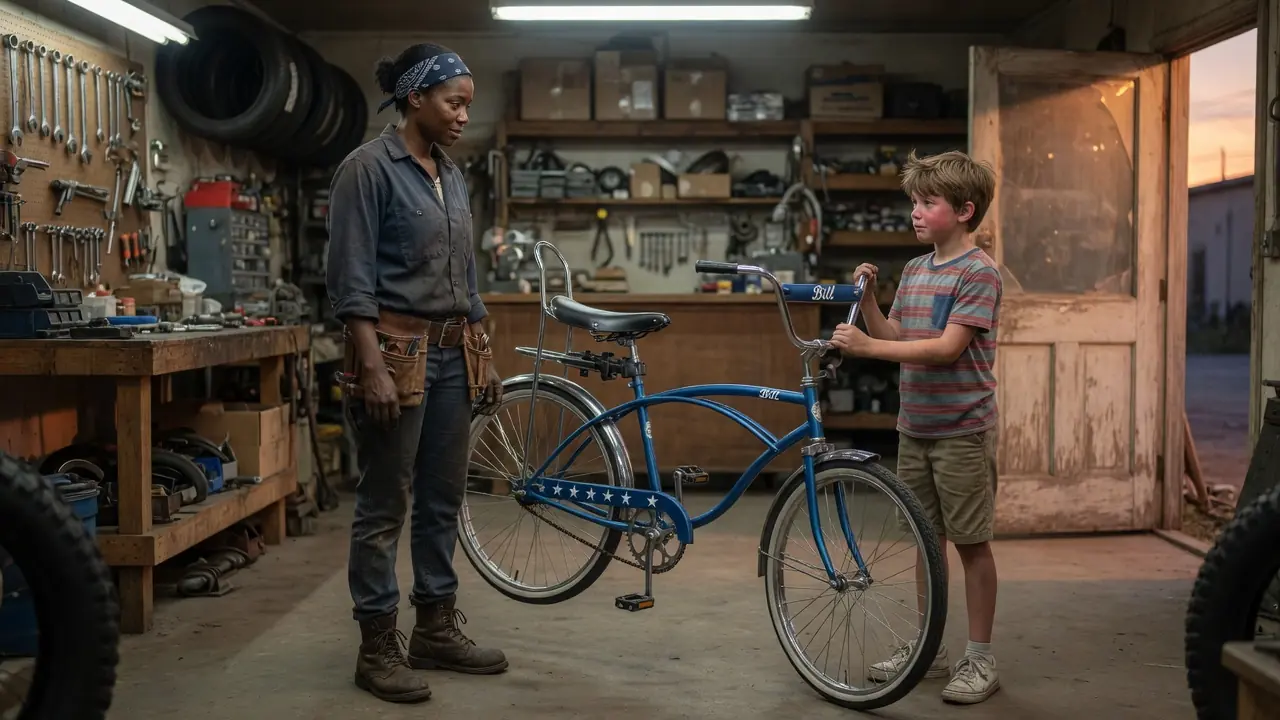
Kate crouched to examine the damage. The frame had been custom-painted with military stars on the chain guard, a name engraved on the handlebars, Bill. A patch of his dad’s unit insignia was tucked beneath the seat, covered in plastic.
“That’s a special ride,” Kate said softly.
“It was,” he whispered. “My dad got it for me. He said it’s just like the one he had when he was my age.”
Kate looked up.
His lip trembled.
“He’s deployed overseas. Mom said we can’t afford a new one. I left it at the end of the driveway, and a truck hit it this morning.”
She stayed crouched, glancing toward the shop. Nick was inside, pacing with a clipboard in one hand and his phone in the other.
He wasn’t watching.
“You ride this in the parade?” she asked.
“I was going to,” Bill said, voice cracking. “He might get to watch, if he’s not out on patrol.”
Kate swallowed the tightness rising in her chest.
Sophie had a pair of sneakers with a hole in the side, and she’d been eyeing a used pair at the thrift store for a week. The light bill was due Thursday. There was a can on her counter labeled Sophie’s College Fund that hadn’t seen a deposit in two months.
She stood up slowly and placed a hand gently on Bill’s shoulder.
“Bring it around the back,” she said. “Six o’clock. When we close, I’ll see what I can do.”
Bill’s face lit up.
“Really? How much will it cost?”
Kate looked at him. This kid didn’t need math. He needed mercy.
“Don’t worry about that,” she said. “Just bring the bike.”
That night, after Nick had driven off in his rusted pickup and the last of the air compressors had gone silent, Kate opened the back door and let Bill in.
She wheeled the wrecked Stingray to the workbench, laid it across two padded hooks, and flipped on the overhead lamp.
Under the fluorescent light, the damage was even worse than she thought. The wheel was destroyed. The fork bent. The handlebar grip was stripped. The engraving had a deep gash running through the second L in Bill.
Bill stood quietly nearby, his hands clasped in front of him.
“I’ll need to order some parts,” Kate said. “Can you come back Friday afternoon?”
“But the parade’s Saturday,” Bill said, his shoulders sagging again.
“I know. I’ll have it ready. I promise.”
When he left, she drove to Harlow’s Hardware and spent twenty-three dollars on parts. Then she placed an order online for a vintage wheel set she found from a supplier she’d used once before.
The total came to eighty-four dollars. It was nearly half her grocery money for the week, but she didn’t hesitate.
She’d worked hard to be careful with money, but some things weren’t measured in cents.
Over the next three nights, Kate returned to the shop after hours. She worked alone, letting the silence of the garage fill in the ache that still lived in her chest.
The new wheel arrived Thursday afternoon. She straightened the fork, aligned the chain, and repainted the military stars with a precision brush Nomad had once used to restore a vintage motorcycle tank.
She didn’t cut corners. Every piece mattered.
This wasn’t just a bike. It was a link between a boy and his father. A promise rolling on two wheels.
The shop smelled like machine oil and warm rubber.
When Bill Stewart walked through the back entrance just as the clock above the service desk ticked past six, the sun was dipping low, casting an amber haze across the alleyway, and the buzz of the town had faded into that quiet in-between hour where everything slowed.
Kate had already cleaned the workbench, laid out a clean cloth, and wheeled the bike into the center of the room under the overhead light.
She had spent the past three nights bringing it back to life. Every dent straightened, every spoke replaced, every detail restored with the care of someone who wasn’t just fixing a bike, but honoring something sacred.
Bill stepped inside carrying a paper bag and a can of lemonade. His face was still a little pink from the sun, his freckles standing out beneath his eyes, and there was hesitation in his step, like he wasn’t sure if this was really happening.
He held out the bag.
“My mom baked cookies. She said I should thank you properly.”
Kate took the bag, smiled gently, and set it aside on the workbench.
Then she reached for the tarp draped over the bike and pulled it back slowly.
Bill’s mouth dropped open.
His eyes scanned the bright chrome, the polished blue frame, the perfectly repainted Army star on the chain guard. His fingers twitched, then reached out, touching the restored engraving of his name on the handlebars.
“It looks better than it did before,” he whispered.
Kate nodded, feeling something tight in her chest begin to loosen.
“It’s ready for that parade,” she said softly.
He walked around the bike, hands trailing across the seat and the grip tape.
“I don’t know how to say thank you enough.”
“You don’t have to,” Kate replied. “Just ride it like he’d want you to.”
For a moment, the room felt suspended, like the kind of pause right before a laugh or a tear, when everything was perfectly still and right.
But the spell didn’t last.
The front door slammed open with a sharp bang. The metal latch rattled, and the heavy footsteps that followed were all too familiar.
Nick Russell’s voice cut through the air before he even rounded the corner.
“What the hell is going on here?”
Kate turned slowly.
Her stomach tightened.
Bill froze.
Nick was red-faced, holding his clipboard in one hand, his keys jangling in the other. His eyes darted to the bike, then to the boy, then finally to Kate.
“Are you seriously working on some kid’s toy in my shop? After hours? With my tools?”
Bill’s eyes went wide. He looked up at Kate, searching for permission to speak or run or disappear.
She gave a small nod.
“It’s okay,” she said quietly.
Bill wheeled the bike toward the service door, but Nick pointed a finger at him.
“No. Leave it.”
Kate stepped forward.
“Let him go.”
Nick’s gaze snapped back to her.
“We’re going to talk about this right now.”
“He didn’t do anything wrong,” she said. “He brought in the bike. I fixed it. That’s it.”
“On my time, with my parts, in my shop.”
“I paid for the parts myself,” she replied. “And I worked on it after hours. This was personal.”
“Personal.”
Nick’s laugh was bitter.
“You think this is a charity? This is a business, and you don’t get to use my resources for your personal projects.”
Bill stood frozen near the door, one hand on the handlebar. He looked at Kate again, unsure.
“Go ahead,” she said gently. “Take it home.”
Bill nodded, eyes wide and wet. He slipped out the door with the bike, the sound of rubber tires on concrete echoing faintly behind him.
The silence that followed was heavy.
Nick turned fully toward Kate, his jaw clenched.
“I’ve let a lot slide, Kate. You’ve got some skills, sure, but this, this is a line.”
“I made a decision to help someone. That’s all this was.”
“No. This was you doing what people like you always do, thinking you’re above the rules because you think the rules don’t apply when your feelings are involved.”
The phrase landed like a slap.
People like you.
Kate stood still, eyes locked with his. She could feel her pulse in her ears now. Her fingers curled slightly, but she didn’t move.
“You can’t talk to me like that.”
Nick’s voice dropped, controlled now, clipped.
“I just did. Pack up your things. You’re done here.”
Across the room, a few customers who had wandered in during the argument stood awkwardly by the counter. One of them had a phone in his hand, half-raised, thumb hovering over the record button.
Another, a man in his fifties wearing a denim shirt, was watching silently, arms crossed, his face unreadable.
Kate didn’t argue. She didn’t beg.
She turned to the back wall where her toolbox sat, its red surface worn from years of work. Her hands didn’t shake, but her heart pounded as she opened each drawer and closed it again, making sure everything was in order.
Every wrench and socket had its place. She’d always kept things tidy.
It mattered.
As she latched the top and secured the clasps, Nick hovered nearby, still fuming.
“You want to play the hero? Fine. Just not under my roof.”
Kate stood up, lifted the toolbox handle, and faced him squarely.
“You know,” she said, voice low, “this kid’s dad is overseas. That bike was the only thing he had left that reminded him of him. I gave him something you never will. A reason to feel like he mattered.”
Nick said nothing.
He stared back, jaw tight.
Kate turned and walked past him. Her steps were steady. She didn’t look back.
She didn’t see the man in the denim shirt follow her with his eyes all the way to the door. She didn’t see the phone finally lift, the red circle lighting up as someone pressed record. She didn’t notice the way two customers exchanged glances and whispered.
She only saw the fading evening light outside the shop, the narrow alley that would lead her home, and the faint outline of Bill’s bike turning the corner at the end of the street.
Her arms ached from the weight of the toolbox, and her chest ached from something far heavier.
That night, she would sit alone in her kitchen again, unsure how long she could keep the lights on.
But for the moment, she had done something that couldn’t be taken away. Not by Nick Russell, not by the system that let men like him decide who gets to help and who doesn’t.
And deep down, in the part of her that still believed doing the right thing was worth it, Kate knew this wasn’t the end.
It was only the beginning.
Kate didn’t sleep much that night.
After she got home from the shop, her arms still sore from carrying the heavy toolbox, she sat at the small kitchen table with the lights dimmed, the air sticky and still.
Sophie had fallen asleep early, curled up with her favorite blanket on the couch, unaware of the storm that had rolled through her mother’s day.
Kate sat motionless for hours, her hands folded in front of her, staring down at the untouched envelope of bills and the empty corner of the table where she usually kept a notebook for repair estimates.
She kept replaying the moment in the shop. The look in Bill’s eyes, the way Nick’s voice had cracked through the silence like a whip.
The more she tried to shake it off, the more it clung to her.
Not the firing. That didn’t surprise her as much as it should have. But the way it was done. Loud, public, mean, like she was some kind of threat to the order of things for simply being decent.
Morning crept in slowly, bringing with it a gray-blue light through the blinds and a low hum from the street below.
Kate hadn’t realized she’d fallen asleep until she heard the chime of her phone vibrating on the counter.
She rubbed her eyes, reached for the phone, and saw the time.
It was just after six.
A call at that hour was never good news.
The screen showed Mrs. Fincher, her neighbor from the first floor, who mostly kept to herself except when it came to building gossip or emergencies.
Kate cleared her throat before answering.
“Hello?”
“Kate, dear. I’m sorry to call so early, but there’s something you should see outside,” Mrs. Fincher said in her usual polite but urgent tone. “There are people in the parking lot. Nice people, well-dressed. One of them asked if this was where Kate Murphy lives.”
Kate sat up straighter.
“How many people?”
“At least a dozen, maybe more. And they’re not from around here. I can tell you that. One gentleman said something about wanting to thank you.”
Kate blinked.
“Thank me?”
“Yes, dear. I figured you’d want to know before Sophie wakes up.”
She hung up, and Kate sat for a moment, trying to catch up to what she’d just heard.
Her body moved before her brain caught up. Feet searching for the jeans draped over a chair, hands pulling on a plain T-shirt. She braided her hair quickly and slipped on her sneakers.
On the way out, she peeked into Sophie’s room to make sure she was still sleeping. Then she stepped into the hallway and made her way downstairs.
The front entrance of Willow Court opened onto a small parking lot lined with cracked pavement and dandelions growing between the seams.
But what Kate saw that morning made her stop in her tracks.
Parked in a half circle were luxury vehicles, SUVs, sedans, even a sleek pickup truck.
A group of men and women stood in small clusters talking quietly, all dressed in business casual. Some held coffee cups, others checked their watches.
She recognized one face immediately.
Standing calmly in the center was the man in the denim shirt who had watched her quietly the day before, just after she’d been fired.
He stepped forward as soon as he saw her.
“Miss Murphy,” he called, smiling. “I hope we didn’t wake you too early.”
Kate walked slowly toward the group, confused and self-conscious, trying to make sense of what was happening.
“You were at the shop yesterday.”
“Yes. My name is Steven Fox. I was there when it happened, and I saw everything.”
Kate nodded slowly, unsure of what to say.
Steven gestured toward the others.
“These are friends of mine. We’re part of something called the Pay It Forward Circle. It’s not a formal foundation or anything, just a group of business owners and professionals who were helped at a critical time in their lives and decided to pay that kindness forward when they were able.”
Kate looked around again, her heart beginning to race, but not from fear.
More from disbelief.
“I saw the video last night,” Steven continued. “The one someone posted online of you at the shop. You probably don’t know. It’s been viewed over two hundred thousand times. People are talking about what you did.”
Kate’s mouth went dry.
She hadn’t been online since getting home. The last thing she’d wanted was to see herself on someone’s phone screen, her voice raised, her job slipping away in real time.
“I didn’t do it for attention,” she said. “I just didn’t want the kid to feel forgotten.”
“And you didn’t ask for anything in return. That’s exactly why people are paying attention,” Steven said. “You reminded a lot of us what decency looks like, something that’s been in short supply lately.”
A woman in her sixties stepped forward. She wore a simple cream blouse and carried a folder in one hand.
“Juliet Allen,” she said, holding out her hand. “I own Treetop Orchards. Forty years ago, a mechanic in a town not unlike this one fixed my delivery truck when I couldn’t pay. I was trying to get my first harvest to market. That act saved my entire season. I’ve never forgotten it.”
Another man introduced himself as a trucking company owner who had once been taken in by a foster family and given his first job by a stranger.
One by one, each person in the group shared a small piece of how someone had helped them when they had nothing to give back. Some had received rides, jobs, meals. Others just a kind word.
But each one had been changed by it.
Kate listened quietly, standing among them like she was in the wrong room by mistake. Her hands fidgeted at her sides.
She couldn’t remember the last time a group of strangers looked at her with anything other than pity or suspicion.
Now they were treating her like she’d done something extraordinary, and that felt heavier than being invisible.
Steven reached into his jacket and pulled out a small envelope.
“First,” he said, “this is for you. There are no strings attached. It’s enough to give you space to breathe. A few months of rent, groceries, whatever you need.”
Kate hesitated but took the envelope. It felt too light to carry that much weight.
“We’re not here to hand out charity,” Steven continued. “We’re here because we believe in investing in people who prove that character still matters. And after yesterday, it’s clear you have plenty of it.”
Juliet stepped forward again, handing over the folder.
“There’s a second part to this,” she said. “We’d like to propose something a little bigger.”
Kate opened the folder slowly.
Inside was a preliminary proposal. A community bicycle repair shop, one focused on affordable repairs, youth training, and a pay-it-forward policy for kids in need.
It would be owned and run by Kate, with startup capital and business mentorship provided by the group.
“I don’t understand,” Kate said quietly. “Why me?”
Steven nodded, his tone firm but kind.
“Because you didn’t hesitate to help someone who couldn’t give you anything. Because you didn’t ask permission to be decent. And because this town needs people like you in positions where they can actually make a difference.”
Kate stared down at the folder.
The words were there, printed in clear ink, but her mind was still catching up to what they meant.
Ownership. Opportunity. Respect.
“I don’t want to be anyone’s charity project,” she said after a moment.
“You’re not,” Steven replied. “You’re someone we believe in.”
For the first time in years, Kate didn’t feel like she was standing on the edge of something collapsing.
She felt like maybe, just maybe, she was standing at the start of something being built.
Steven glanced at his watch.
“We’ll be back tomorrow. Think about it. Talk to your daughter. No pressure, but we’d be proud to stand with you.”
As the group slowly made their way back to their vehicles, Kate turned to head inside. Her hands still held the envelope and folder tightly.
From the stairwell above, Sophie’s small voice broke the silence.
“Mom?”
Kate looked up and saw her daughter peeking out from behind the railing. Her hair messy, her pajamas wrinkled.
“What’s happening?”
Kate smiled softly, holding the folder against her chest.
“Remember what your dad used to say about kindness being more important than money?”
Sophie nodded.
“Well,” Kate said, her voice steady. “Sometimes kindness finds its way back to you.”
Kate spent the rest of the morning in silence, sitting at the small kitchen table, where the air still held a trace of cinnamon from the cookies Bill had brought her the day before.
The envelope from Steven Fox lay unopened in front of her, its clean edges staring back like some kind of test she hadn’t studied for.
Next to it was the manila folder Juliet Allen had handed her, inside pages of printed proposals, startup estimates, projected timelines, even sketches of possible layouts for the bike shop they wanted her to own.
It didn’t feel real.
Not yet.
The sun had climbed higher through the blinds, casting narrow lines of gold across the table, and Sophie was now fully awake, sitting across from her mother with a bowl of dry cereal and her knees tucked up under her chin.
She had been unusually quiet, watching Kate with that thoughtful look children wore when they could tell something big was happening but didn’t know whether to be excited or afraid.
Kate exhaled slowly and pushed the envelope toward Sophie.
“You want to open it?” she asked.
Sophie blinked.
“Can I?”
Kate nodded.
The girl tore it carefully, like she understood it wasn’t just a piece of paper inside. It was something heavier, something important.
She pulled out the check and turned it around so Kate could see.
Kate’s breath caught.
It was more than she had made in a full year at Cedar Cycle. Rent for several months, groceries, utilities, enough to cover Sophie’s school supplies and maybe even that pair of sneakers she’d been asking about.
The room felt smaller suddenly, like the air had thickened.
Sophie stared at the check, then looked up.
“Does this mean you don’t have to go back to work at that place?”
Kate didn’t answer right away. She was still trying to process what that check represented.
It wasn’t just money. It was a crack in the wall that had kept her boxed in for so long. Boxed in by routine, by survival, by the quiet rules people like her learned to follow without ever being told.
“I’m not going back,” she said finally, her voice firm.
Sophie smiled softly.
“Good.”
They sat that way for a few more minutes before Kate reached for the folder and opened it again.
She spread out the pages across the table, scanning the proposal with more focus this time. There were sections on community engagement, apprenticeships for local teens, options for sliding-scale pricing.
Every page was written in plain, clear language. No legal traps, no hidden terms.
But that didn’t mean she trusted it completely.
Not yet.
Her life had taught her that generosity often came with fine print.
Kate grabbed a notebook from the counter and started writing questions.
Who owns the space?
Will I have full authority on hiring and operations?
Is there a lease?
What are the reporting expectations?
How will marketing be handled?
As she wrote, her breathing slowed.
She was building structure around something that had felt impossible just hours ago. She was testing its edges, looking for cracks the same way she would check the frame of an old Schwinn.
Not because she wanted to reject it, but because she needed to know if it could hold her weight.
Around noon, she picked up her phone and called Steven.
He answered on the second ring.
“Miss Murphy,” he said warmly. “I was hoping you’d call.”
“I have questions,” she said without hesitation.
“I would be surprised if you didn’t,” he replied.
Kate stepped into the bedroom and closed the door behind her.
“I read the proposal. I need to understand exactly what this means for me. Not just the money, but the control, the responsibility.”
Steven didn’t interrupt.
He listened.
“I’ve worked hard,” she continued. “I know how to fix bikes. I know how to treat customers. What I don’t know is how to write contracts or deal with business taxes or city permits. If I walk into this, I can’t do it halfway. I need to know I won’t be treated like a figurehead or like someone you all feel sorry for. If I say yes, it’s because I plan to make this thing real. I just can’t do that if there are strings I don’t see yet.”
There was a pause on the line before Steven responded.
“That’s exactly why we chose you,” he said. “Because you’re not just grateful. You’re thoughtful. You’re not a figurehead, Kate. This is your shop. The capital is a grant. No repayment, no strings. The building is already secured. You’ll be the registered owner. We’ll help you with legal setup and mentorship, but you’ll make the decisions. Hiring, branding, pricing, hours, all of it. We’re not giving you a project. We’re investing in a person. That’s you.”
Kate didn’t answer right away.
She felt her eyes sting. She sat on the edge of the bed and stared at the floor.
Steven’s voice came again, gentler now.
“Take your time. Talk to your daughter. Talk to Juliet. She’s been where you are.”
After they hung up, Kate placed the phone on the nightstand and leaned back against the wall.
She thought of Nomad, of his hands guiding hers over a brake cable when she was just learning.
“Your hands will get you through things the world can’t touch,” he had said once.
She hadn’t understood it back then.
Now she did.
Later that afternoon, Kate called Juliet.
The older woman picked up with a cheerful tone that felt like sunshine on an overcast day.
“I was hoping you’d call,” Juliet said.
“I needed to hear from someone who’s done this,” Kate replied.
Juliet didn’t rush to reassure her. She let the silence settle a bit.
“It’s not easy,” she said finally. “When I started, I was terrified. I had a truck I could barely afford and trees that wouldn’t wait another season to be harvested. But someone believed in me. That belief gave me room to believe in myself. And I’m telling you this because I see that same quiet strength in you. The kind that doesn’t make noise but gets things done.”
Kate let that settle in.
It wasn’t praise. It was recognition.
They talked for nearly an hour about business licensing, managing teenage apprentices, and customers who tried to negotiate every nickel.
Juliet answered every question directly, sometimes laughing, sometimes pausing to give space for the weight of the topic.
By the end, Kate had a full page of notes, a second page of follow-up questions, and the beginnings of something even more valuable, a feeling that she could do this.
That evening after dinner, Kate and Sophie sat outside on the narrow balcony. The sky was streaked with orange and rose.
Sophie had a coloring book in her lap, though she hadn’t touched the crayons in minutes. Her attention was on her mother.
“Do you think Dad would like it?” she asked quietly.
Kate looked out at the skyline. The town wasn’t much to look at, just rooftops and telephone wires, but it was hers.
“I think,” she said slowly, “he’d be proud we didn’t let someone else decide what we were worth.”
Sophie smiled, then picked up her red crayon and started filling in a drawing of a bicycle.
Inside the apartment, on the table where the check still rested beside the proposal, Kate placed her hand on the folder. Not to close it this time, but to keep it steady.
Her heart was still uncertain, her mind still cautious, but her hands were ready.
Kate woke up before the sun had fully risen, the light in her apartment still dim and soft, casting long shadows across the floor.
For a moment, she stayed in bed, staring at the ceiling, letting her breath settle.
The folder from Steven and Juliet was still on the kitchen table, right where she had left it the night before, and the envelope with the check was tucked beneath it.
The silence felt different this morning, less like a wait and more like a pause before something important.
Sophie’s light footsteps echoed down the hallway, and soon the soft clink of a spoon against a cereal bowl joined the hum of the refrigerator.
There was no rush, but everything felt like it was moving toward something.
By 8:30, Kate was dressed in a plain navy blouse, jeans that were neat but worn at the knees, and her work boots, the same pair she had worn to the shop every day for three years.
She didn’t put on makeup, just tied her hair back tight and checked her notebook twice, making sure the questions she’d prepared were in order.
Sophie, sitting at the edge of the table with her sketchbook in her lap, was unusually focused. She flipped to a new page and started drawing, her brow furrowed the way it always was when she was deep in concentration.
After a few minutes, she tore the page out, folded it carefully, and held it out to her mom.
“This is for you,” she said.
Kate unfolded the paper and smiled.
It was a hand-drawn logo, crayon colored, uneven but beautiful. A bicycle with bright yellow wheels shaped like the sun. And underneath, in Sophie’s careful handwriting, were the words, “Kindness is the gear that keeps us going.”
Kate felt her throat tighten as she looked at it.
She held the drawing with both hands for a moment, then leaned down and kissed Sophie’s forehead.
“I love it,” she said. “I’ll keep it with me today.”
Sophie grinned and picked up another crayon.
Kate tucked the drawing into her notebook and took one last look around the apartment before heading out.
The cafe where Steven had arranged the meeting was just a ten-minute walk from Willow Court. It was a small place with brick walls, big windows, and the smell of roasted beans and cinnamon in the air.
Kate arrived right on time, her boots clicking softly against the floor as she stepped inside.
She spotted Steven and Juliet at a corner table, both already seated with folders open and two coffees in front of them.
They looked up and smiled as she approached.
“Miss Murphy,” Steven said, standing to greet her. “Glad you made it.”
“Just Kate,” she replied, shaking his hand. “I’m not big on formal titles.”
Juliet gave a warm nod.
“You look ready.”
“I brought questions,” Kate said, sliding into the chair across from them.
She opened her notebook and placed it between them.
“I’d expect nothing less,” Steven replied.
Kate glanced at the folder on the table.
“Before we talk shop, I need to be sure of a few things. I know you said there were no strings, but I’ve learned that no one offers something this big without expecting something back. So, I want to be clear.”
Juliet leaned forward.
“Go on.”
“First,” Kate began. “I want to make sure I’m not just the face of this thing. I don’t want to be the story that sells it. I want full decision-making authority. Staffing, suppliers, pricing, hours, all of it.”
Steven nodded.
“You’ve got it.”
“Second, I want transparency on funding. Where the money’s coming from, who’s backing it, and how ongoing expenses will be managed.”
“We have a capital pool from our members,” Steven said. “You’ll get access to startup funds and a small contingency reserve for the first year. After that, we’ll help with grant writing and business development, but the shop will be yours to manage. No silent partners, no outside investors.”
Kate flipped to the next page in her notebook.
“What about insurance, zoning, permits, taxes? I’ve never done any of that. I don’t even know where to start.”
“That’s what we’re here for,” Juliet said. “We have legal and financial advisers ready to walk you through it. They’re not salespeople. They’re part of the circle. They’ll help you set everything up. No pressure, no commissions.”
Kate sat back slightly.
She wasn’t smiling yet, but the lines around her eyes had softened.
Her voice lowered.
“I’m not used to people just giving me things.”
Steven looked at her directly.
“We’re not giving you anything, Kate. We’re recognizing what’s already yours. Your skill, your character. We’re just helping you build a frame around it.”
Kate exhaled slowly.
She glanced around the cafe. The place was quiet but not empty. A woman in her sixties read a newspaper in the corner. A young man typed on a laptop near the window.
No one seemed to notice them, and somehow that made it easier to speak.
“Then I want to start small,” she said. “Keep overhead low. Maybe open four days a week at first. Offer repairs, but also classes for kids who want to learn. And I want a pay-what-you-can policy for low-income families.”
Steven nodded.
“That aligns with everything we were hoping you’d say.”
Juliet smiled.
“We were never looking for someone to open a high-end boutique. We were looking for someone who understands what it means to serve a community.”
Kate looked down at her hands for a moment. She rubbed her thumb across a small scar near her knuckle, one she’d gotten years ago tightening a bolt too fast.
She remembered Nomad holding her hand afterward, telling her that real work left real marks, and that was nothing to be ashamed of.
“I want the shop to be called Hometown Wheels,” she said suddenly. “Not Murphy’s, not anything fancy. Just something that tells people this place belongs to them, too.”
Steven’s eyes lit up.
“That’s perfect.”
Juliet reached into her folder and pulled out a simple one-page agreement.
“This isn’t a contract,” she explained. “It’s just a memorandum saying we agree to move forward together. No legalese, just intent.”
Kate read it carefully. Every word.
It was plain, just like Juliet said. No percentages, no clauses, just a statement of purpose and mutual commitment.
She signed it.
Steven extended his hand, and she shook it firmly.
Juliet smiled, her voice soft.
“Welcome, Kate.”
When Kate got back to the apartment later that afternoon, the sun was high and the air thick with summer heat.
Sophie was sitting at the table again, this time coloring a new version of her bicycle logo.
Kate hung her keys on the hook by the door and placed the signed memorandum on the kitchen counter.
Then she walked to the wall beside the refrigerator, took a magnet shaped like a ladybug, and pinned Sophie’s drawing above the calendar.
For the first time in a long while, she stood still and smiled. Not out of politeness, not out of habit, but because something inside her had shifted.
This wasn’t about starting a business.
This was about starting over.
And this time, it would be on her terms.
Kate stood in the doorway of the old brick building that would soon be her shop. The place still smelled like plaster dust and old lumber, the kind of scent that clung to the air during the last stretch of renovations.
Light poured in through the tall front windows, illuminating sawdust that floated gently in the warmth.
The sign wasn’t up yet, but in her notebook, it was already there in bold pencil strokes.
Hometown Wheels.
Built by hands, powered by heart.
For weeks, this space had been full of hammering, sawing, lifting, painting, rewiring, most of it done by volunteers and friends of the Pay It Forward Circle.
A mix of retirees, students, small business owners, and neighbors who heard what Kate was building and wanted to be part of it. Not because of the money, but because of the story, because of the message.
The bike racks had arrived the day before, still in cardboard and zip ties. The service counters were installed but unpainted. The wall that would become the community board was still bare drywall, waiting for color.
Kate moved carefully through the space, inspecting outlets, measuring the distance between tables, double-checking that the repair station lights were positioned exactly where they needed to be.
Her toolbox sat on a rolling cart nearby, worn but clean, the same one she had carried out of Cedar Cycle on the day she lost everything.
Now it was here again, not as a symbol of survival, but of new ownership.
Juliet arrived around ten with a man in overalls and a clipboard, one of the electricians who had volunteered for the rewiring.
They exchanged notes on panel placement and safety inspections. Kate asked clear questions, took careful notes, and thanked each worker by name.
She didn’t command the room. She collaborated with it. Every decision went through her. Every inch of progress reflected her judgment.
And even though the floors were still half concrete, half-finished tile, even though the shelves were bare and the cash register hadn’t arrived yet, something about the room felt honest, like it was becoming what it was meant to be.
Around midday, a boy about fifteen wandered in from the side alley.
He was tall, lanky, and wearing a hoodie despite the summer heat. His eyes darted around, curious but cautious.
Kate noticed him the moment he stepped in, and instead of asking him to leave, she set her clipboard down and walked over.
“Hey there. You looking for someone?” she asked.
The boy hesitated.
“Heard there was a bike place opening. Thought maybe you needed help.”
Kate looked him over.
Grease stains on his fingers, scuffed sneakers, a weary expression that came from being told no one too many times.
She nodded toward the workbench.
“What can you do?”
“I can fix chains, true wheels, change brakes.”
“What’s your name?”
“Devonte.”
She extended her hand.
“You’re hired, Devonte. Intern position. We start tomorrow. Wear something you can ruin.”
His eyes widened, then narrowed like he didn’t believe her. But when she didn’t take it back, he just nodded slowly and stepped out again, murmuring something that sounded like, “Thanks.”
Kate smiled to herself and wrote his name on a clean page in her notebook.
One apprentice down.
That afternoon, Steven arrived with a wrapped object tucked under his arm.
Kate was standing near the back wall, marking studs for a shelving unit, when he called out, “I think you’re going to like this.”
He unwrapped a wooden placard, carefully hand-carved with the same words Sophie had written weeks ago.
Kindness is the gear that keeps us going.
Kate ran her fingers across the lettering, and her heart thudded with something that wasn’t surprise anymore.
It was belonging.
“We thought it should hang by the entrance,” Steven said.
Kate nodded, her voice caught somewhere between gratitude and disbelief.
“That’s perfect.”
By five, the volunteers began to pack up, wiping sweat and dust from their arms, rolling up cords, and stacking boxes.
One of the older men, a retired mechanic named Ron, patted Kate on the shoulder.
“You got yourself a hell of a thing going here, Miss Murphy. Town could use more of this.”
“I think the town’s been ready,” Kate replied. “They just needed somewhere to show up.”
Just before closing the door for the night, a woman stepped in holding a beat-up blue Schwinn with a torn seat and no front tire.
She looked unsure, like she didn’t want to interrupt.
“Are you the one who helped that soldier’s boy? The one from the video?”
Kate nodded.
The woman gestured to the bike.
“We don’t need this anymore. Maybe you can use the parts or fix it up for someone else.”
Kate took the handlebars, nodded quietly, and wheeled the bike inside.
When the door finally closed and the light outside turned to amber dusk, Kate was alone in the shop.
She sat on a stool, pulled out a rag, and wiped the top of the main workbench clean.
The surface, still rough from sawdust, was the same width as the bench she and Nomad used to share back when they worked side by side in their tiny garage.
She reached into her notebook and pulled out a marker.
Above the bench, on the newly painted wall, she wrote one sentence.
We fix more than bikes.
Then she capped the marker, sat back, and looked around the room.
The shelves weren’t stocked yet. The phone line hadn’t been connected.
But in that quiet moment, with the smell of wood, sweat, and machine oil still fresh in the air, Kate knew what she had built was already real.
The morning of the grand opening arrived with a bright sky and the kind of stillness that comes just before a town starts to stir.
Kate stood outside Hometown Wheels, her hand resting on the front door handle, eyes scanning the simple white letters on the new glass.
The sign above the awning caught the light just right.
Hometown Wheels.
Built by hands, powered by heart.
For a few seconds, she didn’t move.
Her heart beat steady, but full. This wasn’t like the nervous flutter she used to get before job interviews or the anxious thud before her performance reviews.
This was something different.
This was pride. This was ownership.
This was her name, not on a time card, but on the deed.
Inside, the shop had been transformed.
The walls were painted soft gray with accents of warm cedar and navy. The workbenches gleamed, freshly oiled and lined with the tools she had spent years collecting.
The parts wall was stocked. The floor was swept.
And at the center of it all, like a quiet monument to everything that had happened, stood the display pedestal holding Bill Stewart’s restored Schwinn Stingray.
The bike was immaculate. Its deep blue paint polished to a mirror finish, the custom decals clean and sharp, and the engraved handlebars reflecting the morning sun.
Just beneath it, mounted on brushed aluminum, a plaque read, “Donated by the Stewart family. Restored by hands that believed no child should be forgotten. In honor of all military families and acts of everyday courage.”
The front door opened, and the day began.
One by one, people arrived.
Juliet Allen was the first, bringing a tray of homemade scones and a bouquet of wildflowers, placing them by the register with a wink and a squeeze of Kate’s hand.
Steven Fox came next, wearing a tailored blazer and jeans, his face lit with quiet satisfaction as he took in the space.
Behind him came a wave of neighbors, business owners, mechanics from around the county, and teenagers from the local high school, some who had seen the video online and others who had only heard whispers about the woman who fixed a soldier’s boy’s bike and got fired for it.
Kate moved through the room like she belonged there, because finally, she did.
She greeted every guest with the same calm dignity, answering questions about repair pricing, apprenticeship applications, and donation policies.
Devonte stood proudly at the secondary workbench, showing a pair of curious kids how to tighten brake cables.
A local reporter took photos, snapping shots of the shop’s interior, the community board covered in thank-you notes, and, of course, the Stingray.
Around noon, a hush fell as the front door opened again.
Kate turned instinctively and saw them.
Bill, his mother, and walking just behind them in full uniform was Bill’s father.
His posture was straight, but his face was soft. He had a slow, deliberate walk, as if every step was an effort not to overwhelm the moment.
Kate blinked, heart thudding once again, this time different.
She hadn’t expected this.
Bill rushed ahead, smiling so wide it looked like it might hurt.
“Miss Kate,” he shouted. “We brought something.”
His mom held a framed photo. Bill and his father standing next to the Stingray, both grinning like fools. The kind of photo that froze time in a perfect second.
She handed it to Kate with both hands.
“We thought maybe this belonged here now,” she said.
Kate held the frame carefully, her hands suddenly less steady.
“It does,” she said softly. “It absolutely does.”
Bill’s father stepped forward and extended his hand. His grip was firm but not forceful.
“I wanted to thank you in person,” he said, voice steady but thick. “Not just for fixing the bike, but for giving my son hope when I couldn’t be here. That kind of bravery matters, even if it doesn’t come with medals.”
Kate didn’t know what to say to that.
So she just nodded, eyes glistening, and looked down at Bill, who was now proudly showing another kid how the seat had been customized by his dad.
Later, a small ceremony was held outside under the makeshift tent someone had donated from the VFW hall.
Steven gave a short speech about community, integrity, and how good things grow from hard ground.
Juliet shared a story about her first broken-down delivery truck, about kindness, and about passing it forward.
When it was Kate’s turn to speak, she stood at the front holding nothing in her hands, wearing the same boots she’d worn on the day she was fired, and looked out over a crowd that was listening, not judging.
“I don’t have a speech,” she said plainly. “But I do have a belief. When you do the right thing, even if it costs you something, it never disappears. It moves forward. Someone sees it. Someone carries it. And if enough people do that, we don’t just fix bikes. We fix trust. We fix what’s broken between people. That’s what I want this place to be.”
There was quiet applause, respectful and sincere.
It was not a spectacle.
It was a community agreeing.
Later that afternoon, Kate stood behind the counter watching Devonte help a father and daughter pump air into their tires.
A woman dropped off a small donation box with snacks for the kids. One of the teenage volunteers was sweeping the sidewalk.
And then a young girl, no more than eight, walked in, holding the handlebars of a tiny bike with a flat front tire.
Her father followed close behind, his work shirt stained with paint, his eyes scanning the room.
Devonte stepped forward, wiping his hands on a rag.
“We got it,” he said gently, reaching for the bike. “Welcome to Hometown Wheels.”
Kate stood still, watching as the shop moved like a living thing, breathing, giving, receiving.
The bell above the door chimed again, and for the first time in years, the sound wasn’t something that startled her.
It was something that felt like home.
The weeks after the grand opening settled into a rhythm that felt honest.
Hometown Wheels wasn’t a sensation anymore. It was something better. It had become part of the town.
Kids came after school to pump tires or ask questions about gear shifting. Retirees stopped by to drop off bikes they no longer used, some with notes taped to the frame.
Give this one another life.
Sophie had claimed the back wall of the office for her drawings. Crayon-colored bikes and simple quotes lined it now, her latest taped dead center.
This is where good hands live.
Kate smiled every time she saw it.
There was a calm to the days, the kind that comes not from ease, but from alignment, like things were finally clicking where they belonged.
It was midmorning on a Tuesday when the bell over the door chimed and two men stepped inside.
Kate was behind the counter going over parts inventory with Devonte. She looked up automatically and felt her entire body pause.
The first man she recognized immediately.
Nick Russell.
Pressed shirt, clipped goatee, the same self-important stride she remembered.
The second was younger, sharply dressed, with a tablet in one hand and a Rolex that caught the light like it was trying to start a conversation.
Kate stood slowly, set her clipboard down, and met them halfway across the floor.
“Nick,” she said, neutral.
He gave a small nod, glancing around the shop with feigned curiosity.
“Looks different than the old place.”
“It should.”
The younger man extended his hand.
“Mark Delgado,” he said. “Business development consultant. I’ve been working with Cedar Cycle on a regional expansion strategy.”
Kate shook his hand, firm but brief.
“Okay.”
Nick cleared his throat.
“We’ve been watching what you built here. Impressive work, Kate. Really. Community engagement, smart layout, clean branding. You’re clearly running this place with purpose.”
Kate said nothing.
She waited.
Delgado took over.
“We want to offer you something. Cedar Cycle is rebranding. New leadership, new direction. We’re building out five satellite shops in nearby towns. We need someone to oversee technical operations, lead mechanic training, set quality benchmarks, full benefits, high six-figure salary, full creative freedom within the system.”
Kate raised an eyebrow.
“You want me to work for Nick again?”
Delgado gave a practiced chuckle.
“Technically, you’d be working for the regional leadership. Nick’s mostly advisory now.”
Nick stepped in.
“Look, I made a mistake, Kate. I see that now. You turned a tough break into something real. I respect that. And I think deep down, you know you could do even more with better resources.”
Kate stared at him.
There was no anger, no bitterness, just clarity.
She had nothing to prove anymore, and that made this moment simpler than she expected.
“Why now?” she asked.
Nick shifted.
“Because talent like yours doesn’t come around often. And because this time, I’m not trying to fix bikes. I’m trying to fix how I run a business.”
Kate nodded slowly, then looked around the shop.
She saw Devonte helping a teenager tighten a loose handlebar. She saw the donation rack stocked with food, the thank-you cards pinned near the register, the sign Sophie had made in the back office.
She saw the Schwinn Stingray still gleaming near the wall.
Then she looked back at Nick and Mark.
“This shop wasn’t built to prove you wrong, Nick,” she said. “It was built to prove that what you said didn’t have to be true.”
Nick blinked, caught off guard.
Kate continued.
“You said this wasn’t a charity, that I wasn’t paid to care, that when I used my hands to do something that didn’t bring a receipt, it wasn’t worth it. Well, look around. Every inch of this place proves the opposite.”
She paused.
“So thank you for the offer.”
“Really?”
“But I’m already where I belong.”
Delgado tried to recover, nodding respectfully.
“If you ever reconsider…”
“I won’t,” Kate said gently. “But I hope your new hires get treated better than I did.”
She offered a polite smile and turned to walk back behind the counter.
Devonte glanced at her wide-eyed, and she gave him a short nod.
The men lingered awkwardly for another moment, then left without another word.
That afternoon, a man in his fifties walked in holding a rusted cruiser bike with one pedal missing. His hands were calloused, his jeans stained with drywall dust, and beside him was a girl about nine clutching a helmet with peeling stickers.
He looked around uncertainly.
“We don’t have much,” he said. “But she wants to ride again. I figured I’d see if…”
Kate stepped forward.
“Bring it over. Let’s take a look.”
As he wheeled it in, Kate crouched low, examined the chain, tapped the brake housing, and made a quick list in her head.
“We’ll replace the pedal, tighten the brakes, swap the front tire,” she said. “Give us a day or two.”
“How much?” he asked.
Kate smiled.
“Teach her how to oil the chain when you get it back. That’ll be your payment.”
He looked stunned for a second, then nodded slowly.
“Yeah. Yeah, I can do that.”
Later that evening, when the shop was quiet again, Kate sat at the back workbench organizing a tray of Allen wrenches.
She glanced at the whiteboard beside her where Sophie had added another phrase.
Even the smallest fix makes the wheel turn.
Kate read it, then looked around the shop again.
No press. No speeches. No applause.
Just a place that ran on something steadier than money.
She didn’t need an offer to feel validated.
She needed only this, a space where decency didn’t require permission, and where work done with care could reshape the ground it stood on.
Twelve months had passed since the day Hometown Wheels first opened its doors. And on that morning, the shop felt more alive than ever.
Kate stood at the front window, watching the street outside come to life with the kind of quiet energy that only came when something good was about to happen.
A handmade banner hung across the front.
Freedom Bike Day.
No cost, no questions, just ride.
Inside, twenty-two fully restored bicycles lined the walls, each tagged with a child’s name, their heights carefully measured and adjusted, tires checked twice, chains cleaned and greased.
A dozen more sat in the back, still waiting for last-minute touches.
Devonte moved briskly between them, his hands fast and steady now, the technical lead in everything but title.
Sophie sat cross-legged near the counter, organizing registration cards and drawing stars next to the names of first-time riders.
The event had grown beyond what Kate imagined.
Volunteers from the neighborhood had shown up early, arranging tables of donated helmets, snacks, and water bottles. Local businesses dropped off coupons for haircuts and school supplies.
The town library set up a booth with books about bike safety and community history.
The energy was tangible, not loud, not chaotic, but present in every voice, every small act of care.
As families arrived, kids ran their hands over the bikes, eyes wide, shoes tapping the floor impatiently as they waited for their turn.
Kate walked the floor, greeting parents, tightening bolts, adjusting seats, reminding one boy gently not to overpump the tires.
Each time she smiled, it was genuine, unhurried.
This was the version of success she had built.
Not a brand, not a platform, but a rhythm where people took care of one another because they wanted to.
Just before noon, the reporter from the local news station arrived, the same woman who had covered Kate’s story the year before.
This time, there was no dramatic backdrop, no hint of controversy. She moved easily through the space, chatting with volunteers, filming the wall of thank-you notes, catching moments of joy without forcing them.
“We’re here today to see how one act of kindness became something bigger than headlines,” the reporter said into the camera. “Hometown Wheels, a repair shop turned community anchor, is celebrating one year of giving back.”
When she approached Kate for an interview, Kate wiped her hands on a towel and leaned casually against the counter.
She didn’t prepare a statement this time.
She didn’t need one.
“What do you want people to know about today?” the reporter asked.
Kate looked around the room.
A little girl was hugging her new bike. A father was showing his son how to adjust a seat post. Devonte was laughing with a teenager about pedal grips. Sophie was handing a helmet to a boy half her size.
“I want them to know it’s possible,” Kate said. “That you can build something real without cutting corners or stepping on anyone to get there. That good work and good people still matter.”
The segment aired that night, and within days, messages began arriving from outside the county. Mechanics, teachers, parents, nonprofit organizers, all asking the same thing.
How do we start something like this in our town?
Kate didn’t keep the idea to herself.
She spent her evenings writing down everything that worked, everything that didn’t. Juliet helped shape it into a guide. Steven found a small grant program to support replication efforts.
And soon, Hometown Wheels was more than a shop.
It was a model.
One afternoon, a woman named Leticia came from Ohio. She had once been incarcerated, now rebuilding her life and hoping to create a similar program for youth in her city.
She spent three days shadowing the team, asking questions, taking notes.
On her last morning, Kate handed her a folder.
“It’s not a franchise,” Kate said. “It’s a ripple. Make it reach the next kid.”
Leticia nodded, her eyes glassy.
“I will.”
That night, after the shop had closed and the last bike had been ridden out the door, Kate and Sophie stayed behind.
The sun was dipping low, casting a warm glow through the front windows.
Sophie tugged on her mother’s sleeve and motioned to the back wall, the one they had left blank since the day they moved in.
“It’s time,” she said.
Kate followed her gaze and saw the old bike propped gently against the wall.
Nomad’s bike.
The one he had given Kate during their first year of marriage. It was worn but well-kept, its frame still solid, the handlebar tape long replaced, but the spirit of it unchanged.
They lifted it together, mounted it to the custom hooks Kate had welded weeks before.
It hung above eye level, centered on the wall now marked Legacy.
Sophie looked up at the bike and whispered, “Why now?”
Kate rested a hand on her daughter’s back.
“Because now it’s not just about remembering your dad. It’s about building with the same hands he believed in.”
Below the bike, they mounted a small plaque. The metal had been brushed by Devonte. The lettering etched by a local craftsman who donated his time.
It read, “For those who believed kindness wasn’t a weakness, but a starting point.”
They stood in silence for a long moment.
Not out of grief, but out of reverence.
The shop didn’t feel like a second chance anymore. It felt like a foundation, not one built on sympathy or charity, but on steady hands, firm values, and the quiet belief that doing good was enough.
That night, as the lights dimmed and the streets outside grew still, Kate closed the front door, turned the lock, and knew she had finished something worth keeping.