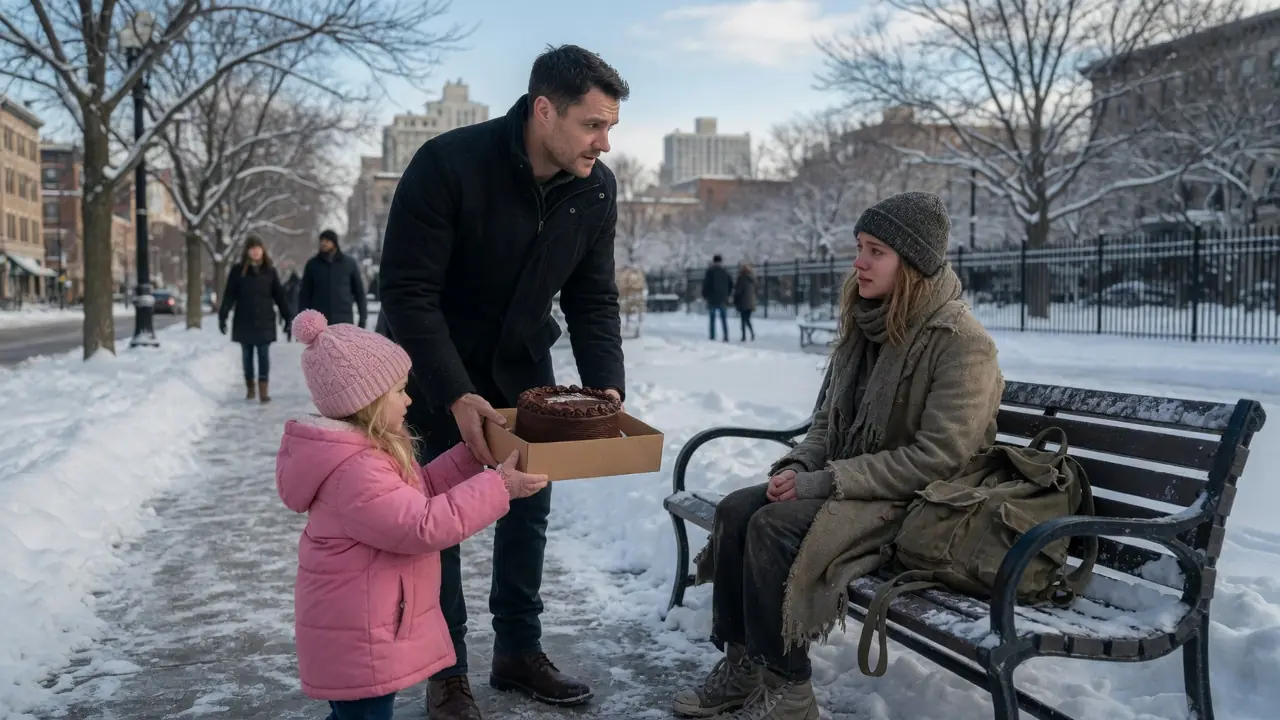
She sat on a frozen park bench with a broken backpack and dreams that felt too heavy to carry.
It was her birthday.
No cake.
No family.
No warm room waiting for her.
Just hunger, cold air, and a silent wish that maybe, just maybe, someone would notice she was still alive.
And someone did.
A single dad holding a birthday cake for his daughter made a choice that would change both their lives forever.
The streets of Chicago had never felt colder than they did that morning.
Snow lined the sidewalks like salt over an old wound, pushed into gray ridges by boots, tires, and the endless hurry of people trying to get somewhere warmer. The wind came through the avenues with no mercy, slipping beneath scarves, cutting through coat sleeves, turning every breath into a pale cloud that vanished almost as quickly as it appeared.
People passed in thick coats with their heads low.
Office workers held coffee cups with both hands.
Parents pulled children along by mittened fingers.
Buses hissed at the curb and rolled away, leaving behind dirty slush and the smell of exhaust.
Everyone seemed to be going somewhere.
Everyone seemed to belong to someone.
But on a park bench near Franklin Square, a young woman sat with her knees drawn to her chest, her lips cracked, her fingers stiff from the cold, and her arms wrapped around a backpack that had finally given up on holding itself together.
Her name was Emily Grace.
And today was her twenty-third birthday.
There were no balloons.
No candles.
No phone calls.
No messages from anyone who remembered.
Not even an automatic greeting from a store mailing list, because her phone had died two days ago, and she had no charger, no outlet, and no reason to believe anyone was trying to reach her.
Her stomach tightened with hunger.
She had stopped calling it hunger after the first day.
By now, it was just a pressure inside her body, a hollow ache that came in waves and made the world tilt slightly whenever she stood up too fast.
Three days earlier, the women’s shelter where she had been staying had closed temporarily because of a serious plumbing problem. A pipe had burst during the freeze, flooding part of the sleeping area and forcing everyone out with promises that repairs would take “only a few days.”
A few days.
For people with houses, a few days was inconvenience.
For Emily, a few days was survival.
Since then, she had slept wherever she could.
A church basement one night.
A train station bench for two hours before security woke her.
A laundromat chair until the owner gently, apologetically asked her to leave.
She had survived on leftover half sandwiches from bins behind cafés, a bruised apple she found near a bus stop, and lukewarm water from a cracked plastic bottle she kept refilling wherever she could.
She had not always lived this way.
That was the part people never seemed to understand.
They looked at someone sitting on a bench with a broken backpack and decided the whole story must have been written in one straight line.
As if she had always been there.
As if hunger had been her natural state.
As if a person simply became invisible one day because that was who they were.
But a year earlier, Emily Grace had a job at a daycare.
She had a little apartment with yellow curtains in the kitchen.
She had a fiancé named Mark, who used to kiss her forehead and say they would build a life full of laughter.
She had a mother who called every Sunday night.
She had plans.
Small ones, maybe, but real.
She wanted to finish her early childhood education certificate.
She wanted to open a little preschool someday, the kind with painted handprints on the walls and story time every morning.
She wanted a reading corner with pillows and warm lamps.
She wanted children to feel safe in rooms she created.
Then her mother got sick.
Not suddenly, not in one dramatic collapse, but slowly enough that hope kept showing up and being disappointed.
Emily used her savings to help with appointments, medicine, rent, groceries, gas, anything.
She missed shifts.
Then more shifts.
Then her manager at the daycare, who had once called her “a natural with children,” began speaking in careful phrases.
“We understand you’re going through a lot.”
“We need reliability.”
“You are wonderful, Emily, but we have ratios to maintain.”
The final conversation happened on a Thursday.
Her mother died the following Monday.
Grief did not arrive like tears.
It arrived like fog.
It settled over everything.
It made brushing her hair feel complicated.
It made answering the phone impossible.
It made getting out of bed feel like climbing through wet cement.
Mark stayed for the funeral.
He held her hand beside the grave.
He told her, “We’ll get through this.”
Then the months after proved that “we” had limits.
He grew tired of her sadness.
Tired of her silence.
Tired of her not being the cheerful girl he had fallen in love with.
One evening, he packed two bags and said he needed space.
By the time Emily understood that “space” meant another woman from his office, he was already gone.
After that, rent became impossible.
Her landlord waited exactly as long as the law required and not one day longer.
Emily kept thinking she would recover.
Find work.
Get stable.
Become herself again.
But life does not pause for grief to heal.
Bills kept coming.
The world kept moving.
And Emily, once a daycare teacher with gentle hands and bright plans, found herself standing outside a shelter with everything she owned in one broken backpack.
Now she sat on a frozen bench in Franklin Square on her twenty-third birthday, watching strangers hurry toward warmth.
Her backpack leaned beside her, one strap torn, the fabric stained by snow and street dust. Inside were two shirts, a pair of socks, a small photograph of her mother, a folder with old job references, and a children’s book she had kept from the daycare because one little boy had loved it so much he made her read it every afternoon.
She reached into the front pocket and pulled out the photograph.
Her mother smiled from a summer day three years ago, sitting at a picnic table with sunlight on her face.
Emily pressed her thumb against the corner of the picture.
She tried to smile.
It broke before it formed.
Across the street, Daniel Parker came out of a grocery store carrying a chocolate birthday cake in a white paper bag.
He was thirty-four years old, broad-shouldered, tired-eyed, and handsome in the unpolished way of men who had stopped thinking about being handsome because bills, work, and fatherhood had taken up all available space.
His dark hair was slightly windblown from walking between the bus stop and the store. His winter coat was clean but old, with a small tear near the cuff he kept meaning to sew and never remembered until he was already outside. In one hand he held the cake bag. In the other, he held the mittened hand of his six-year-old daughter, Lily.
Today was Lily’s birthday too.
She skipped beside him in pink boots, a red coat, and a hat with two soft pom-poms that bounced whenever she moved. Her cheeks were bright from cold, and her eyes were full of the kind of excitement only a child can hold without spilling.
“Daddy, did you get the candles?”
“Yes.”
“The number six?”
“Yes.”
“And sprinkles?”
“The cake already has sprinkles.”
“But extra sprinkles?”
Daniel stopped walking and looked down at her.
“Miss Lily Parker, are you accusing me of forgetting extra sprinkles on your birthday?”
She narrowed her eyes with exaggerated suspicion.
“I’m just checking.”
He reached into the grocery bag and pulled out a tiny plastic container.
Lily gasped.
“You remembered!”
“I value my life.”
She giggled and hugged his leg before continuing down the sidewalk.
Daniel smiled, but the smile carried fatigue at the edges.
He had taken on two extra shifts that week at the garage to afford the small celebration. The cake was store-bought, not fancy, but chocolate with frosting roses. There were balloons at home, a small wrapped doll from the discount aisle, and a Disney movie rented from a streaming service he had almost canceled three times.
It was not much.
But it was enough.
He had promised himself birthdays would remain joyful for Lily no matter how hard life became.
Two years earlier, Lily’s mother, Rebecca, had died after a long battle with cancer.
Lily had been four.
Old enough to remember her mother’s voice.
Too young to understand why it had gone away.
Daniel had learned grief and fatherhood at the same time, which meant he had done both badly at first.
He burned dinners.
Forgot school forms.
Washed red socks with white shirts.
Cried in the bathroom with the shower running so Lily would not hear.
Then one night, Lily had crawled into his bed holding her stuffed rabbit and said, “Daddy, if Mommy’s in heaven, does she still know when it’s my birthday?”
Daniel had pulled her close and promised, “She knows. And we’re going to celebrate so loud she hears us.”
Since then, birthdays mattered.
They were not optional.
They were proof that joy had not died with Rebecca.
So Daniel had planned everything carefully.
Cake.
Candles.
Movie.
Hot chocolate.
Extra sprinkles.
He was thinking about whether he had enough milk at home when Lily suddenly stopped.
Her hand tugged his.
“Daddy.”
He turned.
“What is it?”
Lily pointed across the street toward Franklin Square.
“That girl looks really sad.”
Daniel followed her gaze.
At first, he saw only the park bench, the snow, the gray morning.
Then he saw Emily.
She sat curled into herself like someone trying to take up less room in the world. Her face was pale. Her hair, light brown and tangled from wind, had slipped loose from a knit hat. Her coat was too thin. Her hands were bare and red from cold. A broken backpack sat beside her like a collapsed animal.
Daniel’s first instinct was caution.
Not cruelty.
Caution.
He was a single father.
He had a child with him.
The city was not always kind to people who stepped into strangers’ trouble.
He had learned to keep moving unless he understood what he was walking into.
But then Emily lifted her face toward the sky.
Not dramatically.
Not asking.
Just tired.
So tired that Daniel felt something in his chest recognize it.
He knew that look.
Not homelessness exactly.
Not hunger.
But the look of someone who had reached the end of being strong and found that the world still expected more.
Lily tugged his hand again.
“Daddy, can we share my cake with her?”
Daniel looked down.
The cake was Lily’s.
He had worked extra hours for it.
She had been talking about it all week.
“You want to share your birthday cake?”
Lily nodded solemnly.
“She looks like she needs birthday.”
The sentence made no grammatical sense.
It made perfect moral sense.
Daniel looked back at Emily.
Then at his daughter’s hopeful face.
Rebecca had been like that.
She had noticed people.
Not in a performative way.
She had simply possessed the dangerous habit of seeing.
Daniel inhaled slowly.
“All right,” he said.
Lily’s face brightened.
“But we approach gently,” he added. “We don’t scare her.”
“I know.”
“And you stay beside me.”
“I know, Daddy.”
They waited for the crosswalk light, crossed carefully, and entered the park.
Emily heard footsteps approaching and stiffened.
Her first thought was that someone had come to tell her to leave.
That happened often enough that her body prepared before her mind did.
She looked up.
A man stood a few feet away with a little girl at his side. He kept a respectful distance. His expression was gentle, but not pitying. The girl held a cake bag with both hands as if carrying treasure.
“Hi,” the man said. “I’m Daniel. This is my daughter, Lily.”
Emily did not answer.
Her fingers tightened around the photograph in her hand.
Daniel noticed and lowered his voice.
“It’s Lily’s birthday today. She saw you sitting here and wanted to invite you to have some cake with us.”
Emily stared at them.
The words did not fit the world she had been living in.
Cake.
Invite.
Birthday.
Us.
Her lips parted.
“Why?”
It came out as a whisper.
“You don’t even know me.”
Lily stepped forward half a step before remembering her father’s instruction and stopping.
“Because no one should be alone on their birthday,” she said.
Emily’s breath caught.
Daniel looked at Lily, surprised.
Then Emily broke.
Not loudly.
Not dramatically.
Just one tear sliding down her cheek.
Then another.
She looked away, embarrassed, wiping at her face with the sleeve of her coat.
“I’m sorry.”
“You don’t have to be sorry,” Daniel said.
Lily frowned.
“Are you cold?”
Emily laughed once, a small broken sound.
“A little.”
“You can have my scarf.”
“No, honey,” Daniel said gently. “You need your scarf.”
Lily looked offended by practicality.
Daniel shifted the cake bag.
“There’s a bench over there with less snow. We can sit for a minute if you want. No pressure.”
Emily almost said no.
Pride rose automatically, weak but stubborn.
Then her stomach cramped sharply.
She looked at the cake bag.
Her eyes filled again.
“All right,” she whispered.
Daniel guided them to a bench beneath a bare tree where less snow had gathered. He brushed the seat with his gloved hand before letting Lily sit. Emily sat at the far end, careful to leave space, careful not to seem too eager, careful because need had taught her that accepting kindness could be dangerous if the giver changed their mind.
Daniel opened the cake.
It was not fancy.
A grocery store chocolate cake with chocolate frosting, rainbow sprinkles, and pink icing flowers around the edge.
To Emily, it looked impossible.
Beautiful.
Holy.
Daniel pulled three plastic spoons from the bag.
“I forgot plates,” he said.
Lily gasped.
“Daddy.”
“I remembered extra sprinkles. No man is perfect.”
Emily surprised herself by smiling.
Lily carefully opened the sprinkle container and added more, mostly to the center, creating a small mountain of color.
“There,” she said. “Now it’s birthday enough.”
Daniel handed Emily a spoon.
Emily stared at it.
Her hand trembled when she took it.
“Thank you.”
“What’s your name?” Lily asked.
“Emily.”
“That’s pretty. I’m Lily. But you know that already because Daddy said it.”
Emily nodded.
“I’m twenty-three today.”
Lily’s eyes went wide.
“You have my birthday?”
“I guess I do.”
Lily looked at Daniel with absolute conviction.
“Daddy. She needs the first bite.”
Daniel’s throat tightened.
“All right.”
Emily tried to protest.
“No, it’s your cake.”
Lily shook her head.
“It’s our cake now.”
The word our nearly undid Emily completely.
She took a small bite.
Chocolate.
Sugar.
Soft cake.
Her body reacted before her heart did.
For one second, the cold, hunger, shame, and fear all stepped back.
She closed her eyes.
Daniel looked away to give her privacy.
Lily did not. Children, mercifully, had not yet learned to pretend they did not see what mattered.
“Is it good?” she asked.
Emily nodded, swallowing hard.
“It’s the best cake I’ve ever had.”
“It’s from Martino’s Grocery,” Lily said proudly. “Daddy says their frosting is too sweet, but he’s wrong.”
“I may have said very sweet.”
“You said too sweet.”
“I stand corrected.”
They ate from the cake with plastic spoons, laughing at the ridiculousness of it, three strangers sharing dessert in a frozen park while traffic moved around them and the city continued pretending it did not witness miracles.
Between bites, Daniel asked careful questions.
Not too many.
Not the kind that cornered.
“You from Chicago?”
“Mostly.”
“Do you have somewhere to go today?”
Emily looked down.
“That’s complicated.”
Daniel accepted that.
Lily did not.
“Our couch is comfy,” she said.
“Lily,” Daniel warned softly.
“What? It is.”
Emily’s face flushed.
“I don’t want to be trouble.”
Daniel set his spoon down.
“Trouble is when people make harm. Needing help is not trouble.”
She stared at him.
He seemed almost embarrassed by his own earnestness and looked down at the cake.
“My wife used to say that,” he added quietly.
Emily’s expression softened.
“Used to?”
Daniel nodded.
“She passed two years ago.”
“I’m sorry.”
“Thank you.”
Lily leaned against him.
“My mommy is in heaven. Daddy says she hears birthdays.”
Emily looked at the little girl, at her bright eyes and chocolate frosting on her lip, and felt the ache of her own mother so sharply that she had to grip the spoon tighter.
“My mom passed too,” she said.
Lily’s face grew solemn.
“Maybe they know each other.”
Daniel closed his eyes briefly.
Emily let out a small laugh that became a sob.
“Maybe.”
For a little while, under the gray Chicago sky, they talked like people who had found each other in the same weather.
Daniel told her he was a mechanic.
That he worked at a garage on the west side.
That he raised Lily alone and still sometimes put her shirts on backward if mornings got too hectic.
Lily confirmed this with authority.
Emily told them she had worked at a daycare.
That she loved children.
That she used to dream of opening a preschool one day.
She did not tell everything.
Not the shelter.
Not the garbage bins.
Not the nights in train stations.
But she told enough for Daniel to understand there was no warm room waiting for her.
As the afternoon deepened and the cold sharpened, Daniel looked at the sky.
He knew he had to decide.
A kind word in a park was one thing.
A couch in his apartment was another.
He had Lily to think about.
He also had Lily watching him.
Learning from him.
Measuring the shape of kindness by what he did next.
Rebecca’s voice came to him then, not as grief, but as memory.
If we teach kindness only when it costs nothing, we teach manners, not love.
Daniel took a breath.
“Emily,” he said carefully, “I know this is sudden. And I know you don’t know me. But if you need somewhere warm to stay tonight, just tonight, you can rest on our couch. We can call someone, find resources, figure out tomorrow when tomorrow comes.”
Emily froze.
“No.”
The word came automatically.
Daniel nodded.
“That’s okay.”
“I mean… I can’t. I don’t know you. You don’t know me. I don’t want to bring problems into your house.”
“Fair.”
“I’m not asking for anything.”
“I know.”
“I don’t want pity.”
“I’m not offering pity.”
“What are you offering?”
Daniel looked at Lily.
Then back at Emily.
“A warm room. Hot food. A locked door. No expectations.”
Emily’s eyes filled.
“Why are you being so kind?”
Daniel looked down at the cake, then at his daughter.
“Because I want Lily to know kindness is not just something we talk about on special days. It’s who we are.”
His voice softened.
“And maybe because I’ve been alone too.”
Emily did not answer right away.
Her hands trembled around the broken strap of her backpack.
The old fear whispered all its warnings.
Do not trust.
Do not accept.
Do not need.
But Lily reached over and touched her sleeve with one mittened hand.
“You can bring your backpack,” she said. “And you can sleep with my teddy if you want. He’s good at bad dreams.”
That was when Emily nodded.
Not because she trusted the world.
But because, for the first time in a long time, she wanted to.
Daniel’s apartment was on the third floor of an old brick building above a laundromat and a small convenience store that sold coffee, batteries, lottery tickets, and bananas that looked tired by noon.
The stairwell smelled faintly of detergent, dust, and someone’s dinner.
Emily climbed slowly, conscious of every sound her boots made, every stain on her coat, every way she might seem out of place.
Daniel carried the cake.
Lily held Emily’s hand by the second flight because she had decided that was the natural arrangement.
The apartment was small.
A living room, a narrow kitchen, two bedrooms, one bathroom, and windows that looked out over a row of rooftops and an alley where snow gathered in uneven piles.
It was not grand.
But it was warm.
Cozy in a way that made Emily’s chest hurt.
There were drawings taped to the refrigerator.
A row of children’s books on a low shelf.
A small framed photograph of a smiling woman with Daniel’s arm around her and baby Lily in her lap.
A blue blanket folded over the back of the couch.
A pair of tiny boots near the door.
Life.
Not perfect.
Not polished.
But held together with care.
Lily immediately began giving a tour.
“This is the kitchen. Daddy burned pancakes there one time. This is the couch. It pulls out but Daddy says it squeaks. This is my room. Don’t step on the blocks because they are dangerous. This is Mommy’s picture. We say good morning to her.”
Emily stood before the photograph.
Rebecca Parker had kind eyes.
“I’m sorry,” Emily whispered, not sure whether she was speaking to Daniel, Lily, or the woman in the frame.
Daniel stood behind her.
“Thank you.”
Lily tugged Emily toward the bathroom.
“You can shower. Daddy has towels. I have bubble bath, but it’s mine.”
“Lily.”
“What? I’m just saying.”
Emily could not remember the last time she had taken a warm shower.
The first rush of hot water over her shoulders nearly brought her to her knees.
She stood under it with both hands braced against the tile, eyes closed, while the street smell, cold, fear, and days of survival loosened from her skin.
Vanilla soap.
Clean shampoo.
A borrowed towel soft from use.
When she looked at herself in the mirror afterward, wearing one of Daniel’s old sweatshirts and a pair of flannel pajama pants tied tight at the waist, she almost did not recognize the woman looking back.
Still thin.
Still tired.
Still carrying too much.
But human again.
That alone made tears rise.
She pressed the towel to her mouth until they passed.
When she came out, Daniel had made grilled cheese sandwiches and tomato soup.
Lily sat at the table wearing a paper birthday crown.
There was one across the table for Emily too.
Emily stopped in the doorway.
Lily pointed.
“You have to wear it. Birthday rule.”
Emily looked at Daniel.
He held up both hands.
“I don’t make birthday law. I just live under it.”
Emily put on the paper crown.
Lily applauded.
They ate soup and sandwiches.
Daniel lit six candles on the remaining cake for Lily, then, after a brief consultation with his daughter, lit one extra candle for Emily.
“We don’t have twenty-three candles,” Lily explained. “But one means beginning.”
Emily looked at Daniel.
He looked surprised by that too.
“Where did you learn that?” he asked.
Lily shrugged.
“I just know things.”
They sang Happy Birthday.
Emily did not sing at first.
Then softly, halfway through, she joined in.
Afterward, Lily made a wish and blew out her candles.
Emily stared at hers.
“What do I wish for?” she whispered.
Lily leaned forward.
“You can’t tell or it won’t work.”
Emily closed her eyes.
She wished not for money.
Not for love.
Not even for a home.
She wished for the strength to believe this night was real.
Then she blew out the candle.
Later, after Lily opened her small gifts and watched half of her movie before falling asleep against Daniel’s side, he carried her to bed.
Emily stood awkwardly in the living room, unsure what to do with herself.
When Daniel returned, he found her folding the blanket he had set out.
“You don’t have to clean.”
“I know.”
“Do you?”
She looked down.
“No.”
He softened.
“The couch is yours tonight. Bathroom’s there. Kitchen’s there. If you wake up hungry, eat something.”
“I won’t.”
“I’m not asking whether you think you deserve it.”
That made her look up.
Daniel’s expression was gentle but firm.
“I’m saying food is there.”
Emily nodded.
They sat at the kitchen table with hot cocoa after Lily went to sleep.
The heater hummed.
Snow tapped softly at the window.
For a while, neither spoke.
Then Emily said, “Thank you. Not just for the cake. For treating me like a person. Most people just look away.”
Daniel stirred his cocoa though the marshmallows had already melted.
“I’ve learned looking away doesn’t make pain disappear.”
His eyes shifted toward Rebecca’s photograph in the living room.
“Sometimes the greatest thing you can do is sit beside someone in their silence.”
Emily wrapped both hands around the mug.
“Your wife sounds like she was good.”
“She was.”
“Do you still love her?”
The question escaped before she could stop it.
Her face flushed.
“I’m sorry. That was too personal.”
Daniel did not seem offended.
“Yes,” he said.
Emily nodded, unsure why the answer hurt and comforted her at the same time.
“But grief changes shape,” Daniel added. “At first, it filled every room. Then it started sitting in certain chairs. Now… now it visits. Some days longer than others.”
Emily looked toward the couch.
“My grief still fills every room.”
“Then don’t rush it out,” he said. “Just open a window when you can.”
She looked at him for a long moment.
That night, Emily cried quietly into the pillow on Daniel’s couch.
Not hopeless tears.
Not exactly.
They were tears of release.
Tears that came because the body sometimes waits until safety arrives before it allows collapse.
She fell asleep under a blue blanket while snow covered the city in silence.
For the first time in months, she slept until morning.
Emily tried to leave early.
She folded the blanket, cleaned the mug, changed back into her dry clothes, packed her broken backpack, and was halfway to the door when Daniel came out of his bedroom in sweatpants, hair messy, expression half-awake.
“You planning an escape?”
She froze.
“I didn’t want to be in the way.”
“You’re not.”
“I should go.”
“Where?”
She had no answer.
The apartment was quiet.
Lily’s door was still closed.
Daniel leaned against the hallway wall.
“I’m making pancakes.”
“You don’t have to.”
“I know.”
“I heard you burned them once.”
“That was one time, and my daughter has used it against me ever since.”
Emily almost smiled.
Daniel’s voice softened.
“Stay for breakfast.”
Pride and hunger fought inside her.
Hunger won.
The pancakes were slightly too dark on one side.
Lily declared them perfect because “birthday weekend pancakes don’t follow normal pancake rules.”
Emily ate three and felt embarrassed until Daniel ate four.
After breakfast, Daniel helped her charge her phone. It took ten minutes before the dead screen showed signs of life.
When it turned on, there were no missed calls.
No birthday messages.
Emily stared at the empty notifications longer than she meant to.
Daniel saw.
He said nothing.
Instead, he slid his old laptop onto the table.
“You said you worked at a daycare.”
“I did.”
“Want to look for openings?”
Emily’s first instinct was no.
Not because she did not want work.
Because hope was exhausting.
Hope required imagining rejection before it happened.
But Lily climbed into the chair beside her with a notebook and crayon.
“I can help. I’m good at jobs.”
“You are six,” Daniel said.
“I know what kids like.”
Emily laughed softly.
“All right.”
One day became two.
Two became a week.
Not because anyone formally decided it.
Because the shelter was still closed.
Because the weather worsened.
Because Daniel called a women’s resource center and learned there was a waiting list.
Because Emily applied for daycare jobs during the day and helped with dishes at night.
Because Lily cried the first time Emily mentioned leaving.
Because Daniel, despite all the sensible warnings in his head, found that the apartment felt less like survival when Emily was in it.
He set boundaries.
Clear ones.
The couch was hers.
His room was his.
Lily came first.
Emily respected all of it.
That respect mattered.
By the third day, Daniel came home from work and found the living room tidied, Lily’s clean clothes folded into careful stacks, and Emily sitting at the kitchen table revising her resume.
She had written:
Childcare Assistant, Little Steps Daycare.
Then stopped.
Daniel hung his coat near the door.
“You okay?”
Emily looked at the screen.
“I don’t know how to explain the gap.”
“Tell the truth?”
She gave him a look.
“On a resume?”
“Maybe not all of it.”
“I lost my mother. Lost my job. Lost my apartment. Lost myself for a while.”
Daniel pulled out a chair.
“That sounds like survival.”
“It sounds like failure.”
“It isn’t.”
She looked at him.
“You say things like they’re simple.”
“No. I say things because they’re hard and someone should say them.”
Emily’s eyes softened.
Together, they rewrote the resume.
They did not lie.
They made space for dignity.
Within a week, Emily had an interview at a daycare six blocks from Daniel’s apartment.
The night before, she stood in the living room wearing borrowed black pants from Daniel’s neighbor, a sweater Carmen from downstairs had donated, and boots polished as well as old boots could be polished.
Lily circled her seriously.
“You look like a teacher.”
Emily swallowed.
“I do?”
“Yes. But you need earrings.”
“I don’t have any.”
Lily ran to her room and came back with plastic clip-on butterfly earrings.
Daniel opened his mouth.
Emily put them on.
“How do I look?”
“Professional,” Daniel said with heroic restraint.
Lily nodded.
“And sparkly.”
The interview went well.
Not perfectly.
Emily’s voice shook at first.
But when the director asked how she handled children having difficult emotions, Emily answered from somewhere deep and true.
“Children need to know their feelings are not too big for the room,” she said. “If they feel safe, they can learn. But safety comes first.”
The director looked at her for a long moment.
“When can you start?”
Emily walked out into the cold and called Daniel from the sidewalk.
He answered on the second ring.
“Well?”
“I got it.”
There was silence.
Then Daniel shouted, “Lily! She got it!”
Emily heard Lily screaming in the background.
She laughed so hard she cried.
That evening, they celebrated with spaghetti because it was what Daniel knew how to cook reliably.
Lily made a sign that said, MISS EMILY GOT A JOB, with three backward letters and seventeen hearts.
Emily taped it to the refrigerator.
“You don’t have to keep that up,” Daniel said.
“Yes, I do.”
A month passed.
Emily began rebuilding.
Not quickly.
Not magically.
But steadily.
She worked part-time at Bright Start Daycare, then picked up more hours when another assistant moved away. Her first paycheck was small, but she held it in both hands and cried in the break room.
She opened a bank account.
Bought her own toothbrush.
Replaced the broken strap on her backpack.
Paid for a used coat from a thrift store.
Called the shelter to thank them when they reopened and explain she had found a temporary place.
Temporary became complicated.
Daniel and Emily had a conversation about it one night after Lily fell asleep.
A real conversation.
Adult.
Careful.
Honest.
“You can’t stay on the couch forever,” Emily said.
“I know.”
“I don’t want to take advantage.”
“You’re not.”
“I need to find a room.”
“Maybe.”
“Maybe?”
Daniel leaned back in his chair.
“I’ve been thinking. The unit downstairs might be open next month. Mrs. Alvarez is moving in with her son. It’s small, but close. I could talk to the landlord.”
Emily looked down.
“That would be good.”
The words came out flat.
Daniel noticed.
“You don’t sound happy.”
“I am.”
“Emily.”
She closed her eyes.
“I know it’s the right thing. I just…”
He waited.
She opened them.
“I forgot what it feels like to have people at the end of the day. Lily telling me about school. You burning toast. The radiator making that awful sound. It’s stupid.”
“It’s not stupid.”
“It is. This isn’t my family.”
Daniel’s face shifted.
Not hurt.
Not exactly.
Something quieter.
“Maybe family is not always what starts out yours,” he said.
Emily looked at him.
The room changed.
Just slightly.
Something unspoken stepped closer.
They both felt it.
Daniel stood too quickly and took the mugs to the sink.
Emily pretended not to notice.
The next weeks were full of small domestic things that became dangerous because they felt natural.
Emily reading bedtime stories to Lily with different voices for every character.
Daniel fixing the loose hinge on Emily’s thrift-store dresser after she moved into the downstairs unit.
Lily insisting that Emily still come upstairs for Friday movie night because “downstairs is too far away.”
Emily cooking soup when Daniel caught a cold.
Daniel walking her home after late shifts even though home was one flight of stairs below.
Emily leaving muffins outside his door on mornings when he had early shifts.
Daniel shoveling the front walk before she left for work.
Lily drawing pictures of three people holding hands and labeling them Daddy, Me, and Miss Emily.
At first, Emily corrected her gently.
Then she stopped.
Daniel noticed things he had not planned to notice.
The way Emily tucked loose hair behind her ear when concentrating.
The way she spoke to Lily with patience even when tired.
The way she still apologized too often and then caught herself.
The way her laugh returned in pieces, first small, then fuller, then unexpectedly bright.
The way the apartment felt less empty when she came upstairs.
The way his own heart, which he had believed settled into permanent widowhood, began to wake like something under snow.
That frightened him.
He loved Rebecca.
He would always love Rebecca.
But one evening, while Emily and Lily sat on the floor building a cardboard castle out of grocery boxes, Daniel stood in the kitchen doorway and felt joy so sudden it nearly hurt.
Rebecca’s photograph sat on the shelf nearby.
For the first time, looking at it did not feel like betrayal.
It felt like permission.
As if grief, having filled every room for so long, had finally opened one window.
Spring came slowly to Chicago.
Snow melted into dirty streams along the curbs. Trees began showing tight green buds. The wind still cut between buildings, but now it carried hints of rain instead of ice.
One afternoon, Emily came upstairs after work and found a small cupcake on Daniel’s kitchen table.
A candle stood in it.
Beside it was a note written in Daniel’s careful block letters, with Lily’s messy addition beneath.
For your half birthday.
Because we don’t wait another year to celebrate people we care about.
D and L.
Lily had added:
YOU ARE OUR EMILY.
Emily stood in the kitchen for a long time.
Daniel came in from the hallway carrying laundry and stopped.
“You found it.”
She touched the note.
“You remembered.”
“Lily remembered. I did math.”
Emily laughed through tears.
Daniel set the laundry down.
“You okay?”
“No.”
Then she smiled.
“Yes.”
Lily burst from her room.
“Light the candle! Light the candle!”
Daniel lit it.
Emily closed her eyes.
This time, she did not wish for strength to believe the moment was real.
She believed it.
She wished for courage.
Then she blew out the candle.
That night, after Lily went to bed, Emily helped Daniel wash dishes.
Their hands brushed in the sink.
Both froze.
Neither made a joke.
Emily looked down at the soapy water.
Daniel turned off the faucet.
“Emily.”
She took a breath.
“Please don’t say anything if it’s going to make me leave.”
The words came out trembling.
Daniel turned toward her fully.
“I don’t want you to leave.”
Her eyes lifted.
“I’m scared,” she whispered.
“So am I.”
“You lost someone you loved.”
“Yes.”
“I lost myself.”
“I know.”
“What if we’re just lonely?”
Daniel considered that honestly.
“I’ve been lonely for two years,” he said. “It never felt like this.”
Emily’s eyes filled.
“What does this feel like?”
“Like coming home and realizing the light is on.”
She pressed a hand to her mouth.
Daniel stepped closer, slowly, giving her time to move away.
She did not.
“I care about you,” he said. “Not because you needed help. Not because Lily loves you, though she does. Not because you fit into some empty space.”
He swallowed.
“I care about you because of who you are. The woman who survived. The woman who still knows how to be gentle. The woman who makes my daughter feel safe. The woman who made this place feel alive again.”
Emily cried then.
Quietly.
Daniel did not touch her until she reached for him first.
When she did, he held her carefully, like something precious and not fragile.
Their first kiss came weeks later.
They did not rush it.
Emily needed time to trust that affection would not turn into control.
Daniel needed time to understand that loving Emily did not erase Rebecca.
Lily needed time too, though she was mostly impatient.
One evening, after noticing Daniel and Emily sitting very close on the couch, Lily sighed dramatically.
“Are you two in love yet or still being weird?”
Daniel choked on his tea.
Emily covered her face.
“Lily Parker.”
“What? I have eyes.”
Emily laughed so hard she had to leave the room.
Daniel pointed down the hall.
“Brush your teeth.”
“Fine. But I’m right.”
She was.
Six months after the day in the park, Daniel and Emily stood in the same place where they first met.
This time, the snow was gone.
Franklin Square had turned green.
Children played near the fountain.
Vendors sold pretzels from carts.
Sunlight moved through the leaves, soft and golden over the bench where Emily had once sat hungry, cold, and unseen.
Lily carried a new chocolate cake with both hands, concentrating as if she had been trusted with the crown jewels.
“Careful,” Daniel said.
“I know, Daddy. Cakes are delicate citizens.”
Emily laughed.
She had changed.
Not completely.
Healing had not erased the past.
There were still nights when fear came back.
Still moments when a slammed door made her flinch.
Still days when grief for her mother rose without warning.
But she stood straighter now.
Her cheeks had color.
Her hair was brushed and pinned loosely.
She wore a blue dress under her coat because Lily had said blue made her look “like a storybook teacher.”
She was working full-time at the daycare now.
She had begun taking evening classes toward her certification.
She had savings.
Not much.
But enough to write the number down and look at it when fear lied to her.
Daniel watched her look at the bench.
“You okay?”
Emily nodded.
“I wanted to come here because this is where everything changed.”
Daniel looked at the bench.
Then at her.
“No,” he said softly. “This is where everything started.”
Lily set the cake carefully on the bench and opened the box.
This one had words written in icing.
Happy Birthday Again, Emily.
Emily laughed.
“It is not my birthday.”
Lily shrugged.
“It’s your life birthday.”
Daniel looked impressed.
“That actually works.”
Emily’s eyes filled.
“You two are impossible.”
“Yes,” Lily said. “But in a nice way.”
They ate cake with forks this time because Daniel had remembered plates and napkins and had been praised excessively for personal growth.
After cake, Lily ran toward the fountain to toss a penny.
Daniel and Emily remained near the bench.
His hand slipped into his coat pocket.
Emily noticed because she noticed him now the way he noticed her.
“Daniel?”
He turned toward her.
His face was nervous.
That made her heart begin to pound.
“I thought about doing this somewhere fancy,” he said. “A restaurant. A lakefront walk. Something with candles.”
Emily smiled.
“But?”
“But every important thing with us started here. With Lily seeing you. With cake. With you saying yes to one night of safety.”
His voice thickened.
“I don’t think love always begins with lightning. Sometimes it begins when someone stops walking. Sometimes it begins with a plastic spoon and a grocery-store cake and a little girl who understands kindness better than adults do.”
Emily covered her mouth.
Daniel took a small box from his pocket.
Lily saw from the fountain and screamed.
Not a small scream.
A full, delighted, public scream.
People turned.
Daniel laughed under his breath.
“Well, our witness has noticed.”
He opened the box.
Inside was a simple ring.
Not large.
Not showy.
Beautiful in its honesty.
“Emily Grace,” he said, “I know life has taken more from you than it should have. I know I can’t undo any of it. I know loving me means loving Lily too, and loving a man whose heart still carries grief.”
Emily’s tears spilled freely now.
“But I promise you this. You will never be invisible in my home. You will never have to earn your place by being useful. You will be celebrated. You will be listened to. You will be safe to laugh, safe to cry, safe to become whoever you are still becoming.”
He knelt.
“Will you marry me?”
Lily shouted, “Say yes!”
A woman passing by laughed.
Emily looked at Daniel, then at Lily, then at the bench where she had once believed no one would ever notice her again.
She thought of her mother.
Of winter.
Of cake.
Of a couch that became shelter.
Of a little girl offering a teddy bear for bad dreams.
Of Daniel sitting across from her at a kitchen table, saying hard things gently.
She nodded.
“Yes.”
Daniel exhaled like he had been holding his breath for six months.
“Yes?” he repeated.
Emily laughed through tears.
“Yes.”
Lily ran into them before Daniel could stand fully, wrapping her arms around both.
“We’re a family!” she shouted.
Daniel stood and pulled Emily close.
Emily held Lily with one arm and Daniel with the other.
And in the place where she had once sat hungry, cold, and unseen, Emily said yes to a new life.
Not a rescue.
Not a fairy tale.
A family.
Built slowly.
Built carefully.
Built from kindness that did not ask to be repaid, and love that arrived only after trust had been given time to grow.
Years later, when people asked Emily how she found her way back from the hardest season of her life, she never started with the proposal.
She did not start with the apartment downstairs.
Or the daycare job.
Or the evening classes.
Or even the first time Lily called her “my Emily” in front of her teacher.
She always started with the cake.
A little girl’s birthday cake.
A father’s quiet decision.
A frozen park bench in winter.
Because sometimes the smallest act is not small at all.
Sometimes one slice of cake says, you still matter.
Sometimes one warm room says, you are not forgotten.
Sometimes one child’s question becomes a doorway.
And sometimes a single father, carrying more grief than he knows what to do with, stops long enough to notice a young woman sitting alone in the cold.
He thinks he is saving her for one night.
He does not know she will bring laughter back into his home.
He does not know she will teach his daughter gentleness by surviving without becoming hard.
He does not know that the birthday cake in his hand is not just for his little girl anymore.
It is the beginning of a second chance for all three of them.
And years later, every birthday in the Parker home had the same tradition.
No matter how busy life became.
No matter how many guests came.
No matter whether the cake was homemade, store-bought, lopsided, or perfect.
The first slice was always placed on an empty plate near the center of the table.
For the person still waiting to be noticed.
For the stranger not yet family.
For the reminder that love often begins when someone refuses to look away.
Then Lily, older now but still full of the same bright certainty, would raise her fork and say, “No one should be alone on their birthday.”
And Emily, smiling across the table at Daniel, would answer softly, “No. They shouldn’t.”
Because once, on the coldest birthday of her life, someone had seen her.
And being seen had changed everything.