The dusty streets of Portland, Oregon, had never been kind to dreamers, and Nora Graham learned that truth the moment she told her stepfamily she wanted to open a bakery that served everyone equally, regardless of their station in life.
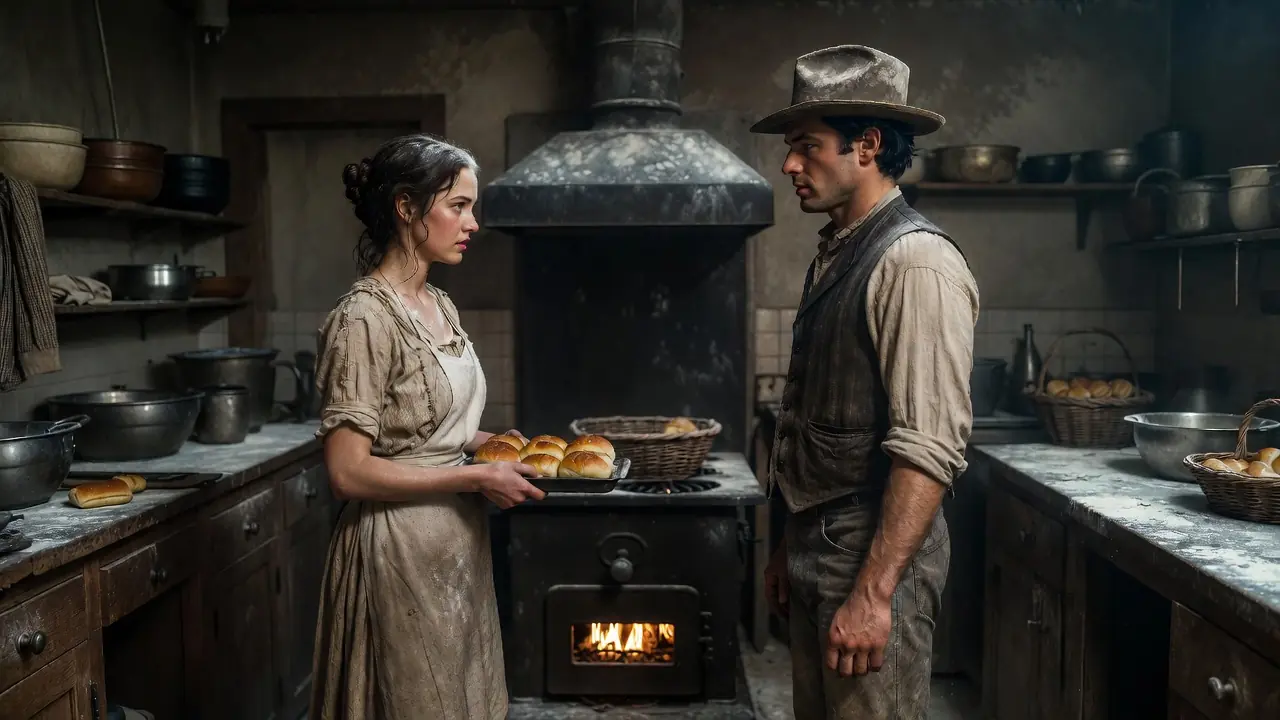
It was the spring of 1878, and Nora stood in the cramped kitchen of the boarding house her stepmother owned, flour dusting her worn calico dress as she pulled a tray of perfectly golden rolls from the cast iron stove.
The scent filled the room, warm and inviting, but Margaret Graham’s face remained cold as stone.
“A bakery?” her stepmother repeated, her thin lips pressed into a line of disapproval. “You think anyone in this town wants bread from a girl with no dowry, no prospects, and hands rough as leather? You think the fine ladies of Portland will step foot in an establishment run by someone like you?”
Nora’s two stepsisters, Helen and Katherine, giggled from their seats at the table, their pristine dresses a sharp contrast to Nora’s patched and faded clothing.
They had never worked a day in their lives, while Nora had spent the five years since her father’s death scrubbing floors, cooking meals, and taking in mending to contribute to the household that barely acknowledged her existence.
“I have been saving,” Nora said quietly, her green eyes fixed on the rolls she was placing in a basket. “I have almost $40 put away. I could rent a small space near the docks where the workers need good, hearty food. I could make something of myself.”
“The docks?” Margaret scoffed. “You want to serve laborers and drifters. You want to ruin what little reputation this family has left. Your father left me with debts and three mouths to feed. The least you could do is marry that butcher, Mr. Hendrix. He has asked for your hand three times now.”
“He is nearly 50 years old and has buried two wives already,” Nora replied, her voice trembling but determined. “I will not marry a man I do not love simply to ease your burden. I want to build something of my own. I want a better life.”
The laughter that erupted from her stepsisters was cruel and sharp.
“Better life?” Helen mocked. “Listen to her, talking as though she is somebody special. You are an orphan living on charity, Nora. You should be grateful for any man willing to take you.”
That night, Nora lay on the narrow cot in the attic room she called home, her savings hidden beneath a loose floorboard.
She counted the coins and bills by candlelight, her fingers tracing each hard-earned penny.
$43.60.
It was not much, but it was hers.
Every loaf of bread she had sold to neighbors, every shirt she had mended, every extra shift she had worked at the boarding house had brought her closer to freedom.
She would not give up on her dream, no matter how many people laughed.
The next morning, Nora rose before dawn and made her way to the central market where farmers and merchants gathered to sell their wares.
She had baked through the night, using the small allowance of flour Margaret grudgingly provided for the boarding house meals.
The basket on her arm contained two dozen rolls, six loaves of bread, and a dozen apple tarts made from fruit she had traded mending work to obtain.
The market was already bustling with activity as the sun crested the horizon, painting the sky in shades of pink and gold.
Nora found an empty spot near the edge of the square and spread a clean cloth on the ground, arranging her goods with careful precision.
Her heart hammered in her chest as early shoppers began to pass by, some glancing at her offerings with interest, others walking past without a second look.
“How much for the bread?” a weathered woman asked, pausing to inspect a loaf.
“Ten cents,” Nora replied, her voice steadier than she felt.
The woman handed over the coin and tucked the bread into her basket. “Smells good. Better than what the bakery on Main Street sells, and cheaper too.”
Encouraged, Nora spent the next two hours selling her goods.
She had nearly emptied her basket when a shadow fell across her cloth.
She looked up to see a tall man standing before her, his broad-shouldered frame silhouetted against the morning sun.
He wore the practical clothing of a working man, denim trousers and a cotton shirt with the sleeves rolled up to reveal tanned, muscular forearms.
A wide-brimmed hat shaded his face, but she could see the sharp line of his jaw and the hint of dark stubble.
“Are those apple tarts?” he asked, his voice a low rumble that seemed to vibrate through her chest.
“Yes, sir. Fifteen cents each, or two for a quarter,” Nora said, meeting his gaze.
His eyes were a striking shade of blue, like the sky on a clear summer day, and they studied her with an intensity that made her breath catch.
“I will take all six,” he said, reaching into his pocket.
“All six?” Nora repeated, surprised.
“I have a crew working on a ranch expansion north of town. Good food keeps good workers happy.”
He handed her the coins, his fingers brushing against hers for the briefest moment.
“These look better than anything I have seen in Portland. You selling here regular?”
“I hope to,” Nora replied, carefully wrapping the tarts in paper. “I want to open my own bakery someday.”
The man’s expression shifted, something like approval crossing his features.
“That is a fine ambition. This town could use more folks willing to work hard for their dreams.”
He tipped his hat to her. “Name is Samuel Jennings. If you do open that bakery, you have got a customer in me and my crew.”
“Nora Graham,” she replied, feeling a warmth spread through her chest that had nothing to do with the spring sunshine.
Samuel Jennings took the package of tarts and turned to leave, but he paused and glanced back.
“You bake like this regular, Miss Graham? You bring some out to the Triple J Ranch, about eight miles north on the main road. I will pay fair prices for quality goods.”
Then he was gone, disappearing into the crowd of market-goers, leaving Nora standing with empty baskets and more money in her pocket than she had made in a month of mending.
She counted her earnings three times to be certain.
$2.40 in a single morning.
Hope bloomed in her chest like wildflowers after rain.
Over the following weeks, Nora fell into a pattern.
She would work her required duties at the boarding house during the day, then stay up late into the night baking.
Before dawn, she would make her way to the market, and by mid-morning, her goods were always sold.
Her savings grew steadily.
$50.
$60.
$75.
Margaret grew suspicious of Nora’s exhaustion, but Nora hid her activities well, claiming she was simply working extra hard on the boarding house chores.
Helen and Katherine were being courted by the sons of local merchants, and Margaret was determined to see them married well.
One Saturday morning, as Nora was packing her baskets for the market, Samuel Jennings appeared again.
This time, he did not come alone.
Three other men accompanied him, all dressed in working clothes and bearing the sun-weathered look of ranch hands.
“Miss Graham,” Samuel greeted her, removing his hat.
In the full light of day, she could see him more clearly.
He was perhaps 26 or 27, with dark hair that fell across his forehead and those remarkable blue eyes.
His face was handsome in a rugged way, all strong lines and honest features.
“My crew would like to put in a standing order if you are willing. Three dozen rolls and two loaves of bread twice a week. We will pay 50 cents per delivery.”
Nora’s mind raced with calculations.
A dollar a week just from one customer.
$4 a month.
“I can do that,” she said, trying to keep the excitement from her voice. “When would you need the first delivery?”
“Tuesday morning, if that suits you. The ranch is not far. If you can bring them out at dawn, we will have fresh bread for the crew’s breakfast.”
“Eight miles is a long walk before dawn,” one of the ranch hands pointed out, a note of concern in his voice.
“I will manage,” Nora assured them, though in truth, she had no idea how she would make the journey.
She did not own a horse and could not afford to hire a wagon.
Samuel studied her for a long moment, his expression thoughtful.
“I will send someone to meet you at the edge of town with a horse. That way, you only walk half an hour instead of three hours.”
“That is not necessary,” Nora began, but Samuel held up a hand.
“It is good business sense, Miss Graham. Cannot have my baker too tired to bake.”
There was a hint of a smile at the corner of his mouth, the first real warmth she had seen in his otherwise serious demeanor.
True to his word, when Nora set out in the pre-dawn darkness that Tuesday, she found a young ranch hand named Tommy waiting at the northern edge of Portland with a gentle mare.
The ride to the Triple J Ranch was peaceful, the world still and quiet in that magical hour before sunrise.
The ranch itself was impressive, with a large main house, several barns, and corrals holding dozens of cattle and horses.
Samuel met her in the yard, taking the baskets from her hands.
“You made good time,” he said, leading her toward the bunkhouse where his crew was already stirring. “Come on in and have some coffee before you head back. It is the least we can offer.”
The bunkhouse was simple but clean, with a long table where the ranch hands gathered for meals.
Samuel set out her bread and rolls, and the men descended on the food with appreciative noises.
Nora found herself sitting at the end of the table with a tin cup of strong coffee, watching as grown men savored her baking as though it were a fine restaurant meal.
“Best bread I have had since leaving Missouri,” one man declared.
“Better than my own mother’s,” another agreed.
Samuel caught her eye from across the table and gave her a small nod of approval.
In that moment, Nora felt something shift inside her.
These men, hardworking and honest, appreciated what she could do.
They did not care that she was an orphan with no prospects.
They cared that she could bake bread that made their difficult work a little more bearable.
“Miss Graham,” Samuel said as he walked her back to the horse. “I have been thinking about your bakery plan. There is a building in town on Second Street near the waterfront.”
“Used to be a cobbler’s shop, but old Mr. Peterson passed last winter, and his widow is looking to rent it out. It has a good stove already installed, and the rent is reasonable. Might be worth looking into.”
“I will inquire,” Nora said, hope rising in her chest. “Thank you for telling me.”
“Thank you for the bread,” Samuel replied.
He helped her mount the horse, his hand steady on her waist, and for a moment, their eyes met.
Nora felt a flutter in her stomach that had nothing to do with hunger or nerves.
“I will see you Friday morning, Miss Graham.”
That afternoon, Nora went to Second Street and found the building Samuel had mentioned.
It was small, just one room with a back area for storage, but it had large windows that would let in good light and a substantial iron stove that would be perfect for baking.
The widow Peterson, a kind-faced woman in her sixties, quoted a rent of $8 per month.
“That includes use of the stove and all the shelving,” Mrs. Peterson said. “My Harold ran his cobbler business here for 30 years. It is a good location, close enough to the docks for working folk, but respectable enough for the town ladies to visit if they have a mind to.”
Eight dollars per month.
Nora had $92 saved.
She could afford the first month’s rent and still have money left for supplies.
Her heart raced with the possibility of it all.
“I will need a few more weeks to prepare,” Nora said carefully, “but I am very interested. Would you be willing to hold it for me until the first of June?”
Mrs. Peterson studied her with sharp, but not unkind eyes.
“You are Margaret Graham’s stepdaughter, are you not? The one who does all the cooking at the boarding house?”
“Yes, madam.”
“I have eaten your biscuits at church socials. You have a gift.”
Mrs. Peterson extended her hand. “First of June it is. Come by with your rent money, and we will make it official.”
Nora practically floated back to the boarding house, her mind spinning with plans.
She would need flour, sugar, salt, yeast, butter, eggs, and lard.
She would need baking pans and mixing bowls, dish towels, and aprons.
She would need to purchase wood for the stove and oil for the lamps.
She made lists in her mind, calculating costs and weighing options.
When she arrived home, Margaret was waiting in the front parlor, her face set in hard lines.
Helen and Katherine sat on the sofa, their expressions smug.
“Where have you been?” Margaret demanded.
“At the market,” Nora replied, which was not entirely a lie. She had passed through the market on her way back from Second Street.
“Helen saw you leaving town at dawn this morning on a horse.” Margaret’s voice was cold. “Where did you get a horse, Nora? What are you doing?”
There was no point in hiding it any longer.
Nora lifted her chin and met her stepmother’s glare.
“I have been selling my baking at the market. I have saved enough money to rent a shop. I am opening my bakery on the first of June.”
The silence that followed was deafening.
Then Margaret laughed, a harsh sound devoid of humor.
“You foolish, foolish girl. Do you honestly think you can run a business? You have no education, no connections, no family support. You will fail within a month, and then where will you be? Penniless and disgraced.”
“I would rather fail trying than never try at all,” Nora said quietly.
“Then you are on your own,” Margaret declared. “If you insist on this ridiculous scheme, you will no longer have a place in this house. You can leave today.”
Nora felt the words like a physical blow, but she had known this moment would come eventually.
“Very well,” she said, her voice steady despite the fear churning in her stomach. “I will pack my things.”
In her attic room, Nora gathered her few possessions into a battered carpet bag.
Three dresses, a nightgown, undergarments, a hairbrush, her mother’s Bible, and the small wooden box containing her savings.
Everything she owned in the world fit into one bag.
She walked out of the boarding house without looking back, her head held high even as her heart pounded with uncertainty.
The afternoon sun was warm on her face as she made her way back to Second Street.
Mrs. Peterson opened her door at Nora’s knock, her eyes widening in surprise at the bag in Nora’s hand.
“Mrs. Peterson,” Nora said, “I have $92. I can pay you for three months’ rent in advance if you will allow me to move into the shop today.”
“I will sleep in the back room and work day and night to make the business succeed. I promise I will not cause you any trouble.”
Mrs. Peterson looked at her for a long moment, then nodded slowly.
“Come in, child. Let us discuss terms.”
An hour later, Nora had the key to her own shop.
She had paid $24 for three months’ rent and used $30 to purchase essential supplies from Mrs. Peterson, who had stored away much of her late husband’s business equipment.
Mixing bowls, baking pans, a small table, a chair, and even a narrow cot that had once belonged to the Petersons’ son.
It was not much, but it was enough to start.
That night, Nora slept on the cot in the back room of her very own shop, wrapped in her shawl against the chill.
Through the doorway, she could see the stove that would be the heart of her business, the shelves where her baked goods would be displayed, and the windows through which customers would peer.
Fear and excitement warred in her chest, but underneath it all was a deep, unshakable certainty.
She was going to make this work.
The next morning, Nora was up before dawn, stoking the stove and preparing her first batch of bread as a true businesswoman.
She had flour enough for four loaves and two dozen rolls.
It was not much, but it was a beginning.
As the bread baked, she scrubbed the shop from floor to ceiling, washing the windows until they sparkled and arranging the sparse furniture to make the most of the small space.
When the bread was ready, she set three loaves and 18 rolls on the shelves, wrapped the remaining loaf and six rolls in cloth, and set out for the market.
She needed to maintain her presence there while building up her shop’s reputation.
The morning was profitable, her goods selling quickly to her regular customers.
Several people asked about her plans, and she told them proudly about her new shop on Second Street.
By the time she returned to her shop that afternoon, two women were peering through her windows.
Nora’s heart leaped with excitement as she unlocked the door and invited them inside.
“Fresh bread,” one woman said approvingly, examining the loaves on display. “How much?”
“Twelve cents per loaf,” Nora replied. “Ten cents if you buy three or more.”
The woman purchased two loaves and promised to return.
The second woman bought all six remaining rolls.
Nora could hardly believe it.
She had made nearly a dollar, and it was not yet noon.
Over the next two weeks, Nora established a routine.
She baked through the night, made her Tuesday and Friday morning deliveries to the Triple J Ranch, sold at the market on Wednesdays and Saturdays, and kept her shop open every afternoon.
Word spread slowly but steadily about the bakery on Second Street, where a young woman made bread as good as any grandmother’s.
Samuel Jennings became a regular sight at her shop.
He would arrive on Wednesday afternoons after making supply runs to town and purchase extra loaves to supplement the deliveries.
He always took time to ask how business was progressing, offering practical advice about managing finances and dealing with suppliers.
Nora found herself looking forward to his visits, not just for the business he brought, but for the steady, calm presence he offered.
“You are doing well,” he told her one afternoon in late May as he watched her wrap his purchases. “The men talk about your bread constantly. I think some of them work harder just knowing they will have your rolls for breakfast.”
Nora laughed, a sound that felt foreign after so many years of living under Margaret’s roof.
“I am glad to provide good food for good workers.”
Samuel leaned against the counter, his blue eyes serious.
“You know, when you first told me about your dream of opening a bakery, I believed you would do it. There was something in your eyes, a determination, but I did not expect you to accomplish it so quickly.”
“I had no choice,” Nora admitted. “My stepmother turned me out when I told her my plans. It was succeed or starve.”
Samuel’s expression darkened. “She threw you out? Where are you living?”
“Here,” Nora said simply. “I have a cot in the back room. It is small, but it is mine.”
For a moment, Samuel looked as though he wanted to say something, but he seemed to think better of it.
Instead, he placed a silver dollar on the counter, though his purchases only came to 40 cents.
“For your trouble,” he said. “Good bread is worth paying for.”
Before Nora could protest, he tipped his hat and left the shop, the bell above the door chiming in his wake.
By mid-June, Nora’s bakery was thriving beyond her expectations.
She had hired a young girl named Annie to help with sales during busy afternoon hours, paying her 50 cents a week.
The arrangement allowed Nora to focus on baking while still maintaining a presence in the shop.
Her customer base grew to include dock workers, shop clerks, and even a few of the town’s more affluent families who appreciated the quality of her goods.
The only dark cloud on her horizon was the continued hostility from her stepfamily.
Margaret had spread rumors that Nora was living in poverty, sleeping in the street, and begging for scraps.
Helen and Catherine made a point of walking past her shop with their noses in the air, loudly discussing how sad it was that some people had such low aspirations.
Nora tried not to let it bother her, but there were nights when loneliness crept in, when the weight of building a life alone seemed almost too heavy to bear.
On those nights, she would think of Samuel’s quiet encouragement, the way he treated her dream as something not only possible, but inevitable.
It gave her strength to keep going.
One sweltering July afternoon, Samuel arrived at her shop with news.
“I am expanding the ranch,” he said, his voice carrying an excitement Nora had not heard before. “Bought another 100 acres to the east. I will be running cattle drives to California starting next spring.”
“It means hiring more men, which means I will need more food. Are you interested in a larger contract?”
“How much larger?” Nora asked, her mind already spinning with possibilities.
“Five dozen rolls and six loaves three times a week. I will pay $1.50 per delivery.”
He paused, then added, “But it would be a lot of work. I do not want to overwhelm you.”
$4.50 per week just from the ranch contract.
That would cover her rent and then some, leaving her shop profits for supplies and savings.
“I can do it,” Nora said without hesitation. “I will need to arrange for transportation, but I can do it.”
“I will send someone with a wagon every delivery morning,” Samuel said. “Five o’clock in the morning, Tuesday, Thursday, and Saturday. Does that work?”
“It works perfectly.”
Samuel extended his hand, and Nora shook it, sealing the deal.
His grip was warm and firm, his calloused palm rough against hers.
“Partners, then,” he said with a slight smile.
“Partners,” Nora agreed, returning his smile with one of her own.
The increased business meant even longer hours, but Nora did not mind.
She was living her dream, supporting herself with her own skills and hard work.
She bought herself a new dress, a simple but pretty blue cotton that made her green eyes brighter.
She allowed herself small luxuries like butter for her morning bread and coffee with real cream.
She was not wealthy, but she was independent, and that was worth more than gold.
In August, disaster struck.
A fire broke out in the warehouse district near the docks, spreading quickly through the wooden buildings.
Nora’s shop was three streets away, far enough to be safe from the flames, but close enough that ash rained down like snow.
The smoke was thick and acrid, making it impossible to bake or do business.
She stood in her doorway, watching the orange glow in the sky and praying the wind would not shift.
Samuel appeared through the smoke, riding hard.
He dismounted in front of her shop, his face streaked with soot.
“Miss Graham, you need to evacuate. The fire is spreading fast.”
“My shop,” Nora said, her voice breaking. “Everything I have is here.”
“Your life is worth more than any building,” Samuel said firmly.
He grasped her shoulders, forcing her to meet his eyes.
“Grab what you cannot replace and get to safety. Now.”
The urgency in his voice snapped Nora out of her paralysis.
She ran to the back room and snatched up her mother’s Bible, her savings box, and her best dress.
Samuel helped her onto his horse, then swung up behind her, his arm tight around her waist as he spurred the horse into a gallop.
They rode to the northern edge of town, where a crowd had gathered to watch the fire.
Nora could not tear her eyes away from the orange glow, fear clenching her stomach.
The fire burned for three hours before the volunteer brigade managed to contain it.
When the smoke finally cleared, 12 buildings had been destroyed, including two warehouses, a boarding house, and several shops.
Nora’s bakery stood untouched, protected by the wind’s fortune and the firefighters’ efforts.
She wept with relief, her body shaking as the terror of nearly losing everything washed over her.
Samuel held her as she cried, his presence solid and reassuring.
“You are safe,” he murmured. “Your shop is safe. Everything is all right.”
When Nora finally composed herself, she looked up at Samuel’s soot-stained face and saw something in his eyes that made her breath catch.
It was not just concern or friendship.
It was something deeper, warmer, more intense.
He looked at her as though she were precious, as though her safety mattered more than anything else in the world.
“Thank you,” she whispered. “Thank you for coming for me.”
“I will always come for you,” Samuel said, and Nora knew he meant it.
The fire changed something between them.
Samuel began stopping by the shop more frequently, not just for business, but to check on her, to make sure she was well.
He brought her firewood for the stove and a sturdy lock for her door.
He fixed the loose board in her front step and replaced a cracked windowpane.
Small gestures, practical and thoughtful, that spoke of care Nora had never experienced before.
She found herself watching for him, her heart lifting whenever she heard his boots on the wooden walkway outside her shop.
They would talk for hours about everything and nothing.
Samuel told her about his ranch, about his plans to build something lasting and good.
Nora told him about her childhood, about her mother who had died when Nora was 12, about her father who had remarried quickly and died even quicker, leaving her in Margaret’s cold care.
“You have built something remarkable,” Samuel said one evening in September as they sat on the bench outside her shop, watching the sun set over Portland.
“You had every reason to give up, to accept whatever life handed you, but you fought for something better. That takes courage.”
“I had help,” Nora said softly. “You helped me more than you know. Your faith in me, your business, your friendship. I could not have done this alone.”
Samuel turned to her, his blue eyes intense in the fading light.
“Nora,” he said, using her given name for the first time. “I need to tell you something.”
Nora’s heart began to race.
She could see the emotion in his face, the careful control he always maintained beginning to slip.
“What is it?”
“I did not plan this,” Samuel said, his voice rough. “When I first bought those apple tarts from you at the market, I just wanted good food for my crew.”
“But then I kept coming back, and it was not just for the bread. It was to see you. To hear you talk about your dreams, to watch you build something from nothing.”
“You are the strongest, most determined person I have ever met, and somewhere along the way, I fell in love with you.”
The world seemed to stop spinning.
Nora stared at Samuel, her mind struggling to process his words.
“You love me?” she whispered.
“I love you,” Samuel confirmed.
He took her hand in his, his thumb tracing circles on her palm.
“I know I am just a rancher, and I cannot offer you fancy things or a life of leisure, but I can offer you a partnership in every sense of the word. I can offer you respect and support, and love that will not waver.”
“If you will have me, Nora Graham, I would be honored to build a life with you.”
Tears spilled down Nora’s cheeks, but they were tears of joy.
“Samuel,” she breathed. “I love you, too. I think I have loved you since that first day at the market, when you looked at my dreams and saw possibility instead of foolishness.”
Samuel cupped her face in his hands, his touch gentle despite his work-roughened palms.
“May I kiss you?” he asked.
Nora nodded, her heart so full she thought it might burst.
His lips met hers in a kiss that was tender and fierce all at once, a promise and a celebration.
Nora melted into him, her hands fisting in his shirt as she kissed him back with all the pent-up emotion of months of growing affection.
When they finally pulled apart, both breathless, Samuel rested his forehead against hers.
“Marry me,” he said. “Marry me and let me spend the rest of my life supporting your dreams and building new ones with you.”
“Yes,” Nora said, laughing through her tears. “Yes, Samuel Jennings, I will marry you.”
The news of their engagement spread through Portland like wildfire.
Most people were happy for them, the hardworking rancher and the ambitious baker whose love story had unfolded in front of the whole town.
But Margaret and her daughters were livid.
They confronted Nora at her shop one afternoon, their faces twisted with anger and jealousy.
“Samuel Jennings could have had his pick of any woman in this territory,” Margaret hissed. “Helen would have made him a much better wife. You trapped him somehow with your pathetic sob story and your desperate situation.”
Nora faced her stepmother calmly, no longer the frightened girl who had cowered under her criticism.
“Samuel chose me because he respects me, because he sees me as an equal partner. He chose me because we built something together based on mutual support and genuine affection. That is what love should be.”
“Love?” Catherine spat. “What do you know about love? You are a nobody, Nora. You will always be a nobody.”
“She is somebody to me,” Samuel’s voice rang out from the doorway.
He strode into the shop, his expression dark as a thundercloud.
“She is the woman I love, the woman I am going to marry, and if you ever speak to her like that again, you will answer to me.”
He positioned himself beside Nora, his presence protective and unwavering.
“Now get out of her shop. You are not welcome here.”
Margaret and her daughters fled, their faces red with humiliation.
After they left, Nora sagged against Samuel, shaking with adrenaline.
“Thank you,” she whispered.
“You do not need to thank me for defending you,” Samuel said, wrapping his arms around her. “We are a team now, Nora. Your battles are my battles. Your dreams are my dreams.”
They were married on a crisp October morning in the small church on the hill overlooking Portland.
Nora wore a dress of cream-colored silk that she had splurged on, her dark hair crowned with wildflowers.
Samuel wore his best suit, his eyes shining with love and pride as Nora walked down the aisle toward him.
Mrs. Peterson stood as Nora’s witness, and Tommy, Samuel’s young ranch hand, stood as his.
The ceremony was simple but perfect, filled with heartfelt vows and joyful tears.
After the wedding, Samuel took Nora to the Triple J Ranch, which was now her home, too.
The main house was larger than Nora had realized, with a spacious kitchen, a cozy parlor, and three bedrooms upstairs.
Samuel carried her over the threshold, both of them laughing like children as he spun her around in the front hall.
“Welcome home, Mrs. Jennings,” he said, setting her down and kissing her soundly.
“Mrs. Jennings,” Nora repeated, testing the name. “I like the sound of that.”
That night, in the privacy of their bedroom, Samuel loved his wife with a tenderness that brought tears to Nora’s eyes.
He treated her as though she were infinitely precious, with a gentleness that made her feel safe, cherished, and deeply loved.
Nora surrendered to the moment completely, trusting him with every vulnerable part of herself.
Their union was both passionate and sweet, a physical expression of the deep emotional connection they had built over months of friendship and partnership.
Afterward, they lay tangled together beneath the quilts, Nora’s head resting on Samuel’s chest as his fingers traced lazy patterns on her bare shoulder.
“I never thought I could be this happy,” she confessed. “I never thought anyone would love me the way you do.”
“I will love you until the day I die,” Samuel promised, “and probably beyond that. You are the best thing that ever happened to me, Nora. You make me want to be a better man, to build a legacy worth leaving behind.”
“We will build it together,” Nora said, tilting her head up to kiss his jaw. “Everything we do from now on, we do together.”
True to their word, Samuel and Nora became true partners in every aspect of their lives.
Nora continued to run her bakery, though now she had the security of Samuel’s support and could afford to hire more help.
She trained two young women, teaching them her recipes and techniques, and expanded her menu to include cakes and pies.
The bakery became one of the most successful businesses in Portland, known throughout the region for its quality.
Samuel’s ranch thrived as well.
With Nora’s keen business sense and his ranching expertise, they made smart investments and careful expansions.
They hired fair wages and treated their workers with respect, which earned them loyalty and dedication.
The Triple J Ranch became known as one of the best places to work in Oregon Territory.
But their greatest joy came in the spring of 1880, when Nora discovered she was expecting their first child.
Samuel was beside himself with excitement, already making plans to expand the house and build furniture for the nursery.
Nora glowed with happiness, her hands resting protectively on her growing belly as she imagined the life they would create for their child.
“Boy or girl, it does not matter,” Samuel said one evening, kneeling beside Nora’s chair and pressing a kiss to her rounded stomach. “As long as they have your determination and your heart.”
“And your integrity and your strength,” Nora added, running her fingers through his hair. “Our child will be so loved, Samuel. We will give them everything we did not have, security, support, and parents who believe in their dreams.”
Their son was born on a snowy January morning in 1881, a healthy baby with his father’s blue eyes and his mother’s dark hair.
They named him Thomas after Samuel’s father, and from the moment Nora held him in her arms, she understood a depth of love she had never imagined possible.
Samuel was a devoted father, walking the floor with Thomas when he fussed, changing diapers without complaint, and singing lullabies in his deep, slightly off-key voice.
Watching her strong, capable husband transformed into a gentle, tender father made Nora fall in love with him all over again.
As Thomas grew, the ranch and bakery continued to flourish.
Nora managed to balance motherhood with her business, delegating responsibilities when necessary but never losing her hands-on involvement.
She taught Thomas to bake as soon as he was old enough to stand on a stool beside her, his small hands learning to knead dough under her patient guidance.
In 1883, their daughter was born, a spirited little girl they named Grace.
She had Nora’s green eyes and Samuel’s adventurous spirit, always getting into mischief and keeping her parents on their toes.
Thomas adored his little sister, protective and gentle with her in a way that made both Nora and Samuel’s hearts swell with pride.
The years passed in a blur of hard work, love, and laughter.
The bakery expanded to a larger location on Main Street, a two-story building with the shop on the ground floor and a commercial kitchen above.
Nora employed six women now, all paid fair wages, and the bakery provided fresh bread to half the households in Portland.
Samuel’s ranch had grown to over 500 acres with a herd of cattle that was the envy of the territory.
But through all their success, Samuel and Nora never forgot where they had started.
They gave generously to those in need, remembering what it was like to struggle.
Nora provided free bread to families who could not afford to pay, and Samuel hired men who were down on their luck, giving them a chance to rebuild their lives.
One autumn afternoon in 1887, as Nora stood in her bakery watching her employees work, she reflected on the journey that had brought her here.
Nine years ago, she had been a desperate girl with a dream that everyone laughed at.
Now she was a successful businesswoman, a beloved wife, and a devoted mother.
She had built the life she had always wanted, not alone, but with a partner who had believed in her from the very beginning.
Samuel appeared in the doorway, Thomas and Grace in tow.
At six years old, Thomas was already showing signs of becoming tall like his father, while four-year-old Grace was a whirlwind of energy and curiosity.
“Mama!” Grace shrieked, running to Nora with her arms outstretched.
Nora scooped her up, kissing her flour-dusted nose.
“We came to walk you home,” Samuel said, crossing the shop to wrap his arm around Nora’s waist. “It is a beautiful evening, and I thought we could take the long way, show the children the new foal that was born this morning.”
Nora leaned into her husband’s embrace, her heart full to overflowing.
“That sounds perfect.”
As they walked through Portland’s bustling streets, their children running ahead and circling back like excited puppies, Nora caught sight of Margaret standing outside a dress shop.
Her stepmother looked older now, her face pinched and bitter.
Helen and Katherine stood beside her, both married to men of moderate means, but looking perpetually dissatisfied.
Margaret’s eyes met Nora’s across the street.
For a moment, Nora expected the familiar sneer, the cutting remark.
But instead, Margaret simply looked away, her shoulders sagging with what might have been regret.
Nora felt no triumph, no vindication.
She felt only pity for a woman who had been so consumed by bitterness that she could not see the value in the people around her.
Nora had learned that love and support were worth more than social standing or material wealth.
She had learned that dreams were worth fighting for, especially when you had someone fighting beside you.
“What are you thinking about?” Samuel asked, noticing her contemplative expression.
“About how lucky I am,” Nora replied, squeezing his hand. “About how one chance encounter at a market changed everything.”
Samuel stopped walking and pulled her close, right there in the middle of the street, uncaring of the people passing by.
“I was the lucky one,” he said, his voice thick with emotion. “You took a chance on your dreams, and somehow I got to be part of them. You made me believe that anything is possible if you are willing to work for it.”
Nora stood on her toes and kissed him, a sweet, lingering kiss that tasted of love and contentment.
“We built this life together,” she said. “Every success, every challenge, every moment of joy, together.”
“Together,” Samuel agreed, and they continued walking home as the sun set behind the mountains, painting the sky in shades of gold and crimson.
The ranch house was warm and welcoming as they arrived, lamplight glowing in the windows.
Samuel had expanded it over the years, adding rooms and modern conveniences, but it still retained the cozy, comfortable feel that made it home.
Nora prepared dinner while Samuel helped the children with their chores, their voices and laughter filling the house with music.
After the children were in bed, Samuel and Nora sat on the front porch, wrapped in a blanket against the cool evening air.
The stars were brilliant overhead, scattered across the black velvet sky like diamonds.
“You remember the night I proposed?” Samuel asked, his arm tight around Nora’s shoulders.
“Of course,” Nora said, smiling at the memory. “You told me you loved me, that you wanted to build a life with me. It was the happiest moment of my existence up to that point.”
“And now?” Samuel prompted.
Nora looked up at him, at the face she loved more than any other, at the man who had stood by her through every triumph and trial.
“Now every day is the happiest moment,” she said truthfully. “Because I get to spend it with you, building this life we have created. Because I wake up every morning knowing I am loved and valued and supported. That is worth more than all the gold in California.”
Samuel kissed the top of her head, his lips lingering in her hair.
“I am so proud of you, Nora, of everything you have accomplished, everything you have become. You inspire me every single day.”
They sat in comfortable silence, watching the stars and listening to the night sounds of the ranch.
Cattle lowed in the distance, horses shifted in their stalls, and an owl hooted as it hunted in the fields.
It was a peaceful, perfect moment, the kind that Nora had learned to treasure.
Over the next few years, their family and businesses continued to thrive.
Thomas showed an aptitude for ranching, following his father around and learning everything he could about managing cattle and land.
Grace developed a passion for baking, spending hours in the kitchen with Nora, her small hands becoming increasingly skilled at creating pastries and breads.
In 1890, Nora discovered she was pregnant again, a surprise that delighted the entire family.
Samuel was even more protective this time, insisting that Nora rest more and delegate more of her bakery duties.
Their third child, a son they named Daniel, was born that autumn, completing their family.
He was a calm, thoughtful baby who rarely cried, content to observe the world with wide, intelligent eyes.
As the decade progressed, Portland grew and changed around them.
The railroad came through in 1891, bringing new opportunities and new challenges.
More settlers arrived, expanding the town into a proper city.
Through it all, Nora’s bakery remained a constant, a beloved institution that had become as much a part of Portland as the Willamette River.
Samuel’s ranch had become one of the largest and most respected in Oregon.
He had diversified beyond cattle, adding horses and sheep, and had begun experimenting with new farming techniques.
He was frequently consulted by other ranchers and farmers, his opinion valued and respected throughout the region.
But despite their success and the demands on their time, Samuel and Nora always made their family the priority.
They had dinner together every evening, sharing stories of their day and listening to their children’s adventures and concerns.
They taught Thomas, Grace, and Daniel the values of hard work, integrity, and compassion.
They showed them through example what a loving partnership looked like.
On their 15th wedding anniversary in 1894, Samuel surprised Nora with a trip to San Francisco.
They left the children in the care of Mrs. Peterson, who had become like a grandmother to them, and took the train south.
It was Nora’s first time leaving Oregon, and she was enchanted by the bustling city, the ocean views, and the grand hotels.
But the best part of the trip was the time alone with Samuel, recapturing the romance and intimacy that sometimes got lost in the daily demands of family and business.
They walked hand in hand along the waterfront, dined in elegant restaurants, and loved each other in their hotel room with the passion and tenderness that had only deepened over the years.
“Thank you,” Nora said on their last evening as they stood on the hotel balcony, watching the sun set over the Pacific.
“Thank you for this trip, for 15 years of love and partnership, for building this beautiful life with me.”
“Thank you for taking a chance on a cowboy who bought too many apple tarts,” Samuel replied with a grin.
Then his expression turned serious.
“You know, I think about that day at the market often, about what might have happened if I had walked past your stand, if I had not stopped to buy those tarts. My life would be so much emptier, so much less meaningful. You are my everything, Nora. You always will be.”
Nora turned into his embrace, her arms wrapping around his waist as she pressed her face to his chest.
“We were meant to find each other,” she said. “Two people who refused to accept the limitations others tried to place on them, who dared to dream of something better. We were always going to find each other.”
When they returned home, they were greeted by three excited children and a thriving business empire that had run smoothly in their absence.
It was a testament to the strong foundations they had built, both in their professional lives and in the relationships with the people who worked for them.
As the century drew to a close, Samuel and Nora began to think about legacy.
Thomas was 17 now, ready to take on more responsibility at the ranch.
Grace, at 15, was increasingly involved in the bakery’s operations, showing a business acumen that impressed even her mother.
Daniel, at nine, was still finding his way, but showed promise in everything he attempted.
“We have built something good here,” Samuel said one evening as he and Nora reviewed the ranch’s financial records, “something that will last beyond us.”
“The children will have every opportunity, every advantage. They will never know what it is like to have their dreams dismissed or mocked.”
“They will know what it is like to work hard for what they want,” Nora added. “We have not spoiled them. We have shown them that success comes from dedication and perseverance, from treating people with respect and honor.”
Samuel reached across the desk and took Nora’s hand, his thumb stroking her wedding ring.
“We did that together,” he said. “Everything good in my life, we did together.”
The new century arrived with celebration and optimism.
On January 1, 1900, the entire family gathered on the porch of the ranch house, watching fireworks light up the sky over Portland.
Nora stood with Samuel’s arms around her, their children beside them, and reflected on the miracle of their lives.
Twenty-two years ago, she had been a desperate girl with nothing but a dream and $43.
People had laughed at her, told her she would fail, insisted she accept a life of limitations and low expectations.
But she had refused to give up, and then Samuel had come into her life, offering not just support but genuine partnership.
Together, they had built an empire.
Two thriving businesses, a beautiful family, a legacy of integrity and compassion.
They had proven that love and mutual respect could accomplish anything, that two people working toward a common goal were unstoppable.
“What are you thinking about?” Grace asked, noticing her mother’s tears.
“About how blessed I am,” Nora replied, wiping her eyes. “About how every challenge, every hardship, every moment of doubt led me exactly where I was meant to be.”
Samuel pulled her closer, pressing a kiss to her temple.
“We still have so much ahead of us,” he said, “so many more dreams to chase, so many more adventures to share.”
And they did.
Over the next decade, they watched their children grow into remarkable adults.
Thomas took over management of the ranch in 1905, allowing Samuel to step back and enjoy a slightly slower pace.
He and Nora traveled more, visiting family in the East and exploring the growing cities of the West.
Grace expanded the bakery into a small chain, opening a second location in Salem and a third in Eugene.
She had inherited her mother’s baking talent and business sense, along with her father’s strategic thinking.
At 25, she was one of the most successful businesswomen in Oregon, respected and admired throughout the state.
Daniel, always a scholar, went east to attend university, returning with a law degree and a passion for social justice.
He opened a practice in Portland, specializing in helping those who could not afford legal representation.
He was very much his parents’ son, using his advantages to lift up those less fortunate.
In 1910, Thomas married a sweet-natured young woman named Sarah.
In 1911, they made Samuel and Nora grandparents for the first time.
Holding her grandson in her arms, Nora was overwhelmed with emotion.
This tiny life was part of the legacy she and Samuel had built, a continuation of their love story.
“What do you think, Grandma?” Thomas asked, grinning at his mother’s tears.
“I think he is perfect,” Nora said, tracing the baby’s soft cheek with her finger. “I think you and Sarah are going to be wonderful parents. I think this is the most beautiful moment.”
Samuel stood beside her, his arm around her waist, looking down at his grandson with wonder.
“Another generation,” he said softly, “another chapter in our family’s story.”
More grandchildren followed over the years.
Grace married a fellow entrepreneur in 1912 and had twin daughters the following year.
Daniel married in 1914 and became a father in 1915.
The ranch house, which Samuel and Nora still occupied, became the gathering place for the growing family, filled with the laughter and chaos of grandchildren during holidays and Sunday dinners.
Through it all, Samuel and Nora’s love remained the foundation upon which everything else was built.
They still held hands while walking, still stole kisses in the kitchen, still looked at each other with the same adoration they had felt as newlyweds.
Their relationship was a model for their children, a living example of what marriage could be when based on mutual respect, genuine partnership, and abiding love.
On a golden afternoon in September 1920, Samuel and Nora celebrated their 40th wedding anniversary.
Their children and grandchildren gathered at the ranch for a grand party with music and dancing and more food than could possibly be eaten.
At 70 years old, Samuel was still strong and vital, his hair silver, but his blue eyes as bright as ever.
Nora, at 63, had aged gracefully, her beauty now seasoned with wisdom and life experience.
As the sun began to set, Samuel took Nora’s hand and led her away from the party out to their favorite spot on the porch.
They sat together on the bench, the same bench where Samuel had first told Nora he loved her 41 years ago.
“Forty years,” Nora marveled, leaning her head on Samuel’s shoulder. “It seems like both a lifetime and no time at all.”
“I would do it all again,” Samuel said. “Every moment, every challenge, every triumph. I would choose you every single time, Nora.”
“You are the love of my life, my partner, my best friend. Nothing I have accomplished means anything compared to the gift of sharing my life with you.”
Nora lifted her head and looked into her husband’s eyes, seeing the depth of his love shining there.
“You saved me,” she said, her voice thick with emotion. “Not just from poverty or loneliness, but from a life without meaning.”
“You taught me that I was worthy of love, that my dreams mattered, that I was enough exactly as I was. You built the life I dreamed of with me and made it more beautiful than I ever imagined possible.”
Samuel cupped her face in his hands, the gesture as tender now as it had been the first time he kissed her.
“We built it together,” he corrected gently. “Everything we have, everything we are, we created together. That is the miracle, Nora.”
“Not that I helped you or you helped me, but that we found each other and chose to build something beautiful together.”
He kissed her then, soft and sweet, a kiss that held 40 years of love and partnership, of shared dreams and mutual support.
Around them, the sounds of their family’s laughter and joy drifted on the evening air, a symphony of the life they had created.
When they finally pulled apart, both had tears streaming down their faces.
But they were tears of joy, of gratitude, of profound contentment.
They had lived full, rich lives filled with purpose and passion.
They had raised remarkable children who were themselves building meaningful lives.
They had created businesses that provided for hundreds of families and contributed to their communities’ prosperity.
But more than any external success, they had loved each other well.
They had been true partners, supporting each other’s dreams while building new dreams together.
They had weathered storms and celebrated triumphs, always side by side, always together.
As the stars began to appear in the darkening sky, Samuel and Nora remained on the porch, wrapped in each other’s arms.
Their family eventually noticed their absence and came looking for them, finding them there in a peaceful embrace.
“Come on,” Thomas called. “We are about to cut the cake.”
Samuel and Nora rose, hand in hand as always, and walked back to the celebration.
Surrounded by their children, grandchildren, and friends, they cut into a towering cake that Grace had made specially for the occasion.
The bakery had come a long way from those first loaves Nora had sold at the market, but the quality and care remained the same.
Late that night, after the guests had departed and the grandchildren had been put to bed in various rooms throughout the house, Samuel and Nora finally retired to their bedroom.
They prepared for bed in comfortable silence, the kind of ease that comes from decades of sharing space and life.
As they lay together in the darkness, Nora said quietly, “Samuel, if I could go back to that frightened girl standing in her stepmother’s kitchen, being mocked for her dreams, I would tell her to hold on.”
“I would tell her that someone is coming who will see her worth, who will believe in her, who will build that better life with her. I would tell her that every hardship is leading her to something beautiful.”
Samuel pulled her close, his lips brushing her forehead.
“And if I could go back to that morning at the market, when I saw a determined young woman selling the best baked goods I had ever tasted, I would tell myself to buy twice as many tarts.”
“I would tell myself that she is going to change my life, that she is going to make me better than I ever thought I could be.”
They fell asleep wrapped in each other’s arms as they had every night for 40 years, as they would for all the years to come.
Outside, the Oregon night was peaceful and still.
The ranch was quiet under a blanket of stars.
Inside the house, three generations of the family they had created slept soundly, secure in the love and legacy that Samuel and Nora had built.
The story of the cowboy and the baker became something of a legend in Portland, told and retold as an example of what was possible when two people refused to let circumstances define them.
Young women starting businesses would point to Nora as proof that dreams were worth pursuing.
Young men learning to manage land and livestock would cite Samuel as an example of integrity and fair dealing.
But for Samuel and Nora themselves, their story was simply their life.
It was a collection of ordinary moments made extraordinary by love.
It was the daily choice to support and encourage each other, to face challenges as partners, to celebrate victories together.
It was the accumulation of four decades of shared breakfasts and stolen kisses, of children’s laughter and grandchildren’s hugs, of hard work and well-earned rest.
Years continued to pass, marked by the changing seasons and the growing family.
Samuel and Nora grew old together gracefully, their bodies slowing but their love remaining vibrant and strong.
They sat together on the porch every evening, holding hands and watching the sun set over the land they had built their life upon.
They took walks through the property, Samuel pointing out improvements Thomas had made, Nora sharing news about the bakery’s continued success.
In the spring of 1925, they celebrated their 45th wedding anniversary quietly, just the two of them and their children.
Samuel was 75 now, his movement slower, but his mind still sharp.
Nora, at 68, had retired from active management of the bakery, but still visited weekly, offering advice and encouragement to Grace and the other employees.
“Forty-five years,” Samuel said, echoing Nora’s words from five years earlier. “Still not enough time.”
“I could have 100 years with you, and it would not be enough.”
“Then we will have to make every moment count,” Nora replied, squeezing his hand.
And they did.
They made every sunrise matter, every conversation meaningful, every touch precious.
They lived fully and loved completely, right up until Samuel’s peaceful passing in the autumn of 1928, surrounded by his family, his wife’s hand in his.
Nora mourned deeply, but without regret.
She had been blessed with 50 years of Samuel’s love, 50 years of partnership and companionship.
She had lived the life she dreamed of, and more importantly, she had shared it with a man who had made every dream bigger and better than she could have imagined alone.
She remained active for several more years, watching her grandchildren grow and begin families of their own.
She saw the bakery expand to five locations across Oregon.
She saw the ranch continue to thrive under Thomas’s capable management.
She saw Daniel’s law practice become one of the most respected in the state.
When Nora passed peacefully in her sleep in 1932 at the age of 75, she died knowing she had lived a full, meaningful life.
She had taken a dream that everyone laughed at and turned it into an empire.
She had found love with a man who saw her worth when no one else did.
She had raised wonderful children and enjoyed the blessing of grandchildren and great-grandchildren.
She had proved that determination, hard work, and the support of a true partner could accomplish anything.
At her funeral, Grace spoke about her mother’s legacy.
“My mother taught us that dreams are worth fighting for, that limitations are often just illusions created by those who have stopped dreaming themselves. But more than that, she taught us about partnership.”
“She showed us that love is not about one person saving another, but about two people choosing to build something beautiful together.”
“My parents’ love story was not about a cowboy rescuing a damsel in distress. It was about two strong, determined people who recognized in each other a kindred spirit, who chose to support each other’s dreams while creating new dreams together.”
“That is the legacy they left us. Not just successful businesses or material wealth, but the example of how to love well, how to partner truly, how to build a life of meaning and purpose.”
Samuel and Nora were buried side by side on a hill overlooking the ranch.
Their graves were marked with simple stones that bore their names, dates, and a single phrase.
“Together always.”
The bakery Nora founded continued to operate for generations, eventually becoming a beloved Oregon institution.
The Triple J Ranch remained in the family, passed down through the generations, each adding their own improvements while maintaining the integrity and values Samuel had established.
The family grew and prospered, branching out into various endeavors, but always remaining connected to the roots Samuel and Nora had planted.
And on quiet evenings, when family gathered at the ranch house for Sunday dinners, the story was told again.
The story of a young woman with a dream that everyone laughed at, and the cowboy who saw the worth in that dream and in her.
The story of how they built a better life together, not through one person’s charity or rescue, but through mutual respect, genuine partnership, and abiding love.
It was a story that reminded each generation that dreams are worth pursuing, that love is worth fighting for, and that together, anything is possible.
The laughter that had once greeted Nora’s dreams had long since faded, replaced by admiration and respect for what she and Samuel accomplished.
They had proved that a girl with nothing but determination and a bag of flour could build an empire.
They had shown that love based on partnership and mutual support could weather any storm.
They had demonstrated that the measure of a life well lived is not wealth or status, but the positive impact you have on others and the love you share with those closest to you.
Their story became more than just family history.
It became a testament to the power of believing in yourself and having someone believe in you.
It became proof that the greatest adventures often begin with a simple choice to pursue a dream, and that the greatest love stories are built on respect, support, and genuine partnership.
In the end, Nora Graham and Samuel Jennings did not just build a better life.
They built a legacy of love, determination, and partnership that would inspire generations long after they were gone.
They proved that when two people commit to building something together, when they support each other’s dreams while creating new dreams to share, there is nothing they cannot accomplish.
And somewhere in the evening breeze that whispered through the pines on the ranch, in the warm scent of fresh bread from the bakery, in the laughter of their descendants gathered around family tables, Samuel and Nora lived on.
Together, always, just as they promised.