Amos Calder smelled death before he saw the broken wagon.
The odor drifted across the frozen Nebraska prairie beneath the sharper scents of snow, exhausted horses, and old wood. It was not the smell of a body, not yet, but of damp blankets, sickness, and people who had been left too long without food or fire. Amos pulled the reins of his freight wagon and stared toward a black wheel lying half buried beside the trail.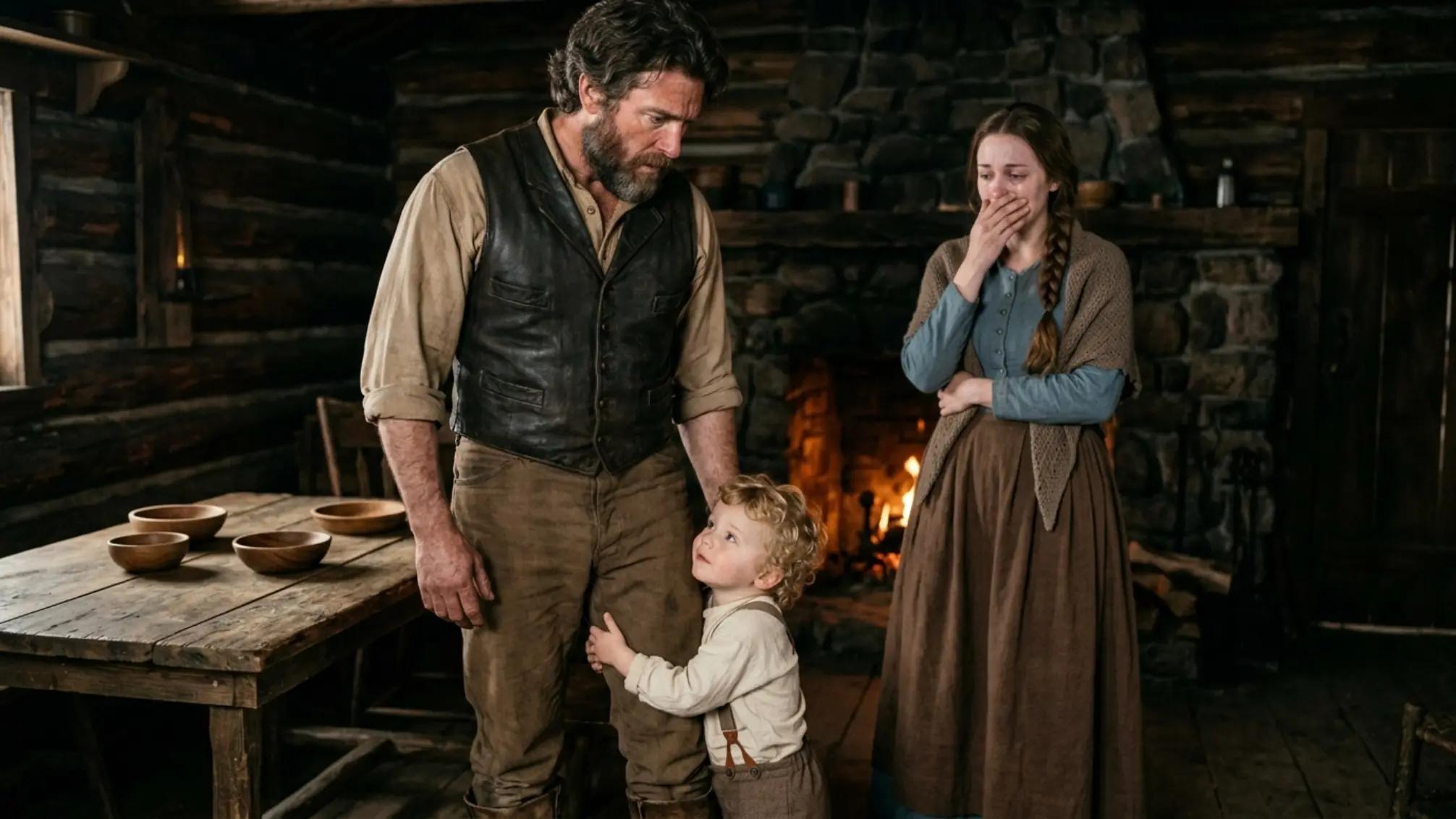
A woman lay beyond it.
Her body was wrapped in filthy quilts beside the wreckage of a small wagon, one ankle swollen beneath the torn hem of her dress. Against her chest rested an infant so still that Amos first believed the child was already dead.
He climbed down without calling out. The sky behind him had turned the dark gray of iron, and wind dragged loose snow across the plain in thin white sheets. His two draft horses shifted nervously as he crossed the frozen ground.
The woman opened her eyes when his shadow fell over her.
“Water,” she whispered.
Amos removed a canteen from his coat but did not place it directly into her hands. A starving person could drink too quickly and make herself sicker. He knelt, supported her head, and allowed only a few small sips between pauses.
She tried to lift the baby.
“My son.”
Amos touched two fingers to the infant’s throat. The pulse was weak but present. The child’s lips carried a faint blue color, and his breathing came in shallow, uneven movements.
“How long have you been here?” Amos asked.
The woman’s cracked lips trembled. “Three days. Maybe four.”
“Where is your wagon train?”
She looked toward the empty western trail.
“They left.”
The answer was too simple to describe what had happened, but the approaching storm allowed no time for a full explanation. Amos studied her swollen ankle, the broken wheel, and the abandoned crates scattered nearby.
“Can you walk?”
“No.”
The first flakes began to fall.
Amos had spent twelve years living alone in the mountains because solitude asked fewer questions than people. He carried only enough supplies for himself. His wagon held pelts, tools, flour, salt, and winter medicine, all calculated carefully for the long journey home.
A wounded woman and a starving infant would slow him.
The high pass might close before he reached his cabin.
He looked toward the road, then back at the child.
Leaving them would be easier.
It would also mean remembering their bodies every time snow covered the ground.
Amos bent down and slid one arm beneath the woman’s knees.
“What are you doing?” she asked.
“Taking you with me.”
“I’m too heavy.”
He lifted her.
She was a large woman, weakened by hunger but still heavier than anyone he had carried. Amos adjusted his grip and stood without mocking her, groaning, or hesitating.
“My horses can pull two tons,” he said. “You are not the problem.”
He placed her inside the freight wagon among the softest animal pelts and returned for the infant. The woman tried to sit up, panic widening her tired blue-gray eyes.
“Do not take him from me.”
“I’m putting him beside you.”
Amos laid the child against her chest and arranged thick furs around them. He collected the blankets, one cooking pot, and what little food the travelers had left behind.
There was no sign that anyone planned to return.
“What is your name?” he asked.
“Monica Nelson.”
“The boy?”
“Samuel.”
“Keep Samuel covered. If he stops breathing, strike the bottom of his foot and call me.”
Monica stared at the hard-faced stranger standing over her. He was forty-two, tall and powerfully built, with weathered skin, deep-set gray eyes, thick dark hair, and a full beard carrying flecks of snow. His faded tan shirt and leather vest made him look more like part of the wilderness than someone who might offer kindness.
“Who are you?” she asked.
“Amos Calder.”
Then he closed the wagon cover and drove directly into the storm.
By nightfall, the snow had swallowed the trail.
Amos guided the horses toward a shallow ravine that offered protection from the wind. He positioned the wagon beside a bank, built a small hidden fire, and melted snow inside a blackened pot.
Samuel had begun crying.
The sound was weak, but Amos considered it better than silence.
Monica sat among the pelts with the child pressed against her body. Her cheeks had regained a little color, though her ankle throbbed badly enough to make her shake.
“I have no milk left,” she whispered. “Not enough.”
Amos opened a tin containing powdered goat’s milk purchased at the last trading post. He warmed a small amount with water, soaked a clean strip of cloth, and allowed one drop at a time to fall between Samuel’s lips.
The baby swallowed.
Again.
Amos continued patiently until the child’s breathing steadied.
“Where did you learn that?” Monica asked.
“My sister had twins.”
“Where are they?”
“Gone.”
His tone ended the question.
Amos prepared venison stew and handed Monica a wooden bowl. She raised the spoon too quickly, driven by hunger, but he caught her wrist before she could swallow a large mouthful.
“Slow.”
“I haven’t eaten since—”
“I know. Eat slowly or you’ll lose it.”
Monica’s eyes filled with humiliation. “I’m a burden to you.”
Amos released her wrist.
“My horses can pull two tons,” he repeated. “You are not a burden, and I don’t leave people in the dirt.”
She ate one careful spoonful at a time.
Afterward, Amos wrapped her injured ankle with clean cloth and thin pieces of wood. He told her it did not appear broken, but the joint had been badly twisted. She would not walk properly for weeks.
“Why did they leave you?” he asked.
Monica looked down at Samuel.
“The animals were weakening. Our wagon wheel split, and the train leader said stopping for repairs would trap everyone before the storm.”
“They could have moved you into another wagon.”
“They said the wagons were already too heavy.”
Amos’s jaw tightened.
“My husband agreed with them.”
The fire cracked between them.
Monica explained that her husband, Warren Nelson, had grown impatient with her after Samuel’s birth. She had recovered slowly and could no longer walk beside the wagon for ten hours each day. Warren complained that she ate too much, moved too slowly, and needed too many stops for the baby.
When the wheel broke, the travelers voted to reduce the load.
“They took my older daughter,” Monica said. “Grace is seven. Warren told her I would follow after the wheel was fixed.”
“Did you believe him?”
“No.”
“Did Grace?”
Monica covered her mouth to hold back a sob.
“She screamed when they put her in the other wagon. Warren pulled her away from me. He promised he would send help from the next settlement.”
Amos stared into the fire.
“He left you no horse?”
“No.”
“Food?”
“A little flour. One canteen.”
“In winter.”
Monica nodded.
“He expected you to die.”
The words were cruel, but she needed someone to say them plainly. Her husband had not made a desperate decision to save the wagon train. He had chosen which members of his family he considered worth carrying.
Monica had always been large. Warren once praised her strength when she worked beside him, carried supplies, and cooked for hired men. After Samuel’s birth, the same body became proof of laziness in his eyes.
Amos added another branch to the fire.
“If the trail remains open, we may catch them.”
Hope rose in her face so quickly that he regretted speaking.
“Grace?”
“Perhaps.”
The storm answered for him.
Wind struck the wagon cover with enough force to bend its wooden supports. Snow thickened until the horses disappeared beyond the nearest tree.
They would not catch anyone that night.
For three days, Amos drove north and west through the blizzard.
He stopped often to check Samuel, warm Monica’s hands, and rest the horses. The trail vanished beneath drifts, forcing him to navigate by ridgelines and clusters of pine visible through the storm.
Monica refused to remain useless.
She sorted the wagon supplies, repaired a tear in the canvas, and held the lantern while Amos dug the wheels free whenever the wagon sank. Despite her injured ankle, she kept the fire alive at night and learned how much milk Samuel could tolerate without becoming sick.
On the third afternoon, they reached the first mountain trail.
The path climbed beside a ravine so deep that clouds of snow concealed the bottom. Amos walked beside the horses, guiding them around patches of ice while Monica remained inside with Samuel.
A sudden crack sounded beneath the left rear wheel.
The wagon tilted.
One wheel slid beyond the trail’s edge, pulling the wagon toward the ravine. The horses screamed as the harness tightened.
“Move right!” Amos shouted.
Monica looked through the opening and saw empty white space beneath the wheel. The wagon leaned farther, throwing crates and pelts toward the cliff side.
Her ankle could barely support her.
She moved anyway.
Monica pushed Samuel into a deep nest of furs on the safer side, then crawled across the tilted floor. She threw her full body over the opposite axle and gripped the wagon frame.
The shift in weight stopped the fall.
Amos drove a wooden block beneath the slipping wheel while the horses strained forward. For several terrible seconds, the wagon remained balanced between the trail and open air.
Then the wheel rose.
The horses dragged the wagon back onto solid ground.
Amos secured it before opening the canvas. Monica lay against the axle, breathing hard, one hand pressed to her injured ankle.
“You saved the rig,” he said.
“I’m heavy.”
The old shame returned to her voice.
Amos looked at the wheel she had kept from falling.
“Heavy enough.”
The answer carried no insult.
For the first time in years, Monica heard her size described as strength rather than failure.
Amos’s cabin stood another day’s journey into the mountains.
It was a broad structure built from dark logs beneath a steep roof designed to carry snow. A stone chimney rose from one side, and a barn stood behind it beside a fenced enclosure.
Monica expected a filthy one-room shelter.
Instead, she found a solid home that felt empty rather than neglected.
Amos carried her inside and placed her near the hearth. He brought Samuel next, then returned for every supply before the storm buried the wagon completely.
The cabin contained one large main room, a loft, a pantry, and a small sleeping chamber Amos had not used in years. He gave the chamber to Monica and placed Samuel inside a wooden box padded with blankets until he could build a proper cradle.
“I can sleep near the fire,” Monica protested.
“No.”
“This is your room.”
“It was my sister’s.”
The same sister whose twins he had mentioned.
Monica did not ask what happened.
Winter trapped them before the week ended.
Snow sealed the pass, blocked the lower trail, and rose nearly to the cabin windows. Amos said they would not see another traveler until spring.
Monica tried to apologize.
Amos handed her a basket of torn clothing.
“If you want to be useful, mend those.”
She looked at him. “That was almost kind.”
“It was not intended to be.”
But he turned away before she saw the faint movement beneath his beard.
Life settled into a quiet rhythm.
Amos hunted, cut wood, and cared for the horses. Monica managed the fire, cooked meals, preserved meat, and repaired clothing. Her ankle healed slowly, first allowing her to stand, then cross the room, and finally walk outside with a wooden staff Amos carved for her.
Samuel changed fastest.
Color returned to his cheeks. His cries grew louder. By the end of the first month, he laughed whenever Amos shook snow from his beard.
Amos pretended not to notice.
He built the cradle from pine and placed it beside Monica’s bed. Then he carved small wooden animals and claimed they were merely scraps left from other work.
Monica tied them above the cradle.
Samuel watched them turn in the warm air from the fire.
One evening, Monica found Amos holding the baby near the window.
Samuel’s hand rested inside his enormous palm.
“You said you wanted no responsibility,” Monica said.
“I said nothing of the kind.”
“You said it with your face every day during the first week.”
“My face looks that way naturally.”
Samuel pulled Amos’s beard.
Monica laughed.
Amos looked toward her, and something unfamiliar passed between them—something softer than gratitude but more dangerous than friendship.
He placed Samuel carefully in the cradle.
“You should rest.”
“So should you.”
“I am not injured.”
“No. You are merely stubborn.”
Amos returned to the hearth, but she saw him smile.
The months passed.
Monica learned that Amos had once lived in the cabin with his younger sister, Rachel. Her husband died in a mine collapse, and Amos brought her and her newborn twins into the mountains.
A winter fever took all three.
Amos buried them beneath a pine tree beyond the barn and stopped setting more than one bowl on the table.
Until Monica came.
By January, three bowls appeared at every meal without discussion.
One belonged to Amos.
One belonged to Monica.
The smallest held mashed vegetables or warm milk for Samuel.
Monica noticed but said nothing.
She also discovered that Amos spoke to the child when he believed no one could hear.
He explained animal tracks, weather signs, tools, and the proper way to stack firewood. Samuel understood none of it, but he listened with complete seriousness.
“You’ll need to learn this,” Amos told him one morning. “Your mother cannot be expected to repair everything you break.”
Monica stood in the doorway.
“Our son seems troublesome already.”
Amos froze at the word our.
She had not meant to say it.
Neither corrected her.
When February brought clearer weather, Amos made the dangerous trip to a trading post below the ridge. He returned with flour, medicine, fabric, and news.
The wagon train had passed through two settlements before disappearing toward Oregon. A traveler remembered seeing a man named Warren Nelson with a seven-year-old girl, but no one knew their final destination.
Monica sat beside the hearth with the information folded in her hands.
“Grace is alive.”
“She was when they reached the settlement.”
“I have to find her.”
“When the pass opens, we will.”
She looked up. “We?”
Amos busied himself removing snow from his coat.
“You cannot travel alone with Samuel.”
“I thought you wanted to sell your pelts and return to the mountains.”
“I can sell them farther west.”
“You hate settlements.”
“I tolerate them when necessary.”
Monica understood what he refused to say.
He would leave the only place he felt safe to help her search for a child he had never met.
“Why?” she asked.
Amos looked toward Samuel sleeping beside the fire.
“Because no child should believe her mother stopped looking.”
Spring arrived in fragments.
First came dripping ice beneath the roof. Then patches of dark soil appeared around the cabin. The trail remained blocked, but Amos began repairing the freight wagon for the journey west.
Monica should have felt only relief.
Instead, every repaired wheel sounded like a countdown to departure.
One evening, Amos entered carrying a bundle of his best pelts.
“The pass may open within two weeks,” he said. “These will pay for passage to Oregon if we find a wagon train.”
Monica stared at him.
“You are sending us away.”
“I am helping you reach Grace.”
“That is not what I asked.”
Amos lowered the pelts. “What did you ask?”
“My husband left me to die. Those people are not my family.”
“Grace is.”
“Yes.”
“Then we find her.”
“And after that?”
Amos’s face closed.
“The cabin is here.”
“For you.”
“There is room.”
“Is that an invitation or another practical arrangement?”
He looked toward the floor.
Monica’s chest tightened.
“Do you want us to leave?”
Amos could face wolves, blizzards, and unstable mountain trails without hesitation. Yet the woman’s question left him unable to speak.
Before he found an answer, Samuel crawled across the floor.
The boy had grown into a healthy curly-haired toddler with bright eyes and a determined way of moving. He reached Amos, grabbed the worn leather of his boot, and pulled himself upright.
Amos looked down.
Samuel wrapped both arms around his leg.
“Papa.”
The cabin became completely still.
Monica covered her mouth as tears rose to her eyes.
Amos’s hand hovered above the child’s golden curls, afraid to touch him, afraid not to.
“Hi there,” he whispered, his voice breaking. “What did you just call me, little man?”
Samuel pressed his cheek against Amos’s leg.
“Papa.”
Monica wiped at her tears. “He only says that when he knows where home is.”
Amos lifted his eyes to her.
For months, he had believed love was a danger waiting to repeat old grief. He had told himself that helping Monica reach Oregon would be an act of kindness. In truth, he had been preparing to remove them before they could choose to leave him.
He bent and lifted Samuel into his arms.
The boy settled against his chest as though the place had always belonged to him.
“Then neither of you is leaving this cabin without me,” Amos said.
Monica’s breath trembled. “What does that mean?”
“It means we find Grace together.”
“And afterward?”
Amos crossed the room with Samuel in his arms.
“If you will have me, we come home together.”
Monica stared at the man who had carried her from the frozen ground, fed her child one drop at a time, and rebuilt his silent life around their presence without admitting what he was doing.
“You do not have to marry me because Samuel called you Papa.”
“I know.”
“You do not owe me a home.”
“I know.”
“Then why?”
Amos looked at her with the same direct honesty he had shown beside the broken wagon.
“Because when I picture this cabin empty again, it no longer feels peaceful. It feels wrong.”
He swallowed.
“Because I love that boy. And because I began loving his mother somewhere between the ravine and the first time she told me my stew tasted like boiled leather.”
“It did.”
“I know.”
Monica laughed through her tears.
Amos shifted Samuel to one arm and extended his free hand.
“I cannot promise I will become skilled with words.”
“That would require a miracle greater than surviving the prairie.”
“But I can promise that no one will ever vote either of you out of my wagon, my cabin, or my life.”
Monica placed her hand in his.
“Then take us west.”
The pass opened eleven days later.
They traveled toward Oregon in Amos’s repaired freight wagon, following every rumor of Warren Nelson and Grace. At settlements, Amos showed travelers a written description while Monica asked ministers, innkeepers, and wagon masters whether they remembered a frightened brown-haired girl.
After six weeks, they found Warren near Fort Boise.
He had joined another wagon company and planned to continue west without telling Grace that Monica might have survived. When Monica approached his camp carrying Samuel, Grace recognized her first.
The child ran so quickly that she lost one shoe in the mud.
“Mama!”
Monica dropped to her knees and wrapped both arms around her daughter. Grace sobbed against her shoulder, asking why she had not followed and why her father said the snow had taken her.
“I tried,” Monica whispered. “I never stopped trying.”
Warren walked toward them, his face pale.
“You survived.”
Amos stepped between him and the children.
“She did.”
Warren claimed he had made the only decision that could save Grace. He said the wagon train would have abandoned all of them if he refused to leave Monica behind.
Monica rose slowly.
“You promised to send help.”
“There was no help to send.”
“You never tried.”
Warren looked toward Amos. “And now you belong to him?”
“I belong to no man.”
She took Grace’s hand.
“But Amos belongs with us because he stayed when leaving would have been easier.”
Several members of the wagon company had gathered nearby. They had heard fragments of Warren’s story but not the truth.
Grace refused to release her mother.
When Warren tried to order the girl back to his wagon, she hid behind Amos. The mountain man did not threaten him. He merely stood where Warren could not reach her.
A local magistrate listened to the witnesses.
Warren admitted leaving Monica without transportation, food, or shelter. Grace described being pulled from her mother and told she was dead before anyone could have known that.
The magistrate allowed Grace to remain with Monica while Warren’s abandonment was reviewed.
Warren left before the decision became permanent.
He did not say goodbye.
Monica watched his wagon disappear and felt no desire to call him back.
Their return to the mountain cabin took another month.
Grace remained suspicious of Amos at first. She had learned that men made promises shortly before disappearing. Amos did not ask her to trust him.
He gave her space in the wagon, answered every question honestly, and never demanded that she call him anything except Amos.
On the final day of the journey, Grace sat beside him as he guided the horses up the mountain trail.
“Samuel calls you Papa,” she said.
“Yes.”
“Do I have to?”
“No.”
“What should I call you?”
“Whatever feels true.”
She considered that answer.
When the cabin appeared between the pines, Grace leaned against his arm.
“Home,” she whispered.
Amos looked toward Monica sitting behind them with Samuel asleep in her lap.
“Yes.”
They married beside the cabin in early summer.
There was no large ceremony. A traveling preacher read the vows, Grace held wildflowers, and Samuel interrupted twice by trying to follow a squirrel.
Amos added two rooms to the cabin.
One belonged to Grace.
The other remained ready for whatever life might bring.
Years later, travelers passing through the mountains heard the story of the solitary frontiersman who found a woman and baby abandoned beside a broken wagon. People said Amos Calder had rescued them from certain death.
Monica always corrected that version.
“He carried us out of the snow,” she said. “But we carried him out of something colder.”
Amos never argued.
Every evening, he set four bowls on the table.
And whenever Samuel climbed onto his lap and called him Papa, Amos answered as though hearing the word for the very first time.
“Hi there, little man.”