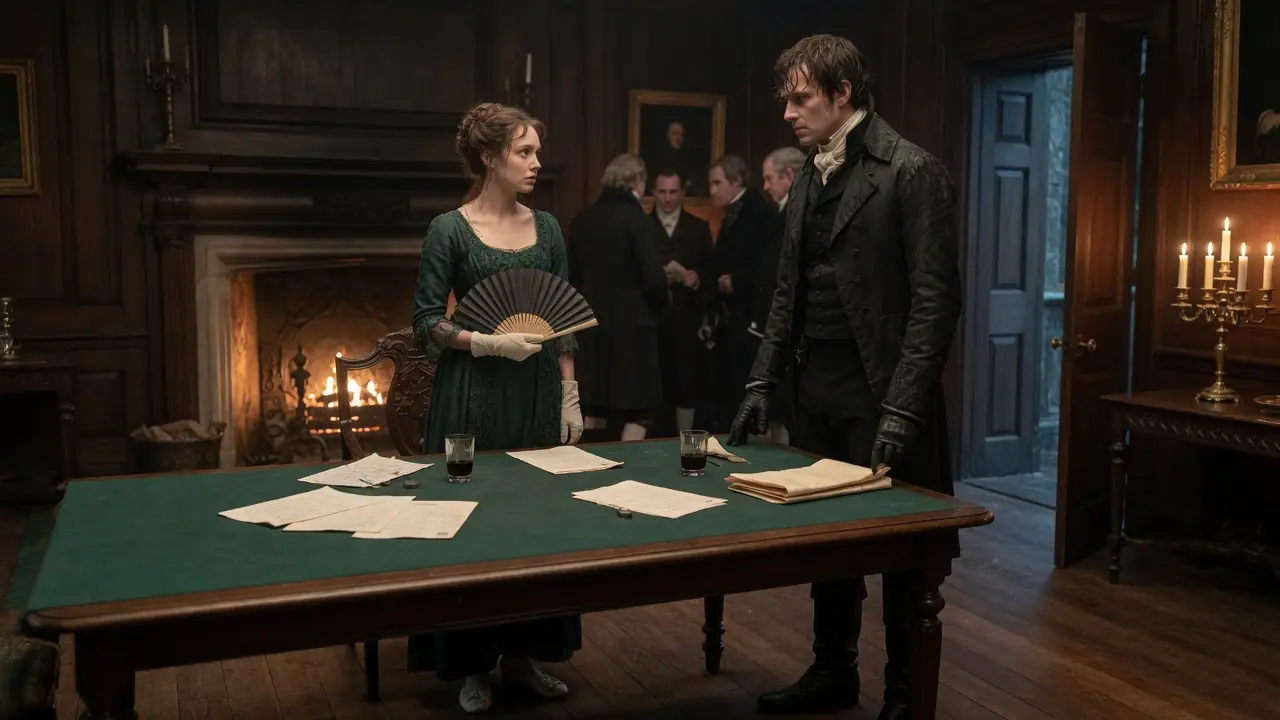
“You are not for sale.”
The words crossed the drawing room of Hartley Court like a blade drawn in a quiet church, low and cold and perfectly clear over the hiss of the fire.
And every head turned toward the doorway where the stranger stood.
The room smelled of beeswax and spilled port and the smoke of a chimney that drew badly.
Eleanor Hartley had been counting the candles on the mantel to keep from looking at the men around the table.
There were nine, their flames leaning all one way in the draft from the open door.
And she had begun a tenth count when the voice cut the warm, close air.
Now she forgot the candles entirely.
She forgot the contract spread across the green baize.
She forgot, for one suspended breath, the cold weight of her father’s silence beside her.
The man in the doorway was tall, broad through the shoulders in a way his dark traveling coat did nothing to hide.
And he had spoken without raising his voice at all.
He did not need to.
The room had gone still the moment he entered, the way a field goes still before weather.
Garrick Vance set down his glass.
He took his time about it, as a man does who is accustomed to being the most dangerous person in any room and has just discovered, with interest rather than fear, that he might not be.
“This is a private matter,” Vance said.
He was a handsome man.
Eleanor had always thought so, in the way one thinks a closed razor handsome.
Fair-haired, smooth-jawed, perhaps two and thirty, dressed at the very forward edge of fashion.
“You’ll forgive me, sir, but I don’t believe you were invited.”
“No,” the stranger agreed. “I was not.”
He came into the room.
He moved without hurry, and the firelight found him as he passed it.
A face younger than his bearing suggested, no more than seven and twenty, with a hard, clean line to the jaw, and gray eyes that took in the table, the contract, the men, her father, and finally her.
When his gaze reached Eleanor, it stopped.
Something moved behind it, quick and contained, and was put away.
“My name is Gabriel Thorne,” he said. “I’m the Duke of Wexton, and I’ve come a long way to put an end to what is happening in this room.”
Eleanor’s father made a sound that was not quite a word.
She looked at Sir Edward then, at the man who had given her her gray eyes and her stubborn chin, and three weeks ago, her ruin.
He had aged a decade in a season.
His coat hung off him.
His hands, which had once dealt cards with the careless confidence of a man who believed the world owed him a good evening, lay open and empty on the baize, beside the contract that would have sold his daughter to settle his debts.
He would not look at her.
He had not looked at her properly in days.
“Your Grace,” Vance recovered first. He always did. “You honor us, but there is nothing here to end. A debt is owed. A settlement has been proposed. Sir Edward and I have come to terms that satisfy us both, and Miss Hartley.”
He turned his smile on Eleanor.
It was the smile that frightened her more than anything else in the room, because it was warm.
“Miss Hartley will want for nothing the rest of her life. I assure you, my intentions are entirely honorable.”
“Your intentions,” the Duke said, “are written on that table. I read them on my way in.”
He crossed to the baize.
He picked up the contract, the marriage articles, the schedule of debts, and the figure at the bottom that had made Eleanor’s stomach drop when she first saw it that morning.
And he read it through while no one breathed.
Then he folded it once, deliberately, and set it down again.
“Thirty thousand pounds,” he said. “That is the sum of Sir Edward’s obligations to you, Mr. Vance. Principal and the interest you have been compounding so creatively since spring.”
He drew a folded paper from inside his coat.
“I hold the rest of his notes besides. The merchants, the tailor, the wine, the two thousand at the tables in Bath that you so kindly arranged he should lose. Near ten thousand more, all told. I bought them last month. Every one. He owes me now, not you. And what he owes me is not a daughter.”
The silence after that had a texture.
Eleanor could feel it on her skin, like the moment before a storm breaks.
“You bought his debts,” Vance said slowly.
“I did.”
“Why?”
And there it was, the question Eleanor herself wanted to ask, the question that had been forming in her since the words, “She is not for sale,” crossed the room.
Why?
She had never seen this man before in her life. She was certain of it.
One did not forget a face like that, a presence like that.
And yet, he had crossed half of England, by his own account, to stand in her father’s drawing room and undo the worst day of her life.
And he had looked at her as though he knew her.
The Duke did not answer Vance’s question.
He looked at Eleanor instead.
“Miss Hartley,” he said, and his voice changed, lost its courtroom edge, dropped to something she would think about for a long time afterward.
“I’m going to ask you to come away from this house tonight with your father, to a place where Mr. Vance cannot reach you. You owe me nothing for it. You will owe me nothing ever. But I cannot make you go, and I will not pretend the choice is anything but yours.”
“Will you come?”
Eleanor Hartley had spent three weeks learning that she had no choices left.
Her father had gambled them away one by one.
Her dowry, the unentailed land, the house in town, and finally, when there was nothing else, her.
She had wept exactly once in the dark, and then she had stopped because tears were a luxury for women with options, and she had run out of those.
So she was unprepared for the thing the Duke had just handed her.
A choice.
A real one, held out plainly with no figure written at the bottom.
She looked at Vance’s warm and terrible smile.
She looked at her father’s bowed gray head.
She looked at the stranger who knew her name and her ruin, and somehow, her.
“Yes,” she said. “I’ll come.”
It was forty miles from Hartley Court to Wexmore, and they made it in a night and half a day.
The Duke’s carriage exchanged tired horses for fresh at posting inns where the ostlers seemed to know him and to be afraid of his name, and glad of it at once.
Eleanor did not sleep.
She sat with her back very straight and her hands folded over the small bundle that held everything she had thought worth taking from the house she would never see again.
Her mother’s prayer book, a green ribbon, two changes of linen, and a chipped enamel cup, blue as a robin’s egg, that she could not have explained keeping if anyone had asked.
Across from her, her father slept the deep, ugly sleep of a man who had not slept in weeks.
The Duke rode alongside on a gray hunter rather than share the carriage, which she understood to be a courtesy and was grateful for.
Wexmore rose out of the autumn dawn like something half-dreamed.
It was older than Hartley Court and far larger.
Gray stone gone gold where the early sun struck it.
Its long windows caught fire one by one as the carriage came up the avenue between bare lime trees.
Frost lay white in the hollows of the park.
Somewhere, a single bell was ringing for a service, and the smell of wood smoke and turned earth and cold came in through the carriage window.
And Eleanor, who had braced herself for everything except beauty, felt her throat tighten unexpectedly.
A woman was waiting at the top of the steps, small, upright, gray-haired under a snowy cap, her hands folded at her waist in the particular way of a housekeeper who has run a great house through three generations and intends to run it through three more.
“Your Grace,” the woman said as the Duke dismounted.
And then, with a glance at Eleanor that took her in entirely, the travel-creased gown, the small bundle, the white face, she said, “The blue room is aired, if it suits, and there’s a fire and broth in the small parlor. If I may say so, the young lady looks perished.”
“You may say so, Mrs. Pruitt,” the Duke said. “You generally do.”
It was not a joke precisely, but there was the faintest dryness under it.
And Mrs. Pruitt’s mouth twitched.
Eleanor, exhausted, frightened, and forty miles from the only life she had known, found herself filing it away.
She had a habit when she was afraid of cataloging things.
It was how she had survived the last three weeks.
By noticing.
By counting.
By making the chaos hold still long enough to be looked at.
The candles on the mantel.
The nine men at the table.
And now, a Duke who paid forty thousand pounds and asked nothing, and made the smallest of jokes to his housekeeper, and would not look at her too long.
She would solve him, she decided.
It was the only thing she knew how to do with a thing that frightened her.
The blue room was the most comfortable room Eleanor had ever slept in.
And she hated it for three days.
It was a soft, cold blue, the color of a thrush’s egg, with heavy curtains the weight of wet wool and a fire that some unseen hand built up before she woke each morning.
So that she opened her eyes to warmth and the small companionable crackle of apple wood, and the faint sweetness of its smoke.
The sheets smelled of lavender and cold linen.
There was a basin of warm water set out at dawn.
A dish of hot house pears, the like of which she had not tasted since her mother’s day.
Their skin gold and bruised soft under her thumb.
And beyond the frosted glass, the great silver reaches of the park ran down to a frozen lake that caught the early light like a coin.
Everything in it was kind.
Everything in it whispered that she was safe and well and wanted.
And she lay rigid under the warm weight of the blankets, listening to the strange house tick and settle, and could not for the life of her believe a single word of it.
She hated it because she did not understand it.
A kept woman understood her room.
It was payment, and payment had a shape she knew.
But she was not kept.
The Duke made that plain by his absence.
He did not come to her, did not summon her, did not so much as send word beyond Mrs. Pruitt’s brisk reports that His Grace hoped she was comfortable, and would she care for the library to be opened to her.
Her father was given a room in the East Wing.
A physician was brought in, and Mrs. Pruitt confided, lips thinning, that there was a stern instruction that there were to be no cards in the house.
Sir Edward kept to his room and his shame.
He had still not spoken to Eleanor of what he had done.
So, on the fourth morning, having slept and eaten and stopped shaking, Eleanor went looking for the Duke of Wexmore to demand an accounting.
She found him before she meant to.
The house was enormous and largely silent, and she had taken a wrong turning out of the long gallery, and come into a wing where the dust sheets still lay over half the furniture, and the air smelled of cold and disuse.
And there, at the end of it, was an open door, and a man at a writing desk with the gray morning behind him, alone.
He had not heard her.
For a moment, Eleanor simply stood, because she was a cataloger, and here was the Duke unguarded, and she could not help reading him.
He was not working.
There was a letter open on the desk that he was not reading, his hand flat upon it, and his gaze fixed on the window and the bare park beyond.
And the line of him, the broad shoulders she had noticed in the doorway at Hartley Court, was bowed in a way she would not have thought that man’s shoulders could bow.
The room around him was the room of someone who lived in a great house alone.
One chair drawn to the fire.
One glass.
And on the desk, beside the unread letter, where a man might keep an inkwell or a paperweight, was a small chipped cup of blue enamel.
And Eleanor’s heart did something strange and arrhythmic.
It could not be the same cup.
Hers was upstairs in her bundle in the blue room.
And yet, the color was exact.
Robin’s egg blue.
And the chip was in the same place, at the lip, where a careless thumb might worry it.
And she had the sudden vertiginous sense of having walked into a room in her own past without knowing the way back out.
“You found the part of the house I don’t let anyone see,” the Duke said without turning. “Which means you went looking, Miss Hartley, and took three wrong turnings to do it. Mrs. Pruitt would have brought you anywhere you asked.”
“I didn’t want to ask Mrs. Pruitt,” Eleanor said, stepping into the room. “I wanted to ask you. And I find I have a great many questions, Your Grace. You have been remarkably difficult to find for a man in his own house.”
He turned then.
The bowed line of him was gone, put away as the thing behind his eyes had been put away at Hartley Court.
And what faced her was the controlled man from the drawing room.
But he had not been quick enough.
She had seen the other thing, and she could not unsee it.
“Ask,” he said.
“Why did you buy my father’s debts?”
“Because Vance was using them to take you, and I would not allow it.”
“That is not an answer. That is a chivalry. Men do not cross England and spend forty thousand pounds on a chivalry for a woman they have never met.”
She heard her own voice climbing and brought it down, because a climbing voice was a losing voice.
“You looked at me, Your Grace, in that room, as though you knew me. You do not. I would remember you.”
She made herself say the next part because it was the fear under all the other fears.
“So I will ask it plainly, and I will thank you to answer me plainly. What do you want from me? Vance at least had the honesty to write his price on the table. What is yours?”
The silence stretched.
“Nothing,” he said at last. “I want nothing from you, Miss Hartley. I am aware that you have no reason on earth to believe me, and I find I cannot prove it to you except by years, which is a poor currency to offer a woman who has spent the last month being bought and sold by the hour. So I will not ask you to believe it. I will only ask you to stay until the spring, until Vance has exhausted his lawyers and there is no door left for him to come through. Then you may go wherever you wish, with money enough to never need a man’s protection again. That is all.”
“And the cup?” Eleanor said.
His stillness changed quality.
“The cup on your desk,” she said. “It is the twin of one I own. To the chip. I’ve carried mine through four houses and a ruin, and I could not tell you why, except that it was the last thing in my mother’s kitchen that was still whole, more or less, when everything else was sold. So I will ask you a second plain question, Your Grace, and I find my heart is beating very hard while I wait for the answer. Where did you get that cup?”
For a long moment, she thought he would not tell her.
Then the Duke of Wexmore crossed to the desk and picked up the small blue cup.
He held it in his broad hand as though it were made of something far more precious than chipped enamel.
“From you,” he said. “Five years ago. Though you would not have known me. I was not a duke yet. And I was not, that winter, anyone you would have looked at twice.”
But he did not tell her the whole of it that morning.
He told her enough to send her back to the blue room with her hands unsteady.
That five winters past, before his elder brother’s death had made him a duke, he had been traveling north on foot, ill and robbed of everything but the clothes he wore.
That he had collapsed at a gate in the dark in a hard frost.
That a young woman had taken him into a warm kitchen against all good sense and fed him broth and tea from a chipped blue cup.
And put her own shawl about his shoulders.
And asked him not one single question.
Not his name.
Nor his business.
Nor what manner of man arrived half-frozen and barely standing at a gentleman’s gate in the small hours.
And that when he woke in the morning, mended enough to walk, she was gone to church.
He had taken the cup and left in its place the only thing of value he had.
A single gold guinea hidden under the saucer.
He had carried the cup ever since, he said, wrapped in a square of flannel in his breast pocket through five winters and a hundred miles of searching.
The chipped blue china and the smell of broth and wood smoke, and the memory of a pair of gray-lit hands folding a shawl, and the face.
Eleanor remembered the guinea.
She remembered finding it under the saucer and being frightened of it because, in their straits, even one gold coin had felt like a thing that would have to be explained.
She remembered the man only as a fever and a pair of gray eyes and a stillness in her kitchen.
And she had told herself afterward that she had dreamed half of it.
She had not dreamed it.
She sat on the edge of the comfortable bed in the blue room with her own chipped cup in her two hands, the twin of his across the silent house.
And she understood that she had been wrong about the shape of the thing she had walked into.
It was not a transaction.
It was a debt.
But it ran the other way.
He believed he owed her.
He had spent five years believing it and forty thousand pounds proving it.
And that was a far stranger and far more dangerous thing than being bought.
Because she did not know what to do with a man who thought himself in her debt.
She decided she would be useful.
It was the only honest coin she had to pay him back with.
And Eleanor Hartley did not care to be in any man’s debt.
Not even a kind one’s.
She began with the household accounts.
It was not difficult to find them.
A house the size of Wexmore generated paper the way a forest generates leaves.
And the steward, Mr. Cole, was an honest, tired man drowning slowly in it.
Eleanor had kept her father’s books since she was sixteen, had kept them better than he had, had watched the columns tip from black to red, and had fought the tide alone for years before it took them under.
And within a week, she had made herself indispensable in the small office off the kitchen.
And within two, she had found the first thing that was wrong.
“This grain account,” she said, laying the ledger before Mr. Cole one gray afternoon. “The Ferncross tenancy. You are charged for seed corn at near double the market rate, and it has been so for three years, and the difference goes to a factor in Leeds I cannot find in any directory. Either your factor is a ghost, Mr. Cole, or someone in this house has been selling your seed corn to himself.”
Mr. Cole went the color of his own paper.
It was the Duke who came to the office that evening, not Mrs. Pruitt.
Not a summons, but the man himself, ducking under the low lintel, filling the small warm room the way he had filled the doorway at Hartley Court.
He had the Ferncross ledger under his arm.
“Cole tells me,” he said, “that you have found a thief in my accounts in a fortnight that he failed to find in three years.”
“Cole was not looking for one. An honest man rarely is. It does not occur to him.”
Eleanor closed the book she was working on.
“It is a particular gift of mine, Your Grace, finding the rot in a column of figures. I had a great deal of practice. I do not recommend the school.”
And the Duke smiled.
It was the first time she had seen it, a real one.
Not the contained line of the drawing room, but a thing that reached his eyes and changed his whole hard face into something younger and warmer, and frankly disarming.
And Eleanor, who had been so careful, felt the smile land somewhere under her ribs and lodge there.
“No,” he said. “I don’t imagine you would. Will you take a glass of wine, Miss Hartley, and tell me precisely how a man steals seed corn for three years? I find I want to know, and Cole is too distracted to explain it without weeping, and I am tired of dining alone with a thief I didn’t know I had.”
“You dine alone a great deal,” Eleanor said before she could stop herself.
“I do,” the Duke agreed.
He set two glasses on the cluttered desk and poured.
“It is one of the privileges of rank. Along with the seed corn, apparently.”
She laughed.
She had not laughed in a month.
And it surprised them both.
After that, there were no more wrong turnings.
The Duke found her in the office the next afternoon, and the one after that.
And by the end of the week, there was a second chair drawn up to Mr. Cole’s cluttered desk that everyone in the house understood to be hers, though no one had been told to put it there.
He gave her the run of the estate’s affairs, slowly, and then all at once, because she was better at them than anyone he employed.
And because, she came to understand this only later, turning it over in the dark, it gave them a reason to be in the same room that neither of them had to say aloud.
They quarreled almost at once, and the quarrels were the best part.
“You cannot give the South tenants a year’s grace on the rent,” the Duke said on a gray morning when the rain came sideways against the office window and the fire smoked.
He had come in with the wool returns and found her already deep in them.
“It will be remembered. A landlord who forgives one bad harvest is asked to forgive the next, and the one after. And inside three years, his rent roll is a charity, and his name is a joke at every market in the riding.”
“A landlord remembered as hard,” Eleanor said, without looking up from the column she was adding, “keeps his tenants exactly as long as it takes them to find a softer one. A landlord remembered as fair keeps them through a bad year, and is repaid in the good ones with loyalty, which does not appear in any ledger, but is the only thing that makes a ledger possible.”
“You are thinking of the rent roll, Your Grace. I’m thinking of the men who fill it. They are not the same account, though they are written on the same page.”
The Duke was quiet a moment.
The rain ticked at the glass.
“You have an opinion on everything,” he observed.
“I have an opinion on everything I have read the figures for. On everything else, I’m as ignorant as the next woman, and I make a point of saying so, which is more than most men of my acquaintance manage.”
She turned the ledger toward him and put her finger on the line.
“There. The South tenancies returned you eleven percent above the estate average for the six years before the harvest failed. They have earned their grace and then some. Give it to them and write it in your own hand, so they know it came from you and not from Cole, and you will have it back threefold the first year the weather turns.”
He looked at her for a long moment over the rain-streaked desk, a look she was beginning to recognize and not yet beginning to understand.
And then he drew the ledger to himself and took up the pen, and wrote the year’s grace into the book in his own hand.
“If I am ruined by Lady Day,” he said, “I shall hold you entirely to blame.”
“If you are ruined by Lady Day, Your Grace, it will be the drainage that does it, not the wool. And I’ve been trying to tell you about the drainage for a fortnight.”
She took the ledger back.
“But one catastrophe at a time. I find it is the only way to enjoy them properly.”
And the Duke laughed.
The real one.
The one that changed his whole hard face.
And Eleanor bent her head to the column again, so that he would not see how the sound of it pleased her.
There was, too, the matter of the dog.
It was an enormous, disgraceful gray wolfhound named Brutus, who belonged to no one and to the whole house at once.
Within a day of Eleanor’s arrival, Brutus had decided that her lap was the warmest seat at Wexmore, and her opinion the only one worth attending in any room.
He followed her from office to library to dinner.
He sat on her feet during the wool quarrels and groaned with enormous theatrical despair whenever the figures went against the South tenants.
He had a particular trick of laying his great gray head on the open ledger at the exact moment a column came out wrong, as if to say that he too found the sum disappointing.
And Eleanor, who had not had a creature of her own to love in years, fell helplessly and entirely under his spell.
“He never once sat on my feet,” the Duke said, watching this with an expression of profound betrayal the second week. “In four years, I fed him through a hard winter from my own plate. He has known you eleven days and he treats me like a footman who has displeased him.”
“He has excellent judgment,” Eleanor said, scratching the great gray ears. “Animals always know. It is one of the few honest things left in the world, a dog’s good opinion. You cannot buy it and you cannot trap it. You can only earn it very slowly by being worth sitting on.”
“I shall take that,” the Duke said, “as instruction.”
There came a night late in that hard November when the weather closed the roads and the house in.
It began as sleet against the windows at dusk, a fine hard rattle like flung gravel, and turned by full dark to a wind that came off the moor smelling of ice and wet heather.
It found every gap in the old stone and made the great rooms of Wexmore groan and shudder like a ship working in a heavy sea.
The servants were sent early to their beds.
Sir Edward had retired with a book and a headache.
And Eleanor, who could not sleep with the house complaining so, came down in her wrapper with a candle to fetch the ledger she had left in the library.
She found the Duke already there in his shirtsleeves before a fire built recklessly high, with Brutus stretched the full length of the hearth rug, a decanter at his elbow, and the look of a man who also could not sleep and had given up pretending he meant to.
She stopped in the doorway.
It was, she was aware, exactly the sort of room a careful woman did not enter.
A Duke in his shirtsleeves alone at midnight, with the wind walling them off from the rest of the world.
She thought of all the reasons to go back up the stairs.
Then the Duke looked up and did not say any of the things a less honest man would have said about the impropriety of it.
He merely moved the decanter and a second glass to the small table between the two chairs.
An invitation made without a single word that could be held against either of them.
And Eleanor found that her feet had decided the matter before her caution could.
“I cannot sleep when the house talks,” she said, sitting.
“Nor I. It has talked for four years and I have never grown used to it.”
He poured for her a small glass, a courtesy, and settled back.
The firelight moved on the planes of his face.
“When I was a boy, this room was always full. My brother’s friends, my mother’s musical evenings, dogs, noise. I used to hide from it. I would give a great deal now to have one such evening back. And instead, I have learned every separate complaint this house makes in the dark. The east gable in a south wind, the long gallery in a north one. It is poor company, a house that talks. But it is the company I have kept.”
It was the most he had ever said of himself unasked.
And Eleanor understood that the dark and the wind and the recklessly high fire had loosened something in him.
And that she should be careful.
And that she did not want to be.
“Tell me about him,” she said. “Your brother.”
So he did.
Haltingly at first, and then not haltingly at all.
A laughing, reckless, generous man, older by six years, who had been everything the second son was not.
And had carried the title like a man wearing a coat cut for someone else.
And had been carried off by a fever after three days’ illness while Gabriel was a hundred miles away.
And arrived too late even for the last of it.
And Eleanor listened.
And did not fill the silences with the things people said.
The “it was God’s will” and the “he is at peace now.”
Because she had buried a mother and knew those words for the cold comfort they were.
She only listened.
And let the fire burn down.
And at some point, her hand and his were both resting on the warm gray flank of the dog between them.
Not quite touching.
Near enough that she could feel the heat of him across the half inch of air.
And neither of them moved away.
And the not moving was louder than any touch could have been.
“You are the first person,” the Duke said at last, very low, “to ask me about him in four years. Everyone else asks how I do, as though I were the estate, and they wished to know whether I was solvent.”
“I find ‘how do you do’ a useless question,” Eleanor said. “It has only one permitted answer, and the answer is always a lie. I would rather ask a true thing and be told to mind my own affairs than ask a polite one and be lied to comfortably. It is a great defect in my character. My mother despaired of it.”
“It is not a defect,” he said. “It is the rarest thing I have met in a drawing room in my life.”
He looked at her then, full.
And the fire was low, and the wind was high, and Eleanor’s heart was doing the strange arrhythmic thing again.
And for one long suspended moment, the half inch of air between their hands seemed the only distance left in the world.
Then Brutus, with the magnificent timing of his kind, rolled over with a groan that displaced both their hands at once and demanded his belly be attended to.
And the moment broke into laughter, and was let go, and was not forgotten by either of them.
Eleanor took her ledger up the stairs that night and did not read a line of it.
Her father grew stronger as the month turned.
He came down to dinner at last, a quieter and smaller man than the one who had dealt cards in Bath.
He and Eleanor circled each other with a careful courtesy that was not forgiveness, but was perhaps the cold ground forgiveness might one day be built on.
The first evening he came down, they were seated alone together, the Duke being away at the far end of the estate over a flooded mill.
And a long table laid for two is a cruel thing for people who do not know what to say to each other.
Sir Edward turned his wine glass by the stem and did not drink it.
Eleanor asked after his health in the voice she would have used to a stranger met on a coach, and he answered in kind.
And the footman came and went, and the silence between the courses grew until it had a shape of its own at the table.
A third guest no one had invited.
“Your mother,” Sir Edward said at last, abruptly, to the candle flame rather than to her. “Used to keep the books. Did you know that? Before you were old enough. She had a hand like a clerk and a head like a banker, and she never let me see how bad it was, not once, because she did not wish to trouble me.”
He turned to the glass.
“I thought, when she was gone and you took it up, that you were only a child playing at her desk. I did not look. It was easier not to look. I have spent my whole life, Eleanor, not looking at the things your mother and then you carried so that I need not. I see that now. I saw it the night that man stood up in my drawing room and named my daughter as a sum I owed.”
It was the nearest he had ever come to speaking of it.
Eleanor found she could not answer him.
Her throat had closed.
She looked at her plate.
“I do not ask you to say anything,” her father said more gently. “I have not earned a word. I only wished you to know that I know what you carried, and from how young. And that I never once thanked the two women who carried it. Eat your dinner, child. You have grown thin. And this is a duke’s table, and it would be a sin to waste it.”
And he picked up his own fork at last and ate.
And Eleanor ate, too.
And it was not forgiveness.
But they finished the meal in a silence that had softened by the end of it into something a person could sit inside without flinching.
After that, he came down most evenings.
He watched her with the Duke.
She caught him at it once or twice, Sir Edward’s eyes going from his daughter to the Duke and back, troubled, as though he were doing a sum and did not like the answer.
The cup stayed on the Duke’s desk.
Hers stayed in the blue room.
Neither of them moved it, and neither of them spoke of it.
And it sat between them in every room they shared like a question that had been asked and not yet answered.
The first frost gave way to a hard, bright November.
There was ice on the inside of the windows in the morning, and the fires were kept blazing.
And Wexmore, which had felt like a beautiful tomb when Eleanor arrived, began quietly, against all her intentions, to feel like something else.
Then Vance’s letter came.
It came on a Tuesday, in a packet of estate correspondence, and Eleanor, who opened all the estate correspondence now, opened it before she saw the hand and went cold to the bone.
It was not addressed to the Duke.
It was addressed to her.
“Miss Hartley,
I trust you are comfortable. A great house is a pleasant cage, and His Grace is, I am told, a generous jailer.
But I wonder if he has told you the whole of how you came to be in it.
Ask the Duke about the night your father lost the last two thousand at Bath.
Ask him whose man sat across the table dealing the cards.
Ask him why a stranger should have spent five years and a fortune arranging the ruin of a family, only to ride to its rescue at the final hour, like a player who has stacked a deck and then offers so graciously to deal you a better hand.
You are a clever girl, they say.
Be clever now.
Yours, in patience,
G. Vance.”
Eleanor read it three times.
Then she sat very still in the small office with the fire ticking beside her.
She felt the careful structure she had built over the last weeks, the trust, the arguing about wool, the smile that had lodged under her ribs.
She felt it shudder on its foundations.
It was a lie.
Surely it was a lie.
Vance was a liar by trade.
He dealt in them as he dealt in debts, and yet, a player who has stacked a deck.
She thought of the Duke’s words at Hartley Court.
“The two thousand at the tables in Bath that you so kindly arranged he should lose.”
And she thought, for the first time, to wonder how the Duke of Wexmore had come to know, in such precise detail, the architecture of her father’s ruin.
One did not buy a man’s debts without studying them.
But to know which night, which table, whose hand on the cards.
She went to find the Duke.
Not in the office, not in the library.
She found him at last in the disused wing, at the desk by the cold window, the blue cup at his elbow.
And she put Vance’s letter down on the desk between them without a word.
He read it.
She watched his face and learned nothing.
He had put everything away.
“Is it true?” she asked.
“Which part?”
“Any of it. All of it. Did you know my father before that night in his drawing room? Did your man sit at that table in Bath?”
Her voice was steady.
She had made it steady.
It cost her.
“Did you arrange any part of the ruin you rode in to mend?”
The Duke was quiet for a long moment.
Then he said, “Sit down, Eleanor.”
It was the first time he had used her name.
She did not sit.
“I will stand,” she said. “Tell me.”
So he told her the rest of it.
The part he had held back.
The dark half of the tender thing.
The man who had robbed him five winters past, who had left him to die at her gate in the frost, had not been a common footpad.
It had been Vance.
They had known each other once, Vance and the young man who was not yet a duke.
They had been at the tables together in the reckless years.
And Vance had taken everything Gabriel Thorne owned in a single rigged night.
And then, when Thorne accused him of cheating, had arranged to have him beaten on a dark road and left to freeze, so that the accusation would die in a ditch with the man who made it.
Eleanor’s kitchen had saved his life.
He had never forgotten either face.
The woman who saved him, or the man who had tried to end him.
When his brother’s death made him a duke and gave him the fortune and the power to act, he had set himself to two things.
To find the woman with the blue cup.
And to ruin the man who had ruined him.
The first had taken years.
The name of a gentleman’s family in the north, half remembered through fever, was a thin thread to follow.
And in following it, he had discovered the second thing.
The thing that had turned his stomach.
That Vance had found Eleanor’s family first.
That Vance, hunting fresh prey among the gentry’s weak and gambling men, had got his hooks into Sir Edward Hartley eighteen months past, and had been bleeding him white ever since.
The same Vance.
The same method.
The same patient stacking of a deck.
The man who had nearly murdered Gabriel Thorne was, by coincidence so cruel it felt like design, methodically destroying the family of the woman who had saved him.
“I did not arrange your father’s ruin,” the Duke said. “I swear it to you on the only thing I have that is worth swearing on, which is that cup. But I knew of it. I knew Vance had him above a year ago. And I knew where it would end, because I know how Vance finishes a man. He takes the money first. And then he takes whatever is left that the man loves. And a daughter of marriageable beauty is the most valuable thing a ruined gentleman owns.”
His jaw worked.
The firelight caught the hard line of it and showed her for a moment how much the plain telling cost him.
“I should have come sooner. I’ve asked myself a hundred times why I waited. Why I bought the debts quietly over a year, note by note, building my case against him in the law courts instead of riding to your door the day I learned your name. And the answer is not one I am proud of.”
“I waited because I was building a trap for Vance that the law could not break. And you, forgive me, you were the bait in it that I told myself I would pull from the fire in time. I did pull you from the fire, but not before you nearly burned. And Vance is not wrong about that part, Eleanor. He is a liar in every particular but one. I knew, and I let it run. And you paid for the year I spent being careful.”
The fire ticked.
Outside the cold window, the bare park stretched gray to the white hollows.
“You let it run,” Eleanor repeated. “You knew what he meant to do to me. And you let it run so that you might have your case.”
“Yes.”
She had wanted, she realized, for him to argue.
To soften it.
To wrap it in the chivalry she had accused him of.
He did none of those things.
He set the ugly fact on the desk beside Vance’s letter and let her look at it.
And that honesty was the cruelest thing he could have done, because it left her nowhere to put her anger but on the man she had, she admitted it now, too late, begun to love.
“Thank you for telling me plainly,” she said, and her own voice frightened her, it was so cold. “You have a gift for it, Your Grace. Plain dealing. I shall remember that you came by your fortune and your trap and your bait all by the most honest means.”
She left the cup where it sat.
She left him where he stood.
She walked back through the disused wing alone, and she did not let herself run until she was out of his sight.
She did not come down to dinner.
She sat in the blue room with her own chipped cup in her hands and tried to be angry because anger was clean and grief was not, and she was so tired of grief.
There was a knock at the door near nine.
It was not the Duke.
It was her father.
Sir Edward Hartley came into the room like a man entering a court where he expected sentence, and he stood turning his hat in his hands, though he wore no hat.
An old gesture from better days.
And for a while, he said nothing at all.
Eleanor had not seen him alone, truly alone, since before the night Vance came to the house.
She braced herself for excuses.
He did not make any.
“I have come to tell you a thing I am ashamed of,” her father said. “And then I will go, and you need not answer, and you need not forgive me, for I have not earned it and I am not such a fool any longer as to think a man can buy back a thing he has thrown away. But you should know it because it touches you, and you have been kept in the dark too long by everyone. Myself the worst.”
He drew a breath.
The candle by the door guttered in the draft and threw his shadow long and trembling up the papered wall.
“Vance did not find me, Eleanor. I found him. Eighteen months ago, when the first debts came due and I could not pay them, I went to Vance because he was known as a man who would lend where others would not. I told myself I would win it all back at his tables, and no one would ever know how close we had come to the edge. I knew what he was. Half of Bath knew what he was. I sat down at his table knowing the cards were stacked because I could not bear for you to know we were poor.”
His voice cracked.
“I gambled you, child, long before I ever signed that contract. I gambled you the first night I sat down at Garrick Vance’s table. The contract was only the bill come due.”
Eleanor sat very still.
“Why are you telling me this now?”
“Because you are angry at the Duke,” her father said simply. “I saw your face at dinner that you did not come to. And I have done you a great many wrongs, but I will not stand by and let you lose the one good thing this catastrophe has thrown up because you have aimed at the wrong man the anger you ought, by every right, to aim at me. Thorne did not ruin us. I ruined us. Thorne knew and was slow, and that is a sin, but it is a small gray sin beside mine.”
He stopped.
And something passed over his ruined face that she had not seen since her mother was alive.
“I think he is a man who has spent five years trying to repay a single kindness. And I think he has fallen in love with the woman who did him that kindness somewhere along the way, and is too honest to use it, and too proud to ask for anything. And I think you know it. And I think it frightens you more than Vance ever did. Good night, Eleanor.”
He set something on the table by the door as he went.
When he had gone, she went to look at it.
It was a single gold guinea.
“I found it under the saucer,” her father said from the corridor, not turning back. “Five years ago, the morning after the stranger left. I never spoke of it. I’ve carried it since, the way you carried the cup. I think it was always meant to come back to you.”
In the morning, the world was white.
Snow had come in the night, the first true snow of the year.
It had drowned the park and the avenue and the long gray reaches of Wexmore in a silence so complete that Eleanor woke into it disoriented, the light wrong, the world hushed.
There was a strange pale glow on the ceiling, the underlit shimmer that only deep snow throws.
And when she went to the window, the cold came off the glass against her face, and her breath bloomed white upon it.
Below her, the park lay smooth and blue-shadowed and untouched.
Every black branch furred with white, the frozen lake a sheet of dull pewter, and not a footprint or a birdsong anywhere in all that muffled brightness.
She lay back down for a while, the sheets still warm, watching the snowlight move on the ceiling of the blue room and turning her father’s guinea over and over in her fingers.
The small cold weight of it.
The worn milled edge catching her thumb.
And somewhere in that quiet hour, the anger she had worked so hard to keep finally went out of her, like a fire she had stopped feeding.
What was left when it had gone was simpler and harder.
He had let it run.
That was true, and it would always be true.
And he had crossed England with a chipped cup in his coat, and learned the price of wool because she cared about it, and written a year’s grace into his book in his own hand because she had asked.
And he had looked at her across a dozen rooms as though she were the answer to a question he had carried for five years.
Both things were true at once.
She had spent so long cataloging the world into columns, debt and credit, safe and dangerous, kept and free, that she had forgotten a person was not a column.
A person was the whole untidy ledger.
She found him in the disused wing, of course, but he was not at the desk.
He had pulled back the dust sheets from a window seat and was sitting in the cold white light with the blue cup in his hands, not drinking from it, only holding it.
And when she came in, he looked up and did not put anything away.
He let her see it.
The tiredness.
The hope he had no right to and could not help.
The thing he had carried.
“I owe you an apology,” Eleanor said. “And I find it is a difficult one. So I will say it plainly in your own dreadful fashion. I was angry at you for a sin that was mostly my father’s. He came to me last night and told me the truth of it. You were slow, Your Grace, and slowness can be a cruelty. And I will not pretend you were blameless. But I aimed the whole of my grief at you because you were near and safe to be angry at. And because…”
She stopped.
The next part was the hardest thing she had said in five years.
“Because it is easier to be angry at a man than to love one. And I have been doing the easier thing.”
The Duke went very still.
“Eleanor…”
“I’m not finished. I have one more plain thing to say, and then you may have your turn.”
She crossed the cold room and stood before the window seat.
And she took her own chipped blue cup from the pocket of her gown, where she had carried it down through the silent, snow-bound house.
And she set it on the sill beside its twin.
Two robin’s egg cups, each chipped at the lip, side by side in the snowlight.
“There,” she said.
And her voice was not steady now.
And she let it not be steady.
“They have been in separate rooms long enough.”
He reached out and turned the two cups so they faced the same way.
And then he took her cold hand in his warm one.
The way one takes hold of something one has been afraid to want.
And Eleanor Hartley, who had run out of choices and been handed one, who had set out to solve a duke and been solved instead, sat down beside him in the white light.
And for a long while, neither of them said anything at all.
And it was the good kind of silence.
The kind with a future in it.
“When the snow goes,” he said at last, “there is a hawthorn walk on the south side that my mother planted. It comes out white as this in May. I’ve not been able to walk in it in five years. I should like to walk in it with you when the spring comes. If you mean to stay.”
“I mean to stay,” Eleanor said. “And I warn you, Your Grace, I shall have a great deal to say about the drainage by May.”
“I am counting on it,” said the Duke of Wexmore.
And there was the smile.
The real one.
And she kissed him then, in the cold bright room with the two cups on the sill.
Because she had run out of reasons not to.
And had never in her life been a coward.
It could not last, of course.
Vance was not a man who lost gracefully.
And he had one card left.
And he played it the way he played everything, patiently and at the worst possible moment.
It came eight days later, when the snow had turned to a gray thaw and the roads were open again.
It came in the form of two men, a magistrate Eleanor did not know and a barrister she did not know, and a third man she knew far too well.
He walked into the great hall of Wexmore at noon with his fair hair smooth and his razor smile in place and a sheaf of papers in his gloved hand.
“Your Grace,” Garrick Vance said. “Miss Hartley. Forgive the intrusion. I have come on a matter of law, and I have brought witnesses so that there can be no question afterward of what was said.”
He inclined his head to the magistrate.
“Sir John has kindly agreed to attend.”
The papers were a suit.
Vance had brought a charge of breach of contract, the marriage articles Sir Edward had signed, the ones the Duke had folded and set down on the green baize.
And he had brought, too, a far more dangerous instrument.
A sworn deposition, three pages of it, alleging that the Duke of Wexmore had abducted a gentlewoman from her father’s house under color of debt.
That she had been held at Wexmore against her will these two months, that her reputation was in ruins and her father’s authority usurped.
And that the only honorable remedy, Vance spread his hands, reasonable and grieved, was for the lady to be returned at once to her father’s keeping, the contract honored, and the matter settled quietly as such matters were always settled, by her marriage to the wronged party.
“You have a choice, Your Grace,” Vance said, and the warmth in his voice was the most frightening thing in the hall. “We can do this in a courtroom, where Miss Hartley will stand in the dock and have her two months under your roof read aloud to all of Yorkshire, and her name will not survive it, whatever the verdict. Or you can hand her back and her father, and the contract will be honored, and not one word of any of it will ever be spoken again. I am, as ever, a generous man. I offer the lady her good name. All I ask in return is what was always mine.”
And Eleanor watched the Duke of Wexmore’s face.
She watched him understand that Vance had found the one door that could not be barred.
That a woman’s name, once spoken in a courtroom, did not come clean again, whatever the truth.
That he could win the case and still destroy her.
But the only way to save her name was to hand her to the man who would destroy the rest of her.
And she watched the Duke do the thing she had been most afraid of.
The thing his honesty had always promised he would do.
“Give us the night,” the Duke said. “You will have your answer in the morning.”
He did not come to her that evening.
He sent Mrs. Pruitt with a letter.
Eleanor read it by the fire in the blue room, and each line of it was a stone laid on her chest.
“Eleanor,
I have turned it over a hundred ways, and there is no way through that does not end with your name spoken aloud in a courtroom.
And I find I cannot purchase my own happiness at that price, however much I want to.
Vance is right that I cannot protect you and keep you both.
So I will do the only thing left that protects you.
In the morning, I will give Vance the contract, but I will buy it from him first at any price he names, and I will not give him you.
I will settle the whole of your father’s debt a second time over, and I will provide for you and for Sir Edward in a way that places you beyond the reach of any man’s contract for the rest of your lives.
And I will send you both with Mrs. Pruitt and every protection I can buy to my house in the south where Vance’s reach does not run.
And you will be free, Eleanor. Truly free of him and of your father’s debts and, this is the part I can hardly write, of me.
For my name attached to yours now is the very thing he will use against you.
The kindest thing I can do, the only honest thing, is to set you down somewhere safe and far, and let you go.
You once saved a stranger’s life and asked him nothing, and let him walk away in the morning.
Let me, just once, be as good as you were.
G. T.”
Eleanor sat with the letter a long time.
He had decided it for her.
That was the thing that broke through the grief and turned it slowly to a white, clean fury.
Not at his cowardice, for it was not cowardice.
It was the opposite.
It was the most expensive courage she had ever seen a man spend.
But at his certainty.
He had read the situation as a column of figures, debt and credit, safe and free, and he had balanced it and found that the sum came out to his own removal.
And he had made the entry in his own hand without once asking the one person the ledger was actually about.
He thought he was being kind.
He thought he was being as good as she had been.
He had courted her with honesty for two months and then, at the last, he had decided he knew better than she did what she could bear.
He had looked at the woman who found the rot in any column of figures and he had not trusted her to find the way through this one.
He believed the only thing he had to offer her was his absence.
He believed she was a debt to be settled and set free, and not a partner to be handed a card and asked, “Well, what do we play?”
She had been handed a choice once before in a drawing room full of dangerous men, and it had changed everything.
She found she was done being handed her choices already made.
She did not weep over the letter.
She folded it and set the two chipped cups together on the mantel where she could see them.
And she sat down at the little writing table in the blue room and began, very calmly, to plan how she was going to save them all herself.
Because she had found the rot in this column, too, hours ago.
And the Duke, in all his honest grief, had walked straight past it.
Vance’s whole suit rested on a contract, and Eleanor Hartley had spent eight weeks inside the accounts of the man Vance had been bleeding.
And three years before that, inside the wreck of her own father’s affairs.
And she knew exactly where a man like Garrick Vance kept his rot.
Because it was the same place she had found it in the Ferncross grain account.
In the figures he thought no one clever enough to read would ever read.
She was in the small office before dawn with three years of Edward’s correspondence and every paper Vance had ever sent, which her father, she could have wept with love for the broken man, had kept.
Every one in a tin box.
Out of the same shame that had made him keep the guinea.
By the time the gray light came up over the thawing park, she had it.
The contract Vance meant to enforce was dated the third of September.
Eleanor laid it beside a letter in Vance’s own hand dated the eleventh of August, in which Vance, careless, certain, a man who never imagined his marks could read, referred to a loan advanced at four and thirty percent monthly.
Usury.
Not the genteel compounding he had named in company, but criminal usury.
Plainly written, four and thirty percent a month, in his own hand and over his own signature, weeks before the contract he now asked a magistrate to enforce.
A contract built upon a usurious and unlawful loan was no contract at all.
It was void in its foundation.
And a man who came before a magistrate to enforce it was confessing in the same breath to the crime that made it worthless.
And to a dozen other counts besides.
For if he had done it to Sir Edward, he had done it to every ruined gentleman whose paper the Duke had been quietly buying for a year.
And every one of those papers, Eleanor realized, her heart beginning to pound against her stays, was sitting in the Duke’s own muniment room.
A year’s worth of evidence the Duke had gathered for a case at law and never once thought to read for this.
She did not go to the Duke.
She thought about it.
For the length of one cold breath, she thought about taking the August letter up the stairs and laying it before him, and letting him be the one to carry it down into the hall at noon.
Because that was how it was meant to go, was it not?
The lady finds the thread and the gentleman pulls it.
And the world is set right by a man’s hand, and the lady is thanked very prettily afterward and given a glass of wine.
But she had spent two months watching the Duke of Wexmore decide things for her out of love.
And she had read his letter in the night.
And she knew with perfect clarity that if she handed him the August letter, he would find some honest, ruinous reason to spend it gently.
To take Vance aside and buy his silence with it, rather than break him with it.
To protect her name by burying the very thing that could clear it.
He would be kind.
He was always kind.
And his kindness was the one weapon Vance had never had to fear.
So she took Mr. Cole’s keys, which were hers to take now, and she let herself into the muniment room while the house still slept.
And she built her case the way Vance had built his trap.
Patiently.
In figures.
Leaving no door.
It was a long, cold room lined floor to ceiling with the deed boxes of three hundred years.
And somewhere in it lay a year of the Duke’s quiet work.
Every note of hand.
Every assigned debt.
Every ruined gentleman’s paper that Gabriel Thorne had bought up note by note while he built his case at law, and never once thought to read for the thing Eleanor needed now.
She found the boxes by their labels in the steward’s cramped hand.
Pratt.
Ainslie.
Harker of Sheffield.
And she lifted them down one by one and set them on the long table, and opened them in the gray light.
And she read.
It was there.
Of course, it was there.
Vance was a careful man in every particular but the one that mattered.
Which was that he had never in his life imagined a reader.
The Pratt papers held a note at one and forty percent.
The Ainslie box held two.
Harker of Sheffield had been bled at the same rate as her father, four and thirty the month, the figure written out in the same fair, careless hand in three separate letters.
A man so certain of his mark’s stupidity that he had not even troubled to vary the wording.
She laid them out across the table in a long row, her father’s August letter at the head of it, and she stood back and looked at the whole of it laid bare in the cold.
And she understood that she was looking at the architecture of a dozen ruins.
Every beam and joint of it drawn out in the builder’s own hand.
Her own hands were stiff with cold, and she did not feel them.
She found paper and ink in the steward’s drawer, and she copied out in her own clear column the date and the rate and the signature of every usurious loan.
A fair abstract a magistrate could read at a glance.
Hartley, August eleventh, thirty-four percent monthly.
Pratt, March second, forty-one percent.
Harker, June ninth, thirty-four percent.
And beside it, she set the date of each contract Vance had since enforced or meant to enforce, so that the rot and the fruit of it stood side by side where no man could pretend not to see the one growing from the other.
She worked the way she had worked at her father’s books at sixteen.
Alone in a cold room at the hour no one else was awake.
Fighting a tide of figures she had not made.
Only this time, the tide was running the other way.
And she was not bailing out a sinking house, but quietly breaching the walls of another.
When the church clock struck eleven, she straightened.
Her back ached, and the row of letters lay across the table like a hand of cards dealt face up.
At last, she gathered the ledgers into her arms.
They were heavier than they looked.
A year of a man’s patience and a morning of her own.
And she went up to the blue room and put on her mother’s emerald green gown.
The one good thing that had survived the sale.
Because she had learned from Vance himself that when you came to break a man, it was as well to be looked at while you did it.
And at noon, when the household assembled in the great hall and the magistrate took his seat and the barrister cleared his throat, and the Duke of Wexmore came down the stairs with the face of a man walking to his own execution, prepared to buy a contract and surrender the woman he loved to save her name, Eleanor Hartley walked into the hall first in her mother’s emerald green gown with an armful of ledgers.
She set them down on the table with a sound like a verdict.
“Before anyone signs anything,” she said, “I find I have a great deal to say about the figures.”
The Duke stopped on the stairs.
“Miss Hartley,” Vance said, and for the first time the warmth in his voice had a thread of something else under it. “This is no place for a lady. The law is a hard country. You would do better to wait above with Mrs. Pruitt until the gentlemen have finished.”
“Sir John,” Eleanor said.
She did not so much as glance at Vance.
She addressed herself to the magistrate, an elderly man with shrewd eyes, who was watching her with the first real interest he had shown all day.
“You have come to consider the enforcement of a contract of marriage dated the third of September, founded upon a debt owed by my father, Sir Edward Hartley, to Mr. Garrick Vance. Is that correct?”
“It is, Miss Hartley,” the magistrate said.
“Then I would draw your attention to this.”
She opened the first ledger and laid Vance’s August letter beside it, then put her fingertip on the line.
“A loan in Mr. Vance’s own hand, over Mr. Vance’s own signature, advanced at four and thirty percent monthly. That is the foundation of the debt. The contract you are asked to enforce is built upon it. I am no lawyer, Sir John, but I’ve read a great many books of account, and I was given to understand that a debt at such a rate is not a debt the law will know. Usury, I think, is the word. And a contract raised upon a usurious loan…”
She let it hang.
“Is void,” the magistrate said slowly. “In its inception. Yes.”
He took the letter from her and read it, and his shrewd old face went still.
“Mr. Vance, this is your hand?”
Vance’s smile had gone entirely now.
“It is a forgery. The girl is the Duke’s creature.”
“It is your hand, Mr. Vance, on a letter you sent my father in August, kept in his own tin box these eighteen months with your seal upon it.”
Eleanor turned at last to face him, and she found she was not afraid of the razor smile any longer.
Because she had read his ledger, and a man you have read holds no more terror.
“And it is not the only one. There is the June note to a Mr. Harker of Sheffield, bled at four and thirty the month exactly as my father was. There is the letter to a Mr. Ainslie, and there is the one to poor old Colonel Pratt at one and forty percent, whose paper His Grace bought last spring and which sits with all the rest in the room behind that door.”
She nodded at the muniment room.
The whole hall had gone still around her.
The cold light from the high windows lay flat on the flagstones, and her own voice sounded very clear in it.
“You have ruined a great many gentlemen the same way, Mr. Vance, with the same crime written down in the same careless hand, because it never once occurred to you that a ruined man’s daughter might learn to read a column of figures, or that a Duke might keep your letters. You came here to enforce a contract. I think instead you have walked into a room and confessed to a dozen crimes before a magistrate. And I think Sir John is even now wondering how many more boxes there are.”
The great hall was utterly silent.
“There are eleven more, Sir John,” the Duke said from the stairs.
His voice had changed.
The man walking to execution was gone.
“Eleven more families. Eleven more boxes. I had gathered them to break him in the courts within the year. I had not…”
He looked at Eleanor, and something broke open in his face that he made no attempt at all to put away.
“I had not thought to let the cleverest person in three counties read them first.”
It ended quickly after that, as these things do once the foundation goes.
The magistrate was an honest man and a thorough one.
And a charge of usury laid before him with the evidence already stacked and a Duke’s resources behind it was not a thing Garrick Vance’s smile could talk its way past.
Sir John took the August letter and the Harker note and the Pratt papers into his keeping.
He bound Vance over to appear at the next assize on the count of usury that touched Sir Edward, and as the Duke’s boxes were opened one by one through the gray afternoon, on the eleven counts that touched the rest.
The barrister Vance had brought to ruin Eleanor’s name spent the afternoon instead very quietly resigning his brief.
But it was not quite finished, and Eleanor would not let it be finished offstage in some courtroom in the spring where she could not see it.
She had been the thing fought over in too many rooms.
She meant to be in this one at the end.
So when the magistrate had gone and the boxes were sealed, and Garrick Vance stood in the great hall of Wexmore, stripped at last of every paper and every smile, a man who had built his whole life on the certainty that no one beneath him could read, Eleanor crossed the hall and stood before him and held out her hand.
“The contract,” she said. “My father’s marriage articles. You will give them to me, Mr. Vance. Here. Now. And you will put them in my hand. Because you came to put a price on me in this house once, and I find I want to be the one who ends it.”
For a moment, she thought he would not.
His hand shook with the effort of his hatred.
But the magistrate was not yet to his carriage, and the Duke stood at Eleanor’s shoulder, near and silent and immovable as a wall.
And in the end, Garrick Vance drew the folded contract from his coat and laid it in Eleanor Hartley’s open palm.
“You think you have won,” he said softly. “A gambler always knows the difference, Miss Hartley, between a hand he has won and a hand the table has merely let him keep. You will learn it too, in time.”
“Perhaps,” Eleanor said. “But I shall learn it free, Mr. Vance, and you will learn it at the assize. And I find I can bear the difference.”
She did not raise her voice.
“You may go now. There is nothing in this house that belongs to you, and there never was.”
He went.
The great door of Wexmore closed behind him on the gray thaw with a boom that rolled away into the high, cold rafters.
And Eleanor stood in the sudden quiet with her father’s marriage articles in her hand.
The paper was cold and stiff and faintly damp from Vance’s coat, and it smelled of him, of snuff and pomade and the particular dry mustiness of money handled too often.
She walked to the great hearth where the fire was banked high against the cold.
The heat of it pressed red against her cheek, and she laid the contract on the coals.
For a moment, it only smoked, the ink blistering.
Then the corner caught with a small bright flare, and the page curled in on itself.
The brown edge ate inward, and she watched it twist and blacken and crumble to a gray lace of ash.
The figure at the bottom, the price they had set on her, glowed orange a moment and then was gone.
With no sound but the soft hiss of the flame.
And somewhere behind her, the Duke let out a breath he seemed to have held for two months.
The Duke had said nothing through all of it.
He had only stood at her shoulder, the wall she could lean on, and had not needed to.
Now, with the others gone to see Vance off the grounds, and the hall emptied around them, he turned her gently by the shoulder so that she faced him.
And Eleanor saw that the Duke of Wexmore, who had crossed England, who had bought a year of a man’s debts to lay a trap, who had been prepared that very morning to give up everything he wanted to save her name, was looking at her as though he had never in his life seen anything like her, and did not expect to again.
“You read my letter,” he said.
“I did.”
“And you ignored every word of it.”
“I did.”
“It was a very honest letter, Your Grace, and a very stupid one. And the two things are not, it turns out, mutually exclusive.”
She found she was smiling, and that her eyes were wet, and that she did not care about either.
“You decided it for me. You looked at the worst day of my life, and you balanced it like a column, and you found that the sum came out to your own going away. You made the entry in your own hand, and you did not once ask me. After two months of asking me about the drainage and the wool and the South tenancies, after handing me a choice in my father’s drawing room when I thought I had run out of them forever, at the very end, when it mattered most, you did not trust me to bear my own life. You thought the only thing you had to give me was your absence.”
“Eleanor…”
“I am not finished. You always let me finish. Do not stop now.”
She took a breath.
“You have spent five years believing you owed me a debt. A life for a bowl of broth and a borrowed shawl. And I let you, because it brought you to my father’s drawing room at the hour I needed you. And I am not such a fool as to refuse a rescue on a point of pride. But I will not marry a debt, Your Grace. I will not be the entry that finally balances your ledger. So I’m going to cancel it. Here. Now.”
She reached up and laid her hand flat against his chest over the warm, steady heart of him, and felt it quicken under her palm.
“The debt is paid. It was paid the morning you left a guinea under the saucer. It was overpaid the day you wrote a year’s grace into your book because I asked. There is nothing between us now but the plain fact of two people and two chipped cups and a hawthorn walk that wants seeing in May. So you will have to find some other reason to want me near, Gabriel. Because the debt is gone, and I will not have you stay for it.”
The Duke took her hand from his chest and held it in both of his.
And when he spoke, his honest, dreadful plainness had gone soft at last, the way the snow had gone soft in the thaw.
“I love you,” he said. “There. That is the reason, and it is the only one. And I’ve been too proud and too frightened to say it plainly for two months, which is a poor showing for a man who lectures everyone else on plain dealing. I do not want you near to balance any ledger. I want you near because the house was a tomb until you walked into the wrong wing of it and started finding thieves in my accounts. I want you near because you argue with me about wool. I want you near because you set your cup down beside mine and turned them both to face the same way, and I have not been able to think about anything else since.”
“Stay. Not as a debt. As…”
His voice caught.
“As the whole untidy ledger. Will you?”
Eleanor Hartley, who had set out to solve a duke and been thoroughly solved instead, looked up at him in the fire-lit hall where she had once been brought to be sold, where she had just watched the proof of her own freedom burn.
And she gave him the same answer she had given a stranger in a drawing room two months before, and meant it ten thousand times more.
“Yes,” she said. “I’ll stay.”
They were married in the spring, in the small church on the Wexmore estate, where the single bell had been ringing on the morning Eleanor first came up the avenue.
The hawthorn was out along the south walk, exactly as the Duke had promised.
White as snow.
White as the day everything turned.
It was a quiet wedding.
Sir Edward gave his daughter away with a hand that did not shake, having gone six months without a card and a tin box lighter for it.
And he wept and was not ashamed.
And that was its own kind of mending.
Vance was at the assize by then, which was as much as either of them ever cared to know of him.
The eleven boxes had done their work, and Colonel Pratt had his name back, and so did the others.
And Eleanor thought that was a better revenge than any courtroom drama.
The slow, quiet returning of eleven men’s good names.
She had found the rot in the column.
The column had balanced.
She found she could let the rest go.
A year after the snow, on a bright, cold December morning, the Duchess of Wexmore sat at the long table in the small parlor with the household accounts open before her and a quarrel with her husband about drainage already two days old and very far from settled.
The fire was high.
Frost feathered the corners of the windows.
From the kitchen came the smell of bread, and from the south, the thin, sweet sound of the estate bell.
On the table at her elbow, beside the inkwell, stood two chipped cups of robin’s egg blue, side by side, turned to face the same way.
They were not kept on a shelf.
She used them every day.
They held her morning tea and his, and the chip at the lip of each had been worried a little wider by two thumbs instead of one.
And that seemed to her exactly right.
A thing made more worn and more whole at once by being shared.
The Duke came in stamping snow from his boots, the gray hunter’s breath still on his coat, and he leaned over her shoulder to see what she was frowning at.
He read it and groaned.
“The drainage again?”
“The drainage always,” Eleanor said.
She reached for the nearer of the two blue cups and found it warm.
He had filled it for her on his way in, the way he did every morning without being asked.
She wrapped her cold hands around it and looked up at the man who had once crossed England to repay a bowl of broth, and had stayed in the end for nothing but love.
“Sit down, Gabriel. I find I have a great deal to say about the figures.”
He sat down beside her and pulled the second cup toward himself.
And outside, the December sun came white over the hawthorn walk where the buds were already counting toward May.
“I’m counting on it,” he said.