“What do you really want from me?”
Abigail’s voice barely rose above the scream of the blizzard striking the cabin walls. She stood beside the black iron stove, one hand clutching the torn shoulder of her slate-blue dress against her chest while melted snow dripped from the ends of her dark hair. Across the room, Silas Boone remained near the frosted window, broad shoulders covered by a black coat speckled with snow, his gray-blue eyes fixed on her with an intensity she could not understand. Between them, on the rough wooden table, lay a silver locket Abigail had not seen since the night her mother disappeared twelve years earlier.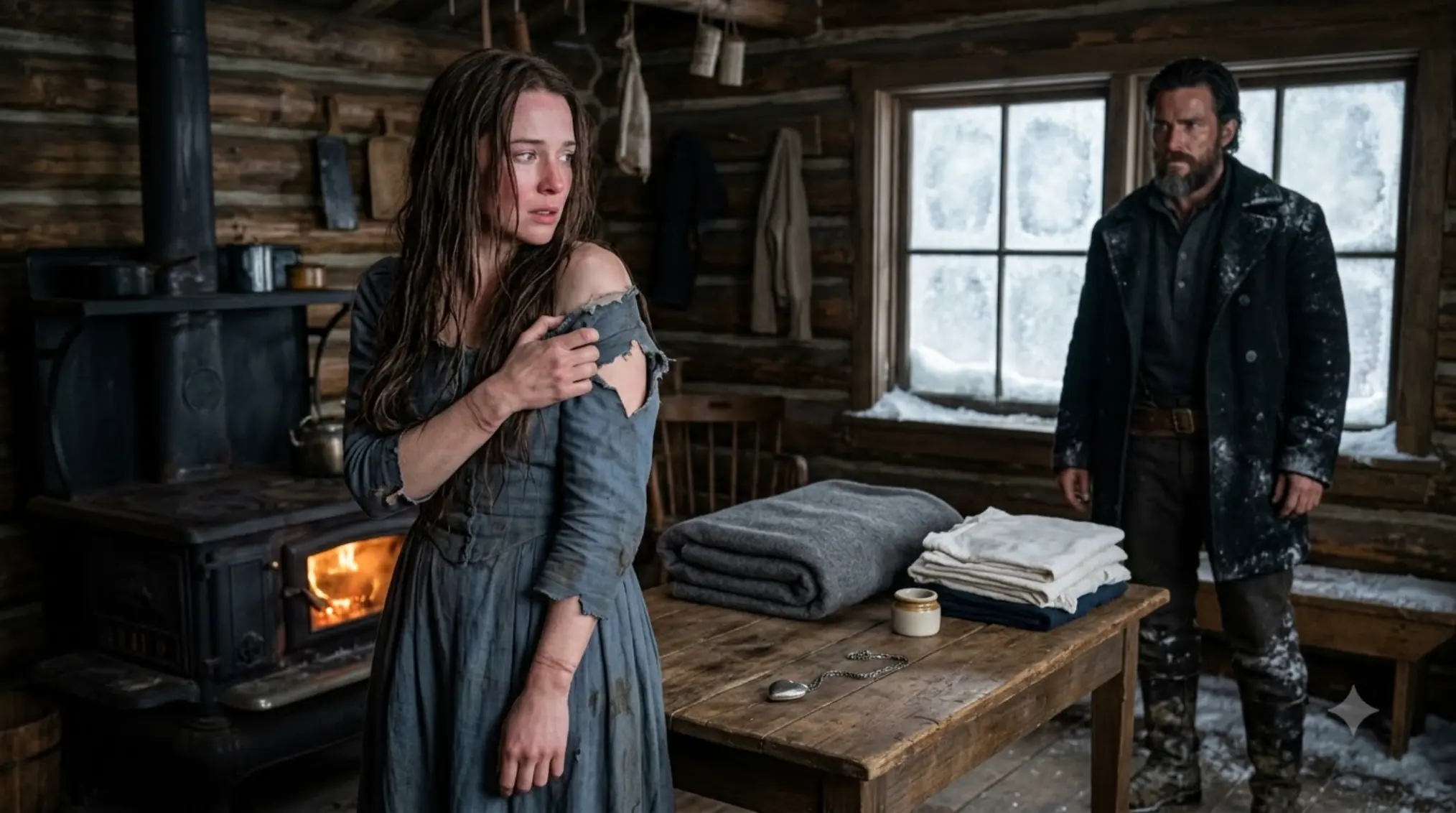
Silas did not approach her. He seemed to understand that another step would send her backward even though there was nowhere left to run. Outside, the Montana mountains had vanished behind blowing white, and the path down to Red Hollow had already disappeared beneath several feet of snow. Abigail had escaped one kind of captivity only to find herself trapped in a cabin with the man who had paid money for her in front of half the town.
“Nothing you don’t choose to give me,” Silas finally said. His voice was low, rough, and completely different from the voices that had surrounded the auction platform that morning. “I paid to get you away from them, Abigail. I didn’t pay for your body.” His eyes shifted toward the locket. “And Abigail isn’t the name I came looking for.”
Her fingers tightened around the ruined fabric of her dress. “Then why does a man I’ve never met know someone changed my name?” Silas picked up the locket carefully, almost reverently, but he still did not move closer. “Because twelve years ago, your mother put this in my hand and made me promise that if I ever found her daughter, I would bring her home.”
Abigail stopped breathing.
The fire popped inside the stove. Snow rattled against the windowpane, and for several seconds the cabin seemed suspended between two different versions of her life. One version belonged to Abigail Crowe, the unwanted servant who had spent twelve years doing whatever was necessary to survive. The other belonged to a frightened ten-year-old girl whose mother had once whispered a different name while brushing her hair beside a little blue house near the Missouri River.
“No,” Abigail said.
Silas remained still.
“No.”
Her voice grew louder.
“You’re lying.”
“I wish I were.”
Abigail crossed the room so suddenly that Silas tensed, but she did not strike him. She grabbed the locket from his palm and snapped it open. Inside was the tiny, faded portrait she remembered: her mother, younger than Abigail was now, smiling with one hand resting beneath her chin.
On the opposite side were two scratched initials.
E.M.
Abigail’s knees nearly failed.
Silas moved instinctively, then stopped himself before touching her.
She noticed.
“Where did you get this?”
“From Eleanor Mercer.”
The name entered the room like another storm.
Abigail stared at him.
Nobody had called her mother Eleanor Mercer since Abigail was ten years old.
In Red Hollow, nobody knew the name.
The people who had raised Abigail after her mother vanished told everyone her mother had been a drunken drifter named Anne Crowe who abandoned her daughter and disappeared east. Abigail had heard the story so many times that by sixteen she had almost learned to doubt her own memories.
Almost.
But she remembered Eleanor.
She remembered soft hands.
Lavender soap.
A blue dress.
A lullaby sung badly because her mother could never remember the second verse.
And she remembered the night men came to their house.
Abigail closed the locket.
“What happened to her?”
Silas looked toward the fire.
“Change your clothes first.”
Her expression hardened immediately.
“Don’t tell me what to do.”
“I’m telling you what the cold will do.”
“That’s different?”
“Yes.”
Silas nodded toward the blanket, dry clothes, and salve he had placed on the table.
“You’re soaked through. Your hands are shaking, and your lips are losing color. I’ll tell you everything, but I’m not going to watch you freeze because you’re afraid I’ll take advantage of you.”
Abigail stared at him, trying to find the hidden bargain.
There had always been a hidden bargain.
Food required work.
Shelter required obedience.
Kindness required repayment.
Even a smile from the wrong man often became a debt Abigail had never agreed to owe.
Silas seemed to read the suspicion in her face.
“I’ll wait outside.”
“You’ll freeze.”
“Not before you change.”
He moved toward the door.
Abigail looked at the violent snow beyond the window.
“You’d actually stand out there?”
Silas opened the door.
A blast of icy air swept across the cabin floor.
He pulled his coat tighter.
“You deserve one locked door in your life that protects you instead of keeping you prisoner.”
Then he stepped outside.
Abigail stood motionless.
No man had ever said anything like that to her.
She waited nearly a minute before moving.
Then she dropped the torn dress.
The dry clothing Silas had provided was plain but clean: a heavy cream blouse, wool skirt, thick stockings, and a brown knitted shawl that smelled faintly of cedar. Everything was slightly too large, but the warmth felt almost unbearable against her frozen skin.
Abigail studied her wrists.
Purple bruises circled them where rope had bitten into the flesh.
That morning, Red Hollow’s sheriff had bound her after she tried walking away from the auction platform.
The memory returned with humiliating clarity.
“Property doesn’t choose where it goes,” Sheriff Harlan Pike had told her.
Abigail had spat at his boots.
He struck her.
Then the auctioneer laughed.
A town of nearly two hundred people watched.
Some approved.
Some looked ashamed.
None stopped it.
Until Silas Boone raised his hand.
“I’ll take her.”
The crowd changed immediately.
Silas rarely came into town. When he did, people moved aside. Rumors followed him like winter smoke: killer, outlaw, bounty hunter, grave robber, madman.
Abigail had believed every one of them.
She had believed something worse once he paid.
Now she stood in his cabin wrapped in clean wool while the most feared man in Red Hollow froze outside to give her privacy.
She did not know which version of him frightened her more.
Abigail dressed quickly.
Then she opened the door.
Silas stood on the porch facing the storm.
Snow already covered his shoulders.
“You can come inside.”
He turned.
His gaze briefly checked that she was warm, then deliberately lifted to her face.
Nothing else.
Abigail noticed that too.
Silas removed his coat and hung it near the stove.
“Sit.”
She gave him a look.
“Please sit.”
“That’s better.”
For the first time, something almost amused appeared in his expression.
It vanished quickly.
Abigail sat near the table.
Silas remained opposite her.
“Start at the beginning.”
He nodded.
“I knew your mother before you were born.”
Abigail’s heartbeat quickened.
“How?”
“My father worked for hers.”
That was not what she expected.
Silas continued.
“Your grandfather was Jonathan Mercer.”
The name meant nothing to Abigail.
“He owned land?”
“A great deal of it.”
“Then why did we live in that little house?”
“Because your mother left.”
Silas folded his hands.
“Jonathan Mercer was one of the wealthiest cattle investors in the northern territory twenty-five years ago. He owned grazing rights, timber land, and shares in two freight companies. He had one child.”
“My mother.”
“Yes.”
“Why would she leave?”
“Because he wanted to choose her husband.”
Abigail almost laughed.
“That sounds familiar.”
Silas’s eyes hardened.
“Your mother refused.”
He explained that Eleanor Mercer had been twenty-one when Jonathan arranged a marriage with Caleb Voss, the son of a politically connected land broker. The marriage would have combined thousands of acres and given Voss access to Mercer transport routes.
Eleanor discovered something ugly before the wedding.
Caleb Voss had been falsifying deeds.
Buying debts from struggling families.
Forcing them off land.
And using county officials to make fraudulent transfers appear legal.
“She confronted her father,” Silas said.
“What did he do?”
“He didn’t believe her.”
Abigail looked toward the fire.
“Of course.”
Silas continued.
“Eleanor ran.”
She eventually met Thomas Vale, a schoolteacher traveling west.
They married quietly.
A daughter was born.
Abigail.
Except that was not the name on the birth record.
Silas reached into an old trunk and removed a folded paper wrapped in oilcloth.
He placed it on the table.
Abigail hesitated before opening it.
The ink had faded but remained legible.
Eliza Eleanor Vale.
Born April 9, 1860.
Mother: Eleanor Mercer Vale.
Father: Thomas Vale.
Abigail stared.
“My name was Eliza.”
Silas nodded.
Something inside her cracked.
Not dramatically.
Quietly.
For twelve years, Abigail Crowe had become an armor built around someone else.
Now three lines of ink told her she had once been another person.
“What happened to my father?”
Silas looked down.
“He died when you were six.”
Abigail remembered a man coughing.
A hand lifting her onto a horse.
A voice calling her Lizzie.
She had convinced herself those fragments were invented.
“Fever?”
“Yes.”
“And Mother?”
“She kept moving because Voss was still looking for her.”
“Why?”
Silas pointed toward the birth certificate.
“Because after Jonathan Mercer died, everything passed to Eleanor.”
Abigail looked up.
“And when she died?”
“To her legal heir.”
Understanding came slowly.
Then all at once.
“Me.”
“Yes.”
The fire cracked sharply.
Abigail stood.
“No.”
Silas watched her.
“This is about land.”
“It began with land.”
“You bought me because I own something.”
“No.”
“You expect me to believe that?”
“I expect you to decide after you hear the rest.”
Abigail paced toward the stove.
“How much?”