“Why did you marry me?” Emily Carter asked, her voice trembling beneath the vaulted timber roof of the mountain chapel. “I’m not pretty.”
Jackson Hayes stood before her in a long brown sheepskin coat, his broad shoulders almost blocking the stone fireplace behind him. The wealthy witnesses from Denver watched with poorly hidden amusement, waiting for the notorious rancher to confirm every cruel thing Emily’s father had taught her to believe. Instead, Jackson looked into her tearful hazel eyes as if no one else existed in the room.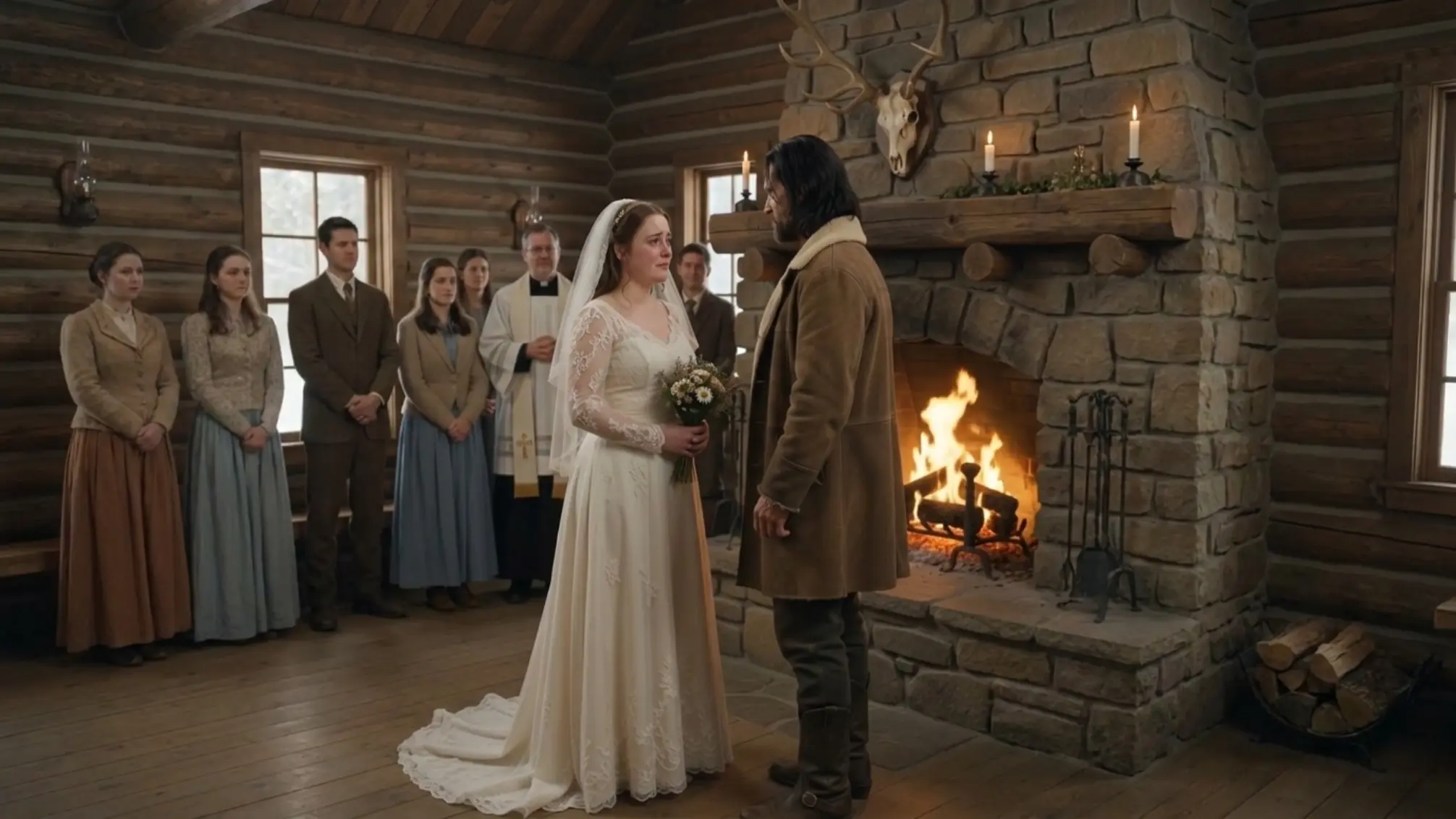
“Because I didn’t marry a burden,” he said softly. “I married the strongest woman I’ve ever known.”
Emily’s fingers tightened around the stems of her wildflower bouquet. No one had ever called her strong—not her father, not the women who whispered behind silk fans at Denver gatherings, and certainly not the young men who evaluated daughters of wealthy families as if selecting horses at auction. Richard Carter had called her inconvenient, awkward, and unsuitable for society. Jackson’s words frightened her because part of her desperately wanted to believe them.
“You barely know me,” she whispered.
“I know enough to choose you,” Jackson answered. His expression hardened when his gaze moved briefly toward Richard. “And enough to know your father lied.”
The minister cleared his throat before Emily could ask what he meant. Richard Carter stood in the front pew wearing a black wool coat and an impatient expression, as though the wedding were merely another contract awaiting signatures. Snow struck the chapel windows while the minister hurried through the final blessing. When he pronounced Emily and Jackson married, no applause followed.
Jackson did not kiss her.
He offered his arm and waited.
Emily stared at the powerful hand extended toward her. Rumors claimed those hands had broken a man’s neck during a saloon fight and strangled Jackson’s own brother after an argument over their inheritance. Some said he had buried bodies beneath his ranch. Others insisted even wolves avoided the high valley where he lived.
Yet he did not seize her wrist or command her to follow. He simply waited until she placed her hand on his arm by choice.
Outside, Richard stopped them beside the waiting sleigh. “The debt is settled,” he told Jackson.
Jackson’s blue eyes became cold. “That depends on whether you honored the rest of our agreement.”
Richard’s mouth tightened. “You received what you demanded.”
Emily flinched.
Jackson felt the movement and immediately looked down at her. “He’s wrong.”
“You asked for me,” Emily said.
“I asked him to release you.”
Richard gave a short, dismissive laugh. “Call it whatever helps you sleep.”
Jackson stepped toward him with such sudden stillness that Richard’s driver reached beneath his coat. The rancher did not touch Emily’s father, but his voice carried the warning of distant thunder.
“If she suffers because you concealed anything, no mountain will be high enough to hide you from me.”
Richard’s confidence faltered for one second. Then he turned away, climbed into his carriage, and left his daughter standing in the snow without saying goodbye.
The journey to Jackson’s ranch took nearly four hours. Emily sat beneath thick buffalo robes while the sleigh climbed through narrow passes surrounded by black pines and white peaks. Jackson drove without conversation, his gloved hands steady on the reins. He occasionally looked back to make certain the blankets covered her feet, but he never asked whether she was crying.
Emily appreciated that small mercy.
By the time they reached the Hayes ranch, darkness had settled across the Rocky Mountains. A large log house stood at the edge of a frozen meadow, surrounded by a stable, smokehouse, and several fenced pastures. Light glowed through the windows, and smoke rose from a stone chimney into the snow.
Emily had imagined a brutal place filled with weapons and animal hides. The house was rough but orderly. Firewood had been stacked beneath the porch, the steps were cleared of ice, and a brass lantern burned beside the door.
Jackson carried her trunk inside but did not carry her. The main room contained a long table, a stone fireplace, shelves of books, and several chairs polished smooth by years of use. A pot of stew rested over low flames, and fresh bread sat beneath a cloth.
“You cooked?” Emily asked.
“Mrs. Bell from the southern cabin prepared most of it. I only kept it from burning.”
The admission surprised her. Her father would have claimed credit for an entire banquet after pouring one glass of wine.
Jackson placed her trunk near the hallway. “The bedroom is the first door on the left.”
“And yours?”
“I’ll sleep here.”
Emily looked at the single blanket folded beside the fireplace. “On the floor?”
“I’ve slept on worse.”
She searched his face for mockery or impatience. “What do you expect from me tonight?”
“Eat while the stew is warm. Lock the bedroom door if it makes you feel safer.”
“You are my husband.”
“That doesn’t make your fear belong to me.”
Jackson removed his coat and hung it beside the door. Beneath it, he wore a plain gray shirt stretched across a muscular chest marked with old scars. Emily remembered the chapel whispers and took an involuntary step backward.
Jackson noticed. He moved away from her rather than closer.
“You will never be touched in this house without your permission,” he said. “Not by me. Not by anyone.”
Emily slept with the door locked anyway.
She woke before sunrise and found Jackson stretched beside the dying fire with one arm beneath his head. A revolver lay within reach, but his breathing was peaceful. Someone had placed another log on the fire during the night and left a cup of water outside her bedroom door.
For the first time since her father announced the marriage, Emily wondered whether she had feared the wrong man.
The days that followed deepened the question.
Jackson gave her no list of duties. He showed her where food was stored, which horse was gentle, and how to signal the ranch hands if trouble came from the northern trail. Then he returned to repairing fences damaged by the storm.
Emily began working because idleness made her feel like property. She cleaned neglected shelves, mended torn curtains, and reorganized the kitchen. When Jackson returned that evening, he paused inside the doorway and studied the room.
“I moved some things,” she said defensively. “I can put them back.”
“I was wondering how you found the table.”
“It was beneath three saddles and a broken lantern.”
“I knew it was somewhere.”
The faint humor in his voice almost made her smile.
At supper, he ate slowly and asked whether she wanted him to purchase different fabric for the bedroom curtains. Emily had expected commands from a man rumored to be savage. Instead, Jackson asked her opinion about curtains.
She could not decide which unsettled her more.
A week passed. Then two.
Jackson never entered her room without knocking. He did not complain when she burned biscuits, and when she apologized, he ate three of them with the solemn determination of a man facing gunfire. He taught her to ride a calm chestnut mare named Fern and walked beside the horse until Emily stopped gripping the saddle horn.
The ranch hands respected him without fear. An older foreman named Silas Bell had worked for Jackson’s father and openly scolded him for skipping meals. Mrs. Bell arrived every Thursday with supplies, gossip, and the confidence of a woman who knew every secret in the valley.
She found Emily peeling potatoes one morning and smiled. “He hasn’t frightened you away yet?”
“I’m still deciding whether the stories are true.”
Mrs. Bell’s smile disappeared. “Stories are useful things when powerful men need the wrong person blamed.”
Emily looked toward the yard, where Jackson was helping a young ranch hand reset a dislocated shoulder. His movements were careful and his voice calm.
“Did he kill his brother?”
Mrs. Bell lowered her knife. “Nathan Hayes was murdered. Jackson found him dying beside the western mine and carried him home. The men who killed Nathan spread the rumor before the blood dried.”
“Why didn’t Jackson defend himself?”
“He tried. The sheriff who investigated was being paid by the same men who wanted Nathan silent.”
“Who were they?”
Mrs. Bell glanced toward the windows. “Ask your husband when he’s ready to answer.”
That evening, Emily waited until Jackson finished sharpening a fence tool.
“Who killed Nathan?”
The blade stopped against the stone.
Jackson did not look up. “Where did you hear his name?”
“Mrs. Bell.”
He released a slow breath. “Nathan discovered illegal blasting beneath a railroad tunnel your father’s company was building. The work was unstable, but Richard Carter refused to stop because a delay would have cost him contracts.”
Emily felt cold despite the fire. “My father’s railroad?”
“Partly his. He had partners.”
“What happened?”
“The tunnel collapsed. Fourteen workers died. Nathan had maps proving the company knew the danger. Before he reached the territorial authorities, someone shot him.”
Emily sat opposite Jackson. “And they accused you.”
“I was found carrying his body.”
“Did my father accuse you?”
“He paid the newspaper that printed the first story.”
The room seemed to tilt around her. Richard had described Jackson as the monster who murdered his own blood, yet he had known the truth all along.
“Why would you marry his daughter?”
Jackson finally raised his eyes. “Because you are not him.”
“That is not an answer.”
“It is the only one I can give tonight.”
Emily rose from the table. “You said my father lied, but you are still hiding something.”
“Yes.”
His honesty stopped her.
“Are you protecting me,” she asked, “or using me?”
Jackson’s face tightened as though she had struck him. “I would die before using you the way he did.”
“Then tell me everything.”
“I can’t.”
“Why?”
“Because the moment you know, you become more dangerous to the men watching this ranch.”
Emily looked toward the black windows. Until then, the mountains had seemed lonely. Now they felt occupied by unseen eyes.
“Someone is watching us?”
“Someone has been watching since the wedding.”
That night, Jackson slept in a chair beside the front door with his rifle across his knees.
Emily lay awake listening to the wind and wondering what kind of marriage began with secrets, armed guards, and a husband prepared to die without explaining why.
The following morning, she found fresh hoofprints beyond the stable fence. Jackson followed them toward the ridge and returned after noon with snow on his coat and anger in his eyes.
He doubled the night watch but told Emily nothing.
Her fear gradually changed shape. She remained afraid of what Jackson concealed, but she no longer feared being alone with him. The safer she felt beside him, the more unbearable his silence became.
Their relationship developed through quiet moments he seemed unable to prevent. Jackson brought her a piece of blue ribbon from town because he had noticed her looking at one in a store window. Emily repaired the torn lining of his coat and found him wearing it indoors because he did not want to remove her work.
One evening, snow trapped them in the stable while a mare struggled through a difficult birth. Jackson guided Emily’s hands as they helped deliver the foal. When the tiny animal finally breathed, Emily laughed and threw her arms around him.
Jackson froze.
She felt his entire body become still beneath her hands. Embarrassed, she stepped away, but he caught the edge of her sleeve.
“Don’t apologize,” he said.
Their eyes met. For one suspended moment, Emily believed he might kiss her. Instead, Jackson released her and turned toward the mare.
He did not sleep by the fireplace that night. He moved into the small study at the opposite end of the house, increasing the distance between them as though closeness had become more dangerous than the armed men outside.
Three days later, Emily entered that study searching for sealing wax.
Jackson kept the room locked, but the door stood open after Silas called him to the southern pasture. Emily intended only to borrow the wax from his desk. She found it beside a locked wooden box partially hidden beneath old survey maps.
The box bore her father’s railroad emblem.
Emily’s hands began to tremble.
A small brass key rested inside the desk drawer. It opened the box.
Inside were mine maps, payment ledgers, photographs of the collapsed tunnel, and letters signed by Richard Carter. The first documents confirmed that he had approved unsafe blasting. The next showed payments to Sheriff Nolan Price and a hired gunman named Gideon Shaw.
Then Emily found a sealed letter addressed to Shaw.
She broke it open.
The words destroyed what remained of the father she thought she knew.
Richard instructed Shaw to wait until Emily and Jackson were legally married. Once the marriage was recorded, Shaw was to enter the ranch, kill Jackson, and make his death appear to be Emily’s act of self-defense. Emily would then be returned to Denver as the grieving widow of a violent outlaw.
But the plan did not end there.
Richard intended to have Emily declared mentally unstable. As her legal guardian, he would control the Hayes ranch, including the western mine beneath which Nathan had hidden original evidence of the tunnel disaster. Once the evidence was destroyed, Richard planned to sell the mountain passage to a competing railroad company and rebuild his fortune.
At the bottom, he had added one final instruction.
If the girl learns too much, she may die beside him. The public already believes Hayes is capable of killing his wife.
Emily’s vision blurred.
She had not been traded to settle a debt.
She had been sent to create a believable murder scene.
Heavy footsteps crossed the hall.
Emily turned slowly.
Jackson stood in the doorway.
His eyes moved from her frightened face to the letter shaking in her hands. He did not look surprised.
“You knew,” she whispered.
“I knew Richard wanted the mine.”
“You knew he planned to use me.”
“I suspected.”
“You let me marry you anyway.”
“To get you out of his house before Shaw could arrange an accident there.”
Emily backed away from him. “You should have told me.”
“I wanted proof first.”
“You kept his letter locked in your desk.”
“It arrived two days ago. I was taking it to the federal marshal tomorrow.”
“Were you ever going to tell me?”
“Yes.”
“When? After another man decided what happened to my life?”
Jackson stepped forward, but Emily raised the letter between them.
“Don’t.”
He stopped immediately.
Tears burned her eyes. “My father sold me, and you rescued me by making another decision without me.”
“I know.”
The lack of defense made her angrier. “Do you?”
“Yes.” His voice broke slightly. “And I was wrong.”
Emily stared at him. The feared mountain killer stood several feet away, powerful enough to seize the paper or silence her, yet he accepted her anger without retreating behind excuses.
“Why did you truly marry me?” she demanded.
Jackson looked toward the box. “Years ago, I delivered horses to your father’s estate. A stable boy fell beneath a carriage wheel. Everyone else worried about the guests seeing blood, but you tore your dress to bind his leg.”
Emily remembered the accident. Her father had punished her for ruining an imported gown.
“I saw you carry food to workers your father refused to pay,” Jackson continued. “I saw you stand between him and a kitchen girl he was striking. You were seventeen and terrified, but you stood there anyway.”
“You watched me?”
“I remembered you.”
“That still doesn’t explain the marriage.”
“When I learned Richard meant to sacrifice you, I offered him a bargain. I would surrender copies of Nathan’s evidence if he released you into my protection.”
“But you never surrendered them.”
“No. I gave him worthless maps.”
Despite everything, a startled breath escaped her.
Jackson moved closer by one careful step. “I married you because it was the only way to take you beyond his legal reach quickly. But that isn’t why I asked you to stay once you were safe.”
Emily’s heart beat painfully. “Why, then?”
“Because every day you were here, this house became less empty.”
A rifle shot shattered the study window.
Jackson threw himself across Emily as glass exploded over the floor. A second bullet struck the desk. He pulled her behind the stone wall and drew his revolver.
“They’re here,” he said.
Men shouted outside. The stable doors burst open, and horses screamed in the yard. Jackson handed Emily a small pistol from the desk.
“Take the box and use the cellar passage.”
“I’m not leaving you.”
“This isn’t courage. There are six men.”
“There are five,” Emily said, looking through the broken edge of the window. “One is circling toward the kitchen.”
Jackson stared at her.
“I counted.”
Another bullet struck the wall.
Emily gripped the pistol. “You said you married the strongest woman you knew. Don’t insult me by treating me like glass now.”
For one second, pride and fear battled across his face. Then he nodded.
“Stay behind me.”
“No.”
“Emily.”
“We’ll argue about that if we live.”
They moved through the hallway as the kitchen door splintered inward. Gideon Shaw entered with a revolver raised. Emily recognized him from the photograph in Richard’s files.
He aimed at Jackson.
Emily fired first.
Her bullet struck the lantern above Shaw’s shoulder. Burning oil fell across the doorway, forcing him backward. Jackson fired through the smoke and knocked the weapon from Shaw’s hand.
Silas and the ranch hands exchanged shots with the other attackers near the stable. Emily carried the wooden box toward the rear cellar entrance while Jackson covered her. Two men came through the side window, but Mrs. Bell appeared from the pantry with a shotgun and sent them diving back into the snow.
“I always disliked visitors,” the older woman muttered.
Jackson almost smiled.
The battle ended when a federal marshal and six deputies rode into the yard. Jackson had secretly sent Silas’s son to Boise City the previous night with copies of Richard’s correspondence. The marshal arrested Shaw and the surviving gunmen.
One attacker confessed before sunrise.
Richard Carter had paid them to kill both Jackson and Emily, burn the ranch, and recover the box from the western mine. Sheriff Price had already prepared a report blaming Jackson for murdering his young wife before taking his own life.
The conspiracy collapsed rapidly after that.
Federal officers recovered Nathan Hayes’s original evidence from an abandoned mine shaft. The records proved Richard’s railroad company had knowingly ordered unsafe blasting and bribed inspectors after the collapse. They also connected Richard to Nathan’s murder and several staged accidents involving potential witnesses.
Richard was arrested at his Denver mansion while attempting to leave for San Francisco. Reporters who once mocked Emily gathered outside the jail, but she refused to speak to them. She had spent nineteen years allowing her father’s opinion to define her worth. She would not let his disgrace define it either.
Weeks later, she returned to the ranch after testifying before a territorial court. The snow had begun melting, exposing dark earth beneath the pines. Jackson waited on the porch wearing the repaired coat she had sewn.
Her trunk stood beside the door.
“You packed my things,” she said.
Jackson’s gaze lowered. “The marriage contract can be annulled. The marshal arranged the papers.”
Emily felt an unexpected pain. “Do you want it annulled?”
“What I want shouldn’t trap you.”
“That isn’t what I asked.”
Jackson looked at her then. “No.”
“Then why is my trunk outside?”
“Because staying must be your decision.”
Emily approached until only one step remained between them. Jackson seemed more frightened now than he had facing six armed men.
“My father told me I was too plain to be loved,” she said. “Society told me a woman like me should be grateful for whatever man accepted her. Then you married me and refused to ask for anything.”
Jackson’s jaw tightened. “You deserved the choice from the beginning.”
“I have it now.”
“Yes.”
Emily placed her hand over his heart. It beat hard beneath her palm.
“Why did you marry me?” she asked again.
Jackson covered her hand with his.
“Because I didn’t marry a burden,” he said. “I married the strongest woman I’ve ever known.”
“That was the answer you gave in the chapel.”
“It was true then.”
“And now?”
His blue eyes softened. “Now I know I married the woman I love.”
Emily rose onto her toes and kissed him.
Jackson remained still for a heartbeat, as though afraid the moment might vanish if he moved too quickly. Then his arms closed gently around her, holding her with strength that protected without imprisoning.
They burned the annulment papers that evening.
Emily never returned to the Carter mansion. She sold what remained of her inheritance and used part of it to compensate the families of the workers killed in the tunnel collapse. With the rest, she and Jackson built a school beside the ranch for mountain children who otherwise traveled days for lessons.
The rumors about Jackson eventually changed. People still called him dangerous, but they added that his danger belonged to men who harmed the innocent. They spoke of the winter he faced hired killers to protect his wife and the testimony that brought down one of Colorado’s most powerful railroad families.
Emily disliked the version that made her merely the woman he saved.
Whenever someone repeated it, Jackson corrected them.
“She saved me too,” he would say.
Years later, the wooden box remained in the study, but its darkest letters had been moved to the territorial archives. In their place, Emily kept a single page written in Jackson’s rough hand on the first anniversary of their wedding.
They sent you here believing you would become my weakness.
They never understood that you would become my strength.
On winter evenings, Emily and Jackson sat together before the stone fireplace while snow covered the mountain valley. The ranch house no longer felt like the lair of a feared killer. It held shelves of schoolbooks, muddy boots near the door, and the voices of children Emily had once believed she would never have.
Sometimes she remembered the frightened bride standing in the chapel, asking why any man would choose her.
Jackson always seemed to know when the memory returned. He would take her hand, kiss the inside of her wrist, and look at her with the same unwavering certainty he had shown before the minister, the witnesses, and the father who tried to destroy them both.
Emily had been sold, shamed, and sent into the mountains as part of a murder plan.
But the man everyone called a monster gave her the first safe home she had ever known—and the freedom to choose him after she no longer needed saving.