The morning they lost everything, it started with a knock.
Not a loud knock. Not the kind that rattles the frame or wakes the neighbors. It was three measured, deliberate taps. The kind that carries authority behind it. The kind that says, “I have every legal right to be here, and you already know it.”
Elena Hart was standing at the stove when she heard it. She had one hand wrapped around a tin cup of coffee that had gone lukewarm. The other pressed flat against the iron surface out of habit, the way she always steadied herself before the day came at her.
It was a Tuesday in late October, and the sky outside the single kitchen window was the color of old pewter. Low clouds, no wind, the kind of stillness that feels wrong somehow, like the land itself is holding its breath.
“Mama.”
Lily’s voice came from the back room. Seven years old, still half asleep, hair tangled from the pillow.
“Stay inside,” Elena said, not harshly.
She set down the cup, smoothed the front of her dress with both palms, and walked to the door. There were two of them on the porch. She recognized one, Deputy Harlon Kates, a thin man with a long jaw and eyes that never quite met yours directly.
The other was a stranger in a brown suit, carrying a leather satchel and a sheet of paper folded into thirds.
“Mrs. Hart,” Kates said.
He had the decency to take off his hat.
“Deputy.”
She looked at the man with the satchel.
“Who are you?”
“Name’s Aldrich. Gerald Aldrich. I represent the estate of Mr. Thomas Hart, deceased.”
He unfolded the paper without ceremony.
“I’m here pursuant to a court judgment filed in Calhoun County regarding outstanding debt obligations left by your late husband.”
Elena said nothing.
She had known this was coming, or something like it. For three months since Thomas’s funeral, she had been waiting for the other boot to drop. She’d found the letters in the bottom drawer of his desk, tucked beneath a stack of land surveys. Loans, accounts she hadn’t known existed, numbers that made her stomach sink.
She’d written to a solicitor in Abilene. He wrote back with six paragraphs of legal language that boiled down to one sentence. You are responsible for debts held in a married household.
“How much?” she said.
Aldrich named the figure.
Elena felt the porch railing behind her without turning. She found it with her left hand and held on.
“That can’t be right,” she said.
Her voice was very steady. She was proud of that, even then.
“I’m afraid it is, ma’am. The property, the house, the livestock, the equipment, all of it has been assessed and will be applied toward the debt. There is also the matter of…”
He paused like he was looking for a kinder word and not finding one.
“Labor arrangements. The court has authorized a public procurement for the remaining balance.”
She stared at him.
“A procurement?”
“For you and your dependents.”
She turned to look at Kates.
He was studying the porch boards with the attention of a man who had chosen to be somewhere else entirely in his mind.
“You mean an auction?” Elena said.
Neither of them answered, which was its own kind of answer.
She had four hours.
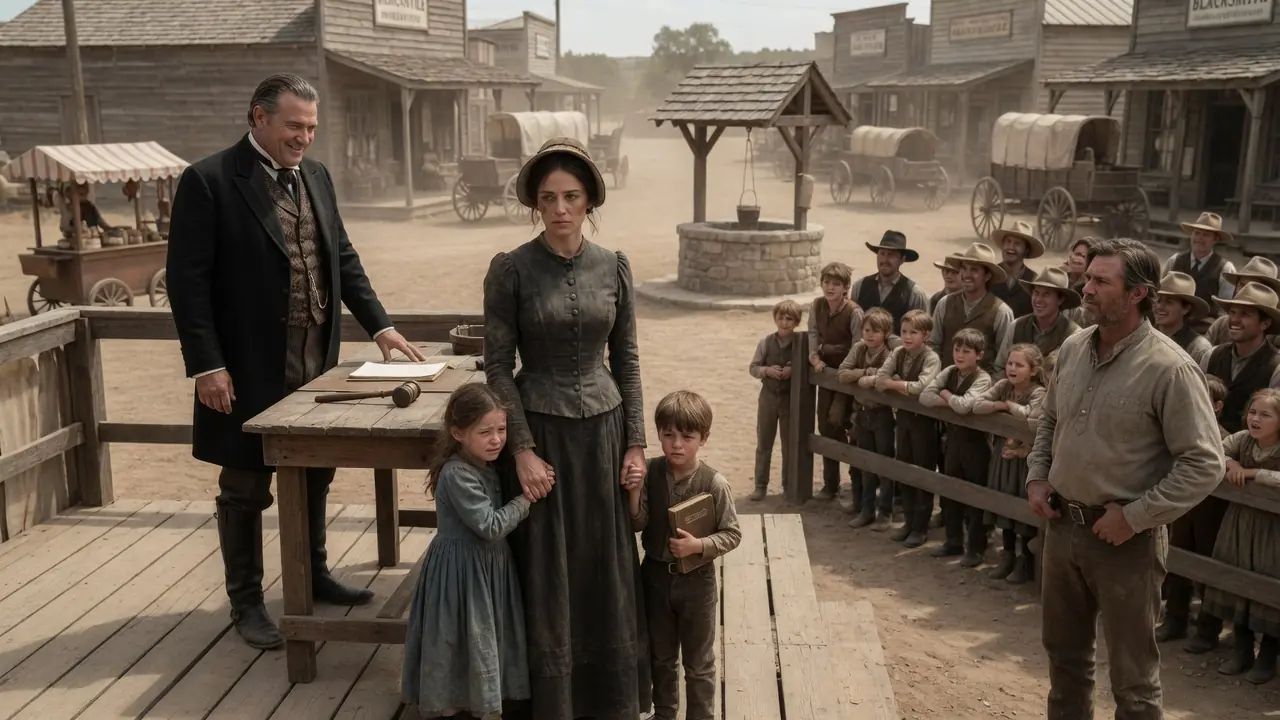
That was how long it took for the word to spread through Iron Hollow, for the men to start gathering in the square, for the wooden platform to be dragged out from behind the county office and set up near the well where everyone could see.
Four hours while Elena moved through her own house like a woman underwater, slow and deliberate, trying not to drown. She packed what she could. Two changes of clothes for each of them. Lily’s worn cloth rabbit, missing one button eye, which she’d had since she was three.
Ben’s reading primer. He’d just turned five and hadn’t actually learned to read yet, but he carried the book everywhere because his father had given it to him.
Elena packed her mother’s silver comb, the only piece of jewelry she owned, and a small tintype photograph of Thomas from their wedding day. She stared at that photograph for a long time before she put it in the bag.
Thomas Hart had not been a cruel man.
She wanted to be clear about that, even to herself, even in this moment. He had been weak in ways she hadn’t understood until it was too late, prone to grand schemes and quiet failures, to borrowing against tomorrow for the sake of today.
He had loved her in his fashion. He had loved the children. But he had also left them standing on the edge of this cliff without ever once mentioning the drop, and she couldn’t seem to hold both truths at the same time without one of them catching fire.
She put the photograph in the bag.
“Mama, where are we going?”
Ben was standing in the doorway of the bedroom, still in his sleeping shirt. He was a compact little boy with his father’s dark hair and Elena’s gray-green eyes. He watched everything with an intensity that people sometimes found unsettling in a five-year-old, like he was already taking notes.
“Into town,” she said.
“Why do you have the bag?”
“We’re going to town, sweetheart. Get dressed for me.”
“Are we coming back?”
She kept her hands moving, folding, tucking, closing the clasp.
“Get dressed, Ben. Nice and quick.”
She had hoped it would be small, discreet. Some county official, a handful of buyers, a quiet transaction on a side street somewhere. That had been her best-case imagining.
Instead, Iron Hollow had turned out. The square was lined with people three and four deep on both sides of the platform. She counted from habit. Men from the ranches and the farms, storekeepers in their aprons, a cluster of women near the milliner’s shop who were pretending they’d come out for other reasons.
Children, even, sitting on the fence rails. Someone had set up a food cart. The whole thing had the atmosphere of a county fair, something festive and communal.
And that detail, the food cart, the casual ease of it all, hit Elena somewhere below the ribs and stayed there.
She walked with her head up.
That had been a decision she’d made on the road into town, one of the few she still had the power to make. Her chin was level. Her children walked on either side of her, Lily’s hand in her left, Ben’s in her right.
Lily had gone very quiet. Ben was looking at everything with those watchful eyes of his.
Aldrich was already on the platform. Beside him stood a man Elena recognized, Wade Crowe.
She had not been in the saloon. Decent women in Iron Hollow did not go into the Silver Crown, but she had seen Crowe in the street often enough to know his face.
He was a broad man, not tall, built like a barrel that had learned to walk upright. His hair was slicked down with something that caught the light, and he wore a vest embroidered with a pattern that must have cost more than Elena’s best dress.
He smiled when he saw her coming through the crowd.
It was the kind of smile that let you know the man behind it was already thinking three steps ahead.
There was another man beside Crowe whom Elena didn’t recognize. Narrow-shouldered, with small, calculating eyes and a nervous way of shifting his weight from foot to foot, like he was waiting for permission to exist.
Kates materialized at her elbow.
“Ma’am,” he said quietly. “If you’ll just come up onto the…”
“I know,” Elena said.
The platform was six steps up. She climbed them without looking at the crowd.
Lily made a small sound, half swallowed, when she reached the top and could suddenly see all the faces looking back at them.
Elena squeezed her hand once, hard.
“You’re all right,” she said quietly enough that only Lily could hear. “You hold my hand and you look at me, not at them. Can you do that?”
Lily nodded, her chin trembling.
“Good girl.”
Aldrich cleared his throat and produced another piece of paper. He began to read from it in a careful voice. Legal language, debt figures, the terms of the arrangement.
Elena stopped listening. She looked out over the crowd instead, making herself see it clearly, making herself understand what this moment was.
The sun was fully up now, burning through the gray, and the light was flat and merciless on all those watching faces.
She thought, I will remember every one of you.
Not as a threat exactly, just as a fact. She was going to carry this moment whether she wanted to or not. So she might as well carry it whole.
“Opening bid of twelve dollars,” Aldrich was saying.
Wade Crowe raised his hand immediately.
“Fifteen.”
His voice had that oiled quality she’d noticed from a distance. Smooth, pleasant, the voice of a man who has spent years learning how to sound like whatever a room needs him to sound like.
She watched him.
He was watching her back.
He wasn’t looking at the children at all.
“Eighteen,” said the nervous man beside him.
Crowe glanced sideways without expression.
“Twenty-five.”
A ripple went through the crowd. Some people shifted the way people do when something interesting is happening.
Elena heard a woman near the front say something to her companion in a low voice, and then a low laugh, and something in her chest pulled so tight she thought it might actually tear.
Lily tugged her hand.
Elena looked down.
Her daughter was staring up at her with brown eyes gone enormous. Not crying, not quite, but close. The way a child looks when they’re trying very hard to be brave for their mother and aren’t sure they’re going to make it.
“Mama,” Lily whispered. “Are they buying us?”
Elena knelt down right there on the platform in front of all of them. She cupped Lily’s face in both hands.
“Listen to me,” she said, keeping her voice very even. “Whatever happens today, whatever you see and hear, I am not leaving you. Do you understand me? I will not leave you.”
“But are they?”
“I don’t care what they think they’re doing. I know what I’m doing.”
She held Lily’s eyes.
“I’m keeping you safe. That’s all that matters. Do you believe me?”
Lily swallowed, then nodded.
Elena stood up.
Ben moved in close against her side, and she felt his small hand find the back of her skirt and grip it. She let him.
“Thirty,” said Crowe, raising his voice just slightly.
He was looking at her directly now, and there was something in his expression that Elena couldn’t name precisely, but recognized instantly. The look of a man who has already decided something and is simply waiting for the world to catch up.
She had met that look before, in other contexts, on other men’s faces. It always meant the same thing.
You don’t get a say in this.
Watch me, she thought.
“Thirty-five.”
The voice came from the back of the crowd.
It wasn’t loud exactly. It cut through the noise without raising itself, the way a stone cuts through water.
Elena looked up past the rows of faces toward the source of it.
She couldn’t see him at first. The crowd shifted and then parted slightly. Not deliberately, the way people part for someone with authority, but the way water moves around a rock.
And she saw him.
Cole Mercer stood at the back edge of the square with his hat pushed back on his head and both thumbs hooked in his belt.
He was a tall man, broader through the chest and shoulders than the crowd around him, with the look of someone who had done hard physical work for a very long time and built up something permanent from it.
He had dark hair going gray at the temples, a face that had been weathered to something simpler than handsome, and eyes that Elena couldn’t read from this distance.
He wore working clothes, not town clothes. Worn canvas pants, a collarless shirt with the sleeves rolled back, boots that had seen genuine miles.
She didn’t know him.
She’d heard the name. Everyone in the county had heard the name.
Redstone Ridge Ranch, forty miles north and east, one of the few operations in the territory that was actually growing instead of shrinking.
Cole Mercer, the man who had bought out three failing ranches in two years and turned them into something. Cole Mercer, who kept to himself and didn’t come to town much, and was talked about in the way that people talk about things they don’t entirely understand.
Crowe had turned to look too.
His expression didn’t change exactly. It went very still.
“Forty,” Crowe said.
“Forty-five.”
Crowe’s jaw tightened. He looked back at Elena, then back at Mercer.
Something passed over his face that might have been calculation or might have been anger. They can look very similar on certain kinds of men.
“Fifty dollars.”
A loud murmur went through the crowd.
Several people turned to look at Mercer.
“Sixty.”
The murmur got louder.
Elena heard someone near her say, “What is he doing?”
And someone else say, “That’s Mercer, isn’t it? The one from Redstone Ridge.”
And someone else say, “He’s lost his mind.”
Crowe’s hand went up, and he opened his mouth, and before he could form the number, Mercer said very flat and clear, “One hundred.”
The square went quiet.
Not immediately. There was a moment where the sound just drained out of it like water down a drain until there was nothing left but wind and the distant sound of a horse shaking its harness.
Elena realized she had stopped breathing.
She made herself start again.
Crowe stood very still.
He looked at Mercer, a long, measuring look, and Mercer stood there with his thumbs in his belt and said nothing more.
Just waited the way men wait when they’ve already decided something and are only still standing there as a courtesy.
Crowe’s mouth formed a thin line.
He turned his head and said something quietly to the nervous man beside him. The nervous man nodded several times quickly, and then Crowe walked off the platform and back into the crowd without looking at Elena again.
It didn’t feel like surrender.
It felt like postponement.
Aldrich looked from Crowe’s retreating back to Mercer. He cleared his throat.
“Sold,” he said, with the flat pragmatism of a man who has long since made his peace with the world. “To Mr. Cole Mercer of Redstone Ridge.”
Mercer made his way through the crowd without hurrying. People stepped aside.
Elena had climbed down from the platform by the time he reached her, the children on either side of her again, the bag over her shoulder.
She made herself stand straight and look at him directly as he came.
He stopped a few feet away.
He looked at her. Not the way Crowe had looked at her, not measuring or possessive. Just looking, the way you look at a person when you’re trying to figure out who they actually are.
“Mrs. Hart,” he said.
“Mr. Mercer.”
She kept her voice level.
“I don’t know what your intentions are. I’d appreciate you telling me plainly.”
Something moved across his face, not quite amusement, but adjacent to it.
“My intentions,” he said, “are to get you and your children out of this square before Crowe does something I’ll have to respond to.”
He paused.
“Beyond that, we can talk on the road.”
She stared at him.
“That’s not an answer.”
“No,” he agreed. “It’s a start.”
Ben had been watching this exchange with his note-taking expression.
“Are you the man who bought us?” he asked.
Mercer looked down at him.
A pause that lasted long enough to mean something.
“Bought your debts,” he said carefully. “That’s a different thing.”
“Is it?” Ben said.
“Ben,” Elena said quietly.
“No, it’s a fair question.”
Mercer crouched down so he was on Ben’s level. He looked at the boy directly.
“The difference is this. I paid what the court said was owed. What happens after that is up to your mother. She decides what comes next, not me.”
He let that sit for a moment.
“Does that make sense?”
Ben considered this with the gravity of a circuit court judge.
“I think so,” he said finally.
“Good.”
Mercer stood.
He looked back at Elena.
“I have two horses and a wagon. It’s a long ride to the ridge. We should start before the afternoon gets away from us.”
Elena looked at him. This stranger who had just spent one hundred dollars on her family and was now talking about wagon schedules with a perfect lack of drama, as though this were the most ordinary morning in the world.
She thought about asking more questions. She had plenty of them.
But she also thought about the food cart in the square, and the crowd that was still watching from a distance, and Crowe’s retreating back, and the look that had been on his face before he left.
“All right,” she said.
They walked toward the north end of the square where his wagon was tied.
The crowd parted the same way it had parted for him before. Not dramatically, just naturally, like weather moving around a particular obstruction.
Elena kept her chin up and her hand steady, and walked like she was going somewhere she had chosen to go.
Lily reached up and found her hand.
The road north out of Iron Hollow was unpaved and rutted from the autumn rains, and the wagon moved over it with a rhythm that was more shake than roll.
Elena sat on the bench beside Mercer, her bag between her feet, the children in the wagon bed behind them with a spare blanket and a canvas sack full of what appeared to be fence-mending tools.
Lily had gone to sleep within twenty minutes. She always crashed after sustained tension, had done it since she was an infant. Ben was awake, sitting with his back against the sideboard, watching the landscape scroll past.
“You can ask,” Mercer said.
Elena looked at him. He was watching the road, hands loose on the reins.
“Ask what?”
“Whatever you’ve been working out in your head since the square.”
He glanced at her briefly.
“You’ve been quiet for forty minutes. That’s not nothing.”
She considered denying it.
“Why did you do it?”
He didn’t answer right away. He let the horses work through a bad stretch of rut before he said anything.
“Wade Crowe is not a man you want owing you.”
“I wasn’t asking about Crowe.”
Another pause.
“No,” he said. “I suppose you weren’t.”
The road straightened out along a ridge, and the view opened up on their right, rolling grassland going amber and brown with the season. A line of cottonwoods along a distant creek caught the last of the afternoon light.
Elena looked at it without seeing it.
“I had debts once,” he said finally. “Not the same. Not court-ordered, not public. But I know what it’s like to owe more than you can pay and have no good options.”
He kept his eyes on the road.
“A man helped me a long time back. Said I could pay him back or pay it forward. I paid him back, and I’ve been looking for the forward part ever since.”
He paused.
“That’s as close to an explanation as I’ve got.”
She turned that over.
It sounded genuine, which made her more careful with it, not less. In her experience, things that sounded too reasonable always had a second layer.
“You said your intentions are to get us out of the square,” she said. “And then what? You spent one hundred dollars, Mr. Mercer. What does that look like, practically speaking?”
“It looks like wages,” he said. “Work on the ranch. There’s plenty of it, and I’m short-handed since Johnson’s family moved on in August. Shelter in the bunkhouse. We’ve got a separate room that’s been used for storage. I can have it cleared out. Your children are welcome within reason.”
He shifted the reins to one hand briefly and rubbed the back of his neck with the other.
“The hundred dollars is gone. I don’t expect you to pay it back. What I expect is that you’ll work honest, and I’ll do the same.”
Elena was quiet for a moment.
“And if I decide to leave?”
“Then you leave.”
“Just like that?”
“Just like that.”
He said it flatly, without dramatics, which was somehow more convincing than if he’d made it into a speech.
“You’re not property, Mrs. Hart. Whatever that court document says. I don’t hold with that kind of thing, and never have.”
She studied his profile. The square jaw, the crow’s feet at the corner of his eye, the slightly flattened bridge of his nose that suggested it had been broken at least once.
He had the face of a man who had made plenty of his own mistakes and hadn’t been particularly gentle with himself about them.
She didn’t trust him.
She wanted to be clear about that, at least to herself. Trust was not something she was in a position to hand out freely.
But there was a difference, she had learned over the years, between trust and provisional cooperation. Between opening the door and swinging it wide.
She could work with provisional cooperation.
She was good at that.
“All right,” she said.
He nodded once, no triumph in it.
“Good.”
They rode in silence for a while.
The road curved away from the ridge and dropped down through a cut in the hillside into a long valley that ran roughly north, with the remains of summer grass still visible through the brown.
Elena could see cattle in the middle distance. A good-sized herd, she thought, grazing without urgency along the valley floor.
“How many hands do you run?” she asked.
“Seven full-time. Two seasonal this time of year.”
“Women on the property?”
He seemed to consider whether the question had a subtext.
“Cookie’s wife, Alma. She handles the kitchen and the garden and whatever else she decides needs handling.”
He stopped.
“She’s not easy exactly, but she’s fair.”
“I’ve handled not easy,” Elena said.
“I expect you have.”
Redstone Ridge announced itself before she could see the buildings.
It was the smell first. Cut grass and cattle and wood smoke, and something underneath it all that was just the particular smell of a working place, of effort and use and maintenance.
Then the fence line appeared, and the gate, and beyond it a long dirt track that ran toward a cluster of buildings set against the western slope of the ridge itself.
The main house was two stories, built from the same red stone that gave the place its name. It was not elegant. The porch sagged slightly on the left side, and one of the upper windows had been patched with a piece of wood that didn’t quite match the frame.
But it was solid. The kind of construction that said, I built this to stay.
There were outbuildings, a barn that was genuinely large, a smaller building that was probably the bunkhouse, a smokehouse, a well, and a chicken yard that occupied more territory than seemed reasonable for chickens.
Three men came out of the barn as the wagon pulled up. They looked at Elena and the children with the guarded curiosity of people who have been instructed not to say anything yet and are working very hard at it.
“Mrs. Hart,” Mercer said, “that’s Deak on the left. He’s been with me longest. Hatch in the middle, and Pete on the right. Gentlemen, this is Mrs. Hart and her children. They’ll be staying on.”
Deak was in his fifties, lean and weathered, with a gray beard cut close and the careful eyes of a man who has seen most kinds of trouble and knows how to sort it.
He looked at Elena for a moment and then nodded once in a way that somehow communicated respect without being demonstrative about it.
“Ma’am,” he said.
Hatch and Pete offered variations on the same, neither enthusiastic nor hostile.
Elena acknowledged them and made a mental note of each face. She always did that. Cataloged people, sorted them into categories that weren’t quite trust and distrust, but were the precursors of both.
A woman appeared in the doorway of the main house. She was perhaps sixty, with iron-gray hair pinned severely, an apron over a dark dress, and the expression of a person who has formed a working philosophy about the world and isn’t looking to revise it.
She looked at Elena, then at the children, then at Mercer.
“Well,” she said.
“Alma,” Mercer said, “this is Mrs. Hart. Elena, and Lily, and Ben.”
He paused.
“Would you mind getting them settled?”
Alma’s gaze moved back to Elena. It was a thorough kind of gaze, the kind that took stock without necessarily reaching conclusions.
“I mind plenty of things,” she said finally, “but not this.”
She pushed the door wider.
“Come in out of the wind, then.”
Elena looked at Mercer.
He gave her a brief nod that she read as, She means it in her way.
She picked up her bag.
“Ben, Lily, come on.”
The room they gave her was small and low-ceilinged, at the back of the main house rather than the bunkhouse. Alma’s decision, delivered without explanation and not invited to be questioned.
There was a bed large enough for the three of them if they didn’t mind closeness, and they didn’t. A chest of drawers, a small table, a hook on the back of the door, and a window that looked out on the garden, currently gone dormant, the turned earth dark and waiting.
After the children were asleep, Elena stood at that window for a long time.
She thought about Thomas, not with grief exactly, but with the complicated exhaustion of someone who has been angry for months at a person they no longer have access to be angry at.
She thought about the auction platform and the crowd and Lily’s face. She thought about Crowe’s retreating back and the flat, particular quality of his last look.
And she did not comfort herself with the idea that she had seen the last of him.
She thought about Cole Mercer, who had spent one hundred dollars on a stranger and then talked about it like it was a practical matter.
She didn’t know what to make of him.
She had been married for eight years and she still didn’t know what to make of Thomas. That meant something, although she couldn’t have said yet what.
Outside, the ridge was dark against a sky gone full of stars, clear and cold and indifferent, the way the frontier sky always was. Not cruel, just enormous, just present.
A coyote called from somewhere up the slope, and another answered from the valley below, back and forth. A conversation she couldn’t translate.
She was alive. Her children were sleeping in a bed. There was a roof over them that did not belong to Wade Crowe.
That’s enough, she told herself. For tonight, that’s enough.
She didn’t entirely believe it, but she said it anyway because some nights that’s the best you can do. You say the true thing and then wait for the rest of yourself to catch up.
She lay down on the bed beside her children.
Lily turned toward her in sleep and made a small sound. Ben lay flat on his back with his arms at his sides, perfectly still. The way he’d slept since he was an infant, like he was already composing something.
Elena stared at the ceiling.
Outside, the coyotes went quiet. The stars moved overhead in their long, indifferent arc.
Iron Hollow fell away mile by mile, and Redstone Ridge settled into night around them, solid and full of red stone.
Not safe exactly. She knew better than to use that word. But real. Present.
She was still staring at the ceiling when she finally fell asleep.
In the morning, she got up before the children and went to find Alma in the kitchen.
“Tell me what needs doing,” she said.
Alma looked at her over the rim of her coffee cup.
A long pause, then something that might, if you were generous about it, be called approval shifted briefly in her expression.
“Sit down,” Alma said. “Have something first. Then I’ll tell you.”
Elena sat.
It was not comfort exactly. Not safety, not yet. Not anything she could name cleanly or count on or hold.
But it was a beginning of what she couldn’t say.
Something that hadn’t existed yesterday.
Something that started with a woman at a kitchen table drinking coffee while the sun came up red and slow over the ridge, her children still sleeping in the next room, and the day beginning to sort itself out from the dark.
She drank her coffee.
The ridge caught the morning light and turned the color of embers, rust and gold and deep amber.
And for just a moment, before the work started and the world came back in, Elena Hart let herself be still.
The first week at Redstone Ridge was about learning the geography of a place that wasn’t hers.
Elena mapped it the way she mapped everything, methodically, without sentiment, filing each detail in the part of her mind she kept organized for survival.
The well was thirty yards from the back door and dropped good, clean water from a depth that meant it wouldn’t run dry in a dry season.
The barn had a weak board on the east side, third plank from the bottom, that flexed when you stepped on it and would eventually give.
The kitchen stove ran hot on the left side and needed to be compensated for, or the bread caught.
Alma had her own system for everything. Where things were stored, what order the morning work happened in, which of the ranch hands she’d allow in her kitchen, and which she sent to the bunkhouse door.
And that system was not written down anywhere, not explained until you violated it.
Elena violated it twice in the first three days.
Alma corrected her both times in the same flat, economical tone she seemed to use for everything. Not angry exactly, just precise, like a carpenter who will tap a crooked nail straight without making a speech about it.
By the fourth day, Elena had stopped making those particular mistakes.
She wasn’t sure Alma noticed. The woman’s face was not designed for showing the subtler registers, but she thought she might have. There was a quality to Alma’s silence on the fourth morning that was different from the first three.
Less assessing, more settled.
“You learn fast,” Alma said on the fifth morning, passing Elena the coffee without being asked.
It was the longest compliment Alma had given her.
Elena accepted it for what it was.
The work itself was not unfamiliar. Cooking, cleaning, preserving what was left of the autumn harvest, the thousand small maintenances of a place that needed constant attention.
What was unfamiliar was the scale of it. Thomas’s household had been modest. A small farm, two animals, a kitchen garden that she’d managed herself.
Redstone Ridge fed nine people three times a day and ran a cattle operation that required more coordination than Elena could fully track yet.
There was always something that needed to be done before the thing she was currently doing, and something else waiting behind that.
It was the kind of work that could have felt overwhelming, except that Elena had always done better with too much than with too little.
Idle time was where the thoughts got in.
Lily attached herself to Alma within the first forty-eight hours, which surprised everyone, including Lily.
It happened gradually and then all at once. First Lily hovering in the kitchen doorway watching, then Lily being given small tasks. Shelling the last of the dried beans, sorting the root vegetables by size, then Lily simply being incorporated into Alma’s morning routine without ceremony, the way a tributary gets absorbed into a river.
Alma didn’t soften toward Lily exactly, but she accommodated her in a way that looked, to Elena’s eye, a lot like tenderness in practical dress.
Ben was a different matter.
Ben watched everything from a careful distance for the first three days, and then on the fourth morning, he went to find Deak.
Elena heard about it secondhand from Hatch, who found the situation amusing.
Ben had walked into the barn while Deak was repairing a bridle, sat down on a hay bale, and said with the directness of a man at a business meeting, “I want to learn how to do things.”
Deak, according to Hatch, had looked at the boy for a long moment and then said, “What kind of things?”
And Ben had said, “Useful things. Things that matter.”
Hatch laughed, telling it.
“Deak didn’t laugh,” he said. “You know how Deak is. He just looked at the boy like he was measuring him. And then he handed him a rag and told him to start with the bridle.”
Elena heard this and felt something move through her that she didn’t immediately have a name for.
Relief maybe, or grief wearing relief’s clothing.
Ben was so much like Thomas in some ways. The intensity, the way he leaned into things.
And watching him lean into something new, something healthy, something without debt attached to it, produced a feeling she wasn’t ready to examine too closely.
She let him learn the bridle.
Cole Mercer was not easy to know.
Elena had time to observe this at some length during those first weeks because the nature of ranch life put them in proximity without requiring interaction.
Meals, the morning sorting of work, the evening accounting of what had and hadn’t gotten done.
He was present without being demanding of attention. He asked questions when he needed information and said nothing when he didn’t, which made him either respectful or withholding. And Elena wasn’t yet sure which.
What she noticed, he worked as hard as any of his men, harder than most, and did it without commentary.
He had opinions about how things should be done, but delivered them in a tone that was more practical than authoritative. Less, Do it this way, and more, This is what I’ve found works.
His men respected him in the way people respect someone who has been through genuine difficulty and come out knowing something from it, rather than the way people respect rank or volume.
He ate quickly and didn’t linger at the table.
He read in the evenings. She’d seen the lamplight under his door. She didn’t know what.
He was kind to the horses in a way that was completely unconscious. The way only people who grew up with animals are kind to them without having to remind themselves to be.
He did not look at her the way Crowe had looked at her.
That was, she recognized, a low bar. But it was the bar she was working with.
The trouble was the distance he kept.
Not unfriendly. He said good morning. He checked in about the children’s adjustment. He mentioned once that Lily had been helping Alma with the preserving, and that Alma had said the girl had a feel for it, which seemed to please him in an uncomplicated way.
But there was a wall somewhere behind his eyes.
Not hostile, just there.
The kind of wall that says, This is how far I let people in, and I have my reasons.
Elena understood walls.
She was living behind several of her own.
It was, she thought, probably easier this way. Less complicated. She was here to work and to keep her children safe, not to unravel anyone’s private history.
She had enough of her own to manage.
She believed this completely for approximately two weeks.
Then she started paying more attention than she’d intended to.
It happened the night Ben got sick.
It came on fast, the way children’s fevers do. Fine at supper, wrong by bedtime, burning at midnight.
Elena was up with him, wringing out cloths in cool water, monitoring the temperature of his skin with the back of her hand, doing the math of how bad it was and how bad it might get, and whether she needed to push hard for the doctor from town before morning.
Ben was mostly incoherent, which scared her, though she’d learned years ago how to be scared without showing it, because showing it never helped anyone.
She didn’t hear Mercer in the doorway until he spoke.
“How is he?”
She looked up.
He was standing at the threshold in a half-buttoned shirt and work pants, his hair uncharacteristically disordered. He’d clearly just gotten up. He was carrying a lamp.
“Fever,” she said. “I’ve had worse with him. I don’t know yet.”
He came in without being invited, which she registered and then let go because the look on his face was not intrusive. It was simply present. The look of someone who sees a problem and moves toward it by reflex.
He set the lamp on the chest of drawers and looked at Ben, who was making small, unhappy sounds into the pillow.
“Deak’s wife was a midwife for twenty years before she died,” Mercer said. “He knows some things. Want me to wake him?”
“Not yet.”
Elena squeezed out another cloth.
“Let me see how the next hour goes.”
He nodded.
And then he sat down on the floor beside the door.
Just sat down on the floor, back against the wall, knees drawn up, and stayed.
She looked at him.
“I’m not in your way down here,” he said. “And you might want someone in the next hour.”
She thought about telling him it wasn’t necessary. She thought about what she had been telling herself for two weeks about distance and simplicity.
Then she turned back to Ben and said nothing, which was its own kind of answer.
He stayed for three hours.
He didn’t talk much.
Somewhere around two in the morning, he got up and went to the kitchen and came back with more cool water without being asked.
Around three, he said quietly, “His color’s better.”
And he was right.
The fever was breaking, Ben’s skin beginning to cool under her hands.
By four, Ben was sleeping peacefully. Elena sat back in the chair, and the exhaustion of the night came over her all at once, the way it does when the crisis passes and the body finally gives you the invoice.
“Thank you,” she said.
Mercer was back against the wall, his lamp gone low.
“You would have managed,” he said.
“That’s not what I said.”
He looked at her.
“No,” he agreed. “It isn’t.”
She studied him for a moment. This man on the floor of her room in the middle of the night, who had spent one hundred dollars on her and three hours on her floor and still somehow managed to ask for nothing.
She thought about the wall behind his eyes, and then she thought about her own walls, and she thought about how exhausting walls were when you’d been maintaining them a long time.
“Why did you really do it?” she said. “At the auction. And before you give me the thing about paying debts forward, I heard it, and I don’t disbelieve it. I just don’t think it’s all of it.”
A pause, a long one, the kind that had something real in it.
“My mother,” he said finally. “She owed money when my father died. Not court-ordered, just creditors. She worked it off over three years, piecemeal, doing whatever was needed. I was twelve. I watched it.”
He stopped.
“I don’t need to tell you what that looked like.”
Elena held still.
“No,” she said quietly.
“I’ve thought about that platform for a long time. Not literally. I didn’t know you existed until two days before.”
He shifted slightly against the wall.
“But the idea of it. Someone standing up there while a crowd decides.”
He shook his head. A small motion. Private.
“I had the money. Crowe was there. It seemed…”
He looked for the word.
“Simple.”
“It wasn’t simple,” Elena said. “It cost you one hundred dollars.”
“Money I had.”
He met her eyes briefly.
“Things I couldn’t fix before. I couldn’t fix things. I can fix now. I try to.”
He paused.
“That’s all it is, Mrs. Hart. No more complicated than that.”
She believed him.
Not entirely. There were whole rooms in that explanation she hadn’t seen yet, and she knew it.
But enough. The bones of it were true.
“Elena,” she said.
He looked at her.
“You can call me Elena. I think we’re past Mrs. Hart.”
Something shifted in his face. Not a smile exactly, but the terrain changed like cloud shadow moving off a hillside.
“All right,” he said. “Elena.”
She turned back to Ben, who was sleeping the deep, uncomplicated sleep of a fever broken.
Outside, the first gray light was beginning at the window.
“You should go sleep,” she said. “The morning won’t wait.”
“No,” he said, getting to his feet. “It won’t.”
He picked up the lamp.
“Call down if he turns again.”
“I will.”
He left without the sound of it, just the quiet withdrawal of the light, and then the house settling back into pre-dawn quiet around her, the kind that feels different from the dark quiet of midnight, already containing somewhere in it the shape of the day that’s coming.
Elena sat with her son and thought about what she’d just learned and what she hadn’t yet, and whether there was a meaningful difference between the two.
The town’s opinion of the arrangement arrived three weeks in, carried by a woman named Mrs. Pruitt.
Mrs. Pruitt was the wife of the hardware merchant and occupied, in the social architecture of Iron Hollow, the position of central load-bearing wall. Necessary, immovable, and involved in every structure, whether she’d been invited or not.
She arrived on a Wednesday morning when Elena had taken the wagon into town for supplies, and she managed to appear at the general store at precisely the same moment, with the kind of coincidental timing that wasn’t coincidental at all.
“Mrs. Hart,” she said, in a tone that compressed about fifteen different observations into two words. “Settling in at the Mercer place, are you?”
“Working there,” Elena said.
She was looking at the bolts of cloth.
A pause waited with meaning.
“Alone up there with him. People talk, you know.”
“People talk everywhere,” Elena said. “It’s a reliable constant.”
Mrs. Pruitt moved slightly closer, lowering her voice to the pitch that meant, I’m being helpful and indiscreet at the same time.
“My concern, and I’m sure you’ll take it in the spirit it’s meant, is your reputation. And your children’s, of course. A widow unchaperoned, living in a man’s house. You understand how that reads.”
Elena set down the bolt of blue cotton she’d been examining.
She turned to face Mrs. Pruitt fully.
“Mrs. Pruitt,” she said with the even courtesy of a woman who has decided to be polite, not because she feels it, but because she’s choosing it deliberately. “Three weeks ago, I was standing on an auction platform. My choice was Mr. Mercer’s ranch or Wade Crowe’s saloon. I chose the ranch.”
She held the woman’s gaze.
“I’m not particularly troubled by how that reads. I’m troubled by how the other option would have looked.”
Mrs. Pruitt’s mouth opened and closed once.
Then she straightened her spine and said with less certainty than she’d started with, “I suppose the circumstances were unusual.”
“They were,” Elena agreed.
She picked up the cloth again.
“Good day, Mrs. Pruitt.”
She paid for her supplies and drove back to the ridge without looking back. Her hands were perfectly steady on the reins.
It was only when she turned north out of town, and the rooftops of Iron Hollow dropped below the rise, that she let herself exhale. A long, shaky release that she’d been holding since the general store.
Maybe since before that. Since the auction. Maybe since the night she’d found Thomas’s letters in the desk drawer.
She sat with the sound of the horse’s hooves on the hard road and the cold autumn wind on her face, and let the shake work through her, then settle.
The whispers would not stop.
She knew that in a town like Iron Hollow, a story like hers was too useful to let go of. Too easy to shape into whatever form the teller needed it to be.
She had known this going in, and had decided somewhere on the road north that first day that she could not afford to spend herself on it.
There was too much else that actually mattered.
What bothered her more, more than Mrs. Pruitt, more than the whispers, was what she’d heard at the feed store while loading the wagon.
Two men talking on the porch, not noticing her or not caring. One of them had said Crowe’s name and then something about making a play in the spring. Then the other one had laughed in a way that wasn’t quite comfortable.
She’d carried that home with her and turned it over for the rest of the drive, the same way you probe a sore tooth with your tongue, not wanting to, but unable to stop.
She didn’t tell Mercer that night.
She wasn’t sure why exactly.
Some combination of not wanting to alarm the children who were within earshot at supper, and not being certain she’d heard what she thought she’d heard.
And, she admitted this to herself with some reluctance, a stubborn resistance to the role of woman who runs to a man with problems.
She’d spent eight years in a version of that arrangement, even if Thomas had never quite been the man she was running to.
She was done with that version of herself.
But she thought about it, and she watched Mercer across the supper table.
The way he answered Ben’s questions about cattle with genuine patience. The way he cut a second piece of cornbread for Lily without being asked because he’d noticed she’d been eyeing it. The way he argued with Deak about the south fence repair with the comfortable ease of men who have disagreed about things for years and are still sitting at the same table.
And she thought about what the man at the feed store had said, and she felt something that was not quite fear, but was the quiet precursor of it, the thing that moves in before fear arrives.
Crowe is not done, she thought.
She had known that since the square, since the quality of his last look.
A man like that didn’t walk away from something he’d wanted. He just walked away from it temporarily and waited and chose his moment.
The question was what he would do when he chose it.
She went to bed that night with that question still open and lay in the dark listening to Lily’s steady breathing and Ben’s flat-on-his-back stillness, and told herself she was being sensible, not afraid.
That there was a difference.
She had started somewhere in the past three weeks to believe it less.
It was Deak who finally told her something useful, and he did it sideways, the way Deak did everything.
They were in the barn on a Thursday afternoon, Elena helping with the inventory of the winter feed stores, while Ben did something with a bridle nearby that was almost certainly more play than work.
Deak moved through the barn with the unhurried efficiency of a man who has done this specific task hundreds of times and doesn’t need to think about it anymore.
“You heard anything in town?” he said without looking up from his tally.
Elena kept writing in the ledger.
“A few things about Crowe.”
“A few things about Crowe.”
Deak made a sound that might have been an acknowledgment.
He moved a stack of hay bags from one side of the loft to the other.
“He’s been talking to some of the smaller operations south of here, ones that are having a hard year.”
He paused.
“Offering to buy their leases. Friendly-like.”
Elena looked up.
“Why would he want ranch leases?”
“He doesn’t want ranches,” Deak said. “He wants territory. There’s a difference.”
He came down the ladder from the loft, unhurried.
“Man like Crowe, he’s been building something in this county for five, six years. Piece by piece. Quiet. Saloon’s just the face of it.”
He met her eyes briefly, then looked away.
“Cole knows some of it. Not all.”
“Why are you telling me?” she said.
Deak picked up the tally sheet and looked at it.
“Because you’re going to be here a while,” he said. “And it’s better to know the shape of a thing than to walk into it sideways.”
He folded the sheet.
“That’s all.”
He went back to his work.
Elena went back to the ledger.
Ben, from his corner of the barn, said without looking up, “Deak, what’s territory mean when it’s not like land territory?”
Deak looked at him then with the same expression he’d had when Ben had come to him about the bridle.
“It means what a man controls, even when he doesn’t own it outright.”
Ben considered this.
“Oh,” he said. “Like power.”
“Like power,” Deak agreed.
Elena wrote numbers in the ledger and did not say anything, but she thought, That is exactly right. And now I need to think about what to do with that.
The first snowfall came in late November, earlier than usual, arriving overnight and covering the ridge in six inches of white that the morning sun turned a blinding, indifferent gold.
Lily ran outside in her coat and wool stockings before breakfast, and her laughter came back through the kitchen window in the particular pitched key of a child who has temporarily forgotten that anything is wrong with the world.
Elena stood at the stove and listened to it and felt something in her chest that hurt and didn’t hurt at the same time.
She had not heard Lily laugh like that in months, not since before Thomas got sick. She realized, listening to it, that she hadn’t noticed the absence until the presence came back, and that itself said something about the kind of survival mode she’d been running on.
Mercer came in from the barn, stamping snow from his boots, and stopped in the kitchen doorway, hearing the laughter. Then he looked at Elena at the stove.
“She’ll be soaked by breakfast,” Elena said.
“Probably,” he agreed.
He poured himself coffee.
“Let her.”
It was such a simple thing to say. The kind of thing that requires no particular wisdom, just the willingness to let a child be a child, to let the moment be what it is without managing it into something more useful.
Elena looked at him sideways.
He was watching out the window, the coffee cup halfway to his mouth, watching Lily fall backward deliberately into the snow and then struggle back upright with the serious determination of a seven-year-old attempting an important experiment.
Something about his face in that moment, unguarded, not performing anything, just watching, told her more about him than three weeks of proximate observation had.
There was a quality to his attention that was gentle in the precise, unfussy way that genuinely gentle things are.
Not soft. Not sentimental.
Just careful.
The way he looked at the horses. The way he’d sat on the floor for three hours while Ben ran a fever.
She turned back to the stove before he could catch her looking.
“Cole,” she said.
She hadn’t used his given name before.
She heard him register it, the slight shift in the air.
“I heard something in town last week about Crowe.”
A pause.
She heard him set the cup down.
“What did you hear?”
She told him the men on the porch, the conversation she’d half caught, and then what Deak had told her in the barn.
She kept it brief and factual without editorializing, giving him the information the way she’d want to receive it. Clean, clear, without additional weight.
When she finished, he was quiet for a moment.
“Deak shouldn’t have…”
He stopped.
“It’s all right. It’s not wrong, what he told you.”
Another pause.
“Crowe’s been at this for a while, building his footprint south of the ridge. Some of it’s legal. Some of it I’m less sure about.”
He picked the cup back up.
“I’ve been watching it.”
“But you haven’t done anything.”
“Not yet. No cause to, legally. And picking a fight with Crowe before you have to is like poking a hive. The stings aren’t worth the timing.”
Elena thought about this.
“He’s going to create a cause,” she said. “Men like that always do. They’re patient until they’re not.”
She said it to the stove, not to him. But she felt him look at her.
“Yes,” he said after a moment. “That’s right.”
“So the question is whether you’re ready for when he stops being patient.”
She finally turned to look at him.
He was watching her with an expression she hadn’t seen on him before. Not quite surprised, but recalibrated somehow, like she’d said something that changed a minor angle in his view of her.
“I’m working on it,” he said.
“Work faster,” she said.
She meant it without accusation, just as information. A statement of practical urgency.
He held her gaze for a moment, and then something that was not quite a smile moved through his face.
“Yes, ma’am,” he said.
It was the first time he’d said that to her.
She wasn’t sure what to make of it, so she filed it in the same place she filed everything she wasn’t sure about yet. The part of her mind she was calling provisional, the part she was trying not to read too much into.
She put the biscuits in the oven and called Lily in out of the snow.
The kitchen filled up with cold air and wet wool, and the sound of a child still laughing from the last remnants of the drift. Mercer poured a second cup of coffee, and said nothing more, and didn’t leave.
The morning settled around them like something that had weight to it.
Not the weight of threat, not the weight of obligation, but the particular weight of something that is still being decided, still finding its shape, still in the long, difficult process of becoming whatever it’s going to be.
The snow kept falling on the ridge.
Inside, the stove worked its heat through the room, and Elena kept her hands busy and her mind careful, and did not let herself think about the things she was not yet thinking about.
She did a fairly good job of it.
Except when she didn’t, which was more often, she acknowledged, than she was entirely comfortable with.
December came in hard and stayed that way.
The cold that settled over Redstone Ridge in the first week of the month was not the gentle cold of early winter. It had edges to it, a mean quality, the kind that found the gaps in the walls and worked its way through them.
The men spent most of their daylight hours reinforcing the cattle shelters on the north pasture and hauling feed to the herd, which had moved down from the upper grazing land and bunched together along the valley floor with the particular dense patience of cattle that know something difficult is coming.
Elena had never lived through a frontier winter at elevation before.
She learned quickly what it required. She learned to bank the kitchen stove before bed so there were still coals in the morning. She learned that the water in the barrel outside the back door would freeze by midnight and had to be brought in before dark.
She learned that the gap between the base of the east-facing bunkhouse door and its frame, the one she’d noted in her first week’s inventory, was wide enough to kill a man in January if nobody addressed it.
She told Hatch about it with enough specificity that he couldn’t pretend he hadn’t heard, and he fixed it within two days with the slightly resentful efficiency of a man who knows he was outmaneuvered but can’t find the unfairness in it.
The children adapted in different directions.
Lily moved further into the kitchen in Alma’s orbit, spending the short daylight hours learning the kind of knowledge that doesn’t come from books. How to read the color of a preserving jar’s seal. How to tell by smell when bread had gone a minute too long. How to render lard from the autumn slaughter with the patient, practical acceptance of a girl who was starting to understand that most of life’s necessities were unglamorous.
Alma taught without pedagogical self-consciousness, simply doing the thing and expecting company.
Lily absorbed it the same way, without either of them making much of it.
Ben spent his mornings in the barn with Deak and his afternoons doing something Elena had not anticipated.
He had found the shelf of books in Cole’s study.
She discovered this on a Tuesday when she went to dust the room, a task Mercer had initially said was unnecessary, and then stopped arguing about when she pointed out that dust did not become less present simply by being ignored.
She found Ben sitting cross-legged on the floor with a large, battered volume open across his knees, his face arranged in the concentrated expression he reserved for things that genuinely interested him.
“Ben,” she said. “Those are Mr. Mercer’s books.”
“He said I could,” Ben said without looking up.
Elena set down her cloth.
“He said you could what?”
“Read them. I asked him.”
Ben turned a page.
“He said the books were no good just sitting there, and I was welcome to them if I was careful.”
He looked up briefly.
“I’m being careful.”
Elena looked at the shelf. Surveying manuals, a thick volume on cattle management, a collection of maps, a history of the territory, three novels that looked genuinely worn from reading, and incongruously, a slim book of poetry wedged between two ledgers.
She looked at the poetry book for a moment longer than she intended.
She picked up her cloth and started on the windowsill.
“Don’t leave them on the floor when you’re done,” she said.
“I won’t,” Ben said, and went back to reading.
Elena dusted the room around him and tried not to think about who had read that poetry book, and when, and why it looked more worn than the novels.
She finally asked Mercer about it one evening, and it came out sideways, not the way she’d intended.
They were in the habit by then of a brief time after supper in the main room while the children wound down. Lily falling asleep faster and faster as the days shortened, Ben staying awake longer with his books, Alma retiring to her own room at the back of the house with the finality of a woman who has been social enough for one day.
It wasn’t a formal arrangement. It had arrived by accumulation, the way most habits do, one evening at a time, until it was simply the pattern.
Mercer was going over some papers at the table. Something about the spring cattle count, she thought.
Elena was mending one of Ben’s shirts, a tear along the shoulder seam that she’d been meaning to get to for a week.
The lamp between them gave off a yellow warmth that made the room feel more enclosed than it was, more deliberate.
“Did you read much?” she asked.
“Before all this,” he looked up.
“Before the ranch, before whatever used your time before the ranch.”
He considered that.
“Some,” he said. “More than I let on probably. It wasn’t thought well of where I grew up. Men who read too much were supposed to be avoiding something.”
“Were you?”
A brief private smile crossed his face and was gone.
“Maybe at first.”
He set down his pencil.
“Then it just became thinking. A way of doing it that was more organized than my own head.”
He paused.
“You?”
“My father believed in it,” Elena said. “He had forty books. He made me read every one before I was fourteen.”
She worked the needle through the seam.
“Including the ones that weren’t meant for me.”
“What kind weren’t meant for you?”
“The history ones. The ones about politics and law and how property worked.”
She pulled the thread taut.
“He said a woman who didn’t understand how the world was arranged was a woman who’d always be surprised by it.”
She paused.
“He was right.”
Mercer watched her for a moment.
“Would have been good to have him around,” he said carefully. “When Thomas…”
He stopped himself.
Elena kept her eyes on the stitching.
“Yes,” she said. “It would have.”
The silence that followed was not uncomfortable. It had weight, but not the bad kind.
More the weight of something acknowledged than avoided, which was different, which was actually easier in some ways than the alternative.
“He left the poetry,” she said. “Your book on the shelf.”
He picked up the pencil again.
“My father’s. It came with the land when I bought this place from his estate.”
He looked at the paper in front of him without appearing to see it.
“I never knew him well enough to know if he actually read it or just kept it because it looked serious.”
“The spine is cracked,” Elena said.
He looked at her.
“If you read something enough, the spine cracks,” she said. “Someone read it.”
He held her gaze for a moment.
“Maybe it was him,” he said. “I’d like to think it was.”
She returned to her mending. He returned to his papers, but the air in the room had shifted slightly.
Not dramatically, nothing you could point to, just that minor recalibration of two people who have shared something small and true and are now sitting differently in relation to each other because of it.
Elena finished the seam, bit the thread, and told herself to be sensible.
She was getting worse at that.
The trip to town in mid-December was unavoidable.
Supplies were running low, and there was a list Alma had been adding to for two weeks. The kind of errand that couldn’t be delegated because it required enough judgment calls about what could be substituted and what couldn’t, that only Elena trusted herself to make it properly.
Mercer offered to come.
She said it wasn’t necessary.
He said he needed to go anyway for the feed order.
She said, “All right,” and then spent the better part of the morning being privately irritated with herself for being pleased about it.
They left early, the wagon loaded with the previous week’s preserved goods for the trade at the general store, the road hard frozen and good for traveling in the cold.
The children stayed at the ridge, Alma’s arrangements delivered without room for discussion. Elena had been briefly resistant, and then recognized the relief of it. A morning without being needed by anyone small, the luxury of a problem that only required her own management.
Iron Hollow in December had a subdued quality. The streets were less populated, the pace more deliberate, everyone moving with the slightly compressed efficiency of people who have a warm room waiting for them and intend to get back to it.
Elena handled the supplies while Mercer went to the feed merchant, and they had agreed to meet at the wagon in an hour, which gave her time to work through Alma’s list, and also, she admitted to herself, a kind of breathing room she hadn’t had in weeks.
She was coming out of the dry goods store, her arms full, when she heard her name.
She knew the voice before she turned. Something in the body knows certain voices. Not through any mystical faculty, just through the animal recognition of things that have registered as threat.
Wade Crowe was standing in front of the Silver Crown across the street, his coat open despite the cold in the way of men who want to seem impervious to ordinary discomforts.
He was not alone. Two men flanked him, both larger than he was, both wearing the specific expression of men who are being paid to stand near someone dangerous and are comfortable with that arrangement.
“Mrs. Hart,” he said.
The smile was the same one from the auction, measured several steps ahead.
“It’s been a few months.”
She stopped on the boardwalk. She did not adjust the packages in her arms, did not look for Mercer, did not show anything on her face that she hadn’t chosen to put there.
“Mr. Crowe,” she said.
He crossed the street toward her, and the two men came with him, which meant she was suddenly flanked in a way that required her to hold still or step back.
And she had decided the day she climbed down from that platform that she was done stepping back.
“I’ve been hearing good things about the Mercer place,” he said, stopping close enough that she could smell the pomade in his hair. “Seems you’ve made yourself comfortable up there.”
“I work there,” Elena said.
“Is that what they’re calling it?”
Not a question.
He let the pause sit there with all its implication, and she refused to fill it.
“If you have something to say to me, Mr. Crowe, say it plainly.”
Something moved in his eyes. Surprise, maybe, or a recalibration. He hadn’t expected plain. He was used to producing discomfort and watching people manage it.
“Plainly,” he said. “All right.”
He took a half step closer.
“You got off that platform before you knew what I was offering. I’m prepared to be considerably more generous than the court arrangement.”
“No,” Elena said.
He blinked.
“I haven’t…”
“No,” she said again, same tone, same weight. “Whatever you were about to say, no.”
His expression shifted.
The pleasantness thinned out, and something harder showed through underneath it. The way ice thins in spring and lets you see what’s moving below.
“You’re being foolish,” he said quietly enough that it was almost gentle, which made it worse. “Mercer’s a rancher. He works land. I have considerably more than that. And you’re a woman alone in a difficult situation, which is not going to improve on its own.”
He paused.
“I’m offering an arrangement that…”
“That what?”
The voice came from behind her.
She didn’t turn. She knew it.
Cole Mercer stepped up beside her, not in front of her. Beside her, which she registered, and looked at Crowe with an expression that was not angry, not theatrical, just absolutely settled.
The look of a man who has decided something and is no longer interested in the decision.
Crowe looked at him.
The two large men shifted slightly.
“Mercer,” Crowe said with the controlled pleasantness of a man who has not yet decided how this scene ends.
“We were just leaving,” Mercer said.
“I was speaking to…”
“I heard what you were speaking to.”
Mercer’s voice stayed level. No heat in it.
He reached over and took the packages from Elena’s arms, not commandingly, practically, freeing her hands, and she let him because it was a practical thing and not a symbolic one.
“Mrs. Hart is my employee. If you have a business matter involving Redstone Ridge, come out to the ranch and talk to me directly.”
He paused.
“Don’t stop her in the street again.”
Crowe looked at him for a long moment. His jaw worked slightly.
“Your employee,” he said.
And something in the way he said it, the flatness of it, the skepticism, the particular quality of the smile that followed, made Elena’s blood run cold in a different way than the encounter itself had.
It wasn’t what Crowe said. It was what he understood.
He understood exactly what was happening at Redstone Ridge, or what he believed was happening, and he was going to use it.
And they both knew it.
And everyone standing on that street knew it.
And Mercer knew they knew.
Mercer held his gaze for exactly three seconds.
Then he said to the small crowd that had gathered in the way crowds gather in small towns when anything interesting is happening, with a calm and very deliberate clarity, “Mrs. Elena Hart and her children are under my protection. She is family to me. Anyone who has a difficulty with that arrangement is welcome to bring it to me personally at the ranch anytime.”
The word family landed in the cold air and stayed there.
Elena stood completely still.
Crowe’s smile did not change, but something behind it changed.
The calculation, the geometry of it, reconfiguring around this new information.
He looked at Mercer one more time, and then at Elena, and then he turned and walked back across the street with his two men.
The crowd gradually dispersed the way small town crowds do, with maximum efficiency and minimum apparent interest.
Mercer handed her back the packages.
He didn’t look at her.
“The wagon’s around the corner,” he said.
She followed him.
They walked in silence. She was aware of her own heartbeat, which had been entirely steady during the confrontation and was now, in its aftermath, somewhat less so.
At the wagon, he loaded the packages, and she climbed up to the bench without assistance, because she could.
He went around to the other side and took up the reins, and they sat there for a moment without moving.
“Family,” she said.
He looked straight ahead.
“It was the word that would carry in a crowd,” he said. “In terms of how people would hear it.”
“It was the word that would carry,” she repeated slowly. “Is that all it was?”
A pause long enough that the horses shifted impatiently in their traces.
“No,” he said. “It isn’t all it was.”
He clicked to the horses.
The wagon moved.
Elena sat on the bench beside him and looked at the road north and the ridge growing closer on the horizon, and thought about that word hanging in the cold air of the square, and did not say anything else.
Neither did he, but they were sitting slightly differently than they had on the way into town.
She told herself all the way back to the ridge that it didn’t mean what she thought it meant. That a man could say a word in a crowd to protect a woman from a predator and have it mean exactly what he’d said it meant.
Practical, strategic, calibrated for the audience, and nothing more.
She was good at being sensible when she tried.
She had been sensible for eight years with Thomas, getting through the disappointments and the quiet failures by not naming them directly, by finding the practical interpretation of every hard thing and holding on to it.
She had gotten considerably worse at that lately.
The trouble was, she knew the difference between a man performing and a man telling the truth.
And she had been watching Cole Mercer for long enough to know which one she’d seen in that square.
She put it away.
That was the only responsible thing to do with it.
She put it away and helped unload the supplies and gave Alma the list of substitutions and checked on the children and got supper started.
And she was fine until she went out to the well before dark to bring in the evening water and found herself standing there in the cold with the bucket in her hand, not moving.
Just standing, looking out at the ridge going dark against a sky that had turned the hard, clear blue of coming snow.
He said family.
She had not belonged somewhere, genuinely, substantively, not as a legal attachment or an arrangement, since her father’s house.
Thomas had been kind in his way, but she had always understood somewhere below the surface of the marriage that she was a component in a plan rather than the center of something.
It had not been cruel. It had just been true.
And she had told herself on that road north on the first day that belonging wasn’t something she was looking for, that survival was enough, that safety, provisional, practical, not romantic about itself, was the only currency that mattered.
She was, she thought, standing at the well in the December cold, a very poor liar.
She went inside.
She did not sleep well that night, and the night after was worse, because that was the night the rider came.
She heard the horse first, that particular speed of hooves that means urgency, not travel. Someone covering ground fast with purpose.
She was awake already, had been lying in the dark, listening to the wind work at the roof.
When she heard the hooves, she was out of bed and at the window before the sound fully registered.
The rider pulled up in the yard below, and before he’d fully dismounted, the door of the main house was opening.
Mercer, already up, already dressed, which meant he’d heard it too.
In the lamplight from the door, Elena could see the rider was young, one of the seasonal hands from the South Pasture operation, and he was breathing hard and had the look of someone who has been rehearsing bad news the whole ride and still isn’t ready to say it.
She couldn’t hear the words from her window.
She saw Mercer go still for a moment, that specific stillness that means a man is processing something and deciding what to do with it.
Then he turned back into the house.
She heard his boots on the stairs, then a knock on her door.
She opened it before he’d finished knocking.
“Raiders,” he said.
His voice was completely level.
“South grazing land. They hit the Parker operation at dusk. One of the smaller leases Crowe’s been trying to buy. Burned two buildings, scattered the herd.”
He looked at her directly.
“They’re moving north.”
Elena held the door frame.
“How far north?”
“Could reach the ridge by midnight. Could be nothing. Sometimes these things burn out after the first hit.”
He held her gaze.
“Could be more than that.”
She understood what he wasn’t saying.
The timing. Crowe in the square two days ago. The convenient southward path of a raiding party that ended potentially here.
“What do you need?” she said.
“I need to ride south with the men. I need you to…”
He stopped.
“To what?” she said when he didn’t finish.
“Stay inside with the children and Alma and wait for…”
“No,” she said.
He looked at her.
“I’m not going to sit in a room and wait,” she said. “Tell me what you need, and I’ll do it. But I’m not doing that.”
Something worked across his face. Not frustration, more like a man recalibrating in real time.
He looked at her for a moment, measuring something.
Then he said, “Do you know how to shoot?”
“My father hunted,” she said. “I know how to load, aim, and fire, and I’m not bad at it.”
A pause.
“The rifle above the kitchen door,” he said. “Ammunition in the second drawer left of the stove. Alma knows where the rest is.”
He held her gaze one more time.
“Don’t open the gate for anyone who doesn’t give the word.”
“What’s the word?”
“Redstone.”
She nodded.
He turned to go, and she said, “Cole.”
He stopped and looked back.
She almost said something else.
There were several things she could have said, several things that had been building for weeks and were suddenly right there at the surface, urgent in a way that surprised her.
She looked at his face in the lamplight. This man who had spent one hundred dollars and three hours on her floor and said the word family in a public square and was now about to ride south into something that might be Crowe’s answer to all of it.
“Come back,” she said.
It wasn’t what she’d been going to say.
Or maybe it was exactly that.
He held her gaze for a moment.
“Plan to,” he said.
He went.
She moved through this house with a speed that was controlled, not frantic.
The way she’d moved the morning the deputy had come. The way she always moved through crisis, because falling apart was a thing you did after, not during.
She woke Alma first, who absorbed the information with the flatness of a woman who has survived enough frontier winters to have been through some version of this before.
Then she got the children up and into the main room, which was more central, more protected, further from windows, surrounded by solid stone.
Lily was frightened.
She didn’t say so directly, but she held Elena’s hand with both of hers and didn’t let go when Elena tried to move away to get the rifle.
“Lily,” Elena said, crouching down. “I need both hands.”
“I know.”
Lily loosened her grip but didn’t release entirely.
“Mama, is it…”
“I don’t know yet,” Elena said honestly. “So we’re going to be ready, and we’re going to stay calm, and we’re going to take care of each other. Can you do that?”
Lily’s chin went through its familiar trembling.
Then she straightened.
“Yes.”
“Good girl.”
Ben was sitting on the hearthstone with his knees drawn up, watching everything, already making his notes.
He had his reading primer in his hands, the one from his father, the one he carried everywhere. He was holding it with both hands in the way he did when he was using it as something to hold on to rather than something to read.
Elena got the rifle.
It was heavier than the one she’d grown up with, newer, better made, with a smell of oil and fresh cleaning. That meant Mercer maintained it properly.
She checked the load the way her father had taught her. Visually, manually, no assumptions.
Full.
She set it against the wall within reach and positioned herself where she could see both the front windows and the door.
And then she waited.
Alma came and sat beside the hearth with a shotgun across her knees that she’d produced from somewhere Elena had not been aware of, with the matter-of-fact air of a woman who has always kept a shotgun within reach and sees no reason to explain herself about it.
She met Elena’s eyes and gave a brief nod.
“You’ve done this before,” Elena said.
“Different times,” Alma said. “Same basic structure.”
Outside, the wind moved through the ridge with a sound like breathing.
The children were quiet. The house was quiet. The fire in the hearth was the only sound.
A low, steady working of wood into heat, the most ordinary sound in the world, grounding her to something real while she listened past it for what was coming.
An hour passed, then another.
Ben fell asleep against the hearthstone, the primer still in his hands.
Lily was leaning against Elena’s side with her eyes open, blinking slower and slower.
Alma sat motionless with the shotgun, looking at the door with an expression that was simply patience, the kind that has been worn down to its essence.
All the anxiety burned off, leaving only the willingness to sit there as long as required.
The sound, when it came, was not from outside.
It was from the south.
A distant quality to the air first, then a smell that hit Elena a full thirty seconds before she could name it.
Smoke.
She was on her feet before Lily could react.
At the front window, hands cupped to the glass, looking out into the dark.
At first, nothing.
And then on the southern horizon, an orange glow that was too large and too steady to be anything other than what it was.
Fire on the ridge and below the main buildings, on the south slope, but moving.
“Alma,” she said.
“I see it,” Alma said.
Elena looked at the sleeping Ben, at Lily who was standing now, white-faced, at the fire on the horizon. She looked at the rifle in her hands.
She thought about Mercer riding south, about the rider who’d said the raiders were moving north, about Crowe in the square two days ago with his reconfiguring smile.
She thought about the auction platform, about Lily’s face on it, about every version of helpless she had ever been in her life, and every one she had refused.
She checked the rifle one more time.
“Lily,” she said, her voice very steady. “You and Ben stay with Alma. You stay inside. You stay back from the windows, and you do not open the door for anyone who doesn’t say Redstone. Do you understand me?”
“Where are you going?” Lily’s voice was tight.
“To see what we’re dealing with,” Elena said. “I’m not leaving the yard.”
She looked at her daughter.
“I need you to hold down this room. I need you to be the responsible one in here. Can you do that?”
Lily stared at her, seven years old, brown eyes gone enormous in the firelight.
Then, “Yes.”
“That’s my girl.”
Elena unbarred the front door and walked out into the cold.
The night air hit her like water, sharp, clean under the smoke. The stars overhead in their indifferent arrangement, the fire on the south slope throwing enough light that she could see the shape of things.
The barn, the fence line, the gate, all still intact.
No figures in the yard.
The fire below was in the grass, not the buildings, moving slow in the thin winter growth.
Nothing like what it would have been in summer.
Manageable, maybe.
Or maybe not.
She stood on the porch with the rifle and looked out at it.
She was not calm, exactly.
She was something else. Something that lived on the other side of calm, past the point where fear does you any good.
She was completely present, completely aware, her senses tuned to every sound and movement in the darkness.
And she was ready.
Nobody was going to take anything from her tonight.
She stood on the porch of Redstone Ridge in the December cold, the rifle at her side, the fire on the slope below casting red light across the yard, and she waited.
Her hands did not shake.
She stood on that porch for two hours.
The fire on the south slope burned through the thin winter grass and then ran out of material and died back on its own, the way grass fires do in December when there’s not enough green left to carry them far.
By the time the orange glow faded to a dull smear against the dark, Elena had walked the perimeter of the yard twice, checked the barn once, and positioned herself back on the porch, where she could see both the gate and the southern approach.
Her feet were numb inside her boots. Her breath made small clouds in the still air.
She did not go inside.
Alma appeared in the doorway at some point past midnight with a coat. Elena’s coat, the heavy wool one, and held it out without comment.
Elena took it and put it on without stepping back from the edge of the porch.
Alma returned inside.
That was all.
It was the right amount.
The riders came back just before two in the morning.
She heard them long before she saw them. The particular sound of a group of horses covering ground steadily, not panicked, not racing, just moving with the deliberate pace of men who have done what they went to do and are coming home.
She stood at the top of the porch steps with the rifle and waited until she could count them against the dark.
Seven.
Mercer’s count, plus Deak and Hatch and Pete and three others.
She counted twice.
The gate opened and the horses came into the yard, and Mercer was the first one through.
He pulled up when he saw her on the porch steps and held the horse still for a moment, looking at her.
She could see by the set of his shoulders and the way he sat the saddle that he was tired in the specific way that comes after sustained physical effort, wrung out, the last of the adrenaline burning off.
“Redstone,” she said.
He looked at her for a moment.
Something moved across his face that she couldn’t read entirely in the dark.
“Yeah,” he said. “Redstone.”
He dismounted and handed the reins to Hatch and came toward the porch.
And she saw as he got closer that he had a cut along his left cheekbone, not deep, but raw, already darkening around the edges, and a tear in the shoulder seam of his coat that hadn’t been there when he left.
She did not ask about it on the porch.
She waited until the men had taken the horses to the barn and the yard had settled back into quiet.
Then she went inside and got the medicine box from the kitchen shelf and set it on the table and said, “Sit down.”
He sat.
He looked at the medicine box and then at her face and said nothing.
She worked on the cut with the clean efficiency of someone who has patched up enough children and enough farm injuries to know the basic mechanics.
Her hands were still cold from the porch, and she noticed him flinch slightly at the first touch of the damp cloth. Not from pain exactly, but from the temperature.
“Sorry,” she said.
“It’s fine.”
“What happened?”
He was quiet for a moment.
“We reached the south pasture about an hour after the rider came to us. Six of them, maybe seven, hard to count in the dark in the smoke. They had the Parker buildings burning and were moving the cattle.”
He paused while she worked.
“We pushed them back. Couple of them went for the fence line on the east side. Deak and Pete cut them off. The rest ran south.”
“The fire on the slope.”
“Their work. Warning or distraction. We got it before it reached the fence.”
It was quiet for another moment.
“Parker’s family is all right. The buildings are gone, but they’d already moved to their cousin’s place for winter. Could have been worse.”
Elena pressed a folded cloth to the cut and held it there.
“Could it?”
“Yes,” he said flatly. “It could.”
She looked at his face, the tiredness in it, the cut, the way his jaw was set in that particular configuration she’d come to recognize as the expression he wore when he was holding something in and not seeing the need to discuss it.
She thought about what Deak had told her two months ago about Crowe’s territory-building.
She thought about the square and Crowe’s reconfiguring smile.
She thought about six or seven men in the dark on Mercer’s south pasture, and how the timing was not coincidental, and whether Mercer was thinking what she was thinking.
“Was it Crowe?” she said.
A pause.
“Can’t prove it.”
“That’s not what I asked.”
He looked up at her. His eyes were level, very direct, the way they always were when he chose not to deflect.
“Yes,” he said. “I think so.”
She held the cloth in place and said nothing for a moment.
“Then it’s going to happen again.”
“Probably.”
“And it’s going to escalate.”
He took a breath.
“Elena, I’m not asking you to reassure me,” she said. “I’m telling you what I think because you should know what I think.”
She took the cloth away and looked at the cut. Clean, shallow, would heal fine.
“And what I think is that you need to stop treating this like a thing that might be avoided if you’re careful enough. Crowe doesn’t avoid. He accumulates. He’ll keep coming at the edges until he finds one that gives.”
Mercer looked at her for a long moment.
The lamp between them threw its yellow circle, and outside the house was quiet, the children still asleep, Alma retired again, the night doing what the night did.
“I know,” he said. “I’ve known for a while.”
“Then what are you going to do about it?”
He was quiet, and she could see him working through it. Not stalling, genuinely sorting the way a man does when the question is real and he’s taking it seriously.
“I’m going to talk to the county sheriff in the morning,” he said. “Lay out what I know and what happened tonight. Get it on record.”
He paused.
“And I’m going to talk to the other operations Crowe’s been pressuring separately. They’ve got nothing together. They might have enough to make the case.”
“That takes time,” she said.
“Yes.”
“And in the meantime?”
“In the meantime, we’re careful and we’re ready.”
He met her eyes.
“Like you were tonight.”
She set the cloth and the medicine box aside.
She sat down across from him at the table.
The lamp sat between them, and the house was quiet, and outside the ridge was settling back into winter dark. The fire on the south slope was fully dead now, the cold coming through the window glass in that fine, steady way it had.
“I wasn’t afraid,” she said.
And then, more honestly, “I was afraid. I just didn’t let it stop me.”
“I know,” he said. “That’s not the same thing as being unafraid. It’s better than that.”
She looked at him.
“You’re not going to tell me I shouldn’t have gone outside.”
“No,” he said. “You made the right call. Staying inside when there’s fire on the slope doesn’t help anyone.”
He paused.
“I would have worried if I’d known, but that’s not the same as saying you were wrong.”
She turned this over.
Thomas would have told her to stay inside. Not cruelly. He would have said it with genuine concern.
But he would have said it, and he would have meant, This is not your domain.
She had understood that for eight years without ever putting it in those precise words, and hearing the alternative stated so matter-of-factly by a man sitting across a kitchen table at two in the morning with a cut on his cheekbone produced a complicated feeling she was not fully prepared for.
“Go to sleep,” she said, because it was easier than saying any of that. “The morning’s going to want a lot from you.”
He looked at her for a moment.
“You too,” he said.
He got up, and she thought he was going to say something more, and he didn’t.
He just picked up the lamp and went toward the stairs, then stopped at the foot of them and looked back.
“Elena,” he said.
“Mhm.”
“I’m glad you were on the porch.”
She held that for a moment.
“So am I,” she said.
He went upstairs.
She sat at the kitchen table in the dark for a long time, listening to the house breathe around her.
The damage on the south slope looked worse in daylight.
Three sections of fence gone, posts burned through at the base. The wire tangled and useless across a thirty-yard stretch.
The grass fire had scorched a wide, irregular swath down the slope before it ran out, leaving a black-edged wound in the brown winter ground that would stay visible until spring.
Two of the cattle had separated from the herd in the chaos and hadn’t been found yet. Deak and Pete were out looking, though neither of them said much about their expectations.
Mercer walked the line with Elena while the morning was still cold and blue, both of them in their heavy coats, their breath coming in small clouds.
He was looking at the fence with the calculating attention of a man doing repair math in his head.
She was looking at the ground, the track evidence, the pattern of where the fire had started and moved, the bootprints in the frozen mud near the break in the fence line.
“Three of them at least,” she said. “Here.”
He came and looked where she was pointing.
The prints. The marks where something had been set down. A can maybe, or a bundle.
“You track,” he said.
“My father,” she said. “He hunted. He said the land tells you everything if you know how to listen to it.”
She followed the prints a few yards east.
“They came from this direction. Came prepared. This wasn’t opportunistic.”
Mercer crouched next to the prints, studying them.
“No,” he said. “It wasn’t.”
He stood up.
“I’ll take this to the sheriff.”
“Will he care?”
A pause.
“I don’t know. Harkins is… he’s not a bad man, but he’s also not a man who’s eager for difficulty. And Crowe represents a considerable amount of difficulty.”
He looked at the burned slope.
“We’ll see.”
They walked back toward the house in the cold, and Elena thought about the word we and what it had started to mean in recent weeks, and whether she was reading something into it that wasn’t there or reading it correctly for the first time.
The answer to that question, she suspected, was going to require more courage than standing on a porch with a rifle.
It was going to require something she had not been particularly good at since Thomas.
The willingness to say a true thing to a person who could be hurt by it or could hurt her with it.
To open a door that couldn’t be unopened.
She was not ready for that yet.
But she was getting closer.
January arrived and brought with it the full weight of a ridge winter.
Temperatures that could kill an animal left outside overnight. Snow that came in heavy and stayed. The days shrank to a pale, narrow strip of light between two long darknesses.
The ranch contracted inward, the way living things do in genuine cold, drawing its resources toward the center.
The work became more elemental. Keep the animals alive. Keep the pipes from freezing. Keep the supply of split wood ahead of the consumption.
Elena had not known she could be this tired.
Not unhappily tired. She wanted to be clear about that distinction in her own mind.
The exhaustion of genuine labor was different from the exhaustion she’d carried through the last months of Thomas’s illness and the first months after.
That had been the bone-deep tiredness of sustained fear and grief and not knowing, of lying awake doing mathematics with no good answers.
This was the tiredness of a body that had worked hard and could sleep.
There was a dignity to it that the other kind had never had.
She also had not known she could be this content.
Content was not quite the right word. Present maybe.
There were stretches of the winter days when she was simply in the moment she was in, not running calculations about the future or cataloging the past.
Just there in the kitchen with the warmth of the stove and the smell of whatever was cooking, and the sound of Lily somewhere nearby, learning something from Alma, and the distant sound of Ben’s voice in the barn asking Deak a question about horses.
She was careful with that feeling.
She did not trust it completely, but she let herself have it in the small doses it came in, which was its own form of progress.
Cole Mercer went to town in mid-January and came back looking like a man who had achieved a limited version of what he went for.
He told her over supper, the children in bed, Alma already retired, just the two of them at the table with the remains of the meal between them, that the sheriff had taken his report seriously enough to open a file, which was something, though not much.
“He can’t move without more evidence,” Mercer said. “And Crowe’s been careful. Nothing directly linkable.”
“What about the other operations?”
“I talked to three of them. Barlow south of here, and the Reese brothers, and old Sumner at the creek property.”
He turned his coffee cup in his hands.
“They’re scared. Barlow practically threw me off his land. He’s convinced that being seen talking to me is going to make things worse for him.”
He paused.
“He’s probably right in the short term.”
“But not in the long term,” Elena said.
“No. Not if Crowe gets everything he’s after.”
She thought about Deak’s word.
Territory.
What a man controls even when he doesn’t own it outright.
“Crowe doesn’t want their land,” she said. “He wants them dependent. He wants to be the only option.”
“Yes.”
“Then the way to stop him is to make sure there are other options.”
She looked at him.
“What if you offered the Barlow operation a partnership of some kind? Not a buyout. Something where they keep ownership but have the backing of Redstone Ridge behind them. Crowe’s pressure works because they’re isolated. If they’re not isolated…”
She stopped because Mercer was looking at her with an expression she recognized now.
The recalibration expression. The one he wore when something she said changed an angle.
“You’ve been thinking about this,” he said.
“I’ve had time,” she said. “Long winters.”
He looked at her for a moment more.
“It could work,” he said slowly. “If they’d accept it. Barlow’s proud.”
“Barlow’s scared,” she said. “Proud men do things when they’re scared that they wouldn’t do otherwise. You just have to make sure the thing you’re offering costs them less dignity than the alternative.”
He was quiet for a moment.
“How do you know that?”
She looked at her coffee cup.
“I was married to a proud man for eight years,” she said. “You learn to see it.”
The silence that followed was comfortable in the particular way that silences between two people become comfortable when they’ve started to trust each other’s company.
Not empty, just resting, not needing to be filled.
“Elena,” he said.
She looked up.
He had his hands flat on the table now, and he was looking at her with that expression that was not the recalibration one and not the practical one, but the third one.
The one she’d been trying not to name for two months.
The one she’d first seen when he sat on the floor of her room at two in the morning and said, “His color’s better,” and had been right.
“I need to say something,” he said.
She held still.
“I’ve been trying to figure out the right time for about six weeks,” he said. “I haven’t found one, so I’m going to just…”
He stopped, started again with the slight roughness of a man who doesn’t do this often and knows it.
“I don’t want you here because of the work.”
“The work?”
“Alma managed fine before you came, and she’d manage fine if you left, and we both know it.”
He looked at his hands for a moment, then back at her.
“I want you here because this place is different with you in it. I’m different.”
He paused.
“And I know that’s not… I know where you came from and what the last year has cost you. And I’m not asking for anything tonight. I just needed you to know that when I said family in the square, I meant it. Not as a protective strategy. I meant it because it was already true, and I hadn’t figured out how to say so.”
Elena sat with that for a moment.
For several moments.
She thought about Thomas. She thought about the letters in the desk drawer and the auction platform and the food cart in the square with its festive, terrible normality.
She thought about every wall she had built in the past year, every deliberate piece of distance, every practical interpretation she’d reached for when the honest one was too frightening to hold directly.
She thought about Lily’s laugh in the snow on that November morning, and Ben on the floor with a book that a man had said he was welcome to, and three hours on a wooden floor beside a sick child, and a coat brought out to a porch at midnight without a word.
She thought about the word family.
“I know you meant it,” she said quietly.
He looked at her.
“I’ve known for a while,” she said. “I just…”
She stopped and tried again and found the honest words, which were, “I was afraid of it. Not of you. Of wanting something again after everything.”
She looked at him directly.
“I’m still a little afraid of it.”
“That’s fair,” he said quietly.
No pressure in it.
“But I’m more afraid of not wanting it,” she said. “Of turning it away because it’s frightening and then carrying that for the rest of my life.”
She looked at her hands, then back at him.
“I’ve been doing a lot of things out of fear this past year. I’m trying to stop.”
He didn’t reach across the table.
He didn’t move at all, actually.
Just sat there with that settled quality he had. That thing she’d been trying to define since the square, and had finally understood was simply the quality of a man who knew how to wait.
Not as passivity, but as respect.
“I don’t know what I’m saying exactly,” she said.
“I think you do,” he said.
She almost smiled.
“You might be right.”
The lamp between them burned low, and neither of them moved to adjust it.
Outside, the January wind worked at the eaves with its usual patience, and inside, the house was warm and quiet and real.
Elena sat across the table from a man who had never asked her for anything, and thought about how strange it was that the things freely offered were always the hardest ones to accept.
“I’d like to stay,” she said. “Not as an employee.”
He held her gaze.
Something moved through his face. Not relief exactly, not triumph, nothing dramatic. Just a kind of settling, like a thing that has been held at tension for a long time finally being set down properly.
“I’d like that, too,” he said.
He asked her three evenings later in the barn.
Not the way she might have imagined it, if she’d let herself imagine it. No particular ceremony, no calculated moment.
She was helping him check the horses before the night cold came fully down, running her hand along the near horse’s flank while he worked on the far side.
And he said in the same tone he might have used to say the south fence needs new posts, “I’ve been thinking about what you said the other night.”
“Mhm,” she said.
“About staying.”
He paused.
“I want to do this properly.”
She looked at him over the horse’s back.
He was looking at her with that direct, level quality. Not quite nervous, but close to it in a way she hadn’t seen from him before.
A slight uncertainty around the edges of his usual steadiness, the way bedrock looks when it’s been exposed by weather.
It made him more human, and she found that it affected her more than the steadiness had.
“Elena,” he said, “I’m asking if you’ll marry me. I’m asking if you’ll let me be their father, Lily and Ben. Not replacing Thomas, just being present. Being the person who stays.”
He paused.
“I know it’s fast. I know this year has been…”
“Yes,” she said.
He stopped.
“Yes,” she said again, in case he hadn’t heard it.
He had heard it. She could see that.
He stood on the other side of the horse with that recalibration expression, but deeper than usual.
Not adjusting an angle, but adjusting something more fundamental. The way a man looks when something he’d been preparing to argue for is simply handed to him, and he doesn’t quite know what to do with his hands.
She came around the horse.
She stood in front of him, close enough that she had to look up slightly, and she said, “I want you to understand that I know what I’m saying. I’m not saying it because I’m grateful or because I’m afraid of winter or because I have nowhere else to go.”
She met his eyes.
“I have enough in me to leave if I needed to. I’m saying yes because I don’t need to. Because I want to stay. Because…”
She paused, finding the last honest piece of it.
“Because you’re a good man, and they’re rare, and I’m not letting a rare thing go because I’m scared.”
He looked at her for a moment.
Then he reached out and took her hand. Both of hers and both of his, with the careful consideration of a man who has thought about this and is trying not to handle it carelessly.
“All right,” he said.
It wasn’t poetry.
She didn’t need it to be.
“Well.”
They told the children together on a Sunday morning at the kitchen table, with Alma conspicuously finding reasons to be on the other side of the house.
Lily looked at Elena, then at Mercer, then back at Elena with the expression of a child who has been doing her own calculations for some time and is now seeing them confirmed.
She said, “Does that mean we get to stay here?”
“Yes,” Elena said. “Forever.”
“For as long as we want,” Mercer said, “which I hope is a long time.”
Lily looked at him for a moment with that serious, assessing gaze she’d inherited from her mother.
Then she said in the tone of someone issuing a ruling, “You’re going to have to learn how to play the card game Alma taught me. She says it’s important.”
The corner of Mercer’s mouth moved.
“I’ll do that,” he said.
Lily seemed satisfied.
She went back to her breakfast.
Ben had been quiet through all of this, his watching-everything expression at full intensity.
He was looking at Mercer with a careful seriousness that Elena recognized as the expression he wore when he was making a real decision about something. Not a child’s impulse, but a genuine evaluation.
“My father’s name was Thomas,” Ben said. “I’m not going to stop using his name.”
“Nobody’s asking you to,” Mercer said.
Ben nodded slowly.
“But I could,” he paused, working through it, “if I wanted to use your name. Mercer.”
He turned this over.
“I’m thinking about it.”
“Take your time,” Mercer said.
Ben picked up his fork.
“I probably will,” he said, and went back to eating.
It was the most Ben-like conclusion to the most Ben-like conversation Elena had ever witnessed.
She looked at her coffee cup and did not cry, which took more effort than the porch had.
It was two weeks later that the full weight of the past months caught up with her.
She had been expecting something like it, had known from experience that the body and the mind save certain things for when the immediate crisis is over. Storing them up with the patient logic of systems that prioritize survival first and processing second.
She’d gotten through the auction, the first weeks, Ben’s fever, Crowe in the square, the night of the fire, and all the slow, careful weeks of winter, running on forward momentum and necessity.
And then one afternoon in late January, with nothing particular to trigger it, she was folding laundry in the bedroom and she sat down on the edge of the bed and simply cried.
Not elegantly, not the kind of crying that looks like anything from a distance.
Ugly, thorough, the kind that takes about twenty minutes and leaves you feeling scraped out and oddly cleaner afterward.
She sat on the edge of the bed and cried for Thomas, who had loved her in his imperfect way and left her in his imperfect way and was gone without the possibility of resolution.
She cried for the auction platform and Lily’s face on it, and all the things a mother should not have to protect her children from, but does anyway.
She cried for the version of herself that had stood at a kitchen window the morning of the deputy’s visit and felt the porch railing behind her and had to hold on.
She cried, and then it was done.
She washed her face in the basin and went back to the laundry.
Mercer was in the hall when she came out.
He looked at her face.
She knew what it showed. She’d seen it in the basin.
He said nothing.
She said, “I’m all right.”
He looked at her for a moment.
“I know you are,” he said.
She almost told him what the crying had been about.
She decided instead to say, “Thank you for not asking.”
He gave her that brief private nod.
“Some things don’t need to be explained,” he said. “They just need to happen.”
She looked at him.
This man with his worn boots and his cracked poetry book and his patient, unglamorous, entirely real kindness.
“Yes,” she said. “That’s exactly right.”
She went back to the laundry.
He went back to whatever he’d been doing.
The house held them both with its stone walls and its imperfect windows and its slightly sagging porch.
Outside, January moved toward February with the slow, indifferent certainty of seasons that don’t particularly care what’s happening inside the walls they surround.
Inside those walls, something was being built.
Not quickly, not without effort, not without the memory of everything that had come before it still present in the room, but being built nonetheless.
And that, Elena thought, folding the last of the sheets, looking out the bedroom window at the ridge going gold in the late afternoon light, was more than she had let herself hope for in those first days.
Hope had seemed like a luxury she couldn’t afford, a frivolous expense. The kind of thing you cut when the accounts don’t balance.
She had been wrong about that.
She was willing to admit it.
The ridge caught the last of the sun and held it the way stone holds warmth long after the air has gone cold, giving it back slowly through the night.
Elena stood at the window for a moment with the folded sheet in her hands, watching the light work across the rock, and let herself feel not what she’d been afraid of, not loss, not the precursor of loss, but the other thing.
The thing on the other side of it.
The thing that was simply, quietly, stubbornly there.
February thawed slowly, the way things thaw at elevation. Reluctantly, in stages, with periodic reversals that reminded you winter wasn’t finished making its argument.
The snow on the upper ridge held through most of the month, but the valley floor began to show brown, and then in the last week, the first thin suggestions of green along the creek, where the water kept the ground from freezing all the way through.
Elena noticed it on a Tuesday morning when she went to the well.
She stood there with the bucket and looked at that thin green line along the creek bank and felt something shift in her chest.
Not dramatically, not like a door swinging open, more like a window unsticking after a long winter of being sealed by cold.
The world was still mostly brown and gray, and the air still had teeth.
But the green was there.
It had been there all along under everything, waiting.
She went back inside and made breakfast and didn’t say anything about it to anyone.
Some things are just for you.
The wedding was on the first Saturday of March, when the road into Iron Hollow had dried enough to be passable without losing a wheel.
Elena had not wanted a large ceremony, had in fact been prepared to argue against one. But it turned out that Mercer had not wanted one either, which made the negotiation considerably shorter than she’d anticipated.
What they agreed on was this.
The judge from Calhoun County, who owed Mercer a professional courtesy from a land dispute the previous year and was willing to make the ride. Deak and Alma as witnesses. The children present. The main room of the house, which Alma had cleaned with the particular intensity of a woman who believes that cleanliness is a form of respect and intended to pay her respects fully.
That was all.
Lily wore her best dress and had her hair braided by Alma with a care that suggested Alma had opinions about the occasion, even if she wasn’t going to voice them directly.
Ben wore his good shirt and his father’s boots, which were still too large for him, and which he wore anyway, with a seriousness that made Elena’s throat close briefly.
She kept her own dress simple, dark blue wool, the best she had, the one she’d packed in the bag on that October morning without knowing what she was packing it for.
The judge was a compact, efficient man named Hollis, who performed the ceremony with the focused brevity of someone who has done this many times and understood that the words were not the important part.
They were just the container for what the people standing in front of him were choosing.
He asked the questions.
They answered them.
He pronounced the legal fact of it.
It took eleven minutes.
Afterward, Alma produced a cake from somewhere. A real one, not a frontier approximation, which meant she had been planning this for at least two weeks and had chosen not to mention it, which was the most Alma thing Elena could imagine.
And they ate it at the kitchen table, all of them together, Hollis included, while outside the March wind worked at the eaves and inside the stove made its steady, ordinary contribution of warmth.
Ben ate two pieces of cake and then said to Hollis with complete seriousness, “What does it mean legally when someone gets married? Does it change the property arrangements?”
Hollis looked at the boy.
Then he looked at Mercer.
Then he said, with the measured respect of a man who recognizes an interesting mind when he encounters one, “It changes quite a lot, actually. Would you like me to explain it?”
“Yes,” Ben said. “Please.”
Elena looked at Mercer over the table.
He was watching Ben with that expression, the quiet, undemonstrative warmth that she had stopped trying to catalog and had simply started accepting as real.
He caught her eye.
Something passed between them that didn’t need words.
She looked back at her cake.
Deak, who had said almost nothing through the entire ceremony, said quietly to no one in particular, “Good day for it.”
It was not a remarkable statement, but from Deak, it was practically a speech.
The trouble with Crowe resolved itself in April, and it resolved in a way that Elena had not predicted, which was abruptly and without their direct involvement, and not cleanly.
The news came by way of a rider from Calhoun County, a deputy not Harlon Kates, a younger man Elena didn’t recognize, who arrived on a Wednesday afternoon asking for Mercer.
He was shown into the main room where Mercer was going over the spring cattle tallies, and Elena stayed in the kitchen because it was her kitchen and she was making bread, and also because she could hear perfectly well from there without it being a formal thing.
What the deputy said was this.
Wade Crowe had been found dead in his office at the Silver Crown three days prior.
The circumstances were, in the deputy’s careful language, under investigation, which in the practical vocabulary of frontier law enforcement meant something had happened that was probably violent and probably connected to Crowe’s business arrangements and probably not going to be resolved with any particular urgency.
Two of the men who had worked for Crowe had been arrested in connection with a robbery at a property south of Iron Hollow, one of the smaller operations that Crowe had been pressuring.
In the course of that investigation, certain documents had come to light that pertained to the arson and raiding activity of the previous December.
Mercer’s name was in those documents as a target.
The county sheriff wanted him to know.
There was a pause after the deputy finished.
Elena kept her hands in the bread dough.
“Is there anything I need to do?” Mercer said.
“Testify to what you saw in December if it comes to that,” the deputy said. “But the cases don’t look like they’ll need you. Mostly they’ve got what they need from the documents.”
Another pause.
“All right,” Mercer said. “Thank you for coming out.”
She heard the deputy leave, heard the front door, heard the hoofbeats diminishing down the road.
Then she heard Mercer come to the kitchen doorway and stop.
She kept working the dough.
“I heard,” she said.
“I know you did.”
She turned it over once, pressed the heel of her hand into it.
“How do you feel about it?”
He was quiet for a moment.
She knew him well enough by now to wait out his silences. They meant something. They weren’t evasion. They were just the processing time of a man who’d rather say the true thing than the quick thing.
“Relieved,” he said. “And I don’t know, something else.”
He paused.
“Not sad, exactly, but not glad in the way I thought I would be.”
He came into the kitchen and sat down at the table.
“I thought I’d want to know it was finished because I’d made it finished. This is just it finished on its own.”
“Does that matter?” she said.
He thought about it.
“I’m not sure.”
She dusted flour from her hands.
“Crowe made his choices,” she said. “Those choices made other enemies. People with less patience than you.”
She looked at him.
“The world came for him the way it comes for people who build on exploitation. That’s not an accident. That’s cause and effect.”
She paused.
“You can be relieved without feeling like you earned it.”
He held her gaze.
“When did you get so clear-eyed about things?”
“I’ve always been clear-eyed,” she said. “I just wasn’t always sure my eyes were right.”
He almost smiled.
It was the almost-smile she’d come to know. The one that was more in the eyes than the mouth. The one that meant something had landed.
“The Barlow operation and the Reese brothers,” he said. “I should go talk to them again. Let them know.”
“Yes,” she said. “You should.”
She went back to the bread.
“Take Ben.”
He looked at her.
“He’s seven,” she said. “He’s going to own part of this land someday if that’s what he wants. He should learn how the people around it work. How you build relationships.”
She pressed the dough.
“It would do him good to see you doing it right.”
Another of those pauses.
“You sure he’s seven?” Mercer said. “He argues like a man twice that.”
“He gets it from me,” she said. “Are you going to take him or not?”
“I’ll take him,” he said.
She heard him get up from the table. Heard him call Ben from somewhere in the back of the house. Heard the particular sound of Ben’s rapid, purposeful footsteps.
The boy never walked anywhere he could move faster.
Then the two of them went out the door together.
She heard Ben ask before the door had fully closed, “Where are we going?”
And Mercer’s answer, patient and direct, “To do some necessary work. I’ll explain on the road.”
She stood at the kitchen table with her hands in the bread dough and listened to the hoofbeats fade down toward the road, and felt something that required no catalog entry, no analysis, no careful management.
It just felt like enough.
Their daughter was born in November, a full year after Elena had first arrived at Redstone Ridge, and she arrived in the manner of all honest things. Difficult, loud, and absolutely certain of her own importance from the first minute.
They named her Maeve, which had been Elena’s mother’s name, which Mercer agreed to without hesitation or negotiation, which told Elena something she had already known, but was glad to have confirmed again.
Alma delivered her with the competence of a woman who had seen enough of life’s extremities to be unimpressed by this one and calm about it in exactly the way that mattered.
Mercer was in the house, not in the room, which Elena had requested. She’d wanted Alma and no one else during the hard part, a preference she didn’t feel required explaining.
He was in the hall when it was done, and when Alma opened the door and said in her flat economy of words, “Come in then,” he came in and sat on the edge of the bed and looked at the infant in Elena’s arms with an expression she had never seen on his face before.
Not competence, not the settled steadiness, something rarer than that. Something that had nothing to do with managing a situation and everything to do with being inside one you hadn’t prepared for adequately.
“She’s very small,” he said.
“They start that way,” Elena said.
He looked at her.
“You all right?”
“Tired,” she said honestly. “Yes.”
He reached out and touched Maeve’s hand with one finger, the careful touch of a man who is aware of his own size and has chosen consciously to use less of it.
The infant’s fingers curled around his instinctively with the indiscriminate grip of newborns who don’t know yet what they’re holding on to.
Mercer looked at that for a long moment.
“Maeve,” he said quietly, trying the name.
“Maeve,” Elena confirmed.
He sat there on the edge of the bed with the lamp burning low, and outside Redstone Ridge going dark into its second winter with them in it, and he held his daughter’s hand and did not say anything more for a while.
Elena watched his face.
She was tired enough that her usual careful management of what she let herself feel had simply stopped functioning.
And so she felt it all directly.
The exhaustion, the soreness, the love, the strange full weight of being exactly where you chose to be.
Lily appeared in the doorway at some point, drawn by the quiet rather than the noise.
She looked at the baby with the expression of a child who had prepared herself to be generous about this and was finding the preparation insufficient for the actual reality of the small red face.
“She’s ugly,” Lily said.
“Lily,” Elena said.
“All babies are ugly at first,” Alma said from the corner where she was cleaning up with the thorough pragmatism of someone who has been through the poetic part and now wants the room sorted. “She’ll improve.”
“How long does it take?” Lily asked.
“Depends on the baby,” Alma said. “Give it a few weeks.”
Lily came into the room and sat carefully on the other side of the bed from Mercer and looked at Maeve with the assessing seriousness she brought to most things.
After a moment, she reached out and touched the baby’s cheek with one finger very gently, in a gesture that was so close to Mercer’s, it made Elena’s breath catch.
“Hello,” Lily said to the baby quietly, like a private introduction. “I’m your sister. I’ve been here longer, so I know where everything is. I’ll show you.”
Elena looked at the ceiling.
Alma handed her a clean cloth wordlessly, which was Alma’s way of acknowledging that certain moments required a practical object to hold.
Ben made his decision about his name in December, on a cold afternoon when the first real snow of the second winter was coming down outside.
He and Mercer were in the study, going over the territory maps that Ben had become quietly obsessed with over the past months.
Elena was feeding Maeve in the next room, the door partly open, and she heard it.
Ben said, “I’ve been thinking about what you said last winter about the name.”
Mercer said, “What have you been thinking?”
A pause.
“My father gave me his name,” Ben said. “Benjamin Thomas Hart. That’s who I am.”
Another pause.
“But I was thinking, some men have two names. A given name and a chosen name. Like how Deak’s real name is Edgar, but nobody calls him that.”
“Nobody would dare,” Mercer said.
“Right,” Ben said. “So I was thinking, I could be Benjamin Thomas Hart for my given name. That’s from my father. That doesn’t change.”
He paused again, and Elena could hear him working through the logic with the careful precision he brought to everything.
“But I could also be a Mercer. Not instead. In addition.”
A silence.
“If that’s all right with you,” Ben added in a tone that was trying to be casual and not entirely succeeding.
The silence went on long enough that Elena almost got up.
Then Mercer said in a voice that was very even and very quiet, “That’s more than all right with me, Ben.”
“Okay,” Ben said.
The word came out with a slight unsteadiness that he recovered from immediately, returning to his map.
“So this creek line here, is this the boundary of the Barlow property, or does it cut through?”
Elena sat in the next room with Maeve in her arms and looked at the window and said nothing at all.
The legal paperwork, Lily and Ben formally becoming Mercers in the county records, was handled in the spring when the road was passable again.
Judge Hollis, who had apparently found the original occasion memorable enough to make the ride again without complaint, managed the proceedings in his same efficient way.
Ben read every document before signing his name to it, which took longer than anyone had anticipated and caused Hollis to look at the boy over his reading spectacles with something that might have been exasperation and might have been admiration.
“He’s thorough,” Hollis said to Mercer.
“Yes,” Mercer said. “It’s a good quality.”
“In the right line of work,” Hollis said after a moment.
Mercer glanced at Elena.
She kept her expression neutral.
Ben continued reading.
When it was done and the documents were filed and Hollis had ridden back toward Calhoun County, they stood in the yard of the county office building.
All of them, Mercer and Elena and Lily and Ben, Maeve in Elena’s arms, squinting at the spring sky with the philosophical equanimity of a four-month-old.
And it occurred to Elena that there was nothing particularly ceremonial about the moment.
It was just a Tuesday.
The sun was out.
The road was muddy.
Lily was complaining that her good shoes were getting dirty.
And yet, it was also the moment when Elena understood fully what had been built over the past year and a half.
Not out of perfect materials.
Not without damage.
Not without the long shadows of everything that had come before.
Built out of a hundred small decisions made by imperfect people in difficult circumstances who kept choosing, day by day, and sometimes hour by hour, to stay.
That was the whole of it.
She thought that was the secret no one told you because it wasn’t dramatic enough to carry in the front of a story.
It wasn’t the grand moments that made a life.
It was the staying, the choosing every ordinary morning to still be here.
Years later, when Maeve was old enough to ask questions, which happened earlier than expected because Maeve had inherited the family tendency toward interrogating everything, she asked her mother about the beginning.
Not the auction, not the platform, not the things Elena had carefully decided how to tell and when.
She asked about something smaller.
“What made you decide to stay?” Maeve said.
She was six, sitting on the porch railing the way she always did despite being told regularly not to, her dark hair loose and her feet dangling.
“Like, really decide.”
Elena thought about this.
About the well and the green line along the creek in February. About the bread dough and the almost-smile. About three hours on a wooden floor and a coat brought out at midnight. About standing on the porch with a rifle and not shaking.
“It wasn’t one thing,” she said. “It was a lot of small things adding up.”
Maeve considered this with the serious dissatisfaction of a child who wanted a cleaner answer.
“But there had to be a moment.”
Elena looked out at the ridge, the red stone going amber in the afternoon light.
The valley below with the herd spread out along the creek, the fence line straight and maintained, the barn rebuilt and larger than before. The whole place bearing the look of somewhere that has been worked and tended and cared for over time, somewhere that was not finished but was solid.
“There was a morning,” she said, “early on, when the snow came for the first time. Your sister was laughing in it.”
She paused.
“And I was standing at the kitchen window listening, and I thought, She sounds like herself again. Like who she was before everything went wrong.”
She stopped.
“I decided that morning that wherever a child could laugh like that, I was going to try to stay.”
Maeve was quiet for a moment.
Then, “That’s because of Cole, though. He made it safe.”
Elena looked at her daughter.
“He made it possible,” she said. “There’s a difference. What made it real was the choice to stay in it.”
She paused.
“That was mine to make. Nobody could make it for me.”
Maeve turned this over with the seriousness she brought to most things.
Then she said, “Can I come down from the railing now, or are you going to keep talking?”
“Get down from the railing,” Elena said.
Maeve got down with the fluid ease of a child who has spent her whole life on this land and is comfortable in every part of it, and went inside.
Elena stayed on the porch for a moment longer.
The sun was moving down behind the ridge. The shadow crept out from the base of the stone in the slow daily way it always did, patient, familiar, nothing to fear.
The cattle moved below in the valley with their unhurried grazing logic.
Somewhere behind her in the house, she could hear Maeve’s voice and then Mercer’s answering something, and then Maeve again, and then the particular sound of a question being answered by another question, which meant Ben was home from wherever he’d been.
She stood on the porch of Redstone Ridge and looked out at the land, at the years of work visible in every repaired fence and well-managed pasture and widened road.
She thought about the woman who had stood on a different kind of platform in Iron Hollow and made a promise about her children, and whether that woman would recognize this life.
She would, Elena thought.
She would recognize the children. Lily’s capable hands, and Maeve’s fearless mouth, and Ben’s measuring eyes.
She would recognize the work and the tiredness and the imperfection of all of it. The way nothing was quite the way you imagined it would be, and was better and harder and realer than that.
What that woman on the platform might not recognize was the ease of it.
Not comfort. It had never been entirely comfortable and probably never would be.
But ease.
The ease of being somewhere you chose to be, with people you chose to stay beside, in a life that was yours all the way through.
That part had been the long project.
That part had required the most.
The shadow reached the porch.
Elena went inside.
The door closed behind her, and the ridge held the last of the light for a while longer, the way stone does, storing it, giving it back slow, making it last past the moment it was given.
Some things, once built, hold.
Not forever. Nothing holds forever.
But long enough to matter.
Long enough to change what comes after.
Long enough that the people inside the walls stop waiting for it to fall and start simply living.
That was enough.
It had always been enough.
It just took her a while to know it.