The flight attendant stopped beside seat 3A without offering a greeting.
Willa Foster noticed the shadow first. It crossed the open page of her paperback, darkening the last two lines of a sentence she had been trying to finish while the passengers behind her settled into Flight 812. She kept her place with one fingertip and looked at the polished shoes planted beside her seat.
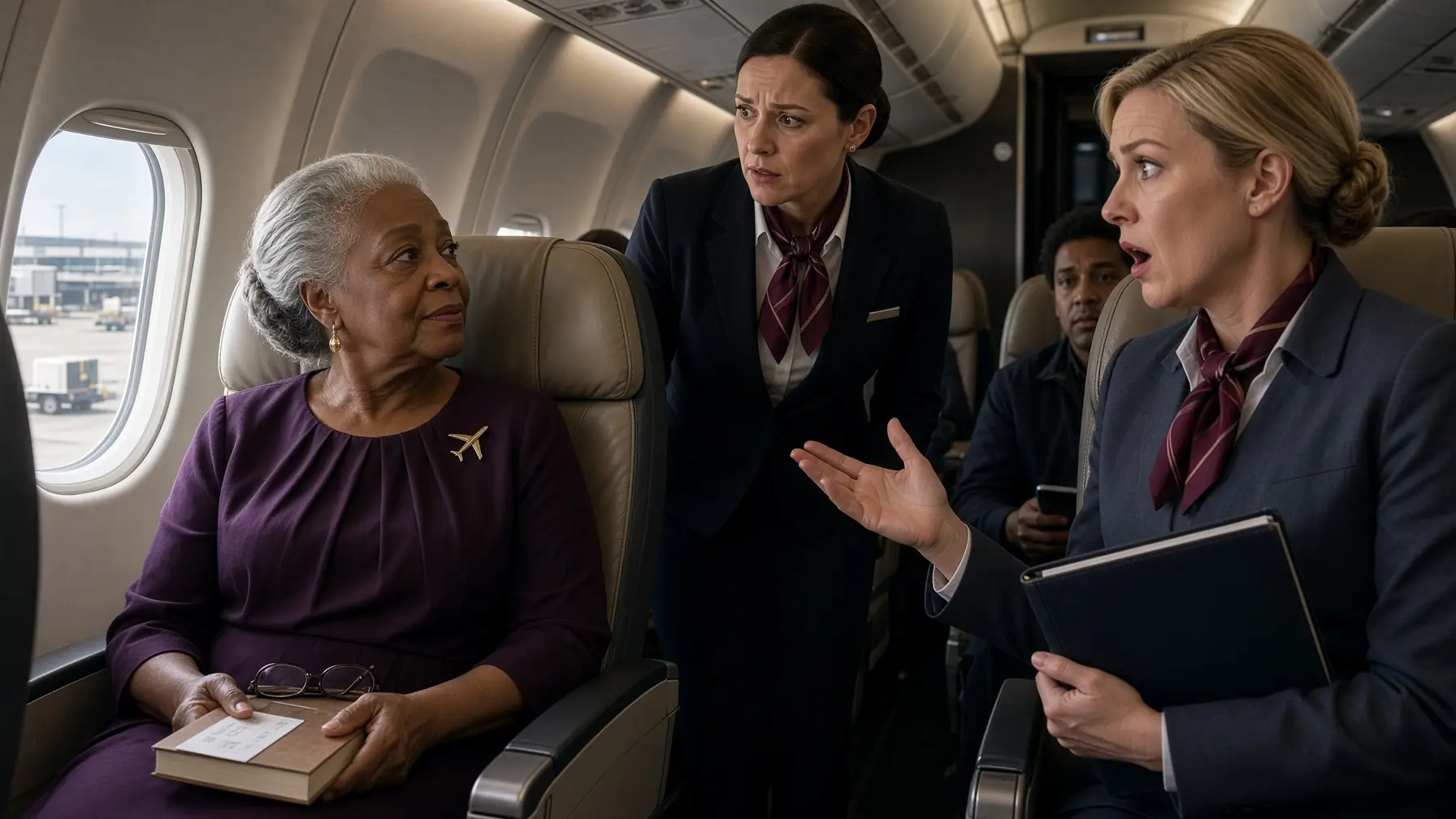
They were turned toward her, not toward the overhead compartments or the passengers farther down the aisle. Whoever stood there had come for her specifically.
Beyond the window, an airport worker guided a baggage cart past the wing. Sunlight lay clean and bright across the concrete at the Atlanta gate, illuminating the ordinary preparations that would eventually lift this airplane into the sky. Inside the cabin, the same light caught the silver in Willa’s neatly styled hair and the small gold airplane pinned to her plum dress.
She had paid for this seat. Her boarding pass rested in her lap, partly beneath the paperback, with 3A plainly printed beside her name.
Yet the woman standing over her held a cabin manifest as though it contained something Willa had failed to understand.
An hour earlier, nothing about the morning had suggested a confrontation.
Willa had arrived at the airport with enough time to walk without hurrying. At seventy-two, she had learned that a rushed beginning could follow a person through an entire day, turning every small inconvenience into another thing to endure. She preferred to leave room for delays rather than spend the morning arguing with them.
Her bag was small enough to manage herself. Its handle had a worn place where her fingers naturally settled, and she had packed it with the same care she used when putting away dishes: heavier things low, useful things within reach, nothing included merely because there was still space.
She wore comfortable brown shoes, chosen for the distance between the entrance and the gate. The plum dress was modest, with a softly pleated neckline that lay flat beneath her coat. Before leaving home, she had checked the brooch’s clasp twice and then forgotten about it until the airport lights brought out its shine.
Travel still asked things of her body that it had once asked without consequence. Her right knee stiffened if she sat too long, and long stretches of polished floor made her grateful for shoes with sensible soles. She disliked having to calculate these things, but disliking them did not remove the need.
At the entrance, she paused out of the stream of people and put her travel documents together. Identification, boarding pass, and the small folded receipt she had kept after choosing the seat all went into the same pocket. She had no intention of searching through a bag while somebody behind her sighed.
Around her, the airport moved with its usual mixture of purpose and confusion. A young man pulled a suitcase with a broken wheel that knocked against the floor at every turn. A couple examined a departure board while their child attempted to climb onto the lower rail of a baggage cart.
Willa stepped around them without resentment. Airports made people think in fragments: a gate number, a pocket, a missing charger, a departure time. Sometimes a person needed a few extra seconds to remember there were other people in the same building.
At security, she followed the gestures of the staff and placed her belongings in the appropriate bins. She was careful with the paperback, laying it on top of her folded coat so its cover would not catch beneath the bag. The book had already survived more than one journey, and she saw no reason to make this one its last.
A woman several places ahead had difficulty gathering everything after the screening. One shoe lay beneath a bench while a laptop, a jacket, and a purse competed for the woman’s hands. Willa waited until there was room to pass rather than squeeze behind her and add another problem.
By the time her own belongings came through, she had worked out the order in which to collect them. Shoes first, documents next, coat over her arm, bag upright. It was a small system, useful precisely because it required no explanation.
She checked that the boarding pass was still in its pocket before moving away.
The terminal beyond security was brighter than she remembered. Morning sunlight entered through tall windows, reaching between rows of seats and across the luggage standing beside them. From somewhere nearby came the smell of coffee strong enough to make her briefly reconsider the cup she had already had at home.
She bought water instead. There was a long line at the coffee counter, and she did not want to spend the first part of her flight regretting an unnecessary second cup.
At a junction between concourses, she stopped beneath a sign and confirmed her direction. Someone passed close enough for the edge of a backpack to brush her sleeve. The person kept moving, apparently unaware, and Willa adjusted the strap of her own bag before continuing.
She did not mistake every careless movement for an insult. Life would have become unbearable if she had.
But she knew the difference between somebody failing to notice her and somebody deciding what she was without looking.
That difference had been part of her education long before she learned how to read airport signs. She had encountered it in shops, in waiting rooms, and across counters where a simple question somehow became an examination of her right to ask it. Age had given her patience, although it had never made those moments pleasant.
Some people imagined composure meant a person felt nothing. Willa knew how much effort could lie beneath an untroubled face.
At the gate for Flight 812, she chose a seat with a clear view of the boarding entrance. The airplane stood just beyond the windows, its nose turned slightly away from the terminal. Workers moved around it with the concentration of people whose tasks depended on other tasks being completed first.
She liked watching those preparations. A suitcase could disappear through a small opening and emerge in another city hours later, and people treated that as routine. There was something reassuring about so much movement being made orderly by ordinary attention.
Her phone remained in her bag. She had checked the time and the flight information before sitting down, and there was no need to keep looking at the same facts merely because everyone around her held a screen.
Instead, she took out the paperback.