Elkhorn, Montana Territory, October 1885.
Norah Callahan had learned, over the six months since her husband died, exactly how to make herself and her daughter invisible in a room.
How to move through a place without asking anything of it, and without letting anyone see quite how little they had left to their name. 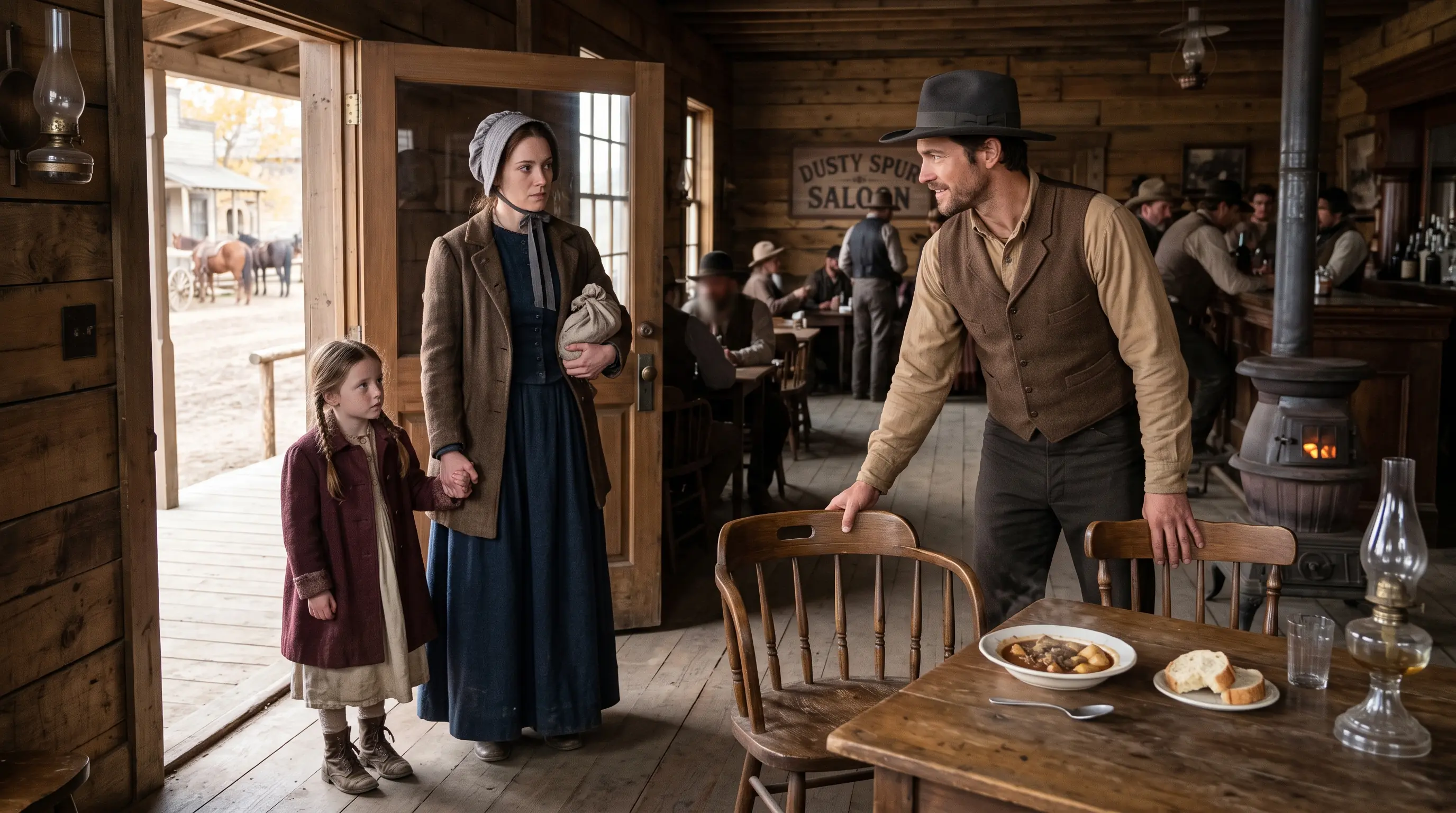
It was a skill no widow should ever have to learn so thoroughly.
She stood just inside the doorway of the Dusty Spur Saloon, her cloth bundle held tight against her side, Eda’s small hand gripped in hers. Both of them were trying to cross the room quietly enough that nobody would notice the state of their boots or the thinness of Eda’s face.
Norah had come only to ask Mr. Dunmore, the saloon keeper, whether he had any cleaning work. Anything. She would have taken anything, scrubbing floors or washing glasses long after closing. He told her, not unkindly but not gently either, that he had nothing for her this month, same as he had told her the month before.
They were nearly to the door when Eda stopped walking. Her small boots scuffed to a halt on the worn floorboards, her eyes fixed on something across the room she could not quite look away from.
Norah followed her daughter’s gaze to a table near the window.
She did not need to ask what had caught Eda’s eye. She had run out of ways to explain hunger to a six-year-old months ago.
The rancher looked up. He looked at Eda’s face. Then, for a long moment, he looked at Norah’s, and something in his expression shifted from simple observation into a decision already half-made. His fork set down against the plate without him seeming to notice he had done it.
“Ma’am,” he said, standing, “would you and your girl care to sit a spell? I ordered more than I can rightly finish, and it’d be a genuine shame to see good food go cold and wasted on a slow afternoon like this one.”
Norah’s husband, Daniel Callahan, had died in April when the mineshaft he had been working near Elkhorn collapsed on a Tuesday morning, along with two other men. All three of them were buried under rock the company took eleven days to clear, though everyone in town had known by the second day there would be no one left alive to find.
Daniel had known the risk, too, same as every man who took the wage anyway. The wage was steady and the alternatives were not, and a young family needed steady more than it needed safe.
He left Norah with Eda, a small rented house at the edge of town, and debts neither of them had known the full size of until the bank came calling that summer, three months after the funeral, when the grief had barely begun to settle into anything manageable at all.
It was money borrowed against the promise of a mining claim that had never paid out. Secured, as it turned out, against the house itself and the one thing of real value Norah owned, the sewing machine her mother had left her. That machine represented the only trade Norah actually knew well enough to earn a living by.
Mr. Abernathy at the Elkhorn Bank had been patient through the summer months, the kind of patience that cost him nothing while the debt continued accruing interest regardless.
By October, his patience had run out. He had given her until the first snow to pay what remained, or the bank would take the house and everything in it, sewing machine included, as settlement.
Norah had spent the six months since April doing every kind of work Elkhorn would give a widow with a young daughter. Laundry, mending, the occasional cleaning job when one came available. Piece by piece, she had discovered that it added up to just barely enough to keep them fed most weeks, and never enough to touch the debt itself.
Sometime in September, she had stopped eating a full meal herself on the days Eda’s portion needed stretching further than the food allowed. She told her daughter she had already eaten while working, a small careful lie so practiced by October that it hardly felt like lying anymore.
Tate Bowen was twenty-eight, ran a modest cattle operation three miles outside Elkhorn, and had grown up himself with a hunger he remembered clearly enough, twenty years later, to recognize instantly in someone else’s child.
His own father had died when Tate was seven, thrown from a horse on a ranch that had gone under within the year. His mother had raised him and two younger sisters on whatever work a widow could find in a territory that did not offer widows very many honest choices.
Tate remembered specific winters with more clarity than he remembered most of his childhood otherwise. The ache of watching his mother claim she was not hungry so the portions would stretch further. The shame of a boy’s stomach growling in a schoolroom where other children’s lunches came wrapped in more than hope.
He remembered, too, the handful of times a neighbor or a teacher had noticed and quietly done something about it. Those small interventions had never once felt like pity. Only like being seen.
He had built his own ranch slowly since then, first as a hired hand, and then by twenty-five as an owner in his own right. He worked through winters that would have broken a less stubborn man and saved every dollar that was not strictly needed for the next season’s seed and stock.
Year after patient year, he had promised himself, somewhere in those hungry years, that he would never again sit comfortably in front of a full plate while a child watched him eat it in silence, having already learned not to ask for anything at all.
He had not known Norah Callahan’s name before that October afternoon. He had simply seen a six-year-old girl’s eyes fixed on his stew with an intensity that told him everything her mother’s careful composure was trying to hide. He had stood up from his table before he had fully decided to, the decision arriving in his legs before it had finished forming in his mind.
Norah’s first instinct was to refuse.
Her second, watching Eda’s eyes, was that refusing on principle was not a luxury she had much room left to afford.
“That’s kind of you,” she said carefully, still hesitant. “But we don’t take charity.”
“Bowen,” he said quietly. “Tate Bowen. And I’d call it charity if I were offering to feed the whole town. Ma’am, I’m offering to share a plate I already paid for and can’t finish with a girl who looks like she hasn’t eaten today. Seems less like charity and more like not letting good food go to waste.”
Eda, without waiting for the adults to finish negotiating the matter, had already climbed into the chair nearest the plate. Norah found herself, despite every instinct toward pride, unable to pull her daughter back out of it.
The sight of her small hands already reaching for a biscuit undid every careful argument Norah had been ready to make.
“Thank you,” Norah said quietly, sitting as well. “We won’t make a habit of it.”
“Didn’t ask you to,” Tate said plainly.
He pushed the plate gently toward the middle of the table, where both of them could reach it, and asked Eda, with the easy patience of a man in no hurry at all, whether she preferred the biscuits with butter or without. As though the whole exchange were simply two friends sharing a meal, rather than anything requiring gratitude at all.
Eda answered him with the first full sentence Norah had heard her daughter offer a stranger in many long months.
Norah watched her daughter’s shoulders come down from around her ears for the first time since April. She had not realized until that exact moment how much she had needed someone else to notice, too.
Around them, the saloon continued its ordinary afternoon business. Nobody else in the room paid the small table by the window any special mind at all, which Norah found, unexpectedly, to be its own kind of mercy.
Tate found reasons over the following weeks to have mending done. Torn work shirts, a saddle blanket that needed patching, curtains for a ranch house that had gone without proper curtains since his mother passed two winters back.
He paid Norah a fair wage for every piece of it. Always in advance. Always without comment on whether the work strictly needed doing.
Norah noticed the pattern within the second week and said nothing about it. She understood it for the careful kindness it was, rather than pointing out how thin the pretense had worn. She was grateful, if she was honest with herself, that he had found a way to help that let her keep something to show for it besides charity.
Norah took the work because refusing it would have meant refusing money Eda needed. She told herself the arrangement was purely practical, even as she found herself taking more care than the mending strictly required, even as Eda began asking on the mornings Norah delivered finished work to the Bowen ranch whether she could come along.
Tate taught Eda to feed the chickens on those visits. He taught her to recognize which of his horses were gentle enough for a small girl’s hand, and which needed a wide berth. Eda began arriving at the ranch with the plain eagerness of a child who had found somewhere she was allowed to simply be a child, rather than a careful, quiet extension of her mother’s worry.
“She hasn’t laughed like that since her father died,” Norah told him one afternoon, watching Eda chase a barn cat across the yard with unrestrained delight.
“Children generally know a safe place when they find one,” Tate said. “Reckon it’s a skill grown folks lose somewhere along the way, worrying too much to trust it plainly.”
Mr. Abernathy came to Norah’s door himself in early November, three weeks earlier than his original deadline. He informed her, with the regret of a man who had decided regret cost him nothing, that a shortfall in the bank’s own accounts meant the deadline was arriving considerably sooner than either of them had planned.
“I’ve collected less than half what’s owed,” Norah said, standing in her own doorway with Eda half hidden behind her skirts, listening carefully to every word passing between the two adults. “I need more time. I’ve worked every day since April, Mr. Abernathy. I haven’t asked for a single day’s grace beyond what you already gave me.”
“I’ve given you since April,” Abernathy said, not unkindly, though the effect was the same as if he had been. “The bank’s patience isn’t unlimited, Mrs. Callahan. Whatever sympathy I might feel personally for your circumstances, I’ll need the house and the machine both by the end of next week, or I’ll be forced to send the sheriff to collect them. I’d rather not do that in front of your girl if it can be avoided.”
Eda had not eaten her breakfast that morning. Norah told Tate later that her daughter had been too worried about her mother’s quiet crying the night before to manage even a bite.
Tate rode into town that same afternoon and sat across from Mr. Abernathy’s desk with a directness that left no room for the banker’s usual careful hedging. His hat was still in his hand, dust from the ride still on his boots.
“What’s the full amount owed?” Tate asked. “And what would it take to convince the bank that a widow with a growing dressmaking and mending trade is a better investment than a foreclosed house nobody in Elkhorn currently has cash to buy?”
She found out about Tate’s visit to the bank before he had the chance to tell her himself. Elkhorn was the kind of town where news outran the people carrying it, and Norah arrived at his ranch that evening with her jaw set in a way Tate had learned over the past month meant an argument was coming.
“You had no right,” she said before he had finished rising from his chair. “That debt is mine to settle, Tate. Not yours to solve quietly behind my back like I’m a problem needing managing.”
“Wasn’t trying to manage you,” Tate said firmly. “I was trying to keep a roof over your daughter’s head, which seemed more urgent than whose pride got bruised settling it.”
“My pride is the only thing I’ve had left to hold on to since April,” Norah said, her voice catching despite her effort to keep it steady. “I’ve taken in laundry. I’ve gone without meals so Eda wouldn’t have to. I have done everything a person can do with dignity intact.”
Her hands trembled once at her sides, and she pulled them still by force.
“And I won’t have you erase all of that by simply solving it for me because it was faster than watching me finish the work myself. You don’t know what it costs a person to hold on to that little bit of control when everything else has already been taken.”
Tate was quiet a long moment.
When he spoke again, his voice had lost its earlier certainty.
“You’re right,” he said. “I should have asked you first. I got scared of Eda losing her home, and I acted on that fear instead of respecting that this was your fight to finish, however you chose to finish it. I’m sorry for that.”
He paused, turning his hat over once in his hands before setting it down entirely.
“What I told Abernathy wasn’t an offer to pay your debt outright. It was an offer to help you prove what your work is actually worth to a man who only understands numbers. That decision is still yours. I should have brought it to you before I brought it to him.”
Norah sat with that a long moment, some of the anger draining out of her at the plainness of the apology. It was the kind that did not try to explain itself out of being wrong.
“Show me what you told him,” Norah said finally. “And then we do the rest of it together, or not at all. I don’t want the debt paid outright. I want work. Real work. Steady enough to pay it down myself, on my own schedule, with my own two hands and nobody else’s charity mixed in with it.”
Neither of them knew it yet, but the following week would test that promise in front of the entire town, with no storm to hide behind and nothing left to blame but the numbers themselves.
The sheriff arrived at Norah’s door exactly one week later. Mr. Abernathy stood behind him with a folded paper in hand, and Norah stood in her own doorway with Eda’s hand gripped tight in hers, watching a stranger prepare to carry her mother’s sewing machine out into the street.
Half the neighborhood had already begun gathering to watch, drawn by how efficiently bad news traveled in a town that size.
“I’ve come to collect what’s owed, Mrs. Callahan,” Abernathy said. Not unkindly, but with the flat finality of a man who had already decided the matter was settled well before he ever rode out to her door that morning. “I gave you every fair chance the bank’s patience allowed.”
“You gave her a chance to fail,” Tate said.
He arrived at a hard trot and swung down before his horse had fully stopped moving, a leather folder held tight under one arm.
“Not a fair one. Look at what’s actually in front of you before you send a man into a widow’s house.”
He handed Abernathy the folder.
Inside was a stack of signed orders from six ranch wives across the county, each one committing to steady mending and dressmaking work through the coming year. It was the kind of guaranteed income no foreclosed house sitting empty through a Montana winter could match.
“That’s more reliable income than half the loans this bank’s currently carrying on its own books,” Tate said. “Restructure the debt against it. Spread it across two years instead of demanding it all at once, and you collect every dollar owed with interest besides. Or you can seize a sewing machine worth a fraction of what it’s owed against, and a house nobody in this county has the cash to buy from you this winter.”
Abernathy studied the folder for a long moment. The whole street was silent around him. Eda’s hand stayed tight in her mother’s. The sheriff himself shifted uncomfortably at having become the center of a scene nobody in it particularly wanted to be part of.
“This is your work,” Abernathy said finally, looking at Norah directly rather than at Tate. “Not his.”
“It’s mine,” Norah said firmly. “Every stitch of it. Mr. Bowen only gathered what was already true and put it where you’d have to look at it plainly.”
Abernathy folded the papers closed slowly. The whole street still watched, waiting.
“My own mother took in washing after my father died,” he said, quiet enough that only those nearest heard it. “I was younger than your girl. I’ve spent twenty years in banking telling myself numbers don’t care whose hands did the work behind them.”
He looked down at the folder again.
“Perhaps that’s the part I’ve been getting wrong.”
He turned to the sheriff.
“We’re not collecting today.”
The sheriff touched his hat and left without a word.
“I’ll have the restructured terms drawn up by Monday, Mrs. Callahan,” Abernathy said. “Two years. Same rate. Secured against the income in this folder instead of your machine.”
The small crowd that had gathered began slowly to disperse. Several of the ranch wives who had signed those orders stopped to squeeze Norah’s hand on their way past.
Norah stood in her own doorway a long moment after the street had emptied. Eda finally let go of her hand to chase after a neighbor’s dog, and Norah found herself, for the first time in seven months, standing on ground nobody was actively trying to take from her.
“You should have asked me before you built that folder, too,” she told Tate, though without much heat left in it.
“I asked Mrs. Pruitt and the others myself, with your name on every line,” Tate said. “But I brought it to you before I ever walked it into that bank. Reckoned that was the part I’d learned to get right this time.”
She found him mending fence the following week. The debt had been settled into restructured terms, and the whole ordeal was finally behind them. The question she had been avoiding all autumn had answered itself somewhere in the space of that single tense afternoon.
The folder of contracts still sat on her kitchen table where she had left it, a physical reminder of exactly what her own two hands had already built before anyone stepped in to help her prove it.
“I want to set up a proper shop in town,” she told him. “Not just mending taken in at the kitchen table. A real trade, with my name on the sign, built on exactly what that folder proved was already true.”
“It’ll do well,” Tate said, setting down the wire cutters. “Half the county already knows your work’s worth paying for.”
“Is that all you have to say about it?” Norah asked.
“No,” Tate said.
He stood slowly, dusting his hands against his trousers.
“I’ve spent two months watching you hold your whole world together with nothing but stubbornness and a sewing needle, and I’d like the chance to spend considerably longer than two months doing it alongside you instead of just admiring it from a distance. That’s a business proposal and something else besides, if you’ll have both.”
Norah looked at this man who had learned, in the space of a single argument, exactly how to help without taking over. Who had waited for her to choose rather than deciding for her.
“Yes,” she said. “I’ll have both.”
They married in January once the debt terms were fully settled and the worst of the winter had passed. It was a small ceremony at the Elkhorn church with half the county in attendance, including Mr. Abernathy, who told anyone who asked that he had simply made a sound business decision.
He never quite managed to explain, when pressed, why he had stood at the back of the church that day looking considerably more moved than a sound business decision usually left a man looking.
Norah opened her dress shop that spring in a small storefront on Elkhorn’s Main Street. It was built on the same six contracts Tate had once carried into the bank in a leather folder, and she grew the trade steadily from there.
Within the first year, she hired a second seamstress, a widow herself, and made a quiet point of paying a fair wage without ever once making the woman feel pitied for needing it.
Within two years, Norah’s shop was the one every ranch wife in the county mentioned first when asked where to have a dress properly made.
Eda grew up largely at the Bowen ranch, calling Tate “Papa” within the year without anyone having asked her to. She never again went to bed hungry a single night in her life, a fact Tate made quietly and permanently certain of every single day without ever once making a show of it.
She learned to ride by the time she was eight, and to sew nearly as well as her mother by ten, carrying pieces of both of them forward in equal measure.
Norah kept framed on the wall of her shop the first receipt Tate had ever paid her for mending a torn work shirt. Three cents’ worth of thread.
Not because the amount mattered, but because it marked, she told customers who asked, the exact day someone had first noticed her working hard enough to deserve to be paid for it properly, rather than pitied for needing the money at all.
Twenty years before Tate ever met Eda, he had been the hungry child nobody noticed fast enough. That was the detail that broke something open in the story. Not the folder full of contracts. Not even the plate of stew.
Just a man finally getting to be, for somebody else’s child, the person he had needed at seven years old and never quite received in time.
Norah spent six months insisting she needed nothing from anyone, and she was not wrong to insist on it. Pride, held on to carefully, was sometimes the only thing keeping a person upright when everything else had already been taken from them.
But the thing that saved her was not Tate rescuing her from a debt.
It was Tate learning, in the space of one hard conversation, the difference between solving a problem for someone and standing beside them while they solved it themselves. A lesson plenty of well-meaning people never manage to learn at all, no matter how many times life gives them the chance.
Eda got a father who remembered hunger well enough to make sure she never had to.
Norah got a partner who learned the first time he got it wrong exactly how to get it right the second time.
That was not a small thing in a man.
And it was not a small thing in a story.