The dust kicked up around her worn boots as Rebecca Bradford stumbled into Paso Robles, California, in the summer of 1877.
Her dress was torn at the hem, and her eyes were hollow with a grief that seemed to have carved itself into her very bones.
She had walked for three days straight after the stagecoach accident that claimed her father's life, the only family she had left in this unforgiving world.
The sun beat down mercilessly on Main Street as she collapsed against a wooden post outside the general store, her legs finally giving out beneath her.
People passed by, some glancing with curiosity, others with suspicion.
A woman traveling alone was unusual, and a woman in her condition even more so.
"Miss, you all right there?"
A deep voice cut through the haze of exhaustion clouding her mind.
Rebecca looked up slowly, squinting against the bright afternoon light.
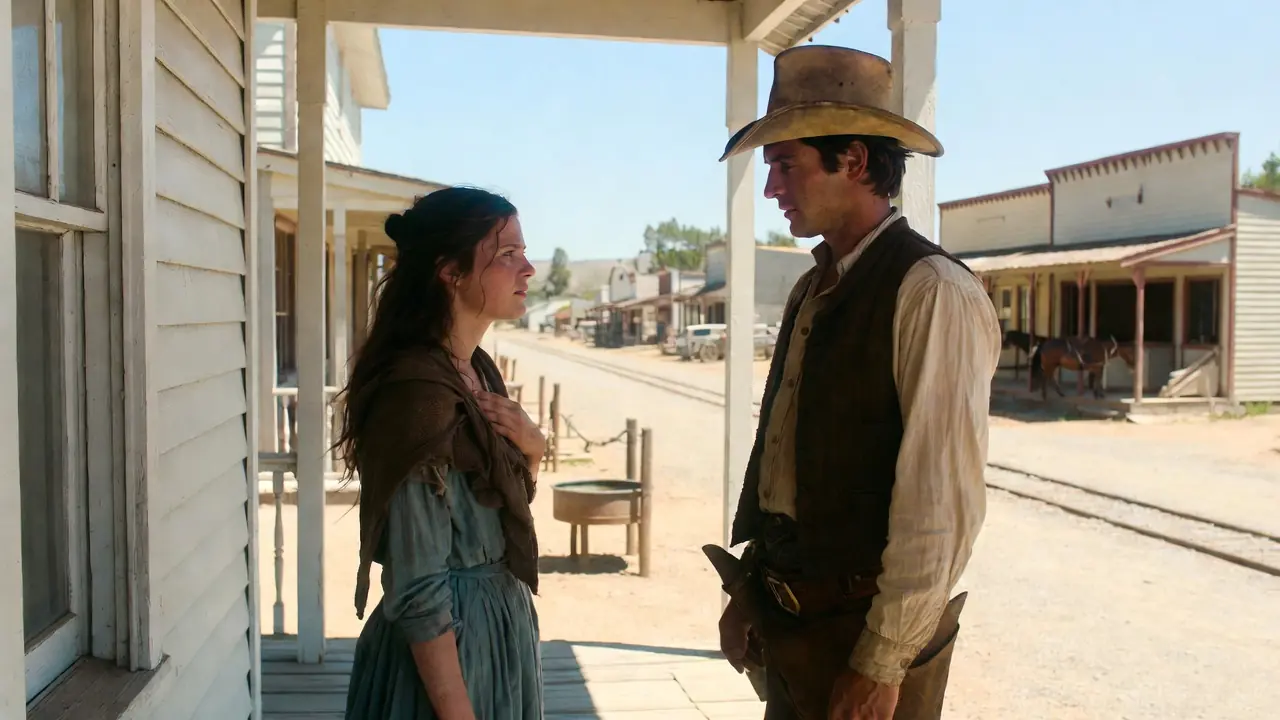
Standing before her was a man in his mid-20s, tall and broad-shouldered, with sun-weathered skin and eyes the color of aged whiskey.
He wore dusty leather chaps over worn denim, a simple cotton shirt, and a hat that had seen better days.
His face was honest, open, concerned.
"I'm fine," she managed to whisper, though her parched throat made the words come out cracked and broken.
"You don't look fine, if you'll pardon me saying so."
He crouched down to her level, keeping a respectful distance.
"Name's Fletcher Evans. I work at the ranch just outside town. When's the last time you had water?"
Rebecca tried to remember, but the days had blurred together.
"I don't know."
Fletcher turned his head and called out to someone.
"Tommy, bring some water from inside, quick."
He looked back at her, his expression softening.
"Let's get you somewhere you can rest properly. Can you stand if I help you?"
She wanted to refuse, wanted to maintain some shred of dignity, but her body had other plans.
When she tried to nod, the world tilted sideways.
Fletcher moved quickly, catching her before she hit the ground, his strong arms supporting her weight with ease.
"Easy now," he said gently. "I've got you."
A young boy ran out with a canteen, and Fletcher carefully helped Rebecca drink, making sure she took small sips so she wouldn't make herself sick.
The water was like salvation, cool and clean, and she felt a tiny bit of strength return to her limbs.
"There's a boarding house just down the street," Fletcher said. "Mrs. Patterson runs it. She's good people. Let me take you there."
"I don't have money," Rebecca admitted, the shame of it burning her cheeks.
Everything had been lost in the accident, including her father's savings that he had been carrying to start their new life in California.
Fletcher didn't hesitate.
"Don't worry about that right now. Let's just get you somewhere safe."
He helped her walk, taking most of her weight on his shoulder, moving slowly down the wooden sidewalk.
People stared, and Rebecca heard whispers following in their wake, but Fletcher paid them no mind.
His focus remained entirely on her, making sure she didn't stumble, murmuring quiet encouragements when her steps faltered.
The boarding house was a two-story structure painted white with a neat porch and curtained windows.
Fletcher knocked on the door, and a plump woman in her 50s answered, her gray hair pulled back in a sensible bun.
"Fletcher Evans, what have you brought to my doorstep?"
Mrs. Patterson's tone was stern, but her eyes were kind.
"Found her collapsed outside the general store, Mrs. Patterson. She needs a place to rest and recover. I'll vouch for her room and board."
Mrs. Patterson studied Rebecca for a long moment, then nodded briskly.
"Bring her in. Third room on the left upstairs. And Fletcher, you stay downstairs while I get her settled."
"Yes, madam."
The room was simple but clean, with a bed covered in a handmade quilt, a washstand, and a small wardrobe.
Mrs. Patterson helped Rebecca out of her filthy dress and into a clean nightgown, all while asking gentle questions.
"Where did you come from, dear?"
"Missouri," Rebecca answered, her voice still rough. "My father and I were heading west. There was an accident with the stagecoach. He didn't survive."
Mrs. Patterson's expression softened with genuine sympathy.
"I'm so sorry for your loss. Do you have other family?"
"No. He was all I had."
The words felt like stones dropping into still water, sending ripples of pain through her chest.
"Rest now," Mrs. Patterson said, pulling the quilt up over Rebecca. "We'll sort everything out once you're stronger. Fletcher's a good man, one of the best I know. If he's vouched for you, that means something in this town."
After Mrs. Patterson left, Rebecca lay in the soft bed, staring at the ceiling.
Tears leaked from the corners of her eyes, trailing down into her hair.
She had been so strong for so long, had held herself together through the accident, through burying her father in an unmarked grave beside the road because she had no tools to dig properly.
Through the long walk with no food and little water.
But now, in this quiet room with clean sheets and the promise of safety, everything came crashing down.
When Rebecca woke, evening light was slanting through the window, painting everything in shades of gold and amber.
She felt better, stronger, though her heart still carried the weight of her loss.
There was a tray on the small table beside the bed with bread, cheese, and a glass of milk.
Her stomach growled fiercely at the sight.
She ate slowly, savoring every bite, then washed her face in the basin.
Someone had left a simple blue dress draped over the chair along with fresh undergarments.
The dress fit reasonably well, if a little loose in places.
Rebecca braided her dark hair, pinned it up as best she could without proper pins, and ventured downstairs.
Mrs. Patterson was in the parlor knitting by lamplight.
She looked up when Rebecca appeared and smiled.
"You have more color in your cheeks. That's good. Fletcher left money for two weeks' room and board. He also left word that when you're feeling up to it, there might be work available at the ranch where he works. The owner's wife needs help with the household."
"That's very kind of him," Rebecca said quietly. "I don't even know him."
"Fletcher's like that. He found a lost dog once and rode 20 miles to return it to its owner. He's got a good heart."
Mrs. Patterson set down her knitting.
"There's stew on the stove. If you're still hungry, help yourself."
Rebecca did feel hungry despite the bread and cheese.
She went to the kitchen and ladled some stew into a bowl.
It was rich with vegetables and beef, seasoned perfectly, and she ate every drop.
Over the next few days, Rebecca gradually regained her strength.
Mrs. Patterson proved to be excellent company, full of stories about the town and its inhabitants.
Fletcher came by every evening after his work at the ranch, always polite, always respectful, checking on how she was doing.
"You don't have to keep checking on me," Rebecca told him on the fourth evening as they sat on the porch. "You've already done so much."
"I want to," Fletcher said simply.
He was leaning against the porch railing, his hat in his hands, turning it slowly.
"If you don't mind me asking, what were you and your father planning to do in California?"
"He had heard about opportunities here. Land, work, a fresh start."
Rebecca folded her hands in her lap.
"We had nothing left in Missouri. My mother died when I was 16, and after that, it was just the two of us. He worked so hard to save enough for the journey."
"I'm real sorry," Fletcher said, and the sincerity in his voice made her eyes sting with fresh tears. "Losing family is the hardest thing."
"Have you lost people?" she asked.
He nodded slowly.
"My parents when I was 19. Fever took them both within a week of each other. My younger sister went to live with our aunt in San Francisco. I stayed here, worked at the ranch. Mr. Douglas, the owner, he took me on when I had nothing. Gave me purpose when I needed it most."
They sat in companionable silence for a while, listening to the sounds of the evening settling in around Paso Robles.
A dog barked in the distance.
Someone was playing a fiddle somewhere down the street.
The air smelled of dust and the roses Mrs. Patterson kept in her garden.
"I talked to Mrs. Douglas," Fletcher said eventually. "About the position. She'd like to meet you tomorrow if you're feeling up to it."
"I am," Rebecca said.
She needed work, needed purpose.
Sitting idle made her think too much about everything she had lost.
"Thank you, Fletcher, for everything. I don't know how I'll ever repay you."
He looked at her, then really looked at her, and something in his gaze made her breath catch.
"You don't owe me anything, Rebecca. Sometimes we all need help. There's no shame in that."
But there was shame, burning hot in her chest.
She had been raised to be self-sufficient, to stand on her own two feet.
Depending on the kindness of a stranger, no matter how genuine, felt like weakness.
As if sensing her thoughts, Fletcher added quietly.
"My pride almost killed me after my parents died. I didn't want help, didn't want charity. Mr. Douglas told me something I've never forgotten. He said that letting people help you isn't weakness. It's trust. And trust is one of the bravest things a person can offer."
Rebecca considered his words, turning them over in her mind.
"What if I break that trust?"
"Then we'll deal with it if it happens, but I don't think you will."
He put his hat back on and stood.
"I'll come by tomorrow morning to take you to the ranch if that suits you."
"It does. Thank you."
After he left, Rebecca sat on the porch for a long time, watching the stars emerge one by one in the darkening sky.
For the first time since the accident, she felt a small flutter of something that might have been hope.
The next morning dawned clear and bright.
Rebecca dressed carefully in the blue dress, wishing she had something nicer to wear for the interview.
Mrs. Patterson insisted she eat a good breakfast before Fletcher arrived.
"You'll do fine," the older woman assured her. "Mrs. Douglas is particular, but she's fair. Just be honest with her."
When Fletcher arrived with a wagon, Rebecca climbed up beside him, acutely aware of how close they sat on the narrow bench.
He guided the horses out of town, taking a well-worn road that led through rolling hills dotted with oak trees.
"The ranch is about five miles out," Fletcher explained. "Mr. Douglas raises cattle and horses. It's good land, reliable water source. I work mostly with the horses. Always had a way with them."
"Do you live on the ranch?"
"There's a bunkhouse for the ranch hands. It's not fancy, but it's home."
He glanced at her.
"If Mrs. Douglas hires you, you'd stay in the main house. There's a room off the kitchen for household help."
Rebecca nodded, trying to calm her nerves.
She needed this position.
Without it, she would be dependent on Fletcher's charity, and that thought was unbearable.
The ranch came into view as they crested a hill.
It was larger than Rebecca had expected, with a sprawling house, several barns, corrals full of horses, and vast pastures where cattle grazed.
Everything looked well-maintained and prosperous.
Fletcher pulled the wagon up to the main house and helped Rebecca down.
His hands were warm and steady on her waist, and he held on just a moment longer than necessary before releasing her.
"You'll do fine," he said encouragingly. "Just be yourself."
Mrs. Douglas answered the door herself, a tall woman in her 40s with dark hair streaked with gray and intelligent brown eyes.
She looked Rebecca up and down, her expression neutral.
"You must be Miss Bradford. Fletcher has told me about your circumstances. Please come in."
The interior of the house was comfortable and tastefully furnished, showing signs of a woman's touch in the curtains and rugs and careful arrangement of furniture.
Mrs. Douglas led Rebecca to a sitting room and gestured for her to take a seat.
"Fletcher, you can go about your work. I'll send Miss Bradford back to town with Joseph later if needed."
"Yes, madam."
Fletcher tipped his hat to both of them and left, though Rebecca saw him glance back at her with an encouraging smile.
Once they were alone, Mrs. Douglas settled into her chair and folded her hands.
"I understand you've had a difficult journey. I'm sorry for the loss of your father. However, I need to know if you're capable of the work I require. Can you cook?"
"Yes, madam. My mother taught me before she passed. I've been keeping house for my father for four years."
"Can you sew? Mend clothes, do basic needlework?"
"I can."
"The position involves cooking, cleaning, laundry, and helping me with various household tasks. The work is demanding, especially during busy seasons when we have extra ranch hands to feed. Room and board are included along with a monthly wage. Do you have any questions?"
Rebecca took a breath.
"I'm a hard worker, Mrs. Douglas. I won't let you down, but I need to be honest with you. I've lost everything. I don't even have proper clothes beyond this dress Mrs. Patterson loaned me. If you give me this chance, I'll do everything in my power to prove myself worthy of it."
Something shifted in Mrs. Douglas's expression, a slight softening around her eyes.
"I appreciate your honesty. Fletcher vouching for you means a great deal. He's an excellent judge of character. When can you start?"
Relief flooded through Rebecca so intensely she almost felt dizzy.
"Whenever you need me."
"Tomorrow. Then I'll send Fletcher to collect you in the morning. We'll start with a trial period of one month, and if things work out, the position is yours permanently."
"Thank you, Mrs. Douglas. I promise you won't regret this."
"I don't think I will."
The older woman stood and extended her hand.
Rebecca shook it, noting the firm grip.
"Welcome to the Douglas Ranch, Miss Bradford."
A different ranch hand, Joseph, took Rebecca back to town in a wagon.
He was older, weathered, and didn't speak much, but he was courteous enough.
When they arrived at the boarding house, Mrs. Patterson was eager to hear the news.
"She hired me," Rebecca told her, unable to keep the smile from her face. "I start tomorrow."
"That's wonderful. Oh, this calls for a celebration. I'll make a special supper tonight."
That evening, Fletcher came by as usual, and Mrs. Patterson insisted he join them for the meal.
It was a lively affair, with Mrs. Patterson telling stories and Fletcher adding his own observations.
Rebecca found herself laughing for the first time in weeks, really laughing until her sides hurt.
After supper, she and Fletcher sat on the porch again, watching the sun set in brilliant streaks of orange and pink.
"Thank you for believing in me," Rebecca said softly. "You didn't have to. You could have just walked past me that day."
Fletcher was quiet for a moment.
"I don't think I could have. When I saw you there, you looked so lost. It reminded me of how I felt after my parents died. If Mr. Douglas hadn't taken a chance on me, I don't know where I'd be now. Maybe I can't repay him directly, but I can pass that kindness forward."
Rebecca turned to look at him.
In the fading light, his face was all planes and angles, handsome in a rough, humble way.
"Is that all it is? Passing kindness forward?"
He met her eyes, and something electric passed between them.
"I'd be lying if I said that was the only reason. There's something about you, Rebecca. Something strong, even in your brokenness. I see you trying so hard to hold yourself together, and I want to help. Not because I pity you, but because I think you're worth helping."
The words struck something deep inside her.
"I whispered to myself every night on the walk here that I was broken," she admitted, her voice barely above a whisper. "That everything inside me had shattered and would never be whole again."
Fletcher reached out slowly, giving her time to pull away if she wanted, and took her hand in his.
His palm was calloused from hard work, warm and solid.
"Then let me help you heal. Not fix you, because you're not something that's broken beyond repair, but help you heal. Help you find yourself again. Let me be your friend, if nothing else."
Tears pricked Rebecca's eyes, but these were different from the tears of grief she had cried so many of.
These were tears of something else, something like gratitude mixed with the first fragile shoots of hope.
"I'd like that. I'd like a friend."
He squeezed her hand gently.
"Then that's what we'll be. And Rebecca, you're stronger than you know. You walked for three days alone. You survived. You're still standing. That's not broken. That's courage."
She held on to his hand like it was an anchor.
And for the first time since her father died, she felt like maybe, just maybe, she would be all right.
The next morning, Fletcher arrived early with the wagon.
Rebecca had already said her goodbyes to Mrs. Patterson, who had tearfully insisted she visit whenever she had time off.
"That woman has been lonely," Fletcher observed as they drove toward the ranch. "Her husband died five years ago, and she never had children. I think she enjoyed having you there."
"I'll visit," Rebecca promised. "She's been very kind to me."
At the ranch, Mrs. Douglas showed Rebecca to her room, a small but comfortable space with a real bed, a dresser, and a window overlooking the garden.
It was more than Rebecca had dared hope for.
The work was indeed demanding.
Rebecca woke before dawn to start breakfast for the ranch hands, a group of eight men, including Fletcher, who ate in the bunkhouse dining area.
Then she helped Mrs. Douglas with the main house, learning the older woman's routines and preferences.
Mrs. Douglas proved to be a patient teacher, showing Rebecca where everything was kept and how she liked things done.
She was exacting but never cruel, and Rebecca found herself wanting to meet those high standards.
Fletcher often found excuses to come by the main house during the day.
He would need to discuss something with Mr. Douglas or check on a horse in the nearby corral, and somehow he always managed to catch Rebecca's eye and smile.
Those small moments became the highlights of her days.
The other ranch hands were respectful enough, though Rebecca caught some of them staring at her with curiosity.
One of the younger ones, a man named Peter, seemed particularly interested, always trying to engage her in conversation during meals.
Fletcher, she noticed, became distinctly cool toward Peter during these times.
A week into her employment, Rebecca was hanging laundry in the yard when Fletcher approached, leading a beautiful chestnut mare.
"Thought you might like to meet Rosie," he said. "She's the gentlest horse we have."
Rebecca approached carefully, extending her hand for the mare to sniff.
Rosie's nose was soft as velvet against her palm.
"She's beautiful."
"You know how to ride a little?"
"My father taught me when I was younger, but we sold our horses before we left Missouri."
Fletcher's face lit up.
"Would you like to learn properly? I could teach you if you have time. Mrs. Douglas gives you Sunday afternoons off, doesn't she?"
"She does," Rebecca confirmed.
The idea of spending that time with Fletcher made her pulse quicken in a way that had nothing to do with fear.
"I'd like that very much."
So began their Sunday tradition.
Every week after church services, which the Douglas family attended and encouraged their household to join, Fletcher would meet Rebecca at the stables.
He was a patient, thorough teacher, showing her how to properly saddle a horse, how to sit correctly, and how to communicate with the animal beneath her.
"Horses can sense your emotions," he explained one afternoon as Rebecca sat astride Rosie, getting used to the feel of being mounted. "If you're nervous, they'll be nervous. You have to be calm, confident. Let her know you trust her, and she'll trust you back."
"Like people," Rebecca observed.
Fletcher grinned up at her.
"Exactly like people, though sometimes I think horses are more honest than people."
As the weeks passed, Rebecca grew more confident in the saddle.
Fletcher took her on longer rides, showing her the beautiful landscape surrounding the ranch.
They rode through oak-studded hills, along creeks lined with willows, through meadows of wild grass that rippled like water in the wind.
During these rides, they talked about everything and nothing.
Fletcher told her about growing up in California, about his dreams of one day having his own small ranch.
Rebecca shared memories of her childhood in Missouri, the good times before her mother's death, her father's quiet strength.
"He would have liked you," she told Fletcher one afternoon as they let the horses drink from a creek. "My father, I mean. He always said a man's character shows in how he treats those who can do nothing for him."
"You've done plenty for me," Fletcher said softly.
"What do you mean? You've done everything for me."
He looked at her, and the intensity in his eyes made her breath catch.
"You've given me something to look forward to. Before you came, every day was the same. Good days, don't get me wrong. I like my work, like the people I work with, but it was all routine. Now I wake up excited because I might see you smile. I think about what stories I want to tell you, what places I want to show you. You've made everything brighter."
Rebecca's heart pounded in her chest.
"Fletcher, I..."
"You don't have to say anything," he interrupted gently. "I know it hasn't been that long. I know you're still healing from losing your father. I just wanted you to know how I feel. No pressure, no expectations, just the truth."
She dismounted from Rosie, needing solid ground beneath her feet.
Fletcher did the same, and they stood facing each other beside the creek, the horses forgotten behind them.
"The truth is," Rebecca said slowly, carefully, "that you've become the best part of my days, too. When I'm working, I listen for your voice. When I see you coming, everything feels lighter. And that terrifies me because I lost everyone I ever loved, and I don't know if I can survive losing anyone else."
Fletcher stepped closer slowly, giving her every chance to move away.
When she didn't, he reached up and gently cupped her face in his hands.
"I can't promise nothing bad will ever happen. Life doesn't work that way. But I can promise that I'm here now, and I want to be here for as long as you'll have me."
"I'm scared," she whispered.
But even as she said it, she was leaning into his touch.
"Me too," he admitted. "Caring about someone is always scary. But Rebecca, you're worth being scared for."
He kissed her then, soft and sweet and careful, and Rebecca felt something inside her chest crack open, not breaking, but opening like a flower turning toward the sun.
She kissed him back, her hands coming up to grip his shirt.
And for that moment, everything else fell away.
When they finally pulled apart, both breathing hard, Fletcher rested his forehead against hers.
"I've wanted to do that for weeks."
"I'm glad you did," Rebecca said, and then she laughed, surprised by the joy bubbling up inside her. "I'm really glad you did."
They rode back to the ranch hand in hand, both grinning like fools.
That night, Rebecca lay in her bed and touched her fingers to her lips, remembering the kiss, and felt something she hadn't felt in so long.
Happiness.
Pure, uncomplicated happiness.
Of course, not everyone was pleased with the development.
Peter made a few snide comments about Fletcher courting the help, which earned him a black eye and a warning from Mr. Douglas himself.
The ranch owner made it clear that anyone who disrespected Rebecca would be looking for work elsewhere.
Mrs. Douglas, however, seemed quietly approving.
She said nothing directly, but Rebecca noticed her smiling when Fletcher found excuses to linger in the kitchen, or when Rebecca's cheeks flushed pink at the mention of his name.
Fall arrived, painting the hills in shades of gold and russet.
The ranch work intensified as they prepared for winter, and Rebecca's days grew longer and more tiring.
But Fletcher was always there with an encouraging word, a gentle touch when no one was looking, stolen moments that kept her going.
One evening in October, after everyone else had gone to bed, Fletcher knocked softly on the kitchen door.
Rebecca let him in, her heart racing at the impropriety of it, but unable to send him away.
"I couldn't sleep," he said, his hat in his hands. "Kept thinking about you."
"That seems to be going around," Rebecca teased gently.
She had been lying awake, too, remembering the feeling of his arms around her during their last riding lesson, when he had held her close to demonstrate proper posture.
They sat at the kitchen table, speaking in whispers, sharing cold cornbread and milk.
Fletcher told her about a difficult horse he had been training.
Rebecca described the new recipe she was trying for the upcoming harvest celebration.
"Rebecca," Fletcher said eventually, his voice serious. "I need to tell you something."
Her stomach clenched with worry.
"What is it?"
"I've been saving my wages for years now. I'm close to having enough to buy a piece of land, start my own small operation. Nothing as big as the Douglas place, but enough for some horses, maybe some cattle, a house."
He paused, gathering courage.
"I know it's only been a few months. I know that by most standards, we should wait longer, but I also know what I feel, and I don't see that changing. Rebecca Bradford, I'm in love with you. Completely, totally in love with you. And if you'll have me, I want to spend the rest of my life proving it to you."
Rebecca's breath caught in her throat.
"Fletcher..."
"You don't have to answer now," he said quickly. "Take all the time you need. I just wanted you to know my intentions. They're honorable, and they're serious."
But Rebecca found she didn't need time.
She had spent months watching this man, learning his character, seeing his kindness and strength and unwavering integrity.
She had seen how he treated animals with gentleness, how he helped the younger ranch hands learn, how he spoke respectfully to everyone regardless of their station.
She had felt the way her heart lightened when he was near, how his absence left an emptiness in her chest.
"I love you, too," she said, and watched his face transform with joy. "I think I've loved you since you caught me when I fainted. Since you looked at me and saw someone worth saving. You've helped me heal in ways I didn't know I needed. The broken parts of me, the grief and the fear, they're still there, but they're not all of me anymore. There's also happiness now, and hope, and love. So much love."
Fletcher pulled her into his arms, holding her tight against his chest.
She could hear his heart pounding, matching the rhythm of her own.
"Say you'll marry me," he murmured into her hair. "Say you'll let me spend every day trying to make you happy."
"Yes," Rebecca said, laughing and crying at the same time. "Yes, Fletcher Evans, I'll marry you."
He kissed her then, deep and passionate, and Rebecca let herself fall completely into it, into him, into this love that had grown from the ashes of her grief.
They went to Mr. and Mrs. Douglas the next morning to share their news.
Mr. Douglas, a quiet man with steel-gray hair and shrewd eyes, regarded them thoughtfully.
"Fletcher, you've been with us five years now. You're one of the best men I've ever employed, and I mean that in every sense of the word."
He turned to Rebecca.
"And Miss Bradford, you've proven yourself invaluable to my wife and this household. I assume you'll want to move forward with your plans for your own place."
"Yes, sir," Fletcher said. "I've been saving, and I've had my eye on the Parker property, the 40 acres that borders your southern pasture. Old Mr. Parker passed last year, and his son is willing to sell."
"That's good land," Mr. Douglas acknowledged. "Tell you what, I'll match whatever you've saved. Consider it a wedding gift and payment for loyal service. That should give you enough not just for the land, but to build a proper house and get your operation started. In return, I'll hire you as a contractor for breaking horses. I'll send horses your way, pay you fair prices for the training. That way, you'll have steady income while you build up your herd."
Fletcher looked stunned.
"Sir, I can't accept."
"You can, and you will," Mr. Douglas said firmly. "You've earned it, son. Besides, it's good business for me. I know your work, and I trust it."
Mrs. Douglas beamed at them both.
"I'm so happy for you. When are you thinking of having the wedding?"
"We haven't discussed it yet," Rebecca admitted.
"Have it here," Mrs. Douglas offered immediately. "We'll host it at the ranch, say a month from now. That will give us time to prepare properly, but not so long that you're waiting forever."
The wedding preparations consumed the next weeks.
Mrs. Douglas enlisted the help of other women in the area, and what had started as a simple affair grew into something more elaborate.
A dressmaker was brought in to make Rebecca a proper wedding dress, a beautiful confection of cream-colored silk that made her feel like royalty.
Fletcher worked longer hours than ever, helping with the purchase and initial improvements to their land.
He was building a house, he told Rebecca, determined to have at least the basic structure completed by the wedding so she could see their home.
"You don't have to do all this," Rebecca said one Sunday when he looked exhausted. "I'd marry you in a barn if that's all we had."
"I know you would," Fletcher said, pulling her close. "But I want to give you more than that. I want to give you everything."
The night before the wedding, Rebecca stood in her small room at the ranch, looking at the wedding dress hanging on the wardrobe.
Tomorrow, she would marry Fletcher Evans, would become Rebecca Evans.
The thought filled her with joy and just a touch of nervousness.
There was a soft knock on her door.
When she opened it, Mrs. Douglas stood there holding a small wooden box.
"May I come in?"
"Of course."
Mrs. Douglas sat on the bed and opened the box, revealing a delicate gold locket.
"This was my mother's. She gave it to me on my wedding day, and I'd like to give it to you on yours. You've become like a daughter to me these past months, Rebecca. I couldn't be happier that you're marrying Fletcher. You're both good people, and you deserve this happiness."
Rebecca accepted the locket with trembling hands.
"Thank you for everything. If you and your husband hadn't given me a chance, I don't know where I'd be now."
"You'd have found your way," Mrs. Douglas said confidently. "You're a survivor, Rebecca. But I'm glad your way led here, to our ranch, to Fletcher."
That night, Rebecca barely slept, too excited about the day to come.
When dawn finally broke, Mrs. Douglas and several other women descended on her room to help her prepare.
They styled her hair, helped her into the dress, and adorned her with simple but elegant jewelry.
When Rebecca finally looked at herself in the mirror, she hardly recognized the woman staring back.
Gone was the broken, desperate girl who had stumbled into Paso Robles six months ago.
In her place stood a bride, radiant with happiness, ready to start a new chapter of her life.
The wedding took place in the afternoon on the lawn of the Douglas Ranch.
Chairs had been set up, and the whole community had turned out for the celebration.
Rebecca stood at the back, her arm linked with Mr. Douglas's.
He had offered to walk her down the aisle, and she had accepted gratefully.
"Your father would be proud," he murmured as the music started. "You've become a fine woman, Rebecca."
Then they were walking, and Rebecca saw Fletcher standing at the front, looking more handsome than she had ever seen him.
He wore a new suit, his hair was neatly combed, and when he saw her, his whole face lit up with such love that Rebecca felt tears prick her eyes.
The ceremony was simple but beautiful.
The local minister spoke about love and commitment, about two people becoming one family.
When it came time for the vows, Fletcher took Rebecca's hands and spoke from his heart.
"Rebecca, six months ago, I found you when you were at your lowest. But even then, I saw your strength. I saw your courage. You've taught me what it means to be resilient, to keep going, even when everything seems lost. I promise to stand by your side through whatever life brings us. I promise to make you laugh when you're sad, to hold you when you're scared, to celebrate your joys and help carry your sorrows. I promise to love you with everything I am for all the days of my life."
Rebecca's voice shook as she replied, but her words were clear and true.
"Fletcher, you saved my life. Not just physically, but in every way a person can be saved. You saw me when I was broken, and you didn't try to fix me. You just offered your hand and walked beside me while I healed myself. You've shown me that love doesn't have to hurt, that it can be gentle and strong at the same time. I promise to be your partner, your friend, your love. I promise to build a life with you, to face whatever comes together. I promise to love you with my whole heart forever."
When the minister pronounced them husband and wife, Fletcher kissed Rebecca with such tenderness and joy that the crowd erupted in cheers.
They turned to face their friends and neighbors as Mr. and Mrs. Fletcher Evans, and Rebecca felt a completeness she had never known before.
The celebration lasted long into the evening.
There was food and music and dancing.
Rebecca danced with Fletcher until her feet hurt, laughed until her sides ached, and felt more loved and welcomed than ever before in her life.
As the sun set and the party began to wind down, Fletcher led Rebecca to the wagon he had decorated with ribbons.
Everyone cheered and threw rice as they drove away toward their new home.
The house Fletcher had built was small but solid, with two rooms downstairs and a loft above.
He had furnished it simply but carefully with a bed he had bought in town, a table and chairs he had made himself, and a rocking chair by the fireplace.
"It's not much yet," Fletcher said, suddenly nervous. "But we'll add to it. We'll make it a real home."
Rebecca turned to him, her eyes shining.
"It's perfect. It's ours."
He swept her up in his arms, carrying her over the threshold, and they both laughed at the tradition of it.
Inside, he set her down gently and cupped her face in his hands.
"I love you, Rebecca Evans."
"I love you, too, Fletcher Evans."
Their first kiss as husband and wife in their own home was sweet and full of promise.
That night, they lay together in their bed, wrapped in each other's arms, talking quietly about their dreams for the future.
"I want children," Rebecca said softly. "At least three. I don't want to be an only child again. And I don't want our children to be either."
"I want that, too," Fletcher agreed, kissing her forehead. "A whole house full of children and laughter. We'll teach them to ride horses and work hard and be kind to others."
"We'll tell them about how we met," Rebecca said, smiling in the darkness. "About how their father saved their mother's life."
"We'll tell them how their mother was the bravest person I ever met," Fletcher countered. "How she survived things that would have broken most people and came out stronger."
They fell asleep like that, dreaming of the future, safe in each other's arms.
The first year of marriage was full of hard work and small joys.
Fletcher proved to be as skilled a rancher as Mr. Douglas had believed.
Word spread about his horse-training abilities, and soon people from neighboring areas were bringing him animals to work with.
Rebecca kept their home, started a garden, and helped Fletcher with the ranch work when needed.
She also discovered she had a talent for healing.
When one of their horses cut his leg badly, Rebecca instinctively knew how to clean and dress the wound.
The injury healed cleanly, and after that, neighbors began coming to her with sick animals or asking for advice on treating injuries.
"You're a natural," Fletcher said proudly after she successfully helped a neighbor's cow through a difficult calving. "We should get some medical books, help you learn more."
So they did, ordering books from San Francisco on veterinary care and human medicine.
Rebecca devoured them, fascinated by what she learned.
She began keeping a small supply of medicines and bandages, and soon people were coming to her as much as to the doctor in town for minor ailments and injuries.
Life settled into a comfortable rhythm.
They attended church on Sundays, visited the Douglas Ranch regularly, and slowly built their own operation.
Fletcher was patient and wise with the horses, teaching them rather than breaking their spirits.
Rebecca loved watching him work, seeing the gentle way he communicated with the animals.
In the spring of their second year of marriage, Rebecca realized she was pregnant.
She waited to be sure before telling Fletcher, but when she finally did, his reaction was everything she could have hoped for.
He picked her up and spun her around, laughing with pure joy.
"A baby," he kept saying. "We're having a baby."
He became impossibly protective after that, not wanting Rebecca to lift anything heavy or work too hard.
She tolerated his fussing with amused patience, knowing it came from love.
"I'm pregnant, not fragile," she reminded him when he tried to carry a basket of laundry for her.
"I know, but let me take care of you anyway."
The pregnancy progressed smoothly.
Mrs. Douglas became a frequent visitor, bringing advice and baby clothes she had saved from when her own children were small.
The community rallied around them, excited for the new addition.
On a cold January morning in 1879, Rebecca went into labor.
Fletcher rode hard to fetch the midwife, Mrs. Chen, a capable woman who had delivered most of the babies in the area.
The labor was long and difficult, and Fletcher paced outside the bedroom, nearly sick with worry every time he heard Rebecca cry out.
When Mrs. Chen finally emerged, holding a squalling bundle, Fletcher nearly collapsed with relief.
"You have a healthy son," she announced. "And your wife did beautifully. She's strong as an ox, that one."
Fletcher rushed into the bedroom.
Rebecca lay in the bed, exhausted but radiant, her hair damp with sweat.
When she saw him, she smiled.
"Come meet your son."
The baby was tiny and red-faced, with a shock of dark hair.
Fletcher took him carefully, awed by the weight of his child in his arms.
"He's perfect," he breathed. "Rebecca, he's absolutely perfect."
"What should we name him?" Rebecca asked.
They had discussed names but never quite decided.
Now, looking at their son, Fletcher said, "What about Thomas, after your father?"
Rebecca's eyes filled with tears.
"Thomas Fletcher Evans. It's perfect."
Young Tommy proved to be a healthy, happy baby.
He had Fletcher's eyes and Rebecca's determination, making his preferences known with lusty cries.
Fletcher was a devoted father, walking the floor with his son at night, singing soft lullabies in his deep voice, changing diapers without complaint.
"You're a natural," Rebecca told him one evening as she watched him rock Tommy to sleep.
"I just remember how my father was with me and my sister," Fletcher said softly. "Patient, loving, present. I want to be that for our children."
The years rolled by full and rich.
When Tommy was two, Rebecca had twin girls, Rose and Ruth, who kept their parents on their toes with their energy and mischief.
Two years after that came another son, Joseph, quiet and thoughtful from birth.
Their ranch prospered.
Fletcher's reputation grew, and they expanded their operation, buying more land and increasing their herd.
Rebecca continued her healing work, and people came from miles around for her help.
She gained particular renown for her skill with childhood illnesses and women's health issues.
Through it all, the love between Rebecca and Fletcher only deepened.
They still made time for each other despite the demands of four children and a working ranch.
On Sunday afternoons, they would leave the children with Mrs. Douglas and ride out to their favorite spots, recapturing the early days of their courtship.
"You remember when I first taught you to ride?" Fletcher asked one such afternoon as they rested beside the creek where he had first kissed her.
"I remember being terrified I'd fall off," Rebecca said, laughing. "And I remember how patient you were with me."
"You weren't the only one who was nervous," Fletcher admitted. "I was terrified I'd mess everything up, say the wrong thing, make you uncomfortable."
Rebecca leaned against him, his arm around her shoulders.
"You've never made me feel anything but loved and safe."
"That's all I've ever wanted," he kissed the top of her head. "To make you happy, to give you the life you deserve."
"You've given me more than I ever dreamed of," Rebecca said softly. "A home, a family, a purpose, and a love I never thought I'd find. Do you remember what I told you that night on Mrs. Patterson's porch? That I was broken."
"I remember telling you to let me help you heal."
"You did help me heal. But more than that, you loved me through it. You saw past the broken parts to who I could be, who I wanted to be. And you loved that person even before she fully existed."
Fletcher turned her to face him, his eyes serious.
"You were never really broken, Rebecca. Wounded, yes. Grieving, absolutely. But not broken. You just needed time and support to remember your own strength. All I did was be there while you found it again."
"All you did," she echoed with a gentle smile. "Fletcher Evans, you did everything. And I love you more today than I did on our wedding day, which I wouldn't have thought possible."
"I know what you mean. Every day I think I can't possibly love you more. And then I wake up the next morning and find that I do."
They kissed in the shade of the oak trees, the creek babbling beside them, and Rebecca thought about how far she had come from that desperate girl who had collapsed in the streets of Paso Robles.
That girl could never have imagined this life, this happiness, this love.
When Tommy turned 10, he began helping Fletcher more seriously with the horses.
He had inherited his father's gentle way with animals, and Fletcher glowed with pride watching his son work.
The twins, now eight, were inseparable and full of mischief, always getting into scrapes that Rebecca had to sort out.
Little Joseph, at six, preferred books to outdoor work, and Rebecca encouraged his scholarly interests, ordering books for him and teaching him to read advanced texts.
"We're raising quite the family," Fletcher observed one evening as they sat on their porch, watching the children play in the yard.
"We are," Rebecca agreed. "Each one so different, so uniquely themselves."
"Think we should try for one more?" Fletcher asked with a teasing glint in his eye.
Rebecca laughed.
"Four is plenty, don't you think? Besides, I'm 35 now. Maybe it's time to focus on the ones we have."
"Maybe," Fletcher conceded, "though I wouldn't complain if another one came along."
As if summoned by their conversation, Rebecca found herself pregnant again that fall.
This pregnancy was harder than the previous ones, and both she and Fletcher worried.
But in the spring of 1889, she delivered a healthy baby girl they named Grace.
"She's our grace note," Rebecca said, holding her youngest daughter, "the perfect ending to our family."
Grace proved to be a sweet-natured child, adored by her older siblings.
Tommy, now 11, was protective of his baby sister.
The twins doted on her, and Joseph read to her constantly, convinced she understood every word.
The family grew closer with each passing year.
Fletcher taught the boys ranching, and the girls could ride as well as any cowboy in the county.
Rebecca taught them all about healing and caring for others, about the importance of kindness and community.
When Mr. Douglas passed away peacefully in his sleep in 1890, Fletcher grieved deeply for the man who had been like a father to him.
At the funeral, he spoke movingly about Mr. Douglas's generosity and wisdom, about the second chance the older man had given him.
"He believed in people," Fletcher said, his voice thick with emotion. "He saw potential where others saw problems. He taught me that how you treat others matters more than how much money you make or land you own. He taught me to be a good man, and I can only hope to pass those lessons on to my children."
Mrs. Douglas continued to run the ranch with her son, William, for several more years before finally retiring and moving to San Francisco to be near her daughter.
Before she left, she came to visit Rebecca and Fletcher.
"I want you to know how proud I am of you both," she said. "When Fletcher brought you to me all those years ago, Rebecca, I saw a young woman who had been through hell but hadn't let it destroy her. You've built something beautiful here, both of you. A family, a business, a legacy."
"We couldn't have done it without you and your husband," Rebecca said, embracing the older woman. "You gave us our start."
"We gave you an opportunity. You did everything else yourselves."
After Mrs. Douglas left, Rebecca felt the weight of time passing.
Tommy was approaching 20 now, a man grown, though still living at home and working the ranch with Fletcher.
The twins were 18, beautiful and spirited, with several local boys vying for their attention.
Joseph, at 16, was planning to attend university in San Francisco to study law.
And Grace, at 10, was still very much their baby.
"We're getting older," Rebecca said to Fletcher one night as they lay in bed.
She was 44 now, and Fletcher was 48.
The years showed in the silver threading through their hair, the lines on their faces, but Rebecca thought Fletcher had never been more handsome.
"We are," Fletcher agreed. "But look at what we've built, Rebecca. Our children are good people, kind and strong and capable. The ranch is thriving. We have friends, community, purpose, and we still have each other. I call that a pretty successful life."
"More than successful," Rebecca said softly. "It's everything I never knew I needed."
Change came inevitably, as it always does.
Tommy married a lovely young woman named Sarah from a neighboring ranch, and they built their own house on the property.
The twins married brothers from town in a double wedding that was the talk of Paso Robles for months.
Joseph left for San Francisco and his studies, promising to visit as often as he could.
Grace grew into a capable young woman with her mother's healing skills and her father's gentle strength.
She had no interest in marrying, she declared, preferring to help Rebecca with her healing work and work alongside Fletcher with the horses.
"She'll change her mind when the right person comes along," Fletcher said.
But Rebecca wasn't so sure.
"Maybe she won't. Maybe she'll forge her own path. And if she does, we'll support her."
Tommy and Sarah's first child, a son they named Fletcher after his grandfather, was born in 1896.
Rebecca held her grandson and marveled at the passage of time.
It seemed impossible that she was a grandmother now, that the tiny baby she had held 17 years ago was now a father himself.
"Look at him," Fletcher said, his voice full of wonder as he watched Tommy with little Fletcher. "He's doing exactly what I tried to do for him."
"You succeeded," Rebecca assured him. "All our children are proof of that."
As the new century approached, Rebecca found herself reflective.
She was 53 now, Fletcher 57.
They had been married for nearly 22 years, and not a day went by that she didn't think whatever providence had led her to collapse in front of the Paso Robles General Store on that fateful day in 1877.
One warm evening in the summer of 1899, Rebecca and Fletcher sat on their porch, as they had done countless times before.
Their grandchildren played in the yard under Grace's watchful eye.
Tommy and Sarah's house was visible in the distance, smoke rising from the chimney.
The ranch stretched out around them, prosperous and peaceful.
"You ever think about that first day?" Rebecca asked. "When you found me?"
"All the time," Fletcher admitted. "I think about how easily I might have walked past, been too busy or too distracted to notice. And then I think about everything I would have missed if I had."
"I was so broken then," Rebecca mused. "I truly believed I would never be whole again."
Fletcher took her hand, the gesture as natural as breathing after all these years.
"And now?"
"Now I know I was wrong. I wasn't broken, just like you said. I was hurt, wounded, grieving. But those wounds healed, Fletcher. They healed because you gave me the space and support to heal them. You never tried to fix me or rush me or make me be something I wasn't ready to be. You just loved me."
"Loving you has been the easiest thing I've ever done," Fletcher said simply. "From that very first day, something in me recognized something in you. I knew you were going to be important to me. I didn't know you'd become everything, but I'm grateful every day that you did."
Rebecca leaned her head on his shoulder, comfortable and content.
"If I could go back and tell that terrified girl in the street what her life would become, I don't think she would believe me. A loving husband, five beautiful children, grandchildren, a home, a purpose, respect in the community, and more happiness than seems possible."
"She might not have believed it, but she earned every bit of it by refusing to give up. By letting herself be helped when she needed it, by being brave enough to love again after losing so much."
They sat in peaceful silence as the sun set, painting the sky in shades of orange and pink.
Grace called the grandchildren in for supper, and they ran past with shouts and laughter.
Tommy rode up on horseback, waving to his parents before heading home to his family.
"We did good," Fletcher said softly.
"We did," Rebecca agreed. "We did very good indeed."
In the years that followed, life continued its inevitable march forward.
Joseph returned from San Francisco as a qualified lawyer and opened a practice in Paso Robles, eventually marrying a teacher from town.
The twins each had children of their own.
Grace surprised everyone by falling in love with a traveling veterinarian who shared her passion for healing animals, and they married in a quiet ceremony in 1902.
Fletcher's health began to decline in his mid-60s, his joints stiffening with arthritis from years of hard ranch work.
But his mind remained sharp and his spirit undimmed.
He spent his days teaching his grandchildren about horses, telling them stories, and sitting on the porch with Rebecca.
Rebecca, too, slowed down, though she never entirely gave up her healing work.
People still came to her for advice and remedies, and she still made house calls when needed, though now Tommy or one of her sons-in-law drove her in a buggy rather than her riding alone.
On their 30th wedding anniversary in 1907, all their children and grandchildren gathered at the ranch for a celebration.
The house and yard were full of love and laughter.
Three generations gathered to celebrate the marriage that had started it all.
"Speech."
Someone called out, and the cry was taken up by others.
Fletcher stood, Rebecca's hand in his, and looked around at the assembled family.
"Thirty years ago, I married the love of my life," he began. "I thought I knew what love was then, but I didn't. Not really. Love isn't just the butterflies and excitement of a new romance, though that's wonderful. Real love is built over time through shared joys and survived sorrows, through raising children and building a life together. It's in the small moments, the everyday kindnesses, the choice to keep choosing each other day after day, year after year."
He turned to Rebecca, his eyes soft.
"You've made me happier than I ever thought possible. You've given me a family, a home, a purpose. You've been my partner in every sense of the word. And I love you more today than I did 30 years ago, which is saying something because I loved you an awful lot then."
Rebecca stood, tears streaming down her face.
"Fletcher Evans, you saved my life. But more than that, you gave me a life worth living. You helped me heal when I thought I was beyond healing. You showed me that broken things can be made whole. That grief doesn't have to be the end of the story. Every day with you has been a gift. And I thank God for the moment you found me on that street in Paso Robles."
They kissed, and their family erupted in cheers and applause.
The celebration continued long into the night, filled with music and dancing, and the kind of joy that comes from being surrounded by people you love who love you in return.
Fletcher passed away peacefully in his sleep in the spring of 1912 at the age of 71.
Rebecca was devastated, but not broken.
She had learned through a lifetime with Fletcher that grief and love could coexist, that mourning someone didn't mean forgetting how to live.
At his funeral, she spoke to the assembled mourners, her voice steady despite her tears.
"Fletcher always said that the measure of a life well-lived wasn't in wealth or fame, but in the people you loved and who loved you in return. By that measure, my husband lived the richest life imaginable. He was loved by his wife, his children, his grandchildren, and this community. And he loved all of us in return generously and completely. I will miss him every day for the rest of my life. But I will never regret a single moment we had together."
Rebecca lived for another 15 years, surrounded by her family, continuing her healing work until nearly the end.
She died in 1927 at the age of 80, sitting in her rocking chair on the porch of the house Fletcher had built for her, looking out over the ranch they had built together.
At her funeral, her children and grandchildren and great-grandchildren gathered to celebrate a life well-lived.
Tommy, now in his late 40s, spoke of his mother's strength and kindness, her courage and compassion.
The twins remembered her laughter and her wisdom.
Joseph talked about how she had encouraged his education and believed in his dreams.
And Grace, the youngest, spoke of the love between her parents that had been the foundation of their entire family.
"My father found my mother when she had lost everything," Grace said. "And together, they built something beautiful. They taught us that love isn't about grand gestures or perfect moments. It's about showing up every day, choosing kindness, supporting each other through good times and bad. They taught us that even when life breaks you down, you can heal if you let yourself be helped. And they taught us that family is everything."
Rebecca and Fletcher were buried side by side on a hill overlooking their ranch under a spreading oak tree.
Their simple headstones bore their names, dates, and a single line.
Together in life, together in eternity.
The ranch stayed in the family for generations, passed down through their children and grandchildren and great-grandchildren.
The story of how Fletcher and Rebecca met became family legend, told and retold at gatherings, a reminder of where they all came from.
In the small family cemetery on the hill, the oak tree grew larger and stronger over the years, its branches providing shade in summer and shelter in winter.
Wild roses grew around the base of the headstones, flowers that no one had planted but that returned every spring, bright and beautiful and enduring, just like the love that had started it all on a dusty street in Paso Robles when a broken woman found a kind man.
And together, they built a life that would last far beyond their years.
They had proven that healing was possible, that love could grow from the ashes of loss, and that sometimes the people who save us are the ones we were always meant to find.
Their legacy lived on in their descendants, in the ranch that still bore the Evans name, in the stories passed down through generations.
And if you visited that hill at sunset, with the golden light streaming through the oak branches and the roses blooming around the stones, you could almost feel their presence still together as they had always been.
Their love story was complete but never really ending.
Because true love, the kind that heals and sustains and endures, never really ends.
It just changes form, living on in memories and in the lives it touched, rippling out through time like waves on water, affecting people who never even knew the original source.
Rebecca and Fletcher's love had done that, touching not just their own children, but their children's children and beyond.
A testament to the power of one man choosing to help one broken woman heal, and the beautiful life they built together from that single choice.