The first thing I noticed was the dress.
Not her perfume, not the way she had curled her hair, not the diamond earrings catching pieces of morning light every time she tilted her head.
It was the dress that stopped me.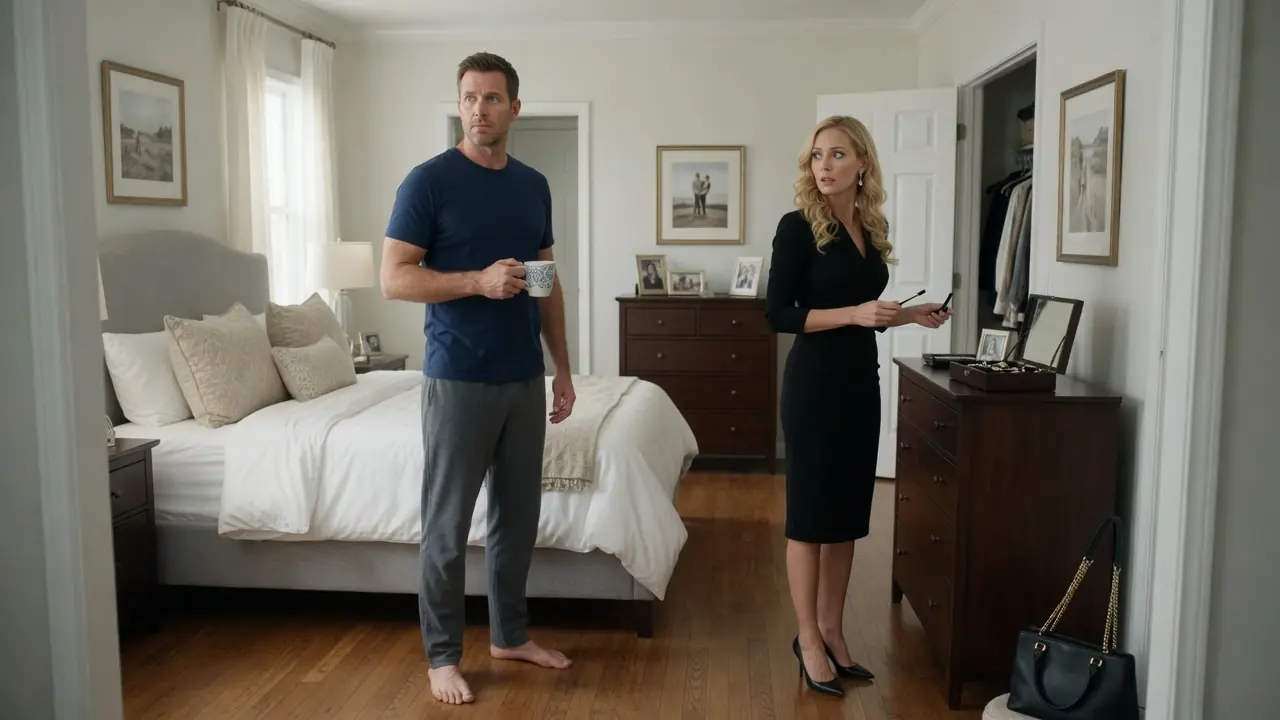
Allison stood in front of our bedroom mirror, one hand braced lightly on the edge of the dresser, the other slowly applying mascara with the patience of a woman who believed the whole day would wait for her.
Morning sunlight fell through the white curtains and spread across the hardwood floor, soft and clean, making the room look more peaceful than it felt.
The dress was black. Fitted. Elegant. The kind of dress that did not simply happen to be pulled from a closet. It had been chosen. Planned. Considered. It shaped her waist, softened her shoulders, and made her look like a version of herself I had not seen on an ordinary weekday morning in years.
After twelve years of marriage, a man learns the difference between “I want to look nice” and “I need someone to notice me.”
That morning, Allison needed someone to notice her.
I was sitting on the edge of the bed with a coffee mug in my hand, watching her reflection in the mirror. I had been awake since five, though I had pretended otherwise when she slipped out of bed before her alarm. I had heard her open the closet. Heard the hangers slide slowly across the rod. Heard the quiet pause before she picked the dress.
Her diamond earrings were the next warning.
I had bought them for our tenth anniversary. We had gone to a restaurant by the river that night, the kind with white tablecloths and waiters who spoke quietly as if volume cost extra. Allison had worn a navy dress then. She had smiled when I opened the box, touched one earring with her fingertip, and said, “Nick, these are too much.”
But she had worn them the whole night.
After dinner, we walked along the riverfront with her hand inside mine, and she kept touching the earrings as if she still could not believe I had bought them. I remembered the way the city lights reflected in the water. I remembered her laughing when I told her the waiter looked personally offended when I ordered the cheapest dessert. I remembered thinking we had made it through ten years and somehow still knew how to find each other.
Since then, she only wore those earrings for weddings, charity dinners, and moments she wanted to remember.
So I asked the question that started everything.
“You look beautiful today,” I said. “Special occasion?”
Her mascara wand stopped halfway to her lashes.
It was only for a second.
But in marriage, a second can be a confession.
Allison smiled into the mirror without looking at me directly. “Just girls’ night with Brianna,” she said, too lightly.
I took a slow sip of coffee. The coffee was already lukewarm, but I needed something to do with my hands.
“That dress hasn’t seen a girls’ night since before we remodeled the kitchen.”
She laughed.
The sound came out polished and fake, like one of those smiles people wear in office elevators when they want to seem friendly but not available.
“Can a woman not dress up for her friends anymore?”
“She can,” I said. “I just didn’t know wine and gossip required diamond earrings.”
That was when she turned around.
Allison was thirty-eight, a senior marketing executive, beautiful in the controlled way successful people learn to be beautiful. Every strand of hair was in place. Her makeup was flawless. Her purse was already sitting on the dresser, zipped, ready, pointed toward the door like she could not wait to leave.
But her eyes carried something the rest of her had not managed to hide.
I had known those eyes since she was twenty-five. I had seen them nervous before job interviews, bright with ambition when she got promoted, wet with tears when her father died, sharp with irritation when I forgot to unload the dishwasher. I knew the difference between anger, exhaustion, excitement, and guilt.
This was guilt.
Not enough to stop her.
Just enough to make her careful.
“Nick, you’re being paranoid,” she said.
“Maybe.”
“I’ll be home late,” she added, picking up her purse. “Don’t wait up.”
The kiss she placed on my forehead felt automatic, like a receipt printed after a transaction. It was there to prove something had happened, not because either of us felt it.
I listened to her heels move down the hallway, then down the stairs. The house held every sound too clearly. The opening of the garage door. The engine of her silver BMW waking up. The faint crunch of tires over the driveway gravel.
A minute later, her car backed out.
I walked to the upstairs window and watched until she turned the corner and disappeared.
Across the street, Janice Morrison was already standing on her porch with a watering can in her hand.
Janice had lived in our neighborhood for three decades. She knew who put trash cans out early, who had guests too often, whose dog had escaped, whose marriage had cooled, and whose teenage son was pretending not to vape behind the garage. She could spot trouble through closed curtains. She was seventy-one years old, sharp-eyed, widowed, and more informed than the city council.
By the time I walked outside to get the mail, she was crossing the street with the determination of a detective approaching a crime scene.
I already knew she had something to say.
“Morning, Nick,” she called.
“Morning, Janice.”
She glanced toward the corner where Allison’s car had vanished. “Allison looked fancy today.”
“Girls’ night,” I said, sorting through envelopes.
Janice made a face that told me she did not believe that any more than I did.
“Funny,” she said.
I looked up.
“Why funny?”
“Because I saw her last Tuesday having lunch downtown with a man in a red Audi. Looked a little cozy for a business meeting.”
My hand stopped on the mail.
“Red Audi?”
“Marello’s Italian,” she said. “Nice suit, silver in his hair, very confident type. You know the type. Walks like doors open before he reaches them.”
I tried to laugh.
It came out wrong.
“Might have been work.”
“Might have been,” Janice said, in the tone of a woman who knew exactly what it had not been. “But they were laughing like people who forgot the rest of the restaurant existed.”
The envelope in my hand bent slightly under my thumb.
Allison had told me she worked through lunch that day. She had said she ate a sandwich at her desk because meetings were stacked back to back.
Marello’s was not a place you accidentally ended up in.
It was candles, wine, dark wood, small tables, and reservations. It was where men took women when they wanted the meal to feel like a secret even before it became one.
I forced a smile because that is what men do when they are trying not to bleed in public.
“Maybe it was a client.”
Janice studied me.
“Maybe.”
She turned to go, then stopped.
“Nick.”
“Yes?”
“I hope it’s nothing.”
I nodded.
“So do I.”
Back inside, the house felt larger without her.
That was one of the first things I learned when suspicion entered a marriage. It changed the shape of rooms. The kitchen became too bright. The hallway too quiet. The bedroom too personal. Every object felt like it was waiting to become evidence.
I walked back upstairs and stood in the bedroom.
The closet door was still half open. The mirror held the ghost of where Allison had stood twenty minutes earlier. On the dresser, her jewelry box was open. One empty slot waited where the anniversary earrings belonged.
A faint trace of her perfume lingered in the air.
I told myself not to overreact.
People have lunch with clients. People have old friends. People dress up because they want to feel attractive. People lie about stupid things because they do not want questions.
But people do not lie about lunch unless the truth has teeth.
By afternoon, I was in my garage office, pretending to finish paperwork for a home inspection report. That was my business. I inspected houses for people who were about to spend too much money and needed someone to tell them the basement leaked, the roof sagged, or the electrical panel looked like a lawsuit waiting to happen.
I was good at noticing details.
Instead, it made everything worse.
A crack in a foundation is easier to face than a crack in a marriage. A bad roof can be replaced. Mold can be cleaned. Wiring can be corrected. But betrayal hides behind clean surfaces. It smiles. It kisses your forehead. It tells you not to wait up.
I opened our joint credit card account.
For a long time, I just stared at the login screen.
Once I entered, there was no going back. Suspicion would become investigation. Investigation would become proof. Proof would become something I could not unknow.
Still, I typed the password.
I searched the date Janice had mentioned.
Marello’s appeared immediately.
Two meals. One bottle of wine. Dessert. A tip generous enough to impress someone.
I leaned back in my chair and stared at the charge.
Allison hated Italian food.
She said garlic stayed with her for days and made her feel sick. She complained if I cooked spaghetti on a weeknight. She once said Marello’s was “too heavy” when I suggested it for our anniversary.
The woman who acted offended by marinara had apparently sat through a long lunch at Marello’s with a man in a red Audi.
That was when suspicion stopped being a feeling and became evidence.
At six that evening, I drove to Brianna’s apartment complex.
If Allison was really having girls’ night, Brianna’s white Honda would be there, or at least some sign that the story held together. Brianna had been Allison’s closest friend since college. Loud laugh, big earrings, always too much perfume, the kind of woman who told stories like she was performing them for a crowd.
I liked Brianna well enough. She was careless, but not cruel. She liked being included in drama, but she usually did not create it herself.
The parking lot was half empty under the yellow apartment lights. Rain from earlier had left dark patches on the pavement. A man in a hoodie carried groceries toward building C. A woman walked a terrier that kept stopping to bark at nothing. Somewhere upstairs, music thumped through a closed window.
Brianna’s white Honda was nowhere in sight.
I sat in my truck for twenty minutes, watching people come and go.
Couples walked dogs. A delivery driver dropped off takeout. A teenager argued with someone over the phone near the mailboxes. None of it had anything to do with me, which made me feel even more pathetic.
Twelve years of marriage had brought me to hiding in a parking lot to see whether my wife was lying.
She was.
I drove home numb.
Not angry yet. Not properly.
Anger requires the mind to accept what the heart is still trying to negotiate.
I poured bourbon into a glass and sat in the living room, staring at our wedding photo on the mantel.
In the photo, Allison was laughing into the camera, one hand pressed against my chest. I was looking at her instead of the photographer. Proud. Amazed. Like a man who could not believe he had been chosen.
I remembered that day too clearly.
The church smelled like flowers and polished wood. Allison’s hands trembled during the vows. My mother cried through the entire ceremony. Allison whispered, “Don’t you dare step on my dress,” before we walked back down the aisle, and I nearly laughed in front of everyone.
For twelve years, that picture had represented a promise.
That night, it looked like evidence from a case I had not known I was building.
She came home a little after midnight.
I heard the garage door open. Her heels clicked on the kitchen tile. She moved quietly, but not carefully enough. A drawer opened upstairs. Water ran in the bathroom. She was washing away the night before bringing me the version of herself I was supposed to believe.
When she finally came down, I was still in the recliner with the bourbon glass in my hand.
She stopped at the foot of the stairs.
“How was girls’ night?” I asked.
“Good,” she said quickly. “Really good. We went to that new wine bar on Elm Street.”
I almost smiled.
The wine bar on Elm Street had been closed for renovations all week. I knew because I had inspected a property across from it two days earlier and seen plywood over the entrance and a sign taped to the door.
She was not just lying.
She was getting lazy.
“Brianna have a good time?” I asked.
“Oh, you know Brianna,” Allison said. “Always full of stories.”
I nodded and looked back at my glass.
“Sounds fun.”
She lingered for a second. “Are you okay? You seem quiet.”
“Long day.”
She accepted that because she wanted to.
Then she went upstairs, and I sat in the dim living room until the house settled around me.
Her purse sat on the kitchen counter, unzipped, tilted open as if it were daring me to look inside.
A better husband might not have looked.
A better husband might have respected privacy, waited for honesty, or asked a direct question in the morning.
But a better wife would not have come home wearing anniversary earrings after lying about where she had been.
So I opened the purse.
My fingers moved carefully, almost professionally. Wallet. Lipstick. Compact. A receipt from a boutique. Breath mints. A folded tissue. Then, tucked behind her wallet, the hotel key card.
Grand Marquee Hotel.
Room 412.
Under it was a restaurant receipt from the same hotel, dated that night.
Two dinners. Two glasses of wine. One chocolate mousse.
Apparently, girls’ night had upgraded to room service.
For a moment, I did not breathe.
It is strange what the body does when it learns the thing the mind already suspected. I expected my hands to shake. I expected rage to rise up like fire. Instead, something inside me went cold and organized.
I took photos of everything. The key card. The receipt. The time stamp. The last four digits of the credit card. Then I put it all back exactly as I had found it.
I did not sleep that night.
Allison slept beside me, facing away, one hand tucked beneath her cheek. I lay still, staring at the ceiling, listening to the quiet rhythm of her breathing.
I remembered the first apartment we rented together after the wedding, the one with the broken air conditioner and the balcony too small for two chairs. I remembered painting the kitchen yellow because Allison said white walls made her feel temporary. I remembered the miscarriage at year three, how she had cried in the shower because she did not want me to see her fall apart, and how I sat on the bathroom floor outside the curtain until she finally reached for my hand.
I remembered building this life board by board, bill by bill, compromise by compromise.
And I wondered when she had started living somewhere else inside herself.
The next morning, after she left for what she called a client breakfast, I called Marty Kowalski.
Marty was my work partner, my oldest friend, and the kind of man who owned strange devices because he once suspected his own wife of cheating with a yoga instructor. He had been wrong, hilariously wrong, but he had kept the tracker.
Thirty minutes later, he was under Allison’s BMW with a tiny magnetic GPS device in his hand.
“This will show everywhere she goes,” Marty said, wiping his hands on a rag.
He was built like a refrigerator, with a beard that made him look less like a home inspector and more like a man who lived in the woods and trusted no one. He had known me since high school. He had stood beside me at my wedding. He had danced badly with Brianna at the reception and still insisted she had been flirting with him.
“Promise me you won’t do anything stupid,” he said.
“Define stupid.”
“Nick.”
“I just want proof.”
He slid out from under the car and looked at me for a long moment.
“Proof has a way of becoming gasoline.”
“I know.”
“No,” he said. “You don’t. Not yet.”
I looked toward the house.
“What would you do?”
Marty leaned against the car, folding his arms.
“I’d want to break something,” he said. “Then I’d call a lawyer before I did.”
That was Marty. Practical, even when angry.
“I don’t want to confront her yet,” I said. “I want the truth first.”
“You already have truth.”
“I have pieces.”
He sighed. “Then collect the pieces. But don’t let them turn you into somebody you can’t live with.”
At the time, I thought he was warning me not to get violent.
Later, I understood he was warning me about revenge.
That evening, the little blue dot moved from Allison’s office to the Grand Marquee Hotel.
She parked in the underground garage at 6:47 p.m.
I watched the tracker from my phone for five minutes, standing in the kitchen with my coat still on. The house was quiet. Too quiet. The kind of quiet that waits for a decision.
Then I grabbed my keys.
Downtown was all glass and wet pavement under streetlights. The Grand Marquee rose above the block with its gold-lit entrance and polished stone columns. Valets moved in dark coats beneath the awning. Couples stepped out of cars, laughing, adjusting scarves, lifting collars against the cold.
I parked across the street, far enough away that I could watch without being obvious.
For three hours, I sat in my truck.
I watched strangers enter and leave. Businessmen with rolling suitcases. A family carrying shopping bags. Two women in evening coats. A man with flowers. Every person who passed seemed to belong to a life that still made sense.
At 9:52, Allison came out of the hotel lobby with him.
He was tall, well dressed, silver threaded through dark hair, with the kind of confident walk that made valets hurry. He wore a dark overcoat and a red scarf that looked expensive without trying. He put one hand lightly at the small of Allison’s back as they stepped outside.
I recognized him before I wanted to.
Kevin Monroe.
I had seen his face in old college photos hidden in Allison’s albums. Kevin at a beach party. Kevin standing beside a younger Allison with his arm around her shoulder. Kevin wearing a graduation gown and the smug smile of a man who believed the future had already reserved a table for him.
Allison had once described him as ancient history.
Apparently, history had made a reservation at the Grand Marquee.
They stood under the awning, close enough that their coats touched. Kevin leaned down and said something near her ear. Allison laughed softly, covering her mouth with her hand. Then he tucked a strand of hair behind her ear.
That small gesture did more damage than I expected.
It was intimate. Familiar. Unhurried.
He knew he had the right to touch her that way.
She smiled up at him in a way I had not seen directed at me in years.
Then he kissed her.
No confusion. No hesitation. No accident.
He kissed my wife under the warm lights of a hotel awning while I sat across the street holding my phone like it could keep my chest from splitting open.
The last fragile excuse I had been holding onto died right there in the street.
I took photos.
Not because I wanted to.
Because I needed to.
Kevin’s red Audi pulled up a minute later. Allison got into the passenger seat. Her BMW remained in the garage. I followed at a distance as he drove west through downtown, past restaurants and office buildings, past couples walking beneath umbrellas, past a world that had not paused for the end of mine.
He took her to an upscale apartment building on the west side of town.
They entered together.
I waited forty minutes.
Then I drove home.
Later that night, I searched Kevin’s name and found the rest easily.
Kevin Monroe. Real estate developer. Husband to Jessica Monroe. Father of two. Community donor. Board member. Golf tournament sponsor. Smiling fraud in expensive suits.
His life looked as polished online as mine had looked from the outside.
There were photos of him with Jessica at charity events. Jessica in elegant dresses, posture perfect, one hand resting lightly on his arm. Their children, a son and daughter, both teenagers, both smiling like people trained to appear happy in public. Kevin cutting ribbons, shaking hands, standing in front of development projects as if the whole city were something he had personally improved.
I sat at my desk until two in the morning, reading articles about him.
Every sentence made me hate him more.
Not because he was better than me.
Because he thought he was.
Two days later, I met Brianna at Murphy’s Tavern.
I had texted her from a number she knew but Allison would not check. All I wrote was, I know about Kevin. We need to talk.
She replied ten minutes later.
Murphy’s. Six o’clock.
When I arrived, she had already had two drinks. Her hair was pinned up messily, and she wore a bright red sweater that made her look more festive than her expression. Brianna had always seemed like someone who treated life as entertainment, but that night she looked older, guilt pulling at the corners of her mouth.
I sat across from her.
“Thanks for coming.”
She stared into her glass. “I almost didn’t.”
“I figured.”
“Does Allison know you contacted me?”
“No.”
“Good.” She lifted the drink and took a long swallow. “She’d kill me.”
“Is that because you’re her friend or because you’ve been covering for her?”
Brianna flinched.
I regretted the sharpness immediately, but not enough to apologize.
“She’s been seeing Kevin,” Brianna said quietly. “Her ex from college.”
“How long?”
She closed her eyes.
“Brianna.”
“A few months,” she admitted. “Maybe longer emotionally. Physically, I think since late summer.”
Late summer.
We had gone to Lake Michigan in August. Allison had slept late, checked her phone often, and said she felt disconnected because work was overwhelming. I had rented a small house near the water hoping we could breathe together again.
She had already been leaving me.
“I told her it was a bad idea,” Brianna said. “More than once.”
“But you covered for her.”
“She said she needed someone to talk to.”
“She needed an alibi.”
Brianna looked down.
“Yes.”
I leaned back, the booth creaking beneath me.
“What did she say about me?”
Brianna’s face twisted.
“Nick…”
“What did she say?”
“She said you were good. Reliable. Kind.” Brianna swallowed. “She said she felt dead inside.”
The words landed harder than I expected.
Dead inside.
Apparently, I had been the husband who paid the bills, fixed the roof, remembered anniversaries, held her hand through grief, built the life, and became furniture in the room she wanted to escape.
“And Kevin?”
“She said Kevin made her feel alive again.”
Alive.
That word burned.
I nodded slowly.
“Did she talk about leaving me?”
Brianna hesitated.
“Yes.”
My throat tightened.
“What was the plan?”
“She said they were waiting for the right time. Kevin had complications with Jessica and his business. Allison didn’t want to look like the villain. She kept saying once things were settled, people would understand.”
“People would understand.”
“She said they had a real connection.”
I almost laughed.
Of course they did.
People destroying families always call it a connection. It sounds better than selfishness.
Brianna reached across the table, then stopped before touching my hand.
“I’m sorry, Nick.”
“You should be.”
Her eyes filled.
“I know.”
I stood.
“Don’t warn her.”
“I won’t.”
“If you do, I’ll know.”
She nodded.
I left Murphy’s with the truth sitting beside me like a passenger.
That night, while Allison slept beside me, I stared at the ceiling and made a decision.
The old Nick might have begged. Shouted. Demanded counseling. Asked what I had done wrong. Offered to change things that had never been the problem. The old Nick still believed a marriage could be saved if both people wanted it enough.
But Allison had stopped wanting ours long before she put on that black dress.
The next morning, while she showered, I opened her laptop.
She had left it on the kitchen table, probably believing I would never invade her privacy. Once, she would have been right.
Her password was still the name of the dog we had adopted in our second year of marriage and lost three years later. That almost broke me more than the messages.
Her conversations with Kevin were not hidden well.
Dinner reservations. Hotel plans. Sweet little lies. Private jokes. Complaints about spouses who did not understand them. Promises that made my chest burn.
Kevin: Last night was dangerous. I almost didn’t let you leave.
Allison: I almost didn’t want to.
Kevin: Soon.
Allison: I hate waiting.
Kevin: We just need to be patient.
Allison: I hate sneaking around, but I want our real life.
Our real life.
My marriage, his marriage, two families, and years of trust were just obstacles to their romantic rebranding.
I screenshotted everything and saved copies in three places. Cloud drive. External drive. Email draft. Then I closed the laptop, brewed coffee, and sat at the kitchen table like a man enjoying a normal morning.
When Allison came downstairs, she wore a blazer and carried herself like nothing in the world was wrong.
I looked at her and saw a stranger with my wife’s face.
“I’ll be late tonight,” she said. “Client dinner.”
“With Kevin Monroe?” I asked before I could stop myself.
She froze with her hand on the door.
Slowly, she turned back to me.
“What did you say?”
“Nothing,” I said, lifting my coffee. “Have a good day.”
She stood there a second longer.
I saw the fear in her eyes.
Good.
Let her wonder.
Let her feel even a fraction of the uncertainty she had been feeding me for months.
That afternoon, I contacted Jessica Monroe.
I wrote a short anonymous message first. I attached screenshots, hotel receipts, photos of Kevin and Allison under the Grand Marquee awning, and enough proof to remove any doubt.
I expected silence.
Maybe anger.
Maybe denial.
Instead, an unknown number called me less than an hour later.
“Is this Nick Barlo?” a woman asked.
“Depends who’s asking.”
“Jessica Monroe,” she said. “I think you and I need to talk.”
We met at a coffee shop downtown, one of those quiet places where people in suits pretend caffeine is lunch.
Jessica Monroe looked like elegance sharpened into a blade. She wore a camel coat, pearl earrings, and no expression that she did not choose. Her hair was dark, sleek, cut just above her shoulders. She had the kind of calm that did not mean peace. It meant control.
I stood when she approached.
“Nick,” she said.
“Jessica.”
We shook hands like business partners.
Not victims.
Not yet.
She listened while I explained what I knew. I expected her face to break, but it did not. Only her fingers changed, tightening slightly around the handle of her teacup.
When I finished, she opened her own folder and slid photographs across the table.
Allison and Kevin entering hotels. Allison and Kevin leaving restaurants. Allison and Kevin in a parking garage, his hand at her waist, her head tilted back as she laughed. Allison wearing the black dress. Kevin holding her coat. Receipts. Dates. Times.
Jessica had hired a private investigator weeks earlier.
I had brought proof to a woman who already had a war chest.
“How long have you known?” I asked.
“Long enough to stop crying,” she said.
That answer told me everything.
She looked at the photographs between us.
“I suspected in July. Hired the investigator in September. Confirmed it in October.”
“It’s December.”
“Yes.”
“Why wait?”
Jessica looked at me then, and for the first time, I saw the exhaustion beneath the polish.
“Because my daughter applied early decision to college, my son had a championship season, and Kevin sits on three boards that affect assets I intend to protect before I divorce him. I did not wait because I was weak, Mr. Barlo. I waited because timing matters.”
I nodded.
“I didn’t mean…”
“I know.”
She took a sip of tea.
“So,” she said, “do you want revenge or closure?”
“Is there a difference?”
“There can be,” she said. “But not today.”
Her plan was simple and cruel enough to be beautiful.
We would not confront them privately. We would let them believe they still controlled the story, then force the truth into public light. Cheaters thrive in secrecy, Jessica said. Take away the shadows and watch them turn on each other.
“I don’t want to become like them,” I said.
“You won’t,” Jessica replied. “They lied to protect themselves. We are telling the truth to protect ourselves.”
“There’s a line.”
“There is,” she said. “So we use documentation. No rumors. No exaggerations. No private images. Nothing indecent. Only what they did, when they did it, and what they charged to whose account.”
I looked at her.
“Company expenses?”
Jessica’s smile was cold.
“Oh, Kevin has been careless. And from what I found, so has Allison.”
That was the first time I understood this was bigger than betrayal.
They had not only lied to us.
They had been sloppy with money that was not theirs.
The first strike was not public.
It was silence.
For three days, I said nothing. Jessica said nothing. We let Allison and Kevin feel the pressure without knowing the source. That was Jessica’s idea. “Guilty people confess more through panic than questions,” she told me.
She was right.
Allison began watching me closely. She asked if I was feeling all right. She asked if work was stressful. She asked if I wanted to go away for a weekend soon, just the two of us, as if she could still patch a crack in the roof after the whole house had already shifted off its foundation.
Kevin started calling Jessica more often. She did not answer most of the calls. When she did, she spoke lightly and briefly. That made him nervous. Men like Kevin do not enjoy silence from women they believe they control.
The second strike was social.
Jessica and I drove to a mountain cabin owned by one of her friends and spent a weekend creating the appearance of a cheerful escape. Nothing improper happened. We slept in separate rooms. We talked for hours, not as lovers, but as two people sitting in the wreckage of similar houses.
Still, the photographs suggested comfort.
A picture of two coffee mugs on a porch rail.
A photo of Jessica laughing near a fireplace.
A shot of my boots beside hers near the cabin door.
One carefully angled selfie, both of us smiling with snow behind us.
We posted just enough to be seen.
No captions that said too much.
Jessica wrote, Clear air helps.
I wrote, Needed this.
That was all.
Allison called me seventeen times that night.
Kevin called Jessica even more.
Neither of us answered.
By Sunday morning, Allison’s messages had shifted from confusion to anger to fear.
Nick, where are you?
Why are you with Jessica Monroe?
Call me.
This is humiliating.
We need to talk now.
Kevin’s messages to Jessica, which she showed me over coffee, were worse.
What are you doing?
Are you with him?
Jessica, answer your phone.
You’re making a mistake.
Think about the kids.
Jessica laughed when she read that one.
“Funny how children become important when shame enters the room,” she said.
That evening, Jessica and I went to Murphy’s Tavern and sat by the window where anyone passing could see us.
We ordered dinner neither of us ate.
We did not have to wait long.
Allison’s BMW arrived first, pulling into the lot too fast. Kevin’s red Audi followed seconds later. They came in together, which was almost funny, considering they were there to accuse us of being inappropriate.
Allison spotted us immediately.
Her face changed from fear to outrage because outrage was easier to wear in public.
“What the hell is this?” she demanded, stopping beside our table.
I looked up calmly.
“Dinner.”
“With her?”
Jessica smiled. “Careful, Allison. You are standing beside my husband while asking that question.”
Kevin stepped forward, face tight with anger.
“This is childish.”
“No,” I said. “Childish is lying about girls’ night while using hotel key cards like bookmarks.”
The bar went quiet around us.
Murphy’s was not a fancy place, but it was full of people who knew people. That was the point. Allison looked around and realized the walls had ears, eyes, and phones.
“It is not what you think,” she said.
I almost laughed.
“You kissed him outside the Grand Marquee, Allison. If I misunderstood, you are welcome to explain the choreography.”
Kevin reached for her arm, but she pulled away.
That small movement told me the pressure was already working.
Their fantasy required candlelight, wine, secrecy, and the flattering lie that what they had was special. It did not look special under bar lights in front of strangers.
Jessica placed a folder on the table.
“We both know enough,” she said. “Hotel receipts, company expenses, messages, photographs, dates. Before either of you tries to play victim, remember that we can prove the timeline.”
Allison went pale.
Kevin went still.
“Company expenses?” he asked, turning toward Allison.
Allison’s face betrayed her before she spoke.
“That was not your concern.”
Jessica laughed softly.
“Oh, it will be. Especially when Hartwell and Associates sees how many romantic dinners were charged as client development.”
Kevin stared at Allison, and I saw the first crack between them.
He had known he was cheating.
He had not known she might bring financial trouble to his door.
Selfish people can excuse passion, but they rarely forgive inconvenience.
Allison looked at me.
“Nick, please. Can we talk outside?”
“No.”
Her lips parted.
“Please.”
“There was a time when you could have talked to me,” I said. “You chose Kevin instead.”
“I was confused.”
“No. You were entertained.”
That hit her. I saw it land.
Kevin’s jaw tightened.
“You don’t know what our marriage was like.”
I looked at him.
“You’re right. I don’t. But I know you were still in it when you started sleeping with my wife.”
Someone at the bar muttered, “Damn.”
Jessica stood then, smooth and calm.
“This was your only warning,” she said. “Control your stories, or the documents speak for you.”
Kevin scoffed, but his face was pale.
“You wouldn’t.”
Jessica smiled.
“You still don’t know me at all.”
The next week unfolded exactly the way Jessica predicted.
Allison tried to control the narrative first.
She told Brianna that I had become unstable. She told two coworkers that our marriage had been over emotionally for years. She hinted that Jessica and I had been seeing each other, that Kevin and Allison had merely found comfort after being neglected by cold spouses.
Unfortunately for her, documentation has a way of making poetry look stupid.
Hartwell and Associates placed Allison on administrative leave after Jessica sent the expense reports to the right person. The report included dates, locations, receipts, and meeting descriptions Allison had filed under client development. Some of the charges matched nights at the Grand Marquee. Others matched restaurants where no client had been present.
Kevin’s largest development client received evidence of his affair, his expense misuse, and his questionable judgment. Jessica knew exactly who to contact. She had spent years beside Kevin at charity functions, listening to men underestimate her while handing her useful information in wine glasses.
His reputation, the thing he polished harder than his shoes, began to crack.
Meanwhile, I called a lawyer.
Then I changed the locks.
I packed Allison’s belongings carefully. That mattered to me. I did not throw her clothes into trash bags or smash perfume bottles or destroy photographs. I boxed her things with the same quiet precision I had used when collecting evidence.
Dresses in garment bags. Shoes wrapped in paper. Jewelry in boxes. Books stacked neatly. Bathroom products sealed in plastic. Her framed photographs placed face up, because cruelty would not make me cleaner.
When Allison came home Thursday evening, her belongings were boxed neatly on the porch.
She stood in the driveway looking at them as if she could not understand how twelve years could be packed into cardboard.
I watched from the porch, holding a beer I barely tasted.
For the first time in months, she looked afraid of me.
Not because I would hurt her.
Because I would not save her.
“You can’t just throw me out,” she said.
“I’m not throwing you out,” I replied. “I’m returning you to the life you chose.”
“This is my house too.”
“My name is on the deed. You know that.”
“We are married.”
“And you treated that like a technicality.”
Her eyes filled with tears, and once that would have broken me.
But I had seen too much by then.
Tears after consequences are not the same as remorse. Sometimes they are only grief for lost comfort.
“I loved you,” she whispered.
“No,” I said. “You loved being safe with me while feeling wanted by him. That is not love, Allison. That is insurance.”
She flinched like I had slapped her.
“I made a mistake.”
“A mistake is forgetting to buy milk. This was planning. Hotels. Receipts. Lies. Alibis. You made a second life and used me to finance the first one.”
“I didn’t mean for it to get this far.”
“You never meant to get caught.”
That silenced her.
She loaded the boxes into her car one by one.
I did not help her.
I did not insult her either.
I simply watched the woman who had shared my bed and my name drive away with the remains of her chosen life rattling in the trunk.
The house felt strange afterward.
Not peaceful yet.
Peace is too gentle a word for what follows betrayal. At first there is only absence. Her shoes gone from the entryway. Her makeup gone from the bathroom counter. Her coffee mug no longer in the sink. Her side of the closet empty except for a few hangers.
But beneath the absence was something clean.
Painful, yes.
But clean.
Like opening windows after years of pretending the air was fine.
The final explosion happened at the Riverside Charity Gala.
Allison and Kevin had planned to attend together before everything fell apart, hoping to reclaim the narrative as two brave people who had found love at the wrong time. That was what Brianna told me, apologetically, over the phone.
“They think if they appear together confidently, people will adjust,” she said.
“People adjust to a lot,” I said.
“Not this time.”
Jessica and I attended too.
Not as lovers. Not really.
By then, people were already whispering. Some believed Jessica and I were having our own affair. Some thought we were plotting. Some thought we were simply angry spouses with too much evidence and not enough restraint.
The truth was simpler.
We were witnesses.
Jessica wore emerald green, a dress that made half the room turn when she entered. I wore a black suit Allison had once told me made me look like I was attending a tax hearing. Jessica laughed when I told her that.
“Good,” she said. “Tonight is an audit.”
The gala took place in the ballroom of the Riverside Hotel. Chandeliers reflected off polished floors. Waiters moved with trays of champagne. Donors smiled for photographs near a banner that thanked sponsors for their generosity. It was the kind of event where reputations floated above people like invisible crowns.
Kevin loved rooms like that.
So did Allison.
They arrived separately.
That was the first sign their great love had already begun to rot under pressure.
Kevin entered with two men from his firm, laughing too loudly. Allison came ten minutes later with Brianna, who looked like she would rather be anywhere else. Allison wore a silver dress and no diamond earrings. I noticed that immediately.
Our anniversary earrings were not on her ears.
I wondered if she had left them behind because they reminded her of me, or because she no longer wanted to wear evidence of the husband she had betrayed.
Either way, it was too late.
Halfway through the evening, after the first round of donor acknowledgments, Jessica stood.
She did not shout.
She did not need to.
The room quieted because people like Jessica have a way of making silence obey them.
She raised her glass.
“My husband Kevin and his companion Allison wanted a public love story,” she said. “So I think everyone deserves the full version.”
The room changed temperature.
At first, people laughed nervously, unsure whether this was a joke.
Then the projector screen behind the stage lit up.
Dates.
Receipts.
Hotel charges.
Expense reports.
Images that told a story no one could mistake.
Nothing indecent. Nothing illegal. Nothing anyone could accuse us of fabricating. Just truth arranged so neatly it became undeniable.
Allison and Kevin entering the Grand Marquee.
Dinner charges filed as client meetings.
Messages about waiting, wanting a real life, being patient.
Photos of them under the hotel awning.
The Marello’s receipt.
The Grand Marquee room-service receipt.
Hartwell expense reports beside hotel reservations.
The crowd went silent in stages.
First confusion.
Then recognition.
Then hunger.
Rich people love scandal even more when it comes with documentation.
Allison sat frozen three tables back, mascara already shining in her eyes.
Kevin stood halfway, face red.
“Jessica, stop.”
“No,” she said. “You stopped nothing when you had the chance.”
A woman gasped.
Someone whispered Allison’s name.
Someone else said, “Is that Kevin Monroe?”
The final slide appeared.
A simple line of text.
When people build reputations on lies, truth is not revenge. It is correction.
Then the screen went black.
For a moment, no one moved.
Allison fled first.
She grabbed her clutch and hurried toward the side exit, face lowered, Brianna trailing after her with a look of horror and pity. Kevin followed seconds later, but not with her. He went in the opposite direction, toward the hallway leading to the hotel offices.
They left in different directions.
That told me everything I needed to know about the strength of their great love.
When public shame arrived, they did not hold hands.
They looked for separate exits.
Jessica sat down beside me and took one calm sip of water.
“You okay?” I asked.
“No,” she said. “But I will be.”
I believed her.
Three weeks later, Allison moved out of state.
Hartwell did not fire her publicly, because companies like quiet exits, but she resigned after the internal review. Kevin’s firm forced him out after clients began asking questions he could not answer. Jessica filed for divorce and kept her dignity like a crown. I filed too, and for the first time in years, the paperwork felt less like an ending than a locked door.
Marty helped me clear out the garage one Saturday.
Not because the garage needed clearing, but because men like us need tasks when feelings become too large.
He carried a box of old paint cans toward the truck and said, “You surviving?”
“Depends on the hour.”
“That’s normal.”
“You’re an expert?”
“No,” he said. “But I watch home renovation shows. Everything looks terrible before the rebuild.”
I laughed for the first time in days.
Janice Morrison became unbearable in the way only a satisfied neighbor can be.
She appeared on my porch with banana bread two days after the gala.
“I won’t ask questions,” she said.
“You absolutely will.”
“I already know most of it.”
“I’m sure you do.”
She handed me the bread. “For what it’s worth, I’m sorry.”
That surprised me.
I looked at her.
“Thank you.”
“She was foolish,” Janice said. “And so was he. People mistake attention for love all the time. Usually when they’ve forgotten what loyalty costs.”
I did not know what to say to that.
So I said nothing.
She patted my arm, then went back across the street to pretend she was not watching everything.
I saw Allison once before she left.
She came by the house to collect a box I had found in the attic. It held a few things from her childhood, yearbooks, old photographs, a cracked music box, and a scarf her mother had knitted.
No black dress this time.
No diamond earrings.
No polished confidence.
Just a woman in jeans and a gray sweater, looking smaller than the memory of her.
I set the box on the porch between us.
“Thank you,” she said.
I nodded.
She looked toward the house.
“Do you ever miss me?”
The question was cruel because it sounded vulnerable.
“Yes,” I said honestly.
Hope flashed across her face.
“I miss who I thought you were,” I continued. “That is not the same thing.”
Her eyes filled.
“I never meant for it to become this.”
“That is the problem,” I replied. “You thought only your feelings would count, not the damage.”
She wiped her cheek.
“I was unhappy.”
“You should have said that before you betrayed me.”
“I didn’t know how.”
“You knew how to book hotels.”
Her face tightened, then softened again.
Maybe she wanted me to comfort her. Maybe she wanted one final proof that I was still the man who would soften when she cried.
I was not that man anymore.
Not for her.
She nodded as if she understood, but I do not know if she did.
People like Allison often think regret is the same as accountability.
It is not.
Regret looks backward and wishes the cost had been lower.
Accountability looks forward and accepts the bill.
After she drove away, I stood on the porch until the street went quiet.
Janice Morrison watched from across the road, pretending to water flowers that were already soaked.
I lifted one hand in a small wave.
She waved back, probably disappointed I had not given her more drama for the neighborhood archive.
Inside, the house felt different.
Not empty, exactly.
Clean.
The kind of clean that comes after you stop pretending the dust is not there.
I took down the wedding photo that night.
Not angrily.
Carefully.
I stood in front of the mantel and held it for a long time. Allison’s laughing face. My proud smile. The church flowers behind us. The promise neither of us had known how to protect forever.
For a moment, I thought I might throw it away.
Instead, I put it in a box.
Some memories do not deserve display, but that does not mean they never happened.
Months passed.
Winter became spring.
The divorce moved forward with less fighting than I expected, mostly because Jessica’s evidence had made Kevin’s world loud enough that Allison did not have much appetite for another war. My lawyer said I was lucky.
I did not feel lucky.
But I felt free.
Freedom, I learned, is not always joyful at first. Sometimes it is quiet. Sometimes it is eating dinner alone at the kitchen island and realizing no one will lie to you tonight. Sometimes it is washing one plate instead of two. Sometimes it is sleeping badly but honestly.
Marty dragged me to baseball games. Janice brought soup I did not ask for. Brianna sent one long apology that I read twice and answered with three words.
I forgive you.
I did, mostly.
Forgiveness is easier when the person did not owe you vows.
Jessica and I stayed in touch.
People expected us to become a couple because people love symmetry. Betrayed husband and betrayed wife, united by revenge, walking into sunset, neat and satisfying.
Life is not that tidy.
Jessica and I had coffee sometimes. We talked about lawyers, kids, public embarrassment, and the strange grief of missing someone you no longer respected. There was comfort there, but not romance. Or maybe there could have been romance in another life. In this one, we were two survivors who had helped each other leave a burning building.
That was enough.
One afternoon in May, I received a postcard from San Diego.
The front showed a sunset over the Pacific. The water was orange and pink, too perfect to feel real. The back had only Allison’s signature.
No message.
Just her name.
For a long time, I stood over the trash can holding it.
Maybe she wanted forgiveness.
Maybe attention.
Maybe proof that some line between us still existed.
Maybe she wanted me to wonder.
Old Nick might have called. Old Nick might have turned one signature into a conversation, then a memory, then a wound reopened.
New Nick dropped it in the trash.
Some chapters do not need a final conversation.
Some doors do not need to be slammed to stay closed.
And some betrayals do not destroy you, not if you let the truth do what truth does best.
It burns away the lie.
It burns away the performance.
It burns away the version of love that only existed because you were willing to be fooled.
For a while, all that burning hurts like hell.
Then one morning, you wake up, make coffee, open the curtains, and realize the house is quiet because no one is hiding anything in it.
A year after the gala, I finally remodeled the kitchen.
Not because it needed remodeling.
Because Allison and I had once done it together, and every cabinet still carried a memory of her choosing, approving, correcting, changing her mind. The counters were white quartz because she liked them. The backsplash was pale gray because she said it looked timeless. The brass handles were hers too, chosen after she made me drive to four different stores on a rainy Saturday.
For months after she left, I avoided changing anything.
I told myself I was being practical.
The truth was, part of me was afraid that changing the kitchen would mean admitting the marriage had not only ended but had become history.
Marty came over to help with demolition.
Janice stood on her porch pretending to sweep leaves while the delivery truck arrived.
“You sure about this?” Marty asked, holding a pry bar.
“No,” I said. “But do it anyway.”
The first cabinet door came down with a crack that echoed through the house.
I expected sadness.
What I felt instead was breath.
The new kitchen was not fancy. But it was mine. Warm wood, darker counters, open shelves, better lighting. Practical. Honest. A room where nothing looked like it was trying to impress someone who had already left.
On the first night after it was finished, I cooked dinner for Marty and Janice.
Marty brought beer.
Janice brought a pie and claimed it was not because she was nosy, though she arrived twenty minutes early and inspected every corner.
“This is better,” she said, running her hand along the counter.
“Better than before?”
She looked at me.
“Better for you.”
That meant more than I expected.
Later, after they left, I stood in the kitchen alone and looked around.
The house was still quiet.
But quiet no longer meant absence.
It meant peace.
A few months after that, Jessica called.
“I’m moving to Chicago,” she said.
“For good?”
“For now. My daughter got into Northwestern. My son is starting school nearby next fall. I think we need a new skyline.”
I smiled.
“That sounds like you.”
“I wanted to say goodbye before the rumor mill turns my move into a scandal involving three CEOs and a yacht.”
“I’ll miss our coffee.”
“So will I.”
There was a pause.
Then she said, “You know, Nick, for a while I wondered if we were supposed to become something.”
“I did too.”
“And?”
“And I think we became exactly what we needed to be.”
She was quiet for a moment.
Then she said, “Witnesses.”
“Yes.”
“Good word.”
We met one last time at the same coffee shop where we had first compared evidence. She wore a navy coat and looked lighter than she had the first time, not healed completely, but no longer carrying herself like a woman braced for impact.
Before she left, she hugged me.
Not long.
Not romantic.
Just enough.
“You were not stupid for loving her,” she said.
I swallowed.
“I know.”
“Do you?”
I looked out the window, at people passing with coffee cups and umbrellas.
“I’m getting there.”
She smiled.
“That counts.”
Then she left, and I watched her walk down the sidewalk until she turned the corner.
Some people come into your life not to stay, but to help you survive the part you thought would kill you.
Jessica was that.
I hope I was that for her too.
Two years after Allison left, I ran into Kevin Monroe at a gas station outside the city.
He looked different.
Not ruined in the dramatic way I might once have imagined. Not homeless, not broken beyond repair, not punished by lightning or divine justice. Just older. Thinner. Smaller in ordinary clothes. Without the suit, the red Audi, the room full of donors, he looked like a man whose confidence had been leased and repossessed.
He saw me near the coffee machine.
For a second, I thought he might pretend not to know me.
Instead, he gave a stiff nod.
“Nick.”
“Kevin.”
That was all.
No fight.
No speech.
No cinematic closure.
He paid for gas and left.
I watched him through the window as he climbed into a gray sedan, not a red Audi. He drove away without looking back.
I expected satisfaction.
Instead, I felt nothing.
That was when I knew I had moved on more than I realized.
Hatred keeps people large in your life.
Indifference lets them shrink to scale.
Years later, people still asked about the gala sometimes. Not directly, but with careful curiosity.
“Was it as bad as everyone said?”
I usually smiled and said, “Probably worse.”
The truth is, public exposure did not heal me.
It only ended the lie.
Healing came later, slowly, in ordinary ways.
It came when I could sleep through the night without checking old screenshots.
It came when I stopped looking for red Audis in traffic.
It came when I could hear Allison’s name without feeling my stomach tighten.
It came when I realized I had gone a whole week without wondering whether she regretted it.
And finally, it came when I understood that her regret was no longer relevant to my life.
She could be sorry.
She could not be sorry.
She could be happy.
She could be lonely.
She could remember me kindly or blame me forever.
None of it rebuilt or destroyed me anymore.
I had done that work myself.
Not perfectly.
Not quickly.
But honestly.
On the third anniversary of the day I saw her in that black dress, I found the diamond earrings in a small velvet box at the back of a drawer.
I had forgotten them.
Maybe she had left them by accident.
Maybe on purpose.
For a long time, I sat on the edge of the bed and held the box.
Those earrings had once meant ten years of love. Then they had become evidence. For a while, I could not think of them without seeing Allison in the mirror, applying mascara, pretending girls’ night required diamonds.
I thought about throwing them into the lake.
Selling them.
Mailing them to her without a note.
Instead, I took them to a jeweler.
The woman behind the counter asked if I wanted them cleaned.
“No,” I said. “I want them reset.”
She looked at me over her glasses.
“Into what?”
I thought about it.
“A pendant,” I said. “Something simple.”
When she asked who it was for, I surprised myself by answering honestly.
“My mother.”
My mother had loved Allison once. She had cried when the divorce became final, not because she wanted me to stay married to a woman who betrayed me, but because she understood that grief sometimes belongs to everyone who believed in the promise.
When I gave her the pendant, she recognized the stones immediately.
Her eyes filled.
“Nick.”
“They shouldn’t stay in a drawer.”
She touched the necklace.
“Are you sure?”
“Yes.”
She hugged me.
That night, I drove home feeling lighter.
The earrings had stopped being Allison’s.
They had stopped being proof.
They had become something else.
That, I learned, is one of the quiet powers of surviving. You can take what hurt you and change its meaning.
Not always.
Not everything.
But sometimes.
And sometimes is enough.
Now, when I think back to that morning, I still remember the dress first.
Black. Fitted. Elegant.
The dress that told me my wife wanted to be seen by someone else.
But I also remember what came after.
Janice with her watering can, telling me the truth before I was ready.
Marty under the BMW, warning me not to become someone I could not live with.
Brianna crying into her drink because guilt had finally become heavier than loyalty.
Jessica sliding photographs across a coffee shop table with hands steady enough to scare me.
Allison standing beside boxes on the porch, learning that choices eventually require addresses.
Kevin leaving the gala through a side hallway, separated from the woman he claimed was his future.
And me, standing in a quiet house that no longer had lies moving through it.
For a long time, I thought betrayal made me less.
Less chosen.
Less desirable.
Less powerful.
Less worthy of loyalty.
But betrayal does not measure the betrayed.
It exposes the betrayer.
Allison’s affair did not prove I was not enough. It proved she did not know what to do with enough when she had it.
That is her story now.
Mine is different.
Mine is the story of a man who noticed the dress.
A man who followed the evidence.
A man who almost let pain become revenge, then chose truth instead.
A man who lost a wife and found himself standing in a cleaner house, with quieter mornings, stronger walls, and no need to wonder whether the person beside him was secretly somewhere else.
The truth did not ruin my life.
The lie did.
And once the lie was gone, there I was, standing in the light, bruised but breathing, finally free.