The first thing people noticed was not the badge.
It was the silence.
A crowded Chevron gas station outside Del Rio, Texas, was usually filled with noise.
Trucks pulling away from fuel pumps.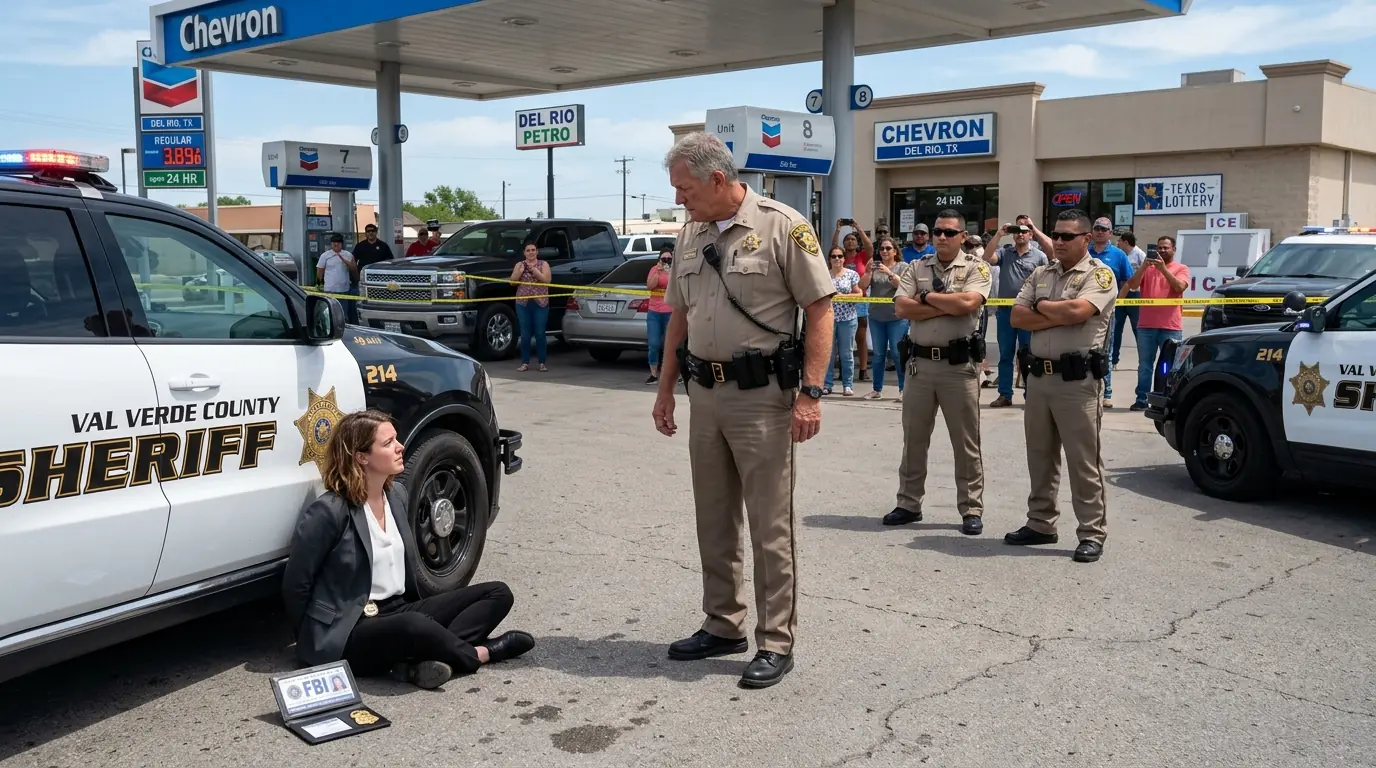
Customers walking in and out of the convenience store.
Children asking parents for snacks.
Drivers talking beside their vehicles.
But on that afternoon, the entire parking lot seemed to stop.
A woman was lying on the concrete near pump number four.
A sheriff’s deputy stood over her.
Several other deputies watched nearby.
And dozens of customers were holding up their phones.
Nobody knew exactly how the situation had reached that point.
But everyone could see something was wrong.
The woman on the ground was not yelling.
She was not fighting.
She was not trying to escape.
She was simply looking up at the officers with an expression that was calm, controlled, and almost impossible to understand.
Her name was Emily Carter.
Most people at the gas station knew nothing about her.
They saw only a woman in a dark blazer on the pavement surrounded by law enforcement.
They did not know she was thirty-four years old.
They did not know she was an FBI special agent.
They did not know she had spent the previous eight years investigating financial crimes, corruption cases, and organized fraud networks across several states.
They did not know that the badge wallet lying several feet away contained the identification that would change the entire encounter.
And Emily preferred it that way.
She had learned during her career that titles changed people.
The moment someone discovered she worked for the federal government, conversations changed.
People became more careful.
More respectful.
Sometimes too respectful.
Emily believed the best way to understand someone was to meet them before they knew who she was.
That was why she had arrived at the Del Rio Chevron that afternoon without announcing herself.
No escort.
No government vehicle.
No visible credentials.
Just Emily.
A woman stopping for fuel.
The trouble started twenty minutes earlier.
Emily had parked beside pump number four after driving through West Texas for several hours.
She was wearing a dark-gray blazer over a light blouse, black pants, and practical shoes.
Her brown hair was tied back loosely.
She looked professional but ordinary.
That was intentional.
She entered the convenience store, bought coffee, and returned to her vehicle.
While standing beside the pump, she noticed two sheriff SUVs entering the parking lot.
The vehicles stopped near the entrance.
Two deputies stepped out.
Deputy Michael Carter was the first.
He was fifty-five years old, a white American sheriff’s deputy with short gray hair, a weathered face, and more than twenty-five years of law enforcement experience.
He was respected by some colleagues because of his confidence.
But others considered him too quick to assume he understood a situation before hearing all the details.
His partner, Deputy Jason Miller, was younger.
Thirty-seven years old.
Less experienced.
More cautious.
The third deputy, Aaron Blake, followed behind them.
The three officers walked toward Emily.
She immediately sensed the difference in their approach.
They were not walking toward someone asking questions.
They were walking toward someone they had already decided was suspicious.
Deputy Carter stopped a few feet away.
“Ma’am.”
Emily turned.
“Yes?”
“We need to talk to you.”
Emily looked around.
“About what?”
Carter glanced toward her vehicle.
“You were reported.”
Emily raised an eyebrow.
“Reported for what?”
“Suspicious behavior.”
Emily waited.
“That is a very broad statement.”
Carter crossed his arms.
“You always answer questions with questions?”
Emily remained calm.
“When the question is unclear, yes.”
Miller looked uncomfortable.
Carter noticed.
“Something wrong?”
“No.”
“Then stay quiet.”
The younger deputy stopped talking.
Emily noticed the exchange.
The chain of command was obvious.
Carter was controlling the conversation.
“Can I ask who reported me?”
Carter ignored the question.
“Identification.”
Emily looked at him.
“Why?”
“Because I asked.”
“That is not an explanation.”
Carter stepped closer.
“You’re making this difficult.”
Emily shook her head.
“No.”
She looked directly at him.
“You are.”
Several customers leaving the store noticed the conversation.
A man wearing a baseball cap slowed down.
A woman near the ice machine looked over.
A truck driver parked nearby began recording.
Carter saw the phones.
His expression changed.
“Everyone wants to record these days.”
Emily looked toward the customers.
“They have that right.”
Carter looked back at her.
“Do you?”
The question was strange.
Emily noticed.
“So we are discussing rights now?”
“We are discussing cooperation.”
“I am cooperating.”
“No, you’re challenging.”
Emily remained silent for a moment.
Then said:
“I am asking you to explain why you stopped me.”
Carter pointed toward her vehicle.
“Open the door.”
Emily frowned.
“Why?”
“Inspection.”
“Based on what?”
Carter’s patience disappeared.