The courtroom laughed when photographs of Major Harper Hayes working in a military truck yard appeared on the projector screen.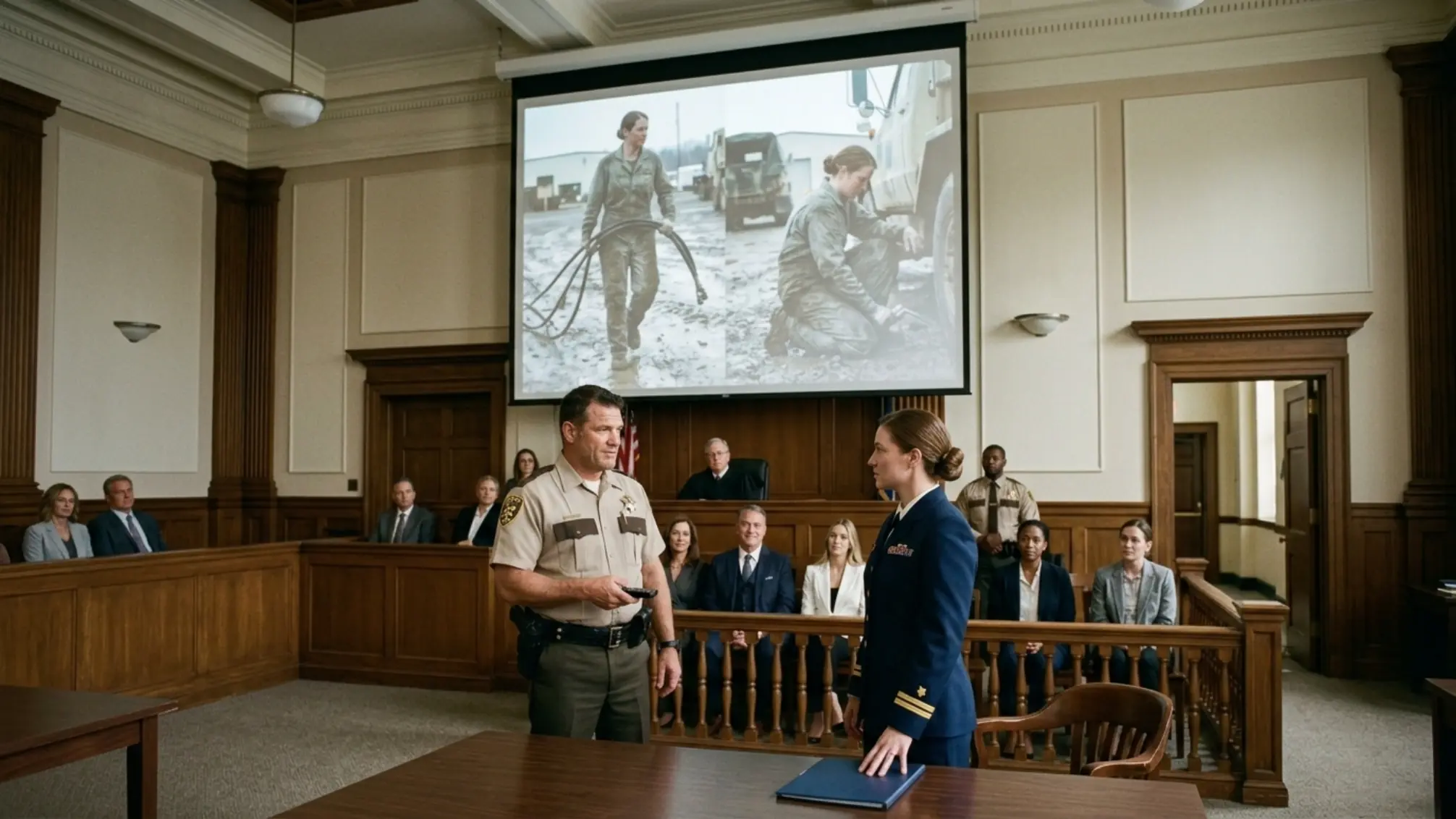
In the first image, grease covered both of her hands as she dragged a thick hydraulic hose across wet concrete. In the second, she knelt beside the open engine compartment of a damaged supply vehicle, wearing faded military coveralls instead of her formal uniform. A third showed her beneath an armored transport truck, one boot protruding from under the chassis while two younger soldiers waited nearby.
Sheriff Brett Calloway stood beside the screen with the remote in his hand and a satisfied smile beneath his dark mustache. He wore a pressed tan uniform, a polished badge, and the expression of a man certain the room belonged to him.
“Those photographs say it all,” he declared. “She’s grease, not brains. Hand the trust to someone qualified and stop pretending a wrench makes you a leader.”
More laughter traveled through the back row.
Harper remained standing at the respondent’s table in her dark-blue military dress uniform. Gold stripes circled her sleeves, ribbons rested above her left pocket, and her brown hair was secured in a precise low bun. She did not look toward the spectators.
Her right hand rested on a navy-blue folder.
Across the aisle, her father leaned back in an expensive charcoal suit. Richard Hayes had spent most of Harper’s childhood telling people that his eldest daughter lacked refinement, ambition, and the instincts necessary to protect the family name. Now he watched the humiliating photographs as if they had finally delivered proof.
Her mother, Elaine, pressed a white tissue beneath perfectly dry eyes.
Behind their attorney sat Harper’s younger sister, Chloe Hayes, wearing a white designer blazer and a gold watch. Chloe appeared calm, but her attention never left the blue folder beneath Harper’s hand.
Judge Evelyn Vance looked down from the bench. “Sheriff Calloway, you will limit your testimony to the financial-capacity assessment you were asked to provide.”
The sheriff lowered the remote. “Of course, Your Honor. My point is that Major Hayes performs low-level manual labor. She follows orders. She does not manage complex assets.”
Harper’s father leaned toward the microphone.
“I raised a grunt,” Richard said. “My younger daughter built a respected defense company. Harper cleans trucks.”
Chloe lowered her eyes modestly.
She had practiced that expression for years.
The dispute centered on the Hayes Legacy Trust, a portfolio valued at slightly more than twelve million dollars when Harper’s grandfather died. Walter Hayes had created the trust to support three purposes: Harper’s future, medical assistance for retired military mechanics, and a transportation scholarship for veterans entering logistics careers.
He had named Harper as managing trustee.
Chloe would receive a smaller distribution after ten years, but only if the principal remained protected. Richard and Elaine received annual allowances and no authority over investments.
For four years, no one challenged the arrangement.
Then Chloe’s company began losing money.
Sentinel Ridge Defense had once been praised as one of North Carolina’s fastest-growing military logistics contractors. Chloe appeared on magazine covers, attended government dinners, and spoke at conferences about innovation in defense supply chains.
Her parents repeated every compliment as though they had personally earned it.
But six months before the courtroom hearing, Richard filed a petition asking the court to remove Harper as trustee. He claimed she lacked financial sophistication, behaved erratically, and had allowed her military obligations to interfere with management of the estate.
Chloe offered to take control.
Their petition included statements from financial advisers who had never met Harper, photographs taken without her knowledge, and an affidavit from Sheriff Calloway describing her as “socially unstable and professionally subordinate.”
The sheriff was not a financial expert.
He was Richard’s longtime friend.
Judge Vance turned toward Harper. “Major Hayes, you may respond.”
Harper lifted the navy folder.
Her father smiled as though he expected her to read a prepared plea. The family attorney, Martin Crowe, leaned back with visible boredom. Sheriff Calloway folded his arms across his chest.
Chloe stopped breathing.
“Your Honor,” Harper said, “before this court decides whether I am qualified to manage my grandfather’s estate, I would like it to examine the account used to pay the private investigator who took those photographs.”
The room fell silent.
Harper removed three banking records and handed them to the clerk. Then she placed a small flash drive beside them.
The judge began reading.
Crowe’s smile disappeared first.
Chloe reached for her father’s sleeve, but it was already too late.
“The investigator was paid sixty-eight thousand dollars over four months,” Harper explained. “The transfers came from an account titled Cedar Meridian Reserve.”
Judge Vance examined the first record. “Who owns that account?”
“On paper, a consulting company registered in Delaware.”
“And in practice?”
Harper looked directly at Chloe. “My sister.”
Richard shook his head. “That is a lie.”
Harper removed another document. “The account was opened using Chloe’s private email address, her personal phone number, and a signature verified by the bank’s biometric system.”
Crowe rose quickly. “Your Honor, these records have not been authenticated.”
“The bank’s records custodian is outside the courtroom,” Harper replied. “So is the federal auditor who obtained them under subpoena.”
Crowe turned toward Chloe.
Her face had lost all color.
Judge Vance looked at the sheriff. “You stated in your affidavit that the photographs were provided by a concerned military employee.”
“Yes, ma’am.”
“That employee does not exist,” Harper said.
Calloway stepped toward her. “Be careful, Major.”
Harper turned slowly.
The sheriff’s warning sounded less like courtroom testimony and more like a threat delivered beside an empty road.
“You spent your entire statement mocking my uniform,” she said. “Now you want protection from it?”
Judge Vance struck the gavel once. “Both of you will address the court.”
Harper faced the bench again. “The investigator delivered the images directly to Sheriff Calloway. He then signed an affidavit claiming they came from an anonymous source so my family could hide the financial connection.”
“That is speculation,” Crowe said.
Harper nodded toward the flash drive. “The drive contains the investigator’s invoices, emails, and recorded phone calls. They were produced during a separate federal contract audit.”
The sheriff’s posture changed.
Harper saw it immediately.
Until that moment, Calloway believed the blue folder contained nothing more than trust statements. He had expected an emotional defense from a daughter humiliated by her family.
He had not expected chain-of-custody records.
Judge Vance ordered the clerk to connect the flash drive to the courtroom system. A list of files appeared on the large screen, replacing the photographs from the truck yard.
One audio file carried the date from three months earlier.
Harper asked permission to play it.
The judge granted it.
Sheriff Calloway’s voice filled the courtroom.
“Make sure you get enough grease in the shots. We need her looking like hired labor, not an officer.”
Then Chloe answered.
“My father wants the judge to believe she can’t handle the trust. Don’t show anyone taking orders from her.”
Calloway laughed on the recording. “For seventy grand, I’ll make General Patton look like a janitor.”
No one in the courtroom moved.
The sheriff looked toward the exit.
Two courthouse deputies standing near the doors straightened.
Judge Vance’s voice became cold. “Sheriff Calloway, remain where you are.”
“It was taken out of context.”
Harper opened the folder again. “The context continues for twenty-three minutes.”
Chloe whispered something to her attorney.
Crowe ignored her.
Harper displayed the complete photograph sequence. The images that had made the courtroom laugh were only tightly cropped sections of larger scenes.
The first uncropped photograph showed eighteen soldiers standing behind Harper while she directed the recovery of a disabled convoy. The second showed two senior officers consulting her beside an open field command station. The third revealed a banner identifying the operation as a joint logistics readiness exercise.
Harper had not been cleaning trucks.
She had been commanding the recovery unit.
Colonel Nathan Rusk entered the courtroom after the judge approved him as a rebuttal witness. He was a tall, silver-haired officer with thirty-one years of service and no interest in family drama.
“Major Hayes designed the emergency vehicle-recovery program used in those photographs,” he testified. “Her system reduced average convoy restoration time by forty-three percent.”
Crowe stood for cross-examination. “But she performed physical labor herself.”
“Yes.”
“Is that typical for a senior officer?”
“When the work requires it.”
“Does she take orders?”
Colonel Rusk looked at him. “Everyone in uniform takes orders. Leadership is not the absence of responsibility.”
A few people in the gallery lowered their eyes.
The colonel continued. “Major Hayes commanded eighty-six personnel during that exercise. She controlled equipment valued at more than sixty million dollars and completed the operation without injury, loss, or budget violation.”
Judge Vance glanced toward Richard. “That seems inconsistent with the description of a low-level laborer.”
Richard’s face tightened. “Military work is not estate management.”
Harper had expected that argument.
She removed the trust’s audited financial statements. During her four years as trustee, the portfolio had increased from twelve million dollars to fourteen point seven million, even after distributing medical grants and scholarships.
She had reduced administrative fees, ended an underperforming investment arrangement established by her father, and recovered more than three hundred thousand dollars in unnecessary charges.
The trust had never missed a payment.
No beneficiary had lost a dollar.
Crowe examined the figures, searching for an opening.
“Major Hayes,” he said, “did you personally make every investment decision?”
“No. I hired licensed professionals, reviewed their recommendations, and required independent audits.”
“So you depended upon advisers.”
“I used qualified expertise. That is what responsible management looks like.”
Crowe’s voice sharpened. “Your younger sister built an entire company without such caution.”
Harper looked at Chloe.
“Would you like to discuss how she built it?”
Chloe whispered, “Don’t.”
Richard heard her. “Don’t what?”
Harper lifted a second group of records from the folder.
Four years earlier, Sentinel Ridge Defense had nearly collapsed. The company won a forty-million-dollar government transportation contract before it possessed the systems necessary to perform it.
Shipments disappeared between warehouses. Vendor invoices were duplicated. Drivers were assigned impossible routes, and military clients threatened to terminate the agreement.
At two o’clock one morning, Chloe arrived at the supply depot where Harper was stationed.
She was crying.
For three weeks, Harper worked her regular military shifts and then spent her nights rebuilding Sentinel Ridge’s logistics system. She restored vendor relationships, created tracking procedures, corrected route assignments, and designed the emergency inventory network that saved the government contract.
Chloe promised the board would recognize her contribution.
Instead, Harper was told not to attend the celebration because her uniform would make the event “feel too industrial.”
Her parents praised Chloe for saving the company.
Harper was sent into the kitchen to help staff carry serving trays.
She had said nothing.
Her family interpreted the silence as weakness.
What they did not know was that federal contracting rules required Harper to document every hour of outside technical assistance. Her commanding officer approved the work, and Sentinel Ridge signed a formal acknowledgment describing her as the architect of the recovery program.
Harper displayed the agreement on the screen.
Chloe’s signature appeared at the bottom.
Richard turned toward her. “You said you designed the system.”
“I supervised the company.”
“That isn’t what he asked,” Harper said.
Chloe rose from her chair. “You enjoyed making me depend on you.”
Harper’s expression did not change. “You came to me.”
“You knew I was desperate.”
“I helped without charging you.”
“You wanted control.”
“No. I wanted the drivers paid and the supplies delivered.”
Judge Vance ordered Chloe to sit.
Harper placed one final account summary before the court. Cedar Meridian Reserve, the secret account used to pay the investigator, had not been created solely for surveillance.
It was an off-book Sentinel Ridge account funded through inflated vendor charges.
Money entered through companies connected to Sheriff Calloway’s brother, then moved into consulting firms controlled by Chloe. Some payments financed private travel and luxury purchases.
Others paid Richard’s legal expenses in the trust case.
The family had not sought control of the estate because Harper was incompetent.
They needed the twelve-million-dollar principal to cover a growing financial crisis.
A pending federal audit had frozen two Sentinel Ridge contracts. Vendors were demanding payment, and Chloe’s lenders were preparing to call in personal guarantees.
If Chloe became trustee, she intended to classify company loans as family investments.
Harper’s grandfather’s money would disappear into Sentinel Ridge within months.
Judge Vance examined Richard. “Were you aware of your younger daughter’s financial condition?”
He hesitated.
Elaine lowered the tissue.
“Richard?” the judge asked again.
“I knew the company had temporary cash-flow issues.”
“Did you know this petition was funded through an undisclosed corporate account?”
“No.”
Chloe stared at her father in disbelief.
He had abandoned her in one word.
The sheriff moved toward Harper’s table.
“You think some spreadsheets make you untouchable?” he said quietly.
Harper turned toward him.
Calloway stepped close enough that the edge of his duty belt struck the table. His hand did not touch his weapon, but the gesture was deliberate.
“I’ve buried stronger people than you,” he whispered.
Harper lifted her chin. “Take one more step.”
The courthouse deputies approached.
Calloway smiled. “Or what?”
“Or the microphones record you threatening a military officer while federal investigators wait outside to question you about bribery.”
His eyes moved toward the ceiling.
A red light glowed on the courtroom recording system.
Judge Vance stood. “Sheriff Calloway, step away from Major Hayes immediately.”
He did not move fast enough.
The deputies took his arms and removed his badge and service weapon under the judge’s order. The man who had entered the courtroom expecting laughter was escorted through the same gallery he had entertained minutes earlier.
No one laughed now.
Judge Vance called a recess and ordered the entire trust frozen against any transfer not already authorized by Harper. She referred the recorded evidence to state investigators, the federal contracting office, and the judicial conduct division.
Chloe attempted to leave.
Federal agents met her in the hallway.
The hearing resumed three weeks later.
By then, Cedar Meridian Reserve had been traced through eleven shell vendors. Investigators found more than six million dollars in questionable Sentinel Ridge transactions, including payments to Calloway’s private security company.
The sheriff had used county databases to search Harper’s travel history, vehicle registrations, and military addresses. He also directed deputies to follow her without a warrant.
Two refused and later testified against him.
The private investigator admitted the photographs were intentionally framed to misrepresent Harper’s rank and duties. He received reduced charges in exchange for cooperation.
Calloway was suspended, then removed from office after a state inquiry. Criminal charges followed for bribery, misuse of government databases, obstruction, and falsifying a sworn affidavit.
Chloe resigned as chief executive of Sentinel Ridge. The company’s board entered supervised restructuring and disclosed the false vendor accounts to federal authorities.
Several government contracts were canceled.
Others were preserved only after an independent compliance team removed every member of Chloe’s executive circle.
Richard and Elaine withdrew their petition.
Judge Vance refused to let the case disappear quietly.
She issued a written ruling finding that Richard, Chloe, and their attorney had presented misleading evidence, concealed financial interests, and attempted to manipulate the court through manufactured humiliation.
Martin Crowe claimed he did not know the photographs were deceptive.
His billing records showed otherwise.
He was referred to the state bar.
Harper remained trustee.
The court also granted her request to terminate her parents’ discretionary allowances until they repaid legal costs taken indirectly from the family companies.
After the final hearing, Richard waited for Harper outside the courtroom.
He seemed smaller without his attorneys and carefully prepared witnesses.
“I was angry,” he said.
Harper closed the navy folder. “You were certain.”
“Chloe told us you wanted to humiliate her.”
“I kept her company alive.”
“You never told me.”
“You never asked.”
Richard looked toward the floor. “I said terrible things.”
“You said what you believed.”
“I was trying to protect the family.”
Harper’s voice remained calm. “You were protecting the daughter whose success made you look important.”
He flinched.
“Can we repair this?” he asked.
Harper thought of the photographs, the laughter, and the moment her father proudly announced that he had raised a grunt. She also remembered years of smaller wounds—the celebrations she was excluded from, the achievements dismissed as manual work, and the silence expected whenever Chloe needed rescuing.
“Repair requires more than regret after failure,” she said. “It requires truth before forgiveness becomes convenient.”
She walked away.
One year later, the Hayes Legacy Trust was worth more than fifteen million dollars. Harper expanded its medical program for retired mechanics and created the Walter Hayes Logistics Fellowship for veterans moving into civilian transportation careers.
She did not name the fellowship after herself.
Her grandfather had recognized the value of work that others considered dirty.
The first scholarship ceremony took place inside a restored vehicle depot. Young veterans stood beside tool benches, diagnostic equipment, and modern transport systems while Harper addressed them in uniform.
“Some people will look at grease on your hands and assume you lack intelligence,” she said. “They will see you beneath a truck and believe you belong beneath them.”
The room became still.
“Let them misunderstand the work. Never let them define its worth.”
Colonel Rusk watched from the front row.
Judge Vance attended privately and declined any public recognition. Two former Sentinel Ridge drivers received grants to start their own logistics company.
Chloe did not attend.
She later accepted a plea agreement involving financial fraud and false contracting records. Her sentence included restitution and a prohibition against managing government vendors.
Sheriff Calloway was convicted after the recorded courtroom threat strengthened the obstruction case against him. The badge he once used to intimidate Harper became evidence displayed before a jury.
Harper kept the blue folder.
She stored it inside a locked cabinet beside her grandfather’s trust documents. The folder was not a trophy. It was a reminder that evidence gathered patiently could speak more powerfully than anger.
The courtroom had laughed when it saw a woman dragging a hydraulic hose across concrete.
Her father called her a grunt.
The sheriff called her a wrench girl and stepped toward her as though his badge gave him control over the truth.
Harper never raised her voice.
She opened the folder.
The cropped photographs expanded. The secret account appeared. The recorded voices filled the courtroom, and the people who mocked her discovered that silence had never meant surrender.
It meant she was waiting until every page was in order.