Sergeant Kenneth Iverson did not even look at the badge.
He struck Arnold Parsons’s hand with the back of his wrist and sent the silver credential spinning onto the sidewalk outside the Dellwood County Sheriff’s Department. The matching identification card slid beneath the open door of a patrol car. Shoppers crossing the street slowed down, and an elderly man sitting outside the hardware store lowered his newspaper.
“You refused my search,” Iverson said, shoving Arnold toward the cruiser. “Now you’re going in cuffs.”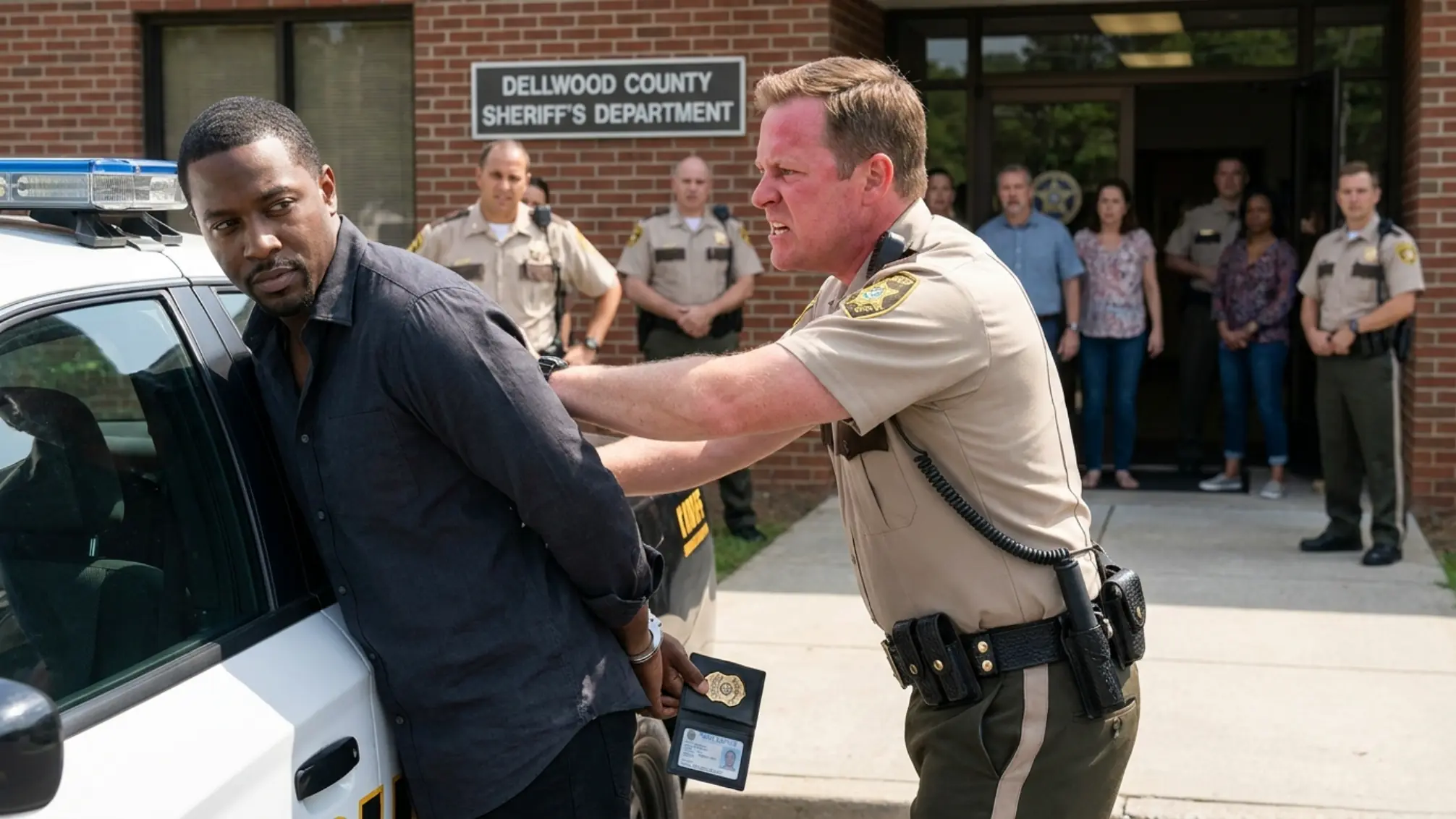
Arnold did not resist. He was forty-seven, tall and solidly built, with deep brown skin, short black hair touched with gray, and the composed eyes of someone who understood exactly how quickly fear could become evidence against him. His charcoal-gray shirt remained neatly tucked into dark jeans even as Iverson forced his hands behind his back.
“Pick up the badge you knocked down and read it,” Arnold said.
Iverson tightened the handcuffs.
“I don’t care who you claim to be. I’ll bury you before anyone listens.”
Arnold turned his head just enough to meet the sergeant’s eyes.
“Then take me inside, Sergeant, because the agents ending your career are already waiting there.”
Iverson’s expression changed for less than a second.
Then he laughed.
Two deputies standing near the station entrance laughed with him, though neither understood the joke. Deputy Logan Pike was twenty-eight and eager to impress his supervisor. Deputy Carl Winslow was older, quieter, and already looking toward the badge lying on the concrete.
Iverson grabbed Arnold by the upper arm.
“Threatening law enforcement adds another charge.”
“That wasn’t a threat.”
“What would you call it?”
“A schedule.”
Iverson shoved him toward the open rear door.
The confrontation had begun eight minutes earlier when Arnold parked beside the hardware store across from the sheriff’s department. He had been carrying a sealed evidence envelope from the Dellwood Federal Courthouse to a meeting inside the station. The department’s command staff had been told only that representatives from the Department of Justice would arrive sometime that afternoon.
Arnold was intentionally early.
For eleven months, he had directed an investigation into complaints against the Dellwood County Sheriff’s Department. Most involved traffic stops, vehicle searches, missing cash, confiscated property, and arrests that disappeared after victims paid unofficial “processing fees.”
The pattern centered around Kenneth Iverson.
Internal complaints rarely survived more than forty-eight hours. Body-camera footage went missing. Reports changed after submission. Witnesses received visits warning them that false accusations against officers could lead to prosecution.
Three complainants moved away.
One lost his business license after county inspectors suddenly discovered violations.
Another, nineteen-year-old Devin Carter, spent four months in jail after Iverson claimed to find a stolen handgun beneath his car seat. The weapon had been listed in police evidence storage six days before the arrest.
That mistake brought federal attention.
Arnold’s team traced the gun to a robbery case handled by Iverson. The evidence record claimed it had been destroyed, but no destruction certificate existed. When prosecutors asked questions, the department produced a photocopy with a signature belonging to an evidence technician who had retired two years earlier.
Somebody had manufactured paperwork.
Arnold suspected the corruption extended beyond Iverson. The sergeant was aggressive, but he was not disciplined enough to erase records, manipulate court filings, and pressure county offices without help.
The investigation required patience.
Arnold had learned patience from his father, James Parsons, who worked thirty-two years as a public defender in Savannah. James often told his son that corrupt authority depended on speed. It frightened people quickly, created official records quickly, and punished resistance before anyone could compare accounts.
“Truth is slower,” James said. “But give it witnesses, and it becomes difficult to move.”
Arnold built the case slowly.
His team interviewed thirty-seven people, recovered deleted messages, examined bank records, and installed lawful surveillance after receiving court authorization. They discovered that Iverson and three other officers had collected more than four hundred thousand dollars through extortion, false seizures, and property theft.
A local towing company helped them.
A county clerk altered documents.
Someone inside the station warned the officers whenever investigators requested files.
The final phase required identifying that person.
Arnold scheduled the meeting with Sheriff Douglas Bell at three o’clock. Federal agents entered through the rear garage at two-thirty and waited in a conference room with warrants sealed inside black document cases.
Arnold planned to walk through the front entrance alone at two-fifty.
He wanted to observe how the department treated a stranger who appeared to possess no influence.
He received his answer before reaching the steps.
Iverson had been standing beside a patrol vehicle when Arnold crossed the street. The sergeant watched him approach, then stepped directly into his path.
“Can I help you?”
“I have a meeting inside.”
“With whom?”
“The sheriff.”
Iverson looked at Arnold’s clothes, the sealed envelope beneath his arm, and the unmarked sedan parked across the road.
“What kind of meeting?”
“Official business.”
“That doesn’t answer the question.”
Arnold remained calm. “I’ll explain it to the sheriff.”
Iverson moved closer.
“You carrying a weapon?”
Arnold was armed. His sidearm remained concealed beneath his shirt in accordance with federal policy.
“Yes.”
“Hands on the hood.”
“No.”
The answer startled Iverson.
Most people obeyed before asking why. Arnold’s refusal was controlled, not loud, which made it more threatening to a man accustomed to interpreting uncertainty as authority.
Iverson rested one hand near his holster.
“You just admitted you’re armed outside a law enforcement building.”
“I also told you I have official business.”
“Hands on the hood.”
“Identify the legal basis for detaining me.”
The two deputies near the entrance started watching.
Iverson stepped within inches of Arnold.
“I don’t need to explain procedure to you.”
“You do if you intend to search me.”
“Are you refusing?”
“I am asking whether I’m free to leave.”
Iverson’s jaw tightened.
He could have answered yes and ended the encounter. He could have requested identification without touching Arnold. He could have called the sheriff’s office and confirmed the meeting.
Instead, he decided resistance required punishment.
Arnold reached slowly toward his jacket.
Iverson seized his wrist.
“Don’t reach!”
“I’m retrieving identification.”
“Slowly.”
Arnold removed the federal badge and credential case.
Iverson knocked them away.
That was where the recording began.
A small camera clipped inside Arnold’s shirt captured the badge striking the pavement. Two federal agents in the conference room watched the live transmission on a secure tablet.
Special Agent Dana Brooks reached for the door.
Assistant U.S. Attorney Melissa Grant stopped her.
“Not yet.”
“He put hands on him.”
“Arnold gave the signal to wait.”
Dana stared at the screen as Iverson applied handcuffs.
“What signal?”
“He told Iverson we were already inside.”
“That sounds like a warning.”
“It means Arnold wants the entire chain documented.”
Outside, Iverson pushed Arnold into the rear of the cruiser.
Deputy Winslow walked toward the badge.
“Sergeant, maybe we should check that.”
Iverson pointed at him.
“Leave it.”
“It looks federal.”
“It looks fake.”
“You didn’t examine it.”
Iverson’s face hardened. “Are you questioning me in front of a detainee?”
Winslow stopped.
That moment would matter later.
He knew something was wrong. He saw the credential and recognized the federal seal. Yet fear of his supervisor outweighed responsibility to intervene.
Deputy Pike picked up the evidence envelope.
“What’s in this?”
“Confidential documents,” Arnold said.
Iverson took it from him.
“Open it.”
Arnold leaned forward from the back seat.
“Do that, and you add obstruction of a federal investigation.”
Iverson smiled.
“There it is again. Pretending you’re important.”
He tore the envelope open.
Inside were copies of three signed statements from people Iverson had threatened during unlawful stops. Their names were redacted, but the summary page contained his badge number.
Iverson read the first line.
The color left his face.
He folded the document quickly, but Pike had already seen it.
“Sergeant, that has your name.”
Iverson closed the envelope.
“He fabricated it.”
Arnold watched him carefully.
“You knocked away my credentials, opened protected evidence, and handcuffed me without probable cause. Every second you continue becomes another choice.”
Iverson leaned into the car.
“Listen to me. You came here armed, refused lawful commands, and carried documents targeting this department. I decide what goes into the report.”
Arnold’s voice remained calm.
“Your body camera is off.”
Iverson glanced toward the device on his chest.
“So?”
“So you still believe nobody is recording you.”
For the first time, Iverson looked around.
The hardware store.
The pedestrians.
The courthouse camera mounted above the intersection.
Arnold’s shirt buttons.
His confidence flickered.
“Search him,” Iverson ordered.
Pike opened the other rear door.
Arnold did not resist as the deputy removed his phone, wallet, keys, and concealed sidearm. The pistol’s serial number returned clean, but Iverson ignored that result.
Pike opened Arnold’s wallet.
The federal identification sat behind his driver’s license.
He stared at it.
“Sergeant.”
Iverson snatched the wallet.
The credential identified Arnold Parsons as a supervisory special agent with the Federal Bureau of Investigation. The photograph matched. The badge number matched the badge on the sidewalk.
Iverson looked toward the station entrance.
He could still stop.
He could remove the cuffs, apologize, and claim confusion.
Instead, he began constructing a defense.
“Could be counterfeit.”
Pike’s voice lowered. “It has a verification number.”
“Call dispatch.”
Winslow stepped closer. “We can walk inside and verify it directly.”
Iverson turned on him.
“Nobody goes inside until I finish the arrest.”
Arnold understood immediately.
Iverson was afraid of what waited beyond the doors.
The sergeant had received advance warning about the federal meeting but had not been told who would attend. He now suspected Arnold was connected to it.
Keeping him outside bought time.
Iverson reached for his phone.
Arnold watched him send a message.
Not to dispatch.
To someone saved as D.B.
The message contained only four words:
They’re here. Clear everything.
Federal agents inside the station intercepted the message under the court order already authorizing surveillance of Iverson’s device.
Dana Brooks looked at the tablet.
“We have the insider.”
Melissa read the recipient information.
Sheriff Douglas Bell.
The elected sheriff himself.
The investigation had finally reached the top.
Inside his second-floor office, Douglas Bell received Iverson’s message while speaking to two federal attorneys. He kept his expression neutral, excused himself, and entered the records room through a private hallway.
Agents followed through cameras installed the previous night.
Bell unlocked a metal cabinet and removed a portable hard drive, several cash envelopes, and handwritten ledgers. He placed them into a canvas evidence bag, then reached toward the industrial shredder.
The conference-room door opened.
Six federal agents entered the hallway.
Bell froze with the ledger in his hand.
Outside, Iverson pulled Arnold from the cruiser.
“We’re processing you at the side entrance.”
“Why not the front?”
“Security.”
“You mean witnesses.”
Iverson shoved him toward the building.
Arnold stumbled once but recovered.
The elderly man across the street stood from the bench. Several shoppers had begun recording on their phones. One woman shouted that Arnold had shown a badge before he was arrested.
Iverson pointed toward them.
“Stop recording police activity!”
Nobody lowered a phone.
Arnold looked at the sergeant.
“You’re losing control of the story.”
Iverson moved close enough that their faces were separated by inches.
“I still control what happens to you inside.”
The station doors opened.
Dana Brooks walked out first wearing a dark suit and federal badge. Four agents followed her. Behind them came Assistant U.S. Attorney Melissa Grant and two internal-affairs investigators from the Georgia Bureau of Investigation.
Iverson stopped.
Pike stepped backward.
Winslow closed his eyes briefly, as though an outcome he feared had finally arrived.
Dana looked at Arnold’s handcuffs.
“Remove them.”
Iverson did not move.
“He’s under arrest.”
“For what?”
“Failure to obey, carrying a concealed weapon, resisting detention, and possible impersonation.”
Dana held up her phone.
“We verified his identity twenty-two minutes ago. So did your deputy.”
Pike’s eyes dropped.
Iverson pointed at Arnold.
“He approached a secure building armed.”
“He had a scheduled meeting.”
“He refused a search.”
“He was not required to consent.”
“He threatened me.”
Arnold answered quietly.
“I told him agents were waiting inside.”
Dana looked toward Iverson’s body camera.
“Why is your device off?”
“Battery failure.”
A technician walked forward and examined it.
“The battery is at eighty-six percent.”
Iverson’s face reddened.
Melissa held up a printed copy of the intercepted message.
“Why did you warn Sheriff Bell to clear everything?”
Iverson stared at the page.
“You accessed my private phone?”
“Pursuant to a federal warrant.”
The words struck like a physical blow.
Two agents escorted Sheriff Bell from the station in handcuffs. His uniform jacket had been removed, and his face had gone gray. Another agent carried the canvas evidence bag containing the cash and ledgers Bell tried to destroy.
Iverson looked at the sheriff.
Bell looked away.
“You told me it was handled,” Iverson said.
Melissa immediately turned toward the court reporter standing behind her.
“Please record that statement.”
Iverson realized too late that he had spoken aloud.
Dana stepped closer.
“Sergeant Kenneth Iverson, you are under arrest for conspiracy, extortion under color of law, evidence tampering, obstruction, and deprivation of civil rights.”
Iverson looked toward his deputies.
“Do something.”
Pike remained frozen.
Winslow removed Iverson’s service weapon.
The gesture surprised everyone.
Iverson turned on him.
“You coward.”
Winslow’s hands trembled, but he maintained control of the firearm.
“No,” he said. “I was a coward when I saw his badge and did nothing.”
Dana removed Arnold’s handcuffs.
Red marks circled his wrists.
“You all right?”
“I’m fine.”
“You waited longer than expected.”
“Iverson led us to Bell.”
Arnold looked toward the discarded badge still lying near the patrol car. The elderly man from across the street walked over, picked it up carefully, and handed it to him.
“I saw him knock this down,” the man said.
“What’s your name?”
“Arthur Jennings.”
“Would you be willing to give a statement?”
Arthur glanced at Iverson.
“I’ve waited six years to give one.”
His answer opened another door.
Arthur’s son had been stopped by Iverson in 2019. The sergeant seized twelve thousand dollars from the car, claiming it might be connected to drug trafficking. No drugs were found, no charges were filed, and the family never recovered the money.
The official property record listed only twenty-seven hundred dollars.
Arthur had complained repeatedly.
Sheriff Bell called the discrepancy a counting error.
Investigators searched the station for seventy-two hours.
Behind a false wall in the evidence room, they found cash, jewelry, electronics, and firearms taken during traffic stops. Several items matched property reported missing by complainants.
The ledgers documented payments divided between Bell, Iverson, Danner, Pike, and two county employees. Each entry used coded descriptions based on vehicle colors and locations.
Blue truck. Highway 14. Cash.
White Mercedes. Medical district. Watch.
Black sedan. Hardware store. Federal problem.
The last entry had been started but never completed.
Arnold’s arrest was not an isolated act of arrogance. It was the department’s standard method used against the wrong person while investigators were already inside.
Within three hours, Sheriff Bell, Sergeant Iverson, Deputy Pike, and the evidence supervisor were suspended. Their access credentials were revoked, service weapons collected, and department accounts frozen.
By sunrise, the county commission placed the sheriff’s department under temporary outside administration.
News crews filled the sidewalk where Arnold’s badge had fallen.
Reporters called the event a dramatic reversal.
Arnold disliked the phrase.
Nothing reversed quickly for the victims.
Devin Carter had spent four months in jail.
Dr. Lena Morris lost her clinic after the department seized payroll cash and leaked allegations that she supported drug activity.
Miguel Santos accepted a plea agreement after deputies planted stolen tools inside his truck.
Arthur Jennings’s son moved to another state because he could no longer drive past a patrol car without shaking.
The arrests lasted minutes.
Repair would take years.
Iverson’s attorney argued that Arnold intentionally provoked the encounter. He claimed the federal agent refused reasonable commands because he wanted to create dramatic evidence.
The sidewalk recording contradicted him.
Arnold had spoken calmly.
He displayed identification.
He asked whether he was free to leave.
Iverson struck away the badge, opened a protected envelope, ordered a search, and sent a warning to Bell.
The hidden camera captured every word.
At trial, prosecutors played the moment when Iverson threatened to bury Arnold before anyone listened.
Then they displayed thirty-two complaints from people who had used nearly identical language.
Nobody will believe you.
I write the report.
Your word against mine.
I can find something if I need to.
Iverson had repeated the threats so often they became procedure.
Sheriff Bell took the stand under a cooperation agreement. He admitted protecting Iverson because the extortion money financed campaign expenses, personal debts, and cash payments to political allies.
The sheriff described himself as a man who lost control of aggressive subordinates.
The ledgers showed otherwise.
Bell approved targets, monitored complaints, and ordered county employees to punish people who refused to remain silent.
He received fourteen years in federal prison.
Iverson received twenty-one.
Deputy Pike pleaded guilty and testified against the others. His sentence was reduced, but he permanently lost the right to serve in law enforcement.
Winslow was not charged.
Investigators found no evidence that he accepted money or participated in false arrests. Yet during the public review, he admitted seeing warning signs for years.
“I told myself I was not part of it because I never took cash,” he said. “But I watched people get hurt and stayed quiet because speaking would have cost me my job.”
The state revoked his certification for failure to intervene and false reporting.
He accepted the decision.
Three years later, the Dellwood County Sheriff’s Department reopened under new leadership. Every vehicle search required a recorded legal basis, and body cameras activated automatically when doors opened during traffic stops.
Property seizures had to be counted under two cameras and verified by two officers from separate units. Complaints went directly to an independent civilian office rather than through the sheriff’s chain of command.
The reforms could not erase the past.
They made repetition harder.
Arnold returned to Dellwood for the reopening ceremony but refused to stand on the stage. He remained beside Arthur Jennings near the same hardware-store bench.
A young deputy approached.
“Agent Parsons?”
“Just Arnold today.”
The deputy nodded toward the station.
“They tell every new hire what happened here.”
“What do they say?”
“That Sergeant Iverson arrested the wrong man.”
Arnold looked at him.
“That is not the lesson.”
The deputy waited.
“He had arrested many wrongfully before me. My title only gave the system a reason to react immediately.”
The young man’s expression became serious.
“Then what should we remember?”
Arnold looked across the street at the sidewalk where his badge had landed.
“Treat every person as though the truth will eventually enter the building.”
The ceremony began, but Arnold continued watching the entrance.
Years earlier, Iverson stood there believing the station belonged to him. He thought an official report could erase a discarded badge, frightened witnesses, and a quiet man’s account.
He was wrong.
The badge mattered because it revealed Arnold’s authority.
The recording mattered because it revealed Iverson’s character.
Three hours ended several careers, but the real work had begun long before Arnold arrived. It began when ordinary people spoke despite threats, preserved receipts, remembered missing cash, and refused to accept that a uniform made corruption untouchable.
Iverson believed Arnold was dangerous only after learning he was federal.
He never understood that every person he abused had carried the same dangerous thing.
The truth.
Arnold adjusted his charcoal-gray sleeve and watched the new deputies enter the building.
His wrists no longer carried marks from the handcuffs.
The department would carry the mark of that afternoon for generations.