Daniel Reed almost walked past the crying woman.
He had only forty-two minutes left on his lunch break, his boots were wet from the freezing Columbus rain, and the diner line had already taken twelve minutes. His plastic tray carried a grilled ham sandwich, a mound of fries, and a bottle of water he had purchased only because his ten-year-old daughter kept reminding him that coffee did not count as hydration. All Daniel wanted was an empty seat, a warm meal, and enough silence to prepare himself for another six hours inside a factory that seemed determined to wear every employee down before deciding whether to keep them.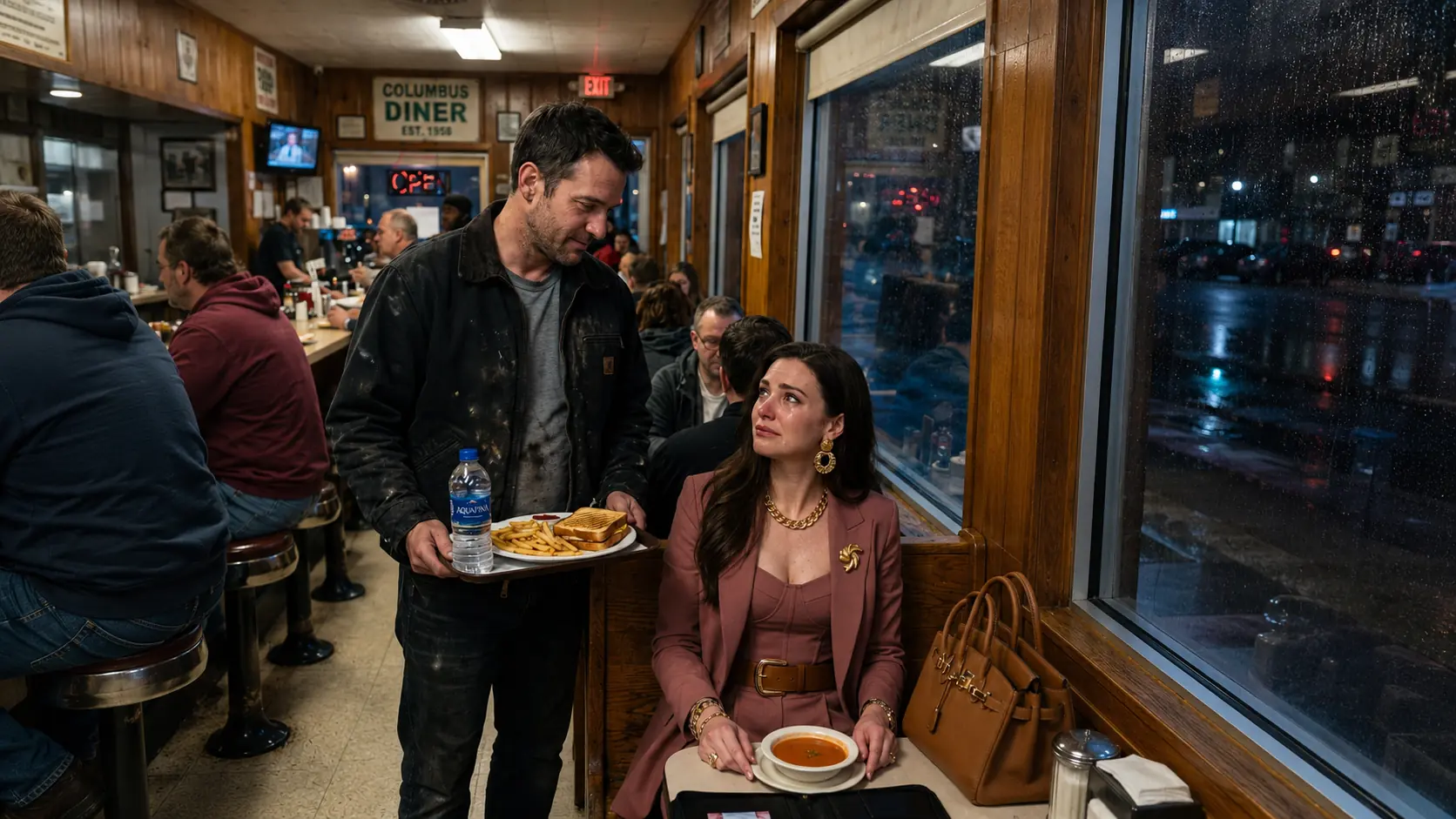
There were no empty tables.
Every booth inside Franklin Street Diner was occupied by office workers, construction crews, nursing students, and families escaping the cold. Near the rain-streaked front window, one woman sat alone in a booth designed for four, staring down at a bowl of soup she had not touched. Her shoulders trembled beneath a tailored navy blazer, and a folded napkin remained pressed between her fingers.
Daniel stopped beside the booth.
The woman quickly wiped her eyes, embarrassed that someone had noticed.
“Sorry,” Daniel said. “I didn’t mean to stare.”
“You weren’t.”
“I was, a little.”
She looked toward the crowded dining room.
Daniel lifted his tray.
“Would you mind if I sat here? I’ll keep to my side, eat fast, and pretend I didn’t see anything.”
The woman studied him.
Daniel was thirty-eight, with short dark-brown hair, light beard stubble, tired hazel eyes, and the slightly hunched posture of a man whose shoulders had spent years carrying tools, groceries, sleeping children, and worries no one else could see. His faded black work jacket carried small oil stains around the sleeves. Beneath it, he wore a gray T-shirt bearing the blue emblem of Columbus Precision Systems.
The woman’s gaze paused on that emblem.
Something painful crossed her face.
Daniel noticed but did not understand.
“You can sit,” she said quietly.
“Thank you.”
He slid into the seat across from her and positioned his tray near the window. For a moment, neither spoke. The noises of the diner surrounded them: silverware touching plates, waitresses calling orders, rain tapping the glass, and the low murmur of conversations belonging to people who did not know that two strangers were about to alter one another’s lives.
Daniel unwrapped his sandwich.
The woman continued staring at her soup.
“You should eat that before it becomes refrigerator temperature,” he said.
“I’m not hungry.”
“That usually means something’s wrong.”
She looked at him.
“You always question strangers?”
“Only the ones who look like they might need someone to.”
The answer was so direct that she had no immediate response.
Daniel took a bite of his sandwich, giving her permission to ignore him. He did not ask her name. He did not lean forward with false concern or offer advice before knowing the problem. He simply sat there, eating quietly while she gathered herself.
After almost a minute, she spoke.
“You said you would pretend you didn’t see anything.”
“I can still pretend.”
“You’re not very convincing.”
“My daughter says the same thing whenever I tell her vegetables taste good.”
A faint smile touched the woman’s lips.
“You have a daughter?”
“Emily. Ten years old. Smart enough to know when I’m lying and kind enough to let me think I got away with it.”
The woman looked down at the leather folder resting beside her handbag. A corner had fallen open, revealing a photograph of a young girl standing beside a lake.
Daniel nodded toward it.
“Yours?”
She closed the folder quickly.
“My niece.”
“She looks happy.”
“She was.”
The last word carried more weight than Daniel expected.
He lowered his sandwich.
“I’m sorry.”
The woman looked through the window at traffic moving through the rain.
“My sister died last year.”
Daniel did not offer one of the empty phrases people often used when death made them uncomfortable. He knew there were no words that reduced grief. His own wife, Laura, had died from an undiagnosed heart condition five years earlier, leaving him alone with Emily and a house filled with ordinary objects that suddenly felt painful.
“My wife died five years ago,” he said.
The woman turned back toward him.
“I’m sorry.”
“Thank you.”
“How old was your daughter?”
“Five.”
“And you raised her alone?”
“I’m still raising her. Ask me again when she’s thirty and has stopped blaming me for every embarrassing school lunch.”
The woman gave another brief smile, but tears remained in her eyes.
Daniel pushed the untouched fries toward the center of the table.
“Grief makes you believe you’re the only person carrying something impossible,” he said. “Then some stranger with a sandwich reminds you the world is full of people walking around with invisible bricks in their pockets.”
She looked at him carefully.
“What kind of work do you do?”
“Industrial maintenance.”
“At Columbus Precision?”
He glanced down at the emblem on his shirt.
“You know the company?”
“I’ve heard of it.”
“That already puts you ahead of most people in Columbus.”
“What do you repair?”
“Whatever management breaks by refusing to replace it three years earlier.”
She almost laughed.
Daniel continued.
“Hydraulic presses, fabrication systems, loading equipment. Some days I fix machines. Other days I convince machines not to kill anyone until replacement parts arrive.”
“Is it dangerous?”
“It can be.”
“Do you like it?”
Daniel considered the question.
“I like the people.”
“That isn’t the same thing.”
“No.”
He looked toward the kitchen, where a cook was placing another order beneath the heat lamps.
“The company used to be different. My father worked there for twenty-nine years. Back then, if a machine failed, somebody asked what it needed. Now somebody asks how many more shifts we can force out of it before spending money.”
The woman’s fingers tightened around her napkin.
Daniel noticed.
“You really do know the company.”
She hesitated.
“I work in corporate finance.”
That was not a complete lie, though it deliberately concealed the truth.
Her name was Victoria Hale. At thirty-five, she was the chief executive officer of Hale Meridian Industries, the parent company that had purchased Columbus Precision Systems three years earlier. Her father had founded Hale Meridian and built it through a combination of ruthless discipline and strategic acquisitions. After his death, Victoria inherited both his controlling shares and the expectation that she would prove herself harder than every man waiting for her to fail.
The board meeting scheduled for the following morning would decide the fate of Columbus Precision.
The plan recommended closing two production buildings, eliminating 418 positions, outsourcing maintenance, and selling the property to a logistics developer. The cuts would increase quarterly earnings, satisfy investors, and strengthen Victoria’s position before a major merger vote.
The documents inside her leather folder contained the final authorization.
All they needed was her signature.
Daniel knew none of this.
“What’s corporate finance like?” he asked.
“Mostly numbers.”
“Numbers are honest. People make them lie.”
Victoria looked sharply at him.
Daniel shrugged.
“At the factory, management says overtime is voluntary because the spreadsheet calls it voluntary. But if you refuse three weekends, suddenly you’re not a team player. The number says choice. The person knows it means punishment.”
Victoria looked at his hands.
They were rough, with faded scars across the knuckles and a dark line of machine oil beneath one thumbnail despite repeated washing.
“Are there rumors about layoffs?” she asked.
Daniel became still.
“There are always rumors.”
“But this time?”
“This time supervisors are photographing equipment, outside consultants keep walking through with tablets, and management suddenly wants every maintenance log from the last seven years.”
“What do people think will happen?”
“They think Building Two will close.”
“And if it does?”
“Some people will transfer.”
“Others?”
“Most won’t.”
Daniel leaned back.
“People in offices like to say workers will find something else. Maybe some will. But Terry in machining is fifty-nine and has one working knee. Alicia has twins and an autistic son whose therapy depends on the company insurance. My neighbor Carlos just bought a house because management told him production was stable.”
“And you?”
Daniel looked at the photograph of Emily tucked inside the clear plastic cover of his wallet.
“I have enough savings for maybe three months.”
Victoria lowered her eyes.
“If the factory closed tomorrow, what would you do?”
“Find whatever work I could.”
“You make it sound simple.”
“It wouldn’t be.”
“Then why say it that way?”
“Because Emily watches my face when she’s scared. If I panic, she thinks the whole world is ending.”
Daniel rubbed one thumb along the edge of his tray.
“I don’t get to collapse whenever I feel like it. Single parents learn that early.”
Victoria thought of her niece, Sophie, now living with grandparents in Michigan. After her sister’s death, Victoria had promised to visit every month. Work reduced that promise to once every six weeks, then occasional video calls arranged by assistants.
She had convinced herself she was preserving the company her father built.
She had not asked what she was losing in the process.
“What would you tell the person making the decision?” Victoria asked.
Daniel gave a tired smile.
“I doubt that person eats in diners with maintenance workers.”
“Pretend they do.”
He looked at her.
“You really want to know?”
“Yes.”
“I’d tell them to visit the floor without cameras or executives. Talk to people whose names aren’t on the organizational chart. Ask what they’ve already sacrificed to keep production running.”
Victoria waited.
“And if the numbers still say the factory should close?”
“Then I’d ask whether the numbers include what happens afterward.”
“What do you mean?”
“The houses people lose. The health insurance that disappears. The small businesses around the plant that depend on workers buying lunch. The kids who move schools because their parents can’t keep the rent.”
Daniel picked up one fry and turned it between his fingers.
“Companies put severance in the cost column and call the damage calculated. But they never calculate the whole thing.”
Victoria’s throat tightened.
The closure analysis in her folder included equipment resale, tax consequences, real-estate value, severance costs, and investor response. It did not include schools, marriages, medical treatment, local businesses, or children watching parents pretend everything would be fine.
She had reviewed those pages for weeks.
She had never noticed what was missing.
“You sound angry,” she said.
“I am.”
“At the company?”
“At people who make decisions from far enough away that they never hear the sound when those decisions land.”
The words were not cruel.
That made them harder to dismiss.
Victoria looked down at her soup.
“I’m about to make a decision that could ruin hundreds of families.”
Daniel’s eyes narrowed slightly.
He had assumed she spoke generally. Now the truth beneath her words became harder to ignore.
“What kind of decision?”
“I can’t tell you.”
“Then why tell me that much?”
“Because I don’t know if I can do it.”
Daniel studied her tailored clothing, expensive watch, guarded expression, and the executive folder beside her handbag.
“You’re not just in finance.”
Victoria did not answer.
“You’re involved in something happening at Columbus Precision.”
Her silence confirmed it.
Daniel placed his sandwich down.
“Who are you?”
She stared at the table.
“Victoria Hale.”
He knew the name.
Every employee did.
Her photograph had appeared in the internal newsletter after Hale Meridian purchased the factory. Daniel had seen polished corporate portraits of her standing beside ribbon cuttings, receiving awards, and speaking about innovation.
He had never seen her crying in a diner.
Daniel slowly leaned back.
“You’re the CEO.”
“Yes.”
The sounds around them seemed to recede.
“You came here knowing the factory might close.”
“I came here because I couldn’t breathe in my hotel room.”
“And you let me talk without telling me.”
“I wanted to hear what you actually thought.”
“You wanted a worker’s opinion without the worker knowing who was asking.”
Victoria flinched.
“That’s fair.”
“No, it isn’t.”
Daniel’s voice remained controlled, but the warmth had disappeared.
“My daughter’s future is in that folder, isn’t it?”
Victoria looked at the leather case.
“The recommendation is to close part of the facility.”
“How many jobs?”
“Four hundred eighteen.”
Daniel’s jaw tightened.
“You knew that while I told you about Alicia’s son.”
“Yes.”
“And Carlos’s house.”
“Yes.”
He stood, lifting his tray.
Victoria rose quickly.
“Daniel, please.”
He stopped.
She had remembered his name from his employee badge.
That made the moment feel even colder.
“I didn’t come here to trick you,” she said.
“Maybe not.”
“I genuinely didn’t know what to do.”
“You’re the CEO. Deciding is your job.”
“I know.”
“No, you know what the title says. People like me are the part you don’t know.”
Victoria absorbed the accusation without defending herself.
Daniel looked toward the window.
“Emily will be waiting for me after school. She’ll ask how work was, and I’ll tell her it was fine because she has a math test tomorrow and doesn’t need to carry this yet.”
He faced Victoria again.
“If you close that factory, don’t call us positions. Don’t say restructuring. Say our names.”
He walked toward the tray return.
Victoria followed him with her eyes.
Daniel stopped halfway across the diner, turned, and returned to the booth.
For a moment, she thought he intended to continue the confrontation.
Instead, he placed his unopened bottle of water beside her soup.
“You haven’t eaten or had anything to drink.”
Victoria stared at it.
“Why are you still being kind to me?”
“Because who you are doesn’t change who I’m trying to be.”
Then he left.
Victoria remained in the booth until the dinner crowd thinned.
The leather folder sat beside her like something alive.
She opened it again and reviewed the closure analysis from the beginning. This time, she did not see production numbers and labor costs. She saw Terry’s damaged knee, Alicia’s twins, Carlos’s mortgage, Emily’s math test, and Daniel standing inside his kitchen pretending not to be afraid.
At the bottom of the final page waited the signature line.
Victoria closed the folder without signing it.
The next morning, Hale Meridian’s board assembled on the forty-second floor of its Chicago headquarters. Twelve executives sat around a glass table while investment advisors displayed slides showing expected savings from the Columbus closure.
Chief Financial Officer Warren Price spoke confidently.
“The facility’s labor costs exceed the industry benchmark by seventeen percent. Outsourcing maintenance and consolidating production will improve annual operating income by thirty-eight million dollars.”
Board member Richard Lang turned toward Victoria.
“The merger partners expect decisive action.”
Victoria sat at the head of the table wearing the same navy blazer from the diner.
The bottle of water Daniel had given her rested unopened beside her tablet.
Warren changed slides.
“Implementation can begin Monday. Public language will emphasize modernization, strategic realignment, and long-term competitiveness.”
Victoria looked at the screen.
“Say their names.”
Warren stopped.
“I’m sorry?”
“The people being terminated. Say their names.”
“There are four hundred eighteen employees.”
“You’re recommending we remove their income. You should know who they are.”
Richard leaned forward.
“This is not the time for sentimentality.”
Victoria looked at him.
“Human consequences are not sentimentality.”
“They are already reflected in severance costs.”
“No, they aren’t.”
She stood and walked toward the screen.
“The report measures equipment, property, wages, taxes, and investor response. It does not measure the local economy, employee health coverage, retraining feasibility, or the cost of losing decades of technical knowledge.”
Warren crossed his arms.
“The financial conclusion remains unchanged.”
“Only because the model excludes anything that complicates it.”
Richard frowned.
“What exactly are you proposing?”
“A ninety-day suspension of the closure.”
The room erupted with objections.
Victoria raised one hand.
“During those ninety days, we will audit management spending, executive bonuses, consulting contracts, supplier agreements, and the maintenance failures that reduced productivity.”
Warren looked alarmed.
“Those categories cannot replace the savings generated by consolidation.”
“We spend eleven million dollars annually on consultants telling plants to reduce costs. Start there.”
Richard stared at her.
“This reversal will damage investor confidence.”
“Then investors can decide whether they want a company capable of long-term thinking.”
“You are risking the merger.”
“I am protecting the company from a decision designed to improve one quarter.”
The debate lasted two hours.
Victoria presented an alternative plan she had written before dawn. Instead of closing the facility, Hale Meridian would modernize Building Two, eliminate redundant consulting contracts, reduce executive incentive payments, expand a profitable repair division, and establish an employee-led efficiency team.
The plan would save less during the first year.
By year three, it could preserve the factory while producing stronger long-term returns.
The vote ended seven to five in Victoria’s favor.
Columbus Precision would remain open.
Daniel learned the news during the afternoon shift.
Every speaker inside the factory clicked on at once, and Victoria’s voice filled the production floor.
“Yesterday, company leadership prepared to approve a partial closure of this facility. That plan has been rejected.”
Machines stopped.
Workers looked at one another.
“We will invest in modernization, preserve all current positions during the restructuring period, and establish direct employee participation in the recovery plan.”
A cheer began near machining and spread across the building.
Daniel did not join immediately.
He stood beside a hydraulic press, listening.
Victoria continued.
“This decision came too close to being made without understanding its full human cost. That failure belongs to leadership, including me.”
Daniel finally looked upward toward the nearest speaker.
“I will visit the Columbus facility tomorrow, without a prepared stage or selected audience. I intend to listen before asking anyone here to trust this plan.”
The next morning, Victoria entered the factory wearing safety boots, protective glasses, and a plain dark coat. No photographers accompanied her. She spent six hours speaking with employees, inspecting damaged equipment, and reviewing maintenance delays.
Daniel found her near the press line.
“You came.”
“I said I would.”
“CEOs say a lot of things.”
“I’m learning that.”
She handed him a document.
It appointed Daniel to the employee modernization committee with full paid participation and authority to challenge capital-spending decisions.
He read it carefully.
“You don’t owe me a promotion.”
“It isn’t one.”
“It comes with more money.”
“It also comes with responsibility.”
Daniel looked at her.
“You want me to tell executives when they’re wrong.”
“You already demonstrated the skill.”
He almost smiled.
Victoria lowered her voice.
“I didn’t save the factory because of one conversation.”
“No?”
“I stopped long enough to see the decision clearly because of one conversation. The workers saved it by giving us a better plan once someone finally asked.”
Daniel accepted the document.
“That answer sounds less dramatic.”
“It’s also true.”
Over the following year, Columbus Precision changed.
Management replaced failing machinery, created predictable scheduling for working parents, and allowed maintenance teams to purchase critical parts without weeks of executive approval. The repair division Daniel proposed became profitable within six months. Factory output rose while injuries and emergency shutdowns declined.
No one lost a job.
Victoria visited regularly.
Sometimes she met Daniel at the factory. Other times they returned to Franklin Street Diner, usually during quieter hours. Their conversations remained cautious at first, then slowly became more personal.
Victoria met Emily after a school science fair.
Daniel met Sophie during one of her visits to Columbus.
Neither rushed what was developing between them.
Daniel did not want gratitude mistaken for love, and Victoria did not want power to turn affection into obligation. They built trust through ordinary moments: shared coffee, homework questions, factory tours, birthday dinners, and long conversations that did not involve balance sheets.
Two years after their first meeting, Daniel sat in the same diner booth beside the window.
Victoria arrived carrying two bowls of soup.
“You look like you shouldn’t be alone tonight,” she said.
Daniel smiled.
“I was waiting for someone.”
She sat across from him.
Outside, rain moved across downtown Columbus exactly as it had the night they met.
Inside, the booth no longer belonged to two strangers carrying invisible bricks in their pockets.
Victoria had once looked at Columbus Precision and seen a collection of costs threatening her company’s future.
Daniel had forced her to see the truth hidden behind those numbers.
Workers were not obstacles to profitability.
They were parents, neighbors, patients, homeowners, children’s protectors, and people building lives one paycheck at a time.
The factory survived because Victoria changed a decision.
Victoria changed because one exhausted single father sat beside a broken stranger, shared his lunch hour, and offered kindness before knowing whether she deserved it.
And Daniel never forgot that she had changed before she knew whether he would forgive her.