The woman stranded beside Highway 89 looked as though she had stepped out of another world.
Her candy-apple-red Ducati Panigale stood beneath the Arizona stars, its polished carbon-fiber body reflecting moonlight like liquid fire. She wore a white silk blouse beneath a fitted black riding jacket, tailored black trousers, pointed leather boots, elegant gold earrings, and dark cat-eye sunglasses despite the late hour. Her long glossy brown hair moved in the desert wind as she stared at a phone displaying no signal.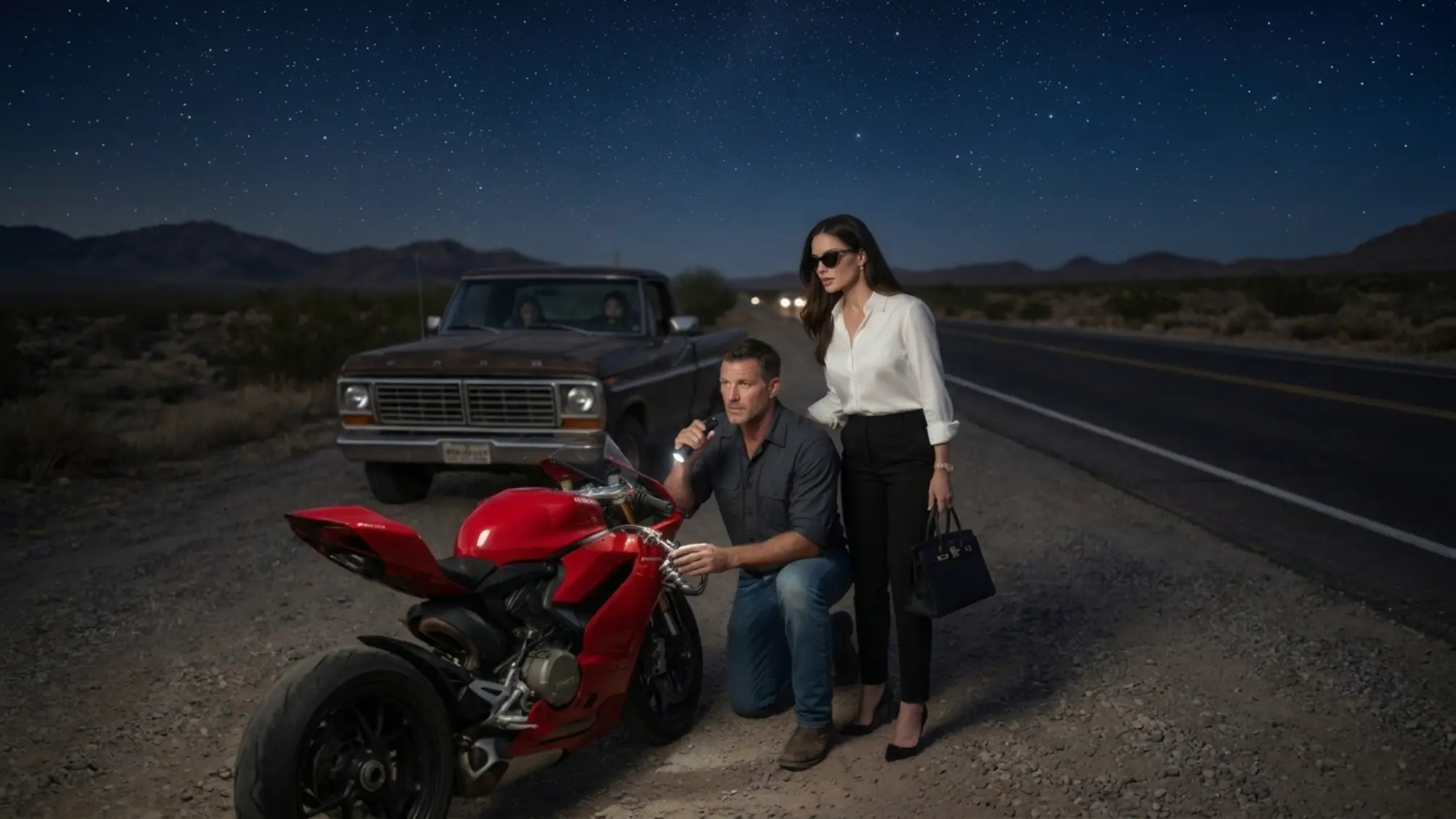
Robert Williams should have kept driving.
His Ford F-150 had more than two hundred thousand miles on the engine, the fuel gauge hovered dangerously close to empty, and only sixty dollars remained in his bank account until Friday. His fourteen-year-old daughter, Emily, slept curled against the back seat window after a long day in Flagstaff. Every practical thought told Robert that helping a stranger was a luxury he could no longer afford.
Then he saw the woman glance toward the darkness surrounding her.
Robert slowed the truck.
He had spent three years teaching Emily that people deserved kindness even when the world had stopped being kind to them. Driving away now would turn every one of those lessons into empty words. He pulled onto the shoulder, switched on the hazard lights, and stepped into the cold desert air.
The woman lowered her phone as he approached.
“You don’t have to stop,” she said.
Robert glanced at the dead motorcycle.
“Already did.”
Her lips curved slightly, as if she was not accustomed to men answering her without trying to impress her. Robert ignored the reaction and crouched beside the Ducati. He used the flashlight on his phone to examine the exposed connections near the fuel system.
“What happened before it stopped?” he asked.
The woman moved closer, watching his hands.
“It began losing power ten miles back,” she replied. “Then the engine cut out completely.”
“Any unusual sound?”
“A soft clicking. Then nothing.”
Robert gently tested the fuel-line connection.
“It lost power,” she added, her voice softer, “right before fate brought you to me.”
Robert looked up.
He expected amusement in her expression, but there was something else there—loneliness hidden beneath confidence.
“I’m only here to get you home safely,” he said.
She removed her sunglasses, revealing striking blue-gray eyes.
“Then don’t fix it too quickly,” she whispered. “I’m not ready to leave you yet.”
Robert held her gaze longer than he intended.
For one brief second, the unpaid bills, the failing truck, and the exhaustion waiting at home disappeared. Then Emily shifted inside the vehicle, pulling Robert back to reality. He returned his attention to the Ducati.
“The fuel-line connector vibrated loose,” he explained. “Someone overtightened it during the last service. The threads aren’t destroyed yet, but they’re close.”
“You recognized that immediately?”
“I’ve spent most of my life listening to machines explain what people did wrong to them.”
The woman watched him reconnect the line and secure it temporarily.
“That sounds personal.”
“Machines remember every mistake,” Robert said. “People should be given more mercy.”
Her expression changed.
Robert could not have known that those words struck deeper than any accusation she had heard in years. To him, she was simply a beautiful stranger with an expensive motorcycle. To the business world, Jennifer Davis was the thirty-six-year-old billionaire CEO of Crosstech Industries, a technology empire valued at more than six billion dollars.
Three years earlier, her company had supplied the artificial-intelligence systems that eliminated Robert’s career.
Robert had spent twenty years at Horizon Aerospace designing satellite propulsion systems. He had trained younger engineers, solved failures no computer model could anticipate, and believed he would retire from the company with dignity. Then Horizon adopted Crosstech’s automation platform and dismissed four thousand employees in one morning.
Jennifer had approved the contract personally.
Robert did not recognize her.
Jennifer recognized him.
She had read the newspaper letter he wrote after the layoffs, describing what it felt like to leave twenty years of work carrying a cardboard box while his security badge stopped functioning behind him. She knew his name before he introduced himself. Seeing him beneath the Arizona stars felt like the past appearing without warning.
“Try it now,” Robert said.
Jennifer swung onto the Ducati. The engine started immediately, settling into a deep mechanical growl. Relief crossed her face, but she did not leave.
“What do I owe you?”
“Nothing.”
“I can afford to pay.”
“That doesn’t mean I need to take it.”
She studied his grease-stained hands.
“I’m Jennifer.”
“Robert.”
“Thank you, Robert.”
He nodded toward the highway.
“Ride carefully. That connector needs replacing before you push the engine again.”
She placed her sunglasses back on.
“What if I need help finding someone who understands it?”
“You just found him.”
Robert returned to the truck and drove toward Sedona.
Emily opened her eyes.
“Was she nice?”
Robert looked in the rearview mirror. Jennifer remained beside the Ducati, watching his taillights disappear.
“I don’t know,” he said. “Maybe.”
Three days later, Jennifer walked into Williams Repair carrying two cups of coffee.
The small garage stood beside the modest house Robert rented on the edge of Sedona. A hand-painted sign above the door promised honest work and fair prices. Inside, tools hung in exact order across old pegboards, and a disassembled Chevrolet engine occupied most of the central workbench.
Robert rolled out from beneath a pickup truck.
Jennifer looked even more beautiful in daylight. Her hair fell freely over a crisp white blouse, and fitted black trousers emphasized the polished confidence she carried into every room. A structured designer handbag hung from one arm, though she had chosen clean sneakers in an obvious attempt to appear casual.
“You found me,” Robert said.
“You gave me the name of the garage.”
“I didn’t invite you.”
She held out one coffee.
“I came to thank you properly.”
“You already thanked me.”
“I also came because I want to learn.”
“Learn what?”
“How engines work.”
Robert looked at her silk blouse.
“You’re dressed for a board meeting.”
“I can change.”
“You own a Ducati worth more than this building. People like you normally pay other people to understand machines.”
“That is exactly the problem.”
Robert folded his arms.
Jennifer met his eyes without flinching.
“I know how to approve budgets, negotiate acquisitions, and make decisions affecting thousands of employees,” she said. “But on that highway, I realized I didn’t understand the machine beneath me. I’d like to learn from someone who does.”
The truth was more complicated.
Jennifer had been preparing to testify before a Senate committee examining automation and workforce displacement. Her advisers warned that she sounded detached whenever she discussed workers whose jobs had disappeared. They recommended that she spend time with someone directly affected by corporate automation.
Her research team found Robert.
The motorcycle breakdown had been genuine, but her return to the garage was not accidental.
Robert studied her for a long moment.
“Two hundred dollars per session,” he said. “Wednesday and Saturday mornings. You arrive on time, wear clothes you can ruin, and do real work.”
“I accept.”
“I won’t pretend you’re talented to protect your feelings.”
“I wouldn’t respect you if you did.”
“And you don’t disappear after the first oil stain.”
Jennifer smiled.
“Careful, Robert. You’re beginning to sound as if you want me to stay.”
He turned away before she could see the reaction in his face.
“Saturday. Nine o’clock.”
She arrived fifteen minutes early.
Her jeans were too new, her work boots had never touched dirt, and the expensive ponytail holder in her hair probably cost more than Robert’s breakfast. Yet she listened carefully when he explained the four stages of internal combustion. She asked precise questions, took handwritten notes, and did not complain when a stubborn bolt refused to move.
“Why is it stuck?” she asked.
“Someone overtightened it twenty years ago.”
“And we’re paying for that mistake now?”
“Machines remember everything.”
Jennifer stopped turning the wrench.
“Unlike people?”
Robert leaned against the workbench.
“People remember, too. We just decide whether a mistake becomes a lesson or a life sentence.”
Their eyes met.
Jennifer looked away first.
Over the following weeks, she returned consistently. She learned to change oil, replace brake pads, test electrical circuits, and recognize uneven wear. Her manicured nails disappeared beneath grease, small cuts formed across her knuckles, and her expensive boots finally looked as though they belonged inside a garage.
Robert found himself waiting for Wednesdays.
Jennifer brought coffee. He pretended not to notice that she always remembered how he took it. She listened when he explained mechanical failures, laughed when he teased her for using the wrong wrench, and sometimes remained after the session ended simply to help sweep the floor.
Emily watched everything.
The teenager often sat in the corner with a physics book open on her lap. She noticed how Jennifer studied Robert when he was not looking and how her father’s voice softened whenever he corrected her. She also noticed Jennifer typing long notes into her phone after each session.
One Saturday, Robert and Jennifer rebuilt a carburetor together.
Their hands moved comfortably around the same components, no longer interfering with each other. Jennifer handed him tools before he requested them, and Robert smiled despite himself.
“You’re improving,” he said.
“That almost sounded like praise.”
“Don’t get excited.”
“Too late.”
She brushed a streak of grease from his cheek with her thumb.
The touch surprised both of them.
Jennifer pulled her hand away.
Robert looked down at the carburetor.
“You asked once what I did before this.”
“I remember.”
“Aerospace engineering.”
Her fingers tightened around the wrench.
“What company?”
“Horizon Aerospace.”
Jennifer became completely still.
Robert did not notice the fear in her eyes.
“I worked there twenty years,” he continued. “Propulsion systems, quality control, training younger engineers. Then an automation contract made half the department unnecessary.”
“I’m sorry.”
“Don’t be. You didn’t fire me.”
The words struck her like a physical blow.
“What happened after?”
“I applied everywhere. Companies said I was overqualified, too old, or trained in systems they were replacing. Eventually, I opened this place.”
“And Emily?”
Robert glanced toward his daughter.
“She adjusted better than I did.”
Emily kept her eyes on the book.
Robert lowered his voice.
“She shouldn’t have needed to.”
Jennifer looked toward the old house, the failing truck, and the stack of unpaid envelopes visible through the kitchen window. For the first time, the consequences of her decisions stood around her as physical objects.
An engine repaired instead of replaced because Robert lacked money.
A teenager wearing the same hoodie each week.
A gifted engineer fixing old pickups while the technology he helped inspire made executives richer.
That night, Jennifer recorded another voice memo.
“Robert Williams is not merely a displaced worker,” she said quietly. “He is an experienced engineer, an exceptional teacher, and a devoted father. The automation model classified him as redundant because it measured cost rather than value.”
She paused.
“This began as research. I am no longer certain what it has become.”
Emily discovered the truth before Robert did.
Unable to dismiss her suspicion, she searched Jennifer’s name online. The first image showed the beautiful woman from the garage wearing an Armani suit beneath the headline: Crosstech CEO Jennifer Davis Named Among America’s Most Influential Technology Leaders.
Emily kept reading.
Crosstech had designed the automation platform used by Horizon Aerospace. Jennifer had celebrated the forty-percent labor-cost reduction in a press release two months before Robert lost his job.
Emily’s hands began to shake.
She searched the company’s testimony plans, then found documents describing Jennifer’s efforts to study displaced workers. The pieces fit together too perfectly.
Jennifer had not entered their garage to learn about engines.
She had entered to learn how Robert’s pain sounded.
Emily wrote through the night.
Her essay, titled The Cost of Efficiency, described her father’s career, the layoff, the unpaid bills, and the billionaire who arrived pretending to be a student. She published it before fear could stop her.
By morning, fifty thousand people had read it.
Robert learned the truth from a journalist calling for comment.
He entered Emily’s bedroom holding his phone.
“Is this real?”
Emily’s face was pale.
“Dad, I’m sorry. But you needed to know.”
Robert searched Jennifer’s name.
He found photographs of her signing the Horizon contract. He found speeches praising automation. He found the exact sentence that had changed his life: This partnership will reduce operational costs by forty percent.
Saturday morning, Jennifer arrived carrying two coffees.
Robert stood beside the workbench with printed articles spread across the metal surface.
Her smile disappeared.
“Who are you?” he asked.
“Robert—”
“Who are you really?”
She set down the coffee.
He pushed the press release toward her.
“You didn’t come here to learn. You came to study the life your company destroyed.”
Jennifer removed her sunglasses slowly.
“It began as research.”
“Did you record me?”
Silence answered first.
“Jennifer.”
“Yes.”
The word broke something between them.
Robert stared at the woman he had begun trusting. He remembered her laughter, the grease on her hands, and the evening she touched his face. Every intimate conversation now felt contaminated.
“You recorded my daughter’s struggles so you could sound compassionate in Washington.”
“I never recorded Emily directly.”
“That is your defense?”
“No.”
“Was any of it real?”
Jennifer’s eyes filled.
“The moment I started dreading the day you discovered who I was, you became real to me.”
Robert looked away.
“You broke the one thing I was finally ready to trust.”
“Then let me spend every day proving my feelings were the only part I never faked.”
He wanted to believe her.
That made the betrayal worse.
“Get out.”
“Robert, please.”
“Leave my garage.”
She stepped toward him.
“I know I don’t deserve forgiveness.”
“You don’t deserve the opportunity to ask for it.”
Jennifer left without touching the coffee.
The scandal spread across the country.
Emily’s essay reached millions. Jennifer’s private voice memos leaked to the press, revealing how clinically she had analyzed Robert’s words. Crosstech’s stock collapsed, senators demanded explanations, and Jennifer faced cameras outside her headquarters.
She could have blamed advisers.
She could have denied the recordings or described them as misunderstood research.
Instead, she resigned.
At a nationally televised press conference, Jennifer admitted everything. She acknowledged deceiving Robert, recording him without permission, and treating a human being as material for political preparation. Then she announced that she was placing four and a half billion dollars of her wealth into an independently controlled trust supporting displaced workers.
Robert watched from his garage.
He did not know whether her tears were real.
He no longer trusted himself to judge.
Weeks later, Jennifer asked to meet at a small café before the Senate hearing. Robert arrived early and chose a table where he could see every entrance. She came alone, without assistants, makeup, or expensive jewelry.
She placed two folders before him.
“The trust documents,” she said. “Independent worker governance, retraining programs, small-business loans, healthcare support, and scholarships.”
“Why show me?”
“Because you’re going to testify about what I did.”
“You want me to defend you?”
“No. I want you to tell them the truth.”
Robert narrowed his eyes.
“All of it?”
“All of it. Tell them I lied. Tell them I used you. Then tell them what I did afterward only if you believe it matters.”
He opened the documents.
Jennifer had surrendered all control. Displaced workers would govern the trust, select programs, and audit every expense. Her money was legally committed beyond her ability to reclaim it.
“This could still be image management,” he said.
“It could.”
“You’re not denying it?”
“My intentions are invisible. Judge the structure.”
Robert closed the folder.
“You hurt me.”
“I know.”
“I cared about you.”
Jennifer’s composure cracked.
“I know that, too.”
He leaned back.
“And what did you feel?”
Her answer came without hesitation.
“I fell in love with the man I was supposed to study.”
Robert looked toward the café window.
“You don’t get to use love as another explanation.”
“I’m not. Love does not excuse betrayal. It only makes me understand what I destroyed.”
At the Senate hearing, Robert told everything.
He described losing his career, struggling to provide for Emily, helping Jennifer on the highway, and discovering that their relationship began as an experiment. He condemned her deception clearly.
Then he held up the trust documents.
“What she did was wrong,” he told the senators. “But what she did after being exposed also matters. Accountability should not end with punishment if genuine repair is possible.”
Jennifer testified after him.
She asked for no forgiveness.
She promised only measurable action.
The trust opened its first training center in Sedona six months later. Robert became its technical director after the worker-led board elected him. Former engineers, factory supervisors, mechanics, and logistics workers learned skills for renewable energy and advanced manufacturing.
Jennifer remained in the background.
She attended no ceremonies unless invited and never used the center in public relations campaigns. When Robert needed funding information, she answered directly. When the worker board rejected her suggestion, she accepted the decision without protest.
Trust returned slowly.
Not in grand gestures, but through consistency.
One evening, after the first class graduated, Robert found Jennifer standing beside the restored Ducati in the parking lot. Arizona stars filled the sky just as they had the night they met.
“You kept the bike,” he said.
“It started everything.”
“It nearly stranded you.”
“It brought me to you.”
Robert approached the motorcycle.
“The connector needs checking again.”
Jennifer smiled.
“Are you offering to fix it?”
“I’m offering to inspect it.”
“And after that?”
He looked at her.
“After that, maybe dinner.”
Her eyes widened.
“Is this forgiveness?”
“No.”
“Then what is it?”
“A second chance.”
Jennifer stepped closer.
“I’ll take it.”
Robert touched her cheek, leaving a faint streak of grease across her flawless skin. She laughed, and this time he knew the sound had not been recorded, analyzed, or prepared for anyone else.
Years later, the training trust operated in eighteen states. Thousands of displaced workers found new careers, and Emily earned a scholarship to study mechanical engineering and public policy. Robert continued repairing cars because the garage remained the place where his hands and mind felt most honest.
Jennifer never returned to corporate leadership.
She worked beside worker boards, accepted criticism, and built systems capable of surviving without her control. Her relationship with Robert remained imperfect, shaped by a wound neither pretended had disappeared.
On the anniversary of the night they met, they returned to Highway 89.
Jennifer parked the Ducati near the same guardrail.
Robert looked at the motorcycle.
“Is something wrong with it?”
“No.”
“Then why are we here?”
She reached into her jacket and handed him a small metal fuel connector—the original damaged part he had replaced years earlier.
“I kept it.”
“You kept a broken motorcycle part?”
“It reminds me that the worst failure in my life led me to the man who taught me how repair actually works.”
Robert turned the connector between his fingers.
“Repair doesn’t erase damage.”
“I know.”
“It takes patience.”
“You taught me that.”
“And sometimes the machine never runs exactly the way it did before.”
Jennifer took his hand.
“Maybe it runs differently because someone finally understands how fragile every connection is.”
Robert looked at the desert, then at the beautiful woman standing beside him.
The billionaire who had helped destroy his career had also surrendered her empire to repair some of the harm. The stranger he once distrusted had become a partner, a student, and eventually someone he loved—not because the past disappeared, but because she never stopped confronting it.
He kissed her beneath the Arizona stars.
Behind them, the Ducati waited in perfect silence.
It no longer needed repair.
They were the ones still rebuilding.