“You repaired my Mercedes, then stole my diamonds,” Vivienne Sterling snapped, shoving an empty velvet jewelry case against Ethan Cole’s chest. “Empty your pockets.”
The black Mercedes-Maybach sat behind her with its hood raised beneath the fluorescent lights of Cole Automotive. Ethan still held the burned fuel-pump control module he had removed less than twenty minutes earlier, while his battered toolbox rested beside his scuffed work boots. Grease darkened his hands and the sleeves of his faded charcoal shirt, but his tired gray-blue eyes remained steady. “Accuse me again,” he said, knocking the velvet case away, “and you’ll answer for every word.”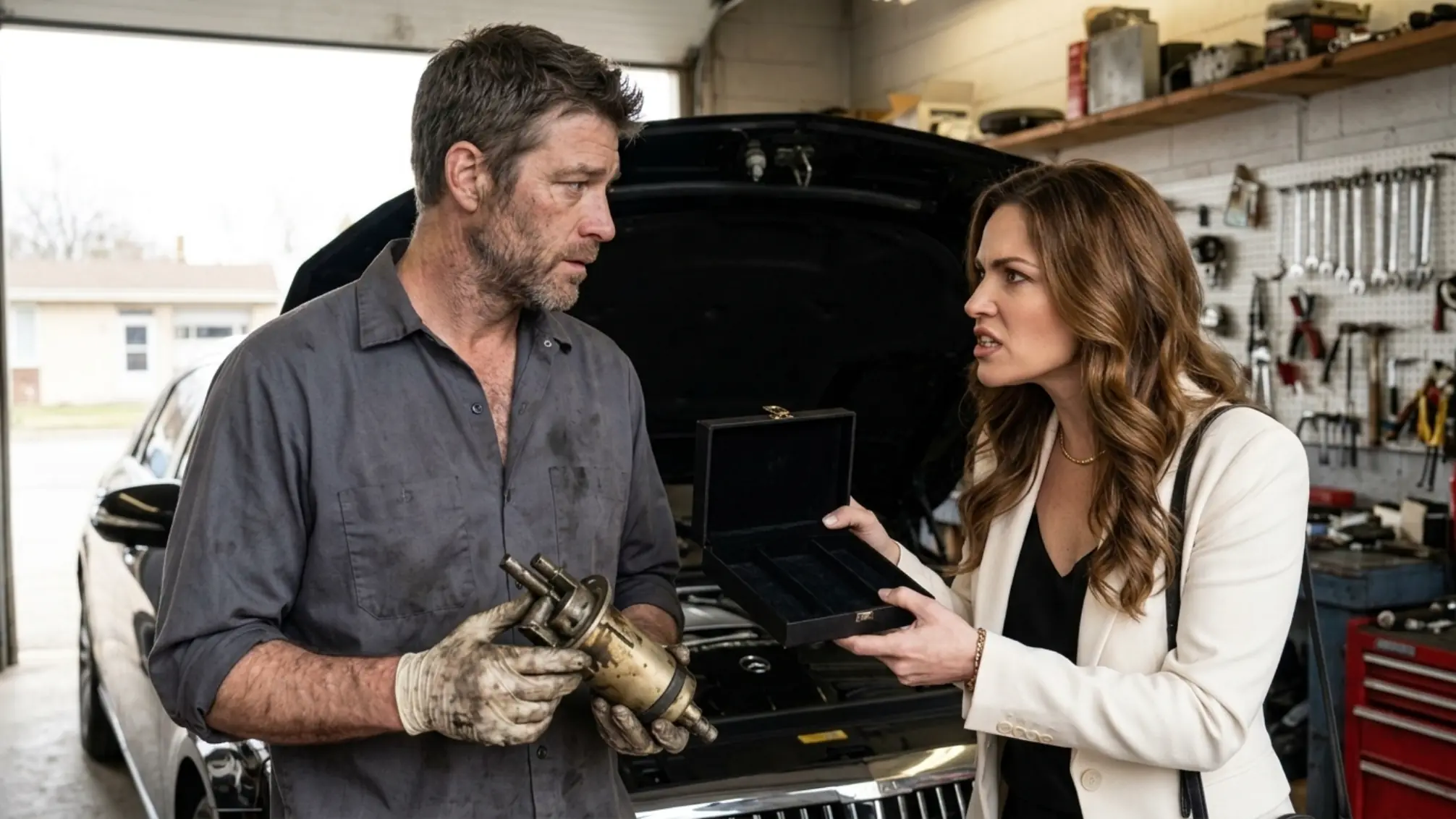
Vivienne stepped closer until only a few inches separated them. Her ivory designer blazer, black silk top, tailored trousers, and polished heels looked painfully out of place inside the modest Wisconsin garage. “I’ll have the police tear this filthy shop apart and drag you out in handcuffs.”
Ethan pointed through the open driver’s door toward the camera mounted behind the rearview mirror. “Call them. Your own Mercedes already recorded the real thief.”
Vivienne’s expression changed for less than a second. It was not fear yet, only the first crack in the certainty of a woman who had spent years believing that confidence could substitute for evidence. Then her jaw tightened again.
“You expect me to believe a convenient camera will clear you?”
“I expect you to watch it before you destroy an innocent man’s reputation.”
She looked toward the dashboard, then back at his worn clothes. “You were alone with the car.”
“No,” Ethan replied. “I was beneath the hood. Your assistant was inside it.”
The garage suddenly seemed quieter.
Rain struck the metal roof in steady waves, and water ran beneath the partially opened bay door. The storm had begun shortly after Vivienne’s Mercedes arrived on a tow truck, trapping them inside while wind shook the trees beyond the parking lot. Ethan had thought the most difficult part of the evening would be locating a rare electrical fault before his daughter’s school recital began.
He had been wrong.
Three hours earlier, Ethan had been closing the shop early when the tow truck pulled into the lot. Cole Automotive was a small independent garage on the edge of Lake Geneva, far from the luxury resorts lining the water. Its sign was faded, two ceiling lights flickered during cold weather, and the customer waiting area contained mismatched chairs Ethan had repaired himself.
The garage did not look impressive, but it had survived twelve difficult years because Ethan never invented problems to increase a bill. Local teachers, farmers, delivery drivers, and retirees trusted him. They knew he might take longer than the dealership, but he would never charge them for work their vehicles did not need.
That reputation was the only valuable thing Ethan owned outright.
His home still carried a mortgage. The garage loan had five years remaining, and the medical bills from his wife’s final months arrived long after her funeral. Ethan was raising his eight-year-old daughter, Lily, alone while trying to keep the shop open without missing the moments her mother would have wanted someone to witness.
That evening mattered more than most.
Lily had spent three months rehearsing for her school’s spring concert. She had one short piano solo, only forty seconds long, but she had practiced it until Ethan could hear every note in his sleep. He had promised to sit in the first row wearing the blue shirt she liked instead of his stained mechanic’s uniform.
At four thirty, he had already cleaned his tools and reached for the shop lights when the tow truck arrived.
The Mercedes-Maybach was followed by a black sport-utility vehicle carrying Vivienne Sterling and her executive assistant, Natalie Cross. Ethan recognized Vivienne from business magazines displayed in the resort hotels. At thirty-five, she controlled Sterling Crown Capital, an investment company with interests in hotels, shipping, commercial property, and luxury transportation.
She was not simply wealthy. According to recent estimates, she was worth more than three billion dollars.
Vivienne entered the garage without greeting him. “The dealership says tomorrow afternoon,” she said. “I need the car ready within an hour.”
Ethan glanced at the wall clock. “That depends on what failed.”
“It lost power, displayed a warning, and shut down.”
“Did the engine make any unusual noise?”
“I have people who answer mechanical questions.”
Natalie stepped forward with a tablet. She was a slim woman in her early thirties, dressed in a navy coat and carrying a structured leather portfolio. “The driver reported hesitation, then an immediate shutdown. No smoke, no impact, and no visible fluid loss.”
“That helps,” Ethan said.
Vivienne removed her sunglasses despite the darkening weather. “I have a dinner at seven with the Bellamy Resort board. The acquisition depends on my presence.”
“I can diagnose the car. I can’t promise the clock will cooperate.”
“Everything cooperates when enough money is involved.”
Ethan looked at her calmly. “Electricity doesn’t know your net worth.”
Natalie lowered her eyes, perhaps hiding amusement. Vivienne did not react.
“Double your usual rate,” she said. “Finish within the hour.”
“I’ll charge for the work I perform.”
“That was not a request.”
“It sounded like one.”
Vivienne studied him as though she had never encountered a mechanic who did not immediately surrender to money. Ethan had dealt with wealthy customers before. Most were courteous, some were impatient, and a few believed expensive possessions made every surrounding person part of their staff.
He had learned not to argue with arrogance unless it interfered with the repair.
Ethan connected a diagnostic scanner, reviewed the stored codes, and began testing the fuel system. The Mercedes had not suffered catastrophic engine failure. A faulty control module had interrupted power to the high-pressure fuel pump, shutting the engine down to prevent damage.
He carried a compatible replacement because another German luxury sedan used the same supplier. The unit was expensive but available, which meant the repair could be finished that evening.
“You are fortunate,” Ethan told Vivienne.
She looked up from her phone. “Fortune had nothing to do with it. I chose a garage with the correct part.”
“You chose the nearest open garage.”
“And you happen to have it. That is the result I required.”
Ethan checked the clock again. If calibration went smoothly, he might still reach the school before Lily’s solo. He called his neighbor, Mrs. Patterson, who had picked Lily up that afternoon, and explained that he was delayed.
“I can bring her to the concert,” Mrs. Patterson offered.
“I promised I’d be there.”
“Then finish and drive carefully.”
Ethan ended the call without noticing that Vivienne had overheard part of the conversation.
“You have somewhere else to be?” she asked.
“Yes.”
“My schedule takes priority until the repair is complete.”
“Your car takes priority while it is on my lift. Your schedule doesn’t.”
Vivienne’s eyes narrowed. Before she could respond, her phone rang, and she walked toward the customer waiting area to answer it. Natalie remained near the Mercedes, typing messages into her tablet.
A minute later, she opened the rear passenger door and leaned inside.
Ethan was removing the faulty module and paid little attention. He assumed she was retrieving documents from Vivienne’s handbag, which rested on the leather seat. Natalie closed the door, carried a folder toward the waiting area, and spoke quietly to Vivienne.
The action lasted only seconds.
It would later become the center of everything.
Ethan installed the replacement module, calibrated it, and started the engine. The Mercedes idled smoothly while he monitored fuel pressure and cleared the temporary fault code. He performed a second test to confirm that the problem would not return on the road.
“Finished,” he said.
Vivienne looked at the clock. “You took seventy-three minutes.”
“And your engine works.”
She handed him a black credit card. Ethan prepared the invoice, charging for the part, diagnostic time, and labor. He did not double the rate.
Vivienne examined the total. “That is less than I expected.”
“The repair did not become harder because the car cost more.”
For the first time, her expression appeared almost curious. “You could have charged me anything.”
“I could have tried.”
“Most people would.”
“I’m not most people.”
Natalie placed Vivienne’s handbag on the counter, then excused herself to take a call outside. Ethan returned the credit card, and Vivienne opened the handbag to put it away.
That was when she noticed the jewelry case.
She removed the small black velvet box and opened it. The white satin interior was empty.
Vivienne stared at it without speaking.
“What’s wrong?” Ethan asked.
She searched the handbag quickly, removing a wallet, two phones, cosmetics, and several envelopes. Her movements became increasingly sharp as she checked each pocket.
“My bracelet is missing.”
Ethan glanced toward the counter. “Did you leave it somewhere else?”
“It was inside this case.”
“When did you last see it?”
“At the resort this afternoon. I removed it before a spa appointment and put it in my bag.”
“Then call the resort.”
Vivienne looked directly at him. “The case was closed when I arrived.”
“That doesn’t mean the bracelet was inside.”
“It was.”
Ethan understood the direction of her thoughts before she spoke again.
“You were alone near the vehicle.”
“I was repairing it.”
“You entered the cabin to connect your diagnostic equipment.”
“For less than a minute.”
“And now a bracelet worth six hundred thousand dollars is missing.”
Ethan placed both hands on the counter. “Choose your next words carefully.”
Vivienne lifted the empty case. “Return it, and I may decide not to involve the police.”
He stared at her. “You believe I stole it?”
“I believe no one else here had the opportunity.”
“Your assistant opened the rear door.”
“Natalie has worked for me for nine years.”
“That doesn’t make her invisible.”
“It makes her trustworthy.”
“And my stained shirt makes me guilty?”
Vivienne’s silence answered him.
Ethan felt anger rise slowly beneath his exhaustion. He had spent years building his garage’s reputation one customer at a time. One public accusation from Vivienne Sterling could destroy everything before the truth had time to catch up.
He imagined headlines repeating her version. Billionaire’s Diamonds Stolen at Local Garage. Mechanic Questioned. Valuable Bracelet Missing After Repair.
Even if the police cleared him later, customers would remember the accusation more clearly than the correction.
Vivienne called Natalie back inside. The assistant entered holding her phone and appeared surprised when she saw the open jewelry case.
“What happened?” Natalie asked.
“The Cartier bracelet is gone.”
Natalie looked toward Ethan immediately.
That quick glance told him more than her words.
“I never touched it,” she said.
Ethan had not accused her yet.
Vivienne noticed nothing unusual. “Call the police.”
Ethan stepped away from the counter. “Do it. But no one leaves until they arrive.”
Natalie’s face tightened. “You cannot detain us.”
“I’m not detaining anyone. I’m telling you that leaving after a theft accusation will look interesting on the security footage.”
Vivienne looked around the garage. “You have cameras?”
“Four.”
Natalie lowered her phone slightly.
Ethan pointed toward one camera above the office door, another over the service bay, and a third aimed at the customer counter. The fourth covered the parking lot.
None had a clear view inside the Mercedes.
Natalie seemed to relax.
Then Ethan remembered the small camera behind the Mercedes’s rearview mirror.
He had noticed it while connecting the diagnostic scanner. It appeared to be an advanced factory security system combined with an aftermarket driving recorder, positioned to capture the front cabin and portions of the rear seating area.
He asked Vivienne whether the vehicle recorded while parked.
“I don’t know,” she said.
Natalie answered too quickly. “It only records while driving.”
Ethan looked at her. “You’re certain?”
“It’s my responsibility to know the vehicle’s security systems.”
“Then you won’t mind checking.”
Vivienne walked toward the car. Natalie moved beside her, but Ethan stepped between them and the driver’s door.
“No one touches the controls until the police arrive.”
“You just told us to check,” Vivienne said.
“I changed my mind when she became eager to reach the system first.”
Natalie’s composure cracked. “This is absurd.”
“Maybe.”
She turned toward Vivienne. “He is trying to redirect suspicion.”
Ethan crossed his arms. “Then the recording should prove it.”
The police arrived twelve minutes later.
Officer Daniel Reeves entered first, followed by a younger officer named Maria Santos. Ethan knew Daniel because the garage maintained several municipal vehicles, but he did not approach him as a friend.
He explained the repair, the missing bracelet, Natalie’s access to the rear seat, and the possible recording. Vivienne repeated her accusation carefully, avoiding the word thief now that officers were taking notes.
Natalie insisted she had only removed a contract folder.
Officer Santos asked whether anyone had searched the garage.
“No,” Ethan said.
Vivienne lifted her chin. “He refused.”
“I refused to empty my pockets for her. You can search me with my consent and document every item.”
He placed his wallet, keys, pocketknife, phone, and a handful of bolts on the counter. The officers checked his clothing, toolbox, workbench, office, and service bay.
They found no bracelet.
Natalie appeared confident again. “He could have hidden it anywhere.”
Ethan looked at Daniel. “Check the car recording before you start tearing apart walls.”
The Mercedes driver had arrived by then and provided the access code to the security system. Officer Santos connected the display and opened the parking-surveillance archive.
There were several recordings from that afternoon.
The first showed Vivienne placing the jewelry case inside her handbag at the resort entrance. The angle was imperfect, but the bracelet was visible when she briefly opened the box before closing it.
The second recording showed the car being loaded onto the tow truck.
The third began inside Ethan’s garage.
Everyone gathered around the center display.
The recording showed Ethan leaning into the driver’s side to connect his diagnostic scanner. His upper body remained visible for forty-three seconds. He touched nothing near the rear seat, then returned to the engine compartment.
Several minutes later, Natalie opened the rear passenger door.
She looked toward Ethan, checked that Vivienne was facing away, and lifted the handbag onto the seat. Her body blocked part of the view, but her right hand entered the bag.
She removed the velvet case.
Natalie opened it, took out the diamond bracelet, and slipped it into the inner pocket of her navy coat. Then she returned the empty case to the handbag and removed a folder to create the appearance that she had entered the vehicle for documents.
No one spoke when the recording ended.
Natalie stepped backward.
Vivienne turned toward her slowly. “Why?”
“It isn’t what it looks like.”
Officer Santos moved toward the garage door, blocking the exit.
Vivienne’s voice became colder. “The camera shows you taking it.”
Natalie glanced between the officers. “I was protecting it.”
“By hiding it in your coat?”
“There were strangers around the car.”
Ethan leaned against the workbench. “Then why put the empty case back?”
Natalie’s eyes flashed with anger. “Stay out of this.”
“You brought it into my garage when you tried to make me carry your crime.”
Officer Santos asked Natalie to remove her coat. She refused until Daniel warned that probable cause had already been established by the recording.
The bracelet was not in the pocket.
For one brief moment, Natalie smiled.
“You see?” she said. “I no longer have it because I returned it.”
But the parking-lot camera showed something else.
While standing outside during her supposed phone call, Natalie had approached the black sport-utility vehicle. She opened the rear door and placed a small object inside a leather portfolio before returning to the garage.
Officers searched the vehicle.
They found the bracelet inside a hidden compartment in the portfolio, along with three luxury watches, a diamond pendant, two sealed envelopes containing cash, and a flash drive labeled with an internal Sterling Crown project number.
Vivienne stared at the items spread across Ethan’s counter. “Where did those come from?”
Natalie stopped answering.
The officers handcuffed her and read her rights. As they prepared to take her away, she looked at Vivienne with nine years of bitterness exposed in her face.
“You never noticed anything,” Natalie said. “Not the jewelry, not the accounts, not the payments. You noticed his dirty shirt before you noticed the woman standing beside you every day.”
Vivienne flinched as though she had been struck.
Natalie continued before the officers led her outside. “You trusted me because I wore the right clothes. You accused him because he didn’t.”
The rain had weakened to a steady drizzle by the time the police vehicles left. Vivienne remained inside the garage while Ethan cleaned the tools he had abandoned during the confrontation.
Her Mercedes waited near the open bay, repaired and ready.
“You were right,” she said.
Ethan did not look up. “About which part?”
“I judged you before I knew anything about you.”
“You knew I repaired your car.”
“I mean who you were.”
“That should not have mattered. You had no evidence I stole from you.”
Vivienne placed the empty jewelry case on the counter. “I nearly had you arrested.”
“You tried.”
“I’m sorry.”
Ethan finally faced her. “Would you be sorry if there had been no camera?”
She opened her mouth, then stopped.
“That’s the question you should answer,” he said. “Not for me. For yourself.”
Vivienne looked around the garage, at the stained floor, worn tools, patched cabinets, and framed customer letters near the office door. Only then did she notice the small program resting beside Ethan’s clean blue shirt.
LAKE GENEVA ELEMENTARY SPRING CONCERT.
The starting time had passed forty minutes earlier.
“You missed something,” she said.
“My daughter’s piano solo.”
Her expression fell. “Because of this?”
“Because I stayed to repair your car. Then because I had to prove I wasn’t a criminal.”
Vivienne looked toward the wall clock. “Is the concert over?”
“Probably.”
“Call the school.”
“There’s no point.”
“Call them.”
Ethan stared at her. “Money doesn’t restart time.”
“No,” Vivienne said quietly. “But perhaps I can stop making the evening worse.”
He called Mrs. Patterson.
The concert had ended, but Lily and her teacher were still inside the auditorium. Mrs. Patterson had explained that Ethan was handling an emergency, though Lily had asked several times whether he had forgotten.
Vivienne told her driver to take the Mercedes outside. Then she asked Ethan for permission to ride with him to the school.
“Why?”
“Because I should apologize to the person who paid for my accusation without even being here.”
Ethan nearly refused. Yet something in her expression had changed. The authority remained, but the certainty was gone.
They drove to the school in Ethan’s service truck.
Lily sat alone at the edge of the stage when they arrived, still wearing her dark-blue concert dress. Mrs. Patterson and the music teacher waited nearby. The auditorium lights had been dimmed, and most of the chairs were empty.
Ethan crossed the room quickly. “I’m sorry.”
Lily looked at his mechanic’s clothes. “The car took longer?”
“Yes.”
“Did you fix it?”
“I did.”
She tried to smile, but disappointment remained in her eyes. “I played all the notes right.”
“I knew you would.”
Vivienne stood several feet behind him, suddenly looking less comfortable than she had while facing police officers. Ethan introduced her only as the customer whose car had broken down.
Vivienne approached Lily carefully. “Your father missed your solo because I made a terrible mistake.”
Lily looked up at her. “What mistake?”
“I blamed him for something he didn’t do.”
“Why?”
Vivienne glanced at Ethan. “Because I believed I could tell what kind of person he was by looking at his clothes and his garage.”
Lily frowned. “Dad says machines don’t care what you wear.”
“Your father is right about many things.”
The music teacher stepped toward the piano. “Lily, would you play it once more?”
Lily looked at Ethan.
He sat in the first row.
The teacher raised the stage lights, Mrs. Patterson took a seat beside him, and Vivienne sat at the opposite end. Lily walked to the piano, placed her hands on the keys, and performed the forty-second piece from beginning to end.
She missed one note.
Ethan applauded as though she had played before thousands.
Vivienne did too.
The theft investigation expanded over the following weeks. The flash drive found in Natalie’s portfolio contained confidential financial records, forged authorization documents, and evidence of payments routed through false consulting firms.
Natalie had not stolen only jewelry.
She had spent nearly four years moving money from Sterling Crown subsidiaries into shell companies controlled by her brother. She used her access to Vivienne’s schedule, passwords, and signatures to conceal unauthorized transactions.
The total loss exceeded fourteen million dollars.
Several executives had noticed irregularities, but Natalie intercepted their reports before they reached Vivienne. Two employees who questioned missing funds were dismissed after Natalie fabricated evidence that they had violated company policy.
Vivienne had trusted her completely because Natalie knew how to appear loyal, efficient, and polished.
Ethan had been condemned within minutes because he looked tired, poor, and replaceable.
The contrast became impossible for Vivienne to ignore.
She returned to Cole Automotive one month later. This time, she arrived without a driver, assistant, or expensive jewelry. Ethan was replacing the alternator in an old farm truck when she entered.
“The Mercedes still working?” he asked.
“Perfectly.”
“Then what broke?”
“My company.”
He wiped his hands and listened as she explained the investigation. Vivienne had reinstated the two dismissed employees, compensated them, and invited federal auditors to examine every subsidiary Natalie had accessed.
She also established a rule preventing any executive, including herself, from ordering an employee searched or removed based solely on an accusation without documented evidence.
“That sounds expensive,” Ethan said.
“It is.”
“Good policies usually are.”
Vivienne placed an envelope on his workbench. Inside was a check large enough to pay off the garage loan.
Ethan pushed it back.
“It isn’t payment for silence,” she said.
“I know.”
“Then accept it.”
“For what?”
“For the damage I could have caused.”
“You cannot purchase forgiveness before earning it.”
Vivienne looked at the check. “What would earning it require?”
“Changing what you do when the next person can’t prove they’re important.”
She folded the envelope and returned it to her handbag.
Over the next year, Vivienne did change.
Not quickly, and not perfectly.
Sterling Crown created an independent employee-protection office and reopened complaints previously dismissed by senior management. Several executives were removed for retaliation and financial misconduct. Workers who had been treated as invisible were invited to explain where the company’s systems had failed.
Vivienne attended those meetings without cameras.
She listened even when the truth was humiliating.
She also began sending company vehicles to Cole Automotive, not as charity, but because Ethan’s work remained better and more honest than the luxury dealership’s. He charged the same rates he charged everyone else.
Lily occasionally visited the garage after school. Vivienne never tried to impress her with gifts. Instead, she asked about piano lessons, helped organize customer files, and once spent an entire afternoon holding a flashlight while Ethan repaired a company van.
“You’re terrible at this,” Ethan told her.
“I control twelve thousand employees.”
“None of them taught you where to point a light?”
“They are usually afraid to criticize me.”
“Then you hired the wrong people.”
Their friendship developed through uncomfortable honesty. Vivienne learned that Ethan did not admire wealth automatically, and Ethan discovered that beneath her arrogance was a woman who had spent most of her life confusing control with safety.
Natalie eventually pleaded guilty to fraud, theft, identity misuse, and obstruction. The bracelet was returned, but Vivienne rarely wore it afterward.
One evening, almost two years after the accusation, the Mercedes entered the garage again. Nothing was wrong with it.
Vivienne stepped out wearing a simple black dress rather than an executive suit. Ethan looked beneath the hood, checked the dashboard, and finally turned toward her.
“The car is fine.”
“I know.”
“Then why bring it here?”
“Lily said her school has another concert.”
Ethan narrowed his eyes. “She invited you?”
“She said the first performance was incomplete because only one of us had learned the lesson.”
He laughed despite himself.
Vivienne held out two tickets. “I thought we could arrive before the music starts this time.”
Ethan closed the hood.
They reached the school together and sat in the first row while Lily performed a longer piano piece with both hands moving confidently across the keys. When she finished, Ethan applauded first.
Vivienne followed.
Years later, people would remember the story as the night a billionaire falsely accused a struggling mechanic of stealing her diamonds. Some focused on the dashboard camera, the arrest, or the millions uncovered in the investigation.
But Ethan remembered something simpler.
The camera had protected him because it happened to be recording.
Many innocent people never received that protection.
Vivienne’s greatest lesson was not that Ethan was a respected mechanic, a devoted single father, or a man capable of exposing the person she trusted most. It was that none of those facts should have been necessary for him to deserve fairness.
A stained shirt was not evidence.
A modest garage was not guilt.
And wealth did not give anyone the right to turn suspicion into a verdict.
Ethan repaired her Mercedes in a little more than an hour.
It took Vivienne much longer to repair the part of herself that had accused him.