Clare Donovan had spent most of her adult life proving she did not need anyone to rescue her. At thirty-four, she was the founder and CEO of Donovan Enterprises, a company that had started in a cramped rented office with two borrowed laptops and now had glass-walled offices in six cities. People called her disciplined, brilliant, impossible to intimidate, and sometimes cold when they thought she was not listening. Clare never corrected them, because cold sounded better than lonely.
That morning, she was driving through the mountains outside Aspen, Colorado, on her way to a private investor retreat that could change the next ten years of her company. Her black luxury car moved along the winding road beneath tall pines, the sky bright and pale above the ridgeline. She had a presentation in two hours, a board call afterward, and a dinner with people who measured trust in numbers. Everything in her life was scheduled, polished, and controlled.
Then the engine warning light flashed.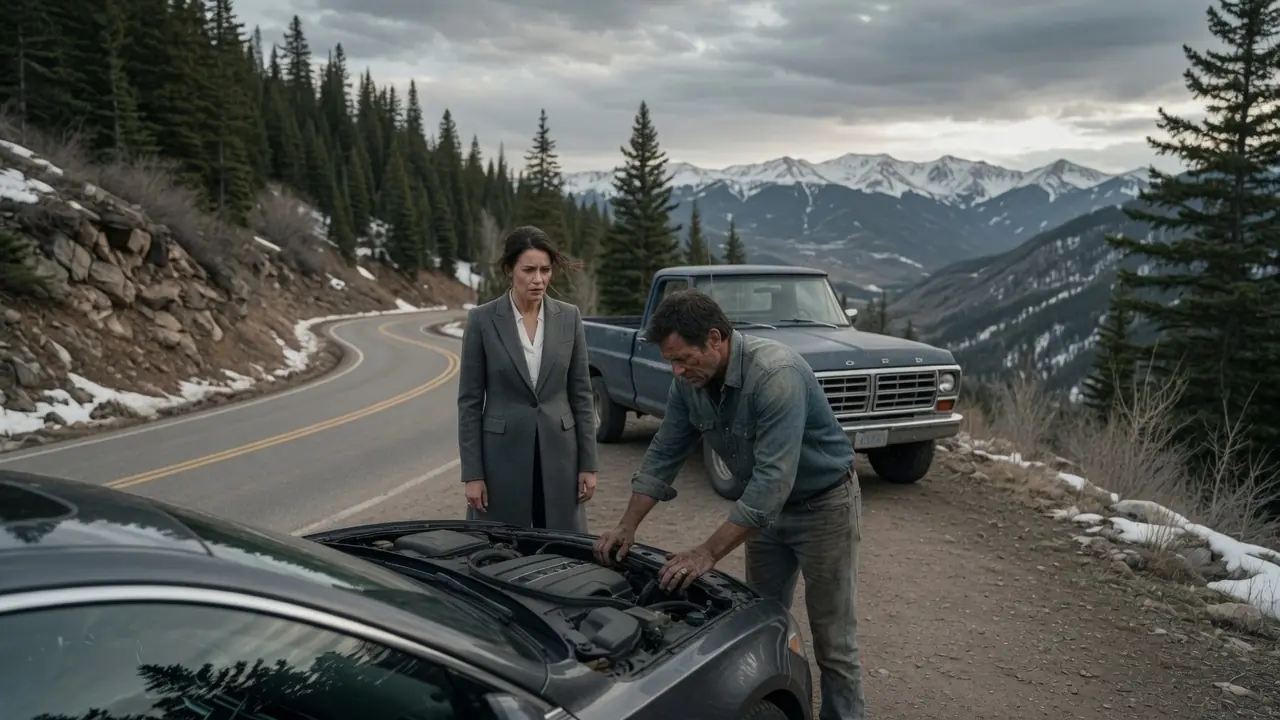
At first, Clare ignored it, because she had built a life around ignoring small warnings until they became problems she could name. A minute later, the car lost power on a quiet stretch of road with no houses, no service station, and no signal on her phone. She guided it onto the gravel shoulder, stopped beneath the shade of the trees, and sat gripping the wheel while the silence pressed in around her. For the first time that morning, she had nothing to command.
She stepped out in her gray business coat and black slacks, the mountain air cutting through her blouse. The road curved behind her, empty in both directions except for the wind moving through the pines. She lifted the hood, stared at the engine, and immediately knew she was looking at a language she did not speak. Clare could restructure a company, read a balance sheet in minutes, and negotiate with men twice her age without blinking, but the machine in front of her did not care who she was.
She tried her phone again. One bar appeared, then vanished. She walked a few steps up the road, lifted it toward the sky, and almost laughed from frustration. The investor retreat was only thirty miles away, but it might as well have been across the ocean. Her assistant would panic when she missed the first check-in, and her board would begin sending careful messages that sounded calm but meant disaster.
A truck appeared around the bend twenty minutes later.
It was an old blue Ford pickup with a dented bumper, dusty tires, and a red cooler in the back. It slowed when it reached her, then pulled onto the shoulder a few yards ahead. Clare straightened automatically, one hand on her phone, because she had learned long ago that help from strangers could still require caution. The driver’s door opened, and a man stepped out wearing a faded denim shirt, worn jeans, and work boots.
He was tall, broad-shouldered, and rugged in a way that belonged to mountain roads, long workdays, and weather instead of offices. His dark hair had a few lines of gray at the temples, and he had a short beard that made his face look older than it might have been. He glanced at the raised hood, then at Clare, not with surprise or admiration, but with quiet assessment. Something about that look struck her before she understood why.
“Car trouble?” he asked.
His voice went through her like a door opening in a house she had tried to forget.
Clare stared at him. The years had changed him, sharpened him, worn him down and built him back in harder lines, but the voice was the same. She knew it from a summer porch, a county fair, a midnight phone call, a goodbye she had never properly survived. Her mouth went dry.
“Ethan?” she whispered.
The man froze.
For a moment, neither of them moved. A truck passed in the opposite lane, its wind tugging at Clare’s coat, but she barely noticed. Ethan Walker looked at her face, then her clothes, then the expensive broken car, and something guarded entered his eyes. He had recognized her too.
“Clare Donovan,” he said.
She tried to smile, but it broke before it formed. “I didn’t know it was you.”
Ethan looked back at the engine. “That’s what happens when you stop looking back.”
The words landed quietly, but they hit harder than shouting. Clare’s fingers tightened around her phone. Fifteen years disappeared and returned at once, bringing with them the smell of summer rain, old coffee, fresh-cut hay, and the sound of Ethan laughing beside a lake when they were nineteen and foolish enough to believe love could survive any distance.
“I didn’t stop looking back,” she said softly.
Ethan lifted one eyebrow but did not answer. He rolled his sleeves, stepped to the front of her car, and looked under the hood. His hands moved with the confident patience of someone who had fixed more things than he had ever been thanked for. He checked the battery connection, the coolant level, a loose hose, then leaned deeper into the engine compartment.
Clare stood beside him, suddenly aware of every expensive detail she wore. Her coat. Her shoes. Her watch. The leather laptop bag sitting uselessly in the passenger seat. Ethan had grease already on one hand, and she remembered a younger version of him wiping oil on his jeans while telling her engines were honest because they only failed for a reason.
“You still fix cars?” she asked.
“I fix whatever keeps the bills paid.”
“That’s not what I meant.”
“I know.”
His voice stayed flat. Clare looked toward his truck and noticed a child’s backpack on the passenger floor, purple with a small keychain hanging from the zipper. Her chest tightened before she knew why. Ethan followed her gaze, then looked back at the engine.
“My daughter’s,” he said.
Clare turned to him. “You have a daughter?”
“Yes.”
“How old?”
“Fourteen.”
The number hit her like a memory with sharp edges. Fifteen years since she had left. Fourteen years old. She looked at his hand, saw an old silver ring on his finger, not a wedding band exactly, but something worn and meaningful. The silence between them changed.
“Ethan,” she said carefully, “I didn’t know.”
He laughed once, bitter and low. “You didn’t know because fifteen years ago, you stopped looking back.”
Clare’s throat tightened. “I left to survive.”
Ethan tightened a bolt harder than necessary. “And I stayed to raise the daughter you never came back to meet.”
The mountain road seemed to tilt beneath her. Clare stepped back from the car, her breath suddenly uneven. She had imagined many things in the years after leaving Mill Creek, but she had never imagined this. A daughter. Ethan’s daughter. A fourteen-year-old child whose life had unfolded while Clare was building a company out of ambition, fear, and the belief that love had been the price she paid to escape.
“I didn’t know you had a child,” she said.
“You knew her mother.”
Clare looked at him.
Ethan did not look away this time. “Lena Carter.”
The name arrived with the force of an old wound. Lena had been Clare’s friend once, or close enough to be called one in a small town where everyone knew everyone’s secrets before they were spoken. She had been gentle, shy, and always in love with Ethan from a distance. Clare remembered hearing, years after she left, that Lena had married young and moved away, but the information had come through old messages she never answered.
“You married Lena?” Clare asked.
“For a while.”
“What happened?”
“She left when Abby was two.”
The words were plain, but Clare heard the years behind them. She imagined Ethan younger, exhausted, holding a toddler in one arm while making formula, paying bills, fixing trucks, keeping work, and learning how to be both father and mother because someone else had chosen to disappear. She felt shame rise inside her, though she had not caused that specific leaving.
“I’m sorry,” she said.
Ethan looked back into the engine. “People say that when they don’t know what else to do with someone else’s past.”
“I mean it.”
“I know.”
That made it worse somehow.
He worked in silence for several minutes. Clare watched his hands move through the engine, confident and steady. Once, those hands had held hers on the steps outside her mother’s apartment the night she told him she had received the scholarship in Boston. He had smiled then, even though his eyes were afraid, and told her she was going to become something nobody in Mill Creek could imagine.
She had said, “Come with me.”
He had said, “I can’t leave Dad alone with the shop.”
She had said they would make it work.
They did not.
The first year, they called constantly. The second year, less often. Then came her internship, his father’s illness, her first real job, his long hours at the garage, and the painful truth that love over distance requires two people to keep reaching through the silence. Clare told herself Ethan had stopped fighting for them. Ethan, she now understood, had probably told himself the same thing about her.
“What’s wrong with it?” she asked, nodding toward the car.
“Loose connection and a cracked vacuum line. Enough to make the system panic.” He looked at her briefly. “Expensive machine. Still stops if one small thing gets ignored.”
Clare almost smiled, but the line hurt too much. “That supposed to mean something?”
“It means cars teach obvious lessons.”
She folded her arms. “You always did that.”
“What?”
“Say something simple and pretend it wasn’t aimed at my heart.”
Ethan paused, one hand braced on the hood. For the first time, his expression softened with the echo of who he used to be. Then it vanished. “Your heart is not my responsibility anymore.”
Clare looked away toward the mountains.
A second truck came around the bend and slowed. A teenage girl sat in the passenger seat, looking at Ethan’s pickup first, then at Clare’s car. Ethan raised one hand in a signal, and the truck pulled onto the shoulder behind them. The girl climbed out wearing jeans, a green jacket, and hiking boots, her dark hair pulled into a messy braid.
“Dad?” she called. “Coach said you didn’t answer, so Mrs. Molina dropped me here.”
Ethan straightened. “I was fixing a car.”
The girl walked closer, then stopped when she saw Clare clearly. She had Ethan’s eyes. That was the first thing Clare noticed, and it almost stole her breath. The same guarded steadiness. The same sharp way of watching before deciding whether someone was safe.
“This is Abby,” Ethan said.
Clare forced herself to breathe. “Hi, Abby.”
Abby nodded politely. “Hi.”
Ethan wiped his hands on a rag. “Abby, this is Clare Donovan.”
Something flickered across Abby’s face. Recognition. Not from fame, Clare realized. From a story.
“You’re the Clare?” Abby asked.
Ethan’s jaw tightened. “Abby.”
The girl glanced at him, then back at Clare. “Sorry.”
Clare’s voice was softer than she expected. “It’s okay. I guess I am.”
Abby studied her expensive coat, her car, her perfect hair now loosened by mountain wind. “Dad said you left town and became important.”
Ethan closed the hood halfway, not quite letting it fall. “That’s enough.”
Clare swallowed. “Did he say anything else?”
Abby shrugged. “He said some people leave because staying feels like dying, and some people stay because someone has to keep the lights on.”
The sentence was too wise for fourteen, which meant it had been learned at a cost. Clare looked at Ethan. He would not meet her eyes.
“I never wanted to hurt him,” Clare said.
Abby’s expression did not change. “Most people don’t want to hurt anybody. They just do what they want and call the hurt an accident.”
Clare had no answer.
Ethan turned to his daughter. “Grab the spare line from the toolbox.”
Abby went to the pickup and returned with a small part. She handed it to Ethan without needing instructions, and he installed it quickly. Watching them work together made Clare feel like she was standing outside a window looking into the life that might have been hers, if she had made different choices, if Ethan had made different choices, if time had been kinder, if pride had been less patient.
The car started on the next try.
Its engine settled into a smooth hum, and Clare should have felt relief. Instead, she felt the moment slipping away. Ethan closed the hood and wiped his hands again.
“You should be fine to make Aspen,” he said.
Clare looked at the dashboard clock. She was late, but not impossibly late. Her assistant had left six messages. Investors were probably waiting. The version of Clare Donovan that the world respected would thank him, leave a generous payment, drive away, and turn the entire encounter into a private ache she buried beneath work.
But that version suddenly felt unbearably small.
“What do I owe you?” she asked.
Ethan’s face hardened. “Nothing.”
“I can pay.”
“I know you can.”
“Ethan.”
He stepped back. “Go to your meeting, Clare.”
Abby looked between them, suddenly less sharp and more like a child watching adults stand near something breakable. Clare reached into her bag, pulled out a business card, then stopped because the gesture felt insulting. Ethan saw it and gave a faint smile with no warmth.
“Don’t,” he said.
She lowered the card. “I want to talk.”
“Fifteen years late.”
“I know.”
“Do you?”
His voice rose slightly, and Abby looked down. Ethan noticed and controlled himself. “You don’t get to appear on a mountain road and ask for the past to open because your car did.”
Clare’s eyes burned. “I’m not asking that.”
“What are you asking?”
She looked at Abby, then back at him. “A chance to understand what I missed.”
Ethan shook his head. “You missed a lot.”
The words were not cruel. They were true. That made them worse.
Clare’s phone buzzed again. She glanced at the screen. Her lead investor. She ignored it.
Ethan noticed. “You should answer.”
“No.”
“Clare.”
“No,” she said, surprising herself with the force of it. “I have answered that phone for fifteen years. I answered it when my mother was sick. I answered it at birthdays, funerals, dinners, holidays, and every night I told myself success would eventually feel like enough.” Her voice broke. “Right now, I’m talking to the man I never stopped wondering about.”
Ethan went still.
Abby’s eyes widened slightly.
For a moment, the mountain road held all three of them in silence. Clare felt exposed in a way no boardroom had ever made her feel. She had built armor from achievement, but Ethan had known her before the armor had a name. Standing in front of him now, she felt like the nineteen-year-old girl who had left with a suitcase, a scholarship letter, and the belief that returning would mean failing.
Ethan looked away first. “I have to get Abby home.”
Clare nodded slowly. “Can I see you again?”
He looked at her, and the old pain in his eyes was joined by something more dangerous: uncertainty. “I don’t know.”
“That’s honest.”
“It’s all I’ve got.”
Clare reached into her purse and removed a small notebook instead of a business card. She wrote her personal number on the first page, tore it out, and held it toward Abby, not Ethan. “Give it to him if he wants it. Throw it away if he doesn’t.”
Abby took the paper.
Ethan looked like he wanted to object, then didn’t.
Clare drove to Aspen with both hands tight on the wheel. She made the meeting forty minutes late, apologized once, and delivered the presentation flawlessly. Investors praised her focus. Her board congratulated her. Her assistant whispered that nobody would remember the delay after the numbers she had just shown.
Clare remembered nothing clearly except Ethan’s voice.
That night, alone in a luxury hotel suite, she stood at the window overlooking the mountains and called no one. The city lights below looked expensive and lonely. She took off her blazer, removed her heels, and opened her laptop, but the numbers blurred. For the first time in years, she closed it before midnight.
The next morning, her phone rang.
It was an unknown number.
Clare answered too quickly. “Hello?”
A pause. Then Ethan’s voice. “Abby said I should call.”
Clare sat down on the edge of the bed. “She did?”
“She said if I didn’t, I’d spend the next month pretending I didn’t want to.”
Despite herself, Clare laughed softly. “She’s direct.”
“She gets that from surviving me.”
“She seems wonderful.”
“She is.”
Silence stretched, but this time neither of them filled it with an exit.
Ethan finally said, “There’s a diner in Glenwood Springs. Tuesday evening. Public place. No promises.”
“I’ll be there.”
“Clare.”
“Yes?”
“If this is guilt, don’t come.”
She closed her eyes. “It’s not guilt.”
“If it’s nostalgia, don’t come.”
“It’s not nostalgia.”
“What is it?”
She looked toward the mountains. “Truth, I think.”
He exhaled. “Tuesday, then.”
The diner was small, old-fashioned, and mostly empty when Clare arrived. She wore jeans and a simple sweater, not because she wanted to pretend she was not wealthy, but because she wanted to arrive as a person rather than a presentation. Ethan was already there in a booth near the back, wearing the same denim jacket, hands wrapped around a coffee mug. He stood when she approached, then seemed annoyed at himself for doing it.
“You look different without the CEO costume,” he said.
She sat across from him. “You look exactly like you belong in a place with bad coffee.”
“It’s not bad. It’s consistent.”
The waitress came. Clare ordered tea, Ethan ordered pie he claimed he did not want but had clearly been planning to eat. For a few minutes, they talked about small things: the mountain road, the car, Abby’s school, the storm forecast. The ordinary words were careful stones laid over a deep river.
Then Clare said, “Tell me what happened after I left.”
Ethan looked into his coffee. “You first.”
So she did.
She told him about Boston, the scholarship, the nights she slept in the library because her apartment had no heat. She told him about being underestimated by classmates, dismissed by investors, and told by a professor that ambition was only admirable in people who already had money. She told him about her mother’s illness, the debts, the impossible fear of becoming trapped in the same town that had made her feel too large and too small at the same time.
“I thought if I came back,” she said, “I’d never leave again.”
Ethan listened without interrupting.
“I told myself you didn’t really want me there,” Clare continued. “That you chose the shop over me. That you had your father, your work, your town, and I was just the girl who wanted too much.”
Ethan’s eyes lifted. “I did want you there.”
“I know that now.”
“I couldn’t leave my dad.”
“I know that too.”
“He was sick longer than I told you.”
Clare’s chest tightened. “Why didn’t you tell me?”
“Because every call already sounded like I was holding you back.”
That hurt because it was partly true. Not that he had held her back, but that she had feared he would. Clare looked down at her tea.
“I’m sorry,” she said.
Ethan nodded. “Me too.”
Then he told her about Lena, not as an accusation, but as history. Lena had been kind when he was lonely, present when Clare was unreachable, and pregnant before either of them fully understood whether they were building love or trying to survive absence. They married because it seemed like the right thing and separated because pretending became harder than the truth. When Lena left, Ethan was twenty-two with a little girl, a failing garage, and no time to mourn the life he thought he had lost twice.
“I was angry at you for years,” he said.
Clare nodded. “You had the right.”
“I don’t know if right matters. Anger still took up space.”
“And now?”
He looked out the diner window. “Now I’m tired of carrying people who aren’t in the room.”
Clare’s eyes filled. “I never forgot you.”
Ethan looked back. “That’s a beautiful thing to say. It also doesn’t change much.”
“I know.”
“But it changes something.”
She held his gaze. “What?”
He smiled sadly. “I’m still figuring that out.”
They met again the next week, then again two weeks later. Clare learned about Abby’s debate tournaments, her love of astronomy, her habit of hiding behind sarcasm when she was scared. Ethan learned that Clare was not as untouchable as she looked in business magazines, that she still carried guilt over leaving, and that the company people admired had cost her more than money. They did not rush. They did not touch much. They spoke like people walking through a house after a fire, careful where they stepped.
Abby remained cautious.
The third time Clare came to Glenwood Springs, Abby joined them for dinner. She asked Clare hard questions with the calm precision of a child who had learned adults often hid behind softness. Why didn’t you call him? Did you love him or just love who you were with him? Are you going to leave again when this gets uncomfortable?
Ethan tried to stop her twice.
Clare answered every question.
“I don’t know if I deserve a place in your lives,” Clare said finally. “But I won’t disappear just because the conversation hurts.”
Abby studied her. “People say that.”
“Yes,” Clare said. “So don’t believe the sentence. Watch the behavior.”
That answer seemed to satisfy her more than any promise.
Months passed. Clare adjusted her schedule in ways that shocked her executive team. She kept her company, but stopped letting it consume every empty hour. She opened a Denver office she had once delayed, partly for business, partly because proximity mattered more than pride. Ethan continued running his repair shop and refused every suggestion that Clare invest in it until Abby pointed out that refusing help could be just another kind of ego.
Eventually, Clare did help, but not by buying the place. She connected Ethan with a small-business lending group, helped him restructure the shop’s debt, and then stepped back enough for him to remain the owner of his own life. That mattered to him. It mattered to her that she finally understood why.
One evening, nearly a year after the roadside repair, Clare stood in Ethan’s garage while rain tapped softly on the roof. Abby was doing homework in the office, and Ethan was replacing a belt on an old pickup. Clare leaned against the workbench, watching him with a smile.
“What?” he asked.
“Nothing.”
“You only look like that when it’s something.”
She looked around the garage. Tools on the wall. Coffee cups near the sink. Abby’s backpack by the door. Ethan’s hands moving with familiar confidence. “I used to think success meant never needing anyone on the side of the road.”
He glanced at her. “And now?”
“Now I think maybe the road was the point.”
Ethan wiped his hands on a rag and came closer. “That sounds like something a CEO says when she wants a mechanic to kiss her.”
Clare laughed, and the sound surprised them both.
He kissed her gently, not like teenagers reclaiming the past, but like adults choosing a future with full knowledge of what had been lost. It was not a perfect ending. Perfect endings belonged to stories people told when they skipped the hard chapters. This was better than perfect because it was honest.
Later, Abby found them standing too close and rolled her eyes. “Finally,” she said.
Ethan coughed. Clare blushed. Abby grinned and returned to her homework as if she had not just healed something neither adult knew how to name.
Years later, Clare would still remember the mountain road more clearly than many boardrooms where important deals were signed. She remembered the raised hood, the cold air, the old blue pickup, and Ethan’s voice cutting through fifteen years of carefully built distance. She remembered the shame of realizing she had missed an entire life. She remembered the courage it took not to drive away once the engine started.
Ethan remembered it too. He remembered seeing her beside that expensive car, beautiful and stranded and still somehow the girl who used to sit on his porch with big dreams in her eyes. He remembered wanting to stay angry because anger was easier than hope. He remembered Abby telling him, “Dad, if you don’t call her, don’t pretend it’s because you don’t care.”
The broken car became a joke between them eventually. Clare said it was the best mechanical failure of her life. Ethan said he should have charged her double. Abby said both of them were dramatic and that the car deserved credit for doing what neither adult had been brave enough to do.
Bring them back to the same road.
Not to erase fifteen years.
But to begin again from the truth.