“Fix it, and maybe I’ll marry you.”
The beautiful CEO delivered the line with an amused smile as three assistants stood behind her inside the vast private garage of her Greenwich estate. Beside them rested a Grand Prix white 1973 Porsche 911 Carrera RS, an automobile so rare that most collectors would have treated it like a museum piece. The man standing at its open engine compartment did not laugh.
Ethan Whittaker slowly raised his eyes from the engine to Vivian Ashworth.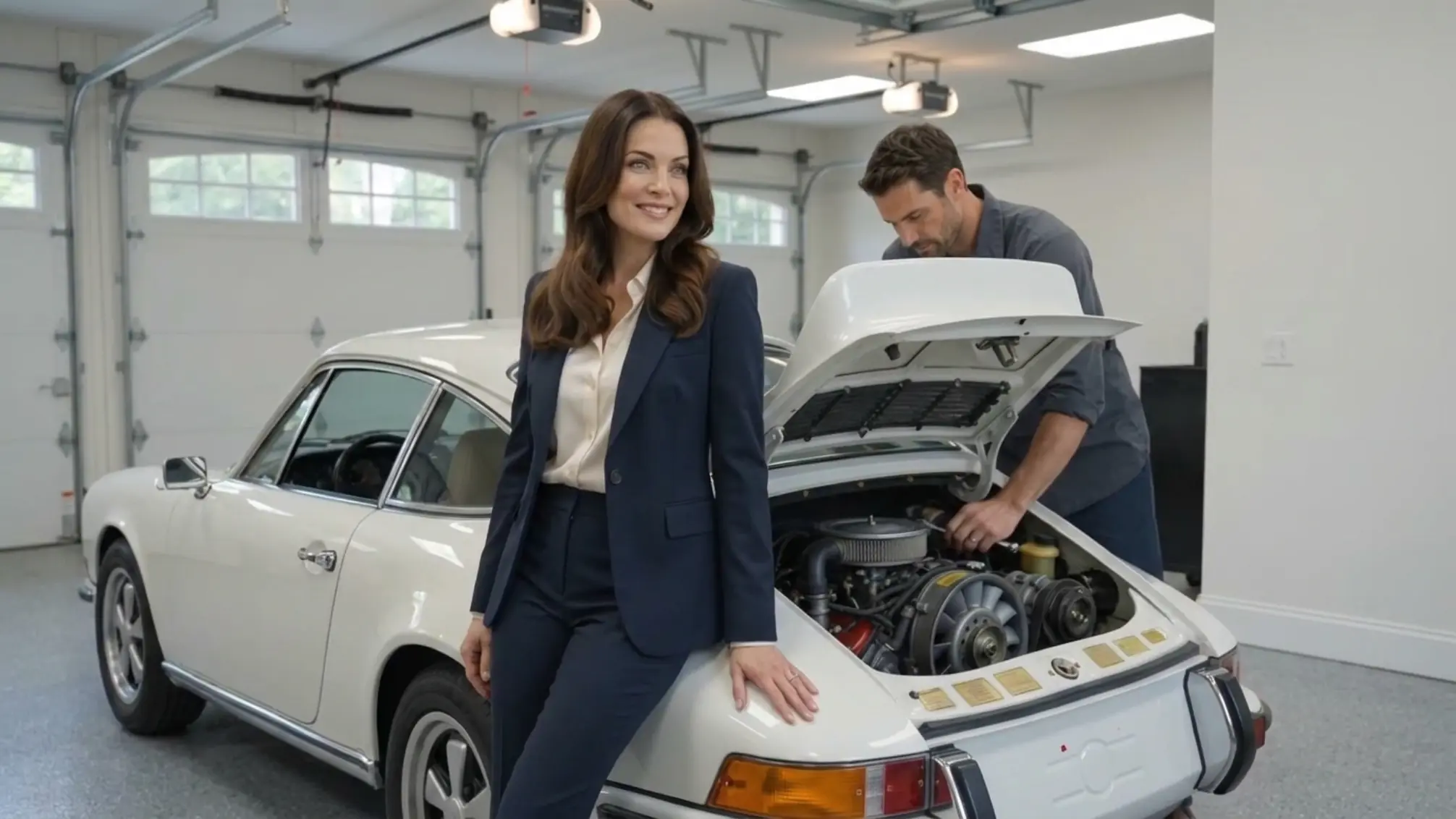
“Careful,” he said softly. “I might believe you.”
The assistants exchanged surprised glances. Vivian’s teasing smile remained, but something in her expression shifted. The mechanic had not responded like an employee trying to impress her, nor like a nervous stranger intimidated by her wealth.
He had answered like a man who had already seen something she did not understand.
Vivian stepped closer.
“You know this car?”
Ethan looked back into the engine bay.
“Yes,” he said. “But not the woman beside it.”
For one brief moment, Vivian forgot about the assistants, her meeting in Manhattan, and the billions of dollars managed by her investment firm. She simply studied the handsome single father standing beneath the garage lights. His charcoal work shirt was clean but worn at the cuffs, his dark hair carried the slight disorder of a man who had already worked several hours, and quiet intelligence filled his hazel eyes.
Then Preston Vance laughed.
Vivian’s business partner stood near the rear of the Porsche in an expensive gray sweater, wearing the polished confidence of a man who believed every room naturally belonged to him. He was forty-seven, impeccably groomed, and accustomed to judging people by what they owned.
“Three prestigious shops failed to repair that engine,” Preston said. “Perhaps we should postpone the wedding until the car actually starts.”
Ethan did not acknowledge the insult.
He leaned closer to the engine and wiped a thin layer of residue from a small metal bracket. Beneath the grime appeared a nearly invisible stamped mark.
MR04.
His breath caught.
Fourteen years earlier, when Ethan was twenty-four and working in European motorsport, a German master technician named Heinrich Müller had personally fabricated that bracket. Ethan had assisted with the engine rebuild at a workshop near the Nürburgring. He remembered the exact angle of the metal, the uneven welding seam, and the initials Heinrich stamped onto only seven special projects during his career.
This Porsche was one of them.
Back then, Ethan’s wife Caroline had still been alive. She had visited the workshop during the summer of 2010, laughing as Heinrich teased Ethan for working too quickly and reminding him that precision required patience. Their daughter had not yet been born, and Ethan still believed life would unfold according to careful plans.
Fourteen years later, Caroline was gone.
Ethan lived with their seven-year-old daughter, Hannah, in a modest two-bedroom apartment above the specialist garage he owned in Stamford. He repaired rare European cars, made school lunches before sunrise, attended parent meetings, and tried to give Hannah enough love for two parents.
He rarely spoke about the life he had lived before grief changed everything.
Yet that life was now sitting beneath his hands inside Vivian Ashworth’s garage.
“When did your father purchase this car?” Ethan asked.
Vivian’s playful mood faded.
“In 1991. Why?”
“Was it restored before he bought it?”
“Yes. He acquired it through a German broker and kept it in Europe for several years.”
Ethan pointed toward the bracket.
“This engine was later rebuilt by Heinrich Müller. He was one of the finest Porsche specialists of his generation.”
“You recognize his work?”
“I helped him perform it.”
Silence spread through the garage.
Preston’s amused expression disappeared first.
Vivian looked from Ethan to the Porsche.
“You worked on my father’s car?”
“During the summer of 2010.”
“That is impossible.”
“No,” Ethan said. “It’s extremely unlikely. That’s different.”
Vivian moved closer to the engine and studied the unfamiliar components as if they might suddenly reveal their history. Her father, Charles Ashworth, had loved the Porsche more than any other possession. After his death, Vivian kept it because driving the car reminded her of Sunday mornings when he allowed her to choose the road.
For eighteen months, however, the Porsche had suffered from an intermittent misfire and unexplained oil-pressure loss. Three dealerships and two specialist workshops had dismantled parts of the engine, replaced expensive components, and returned it without solving the problem.
“What’s wrong with it?” Vivian asked.
“Someone recently installed a modern scavenge pump that does not align with Heinrich’s original bracket. The car operates normally until the engine reaches a specific temperature. Then thermal expansion causes pressure loss and the misfire begins.”
Preston folded his arms.
“You found that in five minutes?”
“I recognized what should have been there.”
“And every other mechanic missed it?”
“They were diagnosing a factory engine. This stopped being a factory engine decades ago.”
Vivian watched Ethan carefully.
“How long will it take?”
“Three days if I can find the correct period component.”
“And if you fix it?”
Ethan glanced at her.
“You’ll have a running Porsche.”
Vivian smiled despite herself.
“And the marriage proposal?”
“You were joking.”
“Perhaps I’m reconsidering.”
Preston gave another laugh, but this one carried discomfort.
Ethan agreed to perform the work at the estate. The following morning, he arrived at eight with diagnostic tools, a camera, notebooks, and the methodical patience Heinrich once questioned whether he possessed. Before removing a single bolt, Ethan photographed the engine from every angle.
Vivian entered the garage an hour later wearing dark jeans, a cream sweater, and her long brown hair loose over her shoulders. Without the tailored suit and executives around her, she appeared younger and more approachable. She carried two cups of coffee.
“I wasn’t sure how you take yours,” she said.
“Black.”
She handed him the correct cup.
Ethan raised an eyebrow.
“My assistant called your shop.”
“You conducted research.”
“I manage an investment company. Research is expected.”
He accepted the coffee.
“Thank you.”
Vivian remained beside the workbench while he documented the engine.
“You didn’t laugh yesterday.”
“At what?”
“My proposal.”
“I understood it was a joke.”
“Most men would have played along.”
“Most men aren’t trying to diagnose a million-dollar Porsche.”
She studied his profile.
“You knew its value?”
“I knew what it could be worth with authenticated provenance.”
Vivian looked surprised.
“Our asset report values it at three hundred and eighty-five thousand dollars.”
Ethan stopped writing.
“That valuation is wrong.”
“By how much?”
“A verified lightweight Carrera RS with Heinrich’s documented restoration history could be worth more than one and a half million.”
Vivian’s face became still.
“My firm’s specialists prepared that valuation.”
“Then they made a significant mistake.”
Preston entered the garage before she could answer. He greeted Vivian warmly, then looked at Ethan’s photographs and handwritten notes.
“Documenting every scratch before billing us for a new one?”
Ethan closed the notebook.
“I document anything that may later matter.”
Preston smiled without warmth.
“Mechanics usually repair cars. They don’t perform investigations.”
“Sometimes those are the same job.”
Vivian glanced between the men.
“Preston, Ethan believes the Porsche has been substantially undervalued.”
Preston’s reaction was almost perfect.
Almost.
He frowned in professional concern, stepped toward the car, and asked several reasonable questions about market comparisons. But before he spoke, his eyes moved briefly toward the modern pump Ethan had removed.
It was only a fraction of a second.
Ethan noticed.
“I’m sure our valuation department had reasons,” Preston said. “Collectible markets fluctuate wildly.”
“Not by more than a million dollars,” Ethan replied.
Preston looked directly at him.
“You should concentrate on the engine.”
Ethan returned the stare.
“I am.”
That evening, after collecting Hannah from school and making pasta for dinner, Ethan sat at his kitchen table researching Ashworth Capital Management. Public regulatory filings revealed that Vivian had used several personal assets as collateral for credit supporting the firm.
The Porsche appeared on that schedule at the reduced valuation.
If someone transferred the car to a related company at the listed value and later sold it privately for its true worth, nearly a million dollars could disappear without Vivian understanding what she had lost.
The altered engine component suddenly looked less like incompetence.
If the original restoration could not be authenticated, the Porsche’s value would remain artificially low.
Ethan called Klaus Reinhardt, a retired Porsche engineer who had known Heinrich personally. Klaus confirmed that Heinrich’s work logs remained with his daughter in Germany and contained records of every personal engine rebuild.
“Your signature is in the 2010 volume,” Klaus said.
“Can you obtain scans?”
“I can call Heinrich’s daughter tomorrow.”
“I need them quickly.”
Klaus became quiet.
“Ethan, why?”
“Because someone may be trying to erase the car’s history.”
Two days later, Ethan installed a period-correct pump obtained from a collector in Pennsylvania. The component seated perfectly against Heinrich’s handmade bracket, restoring the relationship the engine had been designed to maintain.
He started the Porsche.
The flat-six engine settled into a clean, even rhythm that filled the garage with mechanical music. Ethan stood beside it with one hand resting lightly on the bodywork, remembering Heinrich’s workshop, Caroline’s laughter, and a younger version of himself who had not yet learned how quickly happiness could disappear.
Vivian entered quietly.
She did not interrupt.
When Ethan finally noticed her, she was watching him rather than the car.
“You miss someone,” she said.
He turned off the engine.
“My wife.”
Vivian’s expression softened.
“I’m sorry.”
“She died four years ago.”
“And your daughter?”
“Hannah was three.”
“That must have been…”
“Hard,” he finished. “Yes.”
Vivian looked toward the Porsche.
“My father died the year before that. Cancer.”
Ethan nodded.
“So this isn’t just a car.”
“No,” she said. “It’s one of the few places where I still remember him as my father instead of the man whose company I inherited.”
For the first time, they stood together without titles separating them. She was not a billionaire CEO teasing a mechanic. He was not a hired specialist trying to prove his worth.
They were simply two people who understood what it meant to preserve an object because it held the voice of someone gone.
Vivian drove the repaired Porsche for forty minutes. When she returned, tears shone faintly in her eyes. She closed the door with extraordinary care and stood beside the car for several seconds before approaching Ethan.
“It feels exactly as it did when he drove it.”
“That’s how Heinrich built it.”
“What do I owe you?”
“Twenty-eight hundred dollars.”
“I want to pay ten thousand.”
“No.”
Vivian blinked.
“No?”
“I quoted twenty-eight hundred. That is what the work cost.”
“You just restored a car worth more than my financial team realized.”
“I replaced one component and diagnosed the relationship around it.”
“Most people would take the money.”
“I’m not most people.”
Her gaze remained on him.
“I noticed.”
Ethan took a business card from his pocket.
“This belongs to a commercial attorney in Stamford named James Holloway. Call him privately.”
Vivian examined the card.
“Why?”
“Because I think the Porsche was deliberately altered to support a false valuation.”
The warmth left her face.
“Who would do that?”
“I don’t have proof of the person. I only have proof that the installation appears intentional.”
“Do you suspect Preston?”
Ethan hesitated.
“I suspect someone with access to the car and the firm’s asset records.”
Vivian looked toward the main house, where Preston was conducting a conference call beside the pool.
“If you’re wrong, this accusation could destroy a partnership that built my company.”
“I know.”
“And if you’re right?”
“The Porsche will be the smallest thing you’re about to lose.”
Vivian called James the following morning.
Within days, a forensic accountant discovered that Preston had been using related companies to purchase undervalued Ashworth assets, hide unauthorized transfers, and redirect investment profits. The amount was not one million dollars.
It exceeded fourteen million.
Vivian confronted no one immediately. Acting on legal advice, she continued attending meetings beside Preston while investigators quietly preserved records. She smiled through executive lunches, approved routine documents, and listened as the man she had trusted for ten years discussed the future of their company.
Meanwhile, Ethan returned to his garage.
He repaired a BMW, replaced an Audi transmission cooler, packed Hannah’s lunches, and tried not to wonder what was happening inside Ashworth Capital. Vivian called him only once during those weeks.
“I wanted to hear a voice that wasn’t lying to me,” she admitted.
Ethan sat on the steps outside his apartment while Hannah slept upstairs.
“You’ll get through it.”
“How do you know?”
“Because you called the attorney instead of confronting Preston emotionally. That means you’re stronger than the shock.”
“You always make strength sound quiet.”
“The loud version is usually insecurity.”
Vivian smiled through the telephone.
“Is that how you survived losing your wife?”
“No. I survived because a little girl needed breakfast the next morning.”
The honesty silenced her.
Then Vivian whispered, “I would like to meet her someday.”
“Hannah?”
“Yes. The person important enough to keep you moving.”
“When this is over.”
“I’ll remember that.”
Federal investigators searched the offices in November. Preston was charged with wire fraud, embezzlement, and breach of fiduciary duty. His attorneys initially denied everything until financial records connected his companies to the stolen assets.
Then he came to Ethan’s garage.
Preston entered in an expensive overcoat and placed a folded check on the workbench.
“Two hundred thousand dollars.”
Ethan did not touch it.
“For what?”
“You become unavailable as a witness.”
“No.”
“You claim uncertainty about the installation timeline.”
“No.”
Preston’s expression hardened.
“Your daughter attends Stamford Academy. She leaves at three most afternoons.”
Ethan slowly set down the wrench in his hand.
The room became very still.
Preston continued, pretending the information was casual.
“She waits near the maple tree when her usual ride is late.”
Ethan stepped around the workbench.
“Leave my shop.”
“I’m merely discussing public information.”
“Leave.”
Preston saw something in Ethan’s face and moved backward.
He had mistaken restraint for weakness, just as Vivian once mistook grease-stained clothing for ordinariness. He picked up the check and left without another word.
Ethan immediately contacted investigators.
The threat was added to Preston’s charges, resulting in witness-tampering exposure and the suspension of his bond conditions. Within weeks, Preston accepted a plea agreement requiring restitution, surrender of his ownership interests, and a federal prison sentence.
Vivian recovered the stolen assets.
She kept the Porsche.
Months later, she arrived at Ethan’s garage carrying a package wrapped in brown paper. Ethan opened it to find Heinrich Müller’s original leather-bound work log from 2010, temporarily loaned by Heinrich’s daughter.
His younger signature appeared on page forty-seven.
Beneath it, Heinrich had written a note in German.
The American apprentice has the hands. Whether he has the patience, only time will answer. I believe he will.
Ethan read the words twice.
Vivian stood quietly beside him.
“What does it say?”
“He thought I might become someone worthwhile.”
“Was he right?”
“My wife thought so.”
“And your daughter?”
“I hope she does.”
Vivian stepped closer.
“What about me?”
Ethan lifted his eyes.
“You barely know me.”
“I know you refused money when taking it would have been easy. I know you protected someone who once made a careless joke at your expense. I know you stood against a man who threatened your daughter, and I know you still speak gently after life gave you every excuse not to.”
“That isn’t the same as knowing me.”
“No,” Vivian said. “But I’d like the chance.”
The bell above the garage entrance rang.
Hannah walked inside carrying a wooden toy car and wearing her school cardigan. She stopped when she saw Vivian.
“Daddy, is that the Porsche lady?”
Vivian smiled.
“I suppose I am.”
Hannah looked her over with serious curiosity.
“Did Dad fix your car?”
“He fixed much more than the car.”
Ethan gave Vivian a warning look, but Hannah had already approached her.
“Do you really own a Porsche?”
“Yes.”
“Can I ride in it?”
Vivian crouched to meet her eyes.
“Only if your father comes too.”
Hannah turned toward Ethan.
“Please?”
He sighed.
“On the weekend.”
Vivian stood.
“Saturday?”
“You work quickly.”
“I manage four billion dollars.”
“Not anymore.”
She smiled.
“Then I finally have free time.”
Their first outing was not a formal date. Hannah sat in the passenger seat of the Porsche while Ethan followed in his truck because he refused to let a seven-year-old ride without the proper child seat. They drove to Lime Rock Park, where Klaus had arranged for Ethan to discuss leading a new restoration program.
Vivian spent the afternoon with Hannah, listening to detailed explanations about wooden toy cars, school lunches, and why spaghetti tasted better when Ethan made it. She never checked her phone during those conversations.
That mattered to Ethan.
Weeks became months.
Vivian visited the garage without assistants. Ethan brought Hannah to the estate, where the little girl ran across lawns previously occupied only by executives and guests. Vivian learned to cook one acceptable pasta dish, though Hannah continued insisting Ethan’s was better.
Their relationship did not begin with a grand declaration.
It grew through ordinary moments.
Coffee left beside a workbench. A CEO sitting on a garage floor while Hannah painted a cardboard race car. Ethan attending a charity dinner in a suit Vivian chose, then escaping early with her to eat fries at a roadside diner.
One evening, they stood beside the Porsche after returning from a drive along the Connecticut coast.
Vivian rested against the fender.
“Do you remember what I said the first day?”
“You said you’d marry me if I fixed the car.”
“I was joking.”
“I know.”
“What if I’m not joking now?”
Ethan looked at her.
There was no audience, no laughing assistants, and no business partner waiting to belittle him. Only Vivian, beautiful and vulnerable, beneath the garage lights.
“You’re moving too quickly,” he said.
“I waited almost a year.”
“That is quick after everything we’ve both lost.”
She nodded.
“Then I’ll wait longer.”
Ethan stepped closer.
“But you don’t need to stop asking.”
Vivian smiled.
“Careful. I might believe you.”
This time, Ethan kissed her.
Two years later, the Grand Prix white Porsche stood outside a small lakeside wedding venue. Hannah wore a pale-blue dress and carried the rings inside the wooden toy car her grandfather had made.
Vivian did not arrive with assistants.
She walked toward Ethan alone, radiant in a simple ivory gown, her blue-gray eyes fixed on the mechanic who had seen the truth beneath both her car and her life.
During the reception, Hannah climbed onto a chair and announced that her father had technically earned the marriage by repairing the Porsche.
Everyone laughed.
Vivian reached for Ethan’s hand.
“I suppose I should honor the original agreement.”
Ethan looked toward the car, then back at his wife.
“I thought the Porsche brought me there to repair an engine.”
“And now?”
He squeezed her hand.
“Now I think it remembered where I belonged before I did.”