“Your heart monitor is flashing—stop before you collapse.”
Vivian Cross stood beside her disabled SUV as snow gathered across the shoulders of her cream wool coat. Beneath the open hood, Ethan Cole tightened a wrench around the damaged brake assembly, though his right hand had begun trembling badly enough to make the flashlight beam jump across the engine. A thin medical monitor beneath his shirt flashed red against his collarbone.
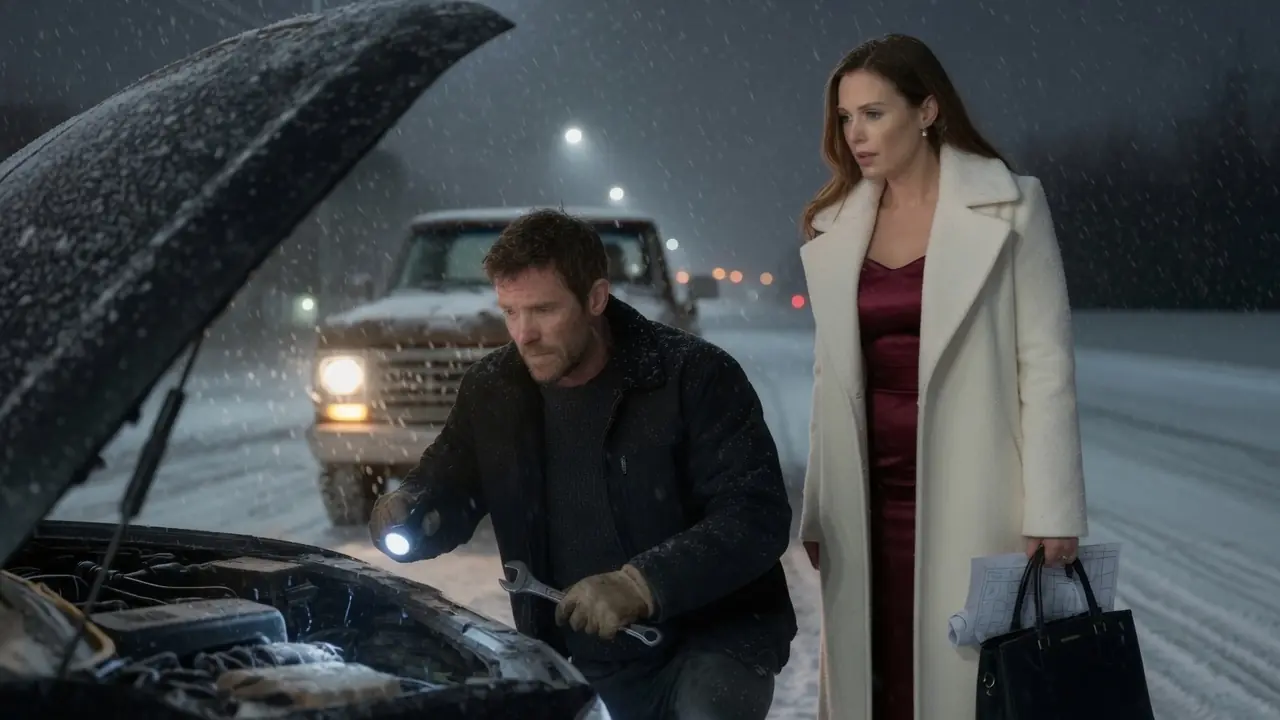
“My daughter needs me alive,” Ethan said, forcing the wrench another turn, “but you need those brakes before anyone follows you.”
Vivian looked down at the severed line hanging beneath the vehicle. The cut was too clean to be accidental, and the dark service road outside Cleveland was too isolated for comfort. “Someone tried to kill me, and you’re risking your life to fix their mistake.”
Ethan pulled the keys to his old pickup from his pocket and pressed them into her gloved hand. “Then drive. If I fall, remember my name before they erase us both.”
The warning should have sounded theatrical.
Instead, it frightened her because Ethan did not appear to have enough strength left to exaggerate anything.
Only fifteen minutes earlier, Vivian had been driving toward a secure conference facility near Lake Erie when the brake pedal suddenly dropped beneath her foot. She had managed to steer the SUV onto the shoulder, using the emergency brake before the road curved toward a steep embankment. Her phone had no signal, her driver had been unexpectedly reassigned, and the nearest building appeared to be a small roadside garage almost half a mile away.
Then Ethan’s pickup emerged through the snow.
He stopped without hesitation.
At thirty-nine, Ethan had the tired appearance of a man who had survived too many nights without enough rest. His work jacket was faded at the elbows, his boots were coated in salt and grease, and a small photograph of an eight-year-old girl had been taped inside his truck’s dashboard. He introduced himself only after making certain Vivian was not injured.
The garage belonged to him.
Cole Roadside Repair occupied an old service station beside the highway, with two narrow bays, a rusted sign, and an apartment above the office. Ethan lived there with his daughter, Lily, after his wife left six years earlier and never returned.
He had been closing for the night when he saw Vivian’s hazard lights.
The snow intensified as he inspected the vehicle. At first, he assumed the brake line had failed from corrosion, but the metal showed fresh tool marks. A secondary electrical cable leading to the emergency assistance system had also been cut.
“This wasn’t an accident,” Ethan said.
Vivian’s first thought was Martin Shaw.
Martin was the chief financial officer of CrossLife Medical Technologies and the only executive who knew the route she planned to take that night. Earlier that afternoon, she had refused his demand to cancel a medical-device trial after discovering suspicious payments connected to one of his consulting firms. Hours later, someone changed her driver assignment and sent her onto an isolated road in a vehicle with no brakes.
She had built CrossLife over fourteen years.
The company began with a small research team developing cardiac monitoring technology for rural hospitals. It eventually became one of the fastest-growing medical-technology firms in the Midwest, producing implantable sensors, emergency cardiac units, and experimental devices that could stabilize patients with advanced rhythm disorders.
The prototype inside Vivian’s secured case was the company’s most important invention.
It was also the reason someone wanted her gone.
The compact device was called the Aegis Pulse Regulator. Unlike a traditional pacemaker, it continuously analyzed unstable electrical patterns and adjusted treatment in real time. Early trials suggested it could prevent sudden cardiac collapse in patients whose conditions were too unpredictable for ordinary implanted devices.
Only twelve prototypes existed.
Vivian carried the authorization papers for the final human trial inside her handbag.
Ethan knew none of that.
To him, she was simply a stranded woman whose car had been deliberately disabled.
He worked beneath the hood while Vivian stood behind him, watching the red signal on his monitor flash more frequently. His breathing became shallow, and twice he had to grip the vehicle for balance.
“You need a hospital,” she said.
“I’ve been to hospitals.”
“That isn’t an answer.”
“They told me the same thing every time.”
“What?”
“That my heart could fail tomorrow or ten years from now.”
Vivian stared at him. “What condition do you have?”
“Idiopathic ventricular instability.”
The medical phrase changed everything.
Vivian stepped closer. “Who diagnosed you?”
“Cleveland Regional, three years ago.”
“What treatment are you receiving?”
“Medication and this monitor.”
“No implant?”
“The insurance rejected the advanced option. Said my episodes weren’t frequent enough.”
Vivian felt anger rise beneath her fear.
Ethan’s condition was nearly identical to the one the Aegis device had been designed to treat. Yet he stood in a snowstorm repairing a stranger’s brakes because the healthcare system had decided he was not sick often enough to deserve protection.
“Stop working,” she ordered.
Ethan glanced toward the road. “Whoever cut this line may come back.”
“Then we call the police.”
“No signal.”
“My satellite phone is inside the SUV.”
“The emergency system cable was cut too.”
Vivian looked toward the dark trees lining the highway.
For the first time, she heard an engine in the distance.
Ethan heard it too.
He closed the hood without finishing the repair and pointed toward his pickup. “Take the truck. Drive to the garage and lock the doors.”
“What about you?”
“I’ll bring your car if I can get it moving.”
“You can barely stand.”
“Neither can the person who cut those brakes afford to let you reach help.”
The approaching headlights appeared around the bend.
Ethan pushed Vivian toward the pickup.
She climbed inside, but instead of driving away immediately, she watched through the rear window. Ethan moved toward the SUV, pretending to continue the repair as a dark sedan slowed near the shoulder.
The sedan did not stop.
It passed once, then disappeared into the snow.
Ethan remained still for several seconds before lifting one hand toward Vivian.
Go.
She drove to the garage.
Lily was inside the office, sitting at an old desk beneath a pink blanket while completing a science project. Her brown hair was tied into an untidy ponytail, and concern immediately replaced curiosity when she saw her father’s truck arrive without him.
“Where’s Dad?”
“He’s helping with my car.”
“Is his monitor red?”
Vivian hesitated.
Lily’s expression told her the answer mattered.
“Yes.”
The child grabbed a small emergency bag from beneath the desk. “We have to go back.”
“He told me to keep you safe here.”
“He says that when he’s scared.”
Vivian knelt in front of her. “What’s inside the bag?”
“Medicine, the hospital papers, and instructions for when he falls.”
Not if.
When.
Vivian felt something tighten inside her chest.
Before she could respond, the garage phone rang.
Ethan’s voice came through weakly. He had managed to start the SUV, but the temporary repair would not survive more than a few miles. He instructed Vivian to call the county sheriff from the garage’s landline and remain inside with Lily.
Then his sentence ended abruptly.
“Ethan?”
No answer.
Lily was already running toward the door.
Vivian caught her before she reached the snow.
“I’m going,” Vivian said. “You stay here and call the number on this card.”
She handed Lily the private emergency contact for CrossLife security.
“Tell them Vivian Cross sent you. Say there has been an attempted attack, and we need medical assistance immediately.”
“Who are you?”
“Someone who is bringing your father home.”
Vivian took Ethan’s emergency bag and drove the pickup back toward the stranded SUV.
She found him lying beside the front wheel.
The temporary brake line had been secured, but the wrench remained in his hand. His monitor emitted a continuous warning tone, and his pulse was dangerously irregular beneath Vivian’s fingers.
She opened the emergency bag.
The medication inside could slow a minor episode, but Ethan’s condition had already passed that stage. His breathing weakened, and his eyes opened only briefly.
“Lily?” he whispered.
“She’s safe.”
“Don’t let her see me like this.”
“You’re going to see her yourself.”
Ethan gave the faintest smile. “You sound certain.”
“I built a company by sounding certain before I had proof.”
“That doesn’t sound healthy.”
“Neither is repairing a sabotaged car during heart failure.”
The sound of engines approached again.
This time, three vehicles appeared through the snow—CrossLife security, county deputies, and an emergency medical unit alerted by Lily. Vivian remained beside Ethan while paramedics attached monitors and prepared to transport him.
One paramedic examined the rhythm display and shook his head.
“He’s unstable. We need the cardiac center now.”
The ambulance departed with Vivian inside.
At Cleveland Regional, Ethan suffered two more severe rhythm events before doctors stabilized him. The attending cardiologist explained that conventional treatment might no longer be enough. His heart could stop without warning, and the hospital had limited options available under his insurance.
Vivian stood outside the intensive-care unit while Lily slept in a chair with her head against Vivian’s coat.
CrossLife security director Aaron Blake arrived shortly before dawn.
He confirmed the SUV had been sabotaged.
Airport and traffic footage showed Martin Shaw’s private security contractor following Vivian’s route. Investigators also discovered unauthorized access to the vehicle’s electronic system less than an hour before she left company headquarters.
Martin disappeared before police reached his home.
Vivian barely reacted to the news.
Her attention remained on Ethan.
“Can Aegis help him?” Aaron asked.
“He matches the target condition.”
“Isn’t the trial waiting for approval?”
“The authorization papers are in my bag.”
Aaron looked at her. “You cannot enroll someone because he saved your life.”
“I wouldn’t.”
“That sounds like exactly what you’re considering.”
Vivian faced him. “I am considering him because he has the condition the device was created to treat, conventional options have failed, and he may not survive long enough to wait for standard approval.”
“You’ll need independent review.”
“I’ll get it.”
“His consent.”
“I know.”
“And if the device fails?”
Vivian looked through the glass toward Ethan.
“Then at least he receives a chance no one was willing to offer him yesterday.”
By morning, an emergency medical review had begun.
The Aegis trial director initially refused. Ethan had not completed the preliminary screening period, and using the prototype immediately carried legal, medical, and ethical risks. Vivian pushed for an emergency compassionate-use pathway, but she did not reveal that Ethan had rescued her until after the independent physicians reviewed his records.
His condition alone qualified him.
The decision belonged to Ethan.
When he regained consciousness, Lily sat beside him holding his hand. Vivian remained near the doorway, uncertain whether she had the right to enter such a private moment.
Ethan opened his eyes and looked at his daughter.
“You followed instructions?”
Lily nodded through tears. “Mostly.”
“That sounds dangerous.”
“I learned it from you.”
He smiled weakly.
Then he noticed Vivian.
“The car?”
“Forget the car.”
“That bad?”
“Someone tried to kill me.”
“I noticed.”
“The police identified the person who arranged it.”
“Good.”
Vivian stepped closer. “There’s something else.”
She explained the Aegis device, the risks, the experimental status, and why the technology might succeed where standard treatment had failed. She did not promise a cure or pretend the procedure was safe.
Ethan listened carefully.
“How much will it cost?”
“Nothing.”
His expression immediately hardened. “I don’t accept charity.”
“This is not charity. You qualify for the trial.”
“Before last night, would your company have found me?”
Vivian could not lie.
“No.”
“Then this is because I fixed your car.”
“This is because your medical records prove the device may help you. Meeting you is the reason I learned those records existed.”
He looked toward Lily.
“What happens if it fails?”
Vivian answered quietly. “The procedure itself carries risk. Without it, your doctors believe another severe episode could kill you within months—or sooner.”
Lily tightened her grip around his hand.
Ethan closed his eyes.
For years, he had built every decision around surviving long enough to raise her. He avoided unnecessary expenses, refused risky work, and kept emergency instructions beneath the garage desk.
Yet survival had slowly become waiting for collapse.
“What would you do?” he asked Vivian.
She looked at him.
“If it were your heart?”
“No. If she were your daughter.”
The question struck deeper.
Vivian had no children, but she understood what he meant. Parents did not fear death only for themselves. They feared leaving unfinished promises inside the people who depended on them.
“I would take the chance,” she said. “Not because it is certain, but because she deserves to watch you choose life instead of preparing her for your death.”
Ethan looked at Lily.
Then he signed the consent papers.
The procedure occurred the following morning.
Vivian remained at the hospital while CrossLife’s board demanded her immediate return. Martin’s fraudulent contracts had begun surfacing, investors were panicking, and reporters had learned about the sabotage attempt.
She refused to leave.
Her deputy chair accused her of allowing emotion to override leadership.
Vivian answered calmly, “A company that abandons the first patient its invention might save has no right to call itself medical.”
The board meeting proceeded without her.
Ethan’s operation lasted five hours.
The device was implanted near his heart and connected to a network of sensors monitoring electrical instability. During the first hour, his rhythm became dangerously erratic. The Aegis system detected the pattern and corrected it before the medical team could intervene manually.
The room went silent when the rhythm stabilized.
The prototype worked.
Ethan remained unconscious until evening.
When he woke, Vivian was sitting beside the window while Lily slept with her head against the bed. A soft green light pulsed on the monitor near his chest.
“No red?” Ethan asked.
“Not yet.”
He looked at Vivian. “You stayed.”
“So did you.”
She smiled, but relief broke through the careful expression she wore in public. Ethan saw then that the powerful CEO from the roadside was still the frightened woman who had stood beside a sabotaged car in the snow.
“Did they catch him?” he asked.
“Martin was arrested at a private airfield.”
“What did he steal?”
“Forty-three million dollars through false research contracts.”
“And the device?”
“He wanted the trial canceled so the missing money would be blamed on development costs.”
Ethan glanced toward the monitor.
“He nearly destroyed the thing that saved me.”
“Yes.”
“Why?”
“Because people protecting lies eventually start treating every truth as an enemy.”
Ethan looked toward Lily again.
“And what happens to my garage?”
Vivian blinked. “Your garage?”
“I’ve been here three days. Bills don’t stop because my heart does.”
She almost laughed, then realized he was serious.
“The garage will remain open.”
“You sent someone?”
“I sent a temporary manager and paid the staff through the emergency patient-support fund.”
Ethan frowned. “That sounds like charity.”
“It is an operational research expense.”
“That sounds like expensive charity wearing a tie.”
“Then repay it by keeping the device alive long enough to complete the trial.”
His expression softened.
“Deal.”
Recovery took months.
Ethan returned home with strict activity limits, medication changes, and a remote monitoring system connected directly to CrossLife’s research center. Vivian visited the garage every week at first, officially to review device data.
Lily knew better.
She began leaving two cups of coffee on the office desk before Vivian arrived. She also asked increasingly direct questions about why Vivian wore high heels to a garage and whether powerful women were allowed to marry mechanics.
Ethan nearly dropped a socket wrench the first time.
Vivian answered without embarrassment.
“Powerful women are allowed to make their own decisions.”
Lily smiled. “Good.”
The relationship between Ethan and Vivian grew slowly.
He disliked receiving help and challenged every company policy that treated patients as numbers. She had spent years surrounded by executives who agreed with her, so his blunt honesty became strangely comforting.
When CrossLife proposed expanding the Aegis trial only to patients with premium insurance, Ethan refused to remain silent.
“You found me because my insurance denied treatment,” he told Vivian. “If this device becomes another machine only rich people can reach, then saving me meant nothing.”
The board resisted.
Vivian used Martin’s recovered funds to establish an access program for uninsured and underinsured patients. She also changed trial recruitment so rural clinics and community hospitals could nominate candidates directly.
Aegis saved seventeen patients in the first year.
Ethan was the first.
His health improved enough that he could return to work, though Lily monitored him with the authority of a hospital administrator. Whenever the device transmitted a warning, she ordered him to sit down before the research center even called.
Vivian became part of their life almost accidentally.
She attended Lily’s school science fair, helped repaint the garage office, and spent Christmas Eve eating burnt cookies above the repair shop. Ethan kept expecting her to grow tired of the small apartment, oily floors, and ordinary routines.
She never did.
One snowy evening, exactly one year after the roadside attack, Vivian’s new SUV stopped outside the garage.
Ethan stepped beneath the open bay door.
“Brake trouble?”
“No.”
“Engine?”
“No.”
“Then why are you here?”
Vivian held up a small black box.
Inside was a polished metal plate engraved with the serial number of Ethan’s Aegis device.
AP-001 — ETHAN COLE
“The trial is complete,” she said. “The device received full approval this morning.”
Ethan stared at the plate.
“How many patients?”
“Four hundred waiting for placement.”
He looked at her. “Four hundred people get another chance?”
“Yes.”
Snow drifted through the garage lights.
Ethan touched the place beneath his shirt where the device continued regulating his heart.
“You came back and saved my life.”
Vivian shook her head. “You saved mine first.”
“That was a brake line.”
“You gave me your truck, stayed behind when someone might have returned, and collapsed finishing the repair.”
“I was doing my job.”
“No. You were choosing who you wanted to be when no one could reward you.”
Ethan stepped closer.
“What are you choosing now?”
Vivian’s eyes softened. “You.”
Lily appeared in the apartment doorway above them.
“Finally!”
They both looked up.
She leaned over the railing. “I have been waiting a whole year for one of you to say that.”
Ethan laughed.
Vivian crossed the remaining distance and kissed him beneath the falling snow, beside the same battered pickup she had driven to safety the night they met.
Two years later, CrossLife opened a cardiac-access clinic beside Cole Roadside Repair.
The location seemed strange to investors until Vivian explained that people who delayed medical care often trusted neighborhood businesses more than hospitals. Mechanics, truck drivers, farmers, and families passing along the highway could receive free screenings without entering a corporate facility.
Ethan helped design the program.
Lily chose the clinic’s name.
Second Start.
The clinic identified dozens of dangerous heart conditions before symptoms became fatal. Patients who could not afford treatment were connected to CrossLife’s assistance fund.
Ethan continued repairing cars.
He also spoke to medical teams about what it felt like to live with a condition that turned every ordinary day into borrowed time. His perspective changed how engineers designed alarms, patient instructions, and emergency support.
Vivian remained CEO.
But she no longer measured the company only through valuation, expansion, or quarterly performance. She measured it through lives that continued because someone had been seen before it was too late.
She and Ethan married in the garage courtyard during the first snowfall of December.
Lily carried the rings inside the same emergency bag that once held her father’s medication. Before the ceremony, she placed Ethan’s old flashing monitor on a shelf beside the engraved Aegis plate.
“Why keep the broken one?” Vivian asked.
Lily looked at her seriously. “Because it brought you back.”
The monitor had not brought Vivian.
The snowstorm had.
The severed brake line had.
So had Ethan’s stubborn decision to help a stranger while his own heart was failing.
Yet Lily’s answer carried its own truth.
Broken things sometimes revealed the people willing to remain when fixing them became difficult.
Ethan had believed his life depended on surviving alone for his daughter.
Vivian had believed leadership meant carrying every danger without exposing weakness.
The night they met proved both of them wrong.
Ethan’s kindness saved Vivian from the person trying to erase her.
Vivian’s invention kept Ethan’s heart beating long enough for him to raise his daughter, rebuild his future, and discover a love he never expected.
Years later, whenever snow began falling over Cleveland, Lily repeated the story to anyone willing to listen.
Her father fixed a CEO’s sabotaged car on a frozen road.
The CEO drove away in his old pickup.
Then she came back with something no money, title, or ordinary repair could replace.
More time.