“Fix my barn—stay out of my land fight.”
Marigold Everhart stood between Silas Callaway and the half-repaired barn, gripping a bundle of property documents against her red-and-brown plaid work shirt. Mud covered her brown farming boots, loose strands of chestnut hair had escaped her braid, and anger sharpened her green eyes. Behind her, a black sedan rolled away from the farm, carrying Damon Caldwell—the land buyer who had just threatened to take everything her family had built.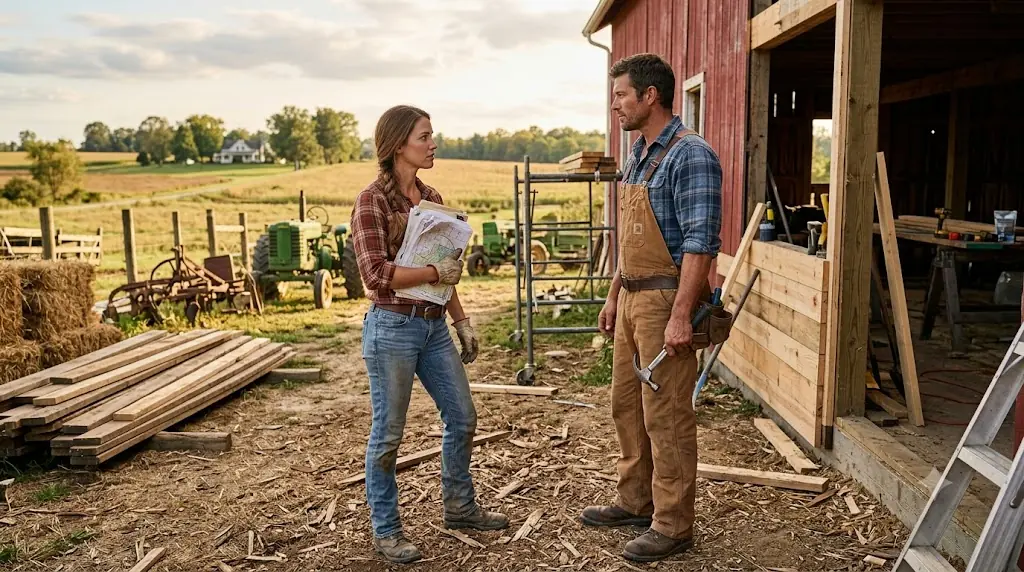
Silas rested his claw hammer against his brown canvas overalls. “Then stop letting him threaten you.”
“I’m not letting him do anything.”
“You stood there while he spoke about your father like he owned his memory.”
Marigold raised the documents between them. “Push again, and you’re fired.”
Silas stared at her without stepping back. “After you reveal what these acres are hiding.”
The autumn wind moved through the wheat fields beyond them, bending thousands of golden stalks in the same direction. Marigold’s expression changed for only a second, but Silas saw it. The woman who had faced Damon without blinking suddenly looked afraid.
“You don’t know what you’re talking about,” she said.
“Maybe not. But men don’t drive from Columbus in polished shoes to threaten someone over one broken barn.”
Silas had arrived in Hopewell, Ohio, only two weeks earlier with a battered pickup truck, a tool chest, and his seven-year-old son, Finn. Since his wife’s death four years before, he had moved from one temporary job to another, telling himself that constant motion kept grief from becoming permanent. In reality, every new town had begun to look like the last: cheap rent, uncertain work, and another school where Finn learned not to get attached.
The Everhart job was supposed to be different only because it paid three weeks in advance.
Marigold had hired him to reinforce the roof of a weathered red barn before winter. She presented herself as the owner of a struggling family farm, dressed in faded jeans, rolled-sleeve flannel shirts, leather gloves, and work boots permanently stained by soil. She drove an old farm truck, repaired fences herself, and poured coffee from a dented thermos.
Nothing about her suggested wealth.
Yet the farm stretched farther than Silas first realized. Beyond the visible wheat fields stood wooded ridges, cattle pasture, orchards, and unused grazing land disappearing toward the horizon. When Silas asked how much property belonged to her, Marigold answered, “Enough to keep me busy.”
He had assumed she meant a few hundred acres.
Damon Caldwell’s visit changed that assumption.
The man had stepped from his sedan wearing a tailored black coat that looked absurd beside the muddy farm road. He spoke to Marigold with the confidence of someone accustomed to obtaining whatever he wanted, reminding her that suppliers had already stopped extending credit and that the county board was discussing “development opportunities.”
Marigold told him to leave.
Damon smiled. “You can keep pretending this place is one little family farm, but those deeds won’t stay buried forever.”
That was when Silas stepped between them.
Now Marigold stood before him, clearly furious that he had heard too much.
“My family’s records are none of your business,” she said.
“You made them my business when you hired me to repair a barn someone wants torn down.”
“I hired you because you needed work.”
“And I stayed because you needed help.”
Marigold’s jaw tightened. “Don’t mistake a paycheck for a place in my life.”
The words hit harder than she intended. Silas’s expression went still, and for a moment she saw the tired widowed father beneath the strong carpenter. He picked up his hammer and walked toward his truck.
“Silas.”
He kept moving.
“I didn’t mean—”
“Yes, you did.” He loaded the hammer into his tool chest. “You’re just angry because I noticed.”
Finn sat on the tailgate with Rusty, the scruffy farm dog who had adopted him on their first day. The boy looked from his father to Marigold, sensing the tension adults believed children could not understand.
“Are we leaving?” Finn asked.
Silas glanced toward the barn. Fresh boards covered half the western wall, but the roof still sagged above the central beam. Another heavy storm could bring the entire structure down.
“Not yet,” Silas said. “We finish what we start.”
Marigold stood alone beside the barn as he returned to work. She wanted to apologize, but pride held the words behind her teeth. Pride had kept her upright after her father died, after banks rejected her applications, and after old family friends began circling the farm like buyers at an estate auction.
It had also kept her isolated.
Silas climbed the ladder without speaking. For the rest of the afternoon, the only sounds between them were hammer strikes, sawing wood, and Finn laughing as Rusty stole one of his work gloves.
Near sunset, Marigold returned carrying a ledger.
“Come inside,” she told Silas. “There’s something you need to see.”
The farmhouse kitchen smelled of coffee, hay, and the apple pie she had baked that morning. Marigold remained in her farmer’s clothes, refusing to dress differently merely because she was about to reveal a secret. She spread several yellowed maps across the heavy wooden table.
Silas studied the boundaries marked in red ink.
The Everhart property did not end at the wheat fields. It stretched across valleys, wooded hills, pastureland, and several abandoned farming communities. According to the oldest survey, the family controlled more than nine thousand acres.
Silas looked at her. “You own all this?”
“Technically, yes.”
“And you let everyone believe you’re about to lose one farm?”
“I may lose all of it.”
Marigold explained that her grandfather purchased failing farms during the Great Depression, but instead of removing the families, he allowed them to remain as tenant farmers. Over time, the Everharts accumulated connected parcels across the county. Her father, Elijah, transformed the land into a cooperative network supplying grain, cattle, apples, and dairy products throughout the region.
Then Damon Caldwell became his investment partner.
Damon promised rail access, processing facilities, and national buyers. Elijah signed complicated agreements without realizing that Damon had placed several operating companies under his own control. When Elijah became ill, Damon began isolating him from accountants and longtime employees.
“After my father died, Damon claimed the farm owed him millions,” Marigold said. “He couldn’t take the land directly because the original deeds contain restrictions.”
“What kind?”
“The property must remain in agricultural use. If the main Everhart farm stops operating, the connected parcels can be challenged and divided.”
Silas looked toward the barn visible through the window. “That’s why this building matters.”
“It was the first registered agricultural structure on the estate. Every later deed references it as the center of operations.”
“If it collapses?”
“Damon can argue the original farm is abandoned.”
Silas’s anger rose slowly. “So he pressured suppliers, blocked your loans, and waited for the barn to fail.”
Marigold nodded. “He wants the county to condemn the land, seize it through eminent domain, and transfer development rights to his company.”
“What does he plan to build?”
“Warehouses, luxury housing, and a private distribution corridor.”
Silas looked again at the map. Small names had been written across distant parcels. They were not empty fields. Families still lived there.
“How many people lose their farms if he wins?”
“Thirty-two families.”
“And you were planning to fight him alone?”
“My father created the problem. I thought it was my responsibility to fix it.”
Silas leaned over the table. “Responsibility isn’t the same as punishment.”
Marigold’s eyes moved to the wedding band Silas still wore on a cord beneath his shirt. “You’ve punished yourself for years.”
He straightened.
“You move Finn every time a place starts becoming home,” she continued. “You work until you’re exhausted because stopping means remembering your wife. Don’t tell me I’m the only one choosing punishment.”
Silas’s face hardened. “My life isn’t written in those deeds.”
“No, but your fear is written all over your truck.”
The argument could have ended everything between them. Instead, Silas pulled out a chair and sat across from her.
“What evidence do you have against Caldwell?”
Marigold opened her father’s ledger. Elijah had recorded payments, land surveys, and conversations with county officials. Several pages had been removed shortly before his death, but enough remained to suggest Damon secretly paid suppliers to cancel agreements and bribed an appraiser to undervalue the land.
“It proves pressure,” Silas said. “Not theft.”
“There may be more records in the barn.”
“Where?”
“My grandfather built a document room beneath the feed-storage floor. Father sealed it after Damon began visiting without permission.”
Silas glanced toward the darkening yard. “You waited until now to mention a hidden room under the collapsing building?”
“I wasn’t certain it still existed.”
“If that floor gives way, every record beneath it gets crushed or soaked.”
Marigold closed the ledger. “Then we open it tonight.”
They entered the barn carrying lanterns, crowbars, and a shovel. Finn remained inside the farmhouse with Rusty after extracting a promise that he could see any treasure they found. Beneath thirty years of packed dirt and rotting boards, Silas discovered iron hinges surrounding a rectangular section of flooring.
Together, he and Marigold lifted the concealed hatch.
Stone steps descended into darkness.
The underground room smelled of damp paper and cedar. Shelves lined the walls, holding account books, sealed crates, survey equipment, and metal document cases. A large Everhart family seal had been painted above a heavy desk.
Marigold touched the desk with trembling fingers. “My father brought me here once when I was twelve.”
“What did he tell you?”
“That land remembers who cared for it.”
Silas opened the first case. Inside were original deeds, letters from tenant families, and contracts signed by Damon. Another box contained photographs showing Caldwell representatives inspecting farmland years before Elijah’s death.
Then Marigold found a sealed envelope bearing her name.
Her father’s handwriting covered six pages.
Elijah confessed that Damon had convinced him to transfer control of the farm’s operating accounts. When Elijah tried to reverse the arrangement, Damon threatened to expose fabricated debts and destroy the Everhart name. Elijah began secretly collecting evidence, but illness advanced before he could contact federal investigators.
The final page contained a warning.
Damon believes the northern fields contain commercially valuable lithium deposits. He does not want the farm for houses or warehouses. He wants the minerals beneath it, and he will destroy every family above them to reach what lies below.
Marigold lowered the letter.
Silas read the geological report attached behind it. The deposits could be worth hundreds of millions of dollars.
“That’s why he won’t stop,” Silas said.
“No.”
“He can’t risk these records reaching the county.”
A vehicle door slammed outside.
Silas extinguished the lantern immediately.
Heavy footsteps crossed the barn floor above them.
Marigold gripped his sleeve. Silas placed one finger against his lips and drew the hammer from his tool belt. Through gaps around the hatch, they saw flashlight beams moving across the rafters.
Someone poured liquid over the hay.
The sharp smell of gasoline entered the underground room.
“They’re burning it,” Marigold whispered.
Silas rushed up the steps and struck the hatch with his shoulder. It opened beneath one intruder, knocking the man onto the floor. A second masked figure swung a metal bar, but Silas blocked it with his forearm and drove the hammer handle into the attacker’s stomach.
Marigold climbed out holding a shovel.
The first man lunged toward Silas. She struck his legs and sent him crashing into a stack of feed sacks.
A glass bottle shattered near the eastern wall. Fire raced across the gasoline-soaked hay.
“Get the documents!” Silas shouted.
“I’m not leaving you!”
“Marigold, move!”
She dragged two metal cases from the hidden room while Silas fought the attackers away from the entrance. One escaped through the side door. The other stumbled after him, leaving behind a torn jacket and a silver cuff link marked with Caldwell Development’s initials.
Flames climbed the old wall.
Silas seized both cases and pushed Marigold outside. Together, they rolled a rain barrel toward the fire while Finn appeared on the farmhouse porch ringing the emergency bell Marigold’s grandfather once used to summon farmhands.
Neighbors arrived within minutes.
Henry Logan brought a water truck. Mrs. Thompson came with three sons carrying buckets. Volunteer firefighters from Hopewell reached the barn before the flames consumed the roof.
The new boards Silas installed slowed the fire long enough to save the building.
By dawn, the barn remained standing.
The eastern wall was blackened, but the central beams held. Marigold stood beside Silas in wet farmer’s clothes, her face streaked with ash. He had a cut above one eyebrow and bruises darkening his forearm.
“You saved it,” she whispered.
“We saved it.”
She looked toward the community members gathering near the fence. “They came.”
Silas nodded. “Because this place matters.”
“No.” Marigold met his eyes. “Because you reminded them.”
The cuff link and hidden records gave the sheriff enough evidence to begin an investigation, but Damon moved faster than expected. By noon, he filed an emergency petition asking the county board to condemn the Everhart property as unsafe and financially unstable.
The hearing was scheduled for three days later.
Silas proposed transforming the farm before Damon could characterize it as abandoned. Marigold contacted every family living on Everhart land. Henry called local business owners, while Mrs. Thompson organized bakers, craftspeople, and produce vendors.
By Saturday morning, the fields surrounding the damaged barn had become the largest farmers market Hopewell had seen in decades.
Families sold apples, honey, bread, cheese, handmade quilts, tools, and vegetables. Children fed goats beside the fence. Local musicians performed from a wagon near the orchard, and visitors filled the roads for nearly two miles.
Finn wore tiny canvas overalls and introduced himself as “assistant barn boss.” Rusty followed him with a stolen glove in his mouth.
Marigold stood beside Silas watching the farm come alive.
“This was your idea,” she said.
“It was already here. People just needed a reason to return.”
Damon’s black sedan arrived shortly before noon.
He emerged wearing another expensive suit, his polished appearance looking almost ridiculous among farmers, livestock, and mud. He stared at the crowded fields, clearly surprised by the scale of the gathering.
Then he saw the blackened barn still standing.
“You should have let it burn,” he told Marigold.
Silas stepped closer. “Careful.”
Damon smiled. “Still playing the protective handyman?”
Silas’s hands curled at his sides. “Still hiding behind hired men?”
The smile vanished.
Marigold raised the recovered cuff link. “One of your employees dropped this inside my burning barn.”
“You cannot prove who wore it.”
“The cameras can.”
Damon glanced toward the farmhouse. Silas had mounted two wildlife cameras after the earlier threats. They recorded the vehicle entering the property, both attackers approaching the barn, and one removing a jacket bearing Caldwell Development’s security emblem.
Marigold continued before he could respond. “We also found my father’s records.”
For the first time, Damon looked frightened.
“You’re bluffing.”
She held up Elijah’s letter. “Lithium, Damon.”
He stepped toward her. “You have no idea what that land is worth.”
“I know exactly what it’s worth. That’s why you’ll never own it.”
“You think these farmers can protect you?”
“No,” Marigold said. “I think evidence can.”
County deputies entered the market behind Damon. The sheriff carried a warrant authorizing the seizure of Caldwell’s business records and arresting two security employees identified in the footage.
Damon turned toward Silas. “You caused this.”
Silas shook his head. “You did. I only fixed the barn long enough for everyone to see it.”
The county hearing took place the following Monday. Every seat was occupied by farmers, workers, teachers, and families whose homes stood on Everhart land. Marigold arrived wearing a clean blue plaid shirt, dark jeans, her best farming boots, and her father’s old leather belt.
She did not dress like a wealthy landowner.
She dressed like the farmer she had always been.
The geological report proved Damon had concealed the mineral deposits while attempting to acquire the land far below market value. Bank records revealed payments to an appraiser, two suppliers, and a county planning official. The arson investigation connected his security department to the barn attack.
The board rejected the eminent-domain petition unanimously.
Federal authorities charged Damon with conspiracy, fraud, attempted arson, and bribery. His company’s assets were frozen, and the suppliers who helped pressure Marigold agreed to testify in exchange for reduced penalties.
The Everhart land was safe.
After the hearing, Marigold found Silas loading his tools into the pickup.
“What are you doing?”
“The barn is finished.”
“You’re leaving?”
“That was the job.”
She stepped between him and the truck. “You fought hired men, uncovered my father’s records, and helped save thirty-two farms.”
Silas closed the toolbox. “And now Finn and I need another paycheck.”
“I can offer you permanent work.”
“I don’t want charity.”
“It isn’t charity.”
“What would I be?”
Marigold looked toward the fields. “Farm manager. Carpenter. Partner in the market program.”
“Employee?”
“If that’s what you want.”
“And if it isn’t?”
Her confidence faltered. “Then tell me what you want.”
Silas looked toward Finn playing beside the restored barn. The boy had spent years asking whether each new town could become home. Silas always answered that they would see, protecting himself from promises he feared he could not keep.
Now Finn belonged here.
So did he.
“I want to stop wondering when we have to leave,” Silas said.
Marigold stepped closer. “Then stop.”
“It isn’t that simple.”
“It can be.”
“You own nine thousand acres.”
“And you own one truck that only starts when Finn kicks the tire. I don’t see the problem.”
Silas laughed despite himself.
Marigold’s voice softened. “This farm was full of land, history, and empty rooms before you arrived. You fixed more than the barn.”
“I’m still a struggling carpenter with a son to raise.”
“You’re a father who gave that boy a reason to trust another home. You stood beside me when walking away would have been easier. Don’t reduce yourself because other people failed to see your value.”
Silas studied her face. “What happens when you don’t need saving anymore?”
Marigold reached for his rough hand. “You never saved me by making me weaker. You reminded me I didn’t have to fight alone.”
Finn ran toward them with Rusty close behind. “Does this mean we’re staying?”
Silas looked at Marigold.
She smiled. “There’s an empty room in the farmhouse.”
Finn’s eyes widened. “For me?”
“For you and your dog, assuming Rusty learns not to steal tools.”
Rusty dropped a wrench at her feet.
“That may take time,” Silas said.
The market became permanent the following spring. Marigold placed the nine thousand acres into an agricultural trust that protected every tenant family from future development schemes. The lithium deposits remained untouched beneath land producing wheat, apples, dairy, and cattle for the surrounding communities.
Silas managed repairs across the entire estate and trained young workers in carpentry. Finn attended the local school, raised two chickens, and continued calling himself assistant barn boss despite receiving no promotion.
The farmhouse changed gradually.
Silas’s boots appeared beside Marigold’s near the kitchen door. Finn’s drawings covered the refrigerator. Laughter replaced the long evenings when Marigold once ate alone beneath portraits of family members who had left her an empire without teaching her how to share its weight.
One autumn evening, a year after the fire, Silas and Marigold stood inside the restored barn. Fresh red paint covered the walls, new beams strengthened the roof, and golden light entered through clean windows.
Marigold touched the smooth wood of the central support.
“You said this place had good bones.”
“It did.”
“Is that why you stayed?”
Silas moved beside her. “No.”
She looked up. “Then why?”
“Because the woman fighting for it did.”
Marigold smiled, but emotion brightened her eyes. “Careful, handyman. That almost sounded romantic.”
Silas took her waist gently. “Then maybe I should say it clearer.”
He kissed her beneath the beam that Damon had tried to destroy.
Outside, Finn’s laughter carried across thousands of protected acres, and Rusty barked at something only he could see. The Everhart farm had survived debt, betrayal, fire, and men who mistook land for nothing more than the wealth hidden beneath it.
Silas had arrived believing he was repairing one broken barn for one desperately needed paycheck.
Instead, he found a woman strong enough to defend an entire community—and a home worth staying to rebuild.