“Don’t touch my SUV,” the woman warned, stepping backward through the rain. “I don’t trust strangers on empty roads.”
Noah Briggs remained crouched beside the red vehicle, one hand gripping a heavy cross wrench while the other steadied the jack sinking into the muddy shoulder. His faded brown work jacket was soaked through, and rain ran from his short dark hair into his tired blue-gray eyes. “Then trust me when I say that jack is about to collapse.”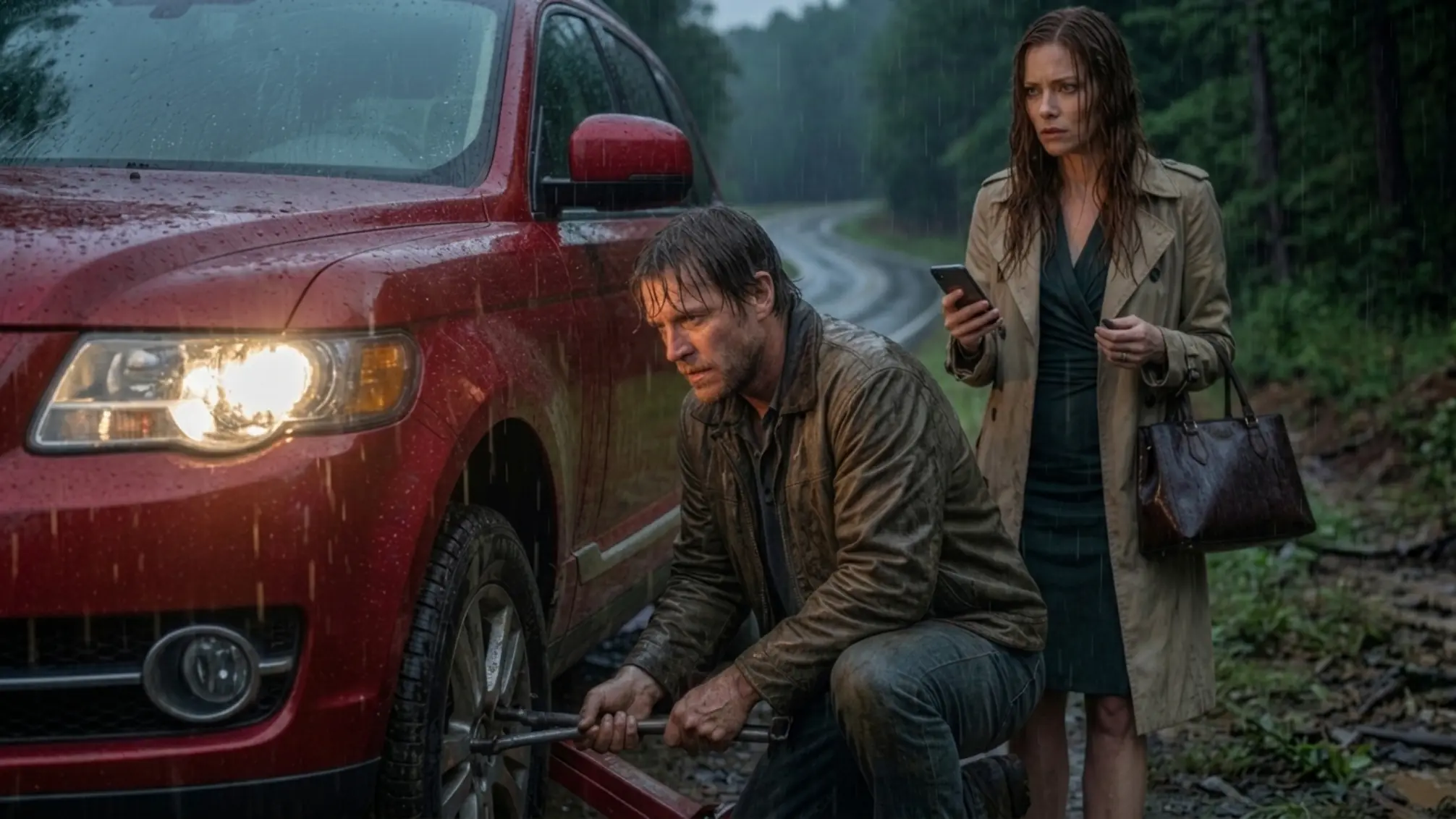
The woman raised her dead phone as though it might still summon help. “One wrong move, and I’ll have you arrested.”
The SUV shifted with a metallic groan. Noah lunged forward, caught her by the arm, and pulled her away just as the jack folded into the mud. “Call them after I save you,” he said, releasing her immediately. “Then remember the man you almost misjudged.”
Thunder rolled over the forest outside Asheville, North Carolina. The highway curved between dark pines, and the violent evening rain had reduced the road to a silver blur. No other headlights appeared in either direction.
The woman stared at the collapsed jack.
For several seconds, the authority in her face disappeared. She was simply a stranded traveler standing in ruined designer heels, clutching a useless phone while cold water soaked through her beige trench coat.
“I could have been under that,” she whispered.
“Yes.”
“You knew it would fail?”
“I saw the base sinking when I pulled up.”
Noah returned to his old pickup and removed a hydraulic floor jack from the bed. The red paint had worn away around its edges, but he handled it like a tool he trusted. He positioned it beneath the SUV’s reinforced lift point, placed a wide wooden block under the wheels, and tested the ground twice before raising the vehicle.
The woman watched every movement.
“You carry all that with you?”
“I repair cars.”
“Professionally?”
“When someone is willing to pay me.”
There was no bitterness in the answer, but there was exhaustion.
Noah removed the damaged wheel. A sharp piece of metal had torn through the tire near the sidewall, leaving it beyond repair. He inspected the spare and found it underinflated.
“I have a compressor,” he said.
“Of course you do.”
He glanced up. “That sounded almost friendly.”
“I’m still deciding whether you’re dangerous.”
“The dangerous man is the one fixing your tire in freezing rain?”
“Appearances can be misleading.”
Noah looked at her expensive handbag, soaked dress, and the guarded way she kept studying his truck. “On that, we agree.”
The woman’s name was Victoria Hale. She was forty-two years old and had served as a county family-court judge for nearly six years. Attorneys feared her discipline, court employees respected her preparation, and local newspapers described her as a woman who never allowed emotion to interfere with the law.
That description had once pleased her.
Lately, it had begun to sound like an accusation.
Victoria had left the courthouse early after reading a difficult custody file. A county social worker recommended removing a seven-year-old girl from her father’s home, citing unstable employment, missed school meetings, unpaid utility bills, and concerns about inadequate supervision.
The father’s name had not stayed in Victoria’s mind.
After hundreds of cases, names could become entries on a calendar. She remembered facts, deadlines, statutory standards, and exhibits more easily than faces.
The hearing was scheduled for the following morning.
Victoria drove into the mountains because she needed distance from the courthouse. She had told herself the trip would help her think clearly, but the truth was less professional.
Her own father had lost custody of her when she was eight.
He was not abusive. He was poor, overworked, and frequently late. Her mother’s attorney transformed every missed appointment into proof that he was irresponsible.
Victoria remembered standing inside a judge’s chambers while adults described her father as though he were a failed business.
She had not seen him again for nine years.
That history was one reason she treated custody files with such severity. She feared sympathy could distort judgment, so she built walls around every decision. The walls had protected her reputation, but she sometimes wondered whom else they had injured.
Noah switched on the portable compressor. Its motor buzzed beneath the rain while the spare tire slowly gained pressure.
Victoria crossed her arms against the cold. “How far is the nearest town?”
“About fourteen miles.”
“My phone has no signal.”
“Mine barely does.”
“Were you already traveling this road?”
“I was coming from a repair job.”
“At this hour?”
“The customer works nights.”
“You seem to work every hour.”
Noah tightened the final lug nut. “Some people don’t have the luxury of stopping when they’re tired.”
The sentence struck harder than he intended.
Victoria’s expression cooled. “You know nothing about my life.”
“You’re right.”
His immediate agreement unsettled her more than an argument would have.
Noah packed the damaged wheel into the rear cargo area and closed the hatch. He then checked the other tires, wiped rain from his face, and handed her a small pressure gauge.
“The spare will get you into town, but keep it under fifty miles an hour. Stop at the first service station and replace it.”
“How much do I owe you?”
“Nothing.”
“I don’t accept unpaid favors.”
“It wasn’t a favor. It was the right thing to do.”
Victoria opened her handbag and removed several bills. “Take this.”
Noah shook his head.
“You spent your time, used your equipment, and stood in the rain.”
“I also pulled you away from a falling vehicle. Are you planning to calculate that separately?”
Her hand stopped.
Noah softened his tone. “Keep the money. Just drive carefully.”
Victoria studied his weathered face. Life had placed strain around his eyes, but his manner remained patient. His boots were cracked, his truck was old, and one sleeve of his jacket had been repaired with dark thread.
“What’s your name?” she asked.
“Noah Briggs.”
The name struck something in her memory, but the thunder interrupted before she could locate it.
“I’m Victoria.”
“Take care, Victoria.”
He turned toward his pickup.
“You have a family?” she asked.
Noah paused beside the driver’s door. “A daughter.”
“How old?”
“Seven.”
The forgotten file shifted in Victoria’s mind.
“What’s her name?”
“Maya.”
Her breath tightened.
Noah Briggs.
Maya Briggs.
The custody hearing.
Victoria looked at him differently, and Noah noticed the change immediately.
“Do I know you?” he asked.
She considered telling him.
Then she saw the exhaustion in his face and understood what the truth would do. If he knew she was the judge assigned to his case, the roadside encounter would become something else. Gratitude, fear, and desperation would enter every word.
“No,” she said. “I don’t believe we’ve met.”
It was technically true.
Noah climbed into his truck and drove away.
Victoria remained beside the SUV, watching his red taillights disappear through the storm. A poor single father facing the possible loss of his daughter had stopped for a stranger despite the weather, the darkness, and whatever urgent worries waited at home.
She immediately distrusted her own reaction.
Good behavior on a roadside did not erase concerns in a custody report. A generous stranger could still be an overwhelmed parent. One moment of kindness was not evidence of a stable home.
But it was evidence of character.
And the report had contained almost none of that.
The next morning, Noah stood outside Courtroom Four wearing the best clothes he owned. His white shirt had been ironed twice, his navy tie belonged to a neighbor, and his dark jacket was slightly too large across the shoulders.
He had slept less than three hours.
After repairing Victoria’s SUV, he returned home to find Maya awake at the kitchen table, waiting beside a plate of untouched macaroni and cheese. Their neighbor, Mrs. Alvarez, had stayed with her while Noah worked.
“You promised you’d be home before bedtime,” Maya said.
“I know.”
“The storm was scary.”
“I know that too.”
He crouched beside her and took her small hands. “I’m sorry.”
Maya’s eyes were the same gray-blue as his. She had lost her mother when she was two and possessed only photographs and a few stories about her. Noah had built their life around keeping the rest of her world steady.
Lately, everything seemed to move beneath them.
His former repair shop closed after the owner died. Noah began taking independent jobs, but income changed from week to week. He missed two school meetings because customers delayed payment, and the electricity had been disconnected for one afternoon after a billing dispute.
Then an anonymous complaint claimed Maya was regularly left alone.
That part was false.
Mrs. Alvarez watched her whenever Noah worked late, but the arrangement was informal. The social worker visited during a week when Mrs. Alvarez was hospitalized and interpreted Noah’s lack of written childcare records as neglect.
Noah tried to explain.
The report had already found its story.
Inside the courthouse, his legal-aid attorney, Rachel Kim, reviewed the hearing plan.
“Answer only what you’re asked,” she said. “Do not interrupt the social worker, no matter what she says.”
“What if she lies?”
“Look at me. I’ll respond.”
“They want to take my daughter because I’m poor.”
“They will say it is about stability.”
“That means money.”
“Not always.”
“For people like me, it does.”
Rachel closed the file. “The judge assigned to this case is strict, but she reads everything. We have affidavits from Mrs. Alvarez, Maya’s teacher, and three customers who confirm your work schedule.”
“Will it be enough?”
“I don’t know.”
The courtroom doors opened.
Noah entered, stopped beside the defense table, and looked toward the bench.
Victoria Hale walked through the side door in her black judicial robe.
Recognition struck both of them at once.
Noah’s face went pale.
Victoria felt the entire room narrow around his expression.
He now understood why she had asked about his daughter.
He also knew she had concealed her identity.
The court clerk announced the case.
Victoria should have recused herself immediately. The roadside interaction created an appearance of personal knowledge outside the formal record. Her duty was not only to remain impartial but to protect confidence in the proceeding.
She looked at both attorneys.
“Before we begin, I need to disclose that I encountered Mr. Briggs yesterday evening on a public highway. My vehicle had a flat tire, and he provided mechanical assistance without payment. We did not discuss this case, and I did not identify myself as the assigned judge.”
Noah’s attorney stared at her.
The county attorney looked alarmed.
Victoria continued. “Because this encounter could reasonably raise questions about impartiality, I will not make a final custody determination today. I will hear only emergency matters, preserve the current placement, and request reassignment unless both parties knowingly waive the conflict after consulting counsel.”
Noah’s shoulders lowered slightly.
The county attorney stood. “Your Honor, the department is requesting immediate temporary removal based on the existing report.”
“Then we will hear evidence limited to whether an immediate danger exists.”
The social worker, Denise Harper, took the stand.
She described unpaid bills, missed appointments, irregular work hours, and Noah’s use of an informal neighbor as childcare. She said Maya appeared tired during one interview and reported eating cereal for dinner several times.
Noah gripped the edge of the table.
Rachel asked whether cereal indicated neglect.
Denise said it could form part of a broader pattern.
“Did Maya show signs of malnutrition?”
“No.”
“Was she unclean?”
“No.”
“Was she injured?”
“No.”
“Did she say her father left her alone?”
Denise paused. “She said he worked late.”
“That wasn’t my question.”
“No. She did not say she was alone.”
Rachel presented Mrs. Alvarez’s affidavit. It included dates, hours, and a statement that she had cared for Maya for almost four years. School records showed Maya had excellent attendance and above-average grades.
The teacher’s statement described Noah as attentive, affectionate, and responsive whenever contacted.
Then Rachel produced phone records.
The two school meetings classified as “missed” had been rescheduled by Noah in advance. One teacher failed to update the central system.
Victoria read the documents carefully.
The report had not mentioned the calls.
“Ms. Harper,” she asked, “did you review these records before recommending removal?”
“I relied on the school attendance notes.”
“Did you contact the teacher?”
“I attempted to.”
“Is that attempt documented?”
Denise searched her file. “Not in this copy.”
Victoria’s voice remained even. “A recommendation to separate a child from a parent requires more than an incomplete copy.”
The county attorney shifted uncomfortably.
Another inconsistency emerged. The utility shutoff had lasted less than six hours and resulted from a disputed transfer after Noah moved payment between accounts. Power was restored before Maya returned from school.
The report described the home as lacking reliable electricity.
It did not include the timeline.
Victoria became increasingly troubled.
Poverty had been translated into danger, inconvenience into abandonment, and missing paperwork into neglect. The department had found genuine instability, but it had not shown that Maya faced immediate harm.
The roadside encounter could not form the basis of Victoria’s ruling.
The courtroom evidence was enough.
“The request for emergency removal is denied,” she said. “Maya Briggs will remain with her father pending reassignment and a full independent review.”
Noah closed his eyes.
Victoria continued. “The court orders voluntary support services, including documented childcare assistance, employment-placement referrals, and utility stabilization. These services are intended to strengthen the home, not punish the family.”
The county attorney began to object.
Victoria raised one hand. “The state’s obligation is not limited to separating families after they struggle. It includes helping safe families become stable enough to remain together.”
Noah looked at her.
For the first time that morning, he saw the woman from the highway rather than the judge behind the bench.
After the hearing, Victoria filed a formal recusal from the final proceeding. Another judge, Samuel Reed, received the case and ordered an independent evaluation.
That review lasted three weeks.
Investigators visited Noah’s home, interviewed Maya privately, inspected his employment records, and spoke with neighbors and teachers. They found no abuse, abandonment, or dangerous conditions.
They did find poverty.
Noah’s refrigerator was not full, but there was food. His apartment was small, but it was clean. Maya slept in the only bedroom while Noah used a folding couch in the living room.
Her drawings covered the walls.
One showed Noah repairing a blue car while Maya stood beside him holding an enormous wrench. Above them, in uneven purple letters, she had written:
MY DAD FIXES THINGS.
Judge Reed dismissed the neglect petition.
He retained the family-support plan because Noah requested it.
The county program helped him secure reliable after-school care, legal assistance for unpaid customer invoices, and an interview at Mountain Ridge Automotive, a respected service center outside Asheville.
Victoria followed none of these developments privately.
Her ethical obligations required distance.
But she could not forget the case.
She requested an internal audit of emergency removal recommendations issued by the department during the previous two years. The review found seventeen reports in which poverty-related conditions had been described as evidence of neglect without adequate investigation.
Several involved missed appointments caused by inflexible work schedules.
Others treated shared housing, informal family childcare, or temporary utility problems as proof of parental unfitness.
Victoria presented the findings to the county judicial council.
“We cannot claim to protect children while punishing parents for lacking resources we never helped them obtain,” she said. “Danger must be addressed. Poverty must not be disguised as danger because doing so is administratively easier.”
New procedures followed.
Social workers were required to distinguish immediate safety threats from financial hardship. Before recommending removal, they had to document efforts to connect families with support services unless a child faced urgent danger.
The reforms did not eliminate mistakes.
They made careless ones harder to defend.
Noah began working at Mountain Ridge Automotive one month after the hearing. The manager offered him a trial position after watching him diagnose an electrical fault two senior technicians had missed.
Within six months, Noah became lead diagnostic mechanic.
The regular income changed ordinary things first. The refrigerator stayed full through the end of the month. Noah no longer chose between electricity and car insurance. He attended every school meeting without calculating how many hours of work it would cost.
Maya remained most excited about the pancakes.
With stable mornings, Noah started making breakfast again. He burned the first batch so badly that the smoke alarm sounded.
“You said you could fix anything,” Maya reminded him.
“Cars,” he said. “I said cars.”
“No, you said anything.”
“That was irresponsible advertising.”
One Saturday afternoon, Victoria drove her repaired red SUV into Mountain Ridge Automotive for a routine tire rotation.
She had considered using another shop.
Then she decided avoidance was its own form of dishonesty.
Noah stood near the service counter, explaining brake repairs to an elderly customer. He wore a clean gray uniform with his name stitched over the pocket.
When he saw Victoria, his expression became cautious.
She waited until the customer left.
“The spare held,” she said.
“I told you it would.”
“I also stayed under fifty.”
“I’m impressed.”
They stood in an awkward silence.
Victoria spoke first. “I owe you an apology.”
“For not telling me you were the judge?”
“Yes.”
“You disclosed it in court.”
“I should have identified myself on the road once I recognized your name.”
Noah considered that. “Would anything good have happened if you had?”
“You would have known the truth.”
“I probably would have spent the night begging you not to take Maya.”
“That is why I remained silent.”
“Then maybe there wasn’t a clean answer.”
Victoria nodded. “There often isn’t.”
Noah looked through the glass wall toward the garage. “Did helping you change the decision?”
“The roadside encounter changed the questions I asked. The evidence changed the emergency ruling.”
“Is that allowed?”
“Judges are allowed to recognize when a file may be incomplete. We are not allowed to decide cases based on personal favors. That is why I recused myself from the final hearing.”
Noah appreciated the distinction.
He had feared that Maya remained with him because he happened to rescue the right person. That possibility made justice feel as fragile as luck.
“The other judge read everything,” Victoria added. “Your daughter stayed because the evidence showed she was safe with you.”
Noah released a breath.
“Thank you for saying that.”
Victoria placed her keys on the counter. “How much for the tire rotation?”
“Standard rate.”
“No discounts?”
“You already tried paying me on the highway.”
“And you refused.”
“I was making a terrible business decision.”
Victoria smiled.
While Noah’s team serviced the SUV, Maya arrived with Mrs. Alvarez. She ran toward her father carrying a school project and stopped when she recognized Victoria from the courtroom.
“You’re the judge,” she said.
Victoria crouched slightly. “I am.”
“You’re the lady Daddy helped in the rain.”
“Yes.”
Maya looked between them. “So he fixed your car before you fixed our case?”
Noah nearly choked.
Victoria answered carefully. “Your father helped me. Then the court looked more closely at your case and discovered important facts.”
Maya considered this. “That sounds like fixing.”
“Maybe a little.”
Maya showed her the project. It was a poster about community helpers. Noah’s photograph appeared beside a firefighter, teacher, nurse, and police officer.
“My dad helps people when their cars stop,” she explained.
Victoria looked at Noah.
“I know.”
Months passed.
Noah and Victoria occasionally crossed paths at community events connected to the new family-support program. She never treated him as a case, and he never treated her as someone who owed him a reward.
Their conversations became easier.
Victoria learned that Noah read repair manuals before bed and had not taken a vacation in nine years. Noah learned that Victoria played the cello badly, disliked courtroom television shows, and still carried a tire-pressure gauge in her handbag because he had given her one during the storm.
One evening, after a county fundraiser, rain began tapping against the community-center windows.
Victoria stood beside Noah near the entrance.
“You have your wrench?” she asked.
“In the truck.”
“Hydraulic jack?”
“Always.”
“Compressor?”
“Victoria, are you planning to damage another tire?”
“Not deliberately.”
Maya ran ahead beneath a yellow umbrella and shouted that they were taking too long.
Victoria watched Noah follow his daughter into the rain.
The first time she saw him, he was a stranger in a torn jacket standing beside an old pickup. She had judged the truck, his clothes, the empty road, and every danger her fear could invent.
The following morning, she saw his name on a custody file.
The report judged him by unpaid bills, long shifts, and appointments marked incomplete. Neither first impression contained the whole man.
The truth existed in the details someone had failed to examine.
Noah was poor, exhausted, and imperfect. He sometimes arrived late, burned pancakes, and promised more than one person could reasonably deliver.
He was also patient, responsible, and fiercely devoted to his daughter.
Victoria was strict, guarded, and occasionally too willing to believe distance created fairness. She had spent years protecting the law from emotion while forgetting that people entered court carrying lives too complicated for a summary page.
The storm did not make Noah a good father.
It revealed qualities already present.
The hearing did not turn Victoria into a compassionate judge.
It reminded her that compassion and evidence were not enemies.
Years later, Maya would remember very little about the custody case. She remembered the day her father came home soaked, the judge with the red SUV, and the breakfast when Noah finally made one pancake without burning it.
Noah remembered the moment Victoria appeared behind the bench and his entire future seemed to depend on a stranger he had helped without knowing her name.
Victoria remembered the jack collapsing into the mud.
She remembered Noah pulling her to safety despite her threat to have him arrested.
Most of all, she remembered the warning he gave before driving away.
“Remember the man you almost misjudged.”
She did.