The wrench stopped in the Single Dad’s hand.
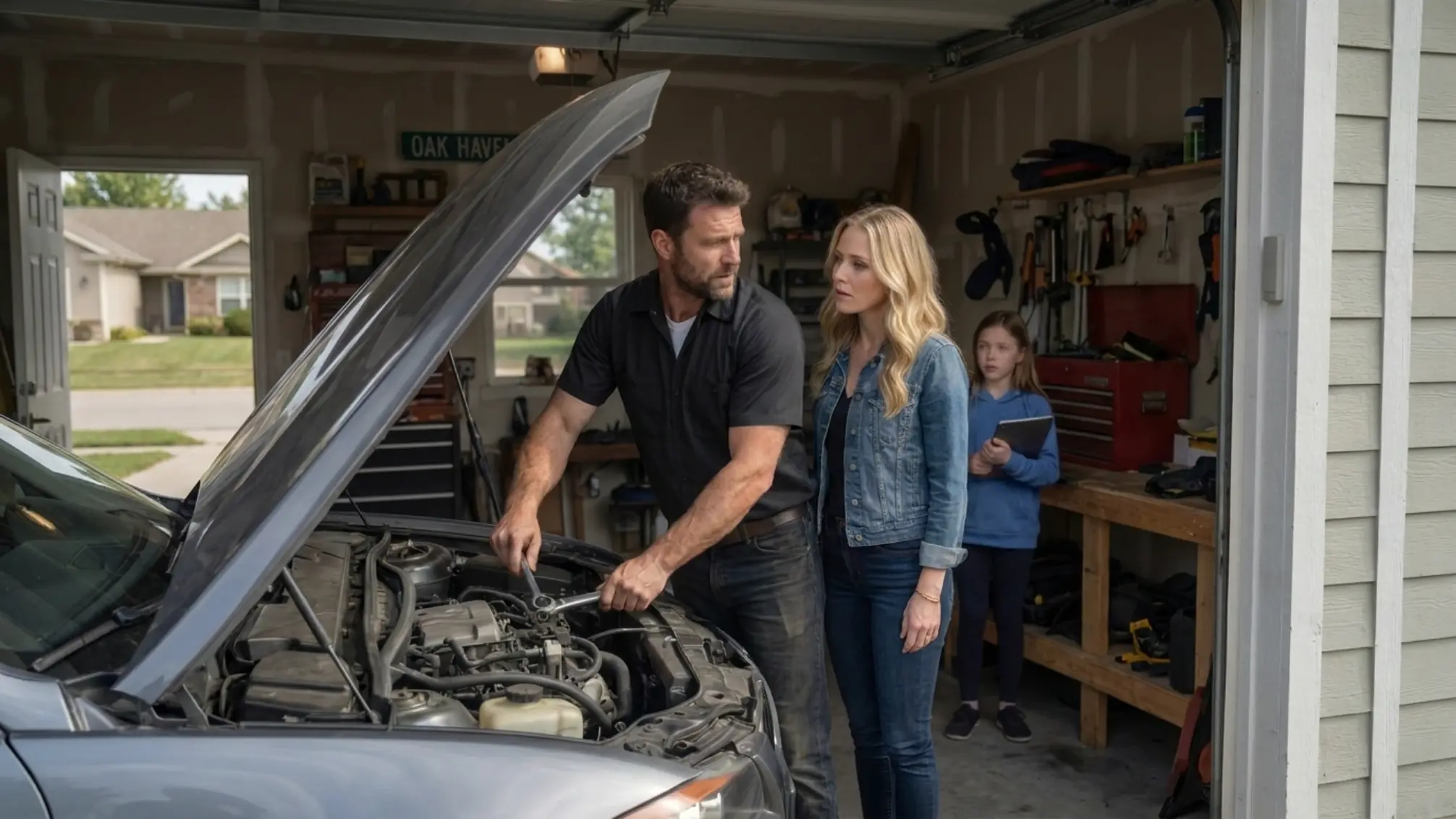
Until that moment, the beautiful American Woman standing beside the silver sedan had been nothing more than a new neighbor asking for help. She wore an elegant white dress, delicate jewelry, and polished heels that looked strangely formal inside his modest suburban garage. Her long blonde hair framed a face time had changed only enough to make the recognition hurt more.
Seven years had passed since he last saw her.
Seven years since he found a note on their Seattle kitchen table.
Seven years since he carried their crying three-year-old Daughter through a dark apartment, promising her that everything would be all right when he had no idea where her mother had gone. He had spent years imagining what he would say if the Woman ever returned, but none of those rehearsed speeches survived the reality of her standing beneath his garage lights.
The Single Dad slowly straightened.
He was a handsome forty-year-old American man with short dark-brown hair, sharp blue eyes, light stubble, and a tall athletic build. Grease marked his fitted blue shirt, and his strong hands showed the small scars of someone who had rebuilt his life through physical work. He no longer resembled the exhausted businessman the Woman had abandoned in Seattle.
Behind them, their ten-year-old Daughter stopped writing.
The beautiful American Girl sat near the workbench with a tablet pressed against her chest. Her light-brown hair was tied into a neat ponytail, and her hazel eyes moved between the adults as she sensed something had changed. She knew the blonde Woman as the elegant stranger who had recently moved into the blue house at the end of their street.
She did not know she was looking at her mother.
The Woman turned.
Recognition reached her face slowly, first confusion, then disbelief, and finally a grief so raw that she gripped the edge of the car for support. She stared at the Girl’s eyes, the curve of her cheeks, and the familiar expression that belonged partly to the child she remembered and partly to the father who had raised her.
“She’s so big,” the Woman whispered.
“She’s ten.”
“I know how old she is.”
“Knowing her age isn’t the same as being there.”
The words struck with enough force to make the Woman lower her eyes. The Single Dad had imagined shouting at her, but his anger now felt colder than noise. He turned back toward the engine because machinery still made more sense than the person who had broken his family.
The clicking came from a loose exhaust bracket. It was a simple repair, the kind he could complete in less than fifteen minutes. He tightened the connection, checked the surrounding components, and started the engine while the Woman stood motionless beside him.
The sound disappeared.
The Girl climbed down from her stool.
“Dad, who is she?”
The Single Dad closed his eyes for half a second. He had always known this conversation might come, but he never expected it to begin over an open engine in their garage. For years, he had protected his Daughter from the ugliest version of the truth.
He had told her that her mother moved away because she was not ready to be part of a family. He never described the unpaid bills, the collapsing business, or the note that contained no plan to return. Most importantly, he never allowed the Woman’s abandonment to become evidence that the Girl had been unworthy of love.
“This is the Woman who lived with us before we moved here,” he said carefully.
The Girl’s eyes narrowed. “My mother?”
“Yes.”
The Woman’s lips trembled. “I’m sorry.”
The Single Dad lowered the hood with a firm metallic sound.
“Not today.”
“Please let me explain.”
“You had seven years.”
“I didn’t know you were here.”
“I believe that.”
The Woman looked surprised.
She explained that a relocation company had found the blue house for her. She had chosen Oak Haven because she wanted a quiet place far from Seattle and the corporate life that had consumed her. She insisted she had not followed them.
The Single Dad believed her because the shock in her eyes could not be rehearsed.
That did not make her return easier.
“The car is fixed,” he said. “You don’t owe me anything.”
“I owe you more than I could ever repay.”
“You owe her the truth. But you don’t get to unload it on her while she’s standing in a garage trying to understand why her mother became a stranger.”
The Woman looked at the Girl.
“I thought about you every day.”
The Girl held the tablet tighter. “Did you know me?”
The question silenced everyone.
The Woman’s tears began to fall. “I knew you when you were little.”
“That isn’t what I asked.”
The Girl was only ten, but she had inherited her father’s instinct for recognizing an answer designed to avoid the truth. She stepped closer to him and took his hand. The simple movement revealed the entire shape of the past seven years.
When she felt afraid, she reached for the parent who remained.
The Woman saw it too.
“I don’t know you now,” she admitted. “But I want to.”
The Single Dad opened the driver’s door and placed the keys on the seat. “Wanting isn’t enough.”
The Woman nodded because she understood that arguing would only repeat the selfishness that had brought them here. She entered the car, but before closing the door, she looked once more at the Girl.
“I’m glad you grew up safe.”
The Single Dad’s expression hardened. “She grew up loved. Safety was only part of it.”
The Woman drove toward the blue house at the end of the street.
The Girl watched until the sedan disappeared into the driveway.
“Did she really leave us?”
“Yes.”
“Why?”
“I can tell you what happened. I can’t tell you what she felt unless she chooses to explain it herself.”
“Did I make her leave?”
The Single Dad immediately knelt in front of his Daughter.
“No. Never let that thought live inside you. You were three years old, and you were the best part of both our lives. Her choice belonged to her.”
That evening, he made pancakes for dinner.
The Girl called it the pancake protocol, a family tradition created for nights when normal food could not compete with abnormal emotions. Butter melted across the warm stack while the Girl sat at the kitchen table moving syrup with her fork.
The Single Dad explained that his Seattle business had failed during a difficult year. They lost money, his father became ill, and bills arrived faster than he could pay them. The Woman felt trapped and frightened.
“One morning, she was gone,” he said.
“Did she say goodbye?”
“Not properly.”
“What did the note say?”
He hesitated.
The Girl deserved honesty, but she did not need every cruel detail at once.
“It said she couldn’t continue living that way and needed to find herself.”
“She found herself without us?”
“Yes.”
The Girl looked toward the window. The blue house stood less than a block away, its porch light visible between two trees. Seven years of absence had suddenly been compressed into a distance she could walk in two minutes.
“Do you hate her?”
“I hated what she did.”
“That isn’t the same question.”
The Single Dad considered his answer.
“No. Hate would require giving her too much room inside the life we built after she left.”
At the blue house, the Woman sat among unopened boxes with an old photograph resting in her lap. It showed the Single Dad holding their newborn Daughter inside a Seattle hospital. The Woman stood beside them, exhausted and happy, with one hand resting over the baby’s blanket.
It was the only family photograph she had taken.
For seven years, she carried it through expensive apartments, promotions, and business trips. Whenever shame became unbearable, she hid it inside another drawer. She told herself she would contact them once she became successful enough to return without looking like the frightened person who left.
Success made the silence worse.
Every year she delayed required a larger explanation. The Girl’s fourth birthday passed, then her first school day, then Christmases the Woman spent alone in luxury apartments. She sent no gifts because a gift required an address, and an address might lead to a conversation she feared she could not survive.
Three months before moving to Oak Haven, she received an executive award at a corporate dinner. Hundreds of people applauded while she stood beneath bright lights holding a glass trophy. Later, she returned to an empty apartment and realized she had built an impressive life around one missing center.
The next morning, she requested remote work and listed her apartment for sale.
She did not expect the quiet suburban house chosen by a relocation agent to place her one block from the family she abandoned. Yet now that chance had brought her there, leaving again would be another choice.
The next morning, the Single Dad walked his Daughter toward the school bus stop. They saw the Woman struggling to lift a heavy box from her driveway.
The Single Dad intended to keep walking.
His Daughter slowed.
“You always say heavy things need two people.”
“That box is not our responsibility.”
“She might hurt her back.”
He looked down at the Girl. Despite everything she had learned the night before, she still noticed another person struggling. Pride and fear tightened together inside his chest.
“Wait here.”
He crossed the street and lifted the opposite side of the box. The Woman stared at him but did not mistake the gesture for forgiveness.
“Use your legs,” he instructed. “Not your back.”
Together, they carried the box onto the porch.
“Thank you.”
“It doesn’t mean anything.”
“I know.”
He turned to leave.
“Was she all right last night?”
The Single Dad stopped.
“No.”
The Woman pressed her lips together.
“But she will be,” he continued. “Because I won’t let your return convince her that she was ever unwanted.”
“I never stopped wanting her.”
He looked back at her. “Wanting someone in private is not the same as loving them where they can feel it.”
The Woman accepted the words without defending herself.
“What can I do?”
“Nothing until she asks.”
Over the next two weeks, the Woman kept her distance. She did not leave gifts, send letters, or invent reasons to visit the garage. She unpacked her home, volunteered at the local library, and joined a neighborhood committee organizing summer activities for children.
The Daughter noticed everything.
“She works at the library on Thursdays,” she told the Single Dad one evening.
“How did you learn that?”
“My friend goes to the art program.”
“You’ve become very informed about the blue house.”
“I want to know if she stays when no one is watching us.”
That sentence revealed the question beneath all the others. The Girl did not want a dramatic apology. She wanted evidence that the Woman could remain present even when forgiveness was not offered as a reward.
Three weeks after the reunion, the Daughter asked to meet her.
The Single Dad chose a public park. The Woman arrived early, wearing simple jeans and a cream sweater instead of the polished executive clothing from the garage. She stopped several feet from the picnic table.
“May I sit?”
The Girl nodded.
She had prepared a list of questions.
“Why did you leave me?”
The Woman inhaled carefully. “Because I was afraid.”
“Of me?”
“Never of you. I was afraid of being poor, of failing, and of watching the life I imagined disappear. Your father was trying to hold everything together, and I convinced myself I was drowning because of him instead of understanding we were both drowning.”
“So you saved yourself.”
“Yes.”
“And left us underwater.”
The Single Dad looked toward his Daughter, surprised by the cold precision of the words. The Woman’s face tightened, but she did not retreat.
“Yes.”
“Why didn’t you come back?”
“Shame.”
“That sounds like fear again.”
“It was fear wearing a different name.”
The Girl asked whether the Woman remembered her birthday. She did. She remembered the stuffed rabbit the Girl carried as a toddler, the song she needed before sleeping, and the way she refused peas unless they were mixed with mashed potatoes.
The memories proved affection had once existed.
They did not prove courage.
When the questions ended, the Girl folded the paper.
“I don’t want to call you Mom.”
“You don’t have to.”
“I’ll call you Laura.”
“I would be grateful.”
“And you cannot promise anything unless you’re going to do it.”
“I understand.”
The Girl looked toward her father. “Can Laura come to my violin recital?”
The Single Dad’s first instinct was refusal. He wanted to protect her from an empty seat, but protecting a child could not mean deciding every emotional risk for her.
He turned toward the Woman.
“If you say yes, you arrive before it begins.”
“I’ll be there.”
“Traffic, meetings, and embarrassment are not emergencies.”
“I’ll be there.”
The recital began at six o’clock on a rainy Thursday evening.
At five forty-five, the chair beside the Single Dad remained empty. At five fifty, his Daughter looked toward the auditorium door from backstage. He felt old anger rising and prepared to explain another disappointment.
At five fifty-seven, the Woman rushed inside.
Rain had soaked her hair and sweater. A traffic accident blocked the main road, so she abandoned her car and walked the final six blocks. She took the seat beside the Single Dad, breathing hard.
“I said I would come.”
Their Daughter saw her from the stage.
Her shoulders relaxed.
She played with visible nervousness, missing two notes before recovering. When the performance ended, the Woman did not offer exaggerated praise. She described the exact section she liked most, proving she had listened closely.
The Girl handed her the program.
“You can keep it.”
Small meetings followed.
The Woman attended soccer practices, helped select art supplies, and sat with the Girl during library activities. She never appeared uninvited. When the Girl became angry, the Woman did not remind her how hard she was trying.
The Single Dad watched for the moment commitment became inconvenient.
It did not come.
One afternoon, the school called because the Girl had fallen during gym class. The Single Dad was repairing a transmission and immediately closed the garage, but the Woman reached the school first because she had been volunteering nearby.
When he entered the nurse’s office, he found her seated several feet from their Daughter. She had signed no forms and claimed no parental authority. She simply distracted the frightened Girl with a drawing game until the parent who had legal responsibility arrived.
The wrist was sprained, not broken.
On the drive home, the Girl stared through the window.
“Laura looked scared.”
“She should have been.”
“No. She looked like you do when I’m hurt.”
That evening, the Woman appeared outside the garage.
“I wanted to make sure she was comfortable.”
“She’s asleep.”
The Woman nodded and prepared to leave.
“Thank you for staying with her,” the Single Dad said.
It was the first gratitude he had offered.
She looked at him with tears in her eyes. “I would have stayed as long as she needed.”
“Seven years ago, that sentence would have changed everything.”
“I know.”
“Part of me hates that you became the person we needed after we learned how to live without you.”
“I hate that too.”
He studied her beneath the garage light.
“Why did you really move here?”
“I didn’t know you were here. But I left Seattle because I finally admitted success had become the place I hid from what I did. I kept believing another promotion would make me brave enough to find you. It only made me more ashamed.”
“You could leave again when this becomes painful.”
“Yes.”
“Will you?”
“No.”
He wanted to believe her.
That frightened him more than anger ever had.
Several months after the accidental reunion, the blue house no longer appeared temporary. Books filled the shelves, plants grew on the porch, and the Girl’s drawings began appearing on the refrigerator. Weekly supervised visits became ordinary dinners.
The Daughter still had angry days.
Once, the Woman arrived five minutes late and found the Girl waiting on the porch with her arms folded.
“You promised six.”
“It is six-oh-five.”
“A promise doesn’t become unimportant because the mistake is small.”
The Woman apologized without arguing and arrived ten minutes early afterward.
The Single Dad observed these moments carefully. He realized his Daughter was not punishing the Woman. She was testing whether boundaries would be respected when they became uncomfortable.
One Saturday, the Girl asked whether the Woman still loved the Single Dad.
The room went silent.
The Woman looked at him before answering. “I never stopped loving part of who he was. But love without courage didn’t help him, and it didn’t protect you.”
“Do you want him back?”
“I want to become someone he can trust. What happens after that belongs to him too.”
The Girl considered this. “Dad fixes things.”
The Woman shook her head gently. “Some things shouldn’t be fixed into exactly what they were. Sometimes you build something new from what remains.”
Later, the Single Dad stood alone in the garage thinking about that sentence. For years, he believed forgiveness required pretending damage had never happened. The idea of building something new allowed the past to remain true without forcing it to control every future choice.
The Woman did not ask him for romance.
She invited him to walk.
The first time, he refused.
The second time, they walked only to the corner.
Eventually, they circled the entire neighborhood while talking about their Daughter’s school, the library program, and his plan to expand the garage. They avoided Seattle until one cool evening when the Woman stopped near the park.
“I know saying sorry changes nothing.”
“It changes whether you understand what you did.”
“I understand that leaving once became thousands of smaller decisions. Every birthday I missed was another choice. Every time I looked at the photograph and put it back into a drawer, I chose my shame over her right to know me.”
The Single Dad looked toward the blue house.
“I spent years telling myself you left because I failed.”
“You didn’t.”
“I know that now.”
“I’m sorry it took my return for you to hear me say it.”
He nodded.
“I don’t know whether I can trust you the way I once did.”
“I don’t expect you to.”
“I cannot promise we become husband and wife again.”
“I’m not asking.”
“Our Daughter comes first.”
“She always should have.”
He offered her another walk.
Months passed.
The Girl began spending occasional afternoons alone with the Woman, though the Single Dad remained close enough to reach quickly if needed. They baked, painted, and discussed Seattle without pretending the city caused anything. The Girl slowly started using the word “Mom” accidentally, then correcting herself.
The Woman never demanded that she stop correcting it.
One evening, the three of them sat in the driveway while the Girl practiced violin beneath the garage lights. She played several measures beautifully, then lost the rhythm and stopped.
“I ruined it.”
The Single Dad shook his head. “You reached a difficult part. Start again from where it changed.”
The Woman looked at him.
The lesson belonged to all of them.
The Girl raised the instrument and started again. This time, the Woman remained seated on one side while the Single Dad cleaned tools on the other. Neither parent interrupted or tried to guide every note.
They simply stayed.
The Girl completed the piece and lowered the violin.
“Was that better?”
The Single Dad smiled. “Much.”
The Girl looked at the Woman.
“Mom?”
The word escaped naturally.
The Woman’s face changed, but she did not rush forward or turn the moment into a performance. She smiled through tears.
“Yes?”
“Can you come to my concert next month?”
“I’ll be there.”
The Girl nodded, satisfied.
The past did not disappear that evening. Seven lost years could not be restored through one recital, one repaired car, or one accidental word. The Single Dad still remembered the note, and the Woman still woke some nights grieving every version of her Daughter she never knew.
But the future no longer belonged entirely to the abandonment.
The silver sedan occasionally returned to the garage for routine service. The Woman paid the standard rate and waited like every other customer. Sometimes she brought coffee. Sometimes she sat near the workbench while their Daughter completed homework.
The car had not repaired their family.
It had simply broken down in the one driveway where three people could no longer avoid the truth.
Seven years earlier, the Woman left because she believed escaping fear would save her. The Single Dad stayed because a frightened little Girl needed one adult whose love did not depend on circumstances.
Now the Woman was learning that returning did not mean arriving once.
It meant choosing them again the next morning, and every morning after that.
The Single Dad was learning something too.
Being the parent who stayed did not require him to remain permanently alone. Protecting his Daughter did not mean refusing every possibility that carried risk.
And the Girl who had once wondered whether her mother left because she was not worth loving finally understood the truth.
She had always been worthy.
One parent had possessed the courage to show it from the beginning.
The other was finally learning how to prove it by staying until the final note.