“You helped me before you knew who I was.”
Victoria Hayes stood near the open service bay of Carter Auto Repair, holding two cups of coffee while soft rain tapped against the metal roof. Daniel Carter wiped grease from his hands and met her blue-gray eyes. “I only saw someone who needed me.”
Victoria smiled, though uncertainty remained beneath it. “Is that why you want me to come back?”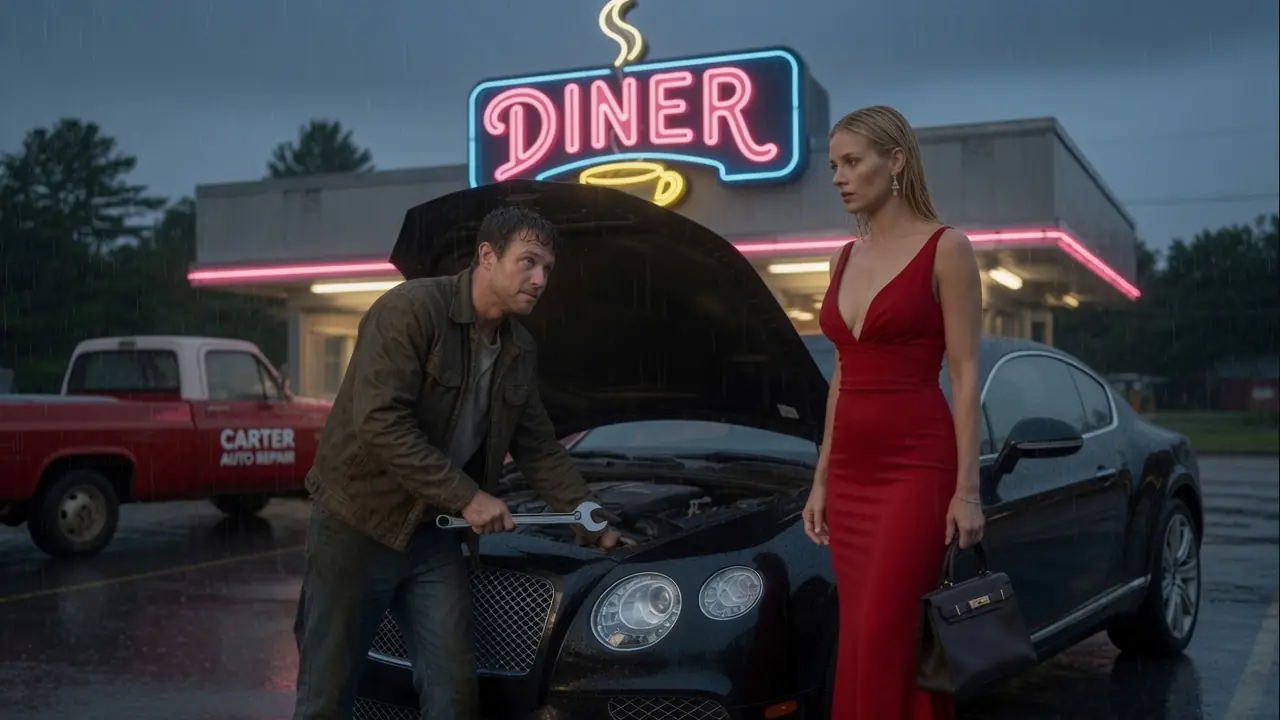
Daniel’s expression softened. “No—I want you to come back because I miss you.”
For several seconds, neither of them moved.
Beyond the office window, Daniel’s eight-year-old daughter Lily sat with an open spelling book, pretending she had not heard every word. Roy Jenkins, Daniel’s fifty-nine-year-old mechanic, stood behind a raised pickup truck with only his boots visible. The sudden metallic clatter of a dropped wrench revealed that he was listening too.
Victoria lowered her gaze toward the coffee cups. She commanded boardrooms, negotiated acquisitions worth hundreds of millions of dollars, and regularly answered questions from investors without hesitation. Yet four quiet words from a mechanic in a faded work shirt had left her unable to speak.
Daniel stepped closer. “Was that too honest?”
“No.” Victoria looked back at him. “I think it was the first completely honest thing anyone has said to me all week.”
Three months earlier, Daniel had known nothing about Victoria Hayes.
He had been leaving Miller’s Roadside Diner with Lily after fulfilling one of the small promises that held their lives together: chocolate-chip pancakes for dinner. The storm outside had turned Route 19 into a dark ribbon of rain, and Daniel was trying to keep Lily’s shoes out of the deepest puddles when a black luxury sedan rolled unevenly into the parking lot.
The engine died near the broken ice machine.
A woman stepped out wearing a cream business suit and black heels, immediately becoming soaked by the downpour. She lifted her phone, searched for a signal, then tried starting the sedan again. Nothing happened.
Daniel watched from beside his old tow truck.
Lily stood beneath her yellow umbrella and followed his gaze. “Her car is broken.”
“It appears that way.”
“You’re going to help her.”
Daniel sighed. “You make that sound like an order.”
“It’s a prediction.”
He handed Lily the umbrella and told her to remain beneath the diner awning. Then he crossed the parking lot, keeping enough distance not to frighten a woman stranded alone after dark. Rain soaked through his work jacket before he reached the sedan.
“I’m not here to bother you,” he called. “Looks like you lost power.”
The woman studied his grease-stained hands, steel-toed boots, and the faded words CARTER AUTO REPAIR painted across the tow truck door. Some of the fear left her face.
“Roadside assistance said it could take two hours.”
“In this weather, probably four.”
Her shoulders dropped. “I’m supposed to be downtown.”
“Mind if I look?”
She hesitated. “What do you charge?”
“Let’s find out what’s wrong first.”
Daniel opened the hood while rain ran down his neck. He checked the battery terminals, fuse box, relays, and wiring until he found moisture around a loose electrical connection. The repair took fifteen minutes, one small wrench, contact cleaner, and several layers of protective tape.
“Try it now.”
The sedan started.
The woman stepped out again and stared at Daniel as though he had performed something far more impressive than tightening a connection. “How much do I owe you?”
“Nothing.”
“You stood in a storm repairing my car.”
“And now it works.”
“I can pay you.”
Daniel glanced toward Lily, who was waving enthusiastically beneath the yellow umbrella. “My daughter’s waiting. Drive slowly and avoid the underpass.”
The woman looked toward the child. “What’s her name?”
“Lily.”
“And yours?”
“Daniel Carter.”
“I’m Victoria.”
He nodded. “Get home safely, Victoria.”
Then he walked away before she could offer money again.
Daniel did not know that Victoria Hayes was the founder and chief executive of Hayes Dynamics, a global technology company valued at more than eight billion dollars. He had never read the business magazines carrying her photograph or watched the financial programs praising her as one of America’s youngest self-made billionaires.
To him, she had been a frightened woman with a broken car.
That was precisely why Victoria could not forget him.
Most people learned her identity before deciding how to behave. Restaurant managers found better tables. Executives laughed too quickly at ordinary comments. Strangers introduced themselves with projects, charities, inventions, and investment opportunities already prepared.
Daniel had known nothing.
He did not request a photograph, business card, reward, or favor. He repaired the vehicle, warned her about the flooded road, and returned to the little girl waiting for him.
The following morning, three black SUVs entered Carter Auto Repair.
Daniel had just arrived with Lily’s lunchbox in one hand and weak gas-station coffee in the other. Roy stepped from the first service bay and watched several professionally dressed assistants emerge from the vehicles.
“Either somebody important needs brakes,” Roy said, “or we are being sued by people with excellent tailoring.”
Victoria stepped from the middle SUV.
This time, her dark hair was perfectly arranged and her navy suit remained untouched by rain. The authority surrounding her made Daniel briefly wonder whether she was truly the same woman he had seen struggling beside a dead sedan.
Lily recognized her first. “It’s the car lady.”
Victoria smiled. “Good morning, Lily.”
The girl’s eyes widened. “You remembered me.”
“Your father mentioned you.”
Daniel approached cautiously. “How did you find the garage?”
Victoria pointed toward his tow truck. “Your business name was on the door.”
Roy leaned closer to Daniel. “Do you know who that is?”
“She said her name was Victoria.”
“Victoria Hayes.”
Daniel waited.
Roy lowered his voice. “Hayes Dynamics. Billionaire. Magazine covers. Owns enough technology to make my telephone afraid of her.”
Daniel looked toward the repaired sedan. “Her battery still failed like everybody else’s.”
Victoria’s assistant lifted a camera.
Daniel instinctively stepped back.
“No photographs,” Victoria ordered. “Not unless Mr. Carter agrees.”
The camera lowered immediately.
She approached carrying a cream-colored envelope. “I wanted to thank you properly.”
“You already thanked me.”
“I spoke two words while standing in a storm.”
“They counted.”
Victoria held out the envelope. “Please.”
Daniel did not touch it. “How much is inside?”
“Enough to make a meaningful difference here.”
He looked around the garage. The cracked concrete, aging lifts, and water stain above the office made her meaning obvious. The business needed nearly everything the envelope could provide.
Still, he shook his head.
“I didn’t stop because I expected payment.”
“I know. That is why I’m offering it.”
“The moment kindness has a price, it becomes another business deal.”
Victoria’s frustration showed. “That money could save this garage, yet you’re rejecting it just to prove you don’t need me.”
Daniel’s tired hazel eyes remained steady. “I never said I don’t need you. I said I won’t let money decide why you come back.”
She lowered the envelope.
After several seconds, Victoria asked him to inspect the sedan properly and charge his normal rate. Daniel agreed. He examined every electrical connection, tested the charging system, checked the tires, brakes, fluids, and battery, then printed a detailed report.
The car required no additional repairs.
Victoria paid the exact amount on the invoice.
She returned four days later claiming the tires felt soft.
Daniel checked all four. “Pressure is perfect.”
“Perhaps the warning system is inconsistent.”
“No warning appeared.”
“It could appear later.”
He looked at her. “You can visit without inventing a mechanical emergency.”
Victoria crossed her arms. “That seems overly confident.”
“You drove thirty miles to have me confirm that air remains inside four tires.”
Roy leaned through the office doorway. “Romance has begun with less.”
“Go replace the alternator in Bay Two,” Daniel said.
“I already did.”
“Then replace it again.”
Victoria laughed, and Daniel found himself smiling with her.
Her visits continued.
Sometimes she brought coffee because the garage machine produced what she described as “a beverage adjacent to coffee.” Roy considered that an insult until he tasted the expensive latte she handed him. Afterward, he described Victoria as a visionary.
She brought Lily a box of mystery novels and listened while the child explained every character before reading the first chapter. She asked Daniel questions about engines, then accepted correction without pretending she understood more than she did.
Victoria also began noticing things Daniel tried to conceal.
She saw him place one customer’s unpaid invoice beneath the counter after learning the woman’s son needed surgery. She watched him repair a delivery driver’s starter at cost because losing the vehicle would mean losing his job. She noticed Daniel regularly skipped lunch when the garage became busy.
“You cannot keep rescuing everyone while this business collapses,” she told him one evening.
Daniel continued sorting receipts. “I’m not rescuing everyone.”
“You have twelve overdue accounts in this drawer.”
“You looked in my drawer?”
“It was open.”
“That does not answer the question.”
Victoria sat across from him. “Why do you let people leave without paying?”
“Because sometimes a car is the only thing standing between a family and disaster.”
“That does not pay your suppliers.”
“No.”
“You need a better system.”
“I need customers with better luck.”
She wanted to offer money again but remembered the envelope. Instead, she asked, “What would help without making you feel as though I’m buying the right to interfere?”
Daniel looked up.
Most wealthy people he had encountered offered assistance in whatever form made them feel generous. Victoria was asking him to define the boundary.
He leaned back in his chair. “People need repairs before the problem becomes dangerous. They wait because they fear the bill. By the time they come here, everything costs more.”
“So the need is early intervention.”
“The need is not losing a job because your brakes failed.”
Victoria nodded slowly. “Transportation access.”
“Cars are freedom in towns like this. When yours dies, your life becomes whatever you can reach on foot.”
Two months later, the Carter Community Repair Fund opened without publicity.
Victoria provided the initial capital anonymously. Daniel discounted labor, Roy volunteered two Saturdays each month, and Lily created the flyer using a drawing of a car wearing a superhero cape.
ESSENTIAL REPAIRS. NO SHAME. SAFE CARS MATTER.
Their first recipient was Mrs. Alvarez, a retired school cafeteria worker whose Corolla needed brakes. She had ignored the grinding sound because her blood-pressure medication increased in price.
When Daniel returned the keys and explained that the repair had been covered, Mrs. Alvarez cried. Lily brought tissues while Roy looked toward the ceiling and claimed brake dust was irritating his eyes.
Victoria watched from the doorway.
After the woman drove away, Daniel found Victoria standing behind the garage, wiping her face.
“You all right?”
“I’ve donated millions to programs with quarterly reports and impact statistics,” she said. “But that woman is going home safely because of brake pads.”
“Impact looks different up close.”
Victoria nodded. “So does gratitude.”
The repair fund became part of the garage rather than a charity operating above it. Customers contributed small amounts when they could. Some returned later and repaid the assistance. Others volunteered time, food, or skills.
Daniel watched Victoria become increasingly comfortable there.
She kept flat shoes in her sedan because heels were useless on the shop floor. She learned which drawer held invoices, how to make the coffee machine work, and why Roy shouted at equipment that could not hear him.
Most importantly, she became part of Lily’s life without trying to force a place.
At Lily’s science fair, Victoria arrived in jeans and a blue sweater. She stood beside the popsicle-stick bridge while Lily explained load distribution with more enthusiasm than accuracy.
When Lily won second place, Victoria clapped with her entire face.
During the drive home, Lily leaned forward from the back seat. “Daddy, do you like her?”
“Victoria is our friend.”
“That isn’t what I asked.”
“You are eight.”
“I am old enough to understand liking.”
Daniel glanced at her in the mirror. “Why are we discussing this?”
“Because Mom would like her.”
Anna’s memory entered the truck gently but completely.
Daniel tightened his fingers around the steering wheel. “Why do you think that?”
“Victoria is kind when nobody tells her to be.”
Daniel looked toward the road.
Anna had once said almost the same thing. She believed kindness mattered most when no one watched and nothing could be earned from it.
“Your mother liked people like that,” he said softly.
Daniel told Victoria about Anna during another rainy evening at the garage.
He explained that his wife had been a second-grade teacher, that cancer took her three years earlier, and that Lily still included her in every drawing of the family. He admitted that grief arrived in strange forms—songs, recipe cards, empty chairs, and ordinary questions about heaven.
Victoria listened without offering easy comfort.
“I don’t know how to move forward without making Lily think we’re leaving her mother behind,” Daniel said.
“Then don’t leave her behind.”
He looked at Victoria.
“Anna is part of the family that made you,” she continued. “Anyone asking to join your life should respect that rather than compete with it.”
That was the first moment Daniel understood how deeply he had begun to care for her.
The second came when Victoria refused to turn the repair fund into publicity.
Her communications director argued that national coverage could bring donations and strengthen the Hayes Dynamics brand. Victoria rejected every proposal.
“This is Daniel’s garage and these are real families,” she said. “They are not material for a campaign.”
When Daniel heard what she had done, he asked why she refused publicity that might expand the program.
“Because you trusted me not to turn your kindness into a product.”
His guarded expression softened.
The evening of their first honest conversation arrived three months after the storm.
Victoria brought coffee and found Daniel locking his tools. Rain fell softly beyond the open service bay, giving the garage the same sound it had carried inside her memory since the night they met.
“You helped me before you knew who I was,” she said.
Daniel met her eyes. “I only saw someone who needed me.”
“Is that why you want me to come back?”
“No.” He stepped closer. “I want you to come back because I miss you.”
Victoria stared at him, suddenly stripped of every title that usually protected her from uncertainty.
“I miss you too,” she whispered.
From behind the pickup truck, Roy dropped the wrench.
Lily appeared in the office doorway. “Does this mean you’re dating now?”
Daniel closed his eyes. “Were both of you listening?”
Roy stood. “This garage has excellent acoustics.”
Lily looked at Victoria. “You should say yes before Daddy gets nervous and starts talking about engines.”
Victoria laughed and reached for Daniel’s hand. “Yes.”
Their relationship grew carefully.
Victoria visited Daniel’s modest home, where Anna’s photograph remained on the mantel. She never asked him to remove it or reduce the stories he told about his wife.
Lily established rules immediately.
No expensive restaurants serving tiny food. No missing Friday movie night. Victoria had to learn Uno, though Lily cheated so confidently that Daniel suspected she had invented several cards.
Victoria entered their ordinary world as though it were valuable.
Daniel entered hers with more difficulty.
At a children’s hospital gala, photographers surrounded them while executives assessed his rented tuxedo and worn hands. One businessman asked what Daniel did, then described auto repair as “refreshingly simple.”
Victoria’s expression sharpened, but Daniel touched her arm.
“I’ve survived worse than rich men confusing manners with personality,” he whispered.
During the ride home, Victoria removed her heels. “I wanted to throw him into the fountain.”
“You would have created paperwork.”
“I have lawyers.”
The photograph from the event spread online the following morning.
BILLIONAIRE CEO DATING SMALL-TOWN SINGLE DAD MECHANIC
Reporters arrived outside Carter Auto Repair. They photographed customers, questioned Roy, and attempted to approach Lily near school.
Daniel became furious.
Victoria arrived before he called.
“I’m sorry,” she said immediately.
“I knew people would talk. I didn’t expect them to treat my daughter like part of a public story.”
“I can make them stop.”
“Not by turning this into a war.”
“Then we make rules.”
They prohibited media inside the garage, refused interviews involving Lily, and declined every offer to discuss their relationship publicly. Hayes Dynamics’ public-relations team warned Victoria that silence allowed strangers to control the narrative.
“Our family is not a narrative,” she answered.
The attention gradually faded.
A year after their first meeting, Daniel gave Victoria a key to his house. Lily had attached a purple-bead keychain and written CAR LADY on a paper tag.
Victoria laughed until she cried.
Then she handed Daniel a key to her home.
“Not because I expect you to move,” she said. “I just don’t want any locked door between us that exists only because I was afraid to open it.”
Daniel accepted the key.
Two years after the storm, he asked Victoria to marry him in the diner parking lot where they met. Rain had begun falling lightly, and Lily stood beneath the same yellow umbrella, though she was now tall enough to hold it properly.
Daniel did not kneel immediately.
He first opened the hood of Victoria’s sedan.
She looked inside. A small ring box rested beside the repaired electrical connection.
“You put jewelry near my fuse box?”
“It seemed appropriate.”
“It is absolutely unsafe.”
“The engine is off.”
“You have destroyed the romance with technical negligence.”
Daniel smiled. “Will you marry me anyway?”
Victoria looked at Lily, who was already crying.
Then she turned back to the man who had crossed a storm without knowing her name.
“Yes.”
They married the following spring in the garden behind Carter Auto Repair.
Mrs. Alvarez brought flowers. Repair-fund families prepared food. Roy built an arch while complaining that romance created unnecessary carpentry, and Lily wore yellow as she walked Victoria down the aisle.
During the vows, Victoria held Daniel’s hands.
“You found me in a storm and gave me something I could never buy—a place to be ordinary and still be loved.”
Daniel looked toward Lily, then back at Victoria.
“You returned when you owed me nothing. That is how I knew your heart was not passing through.”
The garage later expanded by one service bay, but Daniel refused to create a national chain. Instead, he and Victoria grew the repair fund across three counties and opened a scholarship for young mechanics.
The original sign remained above the first bay:
CARTER AUTO REPAIR — HONEST WORK, FAIR PRICES
Lily added another beneath it.
STRANDED PEOPLE ARE EVERYBODY’S THING.
Years later, Victoria still visited the garage during storms. She would stand beside Daniel beneath the open bay while rain tapped against the roof and headlights moved through the wet streets.
“Do you ever wonder what would have happened if you hadn’t stopped?” she asked one evening.
“Your roadside assistance would have taken four hours.”
“Daniel.”
He smiled and wrapped an arm around her. “I think some people enter our path at the exact moment kindness has to make a decision.”
“And you decided.”
“So did you.”
“I only came back.”
“That was the decision that mattered.”
Daniel Carter believed he had repaired one stranger’s car.
Victoria Hayes believed she needed only transportation home.
Instead, an exhausted single father found someone willing to enter his imperfect life without erasing what came before her. A billionaire surrounded by people who wanted something found a family that loved her without calculating her value.
Their lives did not change inside a boardroom or beneath expensive lights.
They changed outside a roadside diner in the rain.
A failed connection.
A yellow umbrella.
A mechanic who stopped.
And a woman who kept coming back because, for the first time in years, someone missed her—not her name, not her company, and not what she could buy.
Just her.