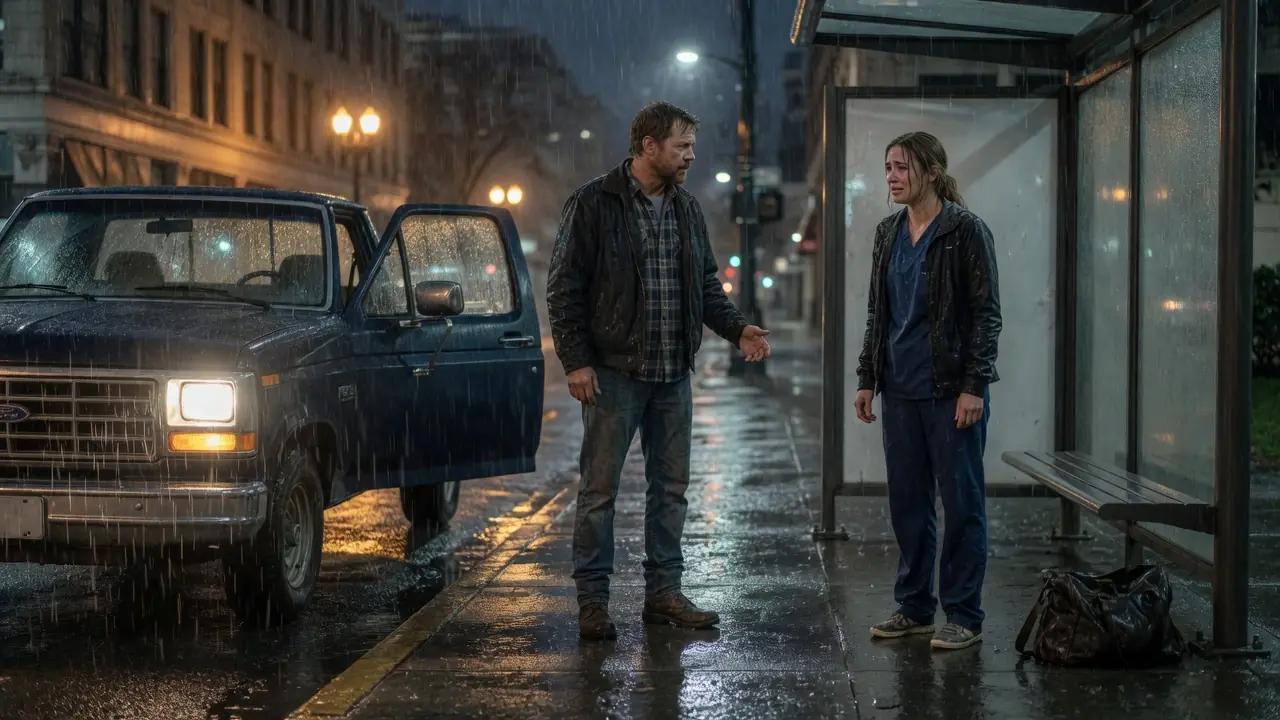
Rain pounded against the windshield. Michael pulled his old pickup truck to the curb. Through the downpour, he spotted her, a woman in scrubs huddled under a bus stop shelter, shoulders shaking, not from cold, but from tears.
He hesitated, remembering his promise to pick up his daughter in twenty minutes. But something in the woman’s posture, defeated yet dignified, made him roll down his window.
“Need a ride?” he asked, expecting rejection.
Instead, her eyes met his, revealing exhaustion deeper than any night shift could explain.
Neither knew that this rainy Tuesday in Portland would change everything. One had lost his faith in love, but kept his heart open for his daughter. The other had lost everything but the compassion that defined her career.
Michael Bennett measured his life in sawdust and promises kept. Each morning, he woke before the sun touched the Portland skyline, careful not to let the floorboards creak as he prepared for another day of being both mother and father to nine-year-old Emma. His workshop below their modest two-bedroom apartment was filled with the scent of pine and possibility.
Each piece of furniture he crafted carried stories his words never could.
The kitchen countertop held evidence of their morning routine, a half-empty coffee mug beside Emma’s cereal bowl decorated with cartoon characters whose names he had memorized to make her smile. A pink hair elastic wrapped around his calloused fingers as he attempted the French braid tutorial he had watched three times the night before.
“Hold still, pumpkin,” he would murmur, concentration furrowing his brow deeper than any hardwood project ever could.
Six years had passed since Catherine chose career advancement in New York over their family, leaving with promises to visit that gradually faded like pencil marks on wood. The divorce papers arrived with her signature already dried, the custody agreement granting her holidays she rarely claimed.
Michael never spoke ill of her to Emma, instead filling photo albums with new memories. Just the two of them at the coast, at the park, in the workshop where Emma had her own little toolbox painted sunshine yellow.
His neighbors in the apartment building knew him as the man who fixed their cabinets without charging labor, just materials.
“It’s nothing,” he would say, eyes downcast at their gratitude.
The elderly couple upstairs received a handcrafted step stool after he noticed Mrs. Abernathy struggling to reach her cupboards. The single mom across the hall found her wobbly kitchen table mysteriously stabilized while she worked the night shift.
Financially, the margins were always thin. The ledger book in his desk drawer told the story in careful handwriting. Monthly calculations ensuring Emma’s art class remained in the budget. Insurance payments highlighted in yellow. Medical savings underlined twice.
He would skip lunch three days a week, telling himself he wasn’t hungry anyway, to afford the special clay Emma needed for her school project.
At night, after tucking Emma in with their ritual, one story, two kisses, three questions about her day, Michael would sit at his workbench, shoulders curved beneath invisible weight. The empty space beside him on the couch remained untouched, a habit formed from years of solitude.
Sometimes he would catch himself cooking enough pasta for three before remembering, the extra portion becoming tomorrow’s lunch. His dating profile remained unwritten, the suggestion from well-meaning friends met with a tired smile.
“No time,” he would say, gesturing to the custom credenza due by Friday.
The truth hung in the workshop like fine sawdust, invisible until caught in the right light. His heart, like his finest woodwork, had been carefully sealed against the elements, functional, but no longer taking new impressions.
On Friday evenings, when other men his age might be starting their weekends at local breweries, Michael and Emma observed their sacred tradition. Two bowls of rocky road ice cream, the battered Monopoly board between them, her triumphant grin when she bought Park Place.
He always let her win without making it obvious, his subtle gift wrapped in normalcy.
At Emma’s school presentation, other parents showcased expensive vacations while Michael helped Emma display a handcrafted dollhouse they had built together.
The admiration in her classmates’ eyes meant more to him than any custom furniture commission.
When he walked through the park with Emma skipping ahead, he would occasionally notice couples walking hand in hand, their easy intimacy a language he once spoke fluently. Something would tighten in his chest, not quite pain, not quite longing, before he would call out to Emma about the ducks on the pond, redirecting his attention to the one love he could count on.
In his workshop, a collection of carpentry books gathered dust on the highest shelf, bookmarks with ideas for projects marked someday. On quiet evenings, he would sometimes pull one down, fingers tracing elaborate designs for furniture requiring time he never had.
The bed frame with a hand-carved headboard.
The hope chest with dovetail joints.
Dreams deferred in favor of practical side tables and bookshelves that paid the bills.
Each night before sleep, Michael would check on Emma one last time, watching the gentle rise and fall of her chest. In these silent moments, he allowed himself to acknowledge the weight of solo parenting, the decisions made alone, the questions he could not answer, the constant fear of not being enough.
Then morning would come, and with it the quiet strength to try again.
Thirty miles away and worlds apart, Sophia Chen removed her stethoscope with hands that had once been welcomed in Boston’s most prestigious medical circles. Now they trembled slightly as she charted her final notes of a fourteen-hour shift at Portland County Hospital.
Six months ago, she had been Dr. Chen’s protégé at Boston Children’s Hospital. Her research had been cited in medical journals, her career trajectory enviable. Today, she was simply the new nurse practitioner, competent but curious, respected but removed.
Her fall from grace began with numbers on a spreadsheet that did not add up. Patient care protocols changed without explanation. Medication brands switched to alternatives that were not quite equivalent. When children in her ward experienced unexpected reactions, Sophia documented everything.
The administration called it cost optimization.
She called it dangerous.
The whistleblower complaint cost her everything but her license and her integrity.
Her apartment now bore little resemblance to her former Boston brownstone. A mattress on the floor surrounded by moving boxes she had not found the energy to unpack. A single mug, plate, and bowl served as her entire kitchen set.
The settlement money from her wrongful termination lawsuit went mostly to legal fees, with the remainder barely covering first and last month’s rent on the studio apartment with temperamental plumbing.
Former colleagues blocked her calls. Recommendation letters were rescinded. Online medical forums contained thinly veiled references to troublemakers who did not understand healthcare economics.
Her savings account dwindled as months passed without employment until Portland County Hospital, chronically understaffed and underfunded, became her only option.
Still, certain habits remained unchanged. She still folded tiny origami cranes for her pediatric patients, a skill learned from her grandmother. She still remembered every child’s name, favorite color, and fear. She still stayed late reviewing charts, looking for patterns others might miss.
Excellence was not a choice for Sophia. It was encoded in her DNA, regardless of title or salary.
In Boston, her apartment had featured expensive furniture chosen by an interior decorator. Yet she had rarely spent enough time there to appreciate it. Her former fiancé, a neurosurgeon with political connections, had commented more than once about her depressing hospital stories ruining dinner parties.
The engagement ended the same week as her employment. His parting words revealed the conditional nature of both relationships.
“I can’t be associated with this scandal.”
Now Sophia walked home in rain that seemed fitting for her circumstances. Her phone battery had died hours ago. The hospital shuttle was long gone. In her waterlogged purse, the last photos of her grandmother, printed on paper rather than saved digitally, dissolved into blue-tinted smears.
Six months of losses culminated in this moment, standing at a bus stop that had stopped running for the night, tears mingling with raindrops on her face.
The headlights cutting through the downpour barely registered until a voice called out.
“Need a ride?”
The question carried no expectations, no judgment, just simple human recognition of another’s distress. The pickup truck was old but immaculately maintained, much like its driver’s weathered but kind face.
Sophia hesitated only briefly before nodding, her practical nature overcoming caution. What more could she possibly lose?
Inside the truck, the heater hummed inefficiently but earnestly.
“Michael Bennett,” he offered, without pressing for her name in return.
The radio played softly, some local station featuring acoustic covers of songs she once knew. The windshield wipers kept imperfect time with the music, a metronome marking moments passing between strangers.
His phone rang, breaking the silence.
“Hey, pumpkin,” he answered, voice transforming into something gentler. “Homework trouble again?”
He listened intently, glancing apologetically at Sophia.
“The water cycle? Hold on.”
He struggled to explain evaporation in terms a nine-year-old would understand.
Without thinking, Sophia leaned closer to the phone.
“Imagine the sun giving water molecules little wings so they can fly up into the sky. Then, when they get cold enough, their wings get too heavy, and they fall back down as rain.”
The delighted “Oh, I get it now!” from the phone was followed by Michael’s grateful smile, the first genuine connection Sophia had experienced in months.
When they arrived at her apartment building, she reached for her wallet only to find it empty. Pride prevented her from explaining how she had spent her last cash on lunch for a patient’s mother who had been at the hospital for thirty-six hours straight.
“Pay it forward someday,” Michael said, simply waving away her embarrassment.
As his truck disappeared around the corner, Sophia stood in the rain a moment longer, wondering why this brief encounter with kindness felt more substantial than all the accolades and accomplishments now stripped from her resume.
Three days later, Michael’s careful routine shattered with a phone call from Emma’s school.
Minor concussion. Playground fall. Precautionary visit to the emergency room recommended.
The twenty-minute drive to Portland County Hospital stretched into an eternity of worst-case scenarios playing through his mind, his knuckles white against the steering wheel.
In the pediatric assessment area, a familiar voice called Emma’s name. There stood the woman from the rainstorm, now in crisp scrubs with a professional demeanor that could not quite mask her surprise.
“The rain lady,” Emma exclaimed, breaking the tension with childish directness.
Something in Sophia’s face softened as she knelt to Emma’s eye level, explaining each step of the examination with patient clarity.
“She’s going to be fine,” Sophia assured Michael, her confidence easing his panic. “I promise to bring a popsicle when we’re done, if that’s okay with your dad.”
The conspiratorial wink she shared with Emma created a tiny alliance that Michael could not help but appreciate. He noticed how other staff deferred to her despite her being new, seeking her opinion on cases beyond her assigned patients.
Two weekends later, Michael arranged his wooden crafts at the local farmers market, cutting boards, salt cellars, small toys that supplemented his custom furniture income. Emma arranged pine cone creatures on their display table, her recently healed head now topped with a hand-knitted beanie from Mrs. Abernathy.
Through the Saturday morning crowd, Michael spotted Sophia examining organic vegetables at a nearby stall. Emma noticed too, waving enthusiastically until Sophia approached their booth.
“We make everything ourselves,” Emma announced proudly, her small hand gesturing toward their handcrafted wares.
Conversation started awkwardly, but warmed as they discovered shared appreciations for cooking, though Sophia admitted most nights ended with simple microwave meals.
“Cooking for one always feels like too much effort,” she confessed.
Her fingers lingered on a maple cutting board, tracing the grain before noting the price tag and reluctantly setting it down.
Michael watched her walk away, noticing her purchases. A single bell pepper, two apples, a small bunch of kale, enough for one person with minimal leftovers.
That night, he found himself crafting a smaller version of the cutting board she had admired, his hands working almost without conscious direction.
Spring arrived, bringing the community garden back to life. Michael and Emma spent Sunday afternoons tending their plot, growing vegetables that supplemented their grocery budget. They discovered Sophia had taken the abandoned corner section, her medical precision evident in perfectly straight rows that nonetheless struggled to thrive.
“You’re drowning them,” Emma announced, surveying Sophia’s waterlogged seedlings with the authority only a nine-year-old could muster. “Dad says plants are like people. They need room to breathe.”
Sophia accepted gardening lessons from both Bennetts with graceful humility, her usual professional confidence replaced by endearing uncertainty. Sandwiches were shared on a weathered garden bench, Emma chattering about school while the adults listened, offering each other shy glances over her head.
Michael noticed how Sophia’s clinical efficiency transformed into genuine warmth around his daughter, while Sophia observed how his gruff exterior melted whenever Emma spoke.
When Emma’s science fair project on medicine hit a roadblock, Michael found himself standing in the community garden watching Sophia harvest her first successful crop of tomatoes.
“I was wondering,” he began, hands fidgeting with his garden gloves, “if you might have time to help Emma with her project. She’s stuck on the difference between bacteria and viruses.”
Their kitchen table became an impromptu classroom. Sophia’s medical knowledge translated into experiments involving soap and glitter to demonstrate how germs spread.
When the demonstration exploded into a mess of colored water and giggling, Michael found himself laughing genuinely for the first time in years.
Dinner materialized from ingredients Sophia had brought just in case. The three of them cooked together in a kitchen that suddenly felt the right size.
Later, with Emma asleep on the couch, surrounded by project materials, they washed dishes side by side in comfortable silence.
“She’s remarkable,” Sophia said softly, handing him a dripping plate. “You’ve done an amazing job with her.”
The simple validation of his parenting, something he had never received from Catherine, lodged somewhere deep in Michael’s chest.
The day his truck broke down outside the hospital was the day something shifted between them. Michael had been delivering a custom bookshelf to the pediatric ward, an anonymous donation he had arranged through the hospital charity office.
Sophia spotted him from a window, bringing him coffee during her break, watching with interest as he explained the differences between hardwoods to the maintenance staff helping him. Their hands brushed when she passed him tools, the brief contact sending an unexpected current through both of them.
In the truck cab, searching for jumper cables, Michael discovered one of Emma’s drawings tucked under the seat, a crayon rendering of three figures at a table. When Sophia saw it, something unspoken passed between them, an acknowledgment of possibility neither was ready to voice.
The invitation to Sunday dinner came from Emma directly. Sophia had stopped by to return a medical reference book, catching them practicing for the father-daughter dance.
“You should come eat with us on Sunday,” Emma declared with the impulsive directness of childhood. “Dad makes really good lasagna, except when he burns it.”
Michael’s momentary discomfort gave way to quiet anticipation when Sophia arrived Sunday evening with homemade apple crumble, her grandmother’s recipe, she explained.
The evening ended on the apartment building’s rooftop, where they had gone to identify constellations for another of Emma’s school projects. Emma fell asleep between them on the blanket Michael had spread out, her small hand still clutching Sophia’s sleeve.
“She trusts you,” Michael observed quietly, the night sky reflecting in his eyes. “She doesn’t get close to people easily. Not since her mom left.”
“Children recognize intention,” Sophia replied. “They know who sees them and who’s just looking.”
The conversation drifted to safer topics, neither ready to acknowledge how comfortable this felt, how natural their orbit around Emma had become, how the empty spaces in their separate lives seemed to fit together like well-crafted joinery.
The fragile peace shattered on a Tuesday afternoon.
Michael arrived at the hospital to drop off a thank-you gift, the small cutting board Sophia had admired at the market, now finished with her initials subtly carved into the corner. In the waiting area, he overheard nurses whispering about the Boston whistleblower and how some hotshot doctor from Massachusetts was making a scene in the hallway.
Curiosity led him toward the commotion, where he found Sophia standing rigid before a gray-haired man in an expensive suit.
“You destroyed careers with your sanctimonious complaints,” the man was saying, loud enough for everyone to hear. “Had the nerve to question protocols established by physicians with decades more experience.”
Sophia’s response was too quiet to hear, but her posture spoke volumes. Straight-backed, chin lifted, the same dignity Michael had first noticed at the rain-soaked bus stop.
The whispers around him filled in details. Prestigious Boston hospital. Patient safety allegations. Professional blacklisting.
The woman he had come to know through small moments of kindness suddenly had a complicated history he knew nothing about.
When she spotted him in the hallway afterward, her face fell.
“Michael,” she began, but he cut her off.
“Were you ever going to mention that you’re not just a nurse? That you had some big-shot career before slumming it here in Portland?”
The words came out harsher than intended, protective instincts flaring.
“What else haven’t you told us?”
The staff lounge provided minimal privacy for her explanation. How she had discovered dangerous corner-cutting and patient care protocols. How reporting it through proper channels led nowhere. How going public cost her everything professionally.
“I reported what was happening to children. Children like Emma. And for that, I lost my home, my savings, my career.”
Her voice remained steady even as her hands trembled.
“I did what was right and lost everything except who I am.”
Something in her words triggered Michael’s deepest insecurity.
“You’ll leave eventually for something better. They always do.”
The ghost of Catherine hovered between them.
“We’re just your small-town rehabilitation project until your real life gets reinstated.”
Sophia’s expression hardened.
“You don’t get to decide my intentions based on your past.”
She gathered her composure like a shield.
“Not everyone leaves, Michael. Some of us get left behind, too.”
The weeks that followed held an emptiness that surprised Michael with its depth. He stopped responding to Sophia’s texts, made excuses when she visited his workshop. Emma’s confusion turned to quiet hurt, her questions about Nurse Sophia gradually tapering into silence.
A letter arrived addressed in Sophia’s precise handwriting. Michael left it unopened on his dresser, unable to face either her explanations or his own overreaction.
In their separate spaces, both struggled with regrets. Michael sanded the same table leg until it was too thin to use, his mind replaying words spoken in anger. Sophia arranged and rearranged her sparse belongings, considering for the first time that perhaps Boston had never really been home at all.
The school’s spring art exhibition brought matters to a head. Emma’s featured drawing showed three figures in a garden, a tall man with carpenter’s tools, a small girl with pigtails, and a woman in scrubs planting flowers.
My family, read the childish handwriting across the top.
Michael stood before it, something crumbling inside his carefully constructed defenses.
That evening, he attempted to call Sophia, only to discover her number disconnected. The visit to her apartment revealed a landlord clearing out abandoned belongings.
“Left yesterday,” the man shrugged. “Said something about heading back east.”
Michael found her packing the last of her meager possessions into her car behind the hospital.
“You’re running away,” he accused, voice rough with emotion. “Just like my wife did.”
“I’m leaving because I’ve been offered my old position back,” Sophia countered, continuing to load boxes. “With a formal apology and settlement. The hospital board reviewed my evidence and fired the administration responsible.”
Her voice held no triumph, only exhaustion.
“I’ve been vindicated, Michael. Isn’t that what everyone wants?”
His bitter response revealed the wound beneath his anger.
“So you get your fancy career back. We were just your small-town distraction.”
The pain in her eyes matched his own.
“No. You were the first real home I’ve ever known.”
The admission hung between them, too honest to dismiss, too raw to embrace.
Emma’s drawing fell from Michael’s pocket during their standoff. Sophia returned it without looking at the image.
“She deserves someone who will stay forever.”
The words carried the weight of her own childhood losses, her parents’ academic careers that moved them every few years, never allowing roots to form.
As he drove home alone, Michael realized he was repeating his wife’s mistake, choosing fear over love, choosing the safety of resentment over the risk of trust. But knowing the pattern did not show him how to break it, how to unlearn the protective instincts that had kept him functioning as a single father for six years.
Two weeks passed in a fog of routine and regret.
Then came the night Emma’s temperature spiked to one hundred three degrees. Her small body burned with fever that would not respond to children’s medicine.
The emergency room overflowed with weekend cases. The triage nurse was apologetic about the hours-long wait despite Michael’s growing panic. Emma’s condition deteriorated as they waited, her usual chatter replaced by listless silence.
Michael overheard a nurse mention the pediatric specialist who had just returned from Boston, brought in specifically for difficult cases.
When Sophia appeared in the doorway of their curtained alcove, the relief that flooded him was almost physical.
Professional distance governed her approach as she examined Emma, her voice gentle but clinical.
“Possible meningitis secondary to concussion,” she told the attending physician, who deferred immediately to her assessment. “We need a lumbar puncture and antibiotics started now.”
The efficiency with which she took charge reminded Michael of what he had learned about her past, her expertise now working to save his daughter.
Hours later, with Emma stabilized and sleeping under observation, Michael found Sophia updating charts in the quiet nurses’ station.
“Thank you,” he said simply.
The words were inadequate for the weight they carried.
“I took an oath,” she replied, not looking up from her documentation. “To help anyone who needs care.”
Dawn painted the hospital windows with gentle light as they sat in silence in Emma’s room.
“You turned down the Boston reinstatement, didn’t you?” Michael finally asked, noticing the Portland hospital ID still clipped to her scrubs.
Sophia nodded, fatigue evident in every line of her body.
“I realized success means nothing if I’m not where my heart is.”
She explained how she donated the settlement money to a patient advocacy fund, how her phone had been disconnected because she could not afford the bill, how she had been packing to move to a smaller apartment across town, not leaving Portland at all.
The shame of his assumptions washed over Michael.
“I pushed you away because I was afraid of depending on someone again,” he confessed. “After Catherine left, I built this life for Emma, this small, safe, predictable life. The idea of someone else becoming essential to us and then leaving…”
He could not finish the thought.
Emma stirred, opening fever-bright eyes to look between them.
“Are you two friends again?” she asked.
The simple question cut through adult complexities.
Sophia’s careful answer held promise without presumption.
“Sometimes grown-ups forget what matters most,” she told Emma, adjusting her IV line with gentle hands. “But we remember when it really counts.”
The moment was interrupted by a nurse calling Sophia away for another emergency.
Michael watched her work through the window. Competent. Compassionate. Completely in her element.
He realized that loving someone meant supporting their purpose, not just wanting them nearby. Catherine had left because family felt like a constraint to her ambition. He had nearly driven Sophia away by assuming she shared the same values.
After Emma’s discharge with follow-up care instructions, they stood awkwardly in the hospital parking lot.
“Thank you again,” Michael offered, uncertain how to bridge the gulf between them.
“She’s special,” Sophia replied, professional masks slipping just enough to reveal the affection beneath. “Take good care of her.”
She turned toward the staff entrance, lab coat billowing slightly in the spring breeze.
At home, helping Emma settle on the couch with her favorite blanket, Michael found her sketchbook tucked between cushions. Flipping through, he discovered a progression of drawings. First, just Emma and Michael, then gradually including a third figure.
The final page bore Emma’s childish handwriting.
My wish.
It showed a picture of all three of them standing before a house with a garden.
The clarity hit him with unexpected force. In trying to protect his heart, he had been denying his daughter the family she clearly wanted. More than that, he had been denying himself the chance to build something new. Not replacing what was lost, but creating something that had never existed before.
For three days, Michael and Emma worked secretly in his workshop, emerging with sawdust in their hair and purpose in their movements.
The medicine cabinet they created featured a hand-carved caduceus symbol. The interior was designed with specific compartments for various supplies. The wood, cherry with maple inlay, glowed with hours of careful finishing.
They found Sophia’s new apartment building across town, a modest improvement over her previous studio, but still sparsely furnished. She was helping an elderly neighbor carry groceries upstairs when they arrived, her scrubs exchanged for faded jeans and a Boston medical sweatshirt with sleeves pushed up to the elbows.
Emma ran to her immediately, brandishing a drawing.
“We made you something.”
The caution in Sophia’s expression gave way to surprised joy at seeing them both.
Michael stepped forward, heart hammering against his ribs.
“You lost everything standing up for what’s right,” he said quietly. “I almost lost everything being afraid to stand up for what matters.”
He presented the handcrafted cabinet.
“For someone who heals everyone but herself.”
Inside the cabinet’s central compartment, he had placed a small note beside a jar of bath salts Emma had helped make.
Healers need healing, too.
Sophia’s fingers traced the woodwork, the medical symbol, the carefully crafted hinges.
“This is beautiful,” she whispered.
The simple words carried layers of meaning neither adult was ready to fully express.
Emma tugged at Sophia’s sleeve.
“Can we have dinner together? Dad burns spaghetti.”
Her innocent request created a bridge across the complicated terrain of adult fears and hopes.
“I think,” Sophia said carefully, looking at Michael with a question in her eyes, “that building anything worthwhile takes patience and daily choice.”
Michael nodded, understanding the deeper meaning.
“And willingness to learn from mistakes,” he added, holding her gaze.
Six months later, Sophia’s apartment walls featured several of Michael’s smaller woodworking pieces, while Emma’s drawings claimed prominent space on the refrigerator. Michael had expanded his workshop to include a small clinic space where Sophia offered free care one evening each week to families without insurance.
Their community garden plot flourished under Emma’s enthusiastic, if sometimes misguided, care. Sunday dinners had become a tradition that gradually expanded to include neighbors who had become an extended family of sorts.
Michael’s wedding ring, long stored in his dresser drawer, had been transformed into a pendant Sophia sometimes wore, not erasing the past, but transforming it into something new.
When the prestigious Boston Children’s Hospital sent Sophia another offer, she opened the letter with Michael beside her. Together, they decided her skills would serve better in their growing community clinic than in the hospital hierarchy she had once valued.
Michael supported her dreams rather than fearing them, while Emma thrived in the stable family unit they were carefully building.
On the one-year anniversary of their rainy first meeting, they broke ground on a combined workshop and clinic space. The local newspaper covered the story of the nurse whistleblower and carpenter creating healthcare access in an underserved neighborhood.
Other medical professionals had begun volunteering their time, drawn by Sophia’s vision and dedication.
Emma led tours for her school class, proudly introducing “my dad and Sophia” to her friends. The adults exchanged glances over her head, their private understanding deepening with each passing day.
“Sometimes you have to lose your way to find your purpose,” Michael observed one evening, watching Sophia organize supplies for the clinic’s opening.
“And sometimes you have to lose everything to recognize what truly matters,” she replied, her hand finding his across the workbench.
Rain fell again, an echo of their first meeting. Michael pulled his truck to the curb, but this time, Sophia waited with an umbrella, Emma between them holding both their hands.
Inside their front door, three sets of rain boots stood in a row. Different sizes, but equally muddy from the garden, a visible symbol of the family formed by choice rather than circumstance.
“Some storms wash away what we thought we wanted,” Sophia murmured, watching the rain through the window, “revealing what we truly need.”
True love isn’t about finding someone perfect. It’s about finding someone who stays even when life isn’t.