On a crowded winter sidewalk outside a gray stone storefront in downtown Chicago, thirty-nine-year-old Jack Lawson dropped to one knee after recognizing the homeless woman pressed against the wall. Five years had passed since Sarah disappeared from his life, yet he knew those green eyes before his mind could accept the gaunt face surrounding them. His navy jacket pulled tight against the bitter wind as he held out a warm takeout box with trembling hands. Around them, pedestrians hurried past without noticing that an entire marriage had just returned from the dead.
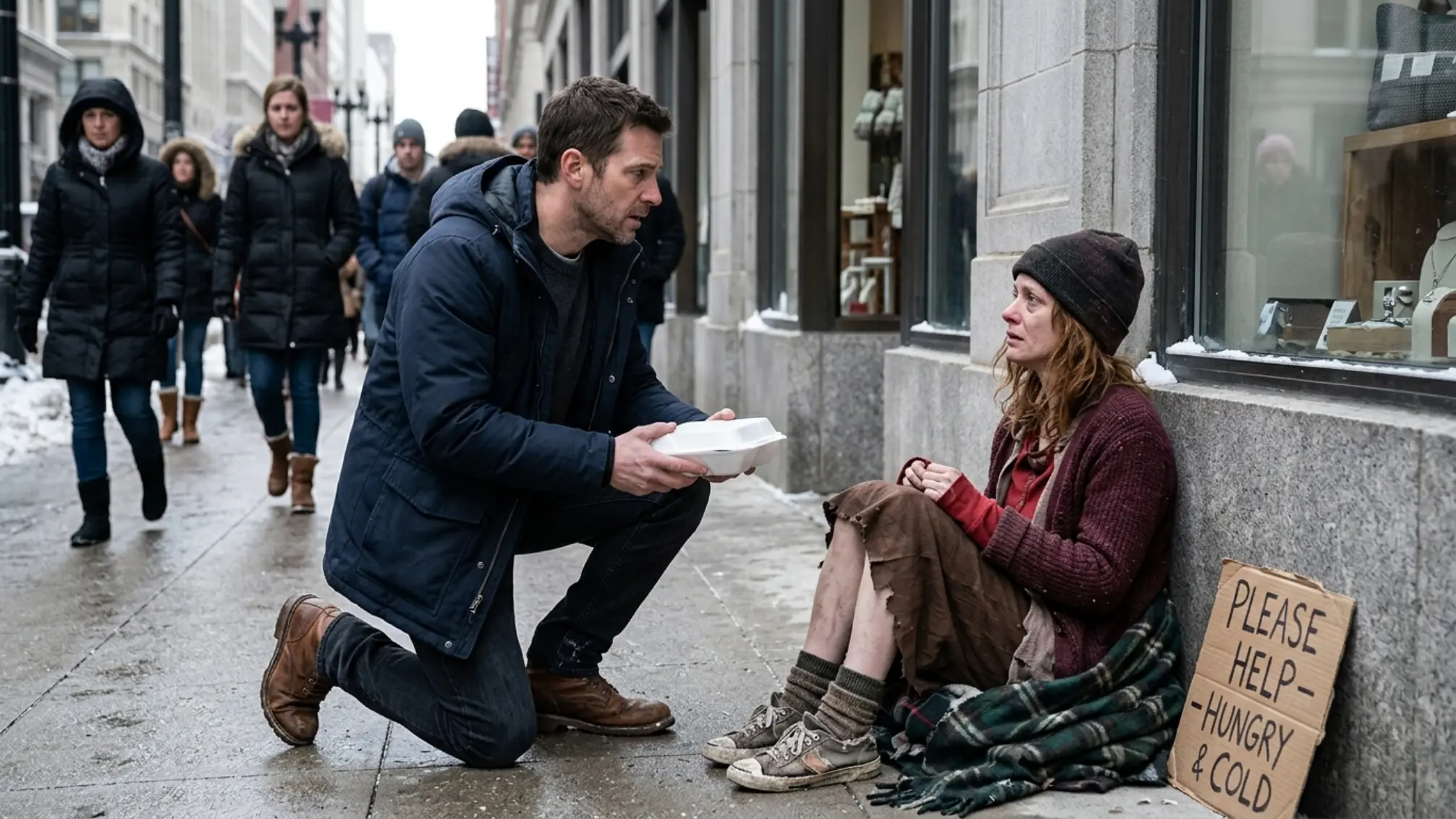
Jack remained on one knee, unable to move. Sarah’s fingers were so cold that he barely felt them against his hand, and the sight of her cracked nails hurt more than any accusation she could have made. Her tangled auburn hair fell around a face once filled with color and mischief, while a faded burgundy cardigan offered almost no protection against the December air. Beside her lay a cardboard sign with two words written in trembling black letters: PLEASE HELP.
For five years, Jack had imagined finding her in a hundred different places. He pictured her living freely in another city, building a life untouched by the responsibilities she abandoned. Sometimes he imagined confronting her at a restaurant or an airport, demanding to know why she stopped attending custody hearings and vanished without saying goodbye to their daughter. Never once had he imagined finding her hungry on a sidewalk, ashamed to look directly at him.
“Please take the food,” he whispered.
Sarah looked down at the container but did not accept it. “You shouldn’t be here.”
“I could say the same thing to you.”
“I mean near me.” Her voice cracked. “You built a good life after I left. Don’t let me drag you back into what I became.”
Jack’s jaw tightened. “You don’t get to decide that for me again.”
Sarah flinched, and he immediately regretted the sharpness in his voice. Yet the anger was real, buried beneath grief, confusion, and the terrible tenderness rising inside him. She had left him alone to explain an impossible absence to a seven-year-old girl who waited beside the window every Saturday for a mother who never arrived. Jack had eventually stopped setting an extra place at the table because watching Emma stare at the empty chair became unbearable.
He stood and offered Sarah his hand.
She hesitated before placing her thin fingers in his palm. Jack helped her rise, discovering that she weighed almost nothing beneath the layers of worn clothing. When her knees buckled, he caught her around the waist, and for one breathless second they stood as they had during their marriage—her body against his chest, his arm holding her upright.
Sarah pulled away first.
“Emma was with you yesterday,” she said.
Jack stared at her. “You saw us?”
Sarah nodded. “I recognized her. She looks like you when she’s serious.”
“You were ten feet away.”
“I know.”
“Why didn’t you call her name?”
Her face folded with pain. “Because she looked happy.”
The sentence struck him harder than any excuse. Jack had spent years insisting Sarah did not care, but the woman before him had watched their daughter from the pavement and remained silent because she feared destroying the child’s peace. That did not erase what happened, but it cracked the certainty protecting his anger.
He led her to a quiet diner two blocks away.
The waitress glanced at Sarah’s clothes, then at Jack, but said nothing as they entered a booth near the back. Jack ordered soup, bread, grilled chicken, coffee, and pie. Sarah protested until her stomach growled loudly enough to embarrass her into silence.
She ate slowly at first.
Then hunger overcame dignity.
Jack watched her tear bread into small pieces and dip them into the soup as if trying to make every bite last. Her hands shook around the spoon. He remembered those same hands decorating Emma’s birthday cakes, tying ribbons into their daughter’s hair, and tracing circles across his back when he could not sleep.
“What happened to you?” he asked.
Sarah lowered the spoon.
“Life happened.”
“That isn’t an answer.”
“It’s the only one I have tonight.”
“Where have you been for five years?”
“Hospitals. Temporary rooms. Shelters. Places I don’t remember clearly.”
Jack leaned forward. “Why did you stop fighting for Emma?”
Sarah closed her eyes.
“I thought I was dying.”
The sounds of the diner seemed to fade. Jack heard the scrape of silverware from another table and the hiss of the coffee machine, but neither felt real. Sarah opened her eyes again, and he saw no attempt to manipulate him—only exhaustion.
“What are you talking about?”
“Two weeks after our divorce hearing began, the doctors found ovarian cancer. Stage four. They said I might have three months. Six if treatment slowed it.”
Jack stared at her.
“You never told me.”
“We were already tearing each other apart.”
“That was my daughter too. That was my life too.”
“I know.”
“Then why didn’t you tell me?”
“Because you would have brought Emma to the hospital.” Tears filled Sarah’s eyes. “You would have made sure she stayed beside me. And I couldn’t let her watch me disappear one piece at a time.”
Jack pushed away from the table.
“So you chose to make her believe you didn’t love her?”
“I chose the pain I thought she could survive.”
“You had no right.”
“No,” Sarah whispered. “I didn’t.”
She reached into the pocket of her cardigan and removed nothing, then laughed bitterly at herself. “I wrote you a letter. I explained everything. I mailed it to the apartment before you moved.”
“I never received it.”
Sarah’s face went still.
“I sent it.”
“I never saw it.”
For several seconds, neither spoke. Five years of hatred hung between them, suddenly balanced on a missing envelope. Jack wanted to reject the possibility because accepting it meant reconsidering every story he had told himself and Emma.
He paid for Sarah’s meal and rented her a motel room for the night.
She tried to refuse the key.
“This doesn’t mean I forgive you,” he said.
“I know.”
“It doesn’t mean you see Emma.”
“I understand.”
“It means you won’t sleep outside tonight.”
Sarah held the key card against her chest. “You always did know how to be kind when you were angry.”
Jack looked away. “And you always knew how to make kindness hurt.”
That evening, he sat alone in his kitchen long after Emma went to bed. His daughter was twelve now, taller than Sarah had been at that age, with the same auburn hair and quick smile. Jack wondered how much of her mother remained hidden inside her and whether he had unknowingly taught her to be ashamed of it.
His phone rang shortly before ten.
The caller was a man named Thomas Reed, the new tenant in Jack’s former apartment. Renovation workers had removed an old radiator and found an envelope wedged behind it. Jack’s name and forwarding address were written across the front, though the postal label showed it had been returned and redelivered several times.
Thomas offered to bring it over.
When Jack saw Sarah’s handwriting, his knees weakened.
He opened the envelope at the kitchen table. The paper inside was stained and wrinkled, and several words had blurred beneath dried tears.
Jack, by the time you read this, I may already be gone. Please do not tell Emma that I stopped loving her. Let her be angry if anger keeps her from being afraid. Tell her I left because I was weak. Tell her anything except that she watched her mother die.
Jack pressed one hand against his mouth.
The letter described the diagnosis, the predicted decline, and Sarah’s decision to withdraw from the custody fight. She had signed away her rights because she believed a clean break would spare Emma months of hospital rooms, vomiting, hair loss, and fear.
At the bottom, Sarah had written one final sentence.
I loved you badly at the end, but I never loved either of you less.
Jack cried silently at the table.
He had believed Sarah walked away in pursuit of freedom. Instead, she entered treatment alone because she thought suffering privately was an act of love. Her choice had been misguided, damaging, and cruel in ways she did not understand, but it had not been careless.
The next morning, Jack returned to the motel.
Sarah opened the door wearing the same clothes, though she had washed her face and combed her hair. Jack held up the letter.
“You were supposed to be dead.”
Her lips parted.
“Where did you find that?”
“Behind the radiator in our old apartment.”
Sarah took the letter as if receiving the ashes of someone she once knew.
“You never read it.”
“No.”
“All these years…”
“I thought you abandoned us.”
“I thought you knew.”
Jack entered the room and closed the door. “Then explain why you never came back after you survived.”
Sarah sat on the edge of the bed.
The doctors enrolled her in an experimental clinical trial after standard treatment failed. The medication nearly killed her, but the tumors began shrinking. After months of surgery, chemotherapy, infections, and rehabilitation, she entered remission.
By then, Jack had moved.
His number had changed, and letters sent through his attorney went unanswered. Sarah had no money for prolonged legal action, and the medical debt consumed everything she owned. During treatment, she became dependent on prescription pain medication, then spent nearly a year fighting to escape it.
“I was ashamed,” she said. “You had custody, a home, and a steady life. I had hospital bracelets and debt collectors.”
“You could have tried harder.”
“I know.”
“You could have found me.”
“I know.”
“Emma needed you.”
Sarah began crying. “I know.”
Jack stopped because each accusation had already lived inside her longer than it lived inside him. She did not defend herself or demand forgiveness. She simply sat beneath the harsh motel light, accepting every word.
“What put you on the street?” he asked more quietly.
“The treatment damaged my immune system. I developed an autoimmune disorder and started missing work. First I lost the job, then the apartment. I stayed with friends until they ran out of patience. The shelter beds filled when the weather changed.”
“Why didn’t you contact me then?”
Sarah looked at the floor. “Because the worse my life became, the more certain I was that Emma should never see it.”
Jack understood the terrible circle she had created. Shame kept her away, and distance created more shame. Every month without contact made returning harder until she believed she had no right to return at all.
“Emma has a dance recital Friday,” he said.
Sarah looked up.
“What?”
“She’s performing a solo.”
Hope appeared so quickly that Jack nearly regretted offering it.
“Are you asking me to come?”
“I’m asking whether you can sit quietly in the back and let me decide what happens after.”
Sarah nodded before he finished. “I’ll do anything you say.”
Jack bought her a warm coat and arranged a medical appointment through a friend. He also paid for another week at the motel, though Sarah insisted she would repay him one day. He did not tell Emma immediately.
On Friday evening, Sarah sat beside him in the last row of the school auditorium. Her hair had been washed and trimmed, and she wore a simple blue dress beneath the new coat. She looked fragile but no longer invisible.
When Emma stepped onto the stage, Sarah stopped breathing.
Their daughter moved beneath the lights with a grace neither parent expected. She turned, lifted, and landed with fierce concentration, her auburn hair pinned neatly behind her head. Sarah covered her mouth as tears slipped down her face.
“That’s our little girl,” she whispered.
Jack felt something inside him break open.
After the performance, he led Sarah into the crowded lobby. Emma stood with her friends, holding flowers and laughing. When she turned and saw the woman beside Jack, confusion crossed her face.
Then recognition came.
“Mom?”
Sarah took one step forward. “You were beautiful.”
Emma’s smile disappeared.
“Why are you here?”
Sarah’s hands trembled. “Your father invited me.”
“You left us.”
“I know.”
“You didn’t call.”
“I know.”
“You didn’t want me.”
Sarah’s face crumpled. “That was never true.”
Emma looked at Jack. “Why did you bring her here? This was my night.”
She pushed through the crowd and ran outside.
Jack started after her, but Sarah caught his sleeve.
“Let me go.”
“You have already left her once.”
“I’m not leaving now. I’m following.”
Outside, Emma stood beside the school steps, crying angrily into her hands. Sarah stopped several feet away instead of approaching too quickly.
“I had cancer,” she said.
Emma lowered her hands.
“The doctors thought I was going to die. I was afraid you would remember me only as someone sick and helpless, so I left. I believed I was protecting you.”
“You weren’t.”
“No.”
“You hurt me.”
“I know.”
“Dad said you chose another life.”
Sarah looked toward the auditorium doors where Jack stood watching.
“Your father believed that because the letter I sent never reached him. He did the best he could with the truth he had.”
Emma’s voice shook. “Why didn’t you come back?”
“Because I survived, but I lost everything else. Then I became ashamed of how much time had passed.”
Emma stared at her mother.
Sarah wiped her face. “I don’t expect you to forgive me tonight. I don’t expect you to call me Mom. I only need you to know that there was never one day when I stopped loving you.”
Emma began crying again.
This time, when Sarah opened her arms, their daughter stepped into them.
Jack turned away because the sight was too private and too painful to witness directly. He heard Sarah sobbing into Emma’s hair and Emma asking questions too quickly for answers. The five stolen years did not disappear, but for the first time, the distance between them stopped growing.
Rebuilding took months.
Jack helped Sarah apply for disability assistance and found her a small apartment near Emma’s school. A friend offered her flexible administrative work she could complete from home when her health declined. Sarah attended therapy, followed her treatment plan, and accepted that love did not excuse the consequences of her choices.
Emma visited twice a week at first.
Some evenings ended with laughter. Others ended with slammed doors and old anger. Sarah never demanded patience from the daughter who had already waited five years.
Jack watched their relationship return in fragments.
Sarah remembered Emma hated mushrooms but had forgotten she now loved black coffee ice cream. Emma discovered her mother still sang while washing dishes. They argued over homework, borrowed sweaters, and cried over photographs from the years Sarah missed.
One rainy evening, Jack arrived to collect Emma and found her asleep on Sarah’s couch.
Sarah sat nearby with a blanket across her legs.
“She asked whether I would leave again,” Sarah whispered.
“What did you tell her?”
“That I might get sick. I might fail. I might be afraid. But I will never disappear without telling her the truth.”
Jack nodded.
Sarah studied him. “And you? Are you still afraid I’ll disappear?”
“Yes.”
“I’m afraid too.”
He sat beside her.
For several minutes, they listened to the rain against the windows. Their marriage had ended in bitterness long before Sarah’s diagnosis, and neither pretended illness had been the only cause. They had stopped listening, turned exhaustion into blame, and used old wounds as weapons.
“I never stopped loving you,” Sarah said.
Jack closed his eyes.
“Don’t say that unless you mean all the difficult parts.”
“I mean the anger. The mistrust. The years I can’t return.”
“I tried to hate you.”
“I know.”
“It was easier than missing you.”
Sarah reached for his hand. “Did it work?”
“No.”
Their reconciliation did not begin with a kiss.
It began with honesty.
They attended counseling separately and together. Jack admitted that even before Sarah disappeared, he often treated her fear as weakness. Sarah admitted she had made enormous decisions alone because she did not trust anyone to love her through helplessness.
Emma watched cautiously.
Six months after Jack found Sarah on the sidewalk, the three of them stood inside a courthouse. They were not remarrying. They were amending the custody agreement to restore Sarah’s legal right to scheduled time with Emma.
When the judge asked whether Jack supported the change, he looked toward Sarah.
She wore a modest amber dress and held Emma’s hand beneath the table. She was still thin, and illness remained visible around her eyes, but she no longer looked like a woman apologizing for existing.
“Yes,” Jack said. “I support it.”
Outside the courthouse, Sarah stopped on the steps.
“I never thought I would get another chance.”
Jack took her hand.
“This isn’t another version of the life we lost.”
“I know.”
“It has to be something new.”
Sarah looked at Emma, who stood several steps below them, pretending not to listen.
“Then we build it slowly.”
Emma turned around. “Slowly is fine, but can we build it somewhere with lunch?”
They laughed.
The sound surprised all three of them.
A year later, Sarah remained in remission, though her autoimmune illness continued to challenge her. Some weeks she worked, cooked, and attended every school event. Other weeks she struggled to leave bed, and Jack or Emma brought soup to her apartment.
No one hid the difficult days anymore.
On the anniversary of the afternoon Jack found her, Sarah asked him to walk downtown with her. They returned to the same gray storefront where she had once sat beneath a torn blanket.
A different homeless woman occupied the corner.
Sarah purchased two hot meals from a nearby restaurant and knelt to offer one to her. Jack watched from several feet away as the women spoke quietly.
When Sarah returned, tears shone in her eyes.
“I used to think being seen was the most painful thing that could happen to me.”
“What changed?”
“You saw me and stayed.”
Jack reached for her hand.
“I almost walked away.”
“But you didn’t.”
They continued down the sidewalk together.
Their story did not become perfect. Trust returned slowly, and forgiveness came in uneven waves. The missing years remained missing, and certain memories still hurt too deeply to discuss without tears.
But Sarah was no longer a ghost in her daughter’s life.
Jack no longer needed anger to protect himself from grief.
And Emma no longer believed her mother disappeared because she was unworthy of being loved.
One cold afternoon had brought them face-to-face with every lie, fear, and misunderstanding that separated them. Jack offered Sarah a box of warm food, believing he was helping a stranger from his past survive one more night.
He did not know she carried the truth that would reshape his entire life.
Sarah believed she had nothing left to give.
Yet inside her remained the one thing Jack and Emma had needed for five years—the knowledge that she had never stopped loving them, even when fear convinced her to love them from far away.
Sometimes a second chance does not restore what was broken.
Sometimes it teaches people to gather the pieces honestly and build something gentler from what remains.