Rain struck the windows of Miller’s Diner so hard that the parking lot beyond the glass looked like a river of red brake lights and blurred headlights. Ethan Walker entered at 8:43 that evening with water dripping from his black work shirt and exhaustion pressing heavily behind his blue eyes. At thirty-eight, he was raising his eight-year-old daughter alone while working full shifts at a warehouse and repairing appliances on weekends to cover what his regular paycheck could not. He had exactly twelve dollars in his wallet, and most of it was supposed to buy the dinner he would share with his daughter when he returned home.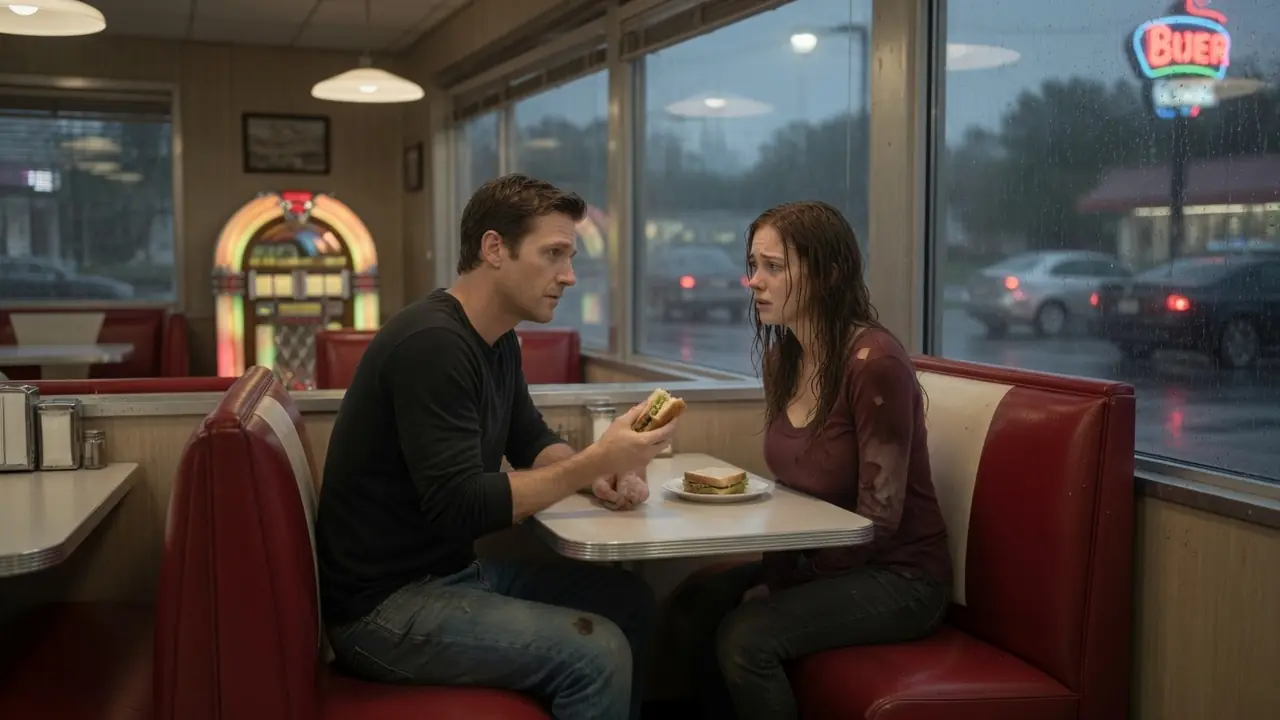
He ordered one grilled chicken sandwich, a cup of coffee, and an extra plate so he could divide the meal before leaving. His daughter, Lily, was waiting at their small apartment with their elderly neighbor, Mrs. Monroe, who watched her whenever Ethan’s shift ran late. The sandwich was not much, but he had promised Lily they would eat together and finish the science project spread across their kitchen table. He was carrying the paper bag toward the exit when he noticed the young woman sitting alone in the last red booth beside the rain-covered window.
She looked about twenty-five, though exhaustion made her appear older. Long wet brown hair clung to her pale cheeks, her burgundy shirt was torn near one shoulder, and her hands trembled around an empty glass of water. A waitress had placed a menu in front of her, but the woman had not ordered anything. She kept glancing toward the entrance each time the bell above the door moved, as though she expected someone dangerous to walk through it.
Ethan stopped beside her booth. “Are you waiting for someone?”
The woman looked up sharply and pressed herself against the wall. Fear appeared in her green eyes before she answered, and Ethan immediately stepped back to give her space. She shook her head but said nothing. Up close, he could see the faint discoloration along her wrist and a healing cut near her eyebrow.
“You look cold,” Ethan said. “I can ask them for a towel.”
“I’m fine.”
Her voice was barely audible.
Ethan glanced at the sandwich in his hand, then thought of Lily waiting at home. He had two boxes of cereal in the apartment and enough milk for breakfast if he watered it slightly. Lily would understand if he came home without the promised dinner, but the knowledge did not make the choice easier. His daughter had become too familiar with understanding things children should never have to consider.
He returned to the counter, asked the waitress for a plate, and divided the sandwich in half. Then he carried one portion to the booth and placed it on the table without sitting down. The woman stared at the food as if it were something dangerous.
“I didn’t ask for that,” she whispered.
“I know.”
“I have no money.”
“I didn’t ask.”
She looked from the sandwich to Ethan’s face. “Don’t feed me. Men never help a woman like me unless they expect something back.”
Ethan gently pushed the plate closer. “My daughter is waiting at home with half a dinner, but I’m still not leaving you here hungry.”
The woman’s expression changed when he mentioned his daughter. Some of the fear remained, but suspicion gave way to confusion. She looked toward the counter, where the waitress was sealing the other half of Ethan’s sandwich inside a paper bag.
“You really divided your own meal?”
“It seemed simpler than giving a speech.”
Her lips trembled. “You don’t understand. The man looking for me hurts anyone who gets involved.”
Ethan glanced toward the rainy windows. “Then he can come explain why a frightened woman had to hide from him in the first place.”
For several seconds, she did not move. Then she picked up the sandwich with both hands and took a small bite. Her eyes closed as she chewed, and tears immediately rolled down her cheeks.
Ethan turned away to preserve what dignity she had left. He asked the waitress to bring hot tea and placed his remaining cash beside the register. When he returned, the woman had eaten almost the entire half sandwich.
“My name is Clara,” she said.
“Ethan.”
“You should leave, Ethan.”
“I will. But not until I know you have somewhere safe to go.”
Clara lowered her eyes. “There is nowhere.”
Ethan sat on the opposite side of the booth, leaving as much distance between them as possible. He did not ask who had hurt her or why she was hiding. He knew from experience that frightened people often disappeared when questions came faster than trust.
Five years earlier, Ethan’s wife Rachel had died after a sudden aneurysm. One ordinary morning, she kissed Lily goodbye and left for work; by evening, Ethan was sitting beside a hospital bed while machines kept her body alive long after the doctors told him she would never wake. Since then, he had learned that pain did not always need advice. Sometimes it only needed another person willing to remain in the room.
“Is there a shelter nearby?” Clara asked eventually.
“The county shelter closes intake at eight.”
She glanced at the clock and looked defeated.
“There’s a twenty-four-hour women’s center in Brookside,” Ethan said. “It’s about fifteen miles away.”
“I can’t go near Brookside.”
“Why?”
Clara’s fingers tightened around the teacup. “He has people there.”
Ethan did not press further. He called a local crisis hotline, explained the situation without using Clara’s name, and asked whether an advocate could meet them at the diner. The volunteer promised someone would arrive within forty minutes.
Clara stared at him after he hung up. “Why are you doing this?”
“Because leaving you alone would bother me more than getting involved.”
“You don’t know me.”
“I don’t need your history to know you’re scared.”
She looked toward the parking lot again. A black sedan slowed near the diner entrance, and Clara dropped below the window line so suddenly that her tea spilled across the table.
Ethan moved between her and the glass. The sedan continued past without stopping, but Clara remained frozen.
“He drives a black car,” she whispered.
“Who?”
“My fiancé.”
The word sounded wrong in her mouth. It carried none of the tenderness or hope normally connected to it.
“Former fiancé?” Ethan asked.
Clara nodded. “I left him six days ago.”
She explained the rest in fragments. His name was Victor Lang, a forty-one-year-old real-estate developer whose public reputation rested on charity events, luxury towers, and photographs with important politicians. Privately, he controlled Clara’s phone, clothing, friendships, and access to money.
He had convinced her that dependence was love. When she questioned him, he accused her of being unstable. When she tried to leave, he apologized, bought expensive gifts, and reminded her that nobody else would tolerate her.
The violence began with a shove.
Then came bruises hidden beneath long sleeves, threats against friends, and nights spent locked inside a bedroom because Victor believed she had embarrassed him at dinner. Clara finally escaped after overhearing him arrange to send her to a private clinic under a false psychiatric diagnosis. She fled with no purse, no identification, and no idea where she could safely go.
“Why didn’t you contact your family?” Ethan asked.
Clara looked away. “Because Victor spent two years convincing them I wanted nothing to do with them.”
“They believed him?”
“He answered my messages. He told them I was traveling, busy, angry, or embarrassed by them.” She wiped at her face. “My mother kept trying, but every time she called, he stood beside me.”
“Then call her now.”
“I don’t remember her number.”
Ethan looked surprised.
“Victor changed my phone three times,” Clara explained. “Every contact was stored digitally. I stopped memorizing numbers because he said it was unnecessary.”
The diner door opened, and Clara flinched. A woman in a navy raincoat entered carrying an identification badge from a domestic-violence assistance organization. Her name was Nicole, and she spoke to Clara quietly before offering transportation to a confidential emergency residence outside the county.
Clara agreed only after Ethan promised he would not reveal where she had gone if anyone asked.
Before leaving, she stood beside the booth and looked at the remaining half of the sandwich in Ethan’s bag.
“Your daughter lost part of her dinner because of me.”
“My daughter will ask whether you ate.”
“What will you tell her?”
“The truth.”
Clara’s eyes filled again. “Tell her thank you.”
Ethan watched Nicole’s car disappear into the rain, then drove home with half a sandwich and an empty wallet. Lily was sitting at the kitchen table in purple pajamas, surrounded by cardboard planets and glue sticks. She looked at the small paper bag and immediately noticed something was different.
“Where’s the rest?”
“I shared it.”
“With who?”
“A woman who hadn’t eaten.”
Lily considered this. “Was she nice?”
“She was scared.”
“That’s not the opposite of nice.”
Ethan smiled and divided the remaining half again. They ate cereal afterward, finished Saturn’s rings, and went to bed later than either of them should have.
For the next two weeks, Ethan saw Clara almost every morning at Miller’s Diner. The women’s center provided temporary shelter, but she was terrified of staying in one place, so she returned to the diner because it was public and because Ethan had promised to check on her before work.
He brought whatever he could afford.
Some mornings it was toast. Other mornings it was an egg sandwich, oatmeal, or half of the lunch he had packed for himself. He always pretended the extra food had been ordered by mistake, and Clara always pretended to believe him.
Slowly, she began speaking more.
She told him that her full name was Clara Hayes. Her mother, Margaret Hayes, was the founder of a national medical-technology company and one of the wealthiest women in Illinois. Clara had grown up surrounded by drivers, private schools, and people paid to anticipate every inconvenience.
None of it had protected her from Victor.
In fact, the wealth became another weapon. He told Clara everyone approached her for access to her family, then isolated her under the excuse of protecting her. When she tried to contact her mother privately, Victor threatened to release edited recordings designed to make Clara appear unstable and addicted.
“I used to think rich women could always leave,” Clara said one morning.
“Money helps,” Ethan replied. “But fear can build a cage without locks.”
She looked at him. “How do you know what to say?”
“I usually don’t. I just know what not to say.”
“What’s that?”
“That you should have left sooner.”
Clara lowered her eyes.
Victor had been searching aggressively. Private investigators visited shelters, hospitals, and bus stations. Men followed two of Clara’s former friends, and her photograph appeared online beside claims that she was experiencing a mental-health crisis.
The story asked the public to contact Victor instead of law enforcement if she was seen.
Clara was terrified that anyone who recognized her would believe the polished man on television rather than the frightened woman in the diner. Ethan encouraged her to contact the police, but she refused. Victor donated heavily to several departments and claimed friendships with officers throughout the city.
Ethan did not tell her she was wrong to be afraid.
Instead, he documented everything she remembered. Dates, locations, names, injuries, threats, account numbers, and employees who may have witnessed Victor’s behavior. He bought a cheap notebook and gave it to her, telling her that memory became harder to erase once it existed on paper.
One morning, Clara noticed him checking the time repeatedly.
“You’re going to be late.”
“I’ll be fine.”
“You’ve said that three times.”
Ethan finally admitted that his warehouse supervisor had warned him about tardiness. If he was late again, he could lose weekend overtime, which paid most of Lily’s after-school expenses.
“Then stop coming,” Clara said.
“No.”
“You could lose your job.”
“I’ll come earlier.”
“You’re already here before sunrise.”
Ethan shrugged. “I’ve survived worse schedules.”
Clara looked down at the breakfast he had purchased for her. “You don’t have enough to keep doing this.”
“Enough is flexible.”
“No, it isn’t.”
“It has to be when you’re a single parent.”
Clara asked about Lily, and for the first time Ethan showed her photographs. Lily at a school science fair. Lily missing two front teeth. Lily asleep beside a pile of library books.
Clara smiled through tears. “She looks happy.”
“She’s good at finding happiness in cheap places.”
Ethan did not mention that their rent was overdue or that the electricity company had sent a final notice. He did not explain that his car’s transmission slipped whenever he turned sharply or that he sometimes skipped lunch so Lily could attend school trips.
His difficulties were not Clara’s burden.
Then, one Thursday morning, Clara failed to appear.
Ethan waited until he was late for work. He called Nicole, but the advocate could not reveal whether Clara remained at the confidential residence. She only promised to pass along a message if possible.
Clara did not appear Friday.
She did not appear Saturday either.
By Sunday, Ethan feared Victor had found her. He drove past the diner twice, checked local news reports, and called every hospital that would speak to him.
On Monday morning, Ethan sat in the same booth beside the window with untouched coffee cooling between his hands. He had nearly convinced himself Clara was gone forever when four black SUVs entered the parking lot.
Large men in dark suits emerged first.
Two sharply dressed attorneys followed, carrying leather cases. Every person in the diner turned toward the door as the group entered.
Ethan stood slowly.
Then Clara stepped through the entrance.
Her hair was clean and brushed, and she wore a simple cream coat over dark trousers. She looked stronger, but her hands trembled when she saw Ethan.
Behind her came a silver-haired woman in an elegant navy suit.
Clara crossed the diner before anyone could speak and wrapped both arms around Ethan. He remained still for one startled second, then gently returned the embrace.
“I thought he found you,” Ethan said.
“He almost did.”
The older woman stopped beside them. Her eyes moved across Ethan’s worn clothes, the cracked phone in his pocket, and the breakfast receipt showing one coffee purchased more than an hour earlier.
“I’m Margaret Hayes,” she said. “Clara’s mother.”
Ethan nodded. “I figured.”
One of the attorneys introduced himself as Benjamin Cole. He explained that Clara finally contacted a family lawyer using a number Nicole helped her locate. Margaret’s security team retrieved her from the shelter and placed her under federal protection after discovering that Victor’s private investigators were monitoring the building.
The notebook Ethan gave Clara became critical.
It contained enough specific details for investigators to secure warrants. Police recovered surveillance footage, controlled medications prescribed under false pretenses, edited audio recordings, and financial documents showing Victor had moved millions from Clara’s trust.
He had been arrested the night before.
Clara sat beside Ethan in the booth where they first met. “They found photographs of every injury,” she said. “He kept them to remind me what would happen if I left.”
Margaret’s face tightened, but she remained composed.
“She told us about you,” the attorney continued. “Every meal. Every morning. The crisis advocate. The notebook.”
Ethan glanced around at the people watching. “I didn’t do anything special.”
Clara reached across the table and placed her hand over his. “You treated me like I was worth helping when I had nothing to offer you.”
“That should be normal.”
“It wasn’t normal for me.”
Margaret sat across from him. “Mr. Walker, my daughter was missing for nearly three months. We spent millions searching and failed to reach her. You found her without looking and gave her the one thing none of our investigators could provide.”
“What was that?”
“A reason to trust someone again.”
She opened a folder and slid several documents across the table. One cleared Ethan’s outstanding debts. Another established a college trust for Lily. A third offered him a management position overseeing facilities and equipment maintenance at Hayes Medical Technologies, with a salary more than four times what he earned at the warehouse.
Ethan stared at the papers.
Then he pushed them back.
“No.”
Margaret looked genuinely surprised. “You have not read the terms.”
“I saw enough.”
“This is not charity.”
“It feels like payment.”
Clara’s expression fell. “You don’t want our help?”
“That isn’t what I said.”
“Then why refuse?”
Ethan looked at her carefully. “Because you don’t owe me your future for a few sandwiches. You survived Victor. You found the courage to call your family. You gave investigators the evidence. Don’t turn me into the man who saved you.”
Clara’s eyes filled.
“You reminded me I could save myself,” she whispered.
Ethan had no answer for that.
Margaret closed the folder. “Then perhaps we approached this incorrectly.”
She asked Ethan what kind of help he could accept without feeling purchased. He thought about Lily, the warehouse, overdue rent, and the constant exhaustion of living one emergency from collapse.
Finally, he said he would interview for the position like any other candidate. He would accept the salary only if he could perform the work, and Lily’s education fund would need to be structured as a scholarship available to children of other single parents.
Margaret smiled for the first time.
“Those terms are acceptable.”
Ethan earned the position.
His background in machinery, logistics, and warehouse safety made him more qualified than he realized. Within six months, he redesigned maintenance procedures that reduced workplace injuries and saved the company hundreds of thousands of dollars.
He did not become rich overnight.
He became stable.
The rent was paid on time. The electricity remained on. Lily received new shoes before the old pair split completely, and Ethan no longer counted slices of bread before packing her lunch.
Clara continued healing.
She testified against Victor, who was convicted of assault, unlawful confinement, fraud, and financial exploitation. The process was painful, but she entered the courtroom surrounded by people who believed her.
She visited Ethan and Lily often.
At first, Lily knew her only as “the lady from the diner.” Later, Clara became the person who helped with art projects, attended school plays, and remembered every birthday without an assistant reminding her.
One rainy evening, almost a year after their first meeting, the three of them returned to Miller’s Diner. They sat in the same red booth beside the window while traffic blurred outside.
Clara ordered two grilled chicken sandwiches.
When the food arrived, she divided one in half and placed part of it on Ethan’s plate.
He looked at her.
“What is this?”
“You shared yours first.”
“You don’t have to repay it.”
“I know.” Clara smiled. “That’s what makes sharing different from debt.”
Lily listened thoughtfully. “Dad says kindness doesn’t need receipts.”
Ethan raised an eyebrow. “When did I say that?”
“Last week when Mrs. Monroe tried to pay you for fixing her heater.”
Clara laughed.
The sound carried none of the fear Ethan remembered from the first night. She was no longer watching the door or flinching at every passing vehicle. The bruises had disappeared, but more importantly, so had the belief that she deserved them.
Ethan looked around the diner and considered how close he had come to walking past her.
He had been tired.
He had been hungry.
He had a daughter waiting at home and too little money to solve anyone else’s problems. Every practical reason told him to leave.
Yet kindness had never asked whether his life was convenient enough to make room for another person.
He gave Clara half a sandwich.
She found the strength to contact her family.
Her evidence exposed a dangerous man, while her family’s gratitude opened a door Ethan had been too exhausted to imagine.
But the greatest change could not be measured in salaries, cleared debts, or scholarships.
Clara learned that help did not always conceal control.
Ethan learned that accepting support did not erase dignity.
And Lily grew up knowing that even when a family had only one meal, compassion could make the table larger.
Outside, rain continued falling over the parking lot.
Inside, three people shared dinner beneath bright diner lights, no longer strangers and no longer alone.
Ethan had believed he was giving away half of the only meal he could afford.
In truth, he had been making room for a family none of them knew they needed.