One rainy night at a small diner, a single father was sitting alone after a long day, finally ready to eat the first real meal he had bought for himself in weeks.
For days, he had saved every spare dollar just to sit down at Murphy’s Diner and order a burger, fries, and a small milkshake, not for celebration, not for luxury, but because sometimes a tired man needed one small thing that felt like his own.
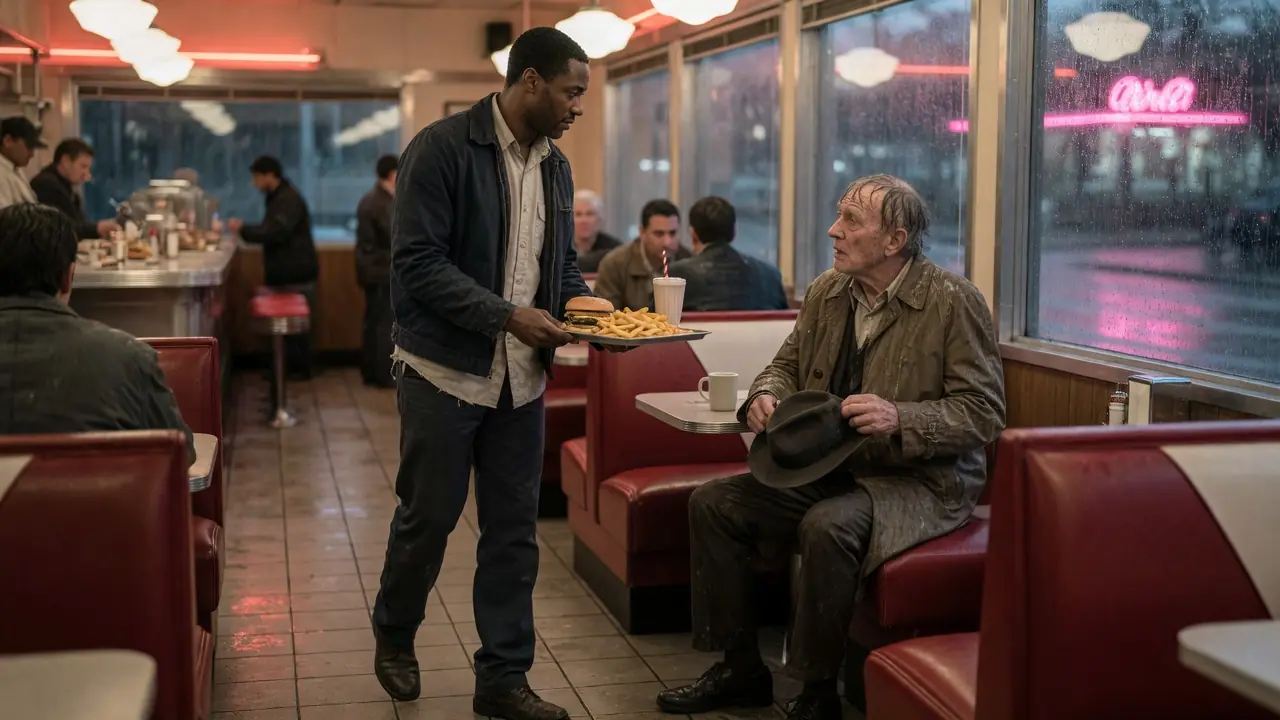
But just as he was about to take his first bite, an elderly man walked in from the rain, soaked through, shivering, and hungry, saying he had lost his wallet.
Daniel Carter hesitated.
He thought of his seven-year-old daughter waiting at home.
He thought of the overdue electric bill, the empty lunch container in his work bag, and the fact that this meal had taken him nearly two weeks to afford.
Then he pushed the plate across the table and gave the old man his only dinner.
A short while later, the stranger left a message for him on a napkin.
The words written there would become the turning point that changed Daniel’s life forever.
The evening rain had started before sunset, slow at first, then steady enough to blur the windows of Murphy’s Diner.
The sign out front, two pink neon letters flickering, buzzed like an old refrigerator. Inside, the place smelled of coffee, fried onions, wet coats, and the kind of old grease that had settled into the walls long before Daniel Carter ever stepped inside.
The dinner crowd had thinned to a few truck drivers, two nurses from the hospital down the street, and an older couple sharing pie near the front window.
Daniel sat in the last booth by the wall, still wearing his office shirt beneath a worn navy jacket. The collar was frayed on one side, and his sleeves were rolled up because one cuff button had cracked that morning.
At thirty-five, Daniel had the kind of tiredness that sleep could not fully fix.
It lived in his shoulders.
In the lines near his eyes.
In the way he checked the time even when he was sitting still.
He worked as an administrative assistant at a shipping office on the west side of town, answering calls, correcting invoices, scheduling deliveries, and handling the small problems no manager wanted to touch. It was not glamorous work, but it paid just enough to keep him and his daughter, Lily, in their small apartment on Elm Street.
Just enough.
That phrase had become the shape of his life.
Just enough for rent.
Just enough for groceries.
Just enough gas in the old car to make it to work if he did not drive anywhere unnecessary.
Just enough patience at night to help Lily with homework even when his head ached from staring at spreadsheets all day.
Lily was seven years old, bright-eyed, curious, and serious in the way children become when they learn too early that their parent is carrying too much.
Her mother had left three years earlier.
There had been no dramatic argument, no long goodbye, no honest explanation. One morning, Daniel had come home from dropping Lily at preschool and found a note on the kitchen table.
I can’t do this anymore.
That was all.
No forwarding address.
No apology that mattered.
No promise to call.
For weeks afterward, Lily had asked when Mommy was coming back. Daniel had answered gently at first, then carefully, then finally with the only truth he could give.
“I don’t know, sweetheart.”
Eventually, Lily stopped asking.
That hurt more than the questions.
Since then, Daniel had built a life out of routine.
Every weekday, he woke at 5:45.
He packed Lily’s lunch before she got up, usually peanut butter and jelly, apple slices, and whatever small treat he could afford from the discount shelf.
He made breakfast, braided her hair badly until she learned to do it herself, checked her backpack, signed reading logs, and walked her to the bus stop.
Then he drove to work, sat under fluorescent lights for eight or nine hours, smiled at people who barely saw him, and came home to be father, mother, cook, cleaner, tutor, and comforter.
He did not have much room left for himself.
Most nights, dinner was leftovers or toast.
Sometimes he ate standing at the counter after Lily went to bed because sitting down made him feel how tired he really was.
But this week, he had saved.
One dollar here.
Two dollars there.
No vending machine coffee.
No extra gas station snack.
No lunch out with coworkers when they invited him, though they rarely invited him anymore.
He had tucked the small bills into an envelope inside his glove compartment and written one word across the front.
Burger.
It felt childish.
It also felt necessary.
Friday night was usually pizza night for Lily. Daniel had promised her frozen pizza and a movie at Mrs. Alvarez’s apartment upstairs while he worked late on extra filing at the office. Mrs. Alvarez, a widowed retired nurse with sharp eyes and a soft heart, watched Lily sometimes when Daniel’s schedule broke.
When Daniel had finished the extra work, he picked up his envelope, counted the money, and decided that before going home, just once, he would sit down at Murphy’s Diner like a regular customer.
Not rushing.
Not calculating.
Not eating the crust Lily left behind.
Just one meal.
Sophia, the waitress with kind eyes and silver roots in her hair, noticed him sitting there with both hands wrapped around a glass of water.
“Well, look at you,” she said, sliding a menu onto the table even though he already knew what he wanted. “You finally came in to eat instead of just picking up coffee.”
Daniel smiled.
“Big night.”
“Don’t tell me. Burger and fries?”
“And a small shake.”
Sophia lifted her brows.
“Small? After all this buildup?”
“Let’s not get reckless.”
She laughed softly and tapped her pen against her order pad.
“Coming right up, sweetheart.”
Daniel leaned back against the booth.
Rain tapped steadily against the windows. Neon light reflected red and pink across the wet pavement outside. For the first time all week, nobody needed him for anything in that exact moment.
His phone buzzed.
A message from Mrs. Alvarez.
Lily finished her pizza and is watching the princess movie. Take your time.
Daniel stared at those three words.
Take your time.
He could not remember the last time anyone had said that to him.
When Sophia set the plate down, the burger was steaming, the fries golden, the shake cold enough to frost the glass.
Daniel looked at it and smiled like a man seeing proof that small mercies still existed.
“Looks beautiful,” he said.
Sophia grinned.
“Best review I’ve had all night.”
Daniel picked up a fry.
Before he could eat it, the bell above the door jingled.
A rush of wind and rain swept into the diner.
An elderly man stepped inside, gripping the doorframe with one trembling hand. His gray hair was plastered to his forehead, and his tan overcoat clung to him, soaked dark by the storm. Water dripped from the brim of his hat onto the floor.
He stood there for a second, blinking under the diner lights, as if he had forgotten where he was.
Sophia hurried over with a towel.
“Evening, sir. Rough night out there?”
The old man gave a weak smile.
“Rougher than I expected.”
His voice was gentle, educated, and strained by cold.
“I’m sorry to trouble you. I seem to have lost my wallet. I stopped for gas a few miles back, and I must have dropped it somewhere. My phone is dead, and I haven’t eaten since morning.”
Sophia’s face softened.
“Oh dear. Sit down and warm up first.”
He shook his head.
“I don’t want to impose. I only came in because I saw the light.”
“You’re soaked through,” Sophia said. “You sit.”
She guided him to a booth near the window.
Daniel watched quietly.
The old man lowered himself carefully, as though every joint hurt. His hands shook when Sophia placed a cup of coffee in front of him.
“I’ll just drink this and be on my way,” he said.
“Do you have someone to call?” Sophia asked.
“My son,” he said, then looked down. “But I don’t remember the number. It’s in my phone.”
“Let me see if we can find you a charger.”
Sophia moved behind the counter, searching through drawers.
The old man sat alone, rubbing his hands together. He looked toward the kitchen when a plate passed, and for one brief second, Daniel saw hunger cross his face before pride covered it.
Daniel looked down at his own meal.
The burger was still untouched.
The fries still hot.
His stomach tightened.
He had saved for this.
He had earned it.
He had not eaten a proper lunch that day, just crackers from his desk drawer and coffee that had gone cold before noon.
He thought of Lily.
He thought of the electric bill due Monday.
He thought of the white envelope in his glove compartment, now empty.
Then he remembered something Lily had said a week earlier when they passed a man holding a cardboard sign near the freeway ramp.
“Daddy, if everybody waits for someone else to help, then nobody helps, right?”
Daniel had not known what to say then.
Now he did.
He picked up the plate.
For one second, he hesitated.
Not because he did not want to help.
Because he was tired of always giving from places that were already empty.
But the old man’s hands were trembling around the coffee cup.
Daniel stood.
He carried the tray to the old man’s booth.
“Excuse me, sir,” he said softly.
The old man looked up.
Daniel set the burger, fries, and shake on the table.
“You can have this.”
The old man stared at him.
“Oh, no. I couldn’t possibly.”
“It’s fresh,” Daniel said. “I haven’t touched it.”
“I can’t take your dinner.”
“You can if I’m giving it to you.”
The old man’s eyes moved from the food to Daniel’s face.
There was something sharp beneath his exhaustion, something observant and steady.
“You don’t know me,” he said.
“No, sir.”
“And yet you would give me your meal.”
Daniel shrugged lightly, though the gesture felt heavier than it looked.
“I’ve been hungry before. I know it’s harder when people are watching.”
The old man’s lips parted slightly.
Daniel slid the tray closer.
“My daughter says if everybody waits for someone else to help, nobody helps. She’s usually right about things.”
Something changed in the old man’s expression.
Not surprise exactly.
Recognition.
“What is your daughter’s name?”
“Lily.”
“A good name.”
“Yes, sir.”
“And yours?”
“Daniel Carter.”
The old man nodded slowly.
“Harold Whitmore.”
Sophia appeared at Daniel’s side, holding a phone charger.
She took in the scene, the food now sitting in front of Harold, Daniel standing empty-handed beside the booth.
Her eyes softened.
“Daniel…”
“It’s all right,” he said.
The old man looked between them.
“You know each other?”
“He comes in sometimes,” Sophia said. “Not enough.”
Daniel smiled faintly.
“Budget doesn’t always allow it.”
Harold heard that.
Daniel wished he had not said it.
The old man’s gaze dropped to the plate.
“I really shouldn’t.”
Daniel reached into his jacket pocket and pulled out the last two dollars from the envelope, folded small.
“Take these too, if you need bus fare or a phone call.”
This time Sophia made a small sound behind him.
Harold looked at the money, then at Daniel.
“No,” he said quietly. “Keep that.”
Daniel placed the bills on the table anyway.
“For tonight.”
Harold’s hand trembled as it covered the bills.
“Mr. Carter,” he said, voice rough. “You have done more than you know.”
“It’s just a meal.”
“Sometimes a meal is not just a meal.”
Daniel did not know how to answer that.
He returned to his booth and sat down with only his glass of water.
His stomach growled.
Sophia appeared a moment later with a small bowl of soup.
“Don’t argue,” she said before he could speak. “Kitchen made too much.”
Daniel looked at her.
“Did the kitchen make too much, or are you lying to protect my pride?”
Sophia set down a spoon.
“Eat your soup.”
He did.
It was thin and salty and probably leftover from the lunch special.
It tasted like kindness.
Harold ate slowly.
Not greedily.
Carefully, as though honoring what had been given.
When he finished, he took a pen from inside his soaked coat and pulled a napkin from the dispenser.
He wrote something on it, folded it once, and stood.
Sophia had managed to charge his phone enough for him to call a driver, and headlights now waited outside the diner.
Before leaving, Harold walked to Daniel’s booth.
He placed the folded napkin on the table.
“If you ever wonder whether a small act matters,” Harold said, “read this.”
Daniel looked up.
The old man’s face seemed different now.
Still tired.
Still wet.
But no longer helpless.
“Good night, Mr. Carter.”
“Good night, Mr. Whitmore.”
Harold paused at the door.
“Tell Lily she is a wise girl.”
Then he stepped back into the rain and disappeared into the waiting car.
Daniel watched the taillights pull away.
Sophia came to stand beside him.
“That was strange.”
Daniel unfolded the napkin.
The handwriting was neat, pressed firmly into the cheap paper.
Harold Whitmore.
Whitmore Foundation.
215 Broad Street.
Under the address, one line had been written carefully.
Kindness given quietly is the only kind I trust.
Daniel stared at it.
Sophia leaned over his shoulder.
“Whitmore Foundation,” she murmured. “Why does that sound familiar?”
Daniel folded the napkin again and slipped it into his wallet.
“Probably some church charity.”
But the name stayed with him.
The walk home felt longer than usual.
The rain had softened to mist, and the streets glowed beneath the lamps. Daniel’s stomach was not full, but the soup had steadied him enough. He walked past the closed barber shop, the laundromat, and the empty lot where a grocery store used to stand.
When he reached the apartment building, he climbed the stairs quietly.
Mrs. Alvarez opened her door before he knocked.
“She fell asleep on the couch,” she whispered.
“Thank you.”
Inside, Lily was curled under a blanket, one hand tucked beneath her cheek, the princess movie still playing quietly on the television.
Daniel lifted her carefully.
She stirred.
“Daddy?”
“Go back to sleep.”
“Did you eat your burger?”
Daniel hesitated.
“No.”
Her eyes opened a little.
“Why not?”
“There was an old man who needed it more.”
Lily blinked sleepily.
“Was he hungry?”
“Yes.”
“Then that’s okay.”
He carried her to bed.
Before he left her room, she whispered, “Did he say thank you?”
“Yes.”
“Good.”
Daniel stood in the doorway for a moment, watching her sleep.
He thought of Harold’s trembling hands.
He thought of the napkin in his wallet.
He thought of the line written there.
Kindness given quietly is the only kind I trust.
The next morning, life did not transform.
No miracle arrived with sunrise.
The rent was still due.
The electric bill was still waiting.
The car still made a grinding noise when he turned left.
Daniel woke at 5:45, packed Lily’s lunch, searched for clean socks, and made oatmeal with water because the milk had run out again.
At work, the phones rang nonstop.
His manager, Paula, dropped a stack of overdue vendor files on his desk.
“Need these corrected before end of day.”
Daniel looked at the stack.
“These are from last month.”
“I know.”
“There are at least sixty pages here.”
“I know.”
He stayed late.
Again.
By the time he picked Lily up from Mrs. Alvarez’s apartment, she was doing math homework at the kitchen table with a serious frown.
“Dad,” she said when he came in, “what’s seven times eight?”
“Fifty-six.”
“Are you sure?”
“Pretty sure.”
“Mrs. Alvarez said you’re good with numbers.”
“I used to be better.”
Mrs. Alvarez looked at him over her glasses.
“Still are. You just don’t get paid like it.”
Daniel smiled tiredly.
“Story of many lives.”
That night, after Lily fell asleep, Daniel took out the napkin again.
He searched Whitmore Foundation on his phone.
The screen loaded slowly.
When the website opened, Daniel sat up straighter.
The Whitmore Foundation was not a small charity.
It was one of the largest private philanthropic organizations in the state.
Education.
Housing.
Community health.
Job training.
Small business grants.
The founder, Harold Whitmore, was a retired real estate developer and investor whose fortune had funded hospitals, libraries, and scholarship programs across the country.
Daniel stared at the photo on the website.
Harold stood beside a ribbon-cutting ceremony, wearing a dark suit, smiling gently.
The same man.
The same eyes.
Daniel lowered the phone.
His first thought was that he had been tested.
His second was anger.
Had Harold pretended to be helpless just to see what Daniel would do?
Had the lost wallet been real?
Had the hunger been real?
Did that matter?
He did not know.
He put the phone face down on the table and rubbed both hands over his face.
The next two days passed without contact.
Daniel told himself nothing would come of it.
Maybe Harold handed out napkins to everyone who helped him.
Maybe the whole thing had meant more to Daniel because he was tired.
On Thursday afternoon, he was called into Paula’s office.
For one terrifying second, he thought he was being fired.
Instead, Paula looked annoyed.
“There’s a woman downstairs asking for you.”
“For me?”
“Says she’s from the Whitmore Foundation.”
Daniel felt his stomach drop.
The lobby of Barrow & Klein Shipping smelled like carpet cleaner and printer toner.
A woman stood near the front desk, dressed in a tailored black coat, her dark hair pinned back, her posture straight and calm. She was in her early forties, perhaps, with intelligent eyes and an expression that suggested she noticed everything.
“Mr. Carter?” she asked.
“Yes.”
“I’m Evelyn Whitmore. Harold Whitmore is my father.”
Daniel’s mouth went dry.
“Is he all right?”
The question came before anything else.
Evelyn’s expression changed.
Just slightly.
“Yes. He’s all right.”
“Good.”
She studied him for a moment.
“He said that would be your first question.”
Daniel did not know what to say.
Evelyn continued, “Do you have ten minutes?”
“My lunch break starts in five.”
“I can wait.”
They sat outside on a bench near the small courtyard beside the office building.
The air was cold but clear.
Evelyn folded her gloves in her lap.
“My father told me what happened at Murphy’s Diner.”
Daniel looked away.
“He may have left out that he staged part of it.”
Evelyn did not flinch.
“He did not stage the storm. He did not stage his hunger. He did not stage losing his wallet, though I admit that part was complicated.”
Daniel looked back.
“What does complicated mean?”
“My father has early-stage memory loss. Some days are better than others. He hates being managed, hates drivers, hates assistants, hates being treated like an old man who once mattered. That night, he left a foundation meeting without telling anyone. He intended to walk two blocks. He walked nearly a mile in the rain, lost his wallet, and ended up at the diner.”
Daniel’s anger softened into something else.
“He really was lost.”
“Yes.”
“And hungry.”
“Yes.”
Evelyn’s voice lowered.
“He came home shaken. Not because of the storm. Because you gave him your meal and tried to give him your last two dollars.”
Daniel looked down at his hands.
“I didn’t know they were my last two dollars.”
“Were they?”
He gave a small, tired laugh.
“Close enough.”
 Evelyn was quiet for a moment.
“My father has spent forty years giving money away. Hospitals, schools, libraries. Very large things. Very public things. But he told me that night was the first time in years someone helped him without knowing his name.”
Daniel said nothing.
“He wants to meet you properly.”
“I don’t want money.”
“I know.”
“I mean it.”
“I believe you.”
That startled him.
Most people heard refusal as performance.
Evelyn seemed to hear it as fact.
“He does not want to hand you an envelope and insult you,” she said. “He wants to understand you.”
Daniel looked toward the office building.
“I’m not that complicated.”
“No?”
He thought of Lily, the bills, the job, the old dream of going back to school, the exhaustion he had hidden so long it felt like part of his body.
“Maybe a little.”
Evelyn smiled faintly.
“Dinner. Saturday evening. You and Lily, if you’re comfortable. My father insisted she be invited because he says she gave you the sentence that made you stand up.”
Daniel almost refused.
But then he thought of Lily asking if the old man had been hungry.
“What time?”
Saturday evening, Daniel ironed his only good shirt.
Lily wore a yellow dress Mrs. Alvarez had found at a church clothing exchange and insisted looked “too beautiful to leave in a closet.” She was nervous, though she tried not to show it.
“Are they rich rich?” she asked while Daniel tied his shoes.
“Yes.”
“Like people with stairs inside their house?”
“Probably.”
“Like more than one bathroom?”
“Definitely.”
Lily’s eyes widened.
“Wow.”
A black car arrived at 5:30.
Daniel nearly told the driver they could take the bus.
Lily gave him a look.
“Dad. Don’t be weird.”
He let the driver open the door.
The Whitmore house sat on a hill outside the city, surrounded by old trees and a long stone wall. It was not as flashy as Daniel expected. Large, yes. Elegant, certainly. But warm light glowed in the windows, and the front porch had rocking chairs with blankets folded over the backs.
Harold Whitmore met them at the door.
He looked better than he had at the diner, dressed in a cardigan and pressed shirt. But Daniel saw the same tremor in his hands, the same careful way he turned as if uncertain of his balance.
“Mr. Carter,” Harold said warmly.
“Daniel, please.”
“And this must be Lily.”
Lily held out her hand.
“My dad said you were hungry, so he gave you his burger.”
Harold took her small hand gravely.
“He did. It was an excellent burger.”
“Murphy’s makes good fries too.”
“They do.”
Evelyn appeared behind him, smiling.
“Come in before the cold steals the whole evening.”
Dinner was served in a room lined with bookshelves.
Lily tried very hard to use the correct fork and failed twice. Harold failed with her on purpose the second time, which made her giggle and relax.
Daniel noticed.
That mattered.
They spoke of simple things first.
School.
Murphy’s Diner.
Lily’s favorite books.
Daniel’s work.
Then, after dessert, Harold led Daniel to a smaller sitting room while Evelyn showed Lily a collection of old music boxes.
Harold lowered himself into a chair near the fire.
“I owe you an apology,” he said.
Daniel sat across from him.
“For what?”
“For letting you wonder whether that night was a test. It was not meant to be. But I can understand why it felt that way.”
Daniel leaned forward.
“Was the napkin a test?”
Harold smiled.
“No. That was an old man trying not to lose the name of someone who mattered.”
The answer disarmed him.
Harold looked into the fire.
“I built the Whitmore Foundation because when I was young, someone fed me when I had nothing. A woman at a roadside café gave me soup, bread, and a place to sleep by the stove. I promised myself that if I ever had money, I would build places where no one had to beg for warmth.”
He paused.
“I built many things. But lately, I fear I began managing kindness from too far away. Budgets. Reports. Ceremonies. I forgot what it felt like when one hungry person looked at another and chose mercy.”
Daniel’s throat tightened.
“I’m not sure I was merciful. I was just there.”
“That is often the difference,” Harold said. “Most people are there. Few notice.”
Evelyn entered then, carrying a folder.
Harold looked at Daniel.
“We would like to offer you something.”
Daniel stiffened.
“I told Evelyn I don’t want money.”
“This is not money,” Evelyn said. “It is work.”
She placed the folder on the table.
Daniel opened it.
The first page read:
Whitmore Foundation, Community Meals and Family Stability Initiative.
Program Coordinator Candidate: Daniel Carter.
He looked up.
Evelyn said, “We are opening a new family resource center near Riverside Mall. Food assistance, after-school meals, job training, emergency support for single parents, and community outreach. We need someone who understands working families, not from a report, but from life.”
Daniel stared at the folder.
“I’m an office assistant.”
“You understand scheduling, invoices, logistics, and people who are too tired to fill out six forms for help,” Evelyn said. “That combination is rare.”
Harold added, “You understand dignity.”
The salary listed on the second page made Daniel stop breathing for a moment.
It was more than double what he made.
Full benefits.
Flexible hours.
Childcare support.
Tuition assistance if he wanted to complete a degree in nonprofit administration or community development.
Daniel closed the folder.
“This is too much because of one meal.”
Harold shook his head.
“It is not because of one meal. It is because of what that meal revealed.”
Daniel stood and walked to the window.
Outside, the trees moved in the cold night wind.
He thought of his apartment.
His job.
Lily’s school.
His wife leaving.
Every year of holding things together with tape and prayer.
“What if I fail?” he asked quietly.
Evelyn answered from behind him.
“Then we adjust, learn, and continue. That is how work is done.”
He turned back.
“You make it sound simple.”
“It won’t be,” she said. “But you will not be alone.”
That sentence stayed with him.
You will not be alone.
Daniel accepted on a trial basis.
Not because he believed he deserved it.
Not yet.
But because Lily deserved to see her father walk through a door instead of standing forever outside it.
The first months were hard.
Daniel kept his old job for three weeks while transitioning into the foundation, which meant long days, late nights, and more coffee than was wise. But when he finally left Barrow & Klein, Paula gave him a stiff congratulations and admitted the office would be “less efficient without him.”
It was the closest thing to praise she had ever offered.
The Riverside Family Center began as a half-empty building that used to be a discount furniture store.
The floors were scratched.
The ceiling leaked in two places.
The back rooms smelled like cardboard and dust.
Daniel loved it immediately.
He walked through the space with a clipboard, imagining what each corner could become.
A meal hall.
A tutoring room.
A play area for children while parents met with counselors.
A small clinic office.
A job training lab.
A wall of shelves stocked with diapers, canned goods, school supplies, and warm coats.
Evelyn worked beside him often, sleeves rolled, hair pulled back, holding blueprints and asking blunt questions.
“Where will people enter if they’re ashamed to be seen asking for help?”
Daniel looked at her.
“That’s a good question.”
“It was yours yesterday.”
He smiled faintly.
“Side entrance then. But not hidden. Just quieter. Same welcome desk, same respect.”
Harold visited when he could.
Some days he was sharp, offering ideas and stories from decades of philanthropy. Other days, he repeated questions or forgot where he had set his cane. Evelyn handled those moments with patience, though Daniel saw how they hurt her.
One evening, he found her alone in the unfinished meal hall, standing beneath bare bulbs.
“You okay?” he asked.
“No.”
The honesty surprised him.
She looked toward the far wall.
“He remembered your daughter’s name today. Forgot mine for nearly ten minutes.”
Daniel did not offer easy comfort.
He knew better.
Instead, he stood beside her.
After a while, Evelyn said, “I spend so much time managing his care that I forget to grieve what is happening.”
Daniel nodded.
“When Lily’s mother left, everyone told me I had to be strong for her. They were right. But nobody told me strength with nowhere to go turns into loneliness.”
Evelyn looked at him.
“Yes,” she said softly. “Exactly.”
That was the beginning of their friendship.
Not dramatic.
Not sudden.
A shared moment in an unfinished building beneath harsh light.
Work continued.
Daniel learned faster than he expected.
He knew how to stretch money because he had done it at home for years. He knew which grocery suppliers offered real discounts and which only changed labels. He knew that families needed evening hours because working parents could not come at noon. He knew that children ate more when meals looked like care instead of charity.
He insisted the dining area have real plates when possible.
“Paper trays feel temporary,” he told the board. “Families already feel temporary enough.”
Some board members resisted.
Evelyn backed him.
The plates stayed.
Lily became part of the center before it opened.
She helped choose paint colors for the children’s room. She tested chairs by spinning in them until Daniel told her that was not a professional evaluation method. Harold taught her to play checkers in the corner office, though sometimes he forgot whose turn it was, and Lily patiently reminded him.
“He’s like a grandpa,” she told Daniel one night.
Daniel watched her carefully.
“Does that make you sad?”
She thought about it.
“No. It makes me feel like we found extra family.”
Extra family.
Daniel carried that phrase for days.
The Riverside Family Center opened on a clear morning in April.
The ribbon stretched across the front doors.
Reporters came.
City officials came.
Families from the neighborhood came, some curious, some cautious, some hungry enough to overcome pride.
Harold stood beside Daniel with one hand on his cane.
Evelyn stood on the other side, composed as always, though Daniel saw tears in her eyes.
When it was time to speak, Daniel looked at the crowd and nearly forgot every word he had prepared.
Then he saw Lily in the front row, holding Mrs. Alvarez’s hand.
She smiled.
He took a breath.
“This place began for me on a rainy night at Murphy’s Diner,” he said. “I thought I was giving away a meal. But what I learned is that kindness does not move in one direction. It circles back. It grows. It becomes a table large enough for more people.”
He looked at Harold.
“One man walked into the rain hungry. I happened to see him. That’s all. This center exists so fewer people have to wait for someone to happen to see them. We want to see them on purpose.”
The applause came slowly at first.
Then stronger.
Evelyn looked at him with something he could not name yet.
Respect, certainly.
Something warmer too.
The center filled quickly.
By the end of the first month, it served dinner to two hundred families a week.
By the third month, it had after-school tutoring, resume workshops, emergency grocery cards, and a support group for single parents that Daniel reluctantly attended before eventually helping lead.
The first time a father came in wearing the same exhausted expression Daniel had seen in his own mirror, Daniel sat with him for forty minutes.
The man’s name was Victor. He had two kids, a warehouse job, and an eviction notice folded in his back pocket.
“I don’t know how to ask for help,” Victor admitted.
Daniel slid a cup of coffee toward him.
“You just did.”
That became the center’s way.
No shame.
No speeches.
No making people prove their suffering beyond what dignity could bear.
Harold called it Daniel’s gift.
Daniel called it common sense.
Evelyn called it leadership.
Over the next year, Daniel’s life changed in ways both large and small.
He and Lily moved to a better apartment with reliable heat, a bedroom big enough for her books, and a kitchen table that did not wobble.
He bought himself new work shirts only after Lily placed one in the cart and said, “This is not optional.”
He began taking classes online using the foundation’s tuition program.
At night, after Lily slept, he studied nonprofit management, grant writing, and community systems while rain tapped against the window.
Sometimes, he thought of the burger he never ate.
It seemed impossible that so much had grown from something so small.
But it had.
Not magically.
Through work.
Through people.
Through one act becoming another.
His bond with Evelyn deepened slowly.
She was not like anyone he had known.
She was precise, reserved, and intimidating to people who mistook quiet for coldness. She spoke plainly, listened completely, and never offered comfort she did not mean.
Daniel found that restful.
She did not ask him to be less tired than he was.
He did not ask her to be softer than she was.
They became partners in the work first.
Then friends.
Then, so gradually that neither noticed the exact moment, something more.
One evening, nearly two years after the diner, Daniel found Evelyn in the center’s kitchen after closing, sleeves rolled up, washing plates alone.
“You know we have volunteers for that,” he said.
“I wanted quiet.”
He took a towel and began drying.
They worked side by side.
After a while, Evelyn said, “My father asked me today if you were my husband.”
Daniel nearly dropped a plate.
“Oh.”
“He was having a confused day.”
“Right.”
She kept washing.
“But after he asked, I realized I was not offended by the idea.”
Daniel went very still.
Evelyn looked at him then, water dripping from her hands.
“I am not good at this sort of conversation.”
“Neither am I.”
“Good. Then we can be awkward with equal standing.”
He laughed, and she smiled.
That was how love began for them.
Not with a grand confession.
With plates.
With honesty.
With two people who had spent years caring for others finally allowing themselves to be cared for too.
Lily approved immediately.
“She already acts like family,” she said.
Daniel raised an eyebrow.
“You’ve thought about this?”
“I’m seven, not unaware.”
By the time Lily was nine, Evelyn was at school plays, birthday dinners, center events, and Saturday pancakes. She never tried to replace Lily’s mother. She never forced affection. She simply showed up, again and again, until Lily trusted the pattern.
One rainy Friday night, three years after Daniel gave away his dinner, he took Lily and Evelyn to Murphy’s Diner.
Sophia greeted them with a grin.
“Well, if it isn’t the man who made a burger famous.”
Daniel groaned.
“Please don’t.”
Evelyn looked amused.
“I would like to hear this story in full.”
“You have heard it.”
“Not from Sophia.”
Sophia placed menus down.
“Oh, honey, I have details.”
They sat in the same booth where Daniel had once waited for his saved-up meal.
The neon still flickered.
The rain still blurred the windows.
Daniel looked across the table at Lily, older now, smiling over a milkshake, and Evelyn, who had somehow become part of the shape of his life.
He felt a quiet fullness that no meal could match.
Halfway through dinner, the door opened.
A young father stepped in carrying a toddler, both of them wet from the rain. The man looked embarrassed as he checked his pockets near the register.
“I’m sorry,” he said to Sophia. “I thought I had my card. I must have left it at home.”
The toddler cried softly against his shoulder.
Daniel stood before he thought about it.
Evelyn watched him with a small smile.
He walked to the counter.
“Put it on mine,” he said.
The young father turned.
“No, sir, I can’t.”
Daniel smiled gently.
“You can. Just pass it on someday.”
Sophia looked at him over the register.
“Still doing it, huh?”
Daniel glanced back at Lily.
She gave him a thumbs-up.
“Trying,” he said.
Years later, the Riverside Family Center expanded into three more locations.
Then five.
The Whitmore Foundation created a national model for family stability programs, built around the idea Daniel had spoken at the opening.
See people on purpose.
Harold lived long enough to visit the second center.
He stood in the meal hall, watching families eat from real plates, and cried quietly.
“I spent millions before I understood this,” he told Daniel. “You understood it with one burger.”
Daniel shook his head.
“Lily understood it. I just listened.”
Harold smiled.
“A wise girl.”
When Harold passed away, the funeral was small but full.
Families from the center came.
Staff came.
Children brought hand-drawn cards.
Daniel stood beside Evelyn as she delivered the eulogy.
“My father spent his life giving,” she said. “But near the end, he received something he did not know he needed. A stranger saw him, not as a name, not as a donor, not as an old man to be managed, but as a hungry person who deserved dignity. That moment brought him back to the heart of his own work.”
Her eyes found Daniel.
“And it brought us Daniel and Lily.”
Daniel held Lily’s hand and felt the circle close.
Not end.
Close.
When Daniel and Evelyn married the following spring, they held the ceremony in the courtyard of the first Riverside Family Center.
Lily walked between them, carrying the rings.
Sophia from the diner catered the reception and told everyone the burger story at least four times.
Mrs. Alvarez cried through the vows.
Daniel’s speech was short.
“Years ago, I thought kindness was something you gave when you had enough,” he said. “Then life taught me that sometimes kindness matters most when you don’t have enough. I gave away one meal. What I received was not money or reward. I received a wider life. A family. A purpose. A reminder that no act of care is ever wasted.”
Evelyn took his hand.
“I spent years building systems to help people,” she said. “Daniel taught me that systems only matter if they protect dignity. He taught me to see people on purpose. And he gave my father one of the last great gifts of his life, the gift of being helped without being diminished.”
Lily stood between them, smiling so hard her cheeks hurt.
The rain held off until evening.
Then, as guests gathered beneath tents and music played softly, a gentle rain began to fall.
No one ran from it.
Daniel stood at the edge of the courtyard, holding Evelyn’s hand, watching droplets shine beneath the lights.
Lily came up beside him.
“Daddy?”
“Yeah?”
“Do you ever wish you ate the burger?”
Daniel laughed.
Then he looked at the people gathered there.
Families from the center.
Friends.
Coworkers.
The old diner waitress who had fed him soup.
The daughter of the man he had helped.
His own daughter, who had taught him the sentence that started everything.
“No,” he said softly. “I think I got something better.”
Lily leaned against him.
“Told you helping works.”
He kissed the top of her head.
“You did.”
Long after the wedding, long after the first center became five, long after Lily grew tall and began writing college essays about community work and compassion, Daniel kept the napkin Harold had left him that night.
The ink faded slightly with time, but the words remained clear.
Kindness given quietly is the only kind I trust.
Daniel kept it framed in his office at the Riverside Family Center.
People often asked about it.
He would tell them the story.
Not as a miracle.
Not as proof that kindness always brings reward.
He was careful about that.
Sometimes kindness costs something and no one sees.
Sometimes you give the meal and still go home hungry.
Sometimes the world does not applaud.
But that does not make the kindness wasted.
Daniel would say, “The point is not that I helped a rich man and got lucky. The point is that I did not know who he was. That is the only reason the act meant anything.”
Then he would point toward the dining hall, where families sat at real tables, eating from real plates, laughing under warm lights.
“The reward came later. The right thing came first.”
And every rainy night, when the windows blurred and the neon sign from Murphy’s Diner flickered across his memory, Daniel thought of the man he had been that evening.
A tired single father.
Hungry.
Worried.
Counting every dollar.
Still willing, for one small moment, to stop counting long enough to see another person’s need.
That moment did not solve his life immediately.
It did not erase his grief.
It did not pay his bills the next morning.
But it opened a door.
And through that door came purpose, family, love, and the understanding that sometimes the smallest act of compassion can become the foundation of an entire life.
All because one single dad looked at a hungry old man on a rainy night and decided his dinner mattered less than another person’s dignity.