The fluorescent lights of the Maple and Maine Cafe buzzed with that familiar tired hum.
The kind of sound that becomes invisible after you have heard it for three years straight.
Ethan Cole knew that sound the way he knew the crack in the third tile behind the counter.
The way he knew exactly how long to let the coffee sit before it turned bitter.
The way he knew the precise angle to hold the butter knife so the toast would not tear.
He knew this cafe the way a prisoner knows his cell.
It was 5:47 a.m. on a Tuesday in late October, and the predawn darkness pressed against the windows like something trying to get in.
Ethan moved through his opening routine with mechanical precision.
Coffee machines gurgling to life.
The industrial refrigerator door squeaking on its hinges.
The cash register chiming its electronic greeting.
$13.23 an hour.
That was what his life was worth, apparently.
After taxes, after the child support payments that went to absolutely no one because Mason’s mother had vanished four years ago, after the rent on their cramped one-bedroom apartment, Ethan Cole was worth approximately $37 at the end of each month.
He had done the math multiple times at 3:00 a.m., mostly when sleep would not come and the ceiling above his pullout couch seemed to press down with the weight of every decision he had ever made wrong.
“You’re here early.”
Ethan looked up to see Marge Whitmore, the cafe’s owner, pushing through the back door with her usual expression of perpetual exhaustion.
She was 63 years old, had owned this place for 27 years, and possessed the remarkable ability to make every sentence sound like an accusation.
“Couldn’t sleep,” Ethan said.
“Hm.”
Marge hung her coat on the hook by the door to her office.
“That kid of yours keeping you up again?”
“Mason sleeps fine. Better than I do.”
“At his age, they should. Wait until he’s a teenager. Then you’ll really know what not sleeping looks like.”
She paused, studying him with those sharp gray eyes that missed nothing.
“You look like death warmed over, Ethan.”
“Thank you, Marge. That’s very kind.”
“I’m not paid to be kind. I’m paid to make sure this place doesn’t burn down and the health inspector doesn’t shut us down.”
She grabbed her apron from the hook.
“Linda called in sick again. You’re on double duty today.”
Ethan’s heart sank, but he kept his face neutral.
Double duty meant double the work for the same pay.
It meant being on his feet for 12 hours straight.
It meant getting home after Mrs. Patterson’s patience with babysitting Mason had worn thin.
It meant heating up whatever canned soup he could find.
It meant falling into bed so exhausted that his bones ached.
“Sure,” he said. “No problem.”
Marge gave him a look that suggested she knew exactly how many problems it actually was, but she said nothing.
That was the thing about Marge Whitmore.
She was not cruel exactly.
She was just someone who had run out of softness a long time ago, worn down by years of tight margins and difficult customers and employees who called in sick on the busiest days.
The cafe opened at 6:00 a.m. sharp.
And for the first hour, it was the usual parade of faces.
Construction workers getting their coffee before the morning shift.
A few elderly regulars who had nowhere else to be.
The young professional in the expensive suit who always ordered a complicated drink that took five minutes to make and tipped exactly 75 cents, as if there were some mathematical formula that determined generosity.
Ethan moved through it all with practiced efficiency.
But his mind was elsewhere.
It was on Mason.
Specifically, on the permission slip sitting on their kitchen counter that needed to be signed for a school field trip that cost $15 they did not have.
It was on the heating bill that was two weeks overdue.
It was on the worn soles of Mason’s sneakers and how much longer they could last before Ethan had to figure out which essential expense to skip this month.
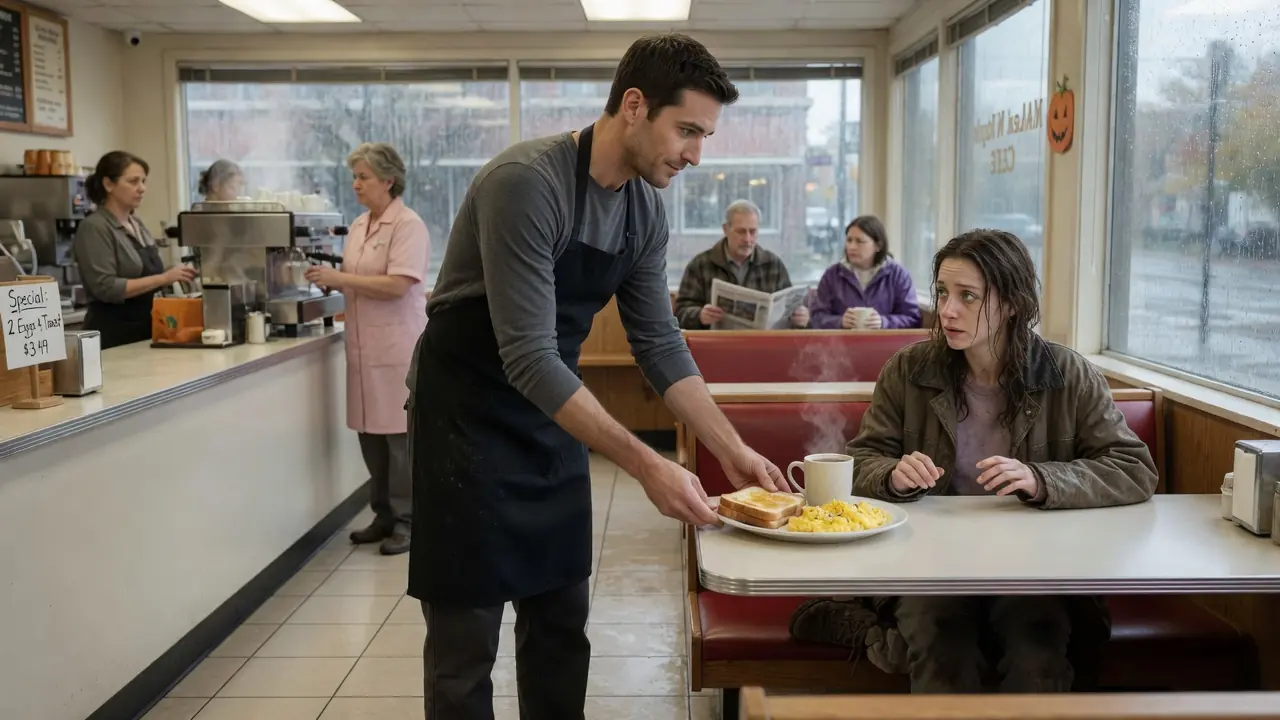
The bell above the door chimed at 7:23 a.m.
Ethan looked up automatically, the greeting already forming on his lips, but the words died somewhere in his throat.
She stood in the doorway like something washed ashore.
Soaking wet.
Hair plastered to her face in dark, tangled strands.
Clothes hanging off her thin frame in a way that made it impossible to tell what color they had originally been.
Rain dripped from her sleeves, forming small pools on the linoleum floor.
She could not have been older than 40, maybe 45, but there was something ancient in her eyes.
Something hollowed out.
She stood perfectly still, as if she had forgotten how to move forward, as if the simple act of entering a building was a task that required more energy than she possessed.
The cafe had gone quiet.
Not silent.
The coffee machine still bubbled.
The fluorescent light still hummed.
But the conversations had stopped.
Heads had turned.
Eyes had narrowed.
Ethan knew that look.
He had been on the receiving end of it himself years ago when his world had first fallen apart.
The look that said, “You don’t belong here. You’re not one of us. Please leave so we can go back to pretending people like you don’t exist.”
Marge emerged from the back, wiping her hands on her apron.
“Oh, for God’s sake. Not another one.”
She started toward the woman with her shoulders squared.
“Look, we’ve talked about this. You can’t just...”
“I’ve got it, Marge.”
The words were out of Ethan’s mouth before he fully understood he was going to say them.
Marge turned to look at him, eyebrows raised.
“Got what exactly?”
“I’ll handle it.”
“Ethan, we can’t have...”
“I’ll handle it,” he repeated.
There was something in his voice that made Marge’s objection die in her throat.
She stared at him for a long moment, then threw up her hands and retreated to the back.
Ethan grabbed a towel from behind the counter, one of the clean ones, not the ratty gray thing they used for spills, and walked slowly toward the woman in the doorway.
She flinched when he got close, her whole body tensing like a cornered animal preparing for a blow.
“Hey,” he said softly. “It’s okay. I’m just going to... here.”
He held out the towel.
“You’re soaked.”
She stared at the towel like it was a foreign object, like she had forgotten what kindness looked like.
“It’s clean,” Ethan added. “Promise.”
Slowly, so slowly it made his chest ache, she reached out and took it.
Her fingers were shaking badly, and he noticed that her nails were broken, bitten down to the quick.
“Thank you,” she whispered.
Her voice was hoarse, barely audible, like she had not used it in weeks.
“There’s a table in the back corner,” Ethan said, gesturing. “It’s warm over there. The heating vent runs right above it. Why don’t you sit down and I’ll bring you something hot to drink?”
She shook her head, a quick, jerky motion.
“I don’t... I can’t... I don’t have any...”
“It’s on me,” Ethan said. “Don’t worry about it.”
Her eyes lifted to his.
He saw now that they were a startling shade of green, vivid even in their exhaustion, filled with something that might have been hope or might have been fear.
With people like her, he had learned, the two often looked the same.
“Why?” she asked.
It was such a simple question.
Such an impossible one.
Ethan thought about all the answers he could give.
Because it was the right thing to do.
Because he had been where she was.
Because in three years of working at this cafe, he had learned that a cup of coffee cost approximately 17 cents to make, and charging someone $3 for it when they were clearly starving was the kind of cruelty he could not stomach anymore.
But what he said was, “Because it’s cold outside and you look like you could use it.”
She stared at him for a moment longer, then nodded and walked, shuffled really, her movement stiff and uncertain, toward the corner table.
Ethan went back behind the counter.
He could feel the eyes of the other customers on him.
Could hear the whispered conversation starting up again.
That’s Ethan, the guy with the kid.
Weird one.
Too soft for his own good.
He ignored them.
He poured a cup of coffee, the good stuff from the pot he had brewed fresh 15 minutes ago, and grabbed two slices of bread.
He put them in the toaster, waited for them to pop, and buttered them carefully all the way to the edges.
When he brought the coffee and toast to her table, her hands were shaking so badly that she could barely lift the cup.
She tried once.
Twice.
Three times.
Then she set it back down with a sound that might have been frustration or despair.
“Here,” Ethan said, pulling out the chair across from her. “Let me.”
He picked up the butter knife and the toast.
She had managed to hold one piece, but could not spread the butter, so he did it for her.
Slow, careful strokes, the way he did it for Mason when Mason was sick and needed taken care of.
“There you go,” he said, setting the toast down in front of her. “Careful. It’s hot.”
She picked up the toast and took a bite, and something in her face changed.
It was such a small thing, that bite.
Just bread and butter, the most basic food in the world.
But she closed her eyes while she chewed.
And when she opened them again, there were tears streaming down her face.
“I’m sorry,” she said, wiping at her cheeks with the back of her hand. “I’m sorry. I don’t... I haven’t...”
“You don’t have to explain anything,” Ethan said. “Just eat. Take your time.”
He should have gone back to work.
Marge would be watching, keeping track of how long he spent away from the counter.
But something kept him in that chair, watching the stranger eat toast like it was the first real food she had had in days.
Which he realized with a sick feeling in his stomach, it probably was.
“I’m Ethan,” he said after a while.
She looked up at him, and there was something guarded in her expression now.
Something careful.
“Harper,” she said finally. “My name is Harper.”
“That’s a pretty name.”
“My mother chose it.”
A pause.
“She said it meant harp player. She thought I’d grow up to be musical.”
A ghost of a smile crossed her face.
“I never learned to play a single instrument.”
“Neither did I,” Ethan said. “My mom wanted me to learn piano. Said it would build character. I lasted exactly three lessons before I announced I was quitting and becoming a professional baseball player instead.”
“Did you?”
“Did I what?”
“Become a professional baseball player?”
Ethan laughed.
A real laugh.
The first one he had managed in longer than he could remember.
“No. I became a professional coffee maker instead. Living the dream.”
Harper’s smile widened just a fraction, and it transformed her face.
In that moment, Ethan could see hints of who she might have been once, before the rain and the worn clothes and the trembling hands.
Someone vibrant.
Someone alive.
“Ethan.”
Marge’s voice cut through the moment like a knife.
Ethan turned to see her standing behind the counter, arms crossed, expression thunderous.
“Coming,” he called back.
He looked at Harper.
“I have to go, but...”
He hesitated.
“Will you be okay? Can I get you anything else before...?”
“This is more than enough,” Harper said softly. “This is more than I’ve had.”
She stopped herself and shook her head.
“Thank you, Ethan. Truly.”
He nodded and stood up, but something made him pause.
“Harper.”
She looked up at him.
“Tomorrow, same time, same place. I’ll have coffee ready for you.”
Her eyes widened.
“You don’t have to.”
“I know I don’t have to. I want to.”
He smiled.
“Besides, I make a mean piece of toast. It would be criminal not to share it with the world.”
He walked away before she could argue, before Marge’s glare could burn a hole through his back, before he could think too hard about what he was doing and why.
The rest of the day passed in a blur of orders and complaints and the endless rhythm of coffee, pour, smile, repeat.
By the time Ethan clocked out at 6:00 p.m., his feet were screaming and his back felt like it had been used as a punching bag.
He picked up Mason from Mrs. Patterson’s apartment two floors below theirs.
Mrs. Patterson was 72 years old, widowed, and had a deep suspicion of anything that had been invented after 1985.
But she loved Mason with a fierce protectiveness that made Ethan forgive every lecture she gave him about kids these days and their screens.
“He ate all his dinner,” Mrs. Patterson reported, handing Mason off at the door. “Including the broccoli. Didn’t even complain.”
“Really?”
Ethan looked down at his son, who was studiously avoiding his gaze.
“Mason, did you really eat the broccoli?”
“I hid it in my napkin,” Mason admitted in a whisper. “But I was going to eat it eventually.”
Mrs. Patterson snorted.
“Children think they’re so clever. I found it in my trash can, by the way, wrapped in exactly 14 napkins.”
Ethan tried to look stern, but Mason’s guilty expression was too adorable to maintain the facade.
“We’ll work on the broccoli,” he promised Mrs. Patterson.
Back in their apartment, which was really just a studio with a thin wall dividing the bedroom from the living area, both terms used generously, Ethan heated up canned chicken noodle soup while Mason sat at the foldout table doing his homework.
“Dad.”
“Yeah, buddy?”
“Tommy Kramer says that his dad makes $100,000 a year.”
Ethan stirred the soup, keeping his face neutral.
“Does he?”
“Yeah. And he says that means Tommy’s dad is a hundred times better than you because you only make...”
Mason frowned, doing the math in his head.
“Like, not $100,000.”
The spoon stopped moving in the pot.
Ethan stood very still for a moment, feeling something hot and sharp behind his ribs.
That might have been anger or might have been shame.
“Mason,” he said carefully. “Do you think how much money someone makes determines how good they are as a person?”
Mason thought about it.
“Tommy says it does.”
“And what do you think?”
“I think...”
Mason chewed on his pencil, a habit Ethan had tried and failed to break.
“I think Tommy’s dad isn’t home very much because he’s always working. And Tommy says he doesn’t remember the last time his dad played catch with him.”
Ethan turned off the stove and walked over to the table.
He crouched down so he was at eye level with his son.
“When’s the last time I played catch with you?”
Mason grinned.
“Yesterday in the hallway. Mrs. Patterson yelled at us.”
“That she did.”
Ethan ruffled Mason’s hair.
“Look, buddy. I’m not going to lie to you. We don’t have a lot of money. We probably won’t ever have a lot of money. But I promise you this. There is nothing in this world more important to me than you. Nothing. Not money, not work, not anything. You’re my number one priority. Always.”
Mason’s eyes were serious behind his too-big glasses.
“Even more than coffee?”
Ethan pretended to think about it.
“Well, coffee is pretty important.”
“Dad.”
“I’m kidding. I’m kidding.”
He pulled Mason into a hug.
“Yes, more than coffee. More than anything.”
They ate dinner together.
Soup and crackers, the same meal they had had three times that week.
Then Ethan helped Mason with his math homework.
Division.
Mason hated division.
He said the numbers did not make sense, that cutting things into pieces was mean.
“What if the numbers don’t want to be divided?” Mason asked, glaring at a problem involving 14 apples shared among seven friends. “What if they want to stay together?”
“Then they’ll have to work it out in therapy,” Ethan said. “Come on, focus. Fourteen divided by seven.”
“Two,” Mason grumbled. “But I’m registering my protest.”
“Noted and filed under things Dad will worry about later.”
After homework came bath time, then story time.
They were working through a battered copy of Charlotte’s Web that Ethan had found at a garage sale for 50 cents.
Then lights out.
Ethan sat on the edge of Mason’s bed, watching his son’s eyes grow heavy, and felt that familiar mix of love and terror that parenthood seemed to be composed of in equal measures.
“Dad.”
“I thought you were asleep.”
“Almost.”
Mason’s voice was dreamy, half in another world.
“Can you promise me something?”
“Anything, buddy.”
“Promise you won’t ever leave like Mom did.”
The words hit Ethan like a physical blow.
He forced himself to keep breathing, to keep his voice steady.
“I promise,” he said. “I’m not going anywhere. Ever.”
“Good.”
Mason smiled, his eyes fully closed now.
“Because I’d miss you a lot.”
“I’d miss you too, buddy. More than you know.”
He sat there long after Mason fell asleep, watching the rise and fall of his son’s chest, counting breaths, reminding himself that this was what mattered.
Not the money.
Not the exhaustion.
Not the way his body ached or the way his bank account bled.
This.
Harper came back the next morning.
She was waiting by the door when Ethan arrived to open up, standing in the gray light of predawn, looking slightly less like a drowned rat and more like a human being who had perhaps slept a few hours.
“You’re early,” Ethan said.
“You said same time.”
“I did, but I also have to actually make the coffee before I can serve it.”
Was that almost a smile?
It was hard to tell in the darkness.
“Come on,” Ethan said, unlocking the door. “You can keep me company while I set up.”
She followed him inside, her movement still hesitant, like a wild animal that had not yet decided if this was a trap.
Ethan flicked on the lights and went through his routine, and Harper sat in her corner booth, the same one from yesterday, and watched him work.
“Do you always open by yourself?” she asked after a while.
“Mostly. The morning shift is just me until eight, when the other staff come in.”
He measured coffee grounds into the machine.
“Marge, she’s the owner. She comes in around 6:00, but she spends the first hour doing paperwork in the back.”
“And you don’t mind being alone?”
Ethan shrugged.
“I like it, actually. It’s quiet. I can think.”
He paused.
“Plus, nobody bothers me about upselling pastries at 5:30 in the morning.”
“Is that a thing? Upselling pastries?”
“Oh, you have no idea. Marge has this whole system. Would you like a muffin with that coffee? These scones are fresh from the oven. Can I interest you in a croissant that costs more than my hourly wage?”
Harper actually laughed at that.
A small, rusty sound, like she had forgotten how laughing worked.
“You’re funny,” she said.
“I’m sleep-deprived. It’s easy to confuse the two.”
He brought her coffee and toast when they were ready, and she ate more slowly today, less desperately.
Her hands were still shaking, but not as badly as before.
“Can I ask you something?” Ethan said.
She looked up at him warily.
“Where did you sleep last night?”
The wariness deepened.
She set down her toast.
“You don’t have to tell me,” Ethan added quickly. “I’m not trying to pry. I just...”
He ran a hand through his hair.
“I have a kid, Mason. He’s seven. And I keep thinking, what if something happened to me? What if he ended up alone on the streets and there was no one to...”
He stopped himself.
“Sorry, I’m rambling.”
“There’s a shelter on Fifth Street,” Harper said quietly. “The beds are gone by 8:00, but if you get there early enough...”
She shrugged.
“It’s better than the alternatives.”
“How long have you been...?”
Ethan hesitated, not sure how to phrase it.
“Homeless?” Harper finished for him. “You can say the word. It’s not profanity.”
She wrapped her hands around her coffee cup, staring into its depths.
“Eleven months, though it feels longer. Time moves differently when you have nowhere to be.”
“What happened, if you don’t mind me asking?”
For a long moment, Harper said nothing.
Then, “Everything fell apart. That’s the short version. The long version is complicated.”
“Most long versions are.”
“I had a life once. A real one. A home, a career. People who cared about me, or at least I thought they cared about me. It turns out...”
She laughed bitterly.
“It turns out that when the money runs out, so do the people.”
Ethan nodded slowly.
“I know something about that.”
“Do you?”
“My wife left when Mason was three. Just walked out one day. Said she couldn’t do it anymore. The struggling, the scraping by, the constant stress. She said she felt like she was drowning and staying with us was only dragging her down further.”
He paused.
“Haven’t seen her since. Haven’t heard from her either. It’s like she just erased us. Like we never existed.”
Harper’s expression softened.
“I’m sorry.”
“Don’t be. We’re better off without her, honestly. At least now I know who’s really committed to this family.”
He smiled wryly.
“Even if this family is just me and a seven-year-old with strong opinions about broccoli.”
“Tell me about him. Mason.”
Ethan’s whole face changed when he talked about his son.
Lit up from within, animated in a way it had not been before.
“He’s incredible. Stubborn as hell, but incredible. He’s got this imagination, you know. He makes up these stories, these elaborate worlds with heroes and villains and talking animals. He wants to be a writer when he grows up. Or maybe an astronaut. Depends on the day.”
“A writer astronaut.”
“Best of both worlds. That’s what he says. He wants to write books about space. Firsthand experience required, according to him.”
Harper smiled.
A real smile this time, one that reached her eyes.
“He sounds special.”
“He is. He really is.”
Ethan glanced at the clock on the wall.
“I should get back to work. Marge will be out any minute, and if she catches me sitting down, she’ll dock my pay.”
“She can do that legally?”
“Probably not. Will she do it anyway? Absolutely.”
He stood up, but Harper caught his wrist.
Her grip was weak, barely there, but it stopped him.
“Thank you,” she said. “For all of this. The food, the conversation, for treating me like...”
She searched for the word.
“Like a person.”
“You are a person, Harper. Whatever you’re going through, whatever happened before, you’re still a person. Don’t forget that.”
Her eyes glistened.
She nodded once quickly and let him go.
The days turned into weeks.
Harper became a fixture at the Maple and Maine Cafe, arriving every morning with the first gray light of dawn, taking her seat in the corner booth.
Ethan always had her coffee ready.
Black, two sugars, exactly the way she liked it.
And toast with butter cut edge to edge.
They talked while he worked, brief conversations stolen between customers, longer ones when business was slow.
She told him about her love of classical music.
“Chopin,” she said. “His nocturnes feel like crying in a beautiful way.”
Her favorite books.
Anything Russian and tragic.
Her habit of watching pigeons in the park and making up stories about their lives.
“That one there,” she said once, pointing out the window at a fat gray bird pecking at the ground. “His name is Jeffrey. He’s a stockbroker. Very stressed. Bad divorce.”
Ethan laughed.
“And that one?”
“Beatrice. She’s Jeffrey’s therapist. She charges him 14 breadcrumbs an hour.”
He told her about Mason.
The good days and the bad.
The funny stories and the heartbreaking ones.
About how Mason had drawn a picture of their family for school and included a stick figure he called Miss Harper because Ethan had mentioned her once or twice at home.
“He drew me right between me and something that’s either a dog or a very large hamster. He’s still working on his animal anatomy.”
Harper’s face did something complicated.
Happy and sad all at once.
Joy and grief braided together so tightly they were indistinguishable.
“I’d like to meet him sometime,” she said softly. “If that’s okay.”
“I’d like that, too.”
They met on a Saturday at the park near Ethan’s apartment.
Mason was suspicious at first, seven years old and already old enough to understand that strangers were not always safe, but Harper won him over within minutes.
“Do you know how to make paper cranes?” she asked him, pulling a sheet of paper from her coat pocket.
“What’s a paper crane?”
“Only the most important origami animal in the entire world. Here, let me show you.”
She folded the paper with quick, practiced movements, her hands steady for once, and when she was done, a tiny crane sat in her palm.
Elegant.
Impossible.
Miraculous.
Mason’s eyes went wide.
“How did you do that?”
“Magic, but the kind of magic anyone can learn if they practice.”
“Will you teach me?”
“Of course, but only if your dad says it’s okay.”
Ethan watched them together.
Harper’s patience.
Mason’s concentration.
And he felt something shift in his chest.
Something that had been locked tight for a long time, loosening.
“Dad, look. I made one.”
Mason held up his crane.
It was lumpy and crooked, more origami blob than elegant bird.
But he was beaming like he had just won the lottery.
“That’s beautiful, buddy. Your first crane.”
“Miss Harper says if you make a thousand of them, you get a wish. Is that true?”
“It’s a Japanese legend,” Harper said. “A thousand origami cranes, senbazuru, and the gods grant you one wish.”
“What would you wish for?” Mason asked her.
Harper’s smile flickered just for a moment.
“I’m still figuring that out,” she said. “What would you wish for?”
Mason thought about it seriously, the way only children can.
“I’d wish for my dad to be happy,” he said finally. “Because he works really hard and he’s tired a lot, and I think he deserves to not be tired.”
Ethan had to look away.
The back of his throat burned.
“That’s a good wish,” Harper said softly. “A really good wish.”
The weeks became months.
Autumn turned to winter, and the mornings grew darker, colder.
Harper wore the same thin coat she had been wearing since October.
One day, Ethan showed up with an extra one, his own winter jacket, the one he had bought three years ago when money was slightly less tight.
“I can’t take this,” Harper said.
“You can, and you will. I have another one.”
He did not.
He had borrowed Mrs. Patterson’s late husband’s coat, but Harper did not need to know that.
“Ethan, please.”
“For me. I’ll worry about you freezing to death, and then I’ll be distracted at work, and then I’ll mess up someone’s order, and then Marge will fire me, and then Mason and I will be homeless too. Do you really want that on your conscience?”
She laughed despite herself and pulled on the jacket.
It was too big for her, hanging off her thin frame.
But her face, when she felt its warmth, made Ethan’s chest ache.
“Thank you,” she whispered. “For everything. You don’t know what this means.”
“You keep saying that. Thank you for everything. But I’m not doing anything special. I’m just...”
“You’re treating me like a human being,” Harper interrupted. “Like someone who matters. Do you know how rare that is? Do you know how long it’s been since anyone looked at me and saw me?”
Ethan did not have an answer for that.
So he just nodded and went back to making coffee.
One evening, after Mason was in bed, Ethan sat at the kitchen table and stared at the stack of bills in front of him.
The numbers swam before his eyes.
Rent.
Utilities.
Food.
Mason’s school supplies.
The credit card debt he had accumulated during the worst months after Rachel left.
He did the math again, hoping it would come out different this time.
It did not.
He was $400 short this month.
$400 that did not exist, that could not exist, that no amount of overtime or skipped lunches or creative budgeting would make appear.
He put his head in his hands and let himself, just for a moment, despair.
A knock at the door.
Ethan wiped his face quickly.
Grown men were not supposed to cry over bills, he told himself, even though he did it more often than he would ever admit.
He opened the door to find Mrs. Patterson standing there in her bathrobe.
“Everything okay, Mrs. Patterson?”
“I was going to ask you the same thing.”
Her sharp eyes took in his face, his red eyes, the bills visible behind him on the table.
“You look like something the cat dragged in and then thought better of.”
“I’m fine. Just tired.”
“Hm.”
She reached into her bathrobe pocket and pulled out an envelope.
“I found this in my mailbox. It was misdelivered.”
Ethan took the envelope.
It was addressed to him, but there was no return address, no stamp.
It had been hand-delivered.
“Thank you, Mrs. Patterson.”
“You should get some sleep. That boy of yours needs you at full capacity.”
“Yes, ma’am.”
He waited until she was gone before opening the envelope.
Inside was a stack of bills, $500 in twenties, crisp and clean, and a folded piece of paper.
The note was written in careful, elegant handwriting.
For Mason’s field trip and whatever else you need. You’ve given me so much more than coffee and toast. Please let me give something back. H.
Ethan read the note three times.
Then he sat back down at the kitchen table and cried.
Really cried.
The kind of crying he had not done since Rachel left.
Because in the middle of his darkest moment, someone had seen him.
Someone had seen him, and they had cared.
He tried to return the money the next morning, but Harper refused.
“Absolutely not.”
“Harper, I can’t accept this. You’re...”
He stopped himself before he said something hurtful.
“I’m homeless,” she finished calmly. “Yes. But that doesn’t mean I don’t have ways of getting money when I need it.”
“What kind of ways?”
“The legal kind.”
She smiled slightly.
“I wasn’t always like this, Ethan. I had a life before. Some parts of that life are still accessible to me occasionally.”
“I don’t understand.”
“You don’t need to understand. You just need to accept that the money is a gift freely given and that refusing it would hurt me far more than accepting it ever could.”
He searched her face for something.
Deception.
Ulterior motive.
Anything that would explain this impossible generosity from someone who had nothing.
He found only warmth, only sincerity, only kindness.
“Thank you,” he said finally. “I don’t know how I’ll ever repay you.”
“You already have, a thousand times over. Every cup of coffee, every piece of toast, every conversation that made me feel like a human being again.”
Her eyes glistened.
“I was drowning, Ethan. Before I walked into this cafe, I was drowning, and you threw me a lifeline. That’s worth more than any amount of money.”
Ethan reached across the table and took her hand.
It was cold, the fingers thin and fragile, but she squeezed back with surprising strength.
“We’re going to be okay,” he said. “Both of us. We’re going to be okay.”
She smiled, but there was something behind the smile, something he could not quite name.
Something that almost looked like goodbye.
“Yes,” she said softly. “I believe we are.”
Three days later, Harper asked Ethan a question that would stay with him for the rest of his life.
“If you could start over,” she said, “would you?”
They were sitting in the corner booth, the cafe empty in the lull between the morning rush and the lunch crowd.
Outside, snow was beginning to fall.
The first real snow of the season.
Fat flakes drifting past the window like something from a movie.
“Start over how?” Ethan asked.
“If you could go back, do things differently. Change the path that led you here.”
She gestured vaguely at the cafe, at herself, at everything.
“Would you?”
Ethan thought about it.
He thought about Rachel leaving, about the years of struggle, about every moment he had questioned whether he was doing right by Mason.
He thought about the nights he had lain awake wondering if his son would grow up damaged by the lack of money, the lack of stability, the lack of a mother who stuck around.
Then he thought about Mason’s laugh, about paper cranes and bedtime stories, about the way his son looked at him with complete, unconditional trust.
About this moment right now, with the snow falling and the coffee warm and Harper across from him asking questions that cut straight to the heart of everything.
“No,” he said finally. “I don’t think I would.”
Harper tilted her head.
“Really? Even with everything you’ve been through?”
“Everything I’ve been through led me here. To Mason, to this cafe, to...”
He hesitated.
“To you. And maybe that’s naive, or maybe that’s just the coffee talking, but I think we’re supposed to meet the people we meet. I think there’s a reason for all of it, even the hard parts. Especially the hard parts.”
Harper’s eyes were bright, and she was looking at him with an expression he could not quite read.
“You really believe that?”
“I really do.”
She reached across the table and took his hand again.
Her fingers were warm this time, warmer than they had ever been, and she held on like she was memorizing the feeling.
“You’re a good man, Ethan Cole,” she said. “A really, really good man.”
“I’m just trying to do my best.”
“That’s exactly what makes you good.”
She smiled, and there was something different about it.
Something final.
“Can you promise me something?”
“Anything.”
“Promise me that you’ll keep being this way. That you won’t let the world make you hard. That you’ll keep seeing people. Really seeing them, even when it would be easier not to.”
“Harper, why are you...?”
“Just promise me, please.”
He looked at her.
Really looked, trying to understand what was happening, why this conversation felt like a goodbye when she was sitting right in front of him.
And he saw the truth written in the lines of her face.
She was saying goodbye.
She was saying goodbye, and she was not going to explain why.
“I promise,” he said.
She squeezed his hand once more, then let go and stood up.
“I have to go,” she said. “But I’ll see you tomorrow. Same time, same place.”
“Harper.”
“I’ll see you tomorrow, Ethan.”
She walked out into the snow, and he watched her go until she disappeared around the corner, her borrowed jacket bright against the white.
That night, he could not sleep.
He lay awake for hours, staring at the ceiling, trying to shake the feeling that something had fundamentally shifted, that the world had tilted on its axis, and he was the only one who had noticed.
The next morning, Harper did not come.
Or the morning after that.
Or the morning after that.
On the third day, Ethan arrived at the cafe two hours early, before dawn, before even the first gray light.
He waited by the door, watching the street, counting the minutes.
She never came.
By the fourth day, the worry had turned to fear.
By the fifth, fear had become something closer to panic.
He called the shelter on Fifth Street.
No one by that name, they said.
He walked the streets near the cafe, asking anyone who would listen if they had seen a woman with green eyes and a too-big coat.
He did everything he could think of and came up with nothing.
On the sixth morning, Ethan woke to the sound of rain.
It was a cold rain, the kind that seeps into your bones and does not let go.
As he walked to work through the gray streets, he found himself bargaining with a God he was not sure he believed in.
Please let her be okay.
Please let her walk through that door.
Please.
He opened the cafe and went through his routine on autopilot.
Coffee machine.
Lights.
Register.
Toast.
The familiar rhythm was a kind of anesthesia, numbing the worst of the fear.
At 7:23 a.m., the door opened.
Ethan’s head snapped up, heart pounding, hope so bright it was almost painful.
But it was not Harper.
It was four men in black suits, faces hard, postures rigid.
Bodyguards.
The word registered somewhere in Ethan’s brain, though he could not have said why.
Behind them came two more people.
A man and a woman in gray suits carrying briefcases, their expressions carefully neutral.
Lawyers, Ethan thought.
Why do I know they’re lawyers?
The entire cafe had gone silent.
Every customer.
Every conversation.
All of it had stopped.
One of the lawyers stepped forward.
“Ethan Cole?”
Ethan’s mouth was dry.
His hands were shaking.
“That’s me.”
The lawyer nodded once.
“Is there somewhere private we can talk?”
“I... what is this about?”
The lawyers exchanged a glance.
The female one reached into her briefcase and pulled out a photograph.
A glossy professional headshot of a woman with green eyes and brown hair, wearing clothes that cost more than Ethan made in a year.
The woman in the photograph was smiling.
The woman in the photograph was Harper.
“I’m sorry to inform you,” the lawyer said, “that Harper Lane passed away two nights ago.”
The words did not make sense.
Ethan heard them.
Passed away two nights ago.
But they refused to arrange themselves into meaning.
“That’s not... that can’t be. I just saw her.”
“Please,” the lawyer said. “If we could speak somewhere private, there are matters we need to discuss. Matters concerning Miss Lane’s estate.”
“Estate?”
The word hung in the air, wrong and impossible.
Ethan felt the floor tilt beneath him.
“I don’t understand,” he said. “Harper wasn’t... she was homeless. She didn’t have an estate.”
The lawyers exchanged another glance, and something shifted in their expressions.
Something almost like pity.
“Mr. Cole,” the female lawyer said gently. “Harper Lane was worth $900 million.”
The world stopped.
Outside, the rain kept falling.
Inside, the coffee machine kept bubbling.
And Ethan Cole stood behind the counter of the Maple and Maine Cafe, trying to understand how everything he thought he knew had just been shattered into a thousand pieces.
$900 million.
The woman he had been feeding toast and coffee.
The woman who had slept in shelters and worn secondhand clothes and cried over a piece of buttered bread was worth $900 million.
And she was gone.
She was gone.
And she had left something behind for him.
The silence in the cafe stretched on for what felt like hours, though it could only have been seconds.
Ethan stood frozen behind the counter, his hands gripping the edge so hard his knuckles had turned white.
The words echoed in his skull, refusing to settle into anything resembling reality.
$900 million.
Harper Lane passed away two nights ago.
“Mr. Cole,” the female lawyer’s voice cut through the fog. “Perhaps we should sit down.”
Ethan nodded mechanically, his body moving without conscious thought.
He walked around the counter on legs that felt like they belonged to someone else and led the group to Harper’s booth.
Her booth.
The corner table where she had sat every morning, where they had talked about paper cranes and Russian novels and the secret lives of pigeons.
The bodyguards remained standing, two by the door and two flanking the table, their faces expressionless.
The lawyers slid into the booth across from Ethan, setting their briefcases on the table with a soft click.
“My name is Victoria Chen,” the female lawyer said. “And this is my colleague, Robert Hartley. We represent the estate of Harper Elaine Lane.”
“I don’t understand,” Ethan managed.
His voice sounded strange to his own ears, distant, hollow.
“Harper was homeless. She slept in shelters. She couldn’t even afford breakfast. How could she possibly be worth...”
“$917 million, to be precise,” Robert Hartley interjected.
He had a clipped, efficient way of speaking, as if every word cost money.
“Though that figure fluctuates somewhat depending on market conditions.”
Victoria Chen shot her colleague a look that suggested he had said the wrong thing, then turned back to Ethan with an expression of practiced sympathy.
“Mr. Cole, I understand this must be incredibly confusing for you. Perhaps it would help if we started at the beginning.”
“Please.”
The word came out as barely more than a whisper.
“Please, just tell me what’s going on. Tell me who she really was.”
Victoria Chen opened her briefcase and withdrew a thick manila folder.
She laid it on the table between them, and Ethan saw Harper’s name printed on the tab in neat official letters.
“Harper Elaine Lane,” Victoria began, “was born on March 15, 1979, in Greenwich, Connecticut. Her father, William Lane, was the founder and CEO of Lane Technologies, a semiconductor company that he built from nothing into one of the most successful tech firms on the East Coast. Her mother, Catherine, came from old money, the Ashworth family of Boston. Harper was their only child.”
Ethan listened, his mind struggling to reconcile the woman in this story with the trembling figure who had stood in the doorway of his cafe, soaked with rain, unable to butter her own toast.
“Harper attended the finest schools,” Victoria continued. “Boarding school in Switzerland, undergraduate at Yale, graduate work at Oxford. She was brilliant, genuinely brilliant. She had a gift for languages, spoke seven fluently, and could have done anything she wanted with her life. After Oxford, she returned to the States and began working at her father’s company, quickly rising through the ranks. By 30, she was being groomed to take over as CEO.”
“What happened?” Ethan asked. “How did she end up...?”
He could not finish the sentence.
Victoria’s expression tightened slightly.
“A series of tragedies, Mr. Cole. The kind that would break most people.”
She paused, as if considering how much to reveal.
“It started seven years ago with her father’s death. Heart attack, very sudden. Harper inherited everything. The company, the estate, the fortune. But along with the money came responsibilities she wasn’t prepared for and people who saw her inheritance as an opportunity.”
“What kind of people?”
“The wrong kind,” Robert Hartley said, leaning forward. “Within a year of her father’s death, Harper was engaged to a man named Marcus Webb. Charming, handsome, seemingly devoted to her. He was also, as we later discovered, a con artist who had specifically targeted her for her wealth.”
Ethan’s stomach turned.
“He used her?”
“Extensively. The marriage lasted three years. During that time, Marcus systematically isolated Harper from her friends, her extended family, anyone who might have noticed what was happening. He convinced her that the people in her life were only interested in her money. Ironic, given that he was the one bleeding her dry. By the time she discovered the extent of his manipulation, he had siphoned off nearly $40 million through a network of shell companies and fake investments.”
“But she was still wealthy,” Ethan said, trying to understand. “Even after losing $40 million, she still had hundreds of millions left. How did she end up homeless?”
Victoria and Robert exchanged a look that Ethan could not quite read.
“The money wasn’t the point,” Victoria said quietly. “The money was never the point. What Marcus took from Harper was far more valuable than $40 million. He took her ability to trust, her faith in humanity, her belief that anyone could love her for who she was rather than what she had.”
The words hit Ethan like a physical blow.
He thought of Harper’s face that first morning, the way she had flinched when he approached her, the disbelief in her eyes when he had offered her a simple cup of coffee with no strings attached.
“After the divorce,” Victoria continued, “Harper retreated from public life. She sold the company, liquidated most of her assets, and put everything into trust. She told us, her legal team, that she wanted to disappear. She said she needed to find out who she was without the money, without the name, without all the things that had brought the wrong people into her life.”
“So she became homeless on purpose.”
Ethan could not keep the incredulity out of his voice.
“Not exactly. It’s more accurate to say she chose anonymity. She lived simply, under the radar, moving from city to city. She had access to funds if she needed them, but she rarely used them. She wanted to see how the world treated people who had nothing. She wanted to understand what it felt like to be invisible.”
“For two years,” Robert added, “she lived on the margins of society. Shelters, soup kitchens, park benches. She kept detailed journals of her experiences, which she intended to publish someday as a commentary on wealth, inequality, and the treatment of the homeless in America.”
Ethan thought of all the mornings they had spent together, all the conversations about nothing and everything.
Not once had Harper mentioned writing.
Not once had she hinted at any of this.
“Why didn’t she tell me?”
The question emerged before he could stop it, carrying with it a weight of hurt he had not realized he was feeling.
“All those months, she never said a word. She let me believe she was just another person struggling to survive.”
Victoria’s expression softened.
“That’s precisely why she didn’t tell you, Mr. Cole. Because you believed it. Because you treated her exactly the same whether she had $900 million or $9. Do you understand how rare that is? How precious?”
Ethan shook his head slowly, not in denial, but in bewilderment.
“In her journals,” Victoria said, reaching into the folder and withdrawing a leather-bound notebook, “she wrote extensively about you, about this cafe, about the kindness you showed her when you had every reason not to. She called you...”
Victoria paused, flipping to a marked page.
“She called you the first genuinely good person I’ve met in years. Maybe the first genuinely good person I’ve ever met.”
The tears came then, sudden and hot, streaming down Ethan’s face before he could stop them.
He did not try to hide them.
There was no point.
“What happened to her?” he asked, his voice breaking. “How did she die?”
Victoria closed the journal gently.
“Cancer. Pancreatic. She was diagnosed eight months ago, shortly before she came to this city. The doctors gave her a year at most. She chose not to pursue aggressive treatment. Instead, she decided to spend her remaining time as she had been, anonymously, simply living among the people society had forgotten.”
Eight months ago.
That meant Harper had been dying the entire time he had known her.
Every cup of coffee.
Every piece of toast.
Every conversation.
She had been carrying the weight of her own mortality, and she had never said a word.
“She didn’t want sympathy,” Victoria said, as if reading his thoughts. “She didn’t want to be treated differently because she was dying. She just wanted to be seen, to be treated like a human being. And you gave her that, Mr. Cole. Every single day. You gave her that.”
Ethan wiped his eyes with the back of his hand, struggling to compose himself.
“You said there were matters concerning her estate. What did you mean?”
Robert Hartley reached into his own briefcase and withdrew a sealed envelope.
The paper was heavy, expensive, the kind of stationery Ethan had only ever seen in movies about wealthy people and their complicated lives.
“Ms. Lane left very specific instructions regarding the distribution of her estate,” Robert said. “The majority of her fortune is going to various charitable organizations, homeless shelters, food banks, medical research foundations. However, she also made provisions for certain individuals who had touched her life in meaningful ways.”
He slid the envelope across the table to Ethan.
“This is for you.”
Ethan stared at the envelope like it was a bomb about to detonate.
His name was written on the front in Harper’s elegant handwriting.
The same handwriting from the note that had accompanied the $500.
“Open it,” Victoria said gently. “It’s what she wanted.”
His hands trembling, Ethan picked up the envelope and broke the seal.
Inside were two items.
A folded letter and a check.
He looked at the check first.
$1 million.
The number stared back at him.
Impossible and undeniable.
More money than he would earn in 50 years of working at the Maple and Maine Cafe.
“This can’t be right,” he breathed. “This has to be a mistake.”
“No mistake,” Robert said. “Miss Lane was very clear in her instructions. $1 million to be paid directly to Ethan Cole. No conditions attached.”
Ethan set down the check with shaking hands and unfolded the letter.
Harper’s handwriting filled the page, and he could almost hear her voice as he read.
Dear Ethan,
If you’re reading this, it means I’m gone.
I’m sorry I couldn’t say goodbye properly.
I’m sorry for so many things, for the secrets I kept, for the truth I couldn’t tell you, for leaving without explanation.
But most of all, I’m sorry that I won’t get to see what happens next for you and Mason.
I would have liked that very much.
By now, Victoria and Robert have told you who I really was.
I imagine you’re confused, maybe even angry.
I wouldn’t blame you.
I lied to you every day for months, and that’s not something that’s easily forgiven.
But I hope you’ll understand why I did it.
All my life, I’ve been surrounded by people who saw me as a bank account with legs.
My wealth was the first thing they noticed and the only thing they cared about.
I learned early that money doesn’t buy happiness, but I also learned something worse.
Money buys loneliness.
The more you have, the less you can trust anyone’s motives, including your own.
When I met you, I was at the end of my rope.
Not just because of the diagnosis, though that certainly didn’t help, but because I had lost faith in humanity entirely.
I had decided that people were fundamentally selfish, that kindness was always transactional, that no one did anything good unless there was something in it for them.
And then you handed me a towel.
You buttered my toast.
You sat with me and talked to me like I mattered.
You didn’t know who I was.
You didn’t know what I had.
You just saw a person in need and you helped.
No questions, no conditions, no expectations.
Ethan, you have no idea how rare that is.
You have no idea what it meant to me.
The money I’m leaving you isn’t payment for your kindness.
Kindness like yours can’t be bought.
It’s a gift freely given because I want you to have the chance I never got.
The chance to start over without the weight of financial worry crushing you.
Use it to build a life for yourself and Mason.
Take him on the field trip.
Buy him new shoes.
Pay off your debts.
And maybe, if there’s anything left over, do something good for someone who needs it.
Not because you have to.
Because you want to.
You asked me once if I could start over, would I?
At the time, I wasn’t sure how to answer, but I’ve thought about it a lot since then, and I finally figured it out.
No, I wouldn’t change anything.
Because everything I went through, the pain, the betrayal, the loneliness, it all led me to that rainy morning when I walked into your cafe.
It led me to you.
And knowing you, even for these few short months, was worth every moment of suffering that came before.
You saw me, Ethan.
When the world refused to, you saw me.
Please don’t let my death change you.
Please don’t let it make you hard or cynical or afraid.
Keep being the person you are.
Keep buttering toast for strangers.
Keep seeing people when no one else will.
The world needs more people like you.
Thank you for everything.
Thank you for the coffee and the toast and the conversations.
Thank you for letting Mason fold paper cranes with me.
Thank you for treating me like a human being when I had forgotten I was one.
I’ll be watching over you both.
I believe that now, even though I’m not sure I believed it before I met you.
You taught me that there’s still good in the world.
That’s a gift no amount of money could ever repay.
Start over.
Build something good.
And remember me kindly.
With all my love,
Harper.
Ethan read the letter three times, tears streaming down his face, his heart breaking and mending and breaking again with every word.
When he finally looked up, Victoria Chen was watching him with an expression of genuine compassion.
“She cared about you very much,” Victoria said softly. “In all my years as her attorney, I never saw her write anything like that. Never saw her trust anyone the way she trusted you.”
“I didn’t know,” Ethan whispered. “I didn’t know any of it. I just... I just gave her coffee.”
“Sometimes that’s enough. Sometimes that’s everything.”
Robert Hartley cleared his throat, shifting uncomfortably in a way that suggested emotional displays were not his forte.
“There are some practical matters we need to discuss. The tax implications of the inheritance, the transfer of funds, paperwork that needs to be signed. But that can wait until you’ve had time to process all of this.”
“There’s one more thing,” Victoria said.
She reached into the folder and withdrew a small object wrapped in tissue paper.
“She asked us to give this to Mason.”
Ethan took the package and unwrapped it carefully.
Inside was a paper crane, but not an ordinary one.
This crane was made of gold, every fold and crease perfectly preserved, every detail exquisite.
It hung on a delicate chain, a pendant small enough for a child to wear.
“She had it commissioned months ago,” Victoria explained, “before she got too sick. She said Mason was the first person in years who had looked at her with wonder instead of suspicion. She wanted him to have something to remember her by.”
Ethan closed his hand around the golden crane, feeling its weight, its impossible preciousness.
“She knew she was dying,” he said. “All that time, she knew, and she never said anything.”
“She didn’t want pity. She wanted connection. She wanted to spend her final months being seen as a person, not a tragedy.”
Victoria paused.
“You gave her that, Mr. Cole. You have no idea how much that meant to her.”
The door to the back office opened and Marge Whitmore emerged.
Her expression was a complicated mixture of confusion and suspicion.
She took in the scene.
The bodyguards.
The lawyers.
Ethan sitting in the booth with tears on his face.
And she stopped dead in her tracks.
“What the hell is going on here?”
Victoria rose smoothly, extending her hand with professional grace.
“Mrs. Whitmore, my name is Victoria Chen. We’re here regarding a legal matter concerning one of your employees, Ethan.”
Marge looked between the lawyer and her employee, her confusion deepening.
“What did you do?”
“Nothing, Marge.”
Ethan stood up, clutching Harper’s letter in one hand and the golden crane in the other.
“I didn’t do anything. I just...”
His voice broke.
“I just made someone coffee.”
Marge stared at him for a long moment, and something in her expression shifted.
Maybe it was the tears on his face, or the way his hands were shaking, or the fact that four bodyguards were standing in her cafe like something out of a movie.
Whatever it was, when she spoke again, her voice was softer than Ethan had ever heard it.
“Well,” she said. “Whatever’s going on, you look like you need to sit down before you fall down. Can I get you anything? Coffee?”
Despite everything, despite the grief and the shock and the million emotions churning inside him, Ethan laughed.
It was a broken sound, halfway to a sob, but it was still a laugh.
“Yeah,” he said. “Coffee would be good.”
The next few hours passed in a blur of paperwork and explanations.
Victoria and Robert walked him through the legal process with patient efficiency, explaining everything twice when he could not focus, giving him space when the grief became too overwhelming.
The check would be deposited directly into his bank account.
There were no conditions, no restrictions.
The money was his to do with as he pleased.
By the time they left, the morning rush had come and gone, and the afternoon sun was struggling to break through the clouds.
Ethan sat alone in Harper’s booth, staring at the check in his hands, still unable to fully believe it was real.
A million dollars.
He could pay off all his debts.
He could move Mason into a real apartment with an actual bedroom instead of a corner separated by a curtain.
He could buy his son new clothes, new shoes, all the things he had been unable to provide.
He could start a college fund.
He could...
His mind stalled on the enormity of it.
He could do anything.
The door chimed, and Ethan looked up to see Marge standing awkwardly by the counter, a cup of coffee in each hand.
“Mind if I sit?”
Ethan nodded, and she slid into the booth across from him, setting one of the cups in front of him.
They sat in silence for a moment, neither quite knowing what to say.
“So,” Marge said finally. “That woman, the one you kept feeding breakfast to. She was some kind of secret millionaire.”
“Billionaire, actually.”
Marge’s eyebrows rose.
“Jesus Christ.”
“Yeah.”
“And she left you a million dollars because you gave her coffee and toast.”
Ethan took a sip of his coffee.
It was too hot, burning his tongue, but he barely felt it.
“She really liked the toast.”
Marge shook her head slowly, processing.
“I owe you an apology, Ethan.”
“For what?”
“For giving you grief about her. Every time you sat down with her, every time you spent a few extra minutes on her order, I was in the back counting the minutes, thinking about how you were wasting company time on some homeless woman who wasn’t even paying.”
“Marge.”
“Let me finish.”
She held up a hand.
“I was wrong. I was looking at her and seeing a liability, a nuisance, another mouth to feed without anything in return. But you...”
She paused, seeming to struggle with the words.
“You saw something else, something I missed entirely.”
“I just saw a person,” Ethan said quietly. “That’s all.”
“That’s everything.”
Marge met his eyes.
“In 40 years of running this place, I’ve forgotten that. Somewhere along the way, people stopped being people and started being customers. Revenue. Numbers on a spreadsheet.”
She sighed heavily.
“You reminded me of something I should have never forgotten.”
Ethan did not know what to say, so he just nodded.
“I suppose you’ll be quitting now,” Marge said. “With a million dollars, I can’t imagine you’ll want to keep making minimum wage, cutting toast.”
The thought had not even occurred to him.
He looked down at the check, then around the cafe.
At the cracked tile behind the counter.
At the buzzing fluorescent lights.
At the booth where Harper had sat every morning, teaching him that kindness did not require grand gestures, just attention and presence.
“I don’t know,” he said honestly. “I hadn’t thought about it.”
“Well, when you figure it out, let me know. I’ll need time to find a replacement.”
She paused.
“Though I doubt I’ll find anyone half as good as you.”
Coming from Marge, that was practically a declaration of love.
The rest of the day passed in a haze.
Ethan finished his shift on autopilot, his body going through the motions while his mind grappled with everything that had happened.
When 6:00 finally came, he clocked out and walked to Mrs. Patterson’s apartment to pick up Mason.
His son greeted him at the door with his usual enthusiasm, launching himself at Ethan’s legs with enough force to nearly knock him over.
“Dad. Dad. I drew a picture at school today. Want to see?”
“Always, buddy. Always.”
Mason produced a crumpled piece of construction paper covered in crayon.
There were stick figures everywhere.
Some at desks.
Some playing.
And one particularly tall figure that Ethan recognized as himself, standing next to a smaller figure that was clearly Mason.
“That’s you and me,” Mason explained unnecessarily. “And that’s my teacher, Mrs. Rodriguez. And that’s Tommy Kramer, but I drew him smaller than me because he was mean today, and I didn’t want to make him big.”
“Sounds fair.”
Ethan studied the drawing, trying to find the words.
“Mason, can we sit down? I need to tell you something.”
Mason’s face fell immediately.
“Am I in trouble?”
“No. No, buddy. You’re not in trouble. It’s just something happened today. Something important.”
They sat together on Mrs. Patterson’s couch while the elderly woman busied herself in the kitchen, pretending not to listen.
Ethan held his son’s hands and tried to explain about Harper, about who she really was, about what she had left them, about why she was gone.
Mason listened with the seriousness that only children can muster, his brow furrowed in concentration.
“So Miss Harper was rich,” he asked when Ethan finished.
“Very rich, yes.”
“But she didn’t have a house.”
“She chose not to have a house. She wanted to see what it was like to live without all the things money could buy.”
Mason thought about this for a long moment.
“That sounds lonely.”
“It was, buddy. It was very lonely until she came to our cafe.”
“And you gave her toast.”
“And I gave her toast.”
Mason nodded slowly, processing.
“Is she in heaven now?”
The question hit Ethan like a punch to the chest.
He thought about Harper’s letter, about her words.
I’ll be watching over you both. I believe that now.
“I think so,” he said, his voice thick. “I think she’s somewhere good.”
“That’s okay, then.”
Mason reached into his pocket and pulled out a crumpled piece of paper.
“Look, Dad. I made another crane. I’ve been practicing like Miss Harper showed me.”
Ethan took the paper crane, lopsided and imperfect and absolutely beautiful, and felt something break open in his chest.
“She left something for you, too,” he said, reaching into his own pocket. “She wanted you to have it.”
He held out the golden crane pendant, and Mason’s eyes went wide.
“Is that real gold?”
“Yes.”
“Like real, real gold?”
“Real, real gold.”
Mason took the pendant carefully, reverently, holding it up to the light.
The gold caught the glow from the window, sparkling like something magical.
“She made this for me?”
“She had it made for you because you were special to her. Because you looked at her with wonder instead of suspicion.”
“What does suspicion mean?”
“It means not trusting someone, thinking they might hurt you.”
Mason considered this.
“Why would anyone think Miss Harper would hurt them? She was nice.”
“I don’t know, buddy. Some people have trouble seeing the good in others.”
“That’s sad,” Mason said simply.
He slipped the chain over his head, adjusting the crane so it hung perfectly in the center of his chest.
“I’m going to wear this forever so she knows I remember her.”
Ethan pulled his son into a hug, holding him tight, feeling the weight of the day finally crash over him in a wave of exhaustion and grief and something that might have been hope.
“She knows, buddy,” he whispered into Mason’s hair. “I promise she knows.”
That night, after Mason was in bed, Ethan sat at the kitchen table with Harper’s letter spread out before him.
He read it again and again, memorizing every word, every loop and curve of her handwriting.
He thought about everything she had said, every piece of advice she had given him.
Start over.
Build something good.
The words echoed in his mind, settling into his bones.
He thought about the million dollars sitting in his bank account, more money than he had ever seen in his life.
He thought about all the ways he could use it.
The debts he could pay.
The things he could buy.
The security he could finally provide for his son.
But he also thought about Harper’s story, about how she had had $900 million and had still felt alone, still felt invisible, still felt like no one truly saw her.
Money could not buy what Harper had been searching for.
Money could not buy what he had given her with coffee and toast and conversation.
“Please don’t let my death change you,” she had written. “Please don’t let it make you hard or cynical or afraid. Keep being the person you are.”
Ethan folded the letter carefully and placed it back in its envelope.
Then he pulled out a sheet of paper, plain lined paper from Mason’s school supplies, and began to write.
He did not know exactly what he was going to say.
He did not have a plan, a mission statement, a clear vision of the future.
He just knew that Harper’s gift deserved more than personal comfort.
It deserved to become something bigger than himself.
The Harper Lane Foundation, he wrote at the top of the page.
The words looked strange.
Too official for a piece of lined paper.
Too ambitious for a single father who made minimum wage cutting toast.
But as he stared at them, something clicked into place.
Harper had spent her final months trying to understand what it felt like to be invisible.
She had wanted to know how the world treated people who had nothing.
Now he knew the answer, and he knew what he had to do about it.
He began writing, words flowing faster than thought.
Ideas for programs, for outreach, for ways to help people who had slipped through society’s cracks.
Homeless shelters that treated residents like human beings instead of problems to be managed.
Job training programs for single parents.
Financial literacy classes for people trying to rebuild their lives.
He wrote until his hand cramped and his eyes burned, until the first gray light of dawn began to creep through the window.
And when Mason woke up two hours later, rubbing sleep from his eyes and asking what was for breakfast, Ethan was still at the table, surrounded by pages of notes and plans and dreams.
“Dad, did you stay up all night?”
Ethan looked up at his son, at the golden crane hanging around his neck, at the confused but trusting expression on his face, and smiled.
“Yeah, buddy, I did.”
“Why?”
“Because Miss Harper gave me an idea. A really big idea, and I couldn’t sleep until I got it all down.”
Mason climbed into the chair next to him, peering at the papers with curious eyes.
“What kind of idea?”
“The kind that helps people. The kind that makes sure no one ever has to feel invisible again.”
Mason nodded seriously, as if this made perfect sense.
“Can I help?”
Ethan pulled his son into his lap, holding him close.
“Yeah, buddy. I think you can. In fact, I think Miss Harper would have wanted you to help. She believed in us, you know, both of us.”
“I believe in us, too,” Mason said. “And I believe in her, even if she’s in heaven.”
They sat together in the early morning light, father and son, looking at the pages spread across the table, looking at the beginning of something new.
Ethan thought about Harper, about her smile, her laugh, the way her eyes lit up when she folded paper cranes.
He thought about her final request, her final gift, her final lesson.
Use this chance.
Start over.
Build something good.
“I will,” he whispered, too quiet for Mason to hear. “I promise you, Harper. I will.”
Outside, the sun was rising over the city, painting the sky in shades of gold and pink.
It was going to be a beautiful day, a day for new beginnings, a day to start building something that would last.
The morning light had barely touched the windows of the Maple and Maine Cafe when Ethan pushed through the door three days later, his mind still churning with the plans he had been drafting in every spare moment.
He had not slept more than a few hours each night since the lawyers had come, since Harper’s letter had changed everything he thought he knew about his future.
The pages of notes had multiplied, covering the kitchen table, the floor around his pullout couch, even the margins of Mason’s old coloring books.
Marge looked up from the register as he entered, her eyes narrowing in that familiar expression of perpetual assessment.
But there was something different in her gaze now, something that might have been respect.
“You’re early again,” she said. “Third day in a row.”
“Couldn’t sleep.”
“Hm.”
She studied him for a moment longer.
“You look like you’ve got something on your mind. More than usual, I mean.”
Ethan hung up his coat and tied on his apron, going through the motions that had become as natural as breathing over the past three years.
But even as his hands moved automatically, his thoughts were elsewhere.
On Harper’s letter.
On the foundation he was planning.
On the enormity of what he was about to attempt.
“Marge, can I ask you something?”
“Depends on what it is.”
“How did you start this place? The cafe, I mean. How did you know you were ready to run your own business?”
Marge’s eyebrows rose, her expression shifting from suspicion to something more contemplative.
She set down the stack of receipts she had been sorting through and leaned against the counter.
“I didn’t know,” she said finally. “Not really. I was 26 years old, fresh out of a bad marriage, with nothing to my name but a small inheritance from my grandmother and a lot of anger at the world. I didn’t have a business plan or investors or any of the things you’re supposed to have. I just had an idea and enough stubbornness to see it through.”
“Were you scared?”
“Terrified. Every single day for the first five years, I woke up convinced this would be the day everything fell apart.”
She paused, a ghost of a smile crossing her weathered face.
“But it didn’t. Somehow, against all odds, it didn’t. And eventually, the fear turned into something else. Confidence, maybe. Or at least the ability to fake it well enough that no one could tell the difference.”
Ethan nodded slowly, absorbing her words.
“Why do you ask?” Marge’s eyes sharpened. “You thinking of leaving to start something of your own?”
“Maybe. I don’t know yet.”
He hesitated, then pulled out the folded pages from his pocket, the notes he had been working on, the rough outline of what he wanted to create.
“Can I show you something?”
Marge took the pages without comment and began to read.
Her face remained impassive, giving nothing away, but Ethan watched her eyes move across the words, watched her turn page after page without looking up.
When she finished, she set the papers down on the counter and was silent for a long moment.
“The Harper Lane Foundation,” she said finally. “You want to use her money to help homeless people.”
“Not just homeless people. Single parents, struggling families, anyone who feels invisible, anyone who’s fallen through the cracks.”
Ethan’s voice gained strength as he spoke, fueled by the conviction that had been building inside him since that first morning after the lawyers left.
“I want to create something that sees people the way Harper wanted to be seen, not as problems to be solved, but as human beings who deserve dignity and respect and a chance to start over.”
Marge studied him with an expression he could not quite read.
“That’s a big dream for a man who makes $13 an hour cutting toast.”
“I know, but Harper believed in me. She trusted me with this money, with her legacy. I can’t just deposit the check and go on with my life like nothing happened. That would be...”
He struggled for the right word.
“That would be betraying everything she stood for.”
“And what about Mason? What about your responsibilities to him?”
“This is for him, too.”
Ethan felt the words rising up from somewhere deep inside him, from a place he had not known existed until Harper’s letter had cracked it open.
“I want my son to grow up in a world where people help each other, where kindness isn’t weakness, where generosity isn’t stupidity. I want him to see his father doing something that matters, something that makes a real difference.”
Marge was quiet for a long time.
The coffee machine bubbled in the silence, and somewhere outside a car horn honked.
“You know,” she said finally, “when you first came to work here, I thought you were just another hard-luck case. Another single father with sad eyes and a chip on his shoulder, working a dead-end job because there was nothing else. I figured you’d last six months, maybe a year, before you burned out or gave up or found something better. And now...”
She picked up the papers and handed them back to him.
“Now I think I was wrong about you. I think you might actually be able to do this. But you’re going to need help. A lot of it. Do you have any idea how to start a nonprofit organization? The legal requirements, the tax implications, the bureaucratic nightmare of paperwork?”
Ethan’s heart sank slightly.
“Not really. I was hoping to figure it out as I went.”
“That’s not going to work. You need lawyers, accountants, people who know what they’re doing.”
Marge reached under the counter and pulled out a business card, sliding it across to him.
“My nephew. He’s a lawyer, specializes in nonprofit law. He’s not cheap, but he’s good, and he owes me a favor. Tell him Marge sent you.”
Ethan stared at the card, then back at Marge.
“Why are you helping me?”
“Because that woman, Harper, she saw something in you that most people miss. And if she thought you were worth a million dollars and her entire legacy, then maybe I should take another look, too.”
She paused, her expression softening almost imperceptibly.
“Besides, this town could use a foundation like the one you’re describing. God knows there are enough people falling through the cracks.”
The door chimed, and the first customer of the day walked in.
An elderly man in a worn coat who ordered the same thing he had ordered every morning for 15 years.
Ethan moved to serve him, but Marge waved him off.
“I’ve got this one. You go make some phone calls.”
Then Ethan turned back.
“And Ethan?”
“Yes?”
“Don’t quit on me just yet. I still need you for the morning shift until I can find someone half as good.”
For the first time in days, Ethan smiled.
“Thanks, Marge.”
“Don’t thank me. Just don’t screw this up.”
The following weeks were a whirlwind of activity that left Ethan exhausted and exhilarated in equal measure.
Marge’s nephew, a sharp-eyed attorney named David Chen, took on the legal work of establishing the foundation with an enthusiasm that surprised Ethan.
“This is exactly the kind of project I got into nonprofit law to do,” David said during their first meeting, spreading documents across the conference table in his downtown office. “Most of my clients want to set up vanity foundations, tax shelters disguised as charity, ways to put their names on buildings without actually helping anyone. But this...”
He tapped the mission statement Ethan had drafted.
“This is real. This could actually make a difference.”
The paperwork was staggering.
Articles of incorporation.
Bylaws.
Tax exemption applications.
Board member requirements.
Ethan spent hours in David’s office learning terminology he had never heard before, signing documents he barely understood, trusting that the process was moving in the right direction.
“You’ll need a board of directors,” David explained during one of their sessions. “At least three people to start, ideally more. They’ll provide oversight, help with fundraising, lend credibility to the organization. Do you have anyone in mind?”
Ethan thought about it.
“Victoria Chen. The lawyer who handled Harper’s estate. She knew Harper better than almost anyone, and she seemed to care about what happened to the foundation.”
“Good choice. Anyone else?”
“Marge Whitmore. She owns the cafe where I work, where Harper used to come every morning. She’s practical, no-nonsense, and she knows this community better than anyone.”
David nodded approvingly.
“That’s a solid start. One more. Ideally, someone with financial experience, a banker, an accountant, someone who can keep an eye on the money side of things.”
The third board member came from an unexpected source.
Mrs. Patterson, upon hearing about Ethan’s plans during one of their daily handoffs of Mason, revealed that she had spent 30 years working as a bookkeeper before retiring.
“I may be old,” she said, fixing Ethan with her sharp gray eyes. “But my mind is still sharp enough to spot a numerical discrepancy at 50 paces. If you need someone to make sure the money goes where it’s supposed to, I’m your woman.”
“Mrs. Patterson, I couldn’t ask you to...”
“You’re not asking. I’m offering. That woman, Harper, she sounded like someone special. And if this foundation is going to honor her memory, then it needs to be run properly. No cutting corners, no sloppy bookkeeping, no room for anyone to question where the funds are going.”
Ethan felt something loosen in his chest.
A tension he had not known he was carrying.
“Thank you,” he said. “Really. Thank you.”
“Don’t thank me yet. I’m a hard taskmaster. Ask my late husband.”
A ghost of a smile crossed her face.
“Actually, don’t ask him. He’s been dead for 12 years. But if he were here, he’d tell you I don’t suffer fools or sloppy math.”
With the board assembled, the foundation began to take shape.
Ethan worked every spare moment.
Mornings at the cafe.
Afternoons in meetings with David and potential partners.
Evenings drafting program proposals and budgets while Mason did homework at the kitchen table.
“Dad, what’s a grant application?” Mason asked one night, peering over Ethan’s shoulder at the laptop screen.
“It’s how you ask people for money to do good things.”
“Like when I ask you for ice cream money?”
Ethan laughed.
“Sort of. Except instead of ice cream, we’re asking for money to help people who don’t have homes or jobs or enough food to eat.”
Mason thought about this.
“That sounds more important than ice cream.”
“It is, buddy. A lot more important.”
“But you could still get ice cream, too, right? Like after you help the people, maybe if there’s money left over.”
“I hope there’s money left over,” Mason said seriously. “Ice cream is pretty important, too.”
The foundation’s first office was a donated space above a dry-cleaning shop on the same block as the cafe.
It was small, barely bigger than Ethan’s apartment, with water-stained ceiling tiles and windows that rattled in the wind.
But it was theirs.
And when Ethan stood in the empty room for the first time, he felt something he had not felt in years.
Hope.
Victoria Chen helped him order the furniture.
A few desks.
Some filing cabinets.
A conference table that had seen better days.
Mrs. Patterson took charge of setting up the accounting systems, arriving each day with a briefcase full of ledgers and a no-nonsense attitude that terrified the vendors who tried to overcharge.
Marge, true to form, contributed in her own way, sending over coffee and leftover pastries from the cafe, offering gruff advice about dealing with difficult people, and occasionally showing up unannounced to inspect the progress.
“Not bad,” she said during one such visit, looking around the office with a critical eye. “Needs more plants. Places like this always need more plants. Makes it feel less like a prison.”
“I’ll add it to the list,” Ethan said.
“See that you do.”
She paused at the door, looking back at him with an expression that was almost proud.
“You’re really doing this, aren’t you? Actually making it happen.”
“Trying to.”
“Harper would be proud of you, for what it’s worth.”
Coming from Marge, those words meant more than any amount of funding or official recognition.
Three months after the lawyers had walked into the cafe, the Harper Lane Foundation officially opened its doors.
The launch event was modest, just a gathering of the people who had helped make it happen, plus a few local journalists who had heard about the mysterious homeless heiress and the single father who had inherited her fortune.
Ethan gave a short speech, his voice only shaking a little as he told Harper’s story and explained the foundation’s mission.
“Harper Lane spent the last two years of her life living among people society had forgotten,” he said, gripping the podium to steady his hands. “She wanted to understand what it felt like to be invisible, to be overlooked, to be treated as less than human. She found out, and it nearly destroyed her.”
He paused, looking out at the small crowd.
Mason was in the front row wearing his golden crane pendant, watching his father with wide, serious eyes.
“But she also found something else. She found that kindness exists even in the darkest places. She found that some people will help you without expecting anything in return. She found that connection, real human connection, is possible even when you have nothing.”
His voice caught, and he had to stop for a moment to compose himself.
“Harper left me a million dollars and a letter asking me to build something good. This foundation is my answer to that request. We’re going to help homeless women, struggling single parents, anyone who feels invisible and alone. We’re going to see people the way Harper wanted to be seen, as human beings deserving of dignity and respect. And we’re going to honor her memory by creating the kind of world she wanted to live in.”
The applause was modest but genuine.
After the speeches, as people mingled and drank coffee from the donated urn, Victoria Chen approached Ethan with a manila envelope.
“There’s something I need to tell you,” she said quietly, drawing him aside. “Something I’ve been holding back until the foundation was established.”
Ethan’s stomach tightened.
“What is it?”
“Harper left more than just the million dollars for you personally. She also designated a significant portion of her estate, $100 million, to be used as an endowment for the foundation, to be released once it was officially operational.”
The number hit Ethan like a physical blow.
He actually staggered, reaching out to steady himself on a nearby desk.
“$100 million.”
“She wanted to make sure the foundation had the resources to truly make a difference, not just for a few years, but for generations.”
Victoria handed him the envelope.
“The paperwork is all here. The funds will be transferred to the foundation’s account within the week.”
Ethan opened the envelope with shaking hands and found another letter inside.
Shorter than the first.
Written in Harper’s now familiar handwriting.
Dear Ethan,
If you’re reading this, it means you actually did it.
You took my gift and turned it into something real.
I knew you would.
This money isn’t charity.
It’s an investment in you, in your vision, in the world I hope you’ll help create.
Use it wisely.
Hire good people.
Build something that will last long after both of us are gone.
And remember, it’s not about the money.
It was never about the money.
It’s about seeing people.
Really seeing them.
That’s the hardest thing in the world and the most important.
I’m proud of you, Ethan Cole.
More than you’ll ever know.
Love always,
Harper.
Ethan read the letter twice, then folded it carefully and put it in his pocket next to the first one.
He would keep both letters with him always, a reminder of what he was fighting for and why.
“Are you okay?” Victoria asked, her voice gentle.
“Yeah.”
He wiped his eyes with the back of his hand.
“Yeah, I think I am.”
The first year of the Harper Lane Foundation was a learning experience in every sense of the word.
There were triumphs and setbacks, moments of incredible progress and periods of crushing frustration.
Ethan made mistakes, plenty of them, but he also learned, adapted, grew.
The foundation’s first program was a pilot partnership with local homeless shelters, providing not just beds and meals, but comprehensive support services.
Case managers who treated clients with dignity.
Job training programs that actually led to employment.
Financial literacy classes that helped people rebuild their lives from the ground up.
Ethan spent hours visiting the shelters, talking to the residents, listening to their stories.
He heard about lost jobs and broken families, about addictions and mental illness, about the thousand small disasters that could send anyone spiraling down into homelessness.
He heard about the indignities they faced every day, the averted eyes, the cruel comments, the way society treated them as problems rather than people.
And he thought of Harper living among them, experiencing everything they experienced, trying to understand.
“You’re different,” a woman named Sandra told him one evening at the Fifth Street Shelter, the same shelter where Harper had sometimes stayed.
Sandra was in her 50s, gray-haired and weathered, with eyes that had seen too much.
“Most people who come here with money, they want to feel good about themselves. They give us things and take pictures and then go back to their comfortable lives. But you actually listen.”
“I had a good teacher,” Ethan said.
“The woman who started all this? Harper?”
“You knew her?”
Sandra nodded slowly.
“She stayed here a few times during the worst weather. Kept to herself mostly, but she was kind. Helped me once when I was having a bad night. Sat with me until morning, just talking. Never asked for anything in return.”
Ethan felt his throat tighten.
“That sounds like her.”
“When I heard about the foundation, about who she really was, I couldn’t believe it. All that money, and she chose to live like us.”
Sandra shook her head in wonder.
“I asked her once why she was here, and you know what she said? She said she was trying to remember what it felt like to be human.”
“Did she find it?”
“I don’t know. But I think maybe she was looking in the wrong place.”
Sandra met his eyes.
“Being human isn’t about suffering. It’s about connection. And she had that at the end, with you. With the little boy. She told me about your son. She talked about Mason all the time. She said he looked at her like she was magic.”
Sandra smiled, and for a moment the weariness fell away from her face.
“I think that’s what she needed more than anything. Someone to look at her with wonder instead of pity.”
That conversation stayed with Ethan for a long time.
He thought about it during the long days and longer nights.
During the board meetings and fundraising events.
During the moments when the work seemed overwhelming and impossible.
He thought about it when the foundation opened its first transitional housing facility, a converted apartment building that provided not just shelter, but a pathway to independence.
Twenty units for families in crisis with on-site child care, job placement services, and the kind of support that actually helped people get back on their feet.
He thought about it when the local newspaper ran a feature story on the foundation, bringing in a wave of donations and volunteers.
When the mayor’s office called to discuss a citywide partnership.
When other organizations began reaching out, wanting to replicate the model in their own communities.
And he thought about it when Mason, now eight years old, asked if he could start volunteering at the foundation after school.
“I want to help,” Mason said, clutching his golden crane pendant the way he always did when he was being serious. “Like Miss Harper helped people. Like you helped people.”
“What kind of helping did you have in mind?”
“I could teach kids to make paper cranes. Miss Harper taught me, and now I can teach them.”
His eyes were bright with enthusiasm.
“She said if you make a thousand cranes, you get a wish. Maybe we could make a thousand cranes together and wish for everyone to have a home.”
Ethan pulled his son into a hug, feeling the familiar ache in his chest that came whenever Mason reminded him of Harper.
“That’s a beautiful idea, buddy. Let’s do it.”
The Paper Crane Project became one of the foundation’s most beloved programs.
Every Saturday afternoon, Mason would set up a table in the community room of the transitional housing facility and teach anyone who wanted to learn, children and adults alike, how to fold the delicate birds.
The walls gradually filled with cranes of every color, strung together on threads, swaying gently in the breeze from the windows.
“We’re at 412,” Mason reported one evening, counting carefully. “588 more and we get our wish.”
“What are you going to wish for?” Ethan asked.
Mason thought about it, his face screwed up in concentration.
“I’m going to wish that Miss Harper can see us so she knows we’re doing what she wanted.”
“I think she already knows, buddy.”
“But I want to make sure. I want her to see the cranes and know that we remember her.”
He looked up at his father with those serious, too-old eyes.
“Do you think she’d be happy with everything?”
Ethan looked around the room at the cranes covering the walls, at the families gathered for the Saturday program, at the children playing together while their parents attended job training sessions down the hall.
He thought about the hundred people the foundation had helped in its first year.
“Yeah, buddy,” he said softly. “I think she’d be really happy.”
The months continued to pass, each one bringing new challenges and new opportunities.
Ethan learned to navigate the complex world of nonprofit management.
To balance compassion with practicality.
To make impossible decisions with imperfect information.
He also learned to accept help when it was offered.
Mrs. Patterson proved to be an invaluable asset, catching financial discrepancies before they became problems and keeping the books so meticulously clean that even the most suspicious auditor could not find fault.
Victoria Chen joined the staff part-time, using her legal expertise to protect the foundation’s interests and her knowledge of Harper to keep the organization true to its mission.
And Marge, gruff, practical, no-nonsense Marge, became an unexpected source of wisdom and support.
She never coddled Ethan or told him what he wanted to hear, but she was always there with honest advice when he needed it.
“You’re spreading yourself too thin,” she said one morning when he stopped by the cafe, looking exhausted. “You can’t help anyone if you run yourself into the ground.”
“There’s so much to do, so many people who need help.”
“And there will always be more. That’s the nature of this work. You have to pace yourself or you’ll burn out and be no good to anyone.”
She poured him a cup of coffee, the good stuff from the fresh pot.
“Harper didn’t leave you that money so you could work yourself to death. She left it so you could build something sustainable, something that would last.”
“I know. It’s just hard to slow down when you can see how much need there is.”
Marge nodded, her expression softening slightly.
“You know what I think? I think you’re trying to make up for all the years you felt helpless. All those years when you wanted to help people but didn’t have the resources. Now you have the resources, and you’re trying to help everyone all at once.”
Ethan stared at her.
“When did you become a therapist?”
“Forty years of listening to customers complain. You pick things up.”
She refilled his coffee.
“My point is, you’re not Harper. You can’t sacrifice yourself the way she did. You have a son who needs you, a foundation that depends on you. Take care of yourself so you can take care of others.”
It was good advice, and Ethan tried to follow it.
He hired more staff, delegated more responsibilities, carved out time each week to just be with Mason.
Reading books.
Playing catch in the park.
Doing all the normal father-son things that had gotten lost in the chaos of building the foundation.
One evening, as they sat together on the couch watching a movie, Mason leaned against Ethan’s shoulder and said, “Dad?”
“Yeah, buddy?”
“I’m proud of you.”
The words, so simple and unexpected, hit Ethan like a wave.
“What do you mean?”
“I mean you’re doing something important, something that helps people. My friend Tommy, his dad makes a lot of money, but he doesn’t help anyone. He just buys things.”
Mason looked up at his father with those serious eyes.
“You help people. It’s better than buying things.”
Ethan pulled his son close, blinking back the sudden moisture in his eyes.
“You know what, buddy? That might be the smartest thing anyone’s ever said to me.”
“I learned it from Miss Harper,” Mason said matter-of-factly. “She said that what you do for others is what really matters, not what you do for yourself.”
“She was a wise woman.”
“I know. That’s why I still wear her crane every day.”
He touched the golden pendant at his chest.
“So I can remember to be wise, too.”
As the foundation’s first anniversary approached, Ethan began planning a memorial event for Harper.
He wanted to do something special, something that would honor her memory and celebrate everything the foundation had accomplished in her name.
The event was held at the transitional housing facility, in the community room now decorated with over 700 paper cranes.
Residents past and present gathered alongside staff, volunteers, and community members.
Victoria Chen gave a speech about the Harper she had known.
Brilliant.
Complicated.
Searching for something she could not name.
Sandra from the Fifth Street Shelter shared her memories of the mysterious woman who had sat with her through a difficult night.
And Ethan spoke about the woman who had changed his life, the woman who had taught him that kindness was never wasted, that seeing people truly was the most important thing anyone could do.
“Harper Lane could have done anything with her fortune,” he said, looking out at the crowd. “She could have lived in luxury, surrounded by yes-men and sycophants. Instead, she chose to live among the forgotten, to understand their struggles, to see the world through their eyes. And in the end, she chose to leave her legacy to a stranger who had done nothing more than offer her coffee and toast.”
He paused, gathering himself.
“I didn’t deserve her trust. I was just a guy working a minimum wage job trying to raise my son, barely keeping my head above water. But Harper saw something in me that I couldn’t see in myself. She believed in me before I believed in myself. And her belief, her gift, has allowed us to help hundreds of people in this first year alone.”
He looked at the paper cranes covering the walls, each one folded with care, each one representing a wish for a better world.
“We’re not done. We’ll never be done because there will always be more people who need help. More invisible souls waiting to be seen. But we’ll keep going. We’ll keep building. And we’ll keep honoring Harper’s memory by doing exactly what she asked us to do. Treating every person we meet with dignity and respect, seeing them for who they truly are, and never, ever giving up on the belief that kindness can change the world.”
The applause was thunderous, echoing off the walls, shaking the paper cranes on their strings.
And somewhere in the midst of it all, Ethan felt something he had not felt in a very long time.
Peace.
After the event, as the guests were leaving and the staff was cleaning up, Mason tugged on Ethan’s sleeve.
“Dad, can we go somewhere?”
“Where, buddy?”
“To visit Miss Harper. I want to show her the cranes.”
Ethan’s heart clenched.
They had not visited Harper’s grave since the funeral, which had been a small private affair attended only by her lawyers and a few distant relatives who had come out of obligation rather than affection.
“It’s late, buddy. Are you sure?”
“Please. I’ve been saving something. I want to give it to her.”
Ethan looked at his son, at the golden crane around his neck, at the determined set of his jaw, and nodded.
“Okay. Let’s go.”
The cemetery was quiet at this hour, the last light of day fading into purple dusk.
They walked together through the rows of headstones until they found the one marked with Harper’s name.
Harper Elaine Lane.
March 15, 1979.
January 23, 2024.
She saw the world as it could be.
Mason knelt down and pulled something from his pocket.
A paper crane, but not just any crane.
This one was covered in tiny handwritten words so small you had to squint to read them.
“I wrote messages,” Mason explained. “From all the people at the foundation, everyone who wanted to say thank you to Miss Harper. I put them all on the crane so she could read them.”
He set the crane gently at the base of the headstone, arranging it just so.
“Hi, Miss Harper,” he said, his voice soft but clear. “It’s me, Mason. I hope you can hear me wherever you are. I wanted to tell you that we’re doing good things with your money. Dad started a foundation with your name, and we help lots of people who don’t have homes, and I teach them to make paper cranes like you taught me.”
Ethan felt tears streaming down his face, but he made no move to wipe them away.
“I wear your crane every day,” Mason continued, touching the pendant at his chest. “It helps me remember to be kind, like you were kind. And I tell everyone about you, about how you were really a princess in disguise who wanted to see what it was like to be normal. That’s what I tell the other kids anyway. I think it’s kind of true.”
He was quiet for a moment, and then he looked up at his father.
“Your turn, Dad.”
Ethan knelt beside his son, facing the headstone, facing the truth of Harper’s absence that he still had not fully accepted.
“Hey, Harper,” he said, his voice rough. “I don’t really know what to say. I’ve been so busy this past year building the foundation, trying to do right by your gift, that I haven’t had much time to just talk to you. But I think about you every day. Every time I help someone, every time I see someone being kind to a stranger, I think about you and what you taught me.”
He reached out and touched the cold stone, wishing it could be warm, wishing it could be her.
“I hope I’m making you proud. I hope this is what you wanted. I hope...”
His voice broke, and he had to stop.
Mason slipped his hand into his father’s and squeezed.
“I hope you’re happy now,” Ethan finished. “Wherever you are, I hope you found what you were looking for. And I hope you know that you’re not forgotten. You’ll never be forgotten. Not by me, not by Mason, not by all the people whose lives you’ve touched.”
He stood up slowly, keeping hold of Mason’s hand.
“We should go, buddy. It’s getting dark.”
“Okay.”
Mason took one last look at the paper crane he had left behind.
“Bye, Miss Harper. I’ll come back soon, and I’ll bring more cranes. We’re almost at a thousand, and when we get there, I’m going to wish for you to be happy forever.”
They walked back to the car in silence, father and son, the fading light casting long shadows across the grass.
As they drove home through the darkening streets, Ethan felt something shift inside him.
A settling.
A releasing of tension he had not known he was carrying.
Harper was gone.
Nothing would change that.
But she had left behind something more valuable than all the money in the world.
She had left behind a legacy of kindness.
And Ethan would spend the rest of his life making sure that legacy lived on.
The drive home from the cemetery was quiet, the kind of silence that settles between two people who have shared something profound and do not need words to acknowledge it.
Mason fell asleep in the back seat before they were halfway home, his hand still clutching the golden crane pendant, his breathing soft and even.
Ethan glanced at him in the rearview mirror and felt that familiar surge of love mixed with terror that parenthood seemed to be made of.
The knowledge that this small person depended on him for everything.
The constant fear that he might somehow fail.
But tonight, the fear was softer than usual.
Tonight, after visiting Harper’s grave, after seeing the paper crane covered in grateful messages from the people the foundation had helped, Ethan felt something closer to peace than he had in a very long time.
He carried Mason up to their apartment.
A real apartment now.
A two-bedroom on the third floor of a decent building, paid for with money he had actually earned rather than scraped together from the margins of survival.
Mason stirred when Ethan laid him on his bed, but did not wake.
He just mumbled something unintelligible and burrowed deeper into his pillow.
Ethan stood in the doorway for a long moment, watching his son sleep, thinking about all the nights he had stood in the same position in their old place.
Terrified about how he was going to pay the rent.
How he was going to keep food on the table.
How he was going to give Mason anything resembling a normal childhood.
Those fears had not disappeared entirely.
They probably never would.
But they had transformed into something different, something more manageable.
The foundation was stable now, approaching its second anniversary.
And while Ethan still worked long hours and worried constantly about funding and programs and the endless needs of the people they served, he no longer lay awake at night wondering if everything was about to fall apart.
Harper had given him that.
Harper and her impossible gift.
He closed Mason’s door softly and went to the kitchen, where the stack of papers he had been avoiding all week sat on the counter demanding attention.
Grant applications mostly, along with a proposal for a new program that Victoria Chen had been pushing.
A mental health initiative that would provide counseling services to foundation clients who needed more support than job training and housing assistance could offer.
It was a good idea, a necessary one, but it was also expensive, complicated, and would require partnerships with health care providers that Ethan was not sure he knew how to build.
He sat down at the table and pulled the papers toward him, but his mind kept drifting back to the cemetery.
To Mason’s voice saying, “Bye, Miss Harper.”
To the paper crane covered in messages from people whose lives had been changed by a woman they had never met.
The phone rang, startling him out of his reverie.
He glanced at the clock.
Nearly 10:00 p.m.
Late calls were rarely good news.
“Hello?”
“Ethan. It’s Victoria. I’m sorry to call so late, but there’s something I need to tell you. Something important.”
Her voice had that careful quality it got when she was trying not to alarm him, which of course alarmed him immediately.
“What’s wrong?”
“Nothing’s wrong exactly. It’s just...”
She paused, and he heard her take a breath.
“I received a call this afternoon from a journalist, a reporter from The New York Times. She’s working on a story about Harper, about the foundation, about you.”
Ethan’s stomach dropped.
The foundation had received press coverage before.
Local newspapers.
A few regional outlets.
Even a brief mention on a national morning show.
But The New York Times was different.
The New York Times was the kind of exposure that could change everything.
“What kind of story?”
“A feature piece. Apparently, she’s been researching Harper’s life, digging into her background, interviewing people who knew her. She wants to tell the whole story, who Harper really was, why she chose to live anonymously, and what you’ve built in her name.”
“That sounds...”
Ethan struggled to find the right word.
“That sounds like it could be good for the foundation. I mean, more visibility, more donations.”
“It could be. But there’s something else.”
Victoria’s voice tightened.
“In her research, she uncovered some things about Harper’s past, about her ex-husband, Marcus Webb. Apparently, he’s been telling people a different version of events, claiming that Harper was mentally unstable, that she gave away her money because she wasn’t in her right mind, that the foundation was built on the delusions of a sick woman.”
The words hit Ethan like a punch to the gut.
“That’s not true. None of that is true.”
“I know. But he’s convincing, and he has documentation, forged probably, but professional enough to fool people who don’t know better. The journalist wants to give him a platform to tell his side of the story. She says it’s about balance, about presenting all perspectives.”
“Balance?”
Ethan’s voice rose with anger.
“Harper was dying when she made those decisions. She was the sanest, clearest person I’ve ever known. She knew exactly what she was doing and why.”
“I agree. And I’ve told the journalist as much, but she wants to interview you, Ethan. On the record. She wants you to respond to Marcus’s claims, to defend Harper’s legacy.”
Ethan closed his eyes, feeling the weight of the day pressing down on him.
An hour ago, he had been standing at Harper’s grave, feeling peaceful for the first time in months.
Now he was being asked to fight a battle he had not known was coming.
“When does she want to meet?”
“She’s flying in tomorrow. She can meet you whenever works for your schedule.”
“Tomorrow?”
Of course it was tomorrow.
The universe never seemed to give him time to prepare.
“Fine,” he said. “Set it up. I’ll meet her.”
“Are you sure? You don’t have to do this. We could issue a statement. Let the lawyers handle...”
“No.”
Ethan’s voice was firm.
“Harper trusted me with her story. She trusted me with her legacy. I’m not going to let someone like Marcus Webb destroy what she built. I’ll meet the journalist, and I’ll tell her the truth.”
There was a pause.
Then Victoria said, “She would be proud of you, Ethan. Harper. She would be so proud.”
“I hope so,” he said quietly. “I really hope so.”
The journalist’s name was Rebecca Morrison, and she was not what Ethan had expected.
He had imagined someone sleek and polished, all sharp edges and sharper questions, the kind of reporter who saw every story as a puzzle to be solved or a target to be destroyed.
Instead, he found a woman in her early 40s with kind eyes and a notebook full of genuine curiosity.
They met at a coffee shop near the foundation’s office.
Not the Maple and Maine Cafe, which felt too sacred for this kind of conversation, but a similar place with similar rhythms.
Rebecca ordered black coffee and listened without interruption as Ethan told her everything.
He started at the beginning, the rainy morning when Harper had appeared in the doorway, trembling and soaked, unable to butter her own toast.
He told her about the weeks and months that followed, the conversations and the paper cranes and the slow building of trust between two people who had both been broken by the world in different ways.
He told her about the morning the lawyers came, about the shock of learning who Harper really was, about the letter that had changed his life.
He told her about building the foundation, about the people they had helped, about Mason’s paper crane project and the thousand wishes they were working toward.
And then he told her about Harper herself.
Not the heiress.
Not the mysterious homeless woman.
But the person.
The woman who loved Chopin and Russian novels, who made up stories about pigeons, who had lost faith in humanity and found it again in the most unlikely of places.
“She wasn’t crazy,” Ethan said, his voice steady despite the emotion churning beneath the surface. “She wasn’t delusional. She was one of the most clear-eyed people I’ve ever met. She knew exactly what she was doing when she chose to live anonymously, and she knew exactly what she was doing when she left her money to the foundation.”
Rebecca nodded, scribbling notes.
“And what about Marcus Webb’s claims? He says Harper was suffering from severe depression, that she made irrational financial decisions, that the foundation was essentially built on the whims of a mentally ill woman.”
Ethan felt anger flare in his chest, but he kept his voice calm.
“Marcus Webb is a con artist who stole $40 million from a vulnerable woman and is now trying to discredit her memory because he’s afraid the truth will make him look bad. Harper was depressed. Yes, she was dying of cancer and had been betrayed by everyone she trusted. But depression didn’t make her irrational. It made her honest. It stripped away all the pretense and left only what really mattered, which was connection, being seen, treating people with dignity.”
Ethan leaned forward.
“Harper spent the last two years of her life trying to understand what it felt like to be invisible. And you know what she learned? That the world is cruel to people who have nothing. That most of us walk past suffering every single day without even noticing. But she also learned that kindness exists. That there are people who will help you without expecting anything in return. That’s what the foundation is built on. Not delusion. Hope.”
Rebecca was quiet for a moment, her pen still.
“You really loved her, didn’t you?”
The question caught Ethan off guard.
He had never put those words to what he felt for Harper.
Had never allowed himself to examine it too closely.
“I don’t know if love is the right word,” he said slowly. “I cared about her. I respected her. I saw her for who she really was, not who her money said she should be. And I think...”
He paused, searching for the truth.
“I think she was the first person who ever really saw me, too.”
Rebecca nodded, something shifting in her expression.
“I believe you, Ethan, for what it’s worth. And I want to tell this story the right way, Harper’s way. But I need you to understand that Marcus Webb has powerful friends. He’s been reaching out to other journalists trying to get his version of events out there before my piece is published. There are people who would benefit from the foundation being discredited.”
“What kind of people?”
“The kind who don’t like seeing money go to homeless shelters instead of luxury real estate. The kind who think charity is weakness and generosity is suspicious. The kind who have built their entire lives on the premise that people only act in their own self-interest.”
Rebecca closed her notebook.
“Harper’s story challenges that premise. Your foundation challenges it. And that makes certain people very uncomfortable.”
Ethan thought about this for a long moment.
“So what do we do?”
“We tell the truth. We document everything. We give people the evidence they need to decide for themselves.”
Rebecca stood up, extending her hand.
“I’m going to write this story, Ethan. And I’m going to write it honestly. But I wanted you to know what you’re up against.”
He shook her hand, feeling the weight of her words settle into his bones.
“Thank you for warning me.”
“Thank me when the story comes out and you’re not buried under an avalanche of bad press.”
She smiled, but it did not quite reach her eyes.
“Good luck, Ethan. You’re going to need it.”
The next few weeks were a blur of activity.
Meetings with lawyers.
Strategy sessions with Victoria and the board.
Long conversations with Mrs. Patterson about how to protect the foundation’s financial reputation.
Ethan barely slept, surviving on coffee and determination and the knowledge that Harper’s legacy was at stake.
Mason noticed the change in his father, as children always do.
“Dad, are you okay?” he asked one evening, watching Ethan stare at his laptop screen without really seeing it.
“I’m fine, buddy. Just busy with work stuff.”
“You look tired. Like really tired. More tired than usual.”
Ethan forced a smile.
“I’ll be okay. There’s just some complicated grown-up things happening right now.”
“Is it about Miss Harper?”
The question made Ethan’s heart clench.
He had not told Mason about Marcus Webb or the journalist’s investigation.
Had not wanted to burden his son with adult concerns.
But Mason was perceptive.
Always had been.
“Sort of,” Ethan admitted. “There are some people saying not nice things about her, about the foundation. I’m trying to make sure everyone knows the truth.”
Mason’s face darkened with an intensity that looked strange on his young features.
“What kind of not nice things?”
“Just lies mostly. People who didn’t know her claiming she wasn’t really as good as she was.”
“That’s stupid,” Mason said flatly. “Miss Harper was the nicest person ever. She taught me paper cranes. She gave us money so we could help people. Why would anyone say mean things about her?”
“Because some people don’t understand kindness,” Ethan said gently. “They see it as weakness or they think there must be some hidden motive behind it. They can’t imagine anyone doing good things just because it’s the right thing to do.”
“That’s sad,” Mason said. “They must be really unhappy.”
Out of the mouths of babes, Ethan thought.
His son had just summarized the entire situation more accurately than any adult analysis could.
“You’re right, buddy. They probably are.”
“Well, we should help them too, then.”
Mason looked up at his father with those serious eyes.
“That’s what Miss Harper would want, right? To help everyone, even the mean people.”
Ethan pulled his son into a hug, feeling tears prick at his eyes.
“Yeah, buddy. That’s exactly what she would want.”
Rebecca Morrison’s article was published three weeks later, on a Tuesday morning that felt like any other until Ethan’s phone started ringing off the hook.
The piece was titled The Invisible Heiress: How One Woman’s Secret Life Changed Everything.
And it was everything Ethan had hoped for and more.
Rebecca had told Harper’s story with compassion and nuance, painting a portrait of a woman who had been failed by the people closest to her and had found redemption in the most unlikely of places.
She included Marcus Webb’s accusations as she had warned she would, but she also systematically dismantled them with evidence and expert testimony.
Financial records showed that Harper’s decisions had been thoughtful and deliberate, made over the course of months with the guidance of qualified professionals.
Medical records confirmed that while Harper had been battling cancer, her mental faculties had remained sharp until the very end.
And then there were the testimonials.
Not from lawyers or doctors, but from the people Harper had touched during her two years of anonymity.
Sandra from the Fifth Street Shelter spoke about the mysterious woman who had sat with her through a difficult night.
A man named Jerome talked about how Harper had helped him navigate the bureaucracy of applying for housing assistance.
A single mother named Patricia described how Harper had given her own coat to Patricia’s daughter during a particularly cold spell.
The article ended with a quote from Mason, which Rebecca had collected during a brief follow-up interview that Ethan had reluctantly agreed to.
“Miss Harper was like a princess who wanted to know what it was like to be normal. She found out that being normal is hard, but she also found out that there are good people everywhere if you know how to look. That’s what my dad taught her, and that’s what she taught us.”
The response was immediate and overwhelming.
Donations to the foundation quadrupled within the first week.
Volunteer applications flooded in from across the country.
Other news outlets picked up the story, spreading it further and wider than Ethan had ever imagined possible.
The Harper Lane Foundation went from being a local organization to a national symbol of what was possible when kindness met resources.
But not everyone was happy about the attention.
Two days after the article was published, Ethan arrived at the foundation’s office to find a man waiting outside.
Well-dressed.
Confident.
With the kind of smile that did not reach his eyes.
“Ethan Cole.”
The man extended his hand.
“Marcus Webb. I think we have some things to discuss.”
Ethan did not take the hand.
He stared at the man who had stolen from Harper, manipulated her, betrayed her trust in the most fundamental way possible.
The man who was now trying to destroy her legacy.
“I have nothing to say to you,” Ethan said, moving toward the door.
“That’s fine. I’ll do the talking.”
Marcus fell into step beside him.
“That article was cute, but it doesn’t change anything. Harper was mentally unwell. The decisions she made at the end of her life were the product of a diseased mind, and the courts will eventually agree with me.”
“The courts already looked at this. Her will was upheld.”
“The foundation is legal for now, but there are appeals in process, new evidence being gathered. It’s only a matter of time before the truth comes out.”
Marcus’s smile widened.
“You know, it’s not too late to make this easy on everyone. Walk away from the foundation. Return the money to Harper’s estate, her real estate, meaning her surviving relatives, and I’ll make sure no one comes after you personally.”
Ethan stopped walking and turned to face Marcus directly.
He was surprised to find that he was not scared.
He was not angry even.
He was just tired.
Tired of people like Marcus Webb, who saw the world as a zero-sum game where kindness was weakness and generosity was stupidity.
“Let me tell you something about Harper,” Ethan said, his voice calm and steady. “She spent two years living among the people society had forgotten. She ate in soup kitchens. She slept in shelters. She experienced what it felt like to be invisible, to be overlooked, to be treated as less than human. And you know what she learned?”
Marcus raised an eyebrow.
“Enlighten me.”
“She learned that people like you are the reason the world is broken. People who take and take and take, who see other human beings as resources to be exploited. She spent her whole life surrounded by people like you, and it nearly destroyed her.”
Ethan stepped closer, meeting Marcus’s eyes without flinching.
“But in the end, she chose to believe in something better. She chose to trust a stranger with her legacy because that stranger showed her kindness without expecting anything in return. She chose hope over cynicism, generosity over greed. And nothing you do, no lawsuit, no smear campaign, no amount of legal maneuvering, is going to change what she built.”
Marcus’s smile had frozen on his face.
For a moment, something flickered behind his eyes.
Uncertainty, maybe, or the first stirrings of fear.
“You’re making a mistake,” he said, but his voice had lost some of its confidence.
“Maybe. But it’s my mistake to make.”
Ethan turned and walked into the building, leaving Marcus standing alone on the sidewalk.
Inside, he found Victoria Chen waiting for him with a concerned expression.
“I saw him outside,” she said. “Are you okay?”
“I’m fine. Better than fine, actually.”
Ethan surprised himself with a small laugh.
“I thought confronting him would make me angry, but it didn’t. It just made me feel sorry for him.”
“Sorry for him?”
“He spent his whole life taking from people, manipulating them, treating relationships as transactions. And for what? Money he couldn’t keep, a reputation in ruins, a legacy of nothing.”
Ethan shook his head.
“Harper died with nothing in her bank account, and she left behind something that will change thousands of lives. Marcus will die with all his money and leave behind nothing but lawsuits and regrets.”
Victoria studied him for a moment, then smiled.
“Harper was right about you.”
“Right about what?”
“She said you were the first genuinely good person she’d met in years. She said you had a gift for seeing the best in people, even when they didn’t deserve it.”
Victoria placed a hand on his arm.
“That’s a rare quality, Ethan. Don’t ever let anyone convince you it’s weakness.”
The weeks that followed were challenging, but not insurmountable.
Marcus Webb’s legal threats proved to be mostly bluster.
His appeals were denied.
His evidence was discredited.
And eventually, he retreated into the shadows from which he had emerged.
The foundation’s lawyers were vigilant, but there was never a serious threat to the organization’s existence.
What there was instead was growth.
The national attention brought not just donations, but partnerships.
Other nonprofits wanting to collaborate.
Corporations looking for meaningful ways to give back.
Government agencies interested in replicating the foundation’s model.
Ethan found himself in meetings he never could have imagined, speaking to audiences he never could have dreamed of addressing.
Through it all, he tried to stay grounded.
He still worked mornings at the Maple and Maine Cafe, though now it was more by choice than necessity.
He still cut toast the way Harper had liked it.
Butter all the way to the edges.
And he still treated every customer with the same respect and attention he had always shown.
“You know, you don’t have to keep doing this,” Marge said one morning, watching him work with the same critical eyes she had always had. “You’re running a multimillion-dollar foundation. You could hire someone to make coffee.”
“I know, but I like it here.”
Ethan smiled at her.
“Besides, this is where it all started. Where I met Harper, where everything changed.”
Marge nodded slowly, and something in her expression softened.
“You’re a strange man, Ethan Cole, but I suppose that’s what makes you good at what you do.”
“I’ll take that as a compliment.”
“Take it however you want. Just don’t burn the toast.”
Mason, now nine years old, had become something of a celebrity in his own right.
The Paper Crane Project had expanded beyond the foundation, spreading to schools and community centers across the city.
Children everywhere were folding cranes and writing wishes, inspired by the story of the homeless princess and the single father who had changed her life.
“Dad, we did it.”
Mason burst through the apartment door one afternoon, his face flushed with excitement.
“We counted all the cranes at the foundation, and guess what? We have 1,047.”
“That’s more than a thousand.”
Ethan set down the report he had been reading and pulled his son into a hug.
“That’s amazing, buddy. What are you going to wish for?”
Mason grew suddenly serious, that familiar look of intense concentration crossing his young face.
“I’ve been thinking about it a lot. At first, I wanted to wish for Miss Harper to come back, but that’s not how wishes work. You can’t bring people back.”
“No, you can’t.”
“So then I thought about wishing for us to have a million more dollars, but we already have enough money to help people. So that seemed wasteful.”
“Very practical of you.”
“And then I thought about wishing for world peace, but that seemed too big. Like, how would one wish even do that?”
Ethan smiled, marveling at the way his son’s mind worked.
“So what did you decide?”
Mason looked up at him with those serious, too-old eyes.
“I wish that everyone would learn to see each other. Really see, like you saw Miss Harper and like she saw you. Because if everyone could do that, I think all the other stuff, the peace and the helping and the kindness, would just happen naturally.”
Ethan felt tears prick his eyes for what seemed like the hundredth time since this journey began.
His son, at nine years old, had grasped something that most adults never figured out.
“That’s a beautiful wish, buddy. The best one I’ve ever heard.”
“You think it’ll work?”
“I think it already is working. Every person we help at the foundation, every crane that gets folded, every act of kindness that spreads from one person to another, that’s the wish coming true, one small piece at a time.”
Mason considered this, then nodded with satisfaction.
“Good. Because I worked really hard on all those cranes, and it would be sad if they didn’t do anything.”
“They’re doing something,” Ethan assured him. “They’re doing more than you know.”
That evening, after Mason was in bed, Ethan sat at the kitchen table with Harper’s two letters spread out before him.
He had read them so many times that he knew them by heart, but he still liked to look at her handwriting, to trace the curves of her letters, to feel connected to her in some small way.
“I hope you can see this,” he said quietly, speaking to the empty room, to the memory of a woman who had changed everything. “I hope you can see what we’ve built, what your gift has become.”
He thought about the foundation’s second anniversary approaching fast, about the thousands of people they had helped.
About the paper cranes covering the walls of the community center, each one representing a wish for a better world.
“Mason made a wish today,” he continued. “A good one. He wished that everyone would learn to see each other the way we saw each other. I think you would have liked that.”
He paused, listening to the silence of the apartment, the soft sounds of Mason sleeping in the next room.
“I still miss you, Harper. I think I always will. But I’m not sad anymore. Or at least not only sad. I’m grateful for the time we had. For the gift you gave me, for the chance to become someone better than I was.”
He folded the letters carefully and placed them back in the drawer where he kept them, next to the golden crane pendant’s original box and a few other treasures from his life before and after Harper.
“Thank you,” he whispered. “For everything.”
And though the room was empty and silent, Ethan could have sworn he felt something.
A warmth.
A presence.
A sense that somewhere, somehow, Harper Lane was watching over them, still seeing them, still believing in them, just as she always had.
The years moved forward the way years do, sometimes slow, sometimes impossibly fast, marked by milestones and ordinary moments that blurred together into the fabric of a life being lived.
Ethan watched his son grow from a serious nine-year-old into a thoughtful teenager and then into a young man with his mother’s eyes and his father’s stubbornness.
Mason never took off the golden crane pendant Harper had left him, not even when his friends teased him about wearing jewelry.
Not even when fashion dictated that such things were uncool.
It hung against his chest like a talisman, a reminder of a woman he had known for only a few months, but who had shaped the trajectory of his entire life.
The Harper Lane Foundation grew alongside Mason, expanding from its humble beginnings above the dry-cleaning shop into a national organization with offices in 12 cities and a staff of over 200 people.
What had started as one man’s promise to a dying woman had become a movement, a network of shelters and support services and programs that had touched tens of thousands of lives.
Ethan remained at the helm, though his role had evolved over the years.
He no longer made coffee at the Maple and Maine Cafe every morning, though he still stopped by regularly, unable to entirely let go of the place where everything had begun.
Marge had retired three years ago, selling the cafe to one of her longtime employees.
But she still came in for coffee and gossip, and to remind everyone that she had known Ethan Cole when he was just a minimum wage worker with a sad story and a good heart.
“You’ve done well,” she told him one morning shortly after the foundation’s tenth anniversary celebration.
They were sitting in Harper’s old booth.
It would always be Harper’s booth to Ethan, no matter how many years passed, drinking coffee and watching the morning customers come and go.
“Better than I ever expected, honestly. When you first told me about your plans, I thought you were crazy.”
“I probably was crazy. Still am.”
“Maybe. No.”
Marge shook her head, her gray hair catching the light from the window.
“You were just brave enough to believe in something bigger than yourself. That’s not crazy. That’s rare.”
Ethan smiled, thinking about all the people who had called him crazy over the years.
The skeptics, the cynics, the ones who could not understand why anyone would pour so much of themselves into helping strangers.
He had stopped trying to explain it long ago.
Either you understood or you did not.
And the people who did not understand were usually the ones who needed help the most.
“Do you ever regret it?” Marge asked. “Giving up a normal life for all this?”
“What normal life? I was working minimum wage, barely scraping by, terrified every month that I wouldn’t make rent.”
Ethan laughed softly.
“This is the most normal I’ve ever felt. This is the first time in my life that I’ve actually known what I’m supposed to be doing.”
“And what’s that?”
“Seeing people. Really seeing them. Just like Harper taught me.”
Marge nodded slowly, her weathered face thoughtful.
“She would be proud of you, you know, if she could see what you’ve built.”
“I hope so. I think about that a lot. Whether I’m doing it right, whether I’m honoring her memory the way she deserved.”
He paused, staring into his coffee cup.
“Some days I’m sure I’m getting it wrong. Other days, I think maybe, just maybe, I’m getting close.”
“That’s all any of us can do,” Marge said. “Get close. Try our best. Hope it’s enough.”
They sat in comfortable silence for a while, watching the cafe fill up with the morning rush.
New faces mixed with familiar ones.
Strangers and regulars sharing the same space without knowing anything about each other’s lives.
That was the thing about places like this, Ethan had learned.
They were crossroads, intersections where different stories briefly touched before moving on.
Harper had understood that.
She had chosen this cafe, this booth, this corner of the world to spend her final months because she had recognized it for what it was.
A place where anyone could belong, at least for a little while.
“I should get going,” Ethan said finally, standing up and dropping money on the table. “Board meeting at 10:00. Victoria will have my head if I’m late.”
“Victoria Chen is still with you after all these years?”
“She says she’ll quit when the work is done.”
Ethan smiled.
“I told her the work is never done, and she said that’s exactly why she’s staying.”
Marge chuckled.
“Smart woman.”
“The smartest. I couldn’t have done any of this without her.”
He said his goodbyes and walked out into the morning sunlight, pausing for a moment on the sidewalk to look back at the cafe.
The sign above the door was new.
The old one had finally fallen apart two years ago, but everything else was the same.
The same cracked tile visible through the window.
The same flickering fluorescent lights.
The same corner booth where a trembling woman had sat on a rainy morning too weak to butter her own toast.
Ten years.
It seemed impossible that so much time had passed.
And yet also impossible that it had only been ten years.
So much had changed.
So much had stayed the same.
Ethan took a deep breath and headed toward the foundation’s headquarters, his mind already shifting to the challenges of the day ahead.
The board meeting was the usual mix of good news and difficult decisions.
The foundation’s annual budget had grown to nearly $20 million, funded by a combination of the original endowment, ongoing donations, and grants from government agencies and private foundations.
They were reaching more people than ever, but the need was also greater than ever, and there were always more requests for help than resources to provide it.
Victoria Chen ran the meeting with her characteristic efficiency, moving through agenda items with the practiced ease of someone who had been doing this for a decade.
Mrs. Patterson, now in her mid-80s but still sharp as a tack, reviewed the financial reports with her usual meticulousness.
David Chen, who had long since moved from outside counsel to full board member, provided legal updates and risk assessments.
And at the end of the table, in the seat that had been empty for years before he claimed it, sat Mason Cole.
Twenty years old now.
A junior at Columbia University.
The newest member of the foundation’s board of directors.
Ethan still could not quite believe it sometimes, seeing his son sitting there in a suit and tie, asking intelligent questions and offering thoughtful suggestions.
Mason had grown into exactly the kind of person Harper would have wanted him to be.
Compassionate but practical.
Idealistic but grounded.
With a gift for seeing the best in people without being naive about their flaws.
“The youth mentorship program is showing strong results,” Mason was saying, flipping through a report he had helped compile. “Ninety-two percent of participants have stayed in school, and 78% have improved their grades by at least one letter. But we’re only reaching about 500 kids right now. If we could expand to the other cities where we have offices...”
“The budget for that kind of expansion would be significant,” David interjected. “We’d need to hire at least 30 new staff members, find appropriate facilities in each city.”
“I know, but the return on investment is clear. Every kid we help stay in school is a kid who’s less likely to end up homeless as an adult.”
Mason looked around the table, his expression earnest.
“Isn’t that the whole point? Prevention, not just intervention.”
Ethan felt a surge of pride so intense it was almost painful.
His son understood.
He truly understood.
“Mason makes a good point,” Victoria said. “We’ve always talked about expanding the mentorship program. Maybe it’s time to actually do it.”
“I’ll draft a proposal,” Mason offered. “Detailed budget projections, staffing requirements, timeline for implementation. I can have it ready for the next meeting.”
“That would be helpful,” Ethan said, keeping his voice neutral despite the emotion swelling in his chest. “Thank you, Mason.”
His son met his eyes across the table and smiled.
A small private smile that said he knew exactly what his father was feeling and did not need it spoken aloud.
After the meeting, as the board members filed out, Mason hung back.
“Dad, can we talk for a minute?”
“Of course. What’s on your mind?”
Mason closed the door to the conference room and turned to face his father.
He was taller than Ethan now, had been for years.
But in this moment, he looked young again, uncertain in a way that reminded Ethan of the serious little boy who had asked if Miss Harper was in heaven.
“I’ve been thinking a lot about the future,” Mason said. “About what I want to do with my life. And I want to work here full-time, I mean, after I graduate.”
He paused, searching his father’s face for a reaction.
“I know you always said I should find my own path, that I shouldn’t feel obligated to follow in your footsteps, but this isn’t about obligation. It’s about...”
He struggled for words.
“It’s about purpose, about meaning, about being part of something that matters.”
Ethan was quiet for a long moment, processing.
He had always been careful not to pressure Mason toward the foundation, not to make his son feel that his worth was tied to continuing Harper’s legacy.
He had wanted Mason to be free to choose his own life, whatever that looked like.
But he had also hoped.
Secretly, silently, he had hoped that someday Mason would choose this.
“Are you sure?” Ethan asked. “There are a lot of other things you could do. You’re smart, capable. You could have any career you wanted.”
“I know, and I’ve thought about it a lot. But every time I imagine myself doing something else, I feel this.”
Mason touched his chest where the golden crane pendant hung beneath his shirt.
“This weight, like I’d be turning my back on something important, on someone important.”
“Harper.”
“Yes. And you, and all the people we’ve helped over the years.”
Mason’s voice grew stronger.
“Dad, I’ve watched you build this foundation from nothing. I’ve seen the lives you’ve changed, the hope you’ve given people who had none. And I want to be part of that. I want to carry it forward. Not because I have to, but because I can’t imagine doing anything else.”
Ethan felt tears prick his eyes.
Tears of joy, of pride, of a love so deep it defied expression.
He pulled his son into a hug, holding him tight the way he had when Mason was small, when the world was scary and uncertain and Ethan was the only solid ground.
“She would be so proud of you,” Ethan whispered. “Harper. She would be so incredibly proud.”
“I hope so,” Mason said, his voice muffled against his father’s shoulder. “I hope I can live up to her legacy.”
“You already have, buddy. You already have.”
The foundation’s 15th anniversary approached with the inevitability of all things, faster than expected, slower than it seemed.
Plans were made for a celebration, a gala event that would bring together donors and staff and the thousands of people whose lives had been touched by Harper Lane’s gift.
But Ethan had other plans as well.
Plans that he had been thinking about for years, ever since Mason first expressed interest in taking over the foundation.
Plans that he had never spoken aloud until now.
“You want to do what?” Victoria stared at him across her desk, her composure cracking for the first time in years.
“I want to step back. Not all the way. I’ll stay on the board, stay involved in major decisions, but I want to hand over the day-to-day operations. I want to train the next generation to carry this forward without me.”
“And by next generation, you mean Mason.”
“Not just Mason. There’s a whole team of young leaders who have grown up in this organization, who understand its mission and values. They’re ready. It’s time.”
Victoria was quiet for a long moment, her sharp eyes studying him with an intensity that made Ethan feel like she was reading his thoughts.
“You’re not dying, are you?” she asked finally. “Because if this is some dramatic reveal...”
Ethan laughed.
“No, I’m not dying. I just...”
He paused, searching for the right words.
“Harper gave me a second chance. She trusted me with her legacy when I was at my lowest point, and I’ve spent 15 years trying to honor that trust, to build something worthy of her gift. I think I’ve done that. I think it’s time to let others take the lead.”
“And what will you do? You’re not exactly the retirement type.”
“No,” Ethan agreed. “But I want to go back to basics, back to what started all of this. I want to spend time actually working with the people we serve, not just managing the organization that serves them. I want to make coffee and cut toast and listen to people’s stories the way I did with Harper.”
Victoria’s expression softened.
“You miss it. The simple work.”
“I do. More than I realized until recently. I got so caught up in running an organization that I forgot why I started it in the first place. It wasn’t about the numbers or the budgets or the strategic plans. It was about seeing people.”
“Really seeing them, like Harper saw you.”
“Yes. Exactly like that.”
Victoria nodded slowly, and Ethan could see her processing, adjusting, adapting to this new reality the way she had adapted to every challenge over the past 15 years.
“Well,” she said finally, “I suppose I can’t argue with the founder. If you think it’s time, then it’s time.”
She paused, a rare smile crossing her face.
“But for the record, you’re not allowed to completely disappear. This organization needs you, even if it doesn’t need you running things day to day.”
“I’m not going anywhere,” Ethan promised. “I’ll always be here, just in a different capacity.”
The announcement of Ethan’s transition was met with surprise and, in some quarters, concern.
The foundation had become so identified with its founder that many people could not imagine it without him at the helm.
But as the months passed and the transition unfolded smoothly, those concerns faded.
Mason proved to be a capable leader, surrounded by a team that shared his vision and values.
The foundation continued to grow, to evolve, to reach more people than ever.
And Ethan, true to his word, went back to basics.
He started volunteering at one of the foundation shelters three days a week, doing the simple work of making coffee and serving meals and listening to anyone who needed to talk.
It was humbling in a way to go from running a national organization to washing dishes and folding laundry.
But it was also deeply satisfying.
This was the work that mattered.
This was the work that Harper had believed in.
One morning, about six months after his transition, Ethan was setting up the shelter’s breakfast service when a young woman walked through the door.
She was in her early 20s, thin and exhausted, with the hollow look of someone who had run out of options.
She reminded him, with a sharp pang, of Harper.
“Hi there,” Ethan said gently. “Can I help you with something?”
The woman flinched at his voice, then seemed to steady herself.
“I heard there was food here and maybe... maybe someone who could help me figure out what to do next.”
“You heard right. Come on in. Have a seat. Can I get you some coffee?”
She nodded, not quite meeting his eyes.
“That would be nice. Thank you.”
Ethan poured her a cup and grabbed a plate of toast, buttering it carefully all the way to the edges.
He set both in front of her and took a seat across the table.
“I’m Ethan,” he said. “What’s your name?”
“Grace.”
Her voice was barely above a whisper.
“My name is Grace.”
“That’s a beautiful name. Is there anything specific you need help with, Grace? Or do you just need a warm meal and a place to rest for a while?”
Grace’s eyes filled with tears.
She looked down at the toast, at the coffee, at the kindness being offered without conditions or expectations.
“I don’t know,” she admitted. “I don’t know what I need. I just... everything fell apart. My job, my apartment, my...”
She stopped, unable to continue.
“You don’t have to explain,” Ethan said. “You don’t owe me your story. You’re here, and that’s what matters. Everything else can wait.”
Grace looked up at him.
Then really looked.
And something shifted in her expression.
It was a look Ethan had seen many times over the years, the look of someone who had expected to be judged and was instead being seen.
“Why are you being so nice to me?” she asked. “You don’t know me. You don’t know anything about me.”
“I don’t need to know anything about you to treat you with kindness,” Ethan said simply. “That’s not how kindness works.”
Grace stared at him for a long moment, and then slowly she began to cry.
Not the desperate sobs of someone in crisis, but the quiet tears of someone releasing a burden they had carried for too long.
Ethan sat with her while she cried, not saying anything, not trying to fix anything, just being present.
It was what Harper would have wanted.
It was what he had learned from her all those years ago, when she had taught him that sometimes the most powerful thing you can do for another person is simply see them.
When Grace’s tears finally subsided, she picked up the toast and took a bite.
Her eyes widened slightly.
“This is really good,” she said, surprised.
Ethan smiled.
“The secret is buttering it all the way to the edges. A friend taught me that.”
“They must have been a good friend.”
“The best. I still miss her every day.”
Grace nodded as if she understood something that had not been said.
They sat together in comfortable silence, eating and drinking, watching the morning light stream through the windows.
And in that moment, Ethan felt Harper’s presence more strongly than he had in years.
Not as a ghost or a memory, but as something more fundamental.
A thread woven through his life, connecting past and present and future.
She was in the toast he had buttered, in the coffee he had poured, in the kindness he had shown to a stranger who needed it.
She was in everything he did and everything he was, and she always would be.
Five years later, on a quiet winter day, Ethan Cole drove to the cemetery where Harper Lane was buried.
He was 62 years old now, his hair more gray than brown, his body showing the wear of decades of hard work and harder worry.
But his eyes were still kind and his heart was still full.
Mason was with him, as he often was for these visits.
At 25, Mason had grown into the leader Ethan had always known he could be.
Thoughtful.
Compassionate.
Wise beyond his years.
Under his guidance, the Harper Lane Foundation had expanded to 30 cities across the country and had helped over 100,000 people find their way back from the margins of society.
They walked together through the rows of headstones until they reached the familiar marker.
Harper Elaine Lane.
March 15, 1979.
January 23, 2024.
She saw the world as it could be.
The grave was well tended, the grass trimmed, fresh flowers in the vase that the foundation maintained.
But today, Ethan had brought something different.
He reached into his coat pocket and pulled out a small package wrapped in brown paper.
Inside was a thermos of coffee, black, two sugars, exactly the way Harper had liked it, and a piece of toast buttered all the way to the edges.
Mason watched as his father knelt down and placed the offerings at the base of the headstone, just as they had done so many times before.
“Hey, Harper,” Ethan said softly. “It’s been a while since I came by myself. Mason’s usually with me, but today I wanted some time alone with you. I hope that’s okay.”
The wind stirred the bare branches of the trees overhead, and somewhere in the distance, a bird called out.
“I have some news. I’m retiring. Really retiring this time. Not just stepping back. Mason’s ready. More than ready. And there’s a whole team of amazing people who will carry this forward. The foundation is in good hands. Your legacy is safe.”
He paused, his throat tightening with emotion.
“I’ve been thinking a lot lately about that morning you walked into the cafe. About how scared you looked, how broken. I didn’t know anything about you, not who you were, not what you had been through, not what you were hiding. I just saw a person who needed help, and I helped.”
He touched the cold stone, tracing the letters of her name.
“You changed my life, Harper. You gave me purpose when I had none. You believed in me when I couldn’t believe in myself. You taught me that kindness matters, that seeing people matters, that the small things we do for each other can ripple out in ways we can never imagine.”
The tears came then, as they always did when he visited her grave.
He did not try to stop them.
“I never told you this, but I loved you. Not romantically, though maybe a little of that too, but in a deeper way. You were the best friend I ever had, even though we only knew each other for a few months. You saw something in me that no one else could see, and you trusted me with everything you had.”
He wiped his eyes with the back of his hand.
“I hope I made you proud. I hope I did right by your gift. I hope wherever you are, you can see what we’ve built, what you’ve built through me and Mason and all the people you’ve touched.”
He stood up slowly, his knees protesting after so long on the cold ground.
“I’ll keep coming back. As long as I’m able, I’ll keep bringing you coffee and toast. It’s the least I can do.”
Mason came up beside him and slipped his hand into his father’s, just as he had done when he was a little boy.
“She knows, Dad,” Mason said quietly. “She’s always known.”
Ethan nodded, squeezing his son’s hand.
“Yeah,” he said. “I think she does.”
They stood together in the winter silence, father and son, looking at the grave of a woman who had changed their lives in ways they were still discovering.
Then, as the sun began to set and the first stars appeared in the darkening sky, Mason spoke.
“Do you think she knows?”
Ethan looked at his son, saw the earnestness in his eyes, the golden crane pendant glinting at his chest.
“Knows what, buddy?”
“That we reached it. The thousand cranes. We actually made it to a thousand cranes and then kept going. The foundation has helped over 100,000 people now. That’s like...”
Mason paused, doing the math in his head.
“That’s like 100 wishes. A hundred different chances for the world to get a little bit better.”
Ethan felt something warm bloom in his chest.
Something that felt like hope, like love, like the presence of a friend he would never stop missing.
“Yeah,” he said softly. “I think she knows.”
They walked back to the car together as the darkness settled around them, leaving behind the coffee and toast, the flowers and memories, the love that transcended death and time.
And if either of them had looked back at that moment, they might have seen something impossible.
A paper crane, delicate and white, drifting down from nowhere to land gently on Harper’s headstone.
But they did not look back.
They did not need to.
Some things you just know without seeing.
The drive home was quiet, filled with the comfortable silence of two people who had said everything that needed to be said.
When they pulled up to Ethan’s house, a modest place in a quiet neighborhood, not much different from the apartment where he had raised Mason all those years ago, Mason turned to his father with an expression of deep seriousness.
“Dad, I want to tell you something.”
“What is it?”
“I’m going to have a baby. Sarah and I, we just found out.”
A smile broke across Mason’s face, transforming him into the excited little boy Ethan still saw sometimes beneath the surface.
“You’re going to be a grandfather.”
The news hit Ethan like a wave, sweeping away everything else.
A grandfather.
He was going to be a grandfather.
“Mason, that’s...”
He could not find the words.
“That’s wonderful. That’s the best news I’ve heard.”
He stopped, overwhelmed.
“We’ve already picked a name,” Mason said. “If it’s a girl, we want to call her Harper.”
The tears came again, but this time Ethan did not even try to wipe them away.
He pulled his son into a fierce hug, holding on as if he would never let go.
“She would love that,” he managed. “She would absolutely love that.”
“I know. That’s why we chose it.”
Mason pulled back, his own eyes bright with emotion.
“We want her to grow up knowing the story, knowing what one person’s kindness can do, knowing that she carries the legacy of someone who changed the world.”
Ethan nodded, unable to speak.
“And Dad, I want you to be there for everything. The birth, the first steps, the first words, all of it. I want Harper to know her grandfather. I want her to learn from you the way I learned from you.”
“I’ll be there,” Ethan promised, his voice rough with emotion. “Nothing could keep me away.”
That night, alone in his house, Ethan sat at the kitchen table with Harper’s letters spread out before him.
He had read them so many times over the years that the paper was soft and worn, the creases threatening to tear, but he handled them carefully, reverently, as he always did.
“You’re going to have a namesake,” he said to the empty room. “Mason’s having a baby girl, and they’re calling her Harper. Can you believe it?”
He imagined her smile, that rare, radiant smile that had transformed her face on the few occasions she had let herself feel joy.
“I wish you could meet her. I wish you could see everything that’s happened, everything that your gift made possible. But I think...”
He paused, choosing his words carefully.
“I think maybe you can. I think maybe you’ve been watching all along.”
He folded the letters and put them away, then went to the window and looked up at the stars.
“Thank you, Harper,” he whispered. “For everything. For the coffee and the conversations and the paper cranes. For believing in me, for showing me what it means to really see someone.”
The stars twinkled silently in the vast darkness, offering no response but needing none.
“I’ll keep my promise,” Ethan continued. “I’ll keep seeing people. I’ll keep treating them with kindness. And I’ll make sure Harper, little Harper, knows your story, knows what you taught me, knows that the smallest act of kindness can change the world.”
He stood there for a long time, watching the stars, feeling the presence of something he could not name but knew was real.
And when he finally went to bed that night, he dreamed of a rainy morning and a woman in the doorway of a cafe, trembling and lost and waiting to be seen.
In the dream, he walked toward her with a towel and a cup of coffee, just as he had done all those years ago.
And she smiled at him, that rare, radiant smile, and said, “Thank you, Ethan. For everything.”
When he woke, the sun was streaming through the windows, and the birds were singing in the trees outside.
It was going to be a beautiful day, a day for new beginnings, a day to keep building something good.
Seven months later, on a warm spring evening, Harper Elizabeth Cole came into the world with a lusty cry and a full head of dark hair.
Ethan was there in the hospital waiting room when Mason emerged, exhausted and elated, to deliver the news.
“She’s perfect, Dad. Absolutely perfect.”
They went to see her together, the tiny miracle wrapped in a pink blanket, eyes squeezed shut, fingers curled into impossibly small fists.
Sarah looked tired but radiant, beaming at her husband and father-in-law with a joy that needed no words.
“Do you want to hold her?” Sarah asked.
Ethan nodded, not trusting his voice.
Mason carefully transferred the baby into his arms, and Ethan looked down at his granddaughter for the first time.
She was so small, so fragile, so full of possibility.
“Hello, Harper,” he whispered. “Welcome to the world. You’ve got a lot to live up to, you know. You’re named after someone very special.”
The baby stirred slightly, her eyes fluttering open for just a moment.
And in that instant, Ethan could have sworn he saw something there.
A spark.
A recognition.
A connection that transcended time and space.
“I’m going to tell you all about her,” he continued, his voice thick with emotion. “About the woman you’re named after. About how she changed my life. About how she taught me that kindness matters, that seeing people matters, that the smallest thing can make the biggest difference.”
He looked up at Mason and Sarah, saw the love and hope shining in their faces.
“And I’m going to teach you everything she taught me. I’m going to make sure you grow up knowing that you carry her legacy, that you have the power to change the world, one small act of kindness at a time.”
The baby yawned, a tiny, perfect gesture that made everyone in the room laugh.
“But for now,” Ethan said, carefully handing her back to Sarah, “you just need to sleep and eat and grow. There’s plenty of time for world changing later.”
He stepped back, watching his son and daughter-in-law with their newborn daughter, feeling the weight of years and the lightness of hope.
This was what Harper had given him.
Not just money.
Not just a mission.
But this.
A future full of love and possibility.
A legacy that would continue long after he was gone, carried forward by his son and his son’s children and all the generations yet to come.
Outside the hospital window, the sun was setting over the city, painting the sky in shades of gold and pink.
It was the kind of sunset Harper would have loved.
Beautiful and fleeting and full of promise.
“Thank you,” Ethan whispered too quietly for anyone else to hear. “For all of it.”
And somewhere in the vast mystery beyond the stars, he knew she was smiling.
The story that had begun with a cup of coffee and a piece of toast had become something more than he ever could have imagined.
It had become a legacy of kindness passed from one generation to the next, rippling out into the world in ways that would continue long after all of them were gone.
Harper Lane had seen the world as it could be.
And through Ethan Cole, through his son, through his granddaughter, through the countless lives touched by her gift, that vision was slowly becoming reality.
One small act of kindness at a time.