The first time Ryan Carter saw Evelyn Monroe, she was standing in the middle of a half-finished hotel lobby with dust on her expensive coat and tears she refused to let fall.
It was not the kind of place where a woman like her belonged.
At least, that was Ryan’s first thought.
The Monroe House Hotel sat on a quiet street in Asheville, North Carolina, just beyond the busy downtown shops and old brick restaurants.
It had once been a proud building, four stories tall, with tall windows, white columns, and a wide front porch that looked toward the Blue Ridge Mountains.
For years, it had been abandoned, its paint peeling, its doors chained, its windows covered with old boards.
Then Monroe Hospitality bought it.
For months, the town had talked about the renovation. Some people said it would bring jobs. Some said it would bring rich tourists and higher rent. Some said the young woman running the project was too ambitious for her own good.
Ryan did not care much for gossip.
At thirty-three years old, he had too many real problems to waste energy on imagined ones.
He was a single father, a carpenter, and the owner of a small custom woodwork business that operated out of a rented garage behind a hardware store. His ten-year-old son, Noah, was the center of his world and the reason he kept going even when his hands ached and his bank account looked thinner than hope.
Noah’s mother, Claire, had left when Noah was six.
She had not been cruel in a loud way. She had not slammed doors or said hateful things. She had simply become distant, then restless, then gone. She said she needed a life that did not make her feel trapped. She said Ryan was a good father. She said Noah would understand someday.
Ryan had never known what to do with that sentence.
Noah did not understand.
He only learned to stop asking when his mother was coming back.
Since then, Ryan had built their life carefully. School lunches. Homework. Soccer practice when he could afford the registration fee. Pancakes on Sunday. Work during the day. More work at night. Smiles even when he was tired. Patience even when he wanted to break.
That morning, Ryan had arrived at Monroe House to install the final set of custom wooden handrails for the grand staircase.
It was supposed to be a simple job.
In and out.
Two hours, maybe three.
Enough money to cover Noah’s new winter coat and the overdue electric bill.
But the moment Ryan stepped into the lobby, he knew something was wrong.
Workers stood in small groups, whispering. A painter sat on an overturned bucket with his arms crossed. Two electricians packed tools into cases. Sheets of plastic hung from the walls. The floor was covered in dust and shoe prints. A chandelier, still wrapped in protective cloth, hung above the lobby like a promise no one believed in anymore.
And near the center of it all stood Evelyn Monroe.
Ryan recognized her from the local paper.
Twenty-eight years old.
CEO of Monroe Hospitality.
Daughter of the late Richard Monroe, a hotel developer who had restored old properties across the Southeast before his sudden death two years earlier.
In the photograph, Evelyn had looked elegant and confident, with long dark blonde hair, pale skin, soft brown eyes, and the kind of calm smile people used when cameras were watching.
In person, she looked smaller.
Not weak.
Never weak.
But tired in a way Ryan understood.
She wore a tailored ivory coat over a gray dress, delicate gold earrings, and nude heels that were now dusty from the unfinished floor. Her hair was pinned at the back of her neck, though several loose strands had fallen near her face. In one hand, she held a folder. In the other, her phone.
A man in a navy suit stood in front of her, shaking his head.
“I’m sorry, Miss Monroe,” he said, though he did not sound sorry. “Without final payment, my crew is walking.”
Evelyn’s face remained controlled.
“The payment was scheduled for Friday.”
“Friday is too late.”
“The contract says Friday.”
“The contract assumed normal supply costs. We’ve already eaten enough delays.”
“You submitted the change order yesterday.”
“And you didn’t approve it.”
“Because it included charges we never agreed to.”
The man smiled in a way that made Ryan dislike him immediately.
“Then I guess you don’t need my crew.”
Evelyn lowered her voice.
“Martin, the opening is in five days.”
“Then you should have chosen your partners better.”
The sentence landed like a slap.
Several workers looked away.
Ryan stood near the entrance with his toolbox in one hand and the wooden rail pieces stacked beside him. He wanted no part of this. Rich people argued over numbers that could change his life and called it business. He had learned long ago to keep his head down, finish the job, and get paid before someone higher up decided money should flow somewhere else.
But then he saw Evelyn’s hand tremble.
Only once.
So quickly most people would have missed it.
Ryan did not.
Maybe because he knew what it looked like when someone was trying to hold an entire world together with one tired hand.
Martin turned to the workers.
“Pack it up.”
Evelyn stepped forward.
“If you walk today, you breach contract.”
“If you don’t pay today, so do you.”
“That’s not true.”
“Prove it in court.”
The workers began gathering tools.
Evelyn looked around the lobby, and for the first time, her control nearly broke.
Ryan saw it clearly.
This was not just a hotel opening to her.
It was something personal.
Something inherited.
Something she was desperate not to lose.
He set down his toolbox.
“Excuse me.”
Everyone turned.
Martin frowned. “Who are you?”
“Ryan Carter. Custom woodwork. I’m here for the staircase.”
“This doesn’t involve you.”
Ryan nodded. “Probably not.”
Then he looked at Evelyn.
“Do you have the signed change order?”
She blinked. “What?”
“The one he says you didn’t approve.”
“I did not sign it.”
“Then he can’t stop work over it unless the base contract allows immediate suspension.”
Martin’s eyes narrowed.
Ryan continued, “I’ve worked under enough contractors to know that trick. Push a last-minute change order, threaten delay, force approval because the client is scared.”
The lobby went very quiet.
Martin’s face hardened.
“You should be careful.”
Ryan looked at him calmly.
“I usually am.”
Evelyn stared at Ryan as if she could not decide whether to thank him or warn him to stop.
Martin stepped closer.
“You think you know construction law because you build railings?”
“No,” Ryan said. “I know pressure because men like you use it on people who can’t afford delays.”
A few workers exchanged glances.
Ryan pointed toward the electricians.
“Your own subcontractors look surprised. I’m guessing half of them didn’t know you planned to walk until this morning.”
One of the electricians looked down.
That was enough.
Evelyn noticed.
Her expression changed.
The panic did not disappear, but something sharper came forward.
“Martin,” she said quietly, “show me the clause in our signed agreement that allows suspension before Friday’s payment deadline.”
Martin clenched his jaw.
Evelyn held out the folder.
“Now.”
The silence stretched.
Then Martin snapped, “This is bad faith negotiation.”
“No,” Evelyn said. “This is me asking you to honor the document you signed.”
Ryan almost smiled.
Not because the situation was funny.
Because Evelyn Monroe’s voice had changed.
She no longer sounded like someone trying not to fall apart.
She sounded like someone who remembered she had a spine.
Martin looked around the lobby and realized the room had shifted against him.
“Fine,” he said. “My crew stays until Friday. But if payment isn’t received by noon—”
“It will be,” Evelyn said.
Martin stormed away.
The workers slowly returned to their stations, some embarrassed, some relieved.
Ryan picked up his toolbox, ready to disappear into the staircase job as if nothing had happened.
But Evelyn walked toward him.
Up close, she looked even more exhausted. There were faint shadows beneath her eyes, and the dust on her coat made her seem strangely human, not like the polished CEO from the newspaper.
“Mr. Carter,” she said.
“Ryan.”
“Ryan.” She paused, as if the name mattered. “Thank you.”
“You would’ve figured it out.”
“I’m not sure I would have before he scared half my crew out the door.”
“He was counting on that.”
“Yes.” She looked toward the staircase. “And you noticed.”
Ryan shrugged. “I’ve been on the wrong side of last-minute pressure before.”
Her expression softened.
“I’m sorry.”
“You didn’t do it.”
“No, but people in my world do it often enough.”
He did not know what to say to that.
So he nodded toward the handrails.
“I should get started.”
“Yes. Of course.” She stepped back. “And Ryan?”
He looked at her.
“You will be paid today. Not Friday.”
He almost refused the special treatment.
Then he thought of Noah’s winter coat.
“Thank you,” he said.
She smiled faintly.
It was small.
Tired.
But beautiful enough that Ryan looked away first.
By late afternoon, the staircase was finished.
Ryan had built the handrails from walnut, sanded smooth and polished until the wood held a soft glow beneath the lobby lights. The staircase curved down into the lobby, and the rails gave it warmth the rest of the unfinished space desperately needed.
Evelyn came to inspect them just as Ryan packed his tools.
For the first time all day, something like peace crossed her face.
“They’re beautiful,” she said.
Ryan ran a hand over the wood. “Old buildings need something real in them.”
She looked at him.
“My father used to say that.”
Ryan paused. “Did he?”
“Yes. He hated renovations that made old places look like shopping malls.” She touched the rail gently. “He would have loved this.”
There was grief in her voice.
Ryan recognized it immediately.
“My wife left four years ago,” he said before he could stop himself.
Evelyn looked up, surprised.
He cleared his throat. “Sorry. I don’t know why I said that.”
“No,” she said softly. “It’s okay.”
Ryan closed his toolbox.
“I guess I meant… when someone’s gone, you start caring about strange things. A song. A coffee mug. A building. A phrase they used to say.”
Evelyn’s eyes glistened, though she did not cry.
“Yes,” she whispered. “Exactly.”
For a moment, the busy lobby faded around them.
Then Ryan’s phone buzzed.
Noah.
He answered quickly.
“Hey, buddy.”
“Dad, are you almost done?”
Ryan glanced at the time and winced.
“I’m leaving now.”
“Mrs. Bell said I can have soup, but not cereal because cereal is not dinner.”
“Mrs. Bell is correct.”
Noah sighed dramatically. “Adults keep agreeing with each other.”
Ryan smiled. “I’ll be there soon.”
When he hung up, Evelyn was watching him with gentle curiosity.
“Your son?”
“Noah. He’s ten.”
“Is he with a sitter?”
“A neighbor. I’m late.”
“Go,” she said immediately.
“I need to—”
“We’re done here. Invoice me tonight.”
Ryan nodded, lifted his toolbox, and started toward the door.
“Ryan,” Evelyn called.
He turned back.
She hesitated, then said, “You helped me today when it would have been easier not to.”
He shifted the toolbox in his hand.
“I’ve had people look away when I needed help. Didn’t like how it felt.”
Her face softened again.
That softness stayed with him all the way home.
Noah was asleep on Mrs. Bell’s couch when Ryan arrived.
His son looked younger when he slept, all messy brown hair, long lashes, and one arm wrapped around a book about space. Ryan lifted him carefully, thanked Mrs. Bell, and carried him across the hall to their apartment.
Their home was small, clean, and tired.
The kitchen table had one uneven leg. The couch had a blanket tucked over the torn arm. Noah’s science drawings covered the refrigerator. Ryan had fixed everything that could be fixed and hidden what could not.
He laid Noah in bed and pulled the quilt up to his chin.
Noah stirred.
“Dad?”
“Yeah, buddy.”
“Did the rich hotel people like your stairs?”
Ryan smiled in the dark.
“One of them did.”
“Good. Your wood stuff is the best.”
Ryan’s throat tightened.
“Thanks, kid.”
“Can we get pancakes Saturday?”
“We can make pancakes.”
“With blueberries?”
“If blueberries are on sale.”
Noah nodded sleepily. “Tell them to be.”
Ryan laughed quietly.
After Noah fell back asleep, Ryan sat at the kitchen table and opened his phone to send the invoice.
There was already an email from Monroe Hospitality.
Payment processed.
Full amount.
Plus a note.
Mr. Carter,
Your craftsmanship and your honesty both mattered today. Thank you for helping me protect something I nearly lost.
— Evelyn Monroe
Ryan read the note twice.
Then he closed the email and told himself not to think about her.
He failed by morning.
The Monroe House opened five days later.
Ryan did not attend.
He saw photos online because Mrs. Bell showed him on her phone while Noah ate cereal at her kitchen table.
The lobby looked finished. Flowers on the desk. Warm lights. Polished floors. People in formal clothes. Evelyn stood near the staircase wearing a pale blue dress, her dark blonde hair falling in soft waves over one shoulder. She looked elegant, graceful, and entirely out of Ryan’s world.
Noah leaned over the phone.
“Dad, that’s your stairs!”
“Handrails.”
“Your handrails are famous.”
“They are not famous.”
“They’re in a picture. That’s famous.”
Mrs. Bell smiled. “The woman is pretty.”
Ryan stood too quickly. “I need coffee.”
Noah looked at Mrs. Bell. “That means yes.”
Ryan spent the next two weeks buried in work.
A pantry installation. A porch repair. A broken cabinet job. Two custom bookshelves. Enough to keep him busy, not enough to get ahead.
Then Evelyn called.
He almost did not answer.
Not because he didn’t want to.
Because he did.
And wanting things had become dangerous after Claire left.
He answered on the fourth ring.
“Ryan Carter.”
“Hi, Ryan. It’s Evelyn Monroe.”
As if he needed the introduction.
“Hi.”
“I hope I’m not interrupting.”
“I’m sanding cabinet doors.”
“That sounds… dusty.”
“It is.”
She laughed softly.
Ryan smiled before he could stop himself.
“I’m calling because I have another project,” she said. “A smaller one. More personal.”
“Personal?”
“My father owned a cabin outside Black Mountain. I haven’t been able to do much with it since he passed. It needs repairs. I’d like to restore it, but carefully. Nothing flashy. I thought of you.”
Ryan leaned against the workbench.
“There are bigger firms.”
“I know.”
“Probably faster ones.”
“I know that too.”
“Then why me?”
There was a pause.
“Because you listen to old wood before you change it.”
Ryan did not have an answer for that.
So he said, “I can look at it.”
The cabin sat at the end of a gravel road, surrounded by pine trees and mountain silence.
It was modest compared with Evelyn’s hotels. A one-story wooden cabin with a stone fireplace, a sagging porch, and windows that looked out toward a valley filled with blue haze. It smelled of cedar, dust, and old memories.
Evelyn arrived in a cream sweater, dark jeans, and ankle boots, looking less like a CEO and more like someone’s daughter returning to a place that hurt.
Ryan brought Noah because it was Saturday and Mrs. Bell was visiting her sister.
He apologized twice.
Evelyn looked at Noah and smiled warmly.
“You must be Noah.”
Noah looked suspicious. “You’re the hotel lady?”
“I am.”
“My dad made your stairs better.”
“He did.”
Noah nodded. “He’s good at things.”
Ryan coughed. “Noah.”
“What? You are.”
Evelyn’s smile widened.
“He’s right.”
The inspection took two hours.
Ryan checked the porch supports, the roof edge, the window frames, the kitchen cabinets, and the old built-in shelves beside the fireplace. Noah wandered carefully with a notebook, pretending to be an assistant inspector.
“This board is squeaky,” Noah announced.
Ryan looked over. “Then step off it.”
“Good safety note.”
Evelyn laughed.
Something about the sound changed the cabin.
Made it feel less haunted.
At lunchtime, Evelyn opened a basket she had brought and pulled out sandwiches, apples, bottled lemonade, and chocolate cookies.
Ryan blinked.
“You packed lunch?”
“I hoped you wouldn’t mind.”
Noah stared at the cookies. “I don’t mind.”
They ate on the porch steps with the valley stretching out below.
For the first time in months, Ryan felt time slow down.
No invoices.
No rushing.
No phone buzzing with problems he could not afford to solve.
Just mountain air, his son beside him, and Evelyn sitting a few feet away with sunlight touching her hair.
Noah looked at her. “Do you have kids?”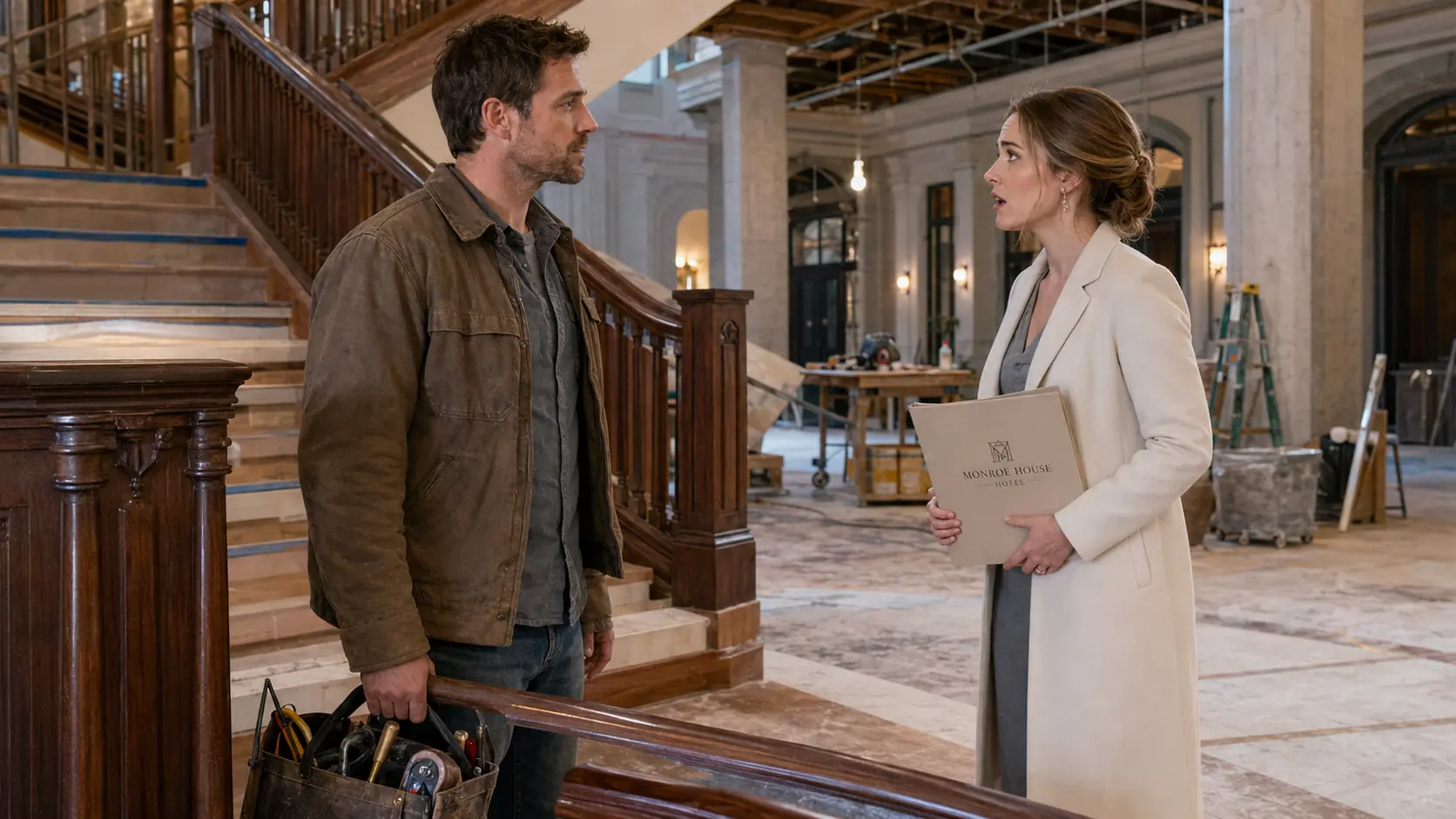
Ryan nearly choked on lemonade.
Evelyn did not seem offended.
“No.”
“Do you want kids?”
“Noah,” Ryan said firmly.
“What? It’s a normal question.”
Evelyn looked down at her hands.
“I think I do,” she said softly. “Someday.”
Noah nodded. “Kids are expensive.”
Ryan covered his face.
Evelyn laughed so hard she had to set down her lemonade.
That was the day Ryan began to worry.
Because Evelyn did not just charm him.
She noticed Noah.
Really noticed him.
She asked about his drawings. She listened when he explained planets. She praised his careful inspection notes instead of laughing at them. When he got a splinter, she stayed calm and held the flashlight while Ryan removed it.
Noah trusted her faster than Ryan did.
That made Ryan careful.
Over the next three months, the cabin restoration became part of their lives.
Ryan worked there twice a week. Sometimes Noah came after school. Sometimes Evelyn joined them after meetings, trading her heels for boots and her polished boardroom voice for something softer.
Ryan repaired the porch first.
Then the bookshelves.
Then the kitchen cabinets.
Evelyn insisted on helping where she could. She sanded window trim badly at first, then better. She learned the difference between walnut and pine. She brought coffee in the mornings and soup on cold afternoons.
Their conversations grew slowly.
Evelyn told Ryan about her father, Richard Monroe, who taught her to walk through old buildings quietly before making plans. He believed hotels were not just rooms but promises of welcome. After he died, investors pushed Evelyn to expand faster, modernize harder, cut costs deeper.
“They call it efficiency,” she said one evening while Ryan adjusted a cabinet hinge. “But sometimes efficiency is just another word for removing the soul.”
Ryan smiled faintly.
“You talk about buildings like they’re people.”
“Don’t you?”
He looked around the cabin.
The old floorboards. The worn stone fireplace. The shelves her father had probably touched.
“Sometimes.”
Ryan told her about Claire.
Not all at once.
The story came in pieces.
How she had left. How Noah waited by the window the first three weekends because she promised to visit. How Ryan learned to stop making promises on other people’s behalf. How he worried that his son had become too careful for a ten-year-old.
Evelyn listened without judgment.
One evening, after Noah fell asleep on the cabin couch during a late repair day, Evelyn stood beside Ryan near the fireplace.
“He watches you,” she said quietly.
Ryan looked toward his son. “Noah?”
“Yes. Like he’s learning how to be strong from you.”
Ryan swallowed.
“I hope he learns more than that.”
“What else?”
“That it’s okay to need people.”
Evelyn looked at him.
“Do you believe that?”
He laughed softly, without humor.
“I’m trying.”
She nodded.
“Me too.”
The air shifted.
Not suddenly.
There was no dramatic music, no confession, no kiss.
Just the quiet realization that they had both said something true.
After that, the space between them felt different.
Warmer.
More dangerous.
Ryan began noticing things he had tried not to notice before.
The way Evelyn tucked loose hair behind her ear when concentrating.
The way she smiled at Noah’s jokes even when she was tired.
The way she went silent when speaking about her father, as if grief still had a hand on her shoulder.
Evelyn noticed things too.
Ryan always checked the passenger door twice when Noah was in the truck. He never let his son apologize for needing care. He sang badly when sanding wood, though he denied it. He treated Evelyn’s memories with more respect than some board members treated her company.
She had dated successful men before.
Men with money, confidence, and ambition.
But Ryan had steadiness.
And steadiness, Evelyn slowly discovered, was far rarer.
One Friday evening, the cabin was nearly finished.
Rain tapped gently on the roof while Ryan installed the last shelf in the living room. Noah sat at the table drawing a map of an imaginary planet. Evelyn unpacked old books from boxes her father had left behind.
She found a photo tucked inside a worn copy of a travel guide.
Her father stood on the cabin porch years earlier, smiling with a young Evelyn beside him. She must have been fifteen. Her hair was in a messy braid, and she wore a sweatshirt too big for her.
Evelyn sat down suddenly.
Ryan noticed.
“You okay?”
She nodded, but her eyes filled.
Noah looked up.
Ryan gave him a small signal, and Noah quietly returned to his drawing.
Evelyn held the photo with both hands.
“I forgot this existed.”
Ryan sat beside her, leaving space.
She showed him the picture.
“He brought me here after my mother died,” she whispered. “He said grief needed windows. I thought that was a strange thing to say.”
Ryan looked at the photo.
“And now?”
“Now I think he meant pain gets worse when it has nowhere to breathe.”
Ryan nodded slowly.
They sat in silence.
Then Evelyn leaned her head against his shoulder.
It was a small movement.
Tired.
Trusting.
Ryan went still for half a second, then relaxed.
He did not put his arm around her.
Not yet.
He simply stayed.
Sometimes that was the kindest thing a person could do.
Noah looked up from his drawing and saw them.
He did not say anything.
But later, in the truck on the way home, he asked, “Do you love her?”
Ryan nearly missed the turn.
“Noah.”
“That’s not a no.”
Ryan took a careful breath.
“I care about her.”
“Is that grown-up for love?”
“Sometimes it’s the road to it.”
Noah looked out the window.
“She won’t leave like Mom, right?”
Ryan’s heart tightened.
“I can’t promise what another person will do.”
Noah was quiet.
Ryan pulled the truck to the side of the road and parked under a tree.
Then he turned to his son.
“But I can promise you this. I won’t bring anyone into our family unless they understand your heart matters too.”
Noah’s eyes shone.
“I like her.”
“I know.”
“She listens when I talk about space.”
Ryan smiled softly. “That’s a strong point in her favor.”
Noah wiped his nose on his sleeve.
Ryan pretended not to see.
“I’m scared,” Noah admitted.
Ryan reached over and squeezed his shoulder.
“Me too.”
“Then maybe we can be scared together.”
Ryan looked at his son.
Sometimes children said the bravest things without knowing they were brave.
“Yeah,” Ryan whispered. “Maybe we can.”
The cabin restoration finished in early winter.
Evelyn invited Ryan and Noah to a small dinner there to celebrate. No investors. No press. No hotel staff. Just the three of them.
The cabin glowed with new life. The repaired porch stood strong. The shelves were filled with books. The kitchen cabinets had been restored instead of replaced. A fire burned in the stone fireplace. Outside, the mountains turned deep blue beneath the evening sky.
Noah helped set the table.
Evelyn cooked pasta badly.
Ryan saved it with butter, garlic, and mercy.
“This is why I manage hotels, not kitchens,” she said.
Noah took a bite. “It’s not the worst.”
Evelyn placed a hand over her heart. “High praise.”
After dinner, Noah fell asleep on the couch under a plaid blanket.
Ryan and Evelyn stood on the porch with mugs of coffee, looking out at the cold mountain night.
For a long while, neither spoke.
Then Evelyn said, “I’m afraid if I say something, everything changes.”
Ryan looked at her.
“Maybe it already has.”
She turned toward him.
Her eyes were soft, nervous, full of feeling she had held back for months.
“I didn’t plan to care about you,” she whispered.
Ryan smiled faintly.
“I didn’t plan to care about you either.”
“That sounds very romantic.”
“I’m a carpenter. We’re known for poetry.”
She laughed quietly.
Then he grew serious.
“I have to move slow, Evelyn.”
“I know.”
“Noah—”
“I know,” she said again, gentler. “I love how much you think of him first.”
Ryan’s chest tightened.
“And I don’t want to be something you chose because I helped you through a hard season.”
“You’re not.” She looked through the window at Noah sleeping on the couch. “You and Noah became the part of my week that felt honest.”
Ryan looked at her for a long moment.
Then, very slowly, he reached for her hand.
She let him take it.
Their first kiss happened under the porch light, with the mountains quiet around them and the cabin her father loved standing strong behind them.
It was soft.
Careful.
A beginning.
When they pulled apart, Evelyn rested her forehead against his.
“I love you,” she whispered.
Ryan closed his eyes.
He had not expected the words to hurt.
But they did.
Not because they were wrong.
Because they were right, and his heart had been locked for so long that opening it felt like breaking something.
“I love you too,” he said.
Inside the cabin, Noah stirred but did not wake.
That was how love entered their lives.
Not with a grand announcement.
Not with a sudden promise.
But with wood dust, repaired shelves, mountain air, and three people learning how to trust slowly.
The following spring, Monroe Hospitality announced a new apprenticeship program for local young people interested in restoration trades.
Evelyn named Ryan as the program’s lead instructor.
He nearly refused.
“I build things,” he said. “I don’t teach programs.”
“You taught Noah how to use a level when he was seven.”
“That was different.”
“You taught me how to sand properly.”
“That took longer.”
She smiled. “Exactly. You’re patient.”
The program offered paid training, tools, mentorship, and job placement in historic restoration projects across the region. It was Evelyn’s idea, but she insisted Ryan helped inspire it.
“People like you preserve places people like me claim to restore,” she told him. “That matters.”
For Ryan, the program changed everything.
It gave him steady income, respect, and a future beyond chasing one job after another. He kept his woodwork business, but he no longer had to accept every underpaid repair just to survive. He moved his shop from the rented garage into a real workshop connected to Monroe House projects.
Noah got his winter coat early that year.
Then a telescope for his birthday.
He cried when he opened it, though he tried to pretend he had allergies.
One evening, Evelyn joined them on the roof terrace of Monroe House to look through the telescope. The hotel lights glowed behind them. The mountains rested in the distance. Noah pointed upward, explaining constellations with absolute confidence and questionable accuracy.
“That one is Orion,” Noah said.
Ryan looked. “Are you sure?”
“Mostly.”
Evelyn nodded seriously. “Mostly is a strong scientific foundation.”
Noah grinned.
Later, when Noah ran downstairs to get hot chocolate from the kitchen, Ryan and Evelyn stood alone by the telescope.
“You gave him that,” Ryan said.
“The stars?”
“The chance to look for them.”
Evelyn slipped her hand into his.
“You gave me back my father’s cabin.”
“You paid me.”
“No,” she said softly. “You restored it. There’s a difference.”
He looked at her.
She smiled.
“And you restored me a little too.”
Ryan pulled her gently into his arms.
Below them, the hotel lobby buzzed with guests. Somewhere inside, people leaned on the walnut handrails he had built the day they met. Most of them would never know that one tired carpenter had once stood in that lobby and chosen to speak up for a woman trying not to fall apart.
But Evelyn knew.
And Ryan knew.
That was enough.
Two years after the Monroe House opening, Ryan stood on the porch of the mountain cabin watching Noah chase fireflies in the yard.
Noah was twelve now, taller, louder, still careful sometimes, but less afraid of happiness. He and Evelyn had built their own bond slowly. She never tried to replace his mother. She never forced affection. She simply showed up.
School events.
Science fairs.
Bad days.
Good days.
Ordinary Tuesdays.
Over time, Noah stopped waiting for her to leave.
That was the real miracle.
Evelyn came out onto the porch carrying two glasses of lemonade. She wore a simple white summer dress, her hair loose, her face relaxed in a way Ryan rarely saw in the city.
She handed him a glass.
“He looks happy,” she said.
Ryan watched Noah run through the grass with a jar in one hand.
“He is.”
“Are you?”
Ryan turned toward her.
The question was gentle, but he heard the vulnerability beneath it.
Even after all this time, some part of Evelyn still feared she was temporary in places that mattered.
He set down his glass and took her hand.
“Yes,” he said. “Because of you.”
Her eyes softened.
“Ryan…”
He smiled. “No big speech.”
“That usually means a big speech.”
“Medium speech.”
She laughed.
He reached into his pocket and pulled out a small wooden box.
Evelyn went still.
The box was handmade from walnut, the same wood he had used for the Monroe House staircase. Her fingers flew to her mouth.
“Ryan.”
He opened it.
Inside was a simple ring.
Elegant.
Beautiful.
Not flashy.
“I know we moved slowly,” he said. “I know we had to. For Noah. For me. For you. And I’m glad we did. Because now I’m not asking from loneliness or fear or gratitude.”
His voice grew rough.
“I’m asking because we built something real.”
Evelyn’s eyes filled.
Behind them, Noah shouted from the yard, “I knew it!”
Ryan closed his eyes. “He was supposed to wait.”
Evelyn laughed through tears.
Ryan looked back toward Noah. “A little privacy?”
“No! This is family history!”
Evelyn laughed harder, then looked at Ryan with love shining across her face.
“Yes,” she whispered. “Of course yes.”
Noah cheered so loudly several birds flew from a nearby tree.
Ryan slipped the ring onto Evelyn’s finger.
Then she kissed him, smiling against his mouth.
The cabin porch creaked beneath them.
The mountains stood quiet in the distance.
And Ryan thought about the first day in the hotel lobby.
The dust.
The fear.
The man trying to push Evelyn into surrender.
The choice to speak.
He had thought he was helping a stranger protect a business.
He had not known he was stepping into the beginning of his own second chance.
Life was strange that way.
Sometimes the thing you gave returned in a form you never expected.
Ryan gave honesty.
Evelyn gave him trust.
Ryan gave help.
Evelyn gave him hope.
Ryan gave one tired moment of courage.
Evelyn gave his son a future where love did not always leave.
Years later, when people asked how they met, Evelyn liked to say Ryan saved her hotel opening.
Ryan always corrected her.
“No,” he would say, smiling at his wife, then at the boy who had become brave enough to believe in staying. “I just installed the handrails.”
Evelyn would take his hand.
And every time, she would answer the same way.
“Yes,” she would say. “But you also helped me stand.”