Four attorneys in dark suits walked into Harbor Light Café at 9:12 on a Monday morning, and every spoon in the room seemed to stop moving.
The bell above the door gave its usual tired jingle, but no one looked away after that.
People always noticed lawyers when they arrived in groups. They noticed the polished shoes, the leather folders, the quiet authority, and the two security men standing behind them with hands folded in front of their coats.
Mateo Rivera froze behind the counter with a coffee pot in one hand and a stack of unpaid bills in the pocket of his apron.
He was thirty-four years old, a widower, a father, and the kind of tired that sleep did not fix anymore.
For nine weeks, he had been serving a sharp-tongued old woman at table seven.
Black coffee.
One scrambled egg.
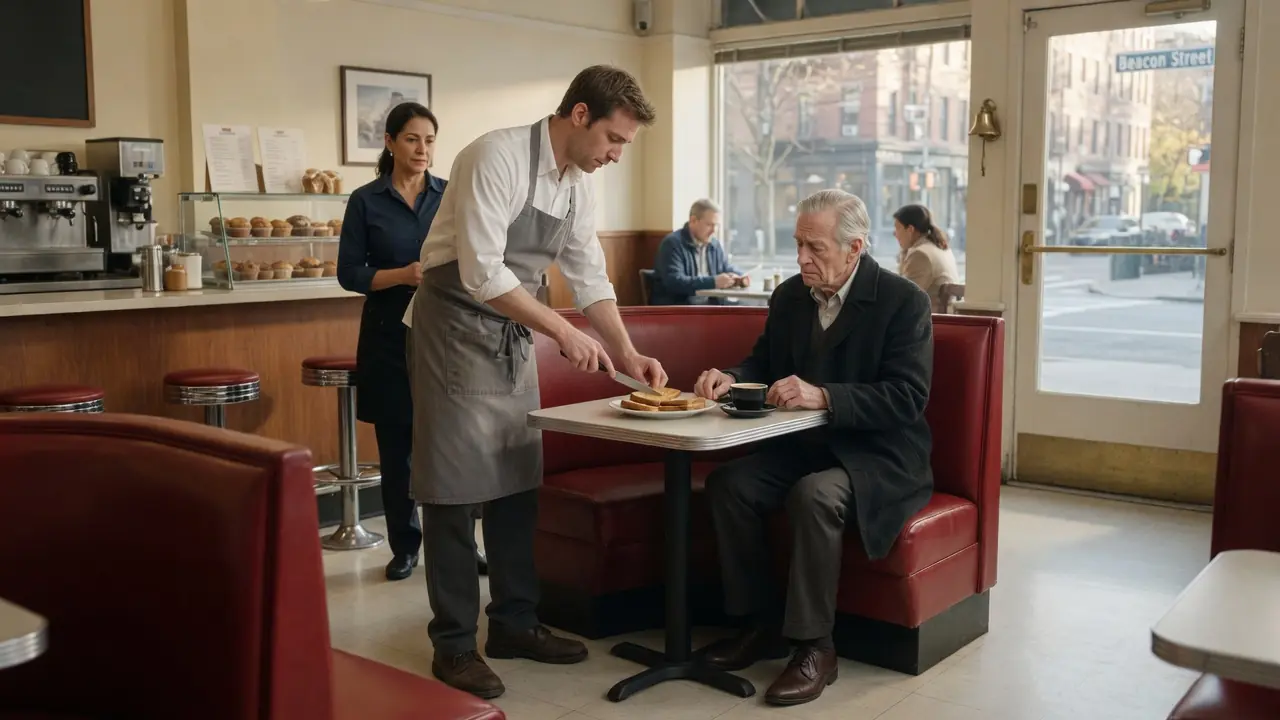
Dry toast cut into narrow strips because her hands shook too badly to manage it herself.
She never tipped more than a quarter.
She complained about the coffee.
She corrected his grammar.
She once told him the café windows were so dirty they looked like “the eyes of a guilty man.”
Still, every morning, Mateo served her with patience.
Every morning, he cut her toast.
Every morning, he listened when everyone else rolled their eyes and looked away.
Now one of the attorneys stepped forward.
“Mr. Mateo Rivera?”
Mateo swallowed.
“Yes?”
The lead attorney removed his glasses slowly.
“My name is Jonathan Price. I represented Mrs. Eleanor Ashford.”
Mateo’s grip tightened around the coffee pot.
Eleanor.
That was her name.
The old woman from table seven.
Jonathan’s voice softened.
“Mrs. Ashford passed away yesterday evening. Her last will requires your immediate presence.”
The café went completely silent.
Mateo stared at him.
“I’m sorry,” he said. “Her what?”
“Her will,” the attorney repeated. “You are named in it.”
Mateo looked toward table seven.
It was empty.
For the first time in nine weeks, the chair by the window held no small elderly woman with a navy coat, trembling hands, and eyes that looked like they had survived too many goodbyes.
Mateo could not breathe.
“I only served her breakfast,” he whispered.
Jonathan Price looked at him for a long moment.
“Mrs. Ashford believed you did far more than that.”
The first time Eleanor Ashford walked into Harbor Light Café, Mateo thought she had taken a wrong turn.
The café sat on a narrow street in Wilmington, North Carolina, three blocks from the water and one block from a bus stop that smelled permanently of rain and cigarette smoke. It was not the kind of place elegant old women visited unless they had lost their way.
Harbor Light had cracked tile floors, red vinyl booths, a ceiling fan that clicked whenever it turned, and a neon sign in the window that only half worked.
The food was decent.
The coffee was strong.
The bills were overdue.
Mateo worked there six days a week, sometimes seven, because the owner, Glen Morris, liked desperate employees.
Desperate people came in early.
Desperate people stayed late.
Desperate people did not complain when the schedule changed with no warning or when their overtime vanished into accounting mistakes no one intended to fix.
Mateo had been desperate for two years.
His wife, Clara, died after a sudden infection that began with a fever and ended with hospital machines Mateo still heard in his dreams. Their daughter, Sofia, had been four then.
She was six now.
Old enough to ask questions.
Too young to understand why answers hurt.
“Daddy,” she had asked one night while Mateo folded laundry at midnight, “why do you work when the moon is awake?”
“Because the moon doesn’t charge rent,” he said.
Sofia had frowned.
“The moon should help.”
Mateo had smiled because she was watching.
Then he had gone into the bathroom, turned on the faucet, and cried as quietly as he could.
That was his life.
Work.
Bills.
School lunches.
Clara’s photograph on the dresser.
Sofia’s drawings taped to the fridge.
A heart trying to keep beating because a little girl needed it to.
Eleanor Ashford came in on a Thursday morning during a storm.
Not a large storm. Just a steady gray rain that made everyone impatient.
She stood inside the door for a long moment, leaning on a carved wooden cane, her silver hair tucked beneath a deep blue hat. Her coat was old but beautiful, the kind of coat made for another era, when clothes were meant to last longer than moods.
Glen looked up from the register.
“Table for one?”
Eleanor looked around.
Her eyes were pale green, sharp and sad.
“Obviously.”
Glen blinked.
Mateo turned away to hide a smile.
The old woman chose table seven by the window.
No one liked table seven because the draft came through the frame in winter and the morning sun hit it too hard in summer. But Eleanor sat there as if she had chosen a throne.
Mateo approached with a menu.
“Good morning, ma’am. Can I get you coffee?”
She looked him over.
“It is.”
“People say that about coffee and politicians. Both are often stale.”
Mateo smiled.
“I’ll bring you the freshest pot.”
She narrowed her eyes.
“You smile too easily.”
“I work for tips.”
“Then you have chosen a tragic profession.”
This time, he laughed before he could stop himself.
Eleanor looked surprised.
Then she looked away toward the window.
“Coffee. Black. One scrambled egg. Dry toast.”
“Yes, ma’am.”
“And do not call me sweetheart.”
“I wasn’t planning to.”
“Good. Men who call old women sweetheart usually mean useless.”
Mateo paused.
Then he said quietly, “My grandmother would have smacked me with a wooden spoon if I talked like that.”
Something moved in Eleanor’s expression.
“Your grandmother sounds sensible.”
“She was terrifying.”
“Even better.”
Mateo brought her coffee in a clean mug with no chips.
He did not know why he chose that one.
Maybe because she looked like someone who had been handed too many broken things already.
When her food came, she stared at the toast for a long moment.
Her hand shook as she reached for the knife.
Mateo noticed immediately.
He had learned to notice things.
He noticed when customers counted coins under the table before ordering. He noticed when parents pretended not to be hungry so their children could finish pancakes. He noticed when old men came in only for coffee but stayed until closing because home was too quiet.
Eleanor tried to cut the toast.
The knife slipped.
Her jaw tightened.
Mateo waited a few seconds, giving her the dignity of trying.
Then he stepped closer.
“Would you like me to cut that for you?”
Her eyes snapped up.
“No.”
“All right.”
He stepped back.
She tried again.
The knife clattered against the plate.
Her face flushed.
Mateo picked up the knife gently.
“My daughter makes me cut toast into strips. She says squares are boring.”
Eleanor stared at him.
He cut the toast into narrow strips and set the knife down.
“There you go.”
“I said no.”
“You did.”
“And yet?”
“And yet the toast is cut.”
For one tense second, Mateo thought she might slap him.
Instead, her mouth twitched.
“Impertinent.”
“My grandmother said the same thing.”
“Was she right?”
“Usually.”
Eleanor picked up one strip of toast with trembling fingers.
She ate slowly.
When she left, she placed exact change on the table and one quarter beside the plate.
Glen watched from the register.
“Don’t waste time on that one,” he said as Mateo cleared the booth. “Rich old ice queen. Comes from money, I bet. People like that think kindness is included in the price of coffee.”
Mateo looked at the quarter.
Then at the empty booth.
“She seemed lonely.”
Glen snorted.
“Lonely doesn’t pay rent.”
Mateo said nothing.
But the next morning, when Eleanor returned at exactly 8:05, table seven was wiped clean, the fresh coffee was ready, and Mateo cut her toast without being asked.
That became the routine.
For nine weeks, Eleanor came in every morning except Sundays.
She ordered the same thing.
She complained about the coffee at least twice a week.
She corrected the spelling on the chalkboard menu.
She told Glen his muffins were “an insult to flour.”
Glen hated her.
Most of the staff avoided her.
Mateo served her.
At first, they spoke only in short exchanges.
“Your tie is crooked.”
“I’m not wearing a tie.”
“Then your shirt is confused.”
Or:
“This coffee is too weak.”
“It can probably hear you.”
“Good. Shame may improve it.”
Little by little, though, Eleanor began asking questions.
Not the polite kind.
The direct kind that made lying difficult.
“Why do you look exhausted?”
“Long shift.”
“That is not an answer. That is camouflage.”
Mateo refilled her cup.
“My daughter had a nightmare.”
“Children often do.”
“She dreams her mother is leaving again.”
Eleanor’s face changed.
Only for a second.
“Her mother died?”
“Two years ago.”
Eleanor looked down at her plate.
“I’m sorry.”
It was the first gentle thing she had ever said to him.
Mateo nodded.
“Thank you.”
“What is your daughter’s name?”
“Sofia.”
“How old?”
“Six.”
“Does she read?”
“She tries. She likes stories with brave animals.”
“Good. Children should meet courage early.”
After that, Eleanor asked about Sofia every morning.
Not sweetly.
Never sweetly.
But consistently.
“Did Sofia sleep?”
“Did Sofia finish the book?”
“Did Sofia’s teacher stop assigning nonsense worksheets?”
One Friday morning, Mateo came in with a bruise under one eye.
Eleanor saw it immediately.
“Who hit you?”
“No one.”
“Lies age a face.”
Mateo sighed.
“I got between two men arguing outside the café last night. One was drunk. He swung.”
“Foolish.”
“Probably.”
“Brave, but foolish.”
“I didn’t want him hitting the woman behind him.”
Eleanor stared at him for a long moment.
“You have a dangerous habit of seeing people.”
Mateo wiped the table beside her.
“Is that dangerous?”
“Extremely. Once you see people, it becomes harder to abandon them.”
He looked at her.
She looked back.
For the first time, Mateo wondered who had abandoned Eleanor Ashford.
He found out in pieces.
Her husband’s name had been Thomas.
He had died nine years earlier.
They had owned a restaurant once, not far from the waterfront, called Ashford House. It had started as a modest place and become famous over time, not because it was fancy, but because Thomas and Eleanor fed everyone like they belonged.
“Your husband cooked?” Mateo asked.
“Thomas cooked,” Eleanor said. “I ran the room. He said I could make a banker, a fisherman, and a runaway teenager sit at the same table and all feel equally important.”
“Could you?”
“Of course.”
“What happened to the restaurant?”
Eleanor’s hand tightened around her cup.
“My family happened.”
She said no more that day.
Weeks passed.
Mateo learned that Eleanor had one son, Charles, and two adult grandchildren, Vivian and Reed. They lived in Charleston and visited her only when documents needed signing.
“They don’t like the café?” Mateo asked once.
“They don’t like anything that does not increase in value.”
“That includes people?”
“Especially people.”
Her voice was dry, but her eyes looked wounded.
Mateo did not push.
He understood the shape of grief when pride sat on top of it.
One Saturday, Sofia’s babysitter canceled.
Mateo had no choice but to bring his daughter to Harbor Light Café with a backpack full of crayons, crackers, and picture books.
Glen was furious.
“This is not a daycare.”
“I know,” Mateo said. “She’ll sit quietly in the back. I can’t miss the shift.”
“You miss a shift, you’re replaceable. You bring a kid, you’re a liability.”
“Please, Glen.”
Glen looked at him with the cold annoyance of a man who enjoyed having power over tired people.
“One complaint and you’re done.”
Sofia sat at the back table with her crayons and tried very hard to be invisible.
At 8:05, Eleanor entered.
Mateo’s stomach tightened.
Eleanor noticed Sofia before she even sat down.
“Who is that child?”
“My daughter,” Mateo said quickly. “Her sitter canceled. She won’t bother anyone.”
Eleanor looked toward the back table.
Sofia looked up.
The old woman and the little girl stared at each other.
Then Sofia lifted one hand and gave a tiny wave.
Eleanor did not wave back.
She turned to Mateo.
“Bring her here.”
Mateo blinked.
“What?”
“To my booth.”
“I don’t want to impose.”
“You impose every day by giving me bad coffee. This is different.”
“Mrs. Ashford—”
“Eleanor.”
He stopped.
It was the first time she had offered her name that way.
“Eleanor,” he said carefully, “she can be shy.”
“Then I shall not be frightening.”
Mateo almost laughed.
“You?”
“I can make an effort.”
He crouched beside Sofia.
“That lady by the window asked if you want to sit with her.”
Sofia peeked over his shoulder.
“She looks like a queen who lost her castle.”
Mateo glanced at Eleanor.
“That is… not inaccurate.”
“Is she nice?”
“She is honest.”
Sofia thought about that.
“Okay.”
She gathered her crayons and climbed into Eleanor’s booth.
“Hi,” Sofia said. “I’m Sofia. My daddy says I can sit here if I don’t bother you.”
Eleanor looked at the crayons.
“What are you drawing?”
“A fox princess.”
“Foxes are thieves.”
“This one is a princess.”
“Royal thieves, then.”
Sofia giggled.
Mateo froze.
He had never heard anyone giggle around Eleanor.
For the next two hours, something impossible happened.
Eleanor Ashford came alive.
She asked Sofia about school, books, colors, clouds, animals, and whether dragons would prefer soup or sandwiches. Sofia answered every question seriously.
When Sofia showed her a drawing, Eleanor studied it as if it belonged in a museum.
“The ears are excellent,” Eleanor said.
“Thank you. I worked hard.”
“Hard work shows.”
“Do you draw?”
“I used to paint.”
“Why did you stop?”
The question landed too directly.
Mateo turned from the counter, ready to rescue them both.
But Eleanor answered.
“Someone I loved died, and I forgot how to enjoy colors.”
Sofia considered that.
“My mommy died too.”
The café seemed to go quiet around them.
Eleanor’s face softened in a way Mateo had never seen.
“I know.”
“Daddy says when people die, love doesn’t leave. It just gets quiet.”
Eleanor’s eyes filled.
“Your father is a wise man.”
Sofia shrugged.
“He says he’s mostly tired.”
Eleanor laughed.
A real laugh.
Bright.
Rusty.
Startling.
Every regular turned to look.
Sofia smiled proudly, as if she had done something important.
She had.
At the end of the shift, Sofia gave Eleanor a drawing.
It showed three figures standing in front of the café.
One tall man labeled Daddy.
One little girl labeled Me.
One small old woman with a cane labeled Mrs. Elner because Sofia could not spell Eleanor yet.
Above them, she had written:
Coffee Friends.
Eleanor held the paper with both hands.
Her fingers trembled.
“May I keep this?”
Sofia nodded.
“It’s for you. So you won’t be lonely at your house.”
Eleanor closed her eyes.
When she opened them, tears had slipped down her lined cheeks.
Mateo looked away to give her privacy.
But Sofia reached across the table and touched Eleanor’s hand.
“It’s okay,” she said. “Daddy says tears mean your heart is too full.”
Eleanor looked at Mateo.
He could not speak.
That day, Eleanor left no quarter.
She left a folded note beneath her cup.
For Sofia, it read.
Inside was a hundred-dollar bill.
Mateo found Eleanor outside before she reached the corner.
“I can’t accept this.”
“It is not for you.”
“It’s too much.”
“It is paper.”
“Eleanor.”
She turned, cane in hand, eyes sharp again.
“Buy your daughter shoes that fit.”
Mateo went still.
He had not told her Sofia’s shoes were too small.
Eleanor’s voice softened.
“I notice things too.”
He wanted to refuse.
Pride rose first, familiar and useless.
Then he thought of Sofia curling her toes inside tight sneakers because she knew better than to complain.
He folded the bill in his palm.
“Thank you.”
Eleanor nodded once.
“Do not make me regret being sentimental.”
“I wouldn’t dare.”
After that Saturday, Sofia became part of Eleanor’s life.
Not every day.
But often.
On days school started late or the sitter helped in the afternoon, Sofia would sit at table seven and color while Eleanor drank coffee and pretended not to enjoy the company.
Eleanor brought her books.
Old ones.
Beautiful ones.
A collection of fairy tales with gold edges.
A nature guide full of birds.
A worn copy of The Secret Garden.
“This was mine,” Eleanor said when Sofia touched the cover.
“From when you were little?”
“I was never little. I was born critical.”
Sofia laughed.
Mateo watched them and felt something in his broken life loosen slightly.
Not heal.
Not yet.
But loosen.
Then one Monday morning, Eleanor did not come.
Mateo noticed at 8:05.
At 8:10, he told himself traffic was bad.
At 8:20, he told himself maybe she had an appointment.
At 8:45, he knew something was wrong.
Glen smirked from the register.
“Maybe the old crow found somewhere better to haunt.”
Mateo looked at him.
“Don’t.”
Glen lifted both hands.
“Touchy.”
By nine, Mateo had burned his hand on the coffee pot and forgotten an order twice.
At 9:12, the attorneys walked in.
Now he stood in the café while Jonathan Price told him Eleanor Ashford was dead.
Sofia was at school.
Glen was staring.
Customers whispered.
Mateo’s whole body felt numb.
Jonathan Price said, “Mrs. Ashford requested that you attend the reading of her will this morning.”
“I can’t just leave work.”
Glen found his voice.
“He can’t. We’re short-staffed.”
Jonathan turned to him.
“Mr. Morris, Harbor Light Café is currently part of Mrs. Ashford’s estate. I strongly suggest you allow Mr. Rivera to leave.”
Glen’s mouth opened.
Then closed.
Mateo stared at Jonathan.
“What do you mean part of her estate?”
The attorney’s expression did not change.
“That will be explained downtown.”
Mateo removed his apron with shaking hands.
As he followed the attorneys out, he looked back at table seven.
The booth was still empty.
But for the first time, it felt like someone had left something behind there.
Something that was not finished.
The reading took place in a law office overlooking the Cape Fear River.
Mateo sat in a conference room that smelled of leather, polished wood, and money. Across the table sat Eleanor’s family.
Charles Ashford, her son, wore a gray suit and an expression of offended entitlement. His wife, Marissa, sat beside him with a tight mouth and diamond earrings large enough to catch every bit of light in the room.
Their children, Vivian and Reed, looked bored until they saw Mateo.
Then bored turned to insulted.
“Who is he?” Vivian asked.
Jonathan Price opened a folder.
“This is Mateo Rivera.”
Charles frowned.
“The waiter?”
Mateo looked down at his hands.
He had heard that tone before.
The tone people used when they believed your job was your size.
Jonathan’s voice remained calm.
“Mrs. Ashford requested his presence.”
“My mother requested many strange things toward the end,” Charles said.
Jonathan looked over his glasses.
“Your mother was evaluated by two independent physicians three weeks ago. She was fully competent.”
Reed leaned back.
“So let’s get this over with.”
Jonathan began reading.
To Charles, Eleanor left a trust distribution of two million dollars, restricted and paid over ten years.
Charles’s face darkened.
To Vivian and Reed, she left education and housing funds already established in their names, but no direct control over the principal.
Vivian snapped, “That’s absurd.”
Reed muttered something under his breath.
Then Jonathan turned the page.
“To Mateo Rivera, who saw me when my own blood saw only an old woman delaying their inheritance…”
The room went still.
Mateo stopped breathing.
Jonathan continued.
“…I leave full ownership of Harbor Light Café, including the building, land, accounts, and business rights. It was once Ashford House, the restaurant my husband Thomas and I built together, and I entrust it now to the only person I found who still understands what a table is meant to be.”
Glen had not owned the building.
He had only leased and managed it.
Mateo understood that in a distant, floating way.
Jonathan continued.
“I also leave Mr. Rivera the sum of eight hundred thousand dollars, free of estate tax burden, for the care and future of his daughter, Sofia Rivera.”
Mateo gripped the table.
His vision blurred.
Sofia.
Eleanor had remembered Sofia.
Vivian shot to her feet.
“This is insane.”
Jonathan continued over her voice.
“Finally, I establish the Thomas and Eleanor Ashford Community Trust, containing nine million dollars in managed assets, to be administered by Mateo Rivera with the assistance of Jonathan Price and two board members of Mr. Rivera’s choosing. The purpose of the trust shall be to provide meals, childcare support, emergency rent assistance, and small business grants to working families, widows, widowers, elderly residents, and any person whom the world has made invisible.”
Charles slammed his hand on the table.
“My mother left nine million dollars to a waiter?”
Jonathan closed the document.
“Your mother left nine million dollars to a man who treated her with dignity.”
“She was manipulated.”
Mateo finally looked up.
“I didn’t even know her last name.”
Charles turned on him.
“Don’t play innocent. People like you always know when old money is vulnerable.”
Mateo stood slowly.
The room quieted.
“I knew she liked black coffee. I knew she missed her husband. I knew her hands shook. I knew she hated being called sweetheart. I knew she liked my daughter’s drawings and pretended not to. That’s what I knew.”
His voice shook, but he did not stop.
“I didn’t know she was rich. I didn’t know she owned the café. I didn’t know she had a family who only cared about the numbers in this folder.”
Charles’s face reddened.
Jonathan raised a hand.
“That is enough.”
But Eleanor had left one more thing.
Letters.
One for her family.
One for Mateo.
Jonathan handed Mateo an envelope with his name written in Eleanor’s sharp, slanted handwriting.
He waited until the family had stormed out before opening it.
Dear Mateo,
If you are reading this, then I have done what old women eventually do and left before finishing my coffee.
Do not cry too much. It will make you look dramatic, and I have always distrusted dramatic men.
Mateo laughed once through tears.
Then he kept reading.
I know you are confused.
You are thinking you did nothing to deserve this.
You are wrong.
You gave me dignity when I was ashamed of needing help.
You cut my toast without making me feel small.
You listened without prying.
You let your daughter sit with me, and for one bright morning, I remembered what it felt like to be useful, interesting, and loved.
Do you know what a gift that is to a lonely old woman?
Probably not.
You are too busy surviving to understand your own goodness.
So I will tell you plainly.
You are a good father.
You are a good man.
You have Thomas’s gift, though you never met him.
You know that food is not only food.
A table is not only a table.
A café is not only a business.
It is a place where the lonely can stop pretending they are not lonely.
It is a place where a tired father can be told he is doing well.
It is a place where an old woman can become human again before she dies.
Use the money wisely.
Pay your debts.
Buy Sofia shoes, books, and every color of crayon she wants.
Do not let guilt rob you of relief.
The café is yours because you already understood what it should be.
Make it warm again.
Make it brave.
Make it a place where people are seen.
And if my family comes for you, let them.
They have lawyers.
You have the truth.
Truth is slower, but it usually has better balance.
With gratitude, irritation, and affection,
Eleanor Ashford
P.S. Sofia spelled my name wrong on the drawing. I did not correct her. This is how you know I loved her.
Mateo pressed the letter to his mouth and cried in a conference room that was too expensive for grief.
Jonathan sat across from him quietly.
After a while, the attorney said, “She spoke about you often.”
Mateo wiped his face.
“She barely spoke to me.”
Jonathan almost smiled.
“That was Mrs. Ashford speaking a great deal.”
“What happens now?”
“Now,” Jonathan said, “you decide what kind of man you want to become with the resources she trusted you to use.”
Mateo looked down at the letter.
“I think she already decided that for me.”
“No,” Jonathan said gently. “She recognized who you already were.”
The first thing Mateo did was pick up Sofia from school.
She ran into his arms at the gate, backpack bouncing.
“Daddy, why are you crying?”
He knelt in front of her.
“Mrs. Eleanor died, baby.”
Sofia’s smile vanished.
“The queen lady?”
Mateo nodded.
Sofia’s eyes filled.
“But I made her another picture.”
“I know.”
“Can we still give it to her?”
Mateo pulled her close.
“We can keep it at the café for her.”
Sofia cried into his shoulder.
“She said she would teach me how to paint roses.”
Mateo closed his eyes.
“She wanted to.”
“Why do people keep dying?”
It was the question he had never learned how to answer.
So he told the truth.
“I don’t know.”
Sofia hugged him tighter.
“I’m tired of goodbyes.”
“Me too.”
That night, Mateo took Sofia to Harbor Light Café after closing.
Glen was there, furious and pale, because Jonathan Price had already delivered official notice that management control had changed immediately.
“You can’t run this place,” Glen snapped. “You’re a waiter.”
Mateo looked around the tired café.
The cracked floors.
The flickering sign.
Table seven.
Then he looked at Glen.
“No,” he said. “I’m the owner.”
Glen laughed bitterly.
“You’ll fail in six months.”
“Maybe.”
“You’re too soft.”
Mateo thought of Eleanor’s trembling hands.
Sofia’s too-small shoes.
Clara’s voice telling him kindness mattered even when life was cruel.
“Then I’ll build a soft place in a hard world,” he said. “People need those.”
Glen had no answer.
Mateo gave him two weeks’ severance and told him not to come back.
The next morning, the news spread through the neighborhood faster than coffee poured.
Eleanor Ashford, widow of the famous Thomas Ashford, had left Harbor Light Café and a fortune to Mateo Rivera, the waiter who cut her toast.
Some people called it beautiful.
Some called it suspicious.
Eleanor’s family called it theft.
By noon, reporters waited outside.
By evening, Charles Ashford had announced plans to contest the will.
Mateo was terrified.
He had never fought rich people.
He had never managed a trust.
He had never owned anything more valuable than his old car.
But each time fear rose too high, he read Eleanor’s letter again.
You have the truth.
Truth is slower, but it usually has better balance.
The lawsuit failed quickly.
Eleanor had prepared for war.
There were medical evaluations, video statements, handwritten notes, security footage from the café, and testimony from multiple witnesses who had seen Mateo serve Eleanor with patience long before he knew who she was.
The strongest evidence was a video Eleanor recorded two days before her death.
She sat in a chair by a window, wearing the blue hat she had worn the first morning Mateo met her.
Her voice was thin, but clear.
“My son believes affection can be scheduled around inheritance strategy. My grandchildren believe legacy is a bank account. They are mistaken. Legacy is what continues after money changes hands.”
She looked directly into the camera.
“Mateo Rivera did not flatter me. He did not ask me for anything. He did not know I had anything to give. He cut my toast because my hands failed me. He let his daughter draw me into a family I had not earned. That is character. I trust character more than blood.”
After that video, Charles Ashford settled.
Vivian deleted her public accusations.
Reed stopped giving interviews.
And Mateo finally had room to breathe.
He closed Harbor Light Café for six weeks.
Not to make it fancy.
To make it honest.
He restored the original brick walls hidden behind cheap paneling. He repaired the windows. He replaced the broken booths but kept table seven exactly where it had always been. He had a brass plaque mounted beside it.
ELEANOR’S TABLE
For Those Who Need To Be Seen
He found old photographs of Ashford House in Eleanor’s files. Thomas cooking in a white apron. Eleanor standing near the door, younger and fierce, greeting customers like they mattered.
In one photograph, a handwritten sign hung behind the counter.
NO ONE EATS ALONE UNLESS THEY WANT TO.
Mateo had that sentence painted on the wall.
When the café reopened, it had a new name.
Eleanor’s Table.
The first customer was an elderly man who had walked by twice before gathering the courage to enter. His coat was thin. His shoes were worn. He asked only for coffee.
Mateo brought him coffee.
Then soup.
The man shook his head.
“I can’t pay for that.”
Mateo smiled.
“Then pay when you can. Or don’t. Today you eat.”
The man stared at him.
“Why?”
Mateo glanced at table seven.
“Because someone taught me what a table is for.”
The café became more than a café.
It became a place where single parents could get a free meal on school nights. Where elderly people came for coffee and stayed for conversation. Where small business owners met with volunteers from the trust to apply for emergency grants. Where children did homework in the back room while parents worked late shifts.
Mateo hired people who needed chances.
A young mother named Denise became the morning manager after escaping a marriage that had nearly destroyed her.
A retired baker named Mr. Okafor made sweet rolls that sold out by ten.
A college student named Hannah worked weekends and helped Sofia with reading between orders.
And Sofia, now seven, became the unofficial artist of Eleanor’s Table.
Her drawings covered the back wall.
One showed Eleanor wearing a crown and holding toast.
Under it, Sofia had written:
Mrs. Elner, Queen of Breakfast.
Mateo never corrected the spelling.
The Thomas and Eleanor Ashford Community Trust held its first meeting in the back room.
Jonathan Price served as legal advisor.
Denise joined the board because she knew what it felt like to need help and fear judgment.
Mrs. Patel from the building next door joined because she had raised three children alone after her husband died and had spent twenty years quietly feeding neighbors from her kitchen.
Mateo chaired the meeting with trembling hands.
“I don’t know how to do this,” he admitted.
Mrs. Patel patted his arm.
“Good. People who think they know everything are dangerous.”
The trust started small.
Rent assistance for a waitress about to be evicted.
A used van for a father who needed transportation to keep his job.
Startup money for a woman opening a laundry service.
Childcare support for night-shift workers.
Meals for seniors who had no one checking on them.
Each grant came with a note written by Mateo.
Someone saw me when I felt invisible.
Now we see you.
Within a year, Eleanor’s Table was known across the city.
Not because it was luxurious.
Because it was warm.
People came for pancakes and left with job referrals. They came for coffee and left with someone remembering their name. They came alone and found that solitude was respected but loneliness was not ignored.
One afternoon, Charles Ashford returned.
Mateo saw him standing near the door in a dark coat, older-looking than he had in the conference room. The arrogance was still there, but thinner now, worn down by something.
Mateo approached carefully.
“Mr. Ashford.”
Charles looked toward table seven.
“My mother sat there?”
“Yes.”
“Every morning?”
“Almost.”
Charles swallowed.
“What did she order?”
“Black coffee. One scrambled egg. Dry toast cut into strips.”
Charles closed his eyes.
“When I was little, she cut my toast that way.”
Mateo said nothing.
Charles looked at him then.
“I hated you.”
“I know.”
“I thought you stole what belonged to me.”
Mateo waited.
Charles’s face tightened.
“But the truth is, I had already thrown it away.”
For the first time, Mateo saw not a rich man angry about money, but a son who had arrived too late at the door of regret.
Charles reached into his coat and pulled out an envelope.
“My mother wrote me a letter. I did not read it at first. I was too angry. I read it last month.”
His hand shook slightly.
“She said if I ever wanted to understand her, I should sit at her table and order what she ordered.”
Mateo nodded toward the booth.
“Then sit.”
Charles sat at table seven.
Mateo brought him black coffee, one scrambled egg, and dry toast cut into strips.
Charles looked at the plate.
Then he began to cry.
Not loudly.
Not dramatically.
Just enough for years to escape.
Mateo did not rush him.
When Charles finally wiped his face, he said, “I don’t deserve forgiveness.”
Mateo thought of Eleanor.
Sharp.
Difficult.
Lonely.
Loving, in ways that sometimes arrived disguised as criticism.
“No,” Mateo said. “Probably not.”
Charles flinched.
“But needing forgiveness and deserving it are different things.”
Charles looked up.
“Did she forgive me?”
Mateo sat across from him.
“I think she wanted to.”
That was the beginning of Charles’s return.
Not a grand redemption.
Real redemption rarely arrives grandly.
It came in small acts.
He volunteered at the trust once a month, quietly at first. He funded a senior meal program in Eleanor’s name. He learned the names of the staff. He apologized to Sofia for calling her father a thief, and Sofia studied him for a long time before saying, “You hurt my daddy’s feelings, but Mrs. Eleanor liked second chances.”
Charles cried again.
Sofia patted his hand.
“You cry a lot.”
Mateo almost choked on his coffee.
Charles laughed through tears.
“I suppose I do.”
Eleanor’s Table changed Mateo too.
He paid off every debt.
He moved Sofia from their cramped apartment into a small house with a porch and a room she could paint any color she wanted. She chose yellow because, she said, “sad things need bright walls.”
He stopped working nights.
He slept.
At first, sleep felt like a suspicious luxury.
Then it became healing.
He visited Clara’s grave every Sunday with Sofia. He told Clara about the café, the trust, Eleanor, and all the people whose lives had crossed theirs because of one old woman who noticed his kindness.
“I’m trying,” he would say.
And in the quiet, he could almost hear Clara’s answer.
I know.
Two years after Eleanor’s death, the city held a small ceremony outside the café.
The trust had helped over four hundred families. Eleanor’s Table had served thousands of free meals without ever making anyone feel poor for accepting one. Three small businesses funded by the trust now employed people from the neighborhood. A childcare room had opened upstairs so parents could attend evening classes or job interviews.
A new sign hung above the door.
ELEANOR’S TABLE
WHERE NO ONE IS INVISIBLE
Mateo stood before the crowd with Sofia holding his hand.
Jonathan Price stood nearby.
Denise, Mrs. Patel, Charles, and the whole staff gathered behind him.
Reporters waited.
Neighbors filled the sidewalk.
Mateo did not like speeches, but he gave one anyway.
“I used to think kindness was small,” he began. “Something you gave when you had nothing else. A cup of coffee. A few minutes of patience. Cutting toast for someone whose hands couldn’t manage it.”
He looked toward table seven through the window.
“But I learned that small kindness can be the beginning of something much larger. Mrs. Eleanor Ashford came into my life as a difficult customer. She complained about my coffee, my windows, my grammar, and once my posture.”
The crowd laughed softly.
Mateo smiled.
“But she also saw me. She saw a tired father trying not to fall apart. She saw my daughter. She saw what this place could become. And because she saw us, she gave us the chance to see others.”
His voice thickened.
“She taught me that a table is not just where food is served. It is where dignity is restored. It is where lonely people remember they still belong to the world. It is where help can be offered without shame.”
Sofia tugged his hand.
Mateo looked down.
She whispered, “Can I say something?”
He lifted her to the microphone.
Sofia looked at the crowd.
“Mrs. Eleanor was grumpy,” she said.
Everyone laughed.
Sofia waited seriously.
“But she was good grumpy. Like toast that looks burnt but still tastes okay.”
More laughter.
Mateo covered his face with one hand.
Sofia continued.
“She missed her husband. My daddy missed my mommy. I missed my mommy too. So we all had missing places. But then we sat together and the missing places got smaller.”
The crowd went quiet.
Sofia looked through the window at Eleanor’s table.
“I think when you help somebody feel less alone, that is a very big thing. Even if it looks small.”
Mateo kissed the top of her head.
“That’s exactly right.”
Years later, people would tell the story in simpler ways.
They would say an old woman left a fortune to a waiter.
They would say a single father became rich because he was nice to the right person.
They would say lawyers came into a café and changed his life.
But Mateo knew the truth was quieter than that.
It began with a woman who could no longer cut her toast.
A man who noticed.
A little girl who drew a lonely old woman into a family.
A table by the window.
A cup of coffee.
A kindness offered without expectation.
That was where everything changed.
Not when the attorneys arrived.
Not when the will was read.
Not when the money came.
Everything changed the first morning Mateo picked up the knife and cut Eleanor Ashford’s toast without making her feel ashamed for needing help.
Because dignity is sometimes served in small pieces.
Because love sometimes arrives disguised as routine.
Because people who seem difficult are often only lonely in armor.
And because one ordinary act, done with a gentle heart, can outlive the person who receives it.
Every morning after that, Mateo opened Eleanor’s Table before sunrise.
He turned on the lights.
Started the coffee.
Checked table seven.
And when the first lonely person stepped through the door, unsure if there was a place for them, Mateo smiled the way Clara had taught him, the way Eleanor had trusted him to keep smiling.
“Good morning,” he would say. “Come in. We’ve been waiting for you.”
And in the corner by the window, beneath the brass plaque and Sofia’s framed drawing of Mrs. Elner, Queen of Breakfast, the empty chair at table seven never felt empty at all.