They saw ashes.
Arthur Bennett still saw Eleanor waiting on the porch.
Every morning, before the world had fully awakened, before trucks rolled down Maple Ridge Road and before children walked past with backpacks bouncing on their shoulders, Eleanor had sat in the white wooden chair on the left side of the porch.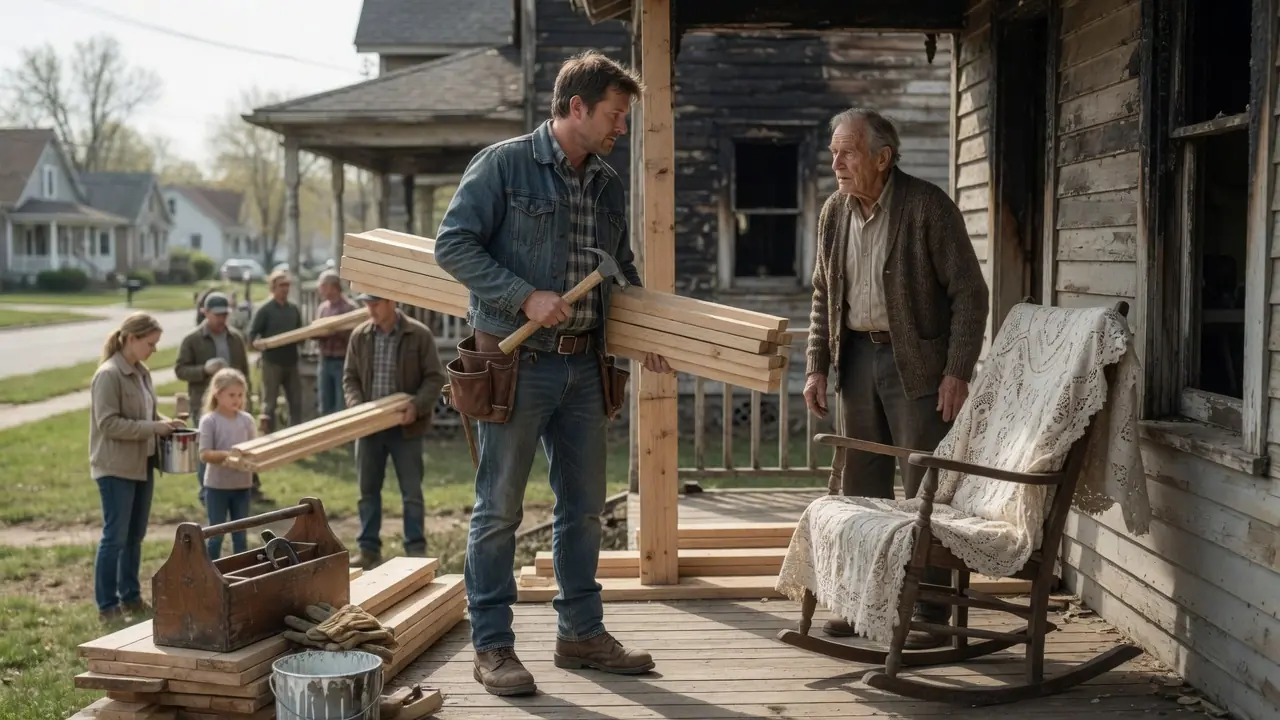
Never the right.
Always the left.
Arthur’s chair was on the right, closer to the steps. Eleanor said that chair had a better view of the street, but Arthur always suspected she gave it to him because she liked watching him wave at neighbors first.
For forty-six years, they had sat there with two cups of coffee between them.
One black, for Arthur.
One with cream and too much sugar, for Eleanor.
When the sun rose, it caught the pale yellow siding of the house and warmed the little porch where they had built their mornings. Eleanor would wrap both hands around her mug, close her eyes, and say, “This is the best part of the day.”
Arthur would pretend not to hear it every time.
“What was that, Ellie?”
And she would smile without opening her eyes.
“You heard me.”
He always had.
Now the house was gone.
The yellow siding was blackened. The upstairs windows were empty squares. The roof had collapsed inward weeks earlier, leaving behind broken beams and gray ash. The porch still stood in pieces, though nobody understood how. Half the railing was gone. Three boards had curled upward from heat and weather. The steps leaned to one side, and the county inspector had already placed orange warning tape around the front.
But Eleanor’s chair had survived.
One leg was scorched. The back was darkened on one side. The seat had cracked down the middle.
Still, it stood.
And every morning, Arthur came back to clean the corner around it.
He was seventy-nine years old, with thin white hair, a narrow frame, and hands that had once built cabinets, fences, bookshelves, and the little porch where Eleanor spent the happiest mornings of her life. Now those hands shook when he lifted a hammer. His back bent forward when he walked. His knees complained with each step.
But he came anyway.
Because he had promised her.
Before Eleanor passed, when her voice had grown soft and her body too tired for the long walks they once took after supper, she had asked him to sit beside her on the porch.
It was October then.
The air smelled like dry leaves and wood smoke. A red blanket covered her lap. Arthur had brought coffee even though the doctor told her not to drink it late in the day. She only held the cup for warmth, smiling as if the rule-breaking itself made the evening sweeter.
“Arthur,” she had said.
“Yes, Ellie?”
“If life ever changes, promise me this little corner stays ours.”
He had looked at the porch.
At her chair.
At the old table between them.
At the chipped blue flowerpot she refused to throw away.
“Life has been changing since the day we met,” he said.
“I mean it.”
He knew she did.
So he reached across the small table and took her hand.
“I promise, Ellie. I’ll keep it for us.”
She smiled then, and for one moment, the years seemed to step backward. She was twenty-three again, standing in a cotton dress outside the county fair, laughing because Arthur had dropped his lemonade after seeing her. She was thirty-two, holding their newborn niece during a summer picnic. She was fifty, painting the porch rail white while telling him he was doing it wrong. She was seventy-one, still looking at him like he was the only man on earth who knew how to make coffee properly.
“Every morning,” she whispered.
“Every morning,” he promised.
Now, two years after losing Eleanor and six weeks after the fire took the house, Arthur still set her place first.
He brought two paper cups of coffee from the gas station down the road. He placed one on his side of the little blackened table and one on hers. He brushed ash from the porch boards. He picked up small pieces of debris and placed them into a bucket. He wiped Eleanor’s chair with a damp cloth even though it would never be clean the way it used to be.
People drove past.
Some slowed.
Most looked away.
A few shook their heads with pity.
But one afternoon, three teenage boys stopped on the sidewalk across the street.
They were old enough to be careless and young enough to think cruelty was humor if someone recorded it. One of them held up his phone.
“Man, he’s out here cleaning ashes like this place is coming back.”
Another laughed.
“Bro, the whole house is gone. What’s he even trying to save?”
Arthur heard them.
He kept sweeping.
The broom bristles dragged softly over the damaged boards.
The third boy raised his phone higher.
“Keep recording. Nobody’s going to believe this old guy still stands here every day.”
“Yeah,” the first boy said. “The whole place is dead, and he’s acting like it can still be saved.”
Arthur paused then.
Slowly, he lifted his head.
The boys laughed again, expecting confusion or anger.
Instead, Arthur looked at them with tired eyes and said, “You see a burned house. I see the last place she was happy.”
For a second, their laughter weakened.
Then one of them recovered and muttered, “Look at him. He can barely swing the hammer, and he still thinks he can fix this place.”
Arthur looked down at the hammer in his hand.
It had belonged to his father.
Then to him.
He had used it to build Eleanor’s porch swing thirty years earlier.
“I’m not fixing a house, son,” Arthur said. “I’m holding on to what’s left of my life.”
Across the street, Caleb Reed stopped beside his old pickup truck.
He had not planned to stop.
He had come to the neighborhood to drop off a repaired rocking chair for Mrs. Dawson, a widow who lived three blocks away and refused to buy new furniture because, in her words, “new things have no manners.” Caleb repaired chairs, tables, cabinets, porch rails, broken drawers, loose steps, and anything else people brought to his small workshop behind his house.
He was thirty-five years old, a single dad raising his seven-year-old daughter, Lily, on his own.
Once, his life had looked fuller.
A wife named Hannah.
A small rental home.
Plans to buy a bigger place.
A daughter who still believed both parents would always be in the same room.
Then illness came quietly and stayed too long. Hannah passed when Lily was four, leaving Caleb with a child who asked heartbreaking questions at breakfast and a workbench he returned to each night because building things was the only way he knew to keep his hands from shaking.
Since then, Caleb had learned what grief did to a house.
It did not only empty rooms.
It changed the sound of footsteps.
It made ordinary objects sacred.
A coffee mug.
A scarf on a hook.
A chair no one else was allowed to move.
So when Caleb saw Arthur standing alone among the ashes, and those boys laughing from the sidewalk, something inside him tightened.
Lily sat in the passenger seat of the pickup, holding a small paper bag of cookies Mrs. Dawson had given her. She leaned forward, her nose almost touching the window.
“Daddy,” she asked, “why are those boys laughing at him?”
Caleb looked at Arthur Bennett.
Then at the burned porch.
Then at the old chair still standing near the broken railing.
“Because they don’t understand what he lost,” he said.
Lily looked up at him.
“Can we help him?”
Caleb swallowed.
He knew what it meant to hold a home together when life tried to break it apart.
He opened the truck door.
“No one should be left to carry this alone.”
Lily scrambled out after him, clutching the cookie bag.
The boys were still filming when Caleb crossed the street.
“Hey,” Caleb said.
They turned.
One of them lowered the phone slightly.
“You know him?” the boy asked.
“No,” Caleb said. “But I know enough.”
Arthur looked up from the porch as Caleb approached, one hand raised so he would not startle him.
“Sir,” Caleb called gently, “are you all right?”
Arthur straightened with difficulty.
“I don’t need anyone feeling sorry for me.”
“Then I won’t,” Caleb said. “But I’ll stand here and listen.”
Arthur studied him.
Caleb placed one hand lightly on Lily’s shoulder, keeping her behind him.
“What keeps you holding on to this place?” Caleb asked.
Arthur looked toward the blackened porch.
Toward the chair.
Toward the place where Eleanor’s coffee used to steam in the morning sun.
“Because to everyone else, it’s empty,” Arthur said. “But to me, she’s still here.”
Lily moved closer to Caleb’s side.
Arthur pointed, his hand trembling.
“That’s Eleanor right there on this porch every morning. Same chair. Same coffee. Same smile. She had a beautiful light in her face. She made even this old porch feel alive.”
His voice thinned.
“They see ashes. I still see her waiting.”
Caleb said nothing for a moment.
He could have offered the easy comfort people gave when they wanted grief to become less uncomfortable.
She’s in a better place.
You need to move on.
It’s just a house.
But Caleb had heard those words after Hannah died, and every one of them had felt like someone folding away his pain before he was done holding it.
So he did not say them.
Instead, he looked at the chair.
“You promised her you’d keep this corner,” Caleb said.
Arthur’s eyes lifted.
“How did you know that?”
Caleb glanced at Lily.
“Because love makes promises other people don’t understand.”
Lily tugged her father’s sleeve.
“Daddy,” she whispered, “that chair is like his heart.”
Caleb’s throat tightened.
Arthur heard her.
For the first time since Caleb arrived, the old man’s face softened.
“She would have liked you,” Arthur said to Lily.
Lily stepped forward and held out the paper bag.
“Do you want a cookie?”
Arthur stared at the bag as if it were something fragile.
Then he took one.
“Thank you, miss.”
Before anyone could speak again, a white county truck pulled up at the curb. A woman in a navy rain jacket stepped out with a clipboard tucked under one arm. Her name badge read Miller County Building Office — Grace Holloway.
Arthur’s shoulders sank the moment he saw her.
“Mr. Bennett,” the inspector said, her voice gentle but firm, “I’m sorry, but this house is no longer safe for you to stay near.”
“I’m not staying inside.”
“You’re standing on a damaged porch.”
“It’s held this long.”
“That doesn’t mean it will hold tomorrow.”
Arthur gripped the broom tighter.
“You’re asking me to walk away from the last place my wife still feels close.”
Grace’s expression changed, but she did not step back.
“Mr. Bennett, I need you to come down and step away from the house.”
“This porch is the last place my wife still feels alive to me,” Arthur said. “Please. Just give me one more day.”
“Mr. Bennett, I’m trying to keep you safe.”
Caleb looked at the porch carefully.
His carpenter’s eye took in what emotion tried to blur. The front beam was weakened. The left support post was cracked but not beyond reinforcement. The steps were unsafe. The railing needed replacement. The house behind it was a different matter, too damaged for quick repair, but the porch corner around Eleanor’s chair might be stabilized if they worked quickly and properly.
“Inspector Holloway,” Caleb said.
She turned to him.
“And you are?”
“Caleb Reed. I do furniture repair and small structural work. Licensed for residential carpentry.”
Her eyes sharpened professionally.
“This is not a simple repair.”
“No, ma’am. But the porch corner can be braced and secured temporarily. Enough to keep him off the dangerous section and preserve the safe edge.”
Arthur looked at him as if afraid to hope.
Grace studied Caleb.
“I cannot ignore the danger.”
“I’m not asking you to. Give us a chance to make it safe. Let me inspect it, draw up what needs immediate support, and bring materials first thing tomorrow.”
“The notice is scheduled for enforcement.”
“How long before full removal?”
Grace hesitated.
“Forty-eight hours.”
“Then give us twenty-four.”
The boys across the street had gone quiet.
Caleb turned toward them.
“Before you laugh at him,” he said, “you should know what this place means.”
One boy looked down at his phone.
Arthur pointed toward the chair.
“This was her,” he said. “Right here on this porch. Every morning for forty-six years, that was her chair.”
The boys looked at one another.
The oldest, a lanky teenager with a red hoodie, swallowed hard.
“We didn’t know, sir.”
Arthur sighed.
“Most people don’t.”
The boy lowered his phone fully.
“We’re sorry.”
Another boy, smaller, shifted his weight.
“My dad has tools,” he said. “And some spare lumber in our garage.”
The red-hoodie boy nodded quickly.
“I can ask him.”
Caleb looked at them.
“That’s a good place to start.”
Lily raised her hand.
“Can I help too?”
Caleb looked down at her.
“You can hand out gloves.”
“And water?”
“And water.”
Arthur watched them all as though the world had briefly changed languages and he was trying to understand the new words.
“You really think people will come back?” he asked.
Caleb looked at the porch, then at Eleanor’s chair.
“I’ll come back.”
Lily lifted her chin.
“We will come back.”
That night, Caleb barely slept.
After dropping Lily at Mrs. Dawson’s for an hour, he drove to his workshop and pulled out lumber from the back wall. Some pieces were leftover from a porch repair he had finished in September. Others came from an old project he had saved because good wood deserved a second chance.
He loaded boards, braces, screws, tarps, gloves, sawhorses, a level, clamps, and two toolboxes into his pickup.
Then he stood in the garage under the single bulb above his workbench and thought about Hannah.
She had loved old houses.
Not because they were perfect.
Because they remembered.
When they first married, she used to trace cracks in plaster walls and say, “That means somebody lived here hard enough to leave a mark.”
After she died, Caleb had nearly thrown away her favorite chair because looking at it hurt too much. Lily had found him carrying it toward the garage one evening and burst into tears.
“That’s where Mommy read to me.”
Caleb had stopped.
The chair stayed.
Now it sat in their living room by the window. Lily sometimes curled up in it with picture books. Caleb never sat there. It did not belong to him.
He understood Arthur Bennett better than Arthur knew.
At six the next morning, Lily appeared in the kitchen wearing mismatched socks and determined eyes.
“You said I could hand out gloves.”
“It’s early, Bug.”
“I know.”
“You have school.”
“It’s Saturday.”
Caleb blinked.
She raised one eyebrow, a look she had inherited from Hannah.
He sighed.
“Fine. Eat breakfast first.”
Lily nodded and climbed into the chair.
“I made sandwiches last night.”
Caleb looked at the counter.
A row of uneven peanut butter sandwiches sat in plastic bags. Some had too much filling. One had a bite taken out.
“That one was quality control,” Lily explained.
Caleb laughed for the first time that morning.
By seven-thirty, the pickup bed was full.
Lily sat in the passenger seat holding a box of sandwiches like she was guarding treasure.
When they arrived on Maple Ridge Road, Arthur was already there.
He stood near the porch wearing a wool coat, his old cap, and work gloves too large for his hands. He stared at Caleb’s truck as though he could not believe promises had wheels.
“You really came back,” Arthur said.
Caleb stepped out.
“We brought lumber, paint, gloves, nails, tarps, and enough coffee to keep three grown men awake.”
Lily climbed down carefully.
“And lunch.”
A few neighbors began arriving behind them.
Mrs. Dawson came first with a thermos and folding chairs. Then Mr. Alvarez from two houses down brought a ladder. A woman named Bethany Rowe arrived with muffins. The teenage boys from the day before came with their father, who looked embarrassed enough for all of them.
The red-hoodie boy walked up to Arthur.
“Sir,” he said, staring at the ground, “my name’s Tyler. I’m sorry about yesterday.”
Arthur looked at him for a long moment.
“You put the video online?”
Tyler’s face went pale.
“I deleted it.”
“Did you laugh before you deleted it?”
Tyler nodded miserably.
“Yes, sir.”
Arthur looked toward the porch.
“Then work harder than you laughed.”
Tyler nodded.
“I will.”
That was the only apology Arthur needed for the moment.
Inspector Grace Holloway returned at eight sharp. She stepped out of her truck, walked toward Caleb, and studied the growing pile of materials.
“You organized all this overnight?”
Caleb adjusted his tool belt.
“People like having something useful to do.”
Grace looked at Arthur, then at the chair.
“If the structure is secured today, I can delay the notice. Temporary delay only. Full rebuild must meet code, and no one steps inside the main structure.”
“Understood,” Caleb said.
Arthur looked at Grace.
“Her chair?”
Grace’s expression softened.
“We will not remove the chair unless it becomes unsafe.”
Caleb added, “This corner stays exactly as it is. We build around it. It belongs to Eleanor.”
Arthur’s eyes filled.
“Understood,” Caleb said again, this time to him. “We’ll build around it.”
They started with the porch frame.
Caleb directed the work calmly, never raising his voice unless someone was about to do something dangerous. Tyler and his friends carried boards. Mr. Alvarez cut temporary braces. Mrs. Dawson and Bethany handed out coffee. Lily distributed gloves with great seriousness, telling people, “You need these because splinters are rude.”
Arthur tried to help too.
He lifted one board, staggered slightly, and immediately looked ashamed.
Caleb stepped beside him.
“Arthur, I need you for the most important job.”
The old man frowned.
“What job?”
“Tell us where everything belongs.”
Arthur looked at him.
Caleb pointed toward the porch.
“I can fix wood. I don’t know memories. You do.”
Arthur swallowed.
Then he stood straighter.
“That board there,” he said, pointing. “Not too far left. Eleanor kept a flowerpot there every summer. Blue one. Chipped at the rim.”
“We’ll leave space for it,” Caleb said.
“And the table goes between the chairs. Small one.”
“The black one?”
Arthur nodded.
“Burned on one edge, but it’ll hold coffee.”
“Then we’ll make sure it stands.”
Lily found Eleanor’s chair under a tarp near the porch and carefully wiped it with a cloth. She worked slowly, as if cleaning a sacred object.
Arthur watched her.
“She used to hum when she cleaned,” he said.
“What did she hum?” Lily asked.
“Old songs. Church songs. Sometimes nonsense.”
Lily nodded.
“I hum when I color.”
“Then you and Eleanor had that in common.”
Lily smiled.
By noon, the damaged corner looked less like a hazard and more like something beginning again. Temporary supports held the porch steady. The safest section was marked clearly. The broken railing had been removed. The blackened boards around Eleanor’s chair had been cleaned and reinforced from beneath.
The house still carried scars.
It would for a long time.
But the porch no longer looked abandoned.
It looked remembered.
Arthur stood in the yard, staring at everyone working.
“I never thought I’d see people care about this place again,” he whispered.
Caleb followed his gaze.
Tyler was measuring a board while his friend held it steady. Mrs. Dawson arranged sandwiches on a folding table. Lily was handing a bottle of water to Grace Holloway, who accepted it with a tired smile. Neighbors who had driven past for weeks were now sweeping, sorting, carrying, asking what came next.
“They’re not just fixing the house, Arthur,” Caleb said. “They’re standing with you.”
Arthur pressed one hand against his chest.
“I don’t know what to do with that.”
“Let them.”
It took two weeks to secure the porch properly.
It took longer to decide what could be rebuilt.
The main house was too damaged to restore quickly, but Caleb found a local contractor willing to inspect it at a reduced rate. Grace helped explain the permit process. A church group offered volunteers for cleanup. The high school shop teacher brought students on a Saturday to help sort usable materials. Someone started a fundraiser called Eleanor’s Porch.
Arthur hated that part.
“I’m not asking for charity,” he said.
Caleb answered, “Then don’t call it charity. Call it people paying back all the mornings Eleanor made them feel seen.”
Because that was the thing Arthur had not known.
People remembered Eleanor.
The mail carrier remembered how she left cold water on the porch in summer.
Mrs. Dawson remembered Eleanor bringing soup after her surgery.
Tyler’s father remembered Eleanor helping his mother fill out medical forms years earlier.
The librarian remembered Eleanor donating children’s books every Christmas.
For weeks, stories came out like light through cracks.
“She gave my son mittens.”
“She sent flowers when my husband died.”
“She always waved.”
“She remembered my name when I was new in town.”
Arthur listened to each one as if someone were handing him pieces of her he thought had vanished.
One evening, after the volunteers had gone and the street had settled quiet, Arthur sat in his chair on the repaired porch corner. Eleanor’s chair sat beside him. The small table stood between them, one leg slightly uneven but steady enough.
Caleb leaned against the railing with a cup of coffee.
Lily sat on the steps drawing flowers on a notepad.
“You ever think about leaving?” Caleb asked.
Arthur looked at the damaged shell of the house behind him.
“Every day since Eleanor passed.”
“But you stayed.”
“She asked me to keep the corner.”
Caleb nodded.
“My wife had a chair.”
Arthur turned toward him.
Caleb had not said much about Hannah before. Not directly.
“She used to read to Lily in it,” Caleb continued. “After she passed, I almost threw it away. Thought it hurt too much to look at.”
“What stopped you?”
“Lily.” Caleb looked down at his daughter. “She said it was where her mommy’s voice still lived.”
Arthur closed his eyes.
“Children know things.”
“Yes,” Caleb said. “They do.”
Lily looked up.
“Daddy, can we bring my old flower stickers tomorrow? Eleanor’s flowerpot needs flowers until real ones grow.”
Arthur’s mouth trembled.
“I would like that very much.”
As repairs continued, Caleb began stopping by even on days when no work was planned.
Sometimes he brought Lily.
Sometimes he came alone after dropping her at school. He would find Arthur on the porch, sweeping the same small corner, adjusting Eleanor’s chair, or sitting with coffee in both cups.
At first, Caleb worried the old man was trapped in the past.
Then he realized the porch was not trapping Arthur.
It was keeping him connected to the one love that had shaped his life.
There was a difference.
One Friday evening, Caleb arrived to find Arthur holding an old photo album. The cover had been smoke-stained but saved.
Arthur opened it across his lap.
“That’s her,” he said.
The photograph showed Eleanor Bennett at about twenty-five, standing on the porch in a yellow dress, one hand lifted to block the sun. Her smile was wide, fearless, full of life.
“She was beautiful,” Caleb said.
Arthur nodded.
“I told her that every day.”
“Every day?”
“Some days twice, if I needed forgiveness.”
Caleb laughed.
Arthur turned the page.
There they were through the years.
Arthur and Eleanor painting the railing.
Eleanor holding a pie on the porch.
Arthur pretending to sleep in his chair while Eleanor pointed at him, laughing.
A group of neighborhood kids gathered on the steps for Halloween candy.
A Christmas wreath on the door.
A young couple, newly married, standing in front of the house with hope in their faces.
“That was the first morning after we moved in,” Arthur said. “We didn’t have furniture yet. Just two folding chairs and a coffee pot.”
“And it became the tradition.”
Arthur nodded.
“Every morning.”
Caleb looked at the photos and thought about how a life could be built out of repetition. Coffee. Chairs. Light. A wave to neighbors. Small things, repeated with love until they became sacred.
Lily climbed onto the porch and peered at the album.
“Is that Miss Eleanor?”
Arthur smiled.
“Yes.”
“She looks like she laughed loud.”
“She did.”
“I wish I met her.”
Arthur touched the photo.
“She would have made you cookies.”
“What kind?”
“Oatmeal raisin.”
Lily wrinkled her nose.
“Could she make chocolate chip?”
Arthur laughed, sudden and full.
“If you asked her with that face, she would have.”
Winter came early that year.
The main structure had been stabilized enough to prevent further damage, though full rebuilding would take months and more money than Arthur wanted to discuss. The porch, however, stood strong and safe. Fresh white rails framed the corner. Repaired boards stretched beneath Arthur’s and Eleanor’s chairs. The small table sat between them, freshly sanded by Caleb and painted black because Arthur insisted that was how Eleanor liked it.
The blue flowerpot returned too.
Tyler found it behind what remained of the garden shed. It was cracked but whole enough to hold soil. Lily filled it with winter pansies, purple and yellow, colors that did not match anything but joy.
On the morning the porch was officially cleared for use, Grace Holloway returned with her clipboard.
She stepped onto the porch carefully, examined the supports, checked the railing, then looked at Caleb.
“Good work.”
Caleb nodded.
“Thank you.”
Grace turned to Arthur.
“You may use this section, Mr. Bennett. But no entering the main house without proper clearance.”
Arthur nodded solemnly.
“I understand.”
Grace’s expression softened.
“I’m glad we didn’t have to take it down.”
“So am I,” Arthur said.
When she left, Caleb carried Eleanor’s chair from the garage where it had been kept safe during repairs.
He placed it exactly where Arthur pointed.
Not too far left.
Not too far right.
Exactly where the morning sun would find it.
Arthur stepped slowly onto the porch.
His hand trembled as he touched the chair.
Caleb stood beside him, Lily holding his hand.
“Welcome home, Arthur,” Caleb said.
Arthur looked toward the empty chair.
“Ellie,” he whispered. “Look at it.”
Lily leaned against Caleb’s side.
“She’d be proud of you.”
Arthur sat in his own chair.
For a long moment, no one spoke.
Then Caleb quietly placed two cups of coffee on the small table between the chairs.
One for Arthur.
One for Eleanor.
Arthur covered his mouth.
His shoulders shook once.
Caleb looked away to give him privacy.
But Arthur reached out and caught his wrist.
“Don’t go yet,” the old man said.
Caleb stopped.
Arthur looked at him through tears.
“I thought when the house burned, I had lost the last place anyone would come looking for me.”
Caleb’s own eyes stung.
“You were wrong.”
Arthur nodded.
“Thank God.”
That Christmas, the neighborhood gathered on Arthur’s porch and front yard for the first lighting of the new porch lamp.
It had been Caleb’s idea, though he pretended it was Lily’s.
In truth, Lily had improved it.
“If Miss Eleanor liked mornings,” she said, “then she needs a light for nighttime too.”
So Caleb installed a porch light with a soft amber glow. Not too bright. Not harsh. Just enough to make the white rail shine and Eleanor’s chair visible from the street.
Neighbors brought cocoa, cookies, folding chairs, and blankets. Tyler and his friends set up a small speaker that played quiet Christmas music. Mrs. Dawson brought a wreath. Grace Holloway came without her clipboard for once. Someone placed a sign near the walkway that read:
Eleanor’s Porch — Built by Love, Rebuilt by Community
Arthur tried to complain.
Nobody listened.
When the light came on, the porch glowed against the dark remains of the house behind it. It did not erase what had happened. It did not pretend everything was whole.
But it declared that something had survived.
Arthur stood beside Caleb and Lily.
“I wish she could see it,” he whispered.
Caleb looked at the two cups of coffee on the table.
“Maybe she can.”
Lily slipped her small hand into Arthur’s.
“I think she likes the light.”
Arthur looked down at her.
“You think so?”
Lily nodded.
“It looks like the porch is smiling.”
Arthur laughed softly.
After that night, people began stopping by more often.
Not crowds.
Not dramatic visits.
Just little acts.
A neighbor left firewood.
A high school student brought paintbrushes.
Mrs. Dawson watered the pansies when Arthur forgot.
Tyler came after school twice a week, at first out of guilt, then because he discovered he liked working with Caleb.
“You ever think about learning carpentry?” Caleb asked him one afternoon.
Tyler shrugged.
“I’m not good at school stuff.”
“Carpentry is school stuff with splinters.”
Tyler smirked.
“You make everything sound weird.”
“You’re welcome.”
By spring, Tyler was spending weekends at Caleb’s workshop, learning to sand, measure, cut, and apologize properly when he cut wrong. The boy who had once recorded Arthur for laughs now helped build replacement window frames for the house.
Arthur noticed.
One afternoon, as Tyler carried a board across the yard, Arthur called him over.
The teenager froze, looking suddenly like the boy from the first day.
“Yes, sir?”
Arthur looked at him for a long moment.
“You’ve worked hard.”
Tyler swallowed.
“I owed you that.”
“You owed me an apology. You gave me work.”
Tyler looked down.
“I’m still sorry.”
“I know.”
Arthur held out an old tape measure.
It had belonged to him for more than forty years.
“Here.”
Tyler blinked.
“For me?”
“Caleb says you measure twice now before cutting.”
“Most of the time.”
Arthur’s mouth twitched.
“Then keep practicing.”
Tyler accepted the tape measure like it weighed more than it did.
“Thank you, Mr. Bennett.”
Arthur nodded.
“Don’t make me regret it.”
“I won’t.”
Caleb watched from the porch, arms crossed, quietly proud.
Lily stood beside him.
“Daddy, Mr. Arthur is kind of like a grandpa.”
Caleb smiled.
“Kind of.”
“Can he be mine?”
Caleb looked at her.
“You’d have to ask him.”
Lily did.
That evening, while Arthur sat with his coffee, Lily climbed onto the porch holding a drawing. It showed three people: Arthur, Caleb, and Lily. Beside them was an empty chair with flowers around it.
At the top, she had written:
Grandpa Arthur and Miss Eleanor’s Porch
Arthur stared at the drawing.
Lily shifted nervously.
“You don’t have to be my grandpa if you don’t want to. I just thought maybe because I don’t have one close, and you don’t have a little kid close, and Daddy says family is who shows up.”
Arthur could not speak for several seconds.
Then he opened his arms.
Lily ran into them.
Caleb turned away, wiping his face with the heel of his hand.
Arthur looked over Lily’s shoulder at Caleb.
“You told her family is who shows up?”
Caleb nodded.
“Learned it the hard way.”
Arthur held Lily gently.
“Then I suppose we’d better keep showing up.”
By summer, the house behind the porch began to rise again.
Not exactly as it had been.
The original structure had been too damaged in places, but Caleb worked with the contractor to preserve what could be saved. A section of brick chimney. The front doorframe. Some old floorboards from the parlor. The porch corner remained untouched, protected like a chapel built for two chairs and morning light.
The community fundraiser covered more than anyone expected. The church donated labor. The lumberyard discounted supplies. A retired electrician volunteered weekends. Grace Holloway helped navigate paperwork without bending rules, though she did smile more than inspectors usually did.
Arthur never returned to living in the house full-time. His doctor and Caleb both insisted he stay in the safer apartment behind Mrs. Dawson’s place until the rebuild was complete. But every morning, Caleb or Tyler drove him to the porch.
Two cups of coffee.
One black.
One with cream and sugar.
Arthur always set Eleanor’s place first.
Even at night, when the street grew quiet and the porch light glowed softly, Arthur would sometimes come sit there with Caleb and Lily. They did not always talk. Sometimes they listened to crickets. Sometimes Lily read aloud from books. Sometimes Caleb sanded small pieces of trim while Arthur corrected him despite barely seeing the grain.
“You missed a spot.”
“I did not.”
“You did.”
“You’ve become bossy since the porch got fixed.”
“I was always bossy. Eleanor just made it charming.”
The first anniversary of the fire came in October.
Arthur dreaded it for weeks.
He did not say so, but Caleb saw it. The way he grew quieter. The way his hand lingered on the chair. The way he stared at the rebuilt porch as if afraid one date on a calendar could undo all the work.
So Caleb planned a morning.
Nothing big.
No speeches.
No crowd.
Just him, Lily, Arthur, Tyler, Mrs. Dawson, and a few neighbors who had become part of the story.
They gathered before sunrise.
Caleb brought coffee.
Lily brought chocolate chip cookies because she insisted Eleanor would have upgraded from oatmeal raisin by now.
Tyler brought a small wooden plaque he had made in Caleb’s workshop. The letters were uneven but careful.
Every Morning, Ellie.
He mounted it beneath the porch rail, close to the corner where only those sitting there would see it.
Arthur touched the words.
His lips trembled.
“I said that to her.”
“We know,” Lily said.
“How?”
“You told us a hundred times.”
Arthur laughed through tears.
The sun rose slowly over Maple Ridge Road.
Golden light touched the porch, the chairs, the little black table, the blue flowerpot, the fresh white railing, and the old man who had once believed everything was gone.
Arthur lifted Eleanor’s cup and set it down again.
“Good morning, Ellie,” he whispered.
Then he looked at Caleb.
And Lily.
And Tyler.
And the neighbors gathered quietly around the yard.
“She would love this,” he said.
Caleb sat on the porch step.
“She would love you being surrounded.”
Arthur nodded.
“I think I forgot how to let people come close.”
Caleb looked at his daughter leaning against Arthur’s chair.
“So did I.”
Arthur turned toward him.
“And now?”
Caleb smiled faintly.
“Now Lily keeps adopting people.”
Lily looked offended.
“They need adopting.”
Nobody argued.
Years later, when people in town told the story, they often began with the fire, the ashes, and the old man who refused to leave a broken porch.
Some told it as a story about grief.
Some told it as a story about community.
Some told it as a story about teenage boys learning shame and responsibility, or a county inspector who chose patience without ignoring safety, or a single father who stopped his truck because his daughter asked one simple question.
Can we help him?
Arthur told it differently.
He always began with Eleanor.
“She loved mornings,” he would say, sitting in his chair while sunlight warmed the porch. “She believed coffee tasted better outside. She waved at everybody, even people too rude to wave first. And she told me this corner was ours.”
Then he would point to the chair beside him.
“People thought I was holding on to ashes. But I was holding a promise.”
Caleb and Lily still came by after work.
Sometimes with groceries.
Sometimes with lumber.
Sometimes with nothing but time.
Lily grew taller. Tyler became Caleb’s apprentice, then an employee. The rebuilt house became a place where neighbors gathered often, especially on Saturday mornings when Arthur allowed visitors but insisted Eleanor’s chair remain untouched.
No one sat there.
Not because Arthur forbade it.
Because everyone understood.
Some spaces are empty only to people who do not know how to see.
On Arthur’s eighty-second birthday, Lily gave him a new drawing. It showed the porch at sunrise, two coffee cups, Caleb’s truck in the driveway, Tyler carrying boards, and Eleanor’s chair glowing with yellow light.
At the bottom, she had written:
Some homes are rebuilt with wood. Some are rebuilt with love.
Arthur framed it and hung it by the front door.
That evening, after everyone left, Caleb stayed behind to lock up.
Arthur sat in his chair, looking at Eleanor’s place.
“You changed my life,” Arthur said.
Caleb turned.
“No, sir. You gave us a reason to show up.”
Arthur shook his head.
“When Eleanor died, I thought love had become something behind me. Then the house burned, and I thought memory had burned with it. But you and Lily walked across the street, and suddenly love had footsteps again.”
Caleb stood quietly, unable to answer.
Arthur looked at him.
“You’re a good father.”
Those words hit Caleb harder than he expected.
He looked toward the yard where Lily had chased fireflies earlier, laughing under the porch light.
“I hope so.”
“You are,” Arthur said. “That little girl knows how to love people because you taught her.”
Caleb swallowed.
“Hannah taught her too.”
Arthur nodded.
“Then Hannah is still here in some ways. Just like Eleanor.”
Caleb looked at the empty chair.
For the first time, he fully understood.
Not as a man helping someone else grieve.
As a man learning how grief could become a bridge instead of a wall.
When Caleb finally left that night, Arthur remained on the porch.
The air was soft.
The rebuilt house stood behind him, scarred in places, changed in others, but alive. The porch light glowed gently. Crickets sang in the grass. Down the road, Caleb’s truck turned toward home, Lily waving from the passenger window until it disappeared.
Arthur reached for his coffee.
Then he looked at Eleanor’s cup.
Still set first.
Always set first.
“Ellie,” he whispered, “you should see what happened to our little corner.”
The night answered with quiet.
But Arthur smiled.
Because he knew.
They saw ashes.
He had seen her waiting.
And because one single father and one little girl were willing to see with him, the porch became more than a memory.
It became a home again.
Even at night.