The windshield wipers fought a losing battle against the torrential downpour as Mark Davidson gripped the steering wheel of his faded blue pickup truck.
The familiar ache in his lower back reminded him of another sleepless night spent hunched over repair manuals at the kitchen table while Emma slept peacefully in the next room, her gentle snores mixing with the settling sounds of the small house that had become the soundtrack of their quiet life together.
The dashboard clock glowed 11:47 p.m. in numbers that seemed to pulse with the urgency of approaching midnight. 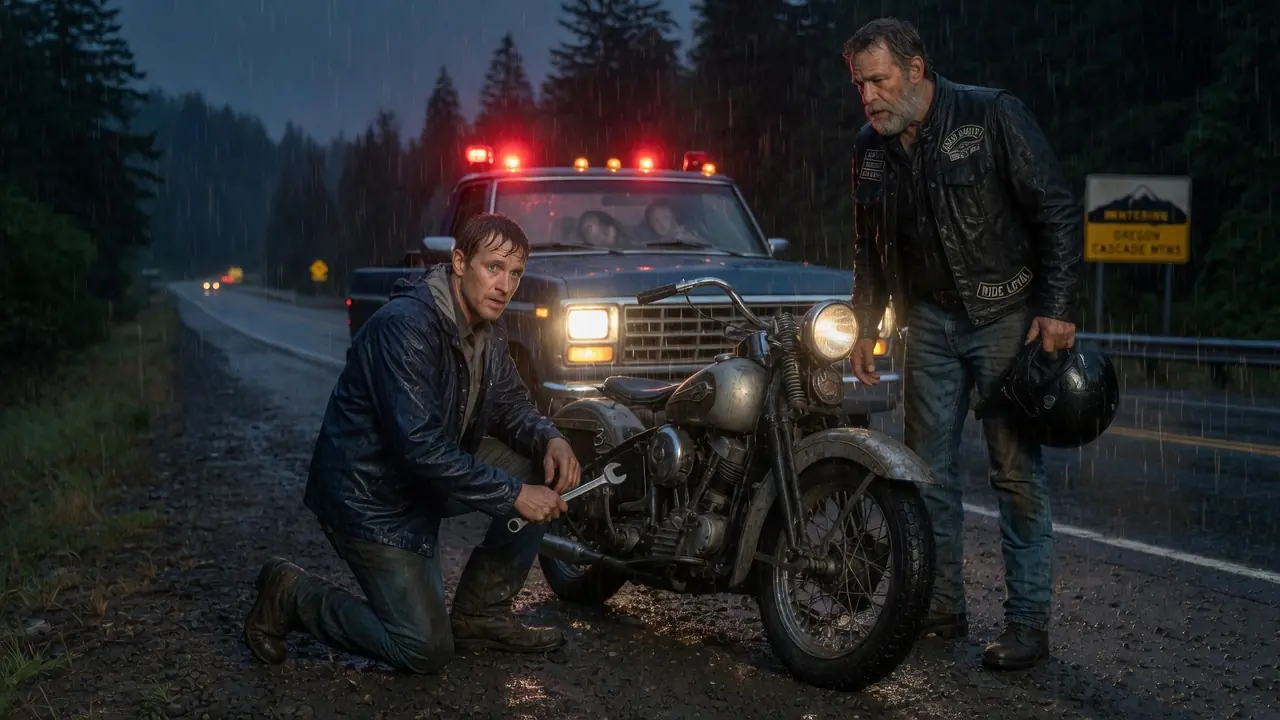
Rain pounded against the metal roof like a thousand impatient fingers drumming out an urgent Morse code only the storm understood. Each droplet seemed to carry the weight of clouds that had traveled across the Pacific just to unleash their burden on Highway 47’s already treacherous curves and blind spots.
In the passenger seat, eight-year-old Emma slept peacefully, her slight chest rising and falling in the rhythm of childhood dreams that still came easily despite the upheaval that had defined the past two years of their lives. One arm was wrapped protectively around Mr. Patches, the threadbare teddy bear that still smelled faintly of her mother’s lavender perfume, even after countless trips through the washing machine had faded his fur from rich brown to the color of old pennies.
The heater hummed its mechanical lullaby, fogging the windows just enough that Mark had to lean forward to see through the curtain of water Highway 47 had become. Each passing semi-truck sent waves across his windshield that momentarily blinded him to the world beyond, forcing him to navigate by memory and instinct through familiar territory made strange by weather that transformed known roads into uncharted waterways.
The emergency fund envelope tucked beneath his visor contained exactly forty-seven dollars and thirty-two cents. It was money he had been saving for Emma’s school supplies and the new winter coat she would need before October’s first frost arrived. Survival required constant vigilance and careful planning when resources were limited, and unexpected expenses could derail months of budgeting.
His calloused hands, permanently stained with motor oil and marked by countless small cuts from years of coaxing life back into broken engines, guided the truck through puddles that could swallow a smaller vehicle whole. His mechanic’s intuition read the road through the steering wheel’s vibrations and the subtle changes in tire pressure that spoke of hidden dangers beneath the water’s deceptive surface.
The radio crackled with weather warnings and static. The announcer’s words faded in and out like transmissions from a distant planet as reports of flooding, road closures, and accident statistics rose with each hour of sustained rainfall. Mark kept the volume low so Emma would not wake and worry about things beyond her control, the way she had during last month’s tornado watch when she had crawled into his bed and asked if storms could take daddies away too.
Just like they took mommy.
The thought hit him with the same quiet ache it always did.
Sarah had died in a car accident that shattered their world into before and after, leaving Mark and Emma to navigate grief and practical concerns with equal measures of determination and barely controlled panic. One day, there had been three of them. The next, Mark had been standing in a hospital hallway, trying to understand how ordinary time could split so violently.
Through the sheets of rain that turned the highway into an impressionist painting of blurred lights and moving shadows, his headlights caught a sight that made him ease off the accelerator.
A figure hunched over a motorcycle on the shoulder.
The person was barely visible against the darkness, except for the reflective strips on rain-soaked leather that caught the light like desperate signals sent from a sinking ship. The bike sat silent and still, its chrome dulled by water and defeat, while its owner crouched beside it in a posture that spoke of frustration, desperation, and the particular helplessness that comes when machines betray the trust we place in them.
Mark’s foot hovered over the brake pedal.
For a moment, he considered the warm, dry sanctuary of his truck cab. He considered the sleeping daughter who trusted him to make safe choices, choices that placed her well-being above all other considerations. He considered the forty-seven dollars above his head, the envelope that represented security in a world where every expense had to be weighed against Emma’s needs and the constant pressure of bills that arrived with clockwork regularity.
But something deeper pulled at him.
It was the familiar instinct that had made him a good paramedic before Emma’s medical bills and the need for flexible hours drove him toward part-time work at Joe’s Auto Repair. There, he fixed other people’s problems for twelve dollars an hour and tried not to think about his own mounting collection of deferred maintenance and postponed dreams.
The rain intensified as he pulled onto the shoulder. Gravel crunched beneath his tires like broken promises while the truck’s emergency flashers began their rhythmic pulse, cutting through the darkness with urgent red light. Steam rose from his hood as the engine idled.
“Stay sleeping, baby girl,” he whispered.
He pulled on the rain jacket that had seen better decades and countless emergencies, emergencies that had taught him the difference between problems that could wait and crises that demanded immediate action regardless of comfort or convenience.
The moment he stepped outside, the storm claimed him. Rain soaked through his jeans and filled his boots with cold water. It called to mind the morning he had scattered Sarah’s ashes in the river she loved, when the rain had felt like the sky was crying for all of them, for love interrupted, plans canceled, and the arbitrary cruelty of accidents that steal futures from people who had done nothing wrong except trust that tomorrow would resemble today in all the ways that mattered most.
The stranded biker looked up as Mark approached.
He was an older man, maybe in his late sixties, with a gray beard plastered to his face by rain and a leather vest heavy with patches. His weathered hands trembled, though not only from the cold.
“You all right?” Mark shouted over the storm.
The man looked at the motorcycle, then back at Mark.
“I’m not hurt,” he said. “But this old girl picked the worst possible night to die on me.”
Mark crouched beside the Harley, shining his flashlight over the engine.
“What happened?”
“She started losing power about ten miles back,” the man said. “Then smoke. Then nothing.”
“What’s your name?”
“Frank,” the biker said. “Frank Morris.”
“Mark Davidson.”
They shook hands briefly, rainwater running between their palms.
Mark’s flashlight revealed the extent of the problem as he probed deeper into the engine’s mechanical heart. His trained eye recognized the telltale signs of a blown head gasket, the kind of failure that typically required days in a proper shop with specialized tools and parts that might not even exist anymore for a bike this old.
The motorcycle was a 1987 Harley-Davidson, beautiful even in failure. Its metal body carried the marks of years, but also the unmistakable signs of devotion. This was not a machine someone neglected. This was a machine someone loved.
Frank paced in tight circles, his boots splashing through puddles that reflected the truck’s headlights like scattered stars. In his movements, Mark noticed the desperation of someone who had spent a lifetime being reliable, showing up, keeping promises, only to face the possibility of failing when it mattered most.
“This bike has been with me through every important moment in my daughter’s life,” Frank said, his words barely audible above the storm. “I rode it home from the hospital when she was born. I rode it to her first day of school. Every birthday. The day she got accepted to college. The day she called to tell me about the engagement.”
His voice broke slightly.
Mark pretended not to notice.
Some emotions were too raw to acknowledge directly, especially between strangers who had known each other for less than an hour.
“The wedding starts at ten in the morning,” Frank continued, checking his phone for what must have been the hundredth time. The screen’s blue glow lit his features, etched with worry and self-reproach. “Rebecca’s been planning this for two years. Every detail perfect. Except she insisted on leaving one thing unplanned.”
“What thing?”
“The moment her old man rides up on Grandpa’s bike and walks her down the aisle.”
Frank looked at the Harley, and his face softened in a way that made him seem older and younger at once.
“Her fiancé thinks it’s silly, all this motorcycle nonsense. But Rebecca said the sound of this engine is the sound of home. Of family. Of all the times I showed up when she needed me.”
The storm intensified around them as if nature itself were testing their resolve. Mark felt the weight of decision pressing down like the low clouds that obscured the horizon. His mechanic’s mind calculated the near impossibility of the situation. Even if he had the right parts, even if he had his fully equipped workshop instead of a roadside shoulder, even if the weather cooperated, this repair would take the better part of a day.
But something else stirred in his chest.
A memory of Sarah’s voice from their last conversation before the accident.
She had looked up from helping Emma with homework and said, “You know what I love most about you, Mark? You’re the kind of person who stops for strangers. You see someone in trouble, and you can’t just drive by. That’s the man I want Emma to remember.”
Inside the truck, Emma shifted in her sleep. Through the rain-streaked window, Mark could see her delicate face, peaceful and trusting, Mr. Patches clutched tight against her chest.
The forty-seven dollars in the envelope above his head represented three weeks of careful budgeting. Portland was six hours away through mountain passes that became dangerous in weather like this. A journey that would eat most of a tank of gas and probably require an overnight stay they could not afford.
Logic and responsibility went to war against something deeper.
Something that sounded suspiciously like Sarah’s voice whispering that sometimes the universe places you exactly where you need to be, exactly when someone else needs you most.
Frank pulled out his phone and showed Mark pictures of Rebecca in her wedding dress during the final fitting. Her face was radiant with joy and anticipation.
“She’s my only child,” Frank explained unnecessarily, the way people do when they desperately need a stranger to comprehend the depth of their love and fear. “Her mother died when Rebecca was twelve. Cancer. After that, it was just the two of us for so many years.”
He swallowed hard.
“This bike was our lifeline. Even when she went away to college, when she moved across the country for work, when life tried to pull us apart, I rode the Harley to every important moment because she said it made her feel like a little girl again. Safe. Loved. Sure that her daddy would always show up.”
The rain pounded against Mark’s jacket with increasing fury.
He made a decision that surprised even himself.
The words emerged before his cautious mind could intervene.
“My truck’s got a trailer hitch,” Mark said, straightening from his examination of the broken engine. “We’ll load your bike in the back, and I’ll drive you to Portland tonight.”
Frank stared at him through the rain.
His mouth opened and closed like he was trying to process an impossible kindness.
“You can’t do that.”
His voice carried the desperate hope of someone who wanted to be wrong about human nature, who needed to believe that help could arrive exactly when it was needed most.
“It’s six hours through mountain passes,” Frank protested. “You’ve got your daughter with you. You don’t even know me. I can’t ask you to drive through this storm for a stranger.”
“You didn’t ask,” Mark said.
Frank stared at him.
Mark was already walking back toward his truck, his mind shifting into the practical mode that had served him well during his paramedic days. Quick decisions. Decisive action. The difference between making it in time and living with regret forever.
Within minutes, they had secured the Harley in the truck bed and begun their midnight journey toward Portland.
The drive became a passage through more than miles. The pickup truck cut through the storm-darkened landscape while Frank’s stories filled the cab with memories. They transformed two strangers into reluctant confidants, bound by the strange intimacy that emerges when people share their deepest fears in the safety of moving darkness.
Emma slept peacefully between them, her head resting against Frank’s leather jacket, which he had insisted on removing so she could use it as a pillow. The gesture revealed arms covered in tattoos that told stories of military service, lost love, and roads traveled in search of something that might have been peace.
Through the windshield, the world blurred past in streaks of shadow and light. Truck stops and small towns appeared like islands in an ocean of rural darkness while Frank’s voice wove tales of his late wife, Margaret.
He told Mark how he and Margaret had met at a motorcycle rally in Sturgis four decades earlier. How she had ridden her own Harley until cancer treatments made her too weak to handle the weight and vibration. How Rebecca, at thirteen, had once polished both bikes by herself because she said her mother would want them shining.
“Margaret used to say bikes were just metal and chrome until you put love into them,” Frank explained as they navigated a particularly dangerous mountain pass. His weathered hands were gentle as he adjusted Emma’s position so she could sleep more comfortably. “She said every mile you ride with someone becomes part of the machine’s soul.”
He looked toward the rearview mirror, where the outline of the Harley sat strapped down in the truck bed.
“That’s why this Harley means so much to Rebecca. It’s not just my father’s bike or mine. It’s forty years of family history. Every Christmas morning ride. Every birthday surprise. Every time I showed up at her school or college or apartment because she needed her dad.”
Mark listened while calculating fuel consumption and drive time. His mechanic’s mind worked through the logistics of their midnight mission while another part of him processed the profound loneliness in Frank’s voice. The way older men sometimes bear grief like a second skeleton, invisible but structural, holding them upright through sheer force of habit and responsibility.
The storm followed them inland, transforming familiar highways into alien waterscapes where visibility shrank to the reach of headlights. Every passing semi-truck sent walls of spray across the windshield like automotive tidal waves.
Frank shared his fears about retirement, about becoming irrelevant to grown children who love you but no longer need you the way they once did. He spoke about watching Rebecca build a life with a man who thought motorcycles were dangerous relics from a simpler time.
“Her fiancé is a good man,” Frank admitted. “College educated. Steady job. Treats her like a queen. But he doesn’t understand why she wants her old man to ride up on a forty-year-old Harley when they could rent a proper limousine. He doesn’t understand why she insists on keeping traditions that probably seem backward to someone his age.”
Mark recognized the ache in Frank’s voice.
It was almost identical to the ache that gripped him when Emma talked excitedly about friends’ fathers who coached soccer teams and attended PTA meetings. Successful men with reliable schedules who could promise their presence at every important moment.
They stopped at an all-night diner outside Salem, the kind of fluorescent-lit sanctuary that exists specifically for travelers caught between destinations, where coffee tastes like burnt hope and pie provides comfort to people who need sugar and human contact more than fine dining.
Emma woke as they parked, her hair tousled and eyes bright with the particular alertness children possess when adventure interrupts their normal routines.
“Are we there yet, Daddy?” she asked.
Frank laughed for the first time since Mark had found him stranded. The sound was rusty but genuine as he helped her down from the truck cab.
Inside the diner, Emma charmed their waitress by ordering pancakes with extra syrup “for energy” and peppered Frank with questions about motorcycles that revealed her natural curiosity about the adult world she was eager to understand.
Frank pulled out his phone to show Emma pictures of Rebecca in her wedding dress. His thick fingers were surprisingly gentle as he swiped through images documenting his daughter’s transformation from little girl to bride.
“She looks like a princess,” Emma declared with the authority that eight-year-olds bring to matters of beauty and fashion.
Frank’s eyes grew bright with moisture that might have been tears or might simply have been exhaustion.
“She is a princess,” he agreed. “Which makes me the luckiest king in the world.”
Mark excused himself to check on the motorcycle in the truck bed. But really, he needed a moment to process the weight of what they were doing.
He stood in the parking lot, his breath creating soft clouds in the cold air, while he examined Frank’s Harley under the harsh glare of security lights. The bike was magnificent, even in its mechanical distress. Chrome and steel shaped into a machine that transcended mere transportation and became sculpture, art, a physical manifestation of freedom, rebellion, and the American dream of endless highways leading toward infinite possibilities.
Mark’s trained eye saw past the blown head gasket to the loving care that had kept the machine running for four decades. Every bolt and wire had been maintained with religious devotion. Frank had probably spent countless hours in his garage treating the motorcycle not like a vehicle, but like a shrine to everything he valued about independence, reliability, and showing up when promises needed to be kept.
While Emma and Frank shared pancakes inside, Mark retrieved his emergency tool kit from behind the truck seat and began working on the Harley by the light of his phone’s flashlight. His fingers found the familiar rhythm of repair work that had sustained him through two years of single parenthood and financial uncertainty.
The head gasket replacement should have been impossible under these conditions.
But Mark had spent enough years coaxing life back into broken machines to know that sometimes impossibility is just another word for a problem that has not been solved yet.
He worked with the focused intensity his former EMT training had taught him. The understanding that when someone is counting on you, when time is running short and stakes are high, you find ways to make the impossible merely difficult.
The rain had softened to a steady drizzle. Through the diner’s windows, he could see Emma demonstrating proper pancake-cutting technique to Frank, who watched her with the delighted attention grandfathers reserve for precocious children who remind them that the world still contains wonder worth protecting.
Mark did not have a replacement head gasket.
He did not have a full shop.
He did not have a proper lift.
What he had was experience, patience, stubbornness, and a small collection of parts he had kept in his truck because living on the edge of poverty had taught him that preparedness was cheaper than panic.
He cleaned what he could. Sealed what he could. Reinforced what he could. Built a temporary workaround that would never survive a cross-country trip but might survive the final stretch to a church if handled with care and a little luck.
By the time Frank and Emma emerged from the diner at nearly four o’clock in the morning, Mark had the Harley’s engine running with a deep, satisfied rumble that cut through the predawn air like a mechanical prayer answered.
Frank stopped dead in his tracks.
His face cycled through disbelief, gratitude, and something approaching awe as he realized what Mark had accomplished in the parking lot of a roadside diner.
“You fixed it,” he said, unnecessarily.
Mark shrugged, as he always did when people thanked him for doing what needed to be done.
“It’ll get you there,” Mark said. “Don’t push her too hard. No showing off until after the ceremony.”
Frank let out a sound that was half laugh, half sob.
Emma clapped her hands with delight at the sound of the engine, and Frank lifted her onto the bike’s seat so she could pretend to ride. Her delicate hands gripped the handlebars while she made motorcycle noises that sent both men into laughter that felt like release, like the moment when pressure finally finds a way to escape.
They reached Portland as the first hints of dawn painted the sky pink.
Near the city, they unloaded the Harley in an empty parking lot. Frank mounted the restored machine carefully, as if approaching an altar. When the engine caught beneath him, the familiar rumble echoed across the quiet morning with a power that seemed to straighten his spine and erase years from his face.
Mark followed behind in the pickup as Frank rode toward St. Mary’s Cathedral.
The city was barely awake. Streetlights still glowed against the soft morning, and rainwater collected in silver ribbons along the curbs. Frank’s Harley rolled through the empty streets, not fast, not loud for the sake of being loud, but steady and alive.
Rebecca emerged from the church steps still in her wedding dress from the early morning photos. She must have heard the engine before she saw him, because she turned suddenly, one hand flying to her mouth.
At the sight of her father on the old Harley, tears of pure joy streamed down her face.
Frank pulled up at the curb and cut the engine.
For a moment, there was silence.
Then Rebecca ran down the steps and threw herself into his arms, wedding dress and all, while Frank held her like she was still twelve years old and afraid of the world.
Mark watched from the truck with Emma asleep against the passenger door, Mr. Patches clutched in her arms.
The promise had been kept.
He did not stay for the wedding. He refused Frank’s insistence, refused the offer of breakfast, refused every attempt to turn his act into something larger than it was. He simply shook Frank’s hand, accepted Rebecca’s tearful hug, and told them both to have a beautiful day.
Then Mark and Emma turned toward home.
They drove back exhausted but fulfilled, the kind of tired that settles in the bones after a long night spent doing something that matters. Emma woke halfway home and asked if biker weddings had cake. Mark told her they probably had the best cake. She accepted this as fact and went back to sleep.
When they finally reached their small ranch house, the sun was already climbing. Mark carried Emma inside, tucked her into bed, and collapsed fully clothed onto his own mattress.
He slept for only a few hours.
Then he woke not to his usual alarm clock, but to a sound that began as distant thunder and grew into something that defied immediate explanation.
A deep, rhythmic rumbling emerged from the earth itself, building into a mechanical symphony that rattled the windows of their small house.
Emma appeared in his bedroom doorway still in her pajamas, wide awake with excitement. She pressed her face against the window that overlooked their quiet residential street.
“Daddy,” she whispered with the reverent tone she usually reserved for Christmas morning or unexpected snow days. “Come look.”
Mark joined her at the window.
What he saw transformed their ordinary Saturday into legend.
Six hundred motorcycles lined Maple Street as far as the eye could see. Their chrome and steel gleamed in the morning sunlight like an army of mechanical knights assembled for an impossible crusade.
The bikes ranged from vintage Harleys that could have been Frank’s contemporaries to sleek modern machines that looked like they had escaped from science fiction. But they all shared one thing.
Purpose.
Their riders, leather-clad men and women from across the Pacific Northwest, had traveled after hearing a story that restored their faith in strangers and random kindness.
At the head of this magnificent procession sat Frank on his father’s 1987 Harley-Davidson, the engine Mark had repaired in a diner parking lot now purring with perfect mechanical contentment. In Frank’s hands was a leather jacket bearing the words HONORARY ROAD FAMILY embroidered across the back in thread that caught the light like golden promises.
The sight defied logic and probability.
Six hundred individual decisions to wake early on a weekend morning and ride, sometimes hundreds of miles, to honor a debt that existed only in the complex mathematics of human decency.
But Mark understood instinctively that this gathering represented something larger than gratitude or even community. These riders had created a living monument to the radical idea that helping strangers matters. That small acts of kindness ripple outward through networks of connection to create waves of generosity that can lift everyone they touch.
Emma gripped his hand with excitement that vibrated through her small frame. Mark realized she was witnessing a lesson about human nature no classroom could provide. She was seeing proof that the world contained more good than cynicism suggested, more connection than isolation allowed.
Frank dismounted and approached their front porch. His weathered face was transformed by a smile that made him look decades younger. Behind him, the assembled riders kept their engines at idle, creating a sustained rumble Mark felt in his chest like a second heartbeat.
“You helped one of us,” Frank called out, his voice carrying easily over the mechanical chorus. “Which means you helped all of us. And that makes you family whether you like it or not.”
The leather jacket he extended represented more than clothing. It was membership in a tribe that valued loyalty and mutual aid above profit and convenience. A community that understood motorcycles as vehicles for purposes beyond simple travel, symbols of freedom, rebellion, and the bonds that form between people who choose to face the world’s uncertainties together rather than alone.
Mark stepped onto the porch slowly.
“I don’t know what to say,” he admitted.
Frank smiled.
“Good. Then just listen.”
The riders began dismounting, and Mark observed that each one brought something. Toolboxes and spare parts. Gift certificates to motorcycle shops and auto parts stores. Business cards from garage owners who wanted to offer him work. Envelopes that probably contained money, and certainly contained stories of their own encounters with unexpected kindness from strangers who had stopped to help when help was needed most.
A woman with silver hair and arms strong enough to handle a bike twice her weight introduced herself as Margaret, just like Frank’s late wife. She owned three auto repair shops in Oregon and explained that she could always use a mechanic who understood that fixing machines was really about fixing the connections between people and the things they loved.
“I heard you work part-time at a shop for twelve dollars an hour,” she said, giving Mark a look that suggested she found this personally offensive. “That ends today if you want it to.”
Mark stared at the card she handed him.
Emma emerged onto the porch, still in her pajamas, her hair uncombed, her smile radiant as she surveyed the incredible scene that had transformed their quiet street into something from a dream or a movie about the kind of world adults wish existed but rarely believe they will ever see.
Frank knelt to her level and presented her with a child-sized leather vest decorated with patches that chronicled famous rides and beloved bikes. It made her an honorary member of a family she had joined simply by being present when her father chose kindness over caution on a rain-soaked highway.
“Every princess needs proper riding gear,” Frank explained seriously.
Emma’s giggle of delight echoed through the crowd of riders, who had all stopped their conversations to witness the moment of pure joy.
The morning unfolded like a festival celebrating human decency.
Riders shared stories of their own encounters with roadside angels. Mechanics who had worked miracles with broken machines. Strangers who had offered shelter during storms or rides to destinations that seemed impossibly distant. Men and women who had learned, one hard mile at a time, that survival is rarely a solo effort.
Mark found himself surrounded by offers of friendship and employment, invitations to rallies and rides, and business cards from people who wanted to hire him, teach him, help him, or simply know him better.
Word had spread through motorcycle communities from British Columbia to Northern California about the single father who drove through a storm to get a stranger to his daughter’s wedding.
Emma moved through the crowd like a young ambassador, accepting patches for her vest and listening to stories about the kind of adventures that await people brave enough to believe in the kindness of strangers.
Neighbors came out onto their lawns in bathrobes and slippers, too stunned to complain about the noise. Children stood barefoot on porches with cereal bowls in their hands. Someone brought coffee. Someone else brought donuts. Within an hour, Maple Street had become a block party no one had planned and everyone would remember.
At one point, Frank took Mark aside.
“I know you wouldn’t take money last night,” he said.
“I didn’t do it for money.”
“I know. That’s why this matters.”
Frank reached into his vest and pulled out a key.
Mark frowned.
“What’s that?”
“A workshop space behind my house,” Frank said. “Rent-free for as long as you need it. Equipped with tools, lifts, storage, the whole thing. Rebecca and her new husband are moving closer to the city after the honeymoon, and I don’t need the space sitting empty.”
“Frank, I can’t accept that.”
“You can. You will. And when you’re ready, you’ll turn what you do into something bigger than fixing cars in somebody else’s shop for somebody else’s profit.”
Mark shook his head, overwhelmed.
Frank’s expression softened.
“Rebecca’s wedding was perfect,” he said. “But watching you work on that engine in a diner parking lot at three o’clock in the morning? That was when I knew I’d met someone who understands that taking care of machines is really about taking care of the people who depend on them.”
Mark looked down at the key in his palm.
For two years, he had been surviving. Not building. Not dreaming. Just surviving. Every decision had been about keeping Emma fed, clothed, safe, and stable. There had been no room for possibility, no room for risk, no room for believing that one act of decency might open a door.
Now six hundred motorcycles sat outside his house because he had pulled over in the rain.
The sound of six hundred engines starting in near unison created a mechanical symphony that neighborhood children would remember for the rest of their lives. As the riders began their procession back to highways that would carry them home to their own families and responsibilities, the rumble that remained in Mark’s heart spoke to something more lasting than noise.
Emma stood beside him on the porch, her new leather vest worn proudly over her pajamas, waving goodbye to friends she had known for less than three hours but would remember forever as proof that the world contained more magic than cynicism allowed.
The street gradually returned to its normal quiet.
But Mark recognized that something fundamental had shifted in their small corner of the universe.
The single decision to help a stranded stranger had opened doorways to possibilities he had never imagined existed.
Emma tugged at his hand.
“Daddy?”
“Yeah, baby?”
“Can we get a motorcycle too?”
Mark looked down at her, then out at the disappearing line of riders. He thought about highways leading toward adventure, about the community that had adopted them, about Sarah’s voice whispering that sometimes the longest journeys begin with the simple decision to pull over in the rain and ask if someone needs help.
He smiled.
“We’ll think about it.”
Emma grinned.
And for the first time in a long time, Mark let himself imagine a future that was not just about getting through the next bill, the next shift, the next hard month.
A future with roads in it.
A future with people in it.
A future where kindness did not disappear after it was given, but returned louder, stronger, and more beautiful than anyone could have expected.