Red emergency lights flashed across the enormous production hall of Orion Aero Components outside Dayton, Ohio. The hydraulic assembly line had been silent for more than three hours, leaving unfinished aircraft parts hanging above motionless conveyor belts while hundreds of anxious workers crowded behind the safety barriers. Every hour of downtime cost the company more than eighty thousand dollars, and management estimated the total loss would reach two million dollars before the next morning. Yet in the middle of the crisis, the company’s billionaire CEO seemed more furious at the janitor holding a wrench than at the dead machinery threatening her entire factory.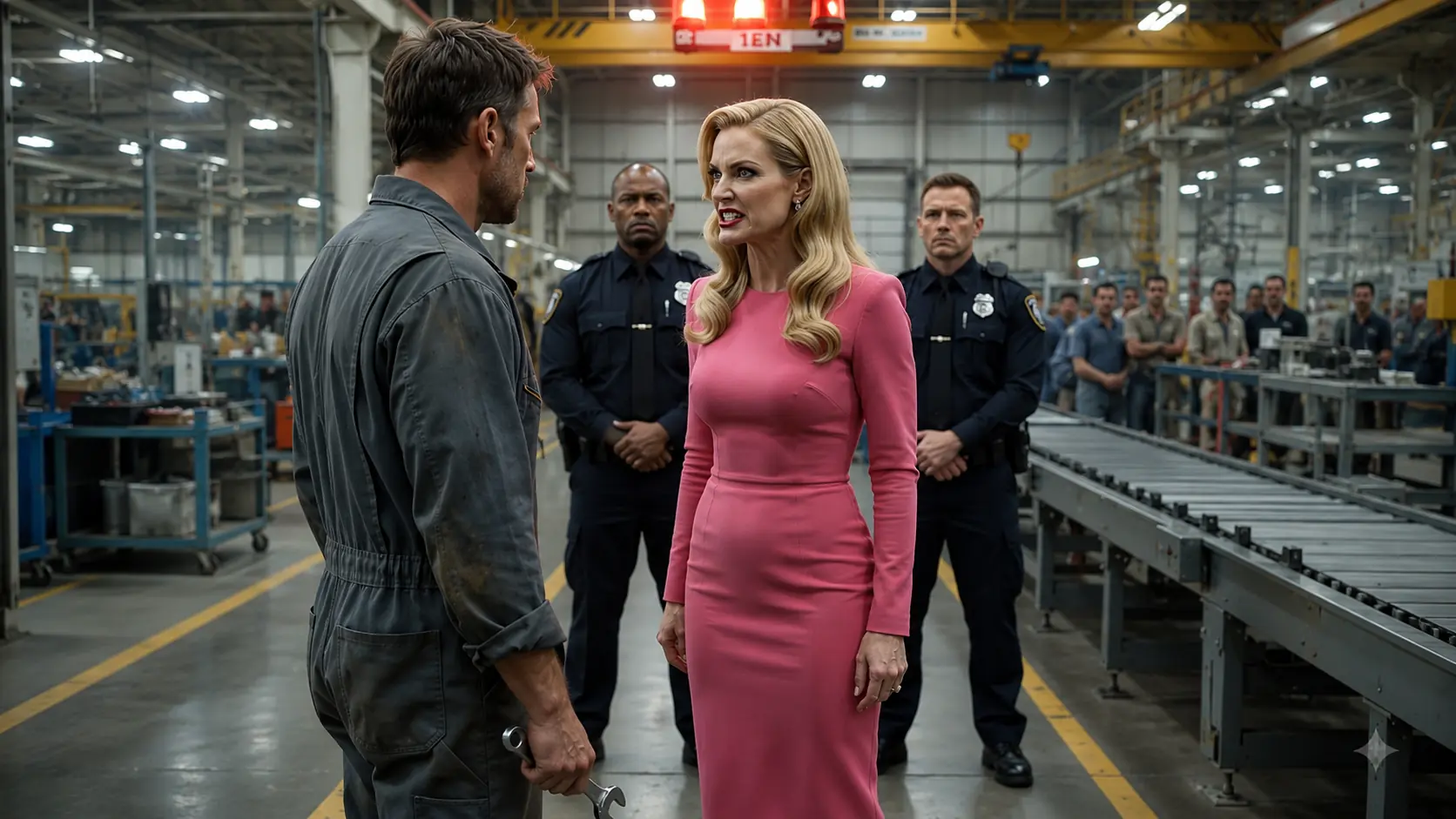
Mark Dawson stood beside an overlooked secondary pressure line in worn charcoal coveralls stained with oil and cleaning fluid. At thirty-eight, he carried the hardened build of a former serviceman, with short dark-brown hair, rough beard stubble, gray-blue eyes, and an old shoulder injury that made his left arm stiff in cold weather. His official job title was night maintenance custodian, which meant most executives saw him only when a floor needed cleaning or a leaking pipe needed reporting. None of them knew he had spent fifteen years maintaining aircraft-launch pressure systems aboard a United States Navy carrier.
Across from him stood Evelyn Cross, the forty-three-year-old CEO who had turned Orion Aero into one of the country’s largest private aircraft-parts suppliers. She wore a fitted bright-pink long-sleeved dress, sheer black stockings, and glossy heels that struck the concrete like small hammer blows. Her blonde hair fell in polished waves around a face built for magazine covers and boardroom intimidation. Behind her, two security guards waited for permission to remove Mark from the production floor.
“Last warning,” Evelyn said. “Put down the wrench.”
Mark glanced at the frozen assembly line. “Your engineers checked the primary system three times.”
“And?”
“The primary system isn’t the problem.”
The lead engineer, Dr. Victor Hale, stepped between them with irritation tightening his narrow face. Victor held two advanced engineering degrees and had spent the morning surrounded by consultants, diagnostic laptops, pressure maps, and technicians carrying equipment worth more than Mark’s house. Every digital reading showed normal operating pressure, yet the safety system continued shutting down the entire production line before startup. Victor had begun blaming corrupted software, but three separate resets had changed nothing.
“You have no authorization to diagnose this system,” Victor said.
“I’m not diagnosing it,” Mark replied. “I already know what happened.”
Several engineers laughed.
Evelyn folded her arms. “You know what thirty specialists missed?”
“I know what they weren’t trained to hear.”
Victor looked at the small wrench in Mark’s hand. “And what exactly did you hear?”
“A hollow vibration behind the auxiliary return valve.”
Victor’s smile disappeared for half a second. He recovered quickly and gestured toward the computer monitors. “All auxiliary readings are within tolerance.”
“That’s the problem. They’re barely within tolerance.”
Mark pointed toward a long pressure pipe running behind a dust shield near the base of the assembly platform. During his cleaning rounds, he had tapped the pipe with the rubber handle of a maintenance tool and heard a thin metallic rattle beneath the normal hum. It reminded him of a failure aboard the USS Enterprise twelve years earlier, when a broken retaining clip traveled through a secondary line and lodged inside a bypass valve. Every primary gauge had appeared normal then, too, until the obstruction confused the launch system’s automatic safety controls.
Victor shook his head. “This isn’t a naval catapult.”
“No,” Mark said. “But pressure still obeys physics.”
A few workers behind the barrier murmured their approval.
Evelyn heard them and became more hostile. She had arrived expecting to intimidate the engineering department into finding a solution, not to watch an oil-stained custodian embarrass senior employees in front of the entire factory. Her company was preparing to fulfill a defense contract worth nearly nine hundred million dollars, and every hour of delay threatened penalties, layoffs, and public humiliation. If the shutdown continued for two days, Orion Aero could miss its delivery window and lose the contract entirely.
“You have five minutes,” she said suddenly.
Victor turned toward her. “Evelyn, allowing unqualified personnel—”
“We are already bleeding money,” she snapped. “Let him humiliate himself quickly.”
Mark looked at the two guards. “And them?”
“They remain where they are.”
“Then keep them out of my hands.”
Evelyn stepped closer until only a few inches separated them. “You should understand something, Mr. Dawson. If you damage this line, I will take your wages, your home, your garage tools, and anything else carrying your name.”
Mark did not blink. “My son is sitting in your break room waiting for me.”
“That changes nothing.”
“It changes everything to me.”
For the first time, Evelyn noticed the ten-year-old boy watching through the glass wall of the employee break room. Ben Dawson sat alone beside a vending machine with a school backpack at his feet and a partially assembled model airplane resting on his knees. His mother had died from an illness four years earlier, leaving Mark to raise him without relatives nearby. Mark worked nights because the schedule allowed him to drive Ben to school in the morning and collect him every afternoon.
Ben pressed both hands against the glass.
Mark gave him a small nod.
Then he turned toward the valve.
A digital timer appeared on one of the control screens after Evelyn ordered an engineer to start counting. Mark crouched beside the dust shield and ran his fingers along the mounting bolts. His shoulder protested when he reached upward, but he ignored the pain and removed the panel with steady movements. Behind him, Victor whispered to another engineer that the custodian was performing theater.
Mark tapped the secondary pipe once.
A faint metallic sound answered.
He tapped it again farther down the line.
The sound disappeared.
“There,” he said.
Victor crouched reluctantly. “I don’t hear anything.”
“You’re listening for a loud failure.”
“What should I be listening for?”
“Something small enough to hide.”
Mark removed a service cap and shone a narrow inspection light into the valve housing. Oil shimmered inside the opening, but the internal plate sat slightly crooked. The distortion was almost invisible, no more than a fraction of an inch, yet it was enough to produce irregular pressure pulses whenever the line attempted to restart.
Victor moved closer.
“What is that?”
Mark inserted a magnetic retrieval tool and carefully rotated it through the opening. The tool resisted against something sharp. After several seconds, he withdrew a broken piece of metal no longer than a thumbnail.
The factory became silent.
Victor took the fragment. “A retaining fin.”
“From an upstream guide bracket,” Mark said. “Vibration broke it loose. It traveled until the auxiliary valve trapped it.”
“That valve isn’t included in automated diagnostics,” one engineer admitted.
“Exactly.”
Evelyn glanced toward the timer. Only two minutes had passed.
“Remove it and restart the line,” she ordered.
Mark stood. “Not yet.”
Her face hardened. “You found the obstruction.”
“And I need to inspect the seat for damage.”
“You said you could restart it before they blinked.”
“I said I’d restart it. I didn’t say I’d gamble with three hundred workers standing nearby.”
Victor looked at the valve housing. “He’s right. If the fragment scored the seat, pressure could surge during startup.”
Evelyn stared at her lead engineer, stunned that he was now defending the janitor.
Mark inspected the internal surface, cleaned the chamber, and manually moved the valve through its full range. The seat remained intact. He replaced the service cap, secured the dust shield loosely for testing, and walked toward the control station.
“Clear the line,” he said.
Nobody moved.
Mark looked at Evelyn. “Do you want it running?”
She raised her chin. “Clear the line.”
Supervisors pushed workers behind marked barriers while engineers returned to the control panels. Ben remained at the break-room window, clutching his model aircraft to his chest. Mark stood beside the emergency stop button and watched the pressure display.
Victor entered the restart command.
For five seconds, nothing happened.
The warning lights continued flashing red.
Evelyn’s lips curled into a cold smile.
Then the auxiliary pressure graph steadied.
A deep mechanical hum rolled beneath the floor as pumps began turning. Conveyor locks released one after another, robotic arms lifted from their resting positions, and the first section of the production line moved forward with a heavy metallic rhythm. Red warning lights changed to amber and then green across the control board.
The entire factory roared back to life.
Workers erupted in applause.
Some shouted Mark’s name while others struck their gloves against the safety rails. The engineers stared at the operating system as though they had witnessed a machine revive from the dead. Victor examined the pressure readings, then looked at the tiny metal fragment still resting in his palm.
Evelyn remained motionless.
Mark walked back toward her.
“Your factory is running.”
She looked at the timer.
Four minutes and twelve seconds had passed.
“You were lucky,” she said.
The applause faded.
Victor turned toward her in disbelief. “That was not luck.”
Evelyn’s eyes stayed on Mark. “He happened to recognize a sound.”
Mark stepped closer. “I spent fifteen years listening for sounds that could kill people.”
She glanced at the scar disappearing beneath his sleeve. “You worked maintenance in the Navy?”
“I maintained hydraulic and pressure systems for aircraft-launch operations.”
Victor stared at him. “On which carrier?”
“The Enterprise.”
A mechanic near the control station let out a low whistle. The launch systems aboard an aircraft carrier operated under enormous pressure and demanded precision far beyond ordinary industrial maintenance. A single overlooked defect could ground aircraft, injure sailors, or compromise an entire mission.
Victor extended his hand.
Mark accepted it.
“I should have listened,” Victor said.
“You should have checked the secondary valve.”
“I will next time.”
“That’s enough.”
Evelyn watched the exchange with growing discomfort. She was accustomed to people using victory to demand humiliation, yet Mark showed no interest in destroying the engineers who had doubted him. He corrected Victor without cruelty and returned the broken fragment as if the matter were finished. That restraint made her own behavior look smaller.
Ben suddenly ran from the break room.
A security guard moved to stop him, but Mark raised one finger.
The guard stepped aside.
Ben crossed the factory floor and threw both arms around his father’s waist. “You fixed the whole building.”
Mark smiled for the first time that morning. “One valve, buddy.”
“You made everybody stop looking scared.”
Workers nearby heard him.
One woman wiped her eyes. Her husband had lost his job six months earlier, leaving her factory wages as the family’s only income. A prolonged shutdown could have forced Orion Aero to cut shifts, and the possibility had terrified hundreds of employees more than the financial charts shown upstairs.
Evelyn noticed their faces.
Until that moment, she had viewed the shutdown as a corporate loss measured in contracts and daily revenue. Mark and his son forced her to see the mortgages, medical bills, tuition payments, and groceries connected to every silent machine. Two million dollars a day was not merely a number on her balance sheet.
It was the combined security of hundreds of families.
Evelyn looked at Ben. “Your father saved the production schedule.”
Ben nodded proudly. “He saves things all the time.”
“Does he?”
“He fixed our washing machine with a spoon once.”
Mark cleared his throat. “A modified spoon.”
Ben smiled. “He also fixed my airplane after I dropped it.”
Evelyn glanced at the model aircraft. One wing had been repaired with a thin internal support so carefully that the break was nearly invisible. The boy’s fingers rested protectively around it.
“Your father is talented,” she said.
“He’s not a janitor,” Ben replied.
Mark touched his shoulder. “There’s nothing wrong with being a janitor.”
“I know. But they talked like that meant you were stupid.”
The sentence struck the adults around them.
Evelyn’s face tightened because she knew Ben had heard her.
Victor lowered his eyes.
Mark crouched despite the pain in his shoulder. “People sometimes judge uniforms before they judge work.”
“Were they wrong?”
“Yes.”
Ben looked directly at Evelyn. “Then she should say it.”
The billionaire CEO who had intimidated executives, politicians, investors, and competitors now found herself challenged by a ten-year-old holding a model airplane. Everyone waited.
Evelyn could have dismissed him.
Instead, she looked at Mark.
“I was wrong.”
Ben tilted his head. “About what?”
A few workers smiled.
Evelyn understood that the child would not allow a convenient apology.
“I was wrong to assume your father’s job title defined what he knew,” she said. “I was wrong to threaten him, and I was wrong to let my security guards intimidate him.”
Ben considered her answer. “Okay.”
Mark nearly laughed.
Evelyn turned toward Victor. “How did someone with fifteen years of naval systems experience end up cleaning our floors?”
Victor looked confused. “I didn’t hire him.”
A human-resources director standing nearby opened Mark’s employment file on her tablet. His military qualifications, technical certifications, and service history were attached to his original application. Mark had applied for three maintenance-engineering positions but had been automatically rejected because he lacked a civilian bachelor’s degree.
“The system filtered him out,” she admitted.
Evelyn looked at Mark. “Why did you accept custodial maintenance?”
“The night schedule worked for Ben.”
“You could earn four times more as an engineer.”
“Most engineering positions require travel, weekends, and emergency callouts.”
“And you refused because of your son?”
“I chose him.”
Ben slipped his hand into Mark’s.
The answer silenced Evelyn.
Her own father had built the first Orion Aero workshop when she was a child, but he had spent nearly every evening inside it. He gave her wealth, education, and eventually a company, yet she remembered waiting beside dark windows for a car that always arrived after she fell asleep. Evelyn had repeated the same pattern throughout adulthood, sacrificing every relationship that interfered with growth.
She had no children.
She had once been married, but her husband left after telling her that every conversation with her felt like a quarterly performance review. Evelyn responded by buying his company shares and removing his name from the building. She had called that victory.
Now she watched a man who had accepted lower pay to remain present for his son.
For the first time, his choice looked stronger than hers.
“Come to my office,” she said.
Mark looked toward the active line. “My shift ended two hours ago.”
“This concerns your future.”
“My future needs breakfast.”
Ben nodded seriously. “Pancakes.”
Workers laughed.
Evelyn almost smiled. “The executive dining room serves pancakes.”
Mark hesitated. “We don’t belong in the executive dining room.”
“You restarted the factory. Today, it belongs to you.”
An hour later, Mark and Ben sat across from Evelyn at a polished conference table overlooking the production floor. Ben ate pancakes while building a small landing gear assembly from spare model pieces. Mark refused coffee until Evelyn explained why she had called them upstairs.
She placed a written offer in front of him.
The position was Technical Reliability Adviser, reporting directly to the plant director rather than the engineering hierarchy. It offered four times Mark’s current salary, full health coverage, a retirement plan, and authority to inspect any production system. Most importantly, the schedule remained flexible around Ben’s school hours, with no mandatory travel.
Mark read every line.
“What’s the catch?”
Evelyn leaned back. “You distrust generous offers.”
“I distrust frightened executives.”
Her eyes narrowed. “You think I’m frightened?”
“Your factory nearly lost two million dollars because your hiring system rejected experience it didn’t know how to measure.”
Victor sat quietly at the other end of the table.
Mark continued. “You don’t only need me. You need to fix that.”
Evelyn folded her hands. “What are you proposing?”
“Review every maintenance employee’s background. Some of the people cleaning your machines probably understand them better than the managers ordering replacements.”
The human-resources director began writing notes.
“Second,” Mark said, “stop punishing workers for reporting small irregularities. That metal fragment didn’t break this morning. Somebody probably heard the valve changing days ago but stayed quiet because supervisors treat concerns like complaints.”
Victor nodded reluctantly. “That is possible.”
“Third, train engineers and maintenance crews together. The people with degrees understand system design. The people touching equipment every night understand how it ages.”
Evelyn studied him. “You are negotiating company policy before accepting your own promotion.”
“I saved a line. I didn’t become your servant.”
Ben looked up from his model. “Dad doesn’t like bosses who yell.”
Mark gave him a warning look.
Evelyn laughed unexpectedly.
It was the first genuine laugh anyone in the room had heard from her.
“Very well,” she said. “Your conditions are accepted.”
Mark signed.
News of the night custodian who solved a two-million-dollar shutdown spread through Orion Aero within days. Employees shared security footage of Mark standing against the CEO and locating the hidden obstruction with a basic wrench. Industry publications picked up the story, but Evelyn refused to describe it as a miracle.
“It was a failure of leadership,” she told reporters. “The expertise was already inside our factory. We simply failed to respect the person carrying it.”
Her statement surprised the board.
Several directors urged her to minimize the embarrassment, but Evelyn refused. She created a company-wide skills review that uncovered welders with engineering diplomas from other countries, military veterans working in shipping, and maintenance employees with decades of specialized experience. Many had been ignored because automated hiring systems valued titles more than proven ability.
Mark began teaching weekly troubleshooting sessions.
He never stood behind a podium.
Instead, he brought engineers and floor workers directly to machinery and made them listen. He taught them that computer diagnostics described what a system could measure, not necessarily what was truly happening. Every machine, he said, possessed a weak point invisible to people who trusted screens more than observation.
Ben often waited nearby after school.
One afternoon, he noticed an irregular click inside a training robot used by apprentices. The instructors had blamed a damaged motor, but Ben asked them to inspect the power connection first. A loose terminal turned out to be the real problem.
Evelyn watched the boy repair it.
“He has your instincts,” she told Mark.
“His mother was an engineer.”
“You never mentioned her.”
“She died when he was six.”
Evelyn’s expression softened. “I’m sorry.”
Mark nodded. “She taught him to ask why before touching anything.”
The following summer, Orion Aero placed Ben in a youth engineering program normally reserved for older students. He built a small pressure system using clear tubes, plastic valves, and a hand pump. His final project demonstrated how a tiny obstruction in a secondary line could shut down a much larger machine.
He dedicated it to his father.
Six months after the shutdown, Mark presented a predictive-maintenance proposal to Orion Aero’s board. His plan combined digital monitoring with scheduled physical inspections performed by mixed teams of engineers and floor technicians. The program would identify small irregularities before they became catastrophic failures.
The implementation cost two million dollars.
A director objected to the price.
Evelyn looked across the table. “That is exactly what ignorance cost us in one day.”
The board approved it unanimously.
After the meeting, Mark found Ben waiting in the lobby with homework spread across a coffee table. The boy looked up eagerly.
“Did they accept your idea?”
“They did.”
“So now you stop machines from breaking?”
“We catch problems before they become shutdowns.”
Ben considered that. “Like how you take care of me.”
Mark sat beside him. “What do you mean?”
“You don’t wait until I’m scared to ask if I’m okay.”
The words reached deeper than any promotion or public praise.
Mark placed one arm around his son.
Inside the factory below, the production line continued moving with a steady, powerful rhythm. The same workers who once watched helplessly now had permission to report unusual sounds without fear. Engineers walked the floor beside custodians, mechanics, welders, and machine operators.
Evelyn changed too.
She still wore bright dresses, spoke sharply, and demanded results. But she stopped using humiliation as motivation and instructed security never to interfere with technical disagreements unless someone posed an actual danger. She also removed degree requirements from positions where experience could demonstrate equal or greater competence.
A year later, Orion Aero reported its lowest equipment-failure rate in company history.
Mark became Director of Systems Reliability but retained one condition in his contract: he would leave the factory every afternoon in time to collect Ben from school. Evelyn never challenged it. Occasionally, she joined them for pancakes in the executive dining room, though Ben continued correcting her whenever an apology lacked enough detail.
The broken metal fragment remained framed inside Mark’s office.
Beneath it was a small plaque:
The smallest ignored problem can stop the largest machine.
Beside it sat Ben’s repaired model airplane.
Mark never considered the morning he restarted Orion Aero’s production line the greatest moment of his career. He had survived dangerous missions, kept aircraft moving at sea, and helped hundreds of families keep their jobs. Yet the memory he valued most was Ben standing before a billionaire CEO and refusing to let anyone reduce his father to a uniform.
The factory had been losing two million dollars a day.
Its most valuable solution had been walking through the building every night with a mop, a wrench, and an identification badge nobody important had bothered to read.
Mark did not become capable when Evelyn promoted him.
He had always been capable.
The only thing that changed was that the people above him were finally forced to look down—and recognize the man who had been holding their entire factory together.