The phone call came at 6:47 in the morning, before the rain had fully stopped and before Jack Morgan had finished warming up the old coffee in the back room of his repair shop. Morgan’s Repairs sat on the edge of Milfield, Ohio, with peeling white paint, a cracked concrete lot, and a faded sign that looked older than half the town. Jack had been there since five, trying to fix a delivery van before the owner lost patience and took the job somewhere else. When the phone rang, he wiped grease from his hands and wondered who would call his struggling shop this early.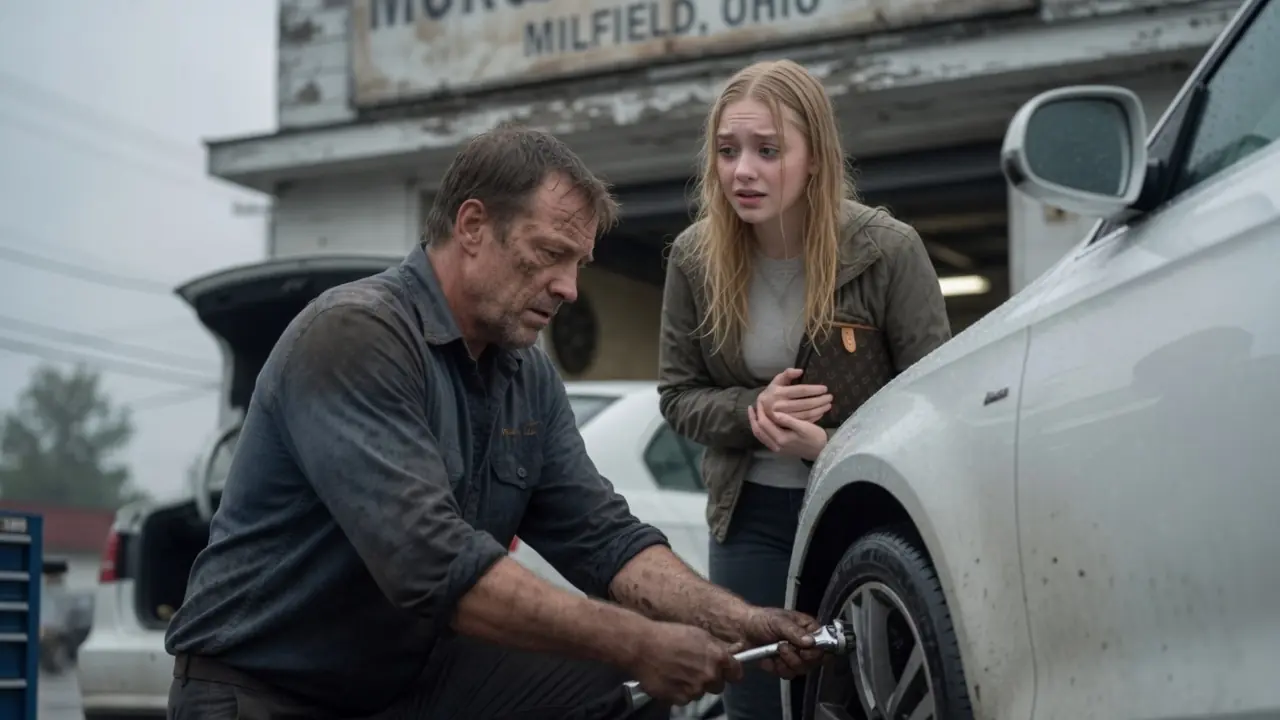
“Is this the mechanic who helped my daughter yesterday?” the woman asked. Her voice was calm, refined, and controlled in a way that made Jack stand a little straighter without knowing why. He looked toward the front window, where the rainwater still ran down the glass in thin silver lines. “If you mean the girl with the white sedan and the flat tire, yes ma’am,” he said. “Is she all right?”
There was a pause on the other end, and for a moment Jack feared he had missed something. The girl had been shaken badly, crying in the rain with her phone almost dead and her hands trembling so hard she could barely unlock the car. He had fixed the tire, checked the spare, made sure the headlights worked, and waited until she called someone before he let her drive away. Still, the silence on the phone made his stomach tighten.
“She is safe,” the woman said at last. “Because of you.” Jack exhaled quietly and leaned one hand against the workbench. “Good. That’s all I needed to hear.” The woman’s voice softened only slightly. “My name is Victoria Sterling. I will be at your shop in one hour.”
Jack frowned. The name sounded familiar, but he was too tired to place it. “Ma’am, you don’t need to come all the way out here. I didn’t do anything special.” This time, the woman answered faster. “Mr. Morgan, my daughter says you refused her money, fixed her tire in the rain, and stayed until she stopped shaking.” Jack looked down at the grease on his hands and the unpaid bills on the counter. “She was a scared kid. That comes before a bill.”
After the call ended, Jack stood in the empty shop listening to the rain tap the metal roof. His twelve-year-old son, Noah, was still asleep upstairs in the small apartment over the garage, where they had lived since the divorce and the slow collapse of everything Jack thought would last. The shop had belonged to Jack’s father, then to Jack, but lately it felt like it belonged to the bank. Every morning he opened the doors with the same quiet fear that this might be the day he could not keep them open anymore.
Yesterday had been worse than most. A supplier had refused to deliver new parts unless Jack paid down the old balance. The electric company had left a final warning taped to the office door. Noah had come home from school pretending not to care that his sneakers were splitting at the sides, though Jack saw him hide them under the bed. By sunset, Jack had been fixing a pickup in the rain because the roof above bay two leaked too badly to work underneath it.
That was when he saw the white sedan roll crookedly into the lot. The rear tire was nearly flat, the hazard lights blinking weakly through the rain, and the girl behind the wheel looked too young to be out alone in that weather. She parked badly near the bay door, opened the driver’s door, and stepped out with tears already running down her face. “Please,” she said before Jack could even ask what happened, “my tire blew out, my mom isn’t answering, and I don’t know where I am.”
Jack remembered how small she looked standing there beside the expensive car. Her jacket was soaked at the shoulders, her blond hair stuck to her cheeks, and she clutched her phone like it was the only thing keeping her connected to the world. Some mechanics might have seen the car first and the girl second. Jack saw the fear first, because fear looked the same whether it came from a rich neighborhood or a broken-down trailer park.
“Come under the awning,” he told her. “You’re shaking.” She tried to explain that she had cash, but maybe not enough, and that she could call someone once her phone charged. Jack waved it away and grabbed his jack from the tool cart. “Keep your money, sweetheart. A kid scared in the rain comes before a bill.”
She had looked at him like she did not understand the sentence. “Why would you help me when you don’t even know me?” Jack knelt beside the wheel and fitted the lug wrench into place. “Because I’m a father,” he said softly. “And if my child was stranded tonight, I’d pray a good man stopped.” The girl had covered her mouth then, trying not to cry harder.
Her name was Emily Sterling. She was sixteen, polite even while panicked, and kept apologizing as if the tire had failed because she personally disappointed the car. Jack talked her through the repair just to keep her calm, explaining each step while the rain soaked the back of his shirt. He showed her where the spare was, checked the tread, and told her not to drive faster than fifty until she got a proper replacement. When she said her mother was important and would pay him later, Jack only shook his head.
“Important people still have children,” he said. “That doesn’t change what matters.” Emily had stared at him with red eyes, holding his old shop towel around her hands. “My mom is always busy,” she whispered. “Not because she doesn’t love me. She just has so many people needing her.” Jack tightened the last lug nut and looked up at her. “Then tonight, you needed someone too.”
Now, the next morning, Jack replayed that moment as he swept the front bay and tried to make the shop look less desperate. He moved the stack of past-due envelopes off the counter and shoved them into a drawer. He wiped the coffee stain from the customer chair, kicked a loose piece of rubber molding under the desk, and turned the heater higher even though he should not have. If the girl’s mother was coming, Jack wanted the place to look like a business, not a man losing a fight slowly.
Noah came downstairs at 7:30 wearing a hoodie and sleepy suspicion. “Why are you cleaning like Grandma’s coming back from heaven?” Jack glanced at him. “A customer’s mother is stopping by.” Noah looked around at the shop, then at his father. “Did we do something wrong?” Jack hated how quickly his son expected trouble.
“No,” Jack said gently. “I helped a girl yesterday with a flat.” Noah poured cereal into a chipped bowl and leaned against the office doorway. “Was she okay?” Jack nodded. “Scared, but okay.” Noah chewed for a second, then said, “You always help people even when they don’t pay.”
Jack wanted to answer lightly, but the sentence landed too close to the truth. “That’s not always a bad thing,” he said. Noah looked toward the cracked window and the wet lot outside. “It is when we need money.” Jack did not scold him, because children who grow up near unpaid bills learn numbers before they learn peace. He only put a hand on Noah’s shoulder and said, “Kindness doesn’t close a shop, son. Bad luck and bad math do.”
At 7:58, three black SUVs turned into the lot. Noah straightened. Jack stepped outside under the awning, wiping his hands on a clean rag though they were already as clean as they were going to get. The first SUV stopped near the office, and a tall woman in a dark coat stepped out with no umbrella, as if weather was something she had already decided not to fear. Behind her came Emily, wearing a dry sweater and looking embarrassed but relieved.
Jack recognized the woman then, not from town, but from newspaper photos and business magazines left behind by customers. Victoria Sterling owned Sterling Global Logistics, a shipping and distribution company with warehouses across the country. She was the kind of woman whose decisions moved trucks, money, buildings, and headlines. Jack suddenly understood why her voice on the phone had sounded like authority wearing pearls.
Emily hurried forward first. “Mr. Morgan.” Jack smiled gently. “Morning, kiddo. Tire hold up okay?” Emily nodded, her eyes already wet again. “Yes. I told my mom everything.” Victoria Sterling stopped a few feet from Jack and studied him with an intensity that made Noah retreat halfway behind the office door.
“Mr. Morgan,” she said, “my daughter told me you found her crying beside her car and refused to leave her alone.” Jack shifted uncomfortably. “She drove into my lot, ma’am. I didn’t find her on a highway.” Victoria’s expression did not change. “You know what I mean.” Jack looked at Emily, then back at her mother. “I did what any decent person should do.”
Victoria’s eyes flicked toward the faded sign, the cracked pavement, the old tool chest, and the leaking roof visible through the open bay. She was not rude about it, but Jack could see she noticed everything. Powerful people noticed details because details told them where leverage lived. Jack braced himself for a check, a speech, or some polished thank-you that would make him feel smaller than he already did.
Instead, Victoria turned to Emily. “Tell him what you told me last night.” Emily swallowed. “Mom.” Victoria’s voice softened. “Please.” Emily looked at Jack, twisting her fingers together. “I told her I was scared because every car kept passing before I got here. And when I pulled into your shop, I thought you’d be angry or charge me money I didn’t have with me.” Her voice shook. “But you talked to me like I mattered before you even knew my name.”
Jack looked away for a second. Noah watched from the office, quiet now. Emily stepped closer and continued, “You gave me your towel, charged my phone, and waited outside in the rain until I called my mom’s assistant.” She wiped her cheek. “I don’t think you know how much that meant.”
Jack cleared his throat. “I’m glad you got home safe.” Victoria’s face changed at that, something controlled cracking just enough for grief to show through. “Emily’s father died three years ago,” she said quietly. “Since then, I have built security systems, hired drivers, created schedules, and still somehow convinced myself that control was the same as protection.” She looked at her daughter. “Yesterday, my child needed kindness, and it came from a stranger in a repair shop.”
The words filled the cold morning air. Jack did not know what to do with them, so he said the only honest thing he had. “She reminded me of my boy.” Noah stepped farther into view when he heard that. Jack looked at him and smiled faintly. “If Noah was stranded somewhere, I’d hope somebody helped him before asking what his last name was.”
Victoria looked toward Noah with new understanding. “You are a single father?” Jack nodded. “Yes, ma’am.” Noah lifted his chin a little, as if being identified as Jack’s son was something he had to stand up for. Emily smiled softly at him. “Your dad was really nice to me.”
Noah shrugged, embarrassed. “He does that.” Jack gave him a look, but the corner of his mouth lifted. For a moment, the billionaire, the mechanic, the frightened teen, and the boy in worn sneakers stood together in the damp lot as if the world had forgotten to separate them by money. Then one of Victoria’s assistants stepped forward with a leather envelope.
Jack’s body tensed. Victoria noticed. “This is not payment for the tire,” she said. “Emily told me you would refuse that.” Jack gave a small, awkward laugh. “She told you right.” Victoria held the envelope herself instead of letting the assistant do it. “Then consider this the beginning of a conversation.”
Jack did not take it. “Ma’am, I appreciate you coming by, but I’m not looking for charity.” Victoria looked at the shop again, then back at him. “Neither am I.” She opened the envelope and removed several pages. “Sterling Global has one hundred eighty-seven regional service vehicles operating within sixty miles of Milfield. Our current maintenance contractor has failed three compliance reviews.” Jack blinked. “I’m sorry?”
“I need a reliable local repair partner,” Victoria said. “My daughter says you are reliable. Your work history will tell me whether she is right.” Jack stared at the pages, unable to speak. Victoria placed them on the hood of the nearest car. “This is a preliminary fleet maintenance proposal. Fair rates. Guaranteed monthly minimum. No ownership stake, no publicity requirement, no cameras.”
Noah’s eyes widened. Jack still did not touch the papers. “Why me?” he asked. Victoria’s answer came quietly. “Because yesterday you did the right thing when there was no audience and no reward.” She looked at the broken sign above the bay. “That is the kind of man I trust with things that matter.”
Jack swallowed, but suspicion and pride fought hard inside him. “I’m one small shop. My roof leaks, my second lift barely works, and I don’t have enough staff.” Victoria nodded. “Then the contract includes an equipment advance against future work, not a gift. You earn it by servicing the fleet.” Jack looked at her carefully. “And if I say no?”
“Then Emily and I still thank you,” Victoria said. “And we leave with respect.” That answer did more to convince him than any number on the page could have. Powerful people rarely gave others a real choice. Victoria had.
Before Jack could respond, a dusty pickup pulled into the lot. A man in a bank jacket stepped out holding a clipboard, his face pinched against the drizzle. Jack’s stomach dropped so fast he felt it in his knees. Mr. Talbot from the bank had chosen that exact moment to arrive, because humiliation had a talent for keeping appointments.
“Mr. Morgan,” Talbot said, glancing at the SUVs with surprise. “I didn’t realize you had company.” Jack stepped away from the hood. “This isn’t a good time.” Talbot gave a thin smile. “Unfortunately, the bank’s timeline is not flexible. We need to discuss the default notice and potential repossession of financed equipment.” Noah’s face went pale.
Jack closed his eyes briefly. He had tried to hide the worst of it from his son, but trouble had walked right through the bay door in a bank jacket. Emily looked at Jack, then at Noah, understanding too much. Victoria turned slowly toward Talbot, and the air changed.
“Repossession?” she asked. Talbot straightened when he recognized her. “Ms. Sterling. I apologize. This is a private matter.” Victoria’s voice cooled. “Then speak privately and respectfully.” Talbot cleared his throat. “Mr. Morgan is behind on payments for two lifts and a diagnostic unit. The bank has been patient.”
Jack felt every word like a stain. “I know what I owe.” Noah whispered, “Dad?” Jack turned toward him, heart breaking. “It’s okay.” But it was not okay, and everyone there knew it.
Victoria did not rescue him with pity. She did something sharper and kinder. She picked up the fleet proposal and looked at Talbot. “If Morgan’s Repairs enters a service agreement with Sterling Global today, would projected revenue satisfy the bank’s restructuring requirements?” Talbot blinked. “That would depend on the contract value.” Victoria handed him the first page. “Read.”
Talbot read it. His posture changed before his mouth did. “This is substantial.” Victoria’s expression remained steady. “Substantial enough?” Talbot looked at Jack, then at the shop, then back at the pages. “It would certainly change the risk profile.” Jack let out a breath he did not know he was holding.
Victoria turned to Jack. “I cannot make you sign. But I can tell you this contract is real.” Jack looked down at the pages again. His hands were rough, scarred, and still faintly dark with grease despite all the wiping. Those hands had fixed engines, held his son through fevers, signed late notices, cooked cheap dinners, and tightened the lug nuts on a crying girl’s tire in the rain. Now they trembled as he picked up the proposal.
He read slowly because numbers mattered and miracles sometimes hid traps. The rates were fair, better than fair, and the equipment advance was structured as prepaid service credit, not a handout. He would need one full-time mechanic within thirty days and a part-time office manager by spring. The contract would not make him rich, but it would keep the doors open, pay the bank, replace the roof, and maybe buy Noah a pair of sneakers without waiting for a sale.
Jack looked at Victoria. “Why would you do all this because of one tire?” Victoria’s face softened. “It was not one tire.” She looked at Emily, then back at Jack. “It was the night my daughter learned the world still had good men in it.” Emily wiped her eyes again. “Mom.”
Jack’s throat tightened. He looked toward Noah, who was staring at him with hope he was trying not to show. Then Jack turned back to Victoria. “I’ll have a lawyer review it.” Victoria nodded once. “Good. You should.” That made Jack trust her even more.
Talbot, suddenly eager to be helpful, promised to pause the repossession process pending contract review. Jack wanted to dislike how quickly the bank’s attitude changed, but he was too relieved to waste energy. After Talbot left, the shop felt different, though nothing physical had changed yet. The roof still leaked, the sign still peeled, and the coffee still tasted burnt, but the air no longer felt like a door closing.
Emily stepped toward Jack and held out a folded twenty-dollar bill. Jack shook his head immediately. “No.” Emily smiled through tears. “It’s not for the tire.” She placed it on the workbench beside his wrench. “It’s for the coffee you gave me. You said coffee isn’t free unless it’s terrible.” Noah laughed before he could stop himself.
Jack chuckled softly. “That coffee was absolutely terrible.” Emily smiled wider. “Then consider it damages.” The small joke broke the heaviness, and even Victoria laughed, a quiet sound that seemed to surprise her daughter. Jack accepted the twenty and pinned it to the corkboard behind the counter.
“What are you doing?” Noah asked. Jack looked at the bill. “Keeping a reminder.” Emily tilted her head. “Of what?” Jack answered slowly. “That sometimes the smallest job on the worst day turns out to be the one that saves you.” Victoria’s eyes glistened, but she did not look away.
Over the next few weeks, everything changed without becoming easy. Jack hired a lawyer from the next town, who reviewed the contract and said, with professional disbelief, that it was clean. Sterling Global sent three vans the first Monday, then six more by Friday. Jack worked late, but now late hours came with invoices that would actually be paid.
Noah started helping after school, sweeping the bay and labeling parts bins with handwriting that grew more confident every day. Jack bought him new sneakers, and Noah pretended they were not a big deal until Jack caught him cleaning them with a paper towel after dinner. The bank restructured the loan. A roofer came to patch the worst leaks, and for the first time in years, rain no longer fell into a bucket beside bay two.
Victoria visited once a month at first, officially to review fleet performance, unofficially because Emily always asked to come along. Emily brought muffins, then homework, then stories from school. She and Noah became unlikely friends, trading sarcastic comments across the office while Jack pretended not to enjoy hearing his son laugh more. Victoria often stood quietly near the bay door, watching Jack work with the same focused respect she gave boardroom negotiations.
One afternoon, she asked him why he named the shop Morgan’s Repairs instead of Morgan Auto. Jack wiped his hands and looked up at the old sign. “My dad said people brought more than cars here.” Victoria waited. Jack smiled faintly. “He said sometimes they brought fear, bad luck, shame, and one last hope before giving up.” He tightened a bolt and added, “So we repaired what we could.”
Victoria looked toward Emily, who was helping Noah tape a drawing to the office wall. “That sounds like what you did for her.” Jack shook his head. “I fixed a tire.” Victoria answered softly, “No, Mr. Morgan. You repaired a night she was going to remember the wrong way forever.” Jack did not know how to respond to that, so he went back to work.
By spring, the faded sign came down. Jack had planned to repaint it himself, but one Saturday morning, Victoria, Emily, Noah, and two Sterling drivers arrived with ladders, brushes, and breakfast sandwiches. Jack stood in the lot, staring at them. “What is this?” Noah grinned. “A hostile renovation.”
Jack pointed at him. “You knew about this?” Noah shrugged. “I was recruited.” Emily held up a paint roller. “We kept the name.” Victoria looked almost nervous, which Jack had never seen before. “We thought the shop deserved to look as strong as it is.”
They spent the day painting in the sun. Jack argued about the cost until Victoria showed him the receipt and said Emily had paid for the paint from her own savings. That silenced him faster than any billionaire check could have. By evening, the new sign read MORGAN’S REPAIRS in bold dark letters, with Milfield, Ohio beneath it.
Jack stood across the street with Noah beside him, looking at the shop his father had built and he had nearly lost. Noah slipped his hand into Jack’s, something he had not done in public for years. “Grandpa would like it,” he said. Jack’s eyes burned. “Yeah,” he whispered. “He would.”
Victoria stood a few feet away with Emily, giving them space. Jack looked over at her. “You know, I still haven’t charged your daughter for that tire.” Emily groaned. “Mr. Morgan.” Victoria smiled. “Then send me the invoice.” Jack shook his head. “Too late. That one’s on the house.”
Emily walked over and hugged him before he could prepare for it. Jack froze for half a second, then gently patted her shoulder. “Thank you,” she whispered. Jack looked at Victoria over Emily’s head. “For what?” Emily pulled back, her eyes shining. “For stopping.”
Jack had no clever answer. He only nodded, because sometimes stopping was the difference between a story ending in fear and beginning again with hope. Victoria stepped closer then, her voice low enough that only Jack could hear. “You gave my daughter safety on one of the worst nights of her life.” She looked at the repaired sign. “I hope we gave you some back.”
Jack looked at the shop, at Noah, at Emily, at the woman who had walked into his life with authority but stayed with kindness. “You did,” he said quietly. “More than you know.” For the first time in a long time, he believed the words as he said them.
Years later, people in Milfield still talked about the morning Victoria Sterling’s black SUVs rolled into Morgan’s Repairs. Some told it like a fairy tale about a billionaire saving a mechanic’s shop. Jack never liked that version. He always corrected it.
He said the story began the night before, when a crying teenager pulled into a rainy lot with a flat tire and a dead phone. It began when nobody knew anyone’s last name, when there were no contracts, no cameras, no bank officers, and no reason for kindness except kindness itself. It began with a father kneeling in the rain, tightening lug nuts for someone else’s child, because he hoped someone would do the same for his.
And whenever customers asked about the twenty-dollar bill still pinned behind the counter, Jack would smile. He would tell them it was the most important payment Morgan’s Repairs ever received. Not because it saved the shop by itself, but because it reminded him of the truth he almost forgot.
A person never knows which small act of decency might become the first light in somebody else’s darkest night.