At 9:18 on a bright Tuesday morning, Elena Hart stepped from a black sedan onto the private apron of Hart Regional Airfield outside Dallas, Texas. Her white corporate jet waited with its stairs lowered, but no engines were running, and a red maintenance barrier had been placed beneath its left wing. Beside it stood a weathered black utility helicopter that looked painfully out of place among polished aircraft and luxury vehicles. Elena had twenty-seven minutes to reach a merger vote that would determine whether she remained in control of the aviation company her father had built.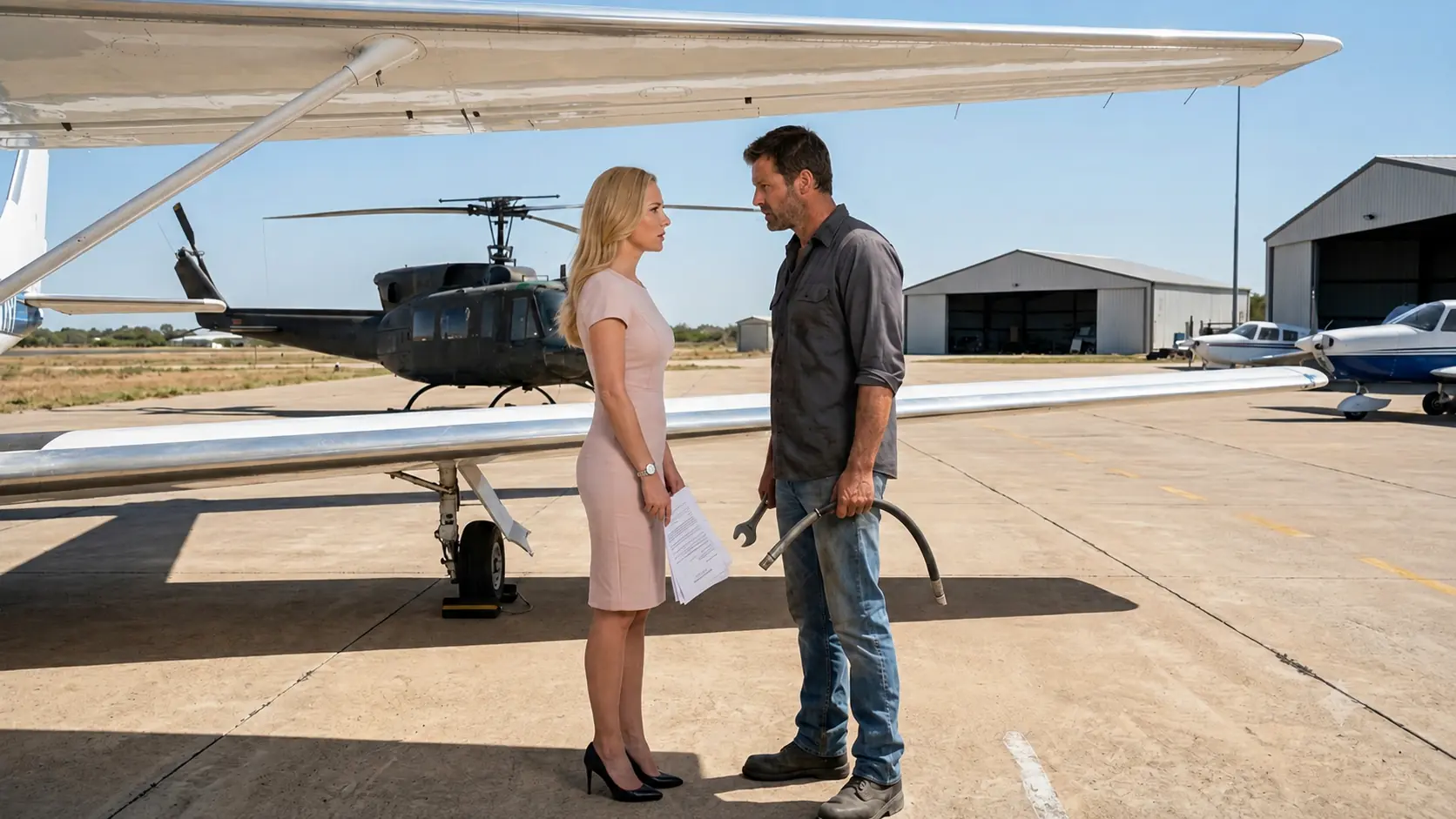
She crossed the pavement in black heels, holding an official suspension order in one hand. Her fitted pale-pink dress and carefully arranged blonde hair made her look composed, but the tightness in her jaw betrayed the panic she refused to show. Three board members had already called, demanding that she remove the mechanic who had grounded the jet and authorize immediate departure. The loudest voice belonged to board chairman Victor Langley, her father’s oldest business partner.
“The mechanic is creating a crisis,” Victor had told her. “Fire him, sign the release, and get airborne.”
The mechanic stood beneath the wing with a large wrench hanging loosely from one hand. Daniel Reed was forty, broad-shouldered, and dressed in a grease-stained charcoal work shirt, faded jeans, and heavy boots. Dark beard stubble covered his jaw, and exhaustion sat beneath his hazel eyes. He did not straighten when Elena approached, nor did he appear intimidated by the document in her hand.
“You grounded my jet before the merger vote,” Elena said. “Give me one reason not to fire you.”
Daniel lifted a severed hydraulic hose.
“Because someone sliced this after inspection and signed your aircraft safe.”
Elena stepped closer, studying the clean diagonal cut across the reinforced line. The damage did not resemble a split caused by age, pressure, or wear. Someone had driven a sharp tool through the outer braid, then repositioned the hose so the cut remained hidden behind a mounting bracket. Had Daniel not removed the inspection panel, the line might have survived takeoff before failing under full pressure.
“My board says you planted it to sabotage the sale,” Elena said.
Daniel pointed toward the black helicopter.
“Then lock the runway. The camera footage just made your board chairman run.”
Elena slowly lowered the suspension order.
Daniel led her toward the helicopter, which he used for maintenance flights, storm inspections, and emergency supply work. A small camera was mounted beneath the tail boom to record overnight activity around aircraft stored near the repair hangar. The system was old, but it operated independently from the airfield’s central network. That detail mattered because every official security camera covering Elena’s jet had mysteriously stopped recording between 1:11 and 2:04 that morning.
Daniel opened a tablet and played the footage.
At 1:37 a.m., a white service van entered the restricted apron using a valid executive access code. Two people emerged wearing Hart Aviation maintenance jackets and caps pulled low over their faces. One positioned a rolling tool cabinet beside Elena’s jet while the other disabled a light near the hangar door. They worked beneath the wing for eleven minutes, then returned to the van.
Elena leaned closer.
“Can you identify them?”
“Not from this angle,” Daniel said. “But look at the driver.”
The footage showed a third figure seated behind the wheel. Just before the van pulled away, the driver lifted a phone, briefly illuminating his face. The image was grainy, but Elena recognized the silver hair, narrow glasses, and angular profile immediately.
Victor Langley.
Her father’s trusted partner had attended Elena’s high school graduation, spoken at her mother’s funeral, and guided her through her first year as chief executive. He had defended her publicly whenever investors questioned whether a thirty-four-year-old woman could lead a major aviation company. Now he appeared to have sat inside a service van while two people tampered with her jet.
Elena stared at the frozen image.
“That could be anyone.”
Daniel did not argue.
“It could.”
“You just said it was my chairman.”
“I said the footage made him run. I didn’t say the image alone would convict him.”
Daniel enlarged another section of the recording. The van’s rear license plate was partially obscured, but four digits remained visible. Those digits matched a vehicle assigned to an aircraft-services subsidiary controlled by Victor’s private investment group. At 8:52 that morning, shortly after Daniel reported the damaged hose, the van had been removed from its usual storage garage.
Elena reached for her phone.
Victor’s number went directly to voicemail.
Her stomach tightened.
The merger vote concerned a proposed acquisition by Stratus Global, a private aviation conglomerate known for buying regional airfields, eliminating union maintenance teams, and selling valuable land to developers. Victor had spent months insisting the deal was necessary. According to him, Hart Aviation was carrying too much debt, losing too many commercial contracts, and facing rising insurance costs that could destroy the company within a year.
Elena had resisted.
Her father had not built Hart Aviation merely as an investment. He had started with one agricultural aircraft, expanded into charter services, then used company profits to establish emergency transportation routes across rural Texas. The business supported three regional airfields, an aviation school, a maintenance division, and more than nine hundred employees. Selling to Stratus would preserve the brand name while dismantling everything that gave it meaning.
Yet the numbers had become impossible to ignore.
During the previous six months, several major clients had canceled contracts without clear explanation. Fuel expenses had increased beyond market rates. Replacement parts arrived late or not at all, forcing aircraft to remain grounded. Banks that had worked with Hart Aviation for decades suddenly tightened lending conditions.
Victor presented the merger as the only way out.
The board vote was scheduled for ten that morning at a conference center in Austin. Elena planned to attend in person and present a restructuring proposal that could preserve the company’s independence. If she failed to arrive, Victor held enough proxy votes to approve the merger without her.
She looked at the damaged jet.
“They didn’t need to kill me,” she said quietly. “They only needed me to miss the meeting.”
Daniel shook his head.
“If they wanted to delay you, they could have drained the battery or contaminated a sensor. That hose controls more than one system. A failure after takeoff could have taken out your landing gear and flight controls.”
Elena’s eyes returned to the severed line.
“You’re sure?”
“I’ve repaired aircraft since I was seventeen.”
“That isn’t what I asked.”
Daniel met her gaze.
“Yes. I’m sure.”
For the first time that morning, Elena felt something colder than fear. Someone had expected her to board the jet, take off, and suffer a mechanical emergency before reaching Austin. Whether they intended a fatal crash or merely accepted that possibility no longer mattered. Her absence from the vote had been worth risking her life.
She called the airfield security director and ordered the runway closed to all nonemergency departures. She also instructed him to preserve access logs, fuel records, maintenance authorizations, and every vehicle entry from the previous forty-eight hours. The man hesitated, explaining that Victor had already authorized a corporate jet for immediate departure. Elena repeated the order under her authority as majority voting shareholder.
“Lock the gates,” she said. “No one leaves.”
When she ended the call, Daniel was studying her.
“What?”
“You believed me faster than I expected.”
“I haven’t decided whether I believe you.”
“You locked an airfield.”
“I believe the hose was cut. I believe the security system failed. And I believe Victor is avoiding my calls.”
“That’s enough for now.”
Elena disliked his calmness. She had spent her career surrounded by executives who softened bad news, concealed uncertainty, and praised her while calculating what her failure might earn them. Daniel spoke as though facts mattered more than rank. It was irritating, but she also found herself depending on it.
“How quickly can you repair the jet?” she asked.
“Not quickly enough.”
“The vote begins in thirty minutes.”
“Then you need another aircraft.”
“Everything on this field requires clearance, and Victor controls flight operations.”
Daniel glanced toward the old helicopter.
“She flies.”
Elena looked at the faded paint, patched body panels, and worn landing skids.
“That thing?”
“That thing has a new transmission, rebuilt turbine, upgraded navigation system, and cleaner maintenance records than your jet.”
“It looks older than I am.”
“So do half the safest pilots I know.”
She almost laughed despite herself.
“Can it reach Austin?”
“With a fuel stop.”
“I don’t have time for a fuel stop.”
“Then we don’t go to Austin.”
Daniel explained that the merger agreement required Elena to be physically present only if the vote occurred at the announced meeting location. But Hart Aviation’s corporate bylaws allowed the chief executive to suspend an emergency board session when credible evidence showed that a director had endangered company assets or personnel. Elena could trigger the emergency provision from any company-controlled property, provided two independent witnesses verified the evidence.
“You’ve read our bylaws?” she asked.
“My wife used to.”
The answer changed his expression. His jaw tightened, and the confidence in his face gave way to something tired and private.
“Your wife worked here?”
“Corporate compliance.”
“Used to?”
“She died four years ago.”
Elena lowered her voice.
“I’m sorry.”
Daniel nodded once and turned back toward the helicopter.
His wife, Rachel, had discovered irregularities in Hart Aviation’s vendor accounts several months before her death. She believed someone was inflating fuel contracts and charging the company for aircraft components that were never delivered. Rachel reported her concerns to Victor because he chaired the audit committee.
Nothing happened.
Weeks later, Rachel was removed from the investigation and reassigned to a smaller office. The official reason was restructuring. Daniel claimed she continued gathering documents privately until she became ill and died from an undiagnosed heart condition. He never proved that her removal was connected to the fraud, but he never stopped believing it.
“Why didn’t you bring this to me?” Elena asked.
“I tried.”
“When?”
“Three times during your first year as CEO.”
“I never saw your messages.”
“I know.”
Daniel retrieved a small folder from the helicopter. Inside were printed emails showing that each message had been sent to Elena’s executive office and then forwarded to Victor’s assistant. None had reached Elena directly. The assistant replied that the allegations had been reviewed and found unsupported.
Elena recognized the assistant’s name.
Natalie Pierce had left the company eighteen months earlier with a generous severance payment approved by Victor.
“How much evidence did Rachel collect?”
“Enough to make someone nervous.”
“Where is it?”
Daniel looked across the airfield toward an old maintenance hangar.
“In a place your chairman doesn’t know exists.”
Elena checked the time. The board meeting would begin in nineteen minutes. She called her general counsel, but the call was answered by a junior attorney who claimed the senior legal team was already inside the conference room with Victor. Elena ordered him to send immediate notice that the vote was suspended under the emergency provision.
The attorney became silent.
“Ms. Hart, Chairman Langley instructed us not to accept procedural changes from you unless they were delivered in person.”
“Victor does not have authority to override me.”
“He provided a temporary incapacity resolution signed by four directors.”
Elena’s breath stopped.
The resolution alleged that she was emotionally unstable, making reckless decisions, and attempting to destroy shareholder value by blocking the merger. It authorized Victor to assume temporary control if Elena failed to appear by ten. The document had been prepared two days before anyone supposedly knew her jet would be grounded.
The sabotage had not been a desperate act.
It had been part of a plan.
“Send me the resolution,” Elena said.
“I’m not authorized.”
“You work for Hart Aviation.”
“I work for the board.”
“I am the board’s chief executive.”
“Not after ten o’clock.”
The call disconnected.
Elena stood motionless beneath the Texas sun. Her entire professional life had been built around appearing prepared, decisive, and impossible to intimidate. She had learned to enter rooms where older men expected her to apologize for having authority. She had trained herself never to raise her voice, never to cry publicly, and never to reveal how deeply criticism affected her.
But no discipline could erase the truth.
Her own board had planned to remove her.
Daniel watched her grip the phone so tightly that her knuckles turned white.
“What do we do?” she asked.
It was the first time she had said we.
Daniel opened the helicopter’s side door.
“We get Rachel’s files.”
The helicopter lifted from the apron six minutes later. Elena sat beside Daniel wearing a headset, her pale-pink dress sharply contrasting with the scratched instrument panel and utilitarian cabin. From the air, she saw security vehicles blocking the runway and a white corporate jet stopped near the departure gate. A black sedan sped away from it toward the executive terminal.
Victor had not escaped.
Daniel flew north toward a smaller Hart Aviation property used for mechanical training. During the flight, Elena reviewed the emergency bylaws on a tablet and sent copies of the severed hose footage to three trusted managers outside Victor’s chain of command. She also contacted a federal aviation investigator she had met after a previous runway incident.
At 9:59, Victor called.
“Elena, where are you?”
“In the air.”
“On what aircraft?”
“One you didn’t sabotage.”
Silence filled the headset.
Victor recovered quickly.
“I don’t know what Daniel Reed has told you, but he has spent years blaming this company for his wife’s death.”
“He showed me footage of you inside a service van.”
“You saw a blurred image.”
“I also saw the plate.”
“That vehicle belongs to a contractor.”
“It belongs to your subsidiary.”
Victor exhaled sharply.
“You are about to lose control of the company because you trusted an angry mechanic over the people who protected your father’s legacy.”
“My father’s legacy doesn’t need protection from me.”
“You have no idea how close Hart Aviation is to collapse.”
“Then explain why the merger documents guarantee you a forty-million-dollar consulting payment.”
Victor did not answer.
Elena had found the payment buried in an appendix the previous night. She had planned to expose it during the board meeting, but Victor believed she would never arrive.
“You think this is about money?” he finally asked. “Your father left you a company built for another century. I kept it alive while you played executive.”
“You kept it weak enough to sell.”
“You should be grateful I found a buyer.”
“And should I be grateful for the cut hose?”
Victor’s voice hardened.
“Land the helicopter, Elena.”
“Why?”
“Because Reed is not who you think he is.”
“He’s a mechanic flying me toward evidence your committee buried.”
“He’s a desperate widower using you to avenge his wife.”
Daniel continued flying without reacting, though Elena saw his hand tighten around the controls.
Victor lowered his voice.
“If you continue this, every lender will withdraw by sunset. Payroll will fail. Hundreds of employees will lose their jobs, and their anger will belong to you.”
Elena looked down at the airfield approaching beneath them.
“No, Victor. Their anger will belong to whoever stole from them.”
She ended the call.
They landed beside an old training hangar at 10:06. Daniel led her through a classroom filled with disassembled engines, worn propellers, and rows of student workbenches. At the rear stood a dented metal cabinet that appeared to contain obsolete manuals. Daniel removed the bottom drawer and reached into a hidden compartment beneath it.
He pulled out three sealed evidence bags and a small external drive.
Rachel had copied vendor contracts, fuel invoices, insurance correspondence, and internal audit notes. She discovered that companies connected to Victor had overcharged Hart Aviation by nearly sixty million dollars over six years. Some invoices listed replacement engines for aircraft that never received them. Others charged premium prices for recycled parts with falsified certification numbers.
The scheme accomplished two goals.
It enriched Victor and weakened Hart Aviation until a forced sale appeared unavoidable.
Stratus Global was not an independent buyer. A private trust linked to Victor held a hidden ownership position in the conglomerate. Once the merger closed, Victor would receive his consulting payment, control several Hart airfields through Stratus, and gain access to land worth hundreds of millions of dollars.
Elena opened the final file.
It contained a recorded conversation between Rachel and Natalie Pierce. Natalie admitted that Victor ordered her to block Daniel’s messages from reaching Elena. She also described a secret account used to reward directors willing to support the merger.
“Why didn’t you release this?” Elena asked.
“Rachel encrypted the drive,” Daniel said. “I couldn’t open it.”
“How did you unlock it now?”
“I didn’t.”
He handed her a handwritten note.
Rachel had designed the encryption around a phrase Elena’s father often used during company meetings: Aircraft can be replaced. Trust cannot.
Elena entered the phrase.
The remaining files opened.
At 10:18, she initiated an emergency virtual board session from the training classroom. Daniel and the school’s senior instructor signed as independent witnesses. Victor attempted to reject the session, but Elena displayed the maintenance footage, the severed hydraulic hose, the prewritten incapacity resolution, and Rachel’s audit records.
One director left the call immediately.
Another claimed he had never reviewed the merger appendix.
Victor remained composed until Elena played Natalie’s recording.
His face changed.
“You stole privileged company materials,” he said.
“My employee preserved evidence of a crime.”
“Your employee is dead.”
Daniel stepped into view.
“But her evidence isn’t.”
Victor stared at him.
For four years, Daniel had lived with the knowledge that powerful people dismissed his wife as a bitter employee who misunderstood routine accounting. He had raised their ten-year-old daughter, Lily, while working long shifts and repairing the helicopter Rachel once loved flying in. He had waited, collected fragments, and refused to destroy evidence even when no one believed him.
Now Victor could no longer pretend Rachel had found nothing.
Federal investigators entered the executive terminal at Hart Regional Airfield before noon. Victor was detained while attempting to leave in a vehicle registered to one of his subsidiaries. Investigators also recovered tools, maintenance jackets, and security access devices from the service van. One of the two men recorded beneath Elena’s jet agreed to cooperate within hours.
He admitted Victor ordered them to create a failure that would prevent Elena from reaching the vote.
When asked whether they intended to kill her, the man said Victor never used those words.
“He said the problem had to solve itself in the air.”
The merger was suspended. Four directors resigned, two were indicted, and Stratus Global withdrew its offer after federal authorities exposed Victor’s ownership interest. Banks initially threatened to freeze Hart Aviation’s credit, exactly as Victor predicted. Elena responded by releasing the complete audit to employees, lenders, and shareholders instead of hiding the damage.
She admitted the company had been manipulated under her leadership.
Then she presented a recovery plan.
Hart Aviation sold two unused executive properties but kept its regional airfields. Elena canceled inflated vendor contracts, pursued restitution from Victor’s companies, and redirected executive bonuses toward payroll protection. She invited maintenance employees, pilots, dispatchers, and ground crews to elect representatives to a new safety and accountability council.
Daniel accepted a position as director of independent maintenance review only after Elena agreed he could continue working with tools.
“I don’t belong behind a desk,” he told her.
“Neither did the people who almost destroyed us,” she replied.
Rachel Reed received public recognition for uncovering the fraud. Elena established an aviation compliance scholarship in her name for employees and single parents returning to school. Daniel’s daughter, Lily, attended the announcement wearing her mother’s old flight wings pinned to her jacket.
Six months later, Elena stood on the same apron where she had once confronted Daniel with a suspension order. Her repaired corporate jet waited nearby, but she had stopped using it for routine trips. The weathered black helicopter had been repainted, though Daniel refused to remove several scratches that Rachel had made during training flights years earlier.
“You missed a spot,” Elena said, pointing toward the faded tail panel.
“That one stays.”
“It looks terrible.”
“It has history.”
Elena smiled.
“So does the company.”
Daniel’s phone rang. Lily was waiting at school, and he had promised not to be late again. He wiped his hands on a cloth and began putting away his tools. Elena watched him move with the same quiet certainty he had shown on the morning he grounded her jet.
“You saved my life,” she said.
Daniel looked up.
“I found a damaged hose.”
“You stopped me from boarding.”
“That was my job.”
“You also protected evidence for four years when no one listened.”
“That was Rachel’s work.”
Elena nodded.
“Then she saved all of us.”
Daniel looked toward the helicopter.
“She would’ve liked hearing you say that.”
A company vehicle arrived to take him to Lily’s school. Before climbing inside, Daniel handed Elena the original suspension order she had carried onto the apron. Grease marked one corner, and her signature remained absent from the bottom.
“You kept this?” she asked.
“Thought you might want a reminder.”
“Of nearly firing the only honest mechanic on the field?”
“Of asking for one reason before you did it.”
Elena folded the document and placed it inside her briefcase.
Her father had once told her that leadership was not the ability to avoid mistakes. It was the discipline to stop moving when the truth demanded another look. For years, Elena believed strength meant never appearing uncertain. Daniel and Rachel had taught her that certainty without evidence was merely another kind of arrogance.
She turned toward the white jet.
The repaired hydraulic system had passed every inspection, but Elena no longer saw the aircraft as a symbol of power. She saw the hidden bracket, the severed hose, and the signature declaring danger safe. She remembered how close she had come to obeying the men who told her there was no time to ask questions.
An aircraft could be repaired.
A company could be rebuilt.
But trust, once cut, required more than a signature to restore.
Elena watched Daniel’s vehicle leave the apron, then walked toward the main hangar where hundreds of employees were waiting for the first company-wide safety meeting. She carried no prepared speech, no merger documents, and no instructions from a board chairman. She carried Rachel’s evidence, Daniel’s unsigned suspension order, and the knowledge that Hart Aviation still belonged to the people who had refused to let it fall.
Behind her, the old helicopter rested beside the corporate jet.
One looked weathered and ordinary.
The other looked flawless.
Only Elena knew which one had carried her safely toward the truth.