Jake Mitchell had already turned off half the lights inside Mitchell’s Auto Repair when he heard the crying outside.
It was a freezing December night in Erie, Pennsylvania, the kind of cold that made every breath feel sharp and every patch of snow look blue under the streetlights. The last customer had left an hour earlier, and Jake was supposed to be home by now, reheating soup for his seven-year-old son, Noah. His babysitter had already texted twice, and the second message carried the polite pressure of someone who had school in the morning.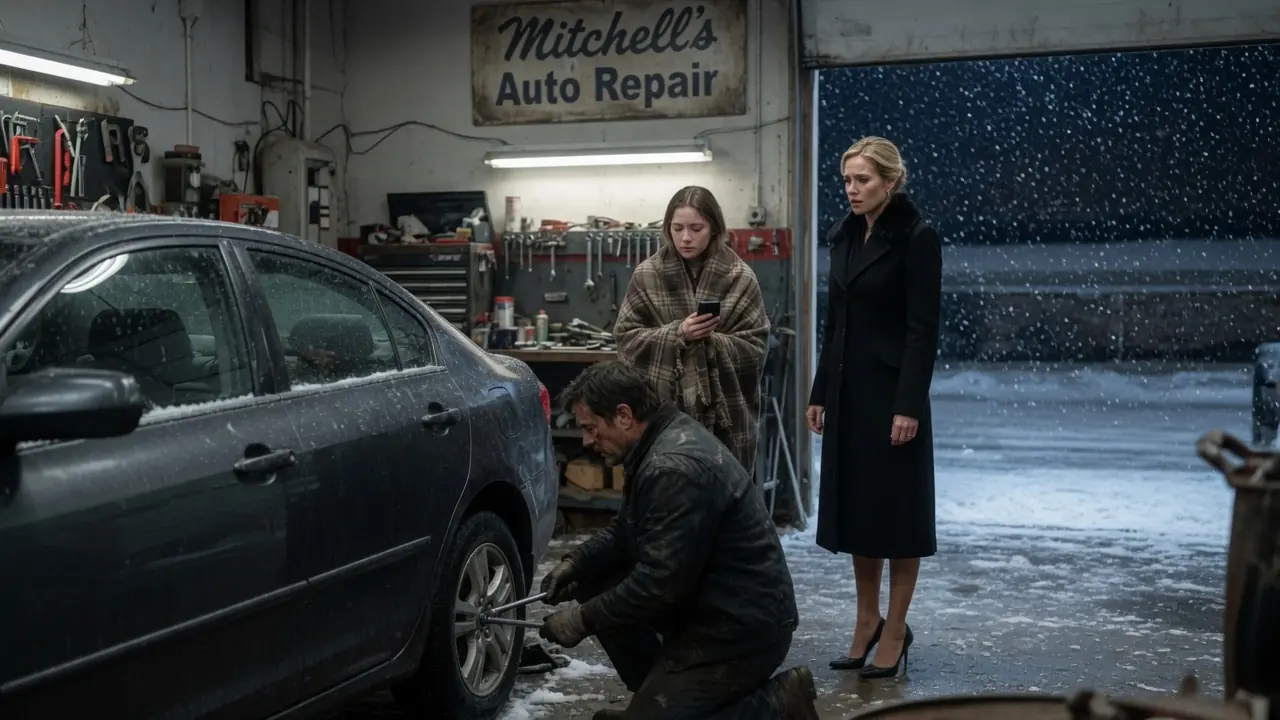
Jake stood by the office door with his keys in his hand, exhausted down to the bone. The shop smelled of motor oil, wet rubber, old coffee, and the metal heater fighting a losing battle against the cold. Outside, snow kept falling across the cracked parking lot, covering the faded yellow lines and the old sign that read Mitchell’s Auto Repair. Business had been slow for months, and every night he locked the door wondering how many more times he could open it.
Then he heard it again.
A girl crying.
Jake stepped back from the office door and looked through the frosted garage window. At first, he saw only the snow and the dim outline of a gray sedan pulled awkwardly near the curb. Then a small figure moved beside the driver’s door, wrapped in a thin coat, one hand pressed to her face. The front tire was flat, the rim sitting too low in the slush, and the girl looked terrified.
Jake hesitated for only one second.
Then he unlocked the bay door.
The cold rushed in as he stepped outside, pulling his jacket tighter around him. “Miss?” he called. “Are you okay?”
The girl startled and turned toward him, her cheeks wet, her hair stuck to the sides of her face from melted snow. She looked about seventeen, maybe still in high school, with a phone clutched in one trembling hand. “I’m sorry,” she said quickly. “I didn’t know anyone was still here.”
“I’m closing,” Jake said, keeping his voice gentle. “But you’re standing in a snowstorm with a flat tire. That matters more.”
She wiped her face with her sleeve. “I called my mom, but she’s not answering. I tried roadside assistance, but they said it could be two hours.” Her voice cracked. “I don’t know what to do.”
Jake looked at the tire, then at the road behind her. Traffic was thin, the sidewalks empty, and the temperature was dropping fast. “You’re not waiting out here,” he said. “Get in the shop.”
She looked unsure. “I don’t have much cash.”
“I didn’t ask for cash.”
Her eyes filled again, but this time with relief she did not trust yet. “Are you sure?”
Jake nodded toward the open bay. “Pull it in slowly if it’ll move. I’ll guide you.”
The girl did as he said, hands shaking on the wheel. The sedan rolled into the garage with the flat tire thumping softly against the floor. Jake lowered the bay door halfway to keep out the wind, then grabbed an old gray blanket from the shelf near the office. It was the same blanket Noah used on cold mornings when he slept in the break room before school.
“Here,” Jake said, handing it to her. “Wrap up. There’s a chair by the heater.”
She took it with both hands. “Thank you.”
“What’s your name?”
“Emma,” she said. “Emma Whitmore.”
Jake did not react to the last name, though he recognized it. Whitmore Logistics owned trucks, warehouses, and delivery contracts across three states. Their company logo was painted on half the freight trailers that passed through Erie. If this girl was part of that family, she lived in a world far beyond Jake’s overdue bills and patched-up shop heater.
“I’m Jake Mitchell,” he said. “I’m going to check the tire.”
Emma sat near the heater, wrapped in the blanket, watching him like she still feared the kindness might change its mind. Jake knelt by the sedan and examined the flat. A nail had gone through the tread, and the tire was low but not destroyed. It could be patched well enough to get her home safely. He rolled his stool closer, pulled the jack into place, and started working.
As he loosened the lug nuts, Emma tried calling her mother again. No answer. She left a shaky message, then stared at the screen.
“She’s going to be mad,” Emma whispered.
Jake glanced over. “Because of the tire?”
“Because I took this road instead of the main one. Because I was late leaving my friend’s house. Because I didn’t check the weather.” She swallowed. “Because everything turns into a lesson.”
Jake paused, wrench in hand. He knew that tone. It was the sound of a kid who expected fear before comfort. “Parents get scared,” he said. “Sometimes it comes out wrong.”
Emma looked at him. “Do you have kids?”
“One son. Noah. He’s seven.”
“Does he get scared of you?”
The question caught Jake off guard. He set the wrench down for a moment and looked at her carefully. “I hope not.”
Emma looked down at her phone. “My mom loves me. I know she does. She just… sees danger everywhere.”
Jake returned to the tire. “Maybe tonight she has a reason.”
A faint smile touched Emma’s face. “You sound like a dad.”
“I practice.”
He removed the wheel and carried it to the workbench. The shop was quiet except for the heater, the occasional ping of metal cooling, and the soft scrape of Jake’s tools. Emma watched him patch the tire with careful hands. She seemed calmer now, though every few minutes she checked her phone again.
Jake’s own phone buzzed in his pocket.
It was the babysitter.
He sighed and answered. “Hey, Molly. I’m sorry. Emergency tire repair. I’ll be late.”
On the other end, Molly said something Jake could not fully hear over the heater.
“I know,” he said. “Tell Noah I’ll bring him hot chocolate tomorrow. Yeah. Thank you.”
He hung up and slipped the phone back into his pocket.
Emma looked guilty. “You have to get home.”
“I do.”
“You can leave me here. I’ll wait.”
Jake gave her a look over his shoulder. “Absolutely not.”
“But your son—”
“My son would tell me not to leave somebody’s kid freezing in a garage alone.”
Emma’s eyes softened. “He sounds nice.”
“He is. Also very bossy about doing the right thing.”
For the first time, Emma laughed.
Jake smiled briefly, then focused on finishing the patch. He inflated the tire, checked for leaks, and remounted it on the sedan. By the time he tightened the last lug nut, almost forty minutes had passed. His hands were cold despite his gloves, his knees ached from the concrete, and the clock above the office door showed 9:38 p.m.
Emma stood from the chair. “How much do I owe you?”
“Nothing.”
She frowned. “No, I can pay.”
“Not tonight.”
“I don’t want charity.”
Jake wiped his hands on a rag. “It’s not charity. It’s me deciding the world doesn’t need to be uglier on a cold night.”
Emma looked like she might cry again. “My mom won’t believe that.”
Before Jake could answer, headlights swept across the garage door windows.
A black Lincoln Navigator pulled into the lot too fast, tires crunching over the snow. The driver’s door opened, and a woman stepped out wearing a long black coat, leather gloves, and heels that had no business on icy pavement. Her face was pale with fear, but her eyes were already sharp with accusation.
Emma turned toward the door. “Mom.”
Caroline Whitmore entered the garage like a storm had followed her inside. She looked first at Emma wrapped in the blanket, then at Jake standing beside the car with grease on his hands. Her expression hardened instantly.
“Get away from my daughter,” Caroline said.
Jake lifted both hands slightly. “Ma’am, she had a flat tire. I brought her inside to keep warm.”
Caroline crossed the garage quickly and pulled Emma behind her, though Emma resisted. “In a closed repair shop? At night? With a man she doesn’t know?”
“Mom, stop,” Emma said. “He helped me.”
Caroline ignored her, eyes locked on Jake. “How much did you ask her for?”
“Nothing.”
“Don’t insult me,” Caroline snapped. “Men in places like this always want something.”
The words hit Jake harder than he expected. He looked down at his grease-stained jacket, his worn boots, the old lift, the secondhand tools, and the cracked floor he swept every morning. He was used to people underestimating his shop. He was not used to being treated like a threat for helping a scared girl.
“Caroline,” Emma pleaded, “he called you twice from my phone. He gave me a blanket. He fixed the tire for free.”
Caroline’s face shifted, but suspicion still held it tight. “Why would he do that?”
Jake picked up Emma’s keys from the workbench and held them out. “Because your daughter was freezing on the side of the road. I didn’t see a rich girl or a poor girl. I saw somebody’s child.”
The garage went quiet.
Caroline looked at the keys but did not take them immediately. Emma stepped forward and took them herself. “Mom, you’re being awful.”
That landed.
Caroline turned to her daughter. For the first time since she walked in, she seemed to truly see Emma’s face: the red eyes, the shaking hands, the exhaustion beneath the fear. Her anger faltered, leaving only the panic that had been underneath it from the beginning.
“I couldn’t reach you,” Caroline said, voice breaking. “I called six times.”
“My phone was almost dead. It kept freezing.” Emma held up the blanket. “He kept me safe.”
Caroline looked back at Jake, and shame slowly replaced the accusation in her eyes.
“I’m sorry,” she said, though the words came stiffly at first. “I thought…”
“I know what you thought,” Jake said quietly.
Her face tightened. “I was scared.”
“So was she.”
Caroline looked away.
Jake did not enjoy making her feel small. He was too tired for that. He only wanted to get home to Noah, close the shop, and maybe sleep four hours before opening again. But Caroline stood in front of him now, a wealthy woman in an expensive coat, realizing she had accused the only stranger who had protected her daughter.
Emma walked over to Jake and tried to hand him money. “Please. Take something.”
Jake shook his head. “No.”
“At least for the patch.”
“No.”
Caroline watched him. “Mr. Mitchell, I can pay you properly.”
“I’m sure you can,” Jake said. “But I already said no.”
“Why?”
“Because if my son were stranded somewhere, I’d pray somebody helped him before they checked his wallet.”
Caroline lowered her eyes.
Emma whispered, “Thank you.”
Jake softened. “Drive slow. Tire should hold, but get it inspected again in a few days.”
“I will.”
Caroline turned toward the sedan, then stopped. She looked around the shop properly for the first time. The old sign. The leaking corner near the bay door. The unpaid invoices stacked near the office window. The heater that rattled like it might give up before winter did.
“Is this your shop?” she asked.
“Yes.”
“How long?”
“Twelve years.”
“Your father’s?”
“My uncle’s first. Then mine.”
She nodded slowly. “And your son?”
Jake’s face changed slightly at the mention of Noah. “He’s with a sitter. Waiting for me.”
That made Caroline wince. She had been so ready to assume the worst that she had not considered he had his own child waiting somewhere. She pulled her gloves tighter and straightened, as if gathering herself.
“I owe you an apology,” she said.
Jake looked at her. “You already gave one.”
“No,” Caroline said. “I gave you fear with polite words wrapped around it. That isn’t an apology.” She took a breath. “I came in here ready to accuse you because I saw my daughter in a garage with a man I didn’t know. But I judged your clothes, your shop, and your circumstances before I listened to her.”
Jake said nothing.
Caroline looked him in the eye. “I am sorry.”
This time, he believed her.
“Accepted,” he said.
Emma looked relieved. “Can we go home now?”
“In a minute,” Caroline said, still looking at Jake. “Mr. Mitchell, do you have a business card?”
Jake almost laughed. “Somewhere.”
He walked to the office, pulled one from a chipped ceramic mug, and handed it to her. Caroline studied it, then placed it carefully in her coat pocket.
“I’ll be in touch,” she said.
Jake’s guard rose. “About what?”
“About doing business the correct way.”
He did not know what that meant, and he was too tired to ask. Caroline and Emma left a few minutes later, the repaired tire rolling steady over the snow. Jake stood in the open bay doorway, watching their taillights disappear down the road.
Then he closed the shop and drove home.
Noah was asleep on the couch when Jake arrived, curled under a dinosaur blanket with one sock missing. Molly, the babysitter, gave him a sympathetic look and said Noah had tried to wait up. Jake paid her, thanked her, and carried his son to bed.
As he tucked Noah in, the boy stirred. “You fixed a car?”
“Yeah, buddy.”
“For somebody who needed help?”
Jake smiled tiredly. “Yes.”
Noah’s eyes stayed closed. “Good.”
The next morning, Jake opened the shop at 7:00 a.m. with coffee in one hand and bills waiting on the desk. The rent was due in nine days. The supplier had called twice about parts invoices. The old compressor needed service, and one of the lifts was making a noise he did not like. Helping Emma had been the right thing to do, but right things did not always pay electric bills.
At 10:15, a black Navigator pulled into the lot again.
Jake looked up from under the hood of a pickup and saw Caroline Whitmore step out. This time, she wore a gray business suit and carried a leather folder instead of fear. Emma was not with her.
Jake wiped his hands and walked toward the office. “Mrs. Whitmore.”
“Caroline,” she said. “If you’re comfortable with that.”
“Jake, then.”
She nodded.
Inside the small office, Caroline sat carefully on the old chair across from his desk. She looked out through the glass at the work bay, the tools on the wall, the oil stains, the patched heater, and the framed photo of Noah taped beside the calendar. Jake remained standing.
“I checked on your business,” Caroline said.
Jake’s expression hardened. “Why?”
“Because I wanted to know who helped my daughter.”
“And?”
“And I found out you have excellent reviews, loyal customers, and no formal fleet contracts.”
Jake frowned. “Fleet contracts usually go to bigger shops.”
“Not always.”
“They do when the fleet belongs to Whitmore Logistics.”
Caroline opened the folder and placed a document on his desk. “Our regional maintenance provider has been overcharging us for three years. I suspected it, but no one brought me better options.” She tapped the paper. “I’m offering you a trial contract.”
Jake stared at her. “For what?”
“Routine inspection and emergency tire service for our local courier vehicles. Twenty vans to start. If your work holds up, we expand.”
Jake looked at the document but did not touch it. “Why?”
Caroline’s face softened. “Because my daughter came home last night and told me something that stayed with me.”
“What?”
“She said, ‘Mom, he treated me like I mattered before he knew who I was.’” Caroline paused. “That is rare.”
Jake looked away toward the garage.
She continued, “I’m not offering charity. I don’t insult people twice. This is business. Your shop needs steady work. My company needs honest mechanics. Last night proved more to me than a polished proposal ever could.”
Jake picked up the contract slowly. The numbers were fair. More than fair. A trial period, guaranteed monthly minimum, parts reimbursement, and payment terms that would keep his shop breathing through winter. He read the first page twice because his mind refused to trust good news.
“This could save my shop,” he said before he could stop himself.
Caroline heard the emotion under the words. “Then let it save the shop. But earn the renewal.”
Jake almost smiled. “I would not accept it any other way.”
Caroline stood. “There is one more thing.”
Jake looked up.
“My daughter asked if your son likes hockey.”
That surprised him. “He loves it. Can’t skate well, but he loves it.”
“Emma volunteers with a youth winter program. She wants to invite him. No cameras, no publicity, no favors attached.” Caroline’s mouth lifted slightly. “Just one kid inviting another.”
Jake swallowed. “He’d like that.”
“Good.”
They shook hands across the desk. Caroline’s grip was firm, respectful, and very different from the woman who had entered the garage ready to accuse him. Jake watched her leave, then sat in the office chair with the contract in front of him.
For a long time, he did not move.
The shop sounds continued around him: a wrench dropping, the heater rattling, a car passing outside, the old building settling in the cold. But beneath all of that was something Jake had not felt in months.
Possibility.
By spring, Mitchell’s Auto Repair looked different. Not fancy, not transformed into something it wasn’t, but alive. The Whitmore vans came in on schedule, and Jake serviced each one with the same care he gave every customer. The steady contract allowed him to pay down invoices, repair the compressor, replace the failing lift motor, and hire a part-time mechanic named Luis who had been looking for work since his dealership cut staff.
Noah visited the shop after school more often now. He liked sitting in the office with homework while Jake worked in the bay. Emma stopped by occasionally when bringing a van from the youth program, always greeting Noah first and asking about hockey practice. She never acted like the girl who had cried in the snow, but she never forgot it either.
One afternoon, she handed Jake an envelope.
“What’s this?” he asked.
“A thank-you note,” Emma said. “Don’t make it weird.”
Jake smiled and opened it later after she left. Inside was a handwritten card.
Mr. Mitchell,
That night I was scared of the snow, the flat tire, and what my mom would say. But mostly I was scared no one would help without making me feel stupid. You helped and made me feel safe. I hope someday I can do that for someone else.
Emma
Jake kept the card in his desk drawer beside Noah’s school photos.
Caroline came by at the end of the trial period with a full contract renewal. This time she brought coffee and sat in the shop office without looking uncomfortable. She had learned to see the place differently. The oil stains were no longer signs of struggle; they were proof of work. The old tools were not signs of failure; they were instruments in careful hands.
“You exceeded every service metric,” she said.
Jake leaned back. “That sounds corporate.”
“It is corporate. It also means you did well.”
“Thank you.”
Caroline looked through the office window at Noah helping Luis organize sockets by size. “Emma says Noah scored his first goal.”
“He did. He told everyone in a three-block radius.”
“As he should.”
They both smiled.
Then Caroline’s expression became serious. “I have thought often about how I walked in here that night.”
Jake looked at her.
“I almost missed the truth because fear made me arrogant,” she said. “That is a hard thing to admit.”
“But you admitted it.”
“Because Emma wouldn’t let me forget.” Caroline looked down at her coffee. “She told me I taught her to be careful, but you taught her not to let caution turn into cruelty.”
Jake did not know what to say to that.
Caroline stood and placed the renewed contract on his desk. “You helped my daughter when no one was watching. I came back with an offer because people like that deserve doors opened when the world keeps closing them.”
Jake looked at the document, then at the garage, then at Noah. “I just fixed a tire.”
Caroline shook her head. “No. You reminded my daughter that good men still exist.”
That night, after closing, Jake and Noah sat in the shop office eating takeout burgers because Noah said celebratory food had to involve fries. The renewed contract sat on the desk. Snow no longer covered the ground outside, but Jake could still remember that December night clearly: the crying girl, the flat tire, the angry mother, the shame in Caroline’s eyes when she realized she was wrong.
Noah dipped a fry into ketchup and asked, “Dad, are we keeping the shop?”
Jake looked at him. The question was simple, but it carried months of silent worry. Noah had heard phone calls, seen bills, and felt his father’s tiredness even when Jake tried to hide it.
“Yeah, buddy,” Jake said softly. “We’re keeping the shop.”
Noah grinned. “Because you fixed Emma’s tire?”
Jake laughed quietly. “Because we did the right thing and someone noticed.”
Noah thought about that. “So doing good stuff helps?”
“Not always the way you expect,” Jake said. “But it matters.”
He looked out into the garage, at the lifts, the tools, the old sign, the floor still marked by winter stains. Mitchell’s Auto Repair was not perfect. It was still hard work, long hours, and uncertain months. But it was alive, and it was his.
Jake had not helped Emma because she was wealthy. He had not known the offer would come, or the contract, or the chance to save what he had almost lost. He had helped because she was cold, scared, and alone, and because he hoped someone would do the same for Noah.
Sometimes kindness returned as gratitude.
Sometimes it returned as an apology.
And sometimes, on a freezing December night, it arrived first as a crying teenager in the snow, then came back later as the offer that kept a single father’s whole world from closing its doors.