Cassandra Whitmore turned toward the rain-darkened curve behind them. For one second, she saw nothing except wet asphalt, swaying pine trees, and the white blur of water sweeping through the headlights of her black SUV. Then a second pair of lights disappeared beyond the bend, moving too slowly to belong to an ordinary driver. The vehicle had been parked there long enough to watch everything happening beside her mother’s disabled Cadillac.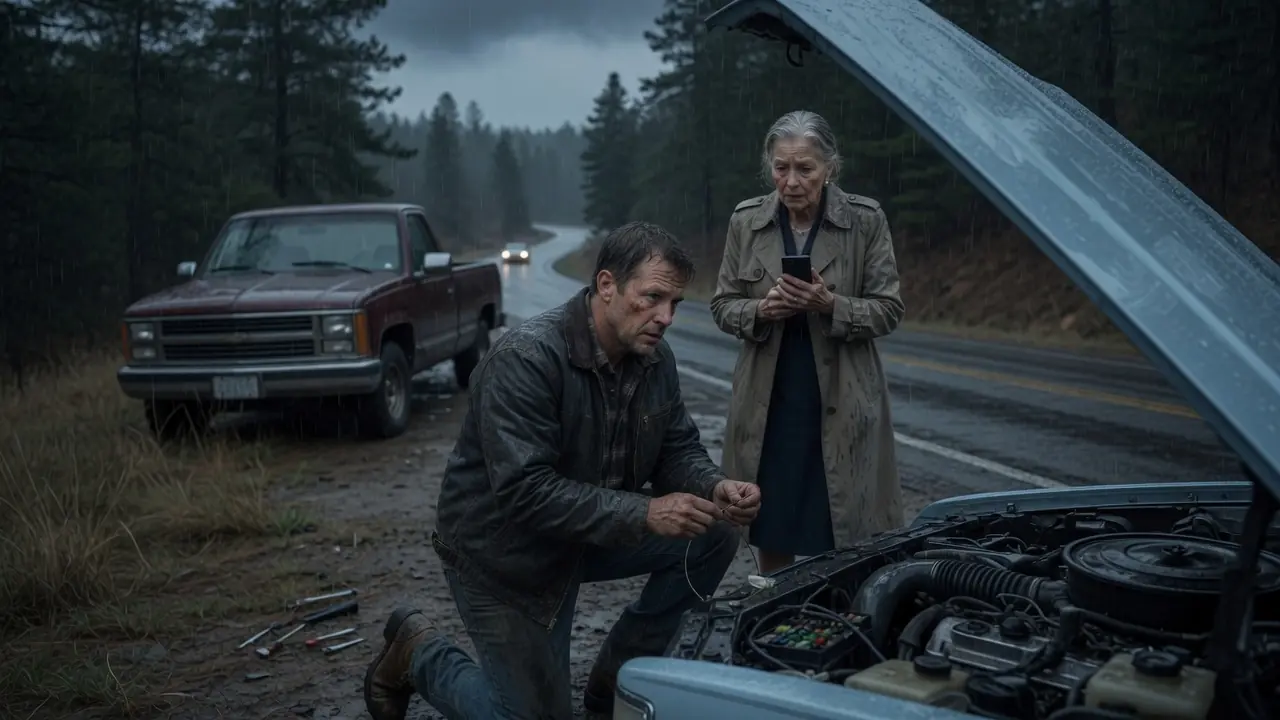
“Get inside my SUV,” Cassandra ordered.
Evelyn Whitmore shook her head and pointed toward Nolan Rourke. “He comes with us.”
Cassandra looked at the grease-stained stranger kneeling beside the open hood. Nolan was thirty-nine, broad-shouldered, with rain running through his short dark hair and down the tired lines of his face. Nothing about his faded work jacket or battered pickup suggested he belonged anywhere near the Whitmore family, yet he was the only person on that road who had stopped.
“I have my own truck,” Nolan said.
“And whoever is watching may know it,” Cassandra replied. “Leave it here.”
Nolan glanced at the shallow toolbox in the bed of his pickup, then toward the pale-blue Cadillac. He had patched the severed wire well enough to start the engine, but he did not trust the vehicle to travel far. The wrong fuse, cut sensor line, and loosened connector had been arranged to produce a gradual electrical failure. Whoever created the damage had wanted Evelyn’s car to die on this isolated stretch after sunset.
Nolan collected the wire, fuse, and connector fragments, sealing them inside clean plastic bags from his emergency kit. He photographed the engine bay from several angles before lowering the hood. Cassandra watched him work with the fast, economical movements of someone who understood machinery far beyond ordinary roadside repairs. Her suspicion did not disappear, but it began changing shape.
They drove to a private medical clinic owned by Whitmore Motors rather than Evelyn’s estate. Cassandra refused to take her mother home until company security completed a sweep of the property. Nolan sat in the front passenger seat, leaving Evelyn in the warmer rear cabin, and watched the road through the side mirror. The distant vehicle followed them for almost five miles before turning away.
At the clinic, a physician examined Evelyn and found no serious injury. She was cold, frightened, and dehydrated, but otherwise stable. Cassandra remained beside the treatment room while Nolan waited near the service entrance, still dripping rainwater onto the polished floor. Several employees stared at his stained clothes as though he had walked in carrying dirt from another world.
A security director named Warren Pike arrived twenty minutes later. He was tall, silver-haired, and careful with every word. He assured Cassandra that Evelyn’s breakdown had been caused by age, moisture, and poor maintenance, citing a preliminary report from the family’s regular automotive contractor.
Nolan listened from the doorway.
“That report was written before anyone examined the car tonight,” he said.
Warren’s eyes shifted toward him. “And you are?”
“The mechanic who found the cut wire.”
“The wire may have separated under vibration.”
“It was sliced with a narrow blade.”
Warren gave Cassandra a patient look. “Ms. Whitmore, frightened civilians sometimes misinterpret ordinary damage.”
Nolan removed the evidence bag from his jacket. “Ordinary vibration doesn’t leave two parallel pressure marks from wire cutters.”
The room became silent.
Cassandra took the bag from him and held it beneath the bright ceiling light. Even without technical training, she could see the clean edge. The metal strands had not frayed or burned. They had been clipped.
“Who inspected my mother’s car last?” she asked.
Warren hesitated. “A contractor assigned by corporate transportation.”
“Name?”
“I’ll need to check.”
“You arrived with a complete explanation but not the technician’s name?”
Warren’s expression tightened. “I was trying to calm the situation.”
“My mother nearly collapsed on an empty road.”
“And I am telling you there is no evidence of a larger threat.”
Nolan placed the mismatched fuse beside the wire. “There are three pieces of evidence on this table.”
Cassandra dismissed Warren from the room and ordered him to provide the complete maintenance records within one hour. He left without arguing, but Nolan noticed the anger buried beneath his professional posture. Warren did not look worried about an unknown attacker. He looked worried that the evidence had survived.
Evelyn reached for Nolan’s hand after the security director left. “You should have taken the money I offered you.”
“I didn’t do anything worth charging for.”
“You stood in traffic and repaired a stranger’s car during a storm.”
“My daughter would never forgive me if I drove past someone who needed help.”
Cassandra looked at him. “You have a daughter?”
“Emily. She’s eleven.”
“Where is she now?”
“With my sister. I was supposed to pick her up an hour ago.”
For the first time, guilt crossed Cassandra’s face. She had been so focused on protecting her mother that she had not considered what Nolan had abandoned to remain with them. She offered to send a driver, but Nolan refused. Emily knew his sister’s home and was safe there.
When Cassandra asked what she owed him, he pushed the question away. He did not want money for saving Evelyn. What he wanted was access to the Cadillac before anyone from corporate transportation touched it.
Cassandra agreed.
The vehicle was brought to a secure laboratory beneath Whitmore Motors headquarters before midnight. Nolan followed in Cassandra’s SUV while Evelyn remained at the clinic. The laboratory contained equipment worth more than his entire garage, but he ignored the sleek diagnostic stations and moved directly beneath the Cadillac’s hood.
The damage was worse than he first believed.
Someone had modified a sensor circuit to fail only after the engine reached a specific temperature. The loose connector delayed the final shutdown, and the incorrect fuse prevented the system from recording the true electrical sequence. An ordinary mechanic would have replaced the failed parts and blamed the age of the vehicle.
Nolan asked Cassandra for the Cadillac’s maintenance history. The file showed that Warren Pike’s department had collected the car the previous afternoon for a routine security inspection. A technician named Adrian Vale signed the work order, but the employee identification number belonged to a man who had resigned eight months earlier.
“That is impossible,” Cassandra said.
“It is deliberate,” Nolan replied.
He connected the Cadillac to a diagnostic terminal and studied the remaining data. Several entries had been deleted remotely after the breakdown. Whoever interfered with the car still possessed access to Whitmore Motors’ internal systems.
Cassandra moved closer to the screen. “Can you recover them?”
“Maybe.”
“You don’t sound certain.”
“Anyone who promises certainty before examining the damage is selling confidence, not skill.”
The answer surprised her. Most people surrounding Cassandra carefully shaped their words to impress her. Nolan spoke as though her title carried no power over the truth.
He recovered only fragments that night, but one identifier appeared repeatedly inside the corrupted data. It belonged to a diagnostic subroutine used by Whitmore Motors’ newest autonomous vehicle project, the Orion A9. The software was highly confidential and had no legitimate reason to communicate with Evelyn’s thirty-year-old Cadillac.
Cassandra called an emergency meeting with her chief engineer, legal counsel, and Warren Pike. Nolan stood near the rear wall while executives entered in tailored suits and looked at him with visible confusion. Warren arrived last and did not appear surprised to see the recovered code displayed on the main screen.
Chief engineer Helen Marsh claimed the identifier could be coincidental. Whitmore Motors had used related diagnostic structures for years. Nolan asked her to display the Orion’s recent failure logs.
Warren interrupted immediately. “A private mechanic has no clearance to view proprietary data.”
Cassandra looked at Nolan. “Can those logs tell us who attacked my mother?”
“They may tell us why.”
That was enough.
The Orion records revealed unexplained sensor failures across six prototype vehicles. Each failure was classified as environmental interference, and each report had been approved by Warren’s security office before reaching Cassandra. Nolan compared the timing patterns to the Cadillac.
The intervals matched.
Someone had tested the Orion sabotage sequence on Evelyn’s car.
The purpose was not merely to strand an elderly woman. Her Cadillac had been used as a live experiment because its outdated systems would make any failure appear natural. The attacker wanted to know whether the altered software could erase evidence after disabling a moving vehicle.
Cassandra stared at Warren. “Why did your office approve these reports?”
“We relied on engineering.”
Helen shook her head. “Security changed the classifications after my team submitted them.”
“That is not true.”
“I have the originals.”
Warren rose from the table. “This meeting has become irrational. You are allowing a roadside mechanic to turn minor errors into a conspiracy.”
Nolan faced him calmly. “The person who cut that wire made one mistake.”
Warren stopped.
“They reused a deletion command from the Orion system,” Nolan continued. “That command carries a hidden technician signature.”
Cassandra had not known Nolan had found a signature. Neither had anyone else in the room.
Warren’s reaction confirmed more than any answer could have.
He reached toward his phone.
Cassandra’s security officer stepped between him and the door.
The phone was seized, but Warren refused to unlock it. He claimed the device contained protected company information and demanded an attorney. Cassandra suspended him immediately, though she knew suspension alone would not explain the entire scheme.
Warren had access, but he lacked the technical knowledge to design the attack.
Nolan recognized the code architecture because he had seen it before. Twelve years earlier, he had worked as a diagnostic engineer for a supplier called Meridian Adaptive Systems. He discovered a hidden method for changing vehicle failure reports after an accident.
Before he could report it, company data was leaked under his credentials.
Nolan lost his job, his reputation, and the engineering career he had worked years to build. He became a single father shortly afterward when Emily’s mother died from complications following surgery. With no company willing to hire him and an infant relying on him, he opened a small repair garage using borrowed tools.
Cassandra searched the Meridian case files.
The attorney who led the internal investigation against Nolan was Graham Voss, now Whitmore Motors’ general counsel. Graham had also recommended Warren Pike for director of corporate security.
Cassandra summoned Graham before dawn.
He entered the laboratory wearing an expensive navy suit and carrying the calm expression of a man who had spent decades protecting powerful people. He dismissed Nolan’s accusation as revenge from a disgraced former employee.
Nolan did not argue.
He displayed the technician signature recovered from the Cadillac. It was not a person’s name, but a numerical sequence assigned to one of Meridian’s old development teams. Graham had supervised that team.
“You could have copied that sequence years ago,” Graham said.
“I could have,” Nolan replied. “But the Orion records show it was uploaded three months ago from your legal department.”
Graham looked toward Cassandra. “He has accessed confidential servers without authorization.”
“You gave him access when you used his stolen work inside my vehicles,” she said.
Graham’s composure broke for only a second.
That second was enough.
Investigators later recovered encrypted messages from Warren’s phone and Graham’s office. The two men had coordinated with several board members and an outside investment fund. Their plan depended on a spectacular public failure during the Orion A9 launch.
If an autonomous prototype crashed during a live demonstration, Whitmore Motors’ stock would collapse. The board would blame Cassandra, remove her as CEO, and sell the company’s most valuable patents to the investment fund at a fraction of their value. Graham and Warren would receive millions through hidden consulting agreements.
Evelyn was targeted because she remained the company’s largest private shareholder. She had planned to attend a special board meeting and vote against the sale of the Orion division.
The sabotage on her Cadillac served two purposes.
It tested the failure system, and it frightened her away from the meeting.
The vehicle following the roadside scene belonged to one of Warren’s contractors. The driver had been ordered to retrieve or destroy the modified components after the Cadillac stopped. Nolan’s arrival ruined the plan.
Cassandra wanted to contact federal authorities immediately, but Nolan urged patience. Graham still controlled legal access to several corporate servers. If he realized how much they knew, the remaining evidence could disappear.
They needed proof no attorney could explain away.
Nolan returned to his garage after sunrise. He had not slept, and overdue bills waited beneath the door, including a notice giving him ten days to pay the rent or leave. Emily sat on the workbench eating cereal from a paper cup when he arrived.
“You missed dinner,” she said.
“I know.”
“And breakfast.”
“I brought coffee.”
“I’m eleven.”
“It was a long night.”
Emily studied his face. “Was the old lady okay?”
“She is now.”
That answer satisfied her more than any explanation about corporations or sabotage. Nolan hugged her and promised to make pancakes after he finished one last job.
Cassandra arrived an hour later without security.
She looked out of place inside the small garage, yet she did not complain about the cold, the smell of oil, or the cracked concrete. Nolan showed her the eviction notice, which had arrived from a development company connected to the same investment fund trying to seize Whitmore Motors.
“They own your building?” she asked.
“They bought the loan six months ago.”
“You think they knew who you were?”
“I think Graham never forgot.”
Nolan’s garage had not been selected randomly. Someone had been quietly tightening pressure around him long before Evelyn’s Cadillac failed. If he ever recognized Meridian’s old sabotage architecture, he would be too poor, discredited, and distracted to fight back.
They had underestimated his stubbornness.
Nolan built a simulation using salvaged control units, the Cadillac’s recovered data, and a clean copy of the Orion diagnostic software. The goal was simple: force the malicious code to activate inside a closed system while independent auditors watched.
Cassandra invited the entire board to an emergency demonstration.
Graham believed the meeting concerned her removal. He arrived confident, accompanied by lawyers and directors already prepared to accuse Cassandra of exposing trade secrets to an unqualified mechanic.
Nolan entered the boardroom in a clean work shirt, carrying the same scarred toolbox he used beside the road.
Several directors smiled.
Graham did not.
Cassandra began without defending Nolan’s clothing or background. She explained that the Orion launch would proceed through a final safety simulation before the board voted on her leadership.
Nolan connected his control unit.
The system began normally. Then he introduced the temperature and sensor conditions recorded inside Evelyn’s Cadillac. The Orion software responded by creating false wear reports, disabling safety warnings, and deleting its own access history.
The board watched in silence.
An independent federal vehicle-safety auditor confirmed that the code existed on Whitmore servers before Nolan entered the company. Another expert verified that the hidden sequence came from Meridian software Nolan had once tried to expose.
Finally, Nolan allowed the system to reconstruct the deleted authorization trail.
Warren Pike’s account initiated the sabotage.
Graham Voss approved it.
Three board members funded it.
The investment company provided the payment structure.
Graham stood and demanded the display be shut down.
Cassandra did not move.
The boardroom doors opened behind him.
Evelyn Whitmore entered wearing the same pearl earrings and navy dress she had worn beside the road. She no longer looked helpless. As founding shareholder, she invoked an emergency clause written by her late husband, suspending every director connected to conduct that endangered the Whitmore family or public vehicle safety.
Graham turned toward Cassandra. “You are destroying your father’s company over the claims of a mechanic.”
Cassandra looked at Nolan.
“No,” she said. “A mechanic saved it after men in this room tried to sell its corpse.”
Federal agents entered moments later.
Warren accepted a plea agreement and testified against Graham. The three directors resigned before criminal charges were announced, though resignation did not protect them from prosecution. The Orion launch was postponed until every vehicle underwent independent inspection.
Nolan’s name was officially cleared.
Whitmore Motors issued a public statement acknowledging that the evidence used to destroy his engineering career had been fabricated. Meridian’s remaining insurers paid a settlement large enough to secure Emily’s future and preserve Nolan’s garage.
Cassandra offered him a senior executive position.
He refused.
“I spent twelve years escaping people who believed a title made them smarter than everyone beneath them,” he said. “I’m not becoming one.”
Instead, they formed an independent safety partnership. Nolan kept his garage, his customers, and his freedom. Whitmore Motors paid him to inspect systems without answering to the executives whose work he reviewed.
A new sign appeared above the garage several weeks later.
Rourke Independent Automotive Safety.
Emily helped paint it.
Evelyn returned in her Cadillac on the morning the sign was installed. The car no longer carried the sabotaged wiring, but she insisted Nolan inspect it anyway. She brought coffee, pastries, and a sealed envelope.
Nolan tried to return the envelope without opening it.
“This is not payment,” Evelyn said.
Inside was the original worn business card Nolan had given her on the roadside. She had placed it in a small frame beneath a handwritten sentence.
The first man who stopped was the only one who saw the danger.
Cassandra arrived shortly afterward. She wore no entourage, carried no legal documents, and parked without blocking the garage entrance. Emily watched her cross the service bay and whispered that the terrifying CEO looked nervous.
Cassandra stopped beside Nolan’s workbench.
“My mother says you still haven’t sent us an invoice.”
“I replaced one wire.”
“You exposed a criminal conspiracy.”
“That wasn’t on the work order.”
She smiled.
Their relationship developed without either of them naming it. Cassandra began visiting the garage under increasingly weak excuses, asking about safety reports she could have received by email. Nolan sometimes brought Emily to Whitmore headquarters, where Cassandra showed her the design studio and allowed her to sit inside an unfinished prototype.
Evelyn noticed before either adult admitted anything.
One afternoon, Cassandra found Nolan beneath the hood of her own car after she complained about a strange sound. He listened to the engine for ten seconds, then closed the hood.
“There’s nothing wrong with it,” he said.
“I heard something.”
“You drove thirty miles because the air vent rattled?”
“It was concerning.”
“It stopped when you turned off the fan.”
Cassandra looked toward the office, where Emily and Evelyn were laughing over a board game. “Maybe the car wasn’t the reason I came.”
Nolan rested one grease-marked hand against the hood. “That explanation sounds expensive.”
She stepped closer. “You refused ten thousand dollars, an executive salary, and every attempt my mother made to reward you.”
“I’m difficult.”
“You stopped in a storm for a woman you had never met.”
“That part was easy.”
Cassandra’s expression softened. “Why?”
Nolan looked through the garage window at Emily.
“Because someday my daughter might be stranded somewhere,” he said. “And I need to believe someone will stop for her.”
Cassandra reached for his hand.
“I would.”
He believed her.
Months later, the Orion A9 completed its public safety demonstration without a single failure. Cassandra stood before reporters and credited the independent mechanic whose evidence protected thousands of future drivers.
Nolan watched from his garage with Emily and Evelyn.
He did not need the cameras.
He had his daughter beside him, his name restored above the door, and a woman entering the garage who no longer looked at him as a poor mechanic standing too close to her mother’s car.
Cassandra walked directly to him and placed a quiet kiss against his cheek.
“You still owe me an invoice,” she whispered.
Nolan smiled. “I’ll send it when the Cadillac breaks down again.”
Evelyn raised her coffee from across the room. “Then you may be waiting a very long time.”
The old car had nearly become the weapon that destroyed a family and a company.
Instead, because one exhausted single father chose to stop when everyone else kept driving, it became the first piece of evidence that exposed the people hiding behind false reports, polished titles, and locked boardroom doors.
Nolan had repaired the wire for free.
What came back to him could never have been measured in money.