Matthew set the grocery bag down on the counter, looked his manager straight in the eye, and said, “He didn’t have enough money. I covered the rest out of my own pocket. That is all I did.”
Richard Marsh did not look back at him.
He simply slid the paper across the desk.
“Your personal items have been boxed up. Security will walk you out.”
Matthew Callaway had forty dollars left in his checking account. He had an eight-year-old son waiting at home, and he had just been fired for helping an old man buy groceries.
But there was one thing he did not know.
The old man he helped was not just any ordinary customer, and the world he came from was about to turn Matthew’s life entirely upside down.
Matthew Callaway was thirty-four years old, and he had long since stopped expecting life to be fair.
He only expected it to be manageable.
That was a different thing entirely, and one he had become very skilled at.
He worked full-time at Barrow & Klein Logistics, a mid-sized office on the outer edge of Columbus, Ohio. The company handled shipping schedules, vendor invoices, warehouse reports, and the sort of quiet administrative work no one noticed unless it went wrong.
Matthew worked on the third floor, in a row of gray cubicles beneath fluorescent lights that hummed faintly all day. His official title was operations assistant, though in practice he handled whatever no one else wanted to handle.
Purchase orders.
Inventory spreadsheets.
Late delivery reports.
Vendor calls.
Expense corrections.
He made twenty-two dollars an hour, which sounded decent until rent, childcare, groceries, utilities, school fees, insurance, and old medical bills took their turns.
His hours were supposed to be 8:00 to 4:30, Monday through Friday.
In reality, he stayed late whenever his manager asked, because saying no felt dangerous when you were a single father with no safety net.
He was a widower.
His wife, Dana, had been killed in a car accident when their son, Theodore, was three years old. Matthew did not speak about it much. Not at work. Not with neighbors. Not even with old friends who had slowly stopped calling after they realized grief did not keep convenient hours.
At his desk, inside the bottom drawer beneath a stack of folders, he kept a small photo of Theodore at the beach at age five, squinting into the sun with both arms thrown out like he was trying to hug the horizon.
Dana was not in the picture, but she had been the one who took it.
Matthew had never replaced it.
That was how memory worked for him now.
Some things stayed exactly where loss had left them.
The logistics of his life required considerable engineering.
He rented a two-bedroom apartment two miles from the office, in a building that kept its heating inconsistent from November through March. The elevator worked when it wanted to. The hallway carpet smelled faintly of dust and old cooking oil. But the rent was still barely within reach, and the elementary school nearby was good enough that Theodore had started smiling again after second grade began.
His neighbor, Margaret Ellis, was sixty-eight years old, patient in the way only people who had survived much and judged little could be. She watched Theodore after school in exchange for Matthew doing her weekly grocery run, carrying heavy laundry baskets to the basement, and fixing whatever little things broke in her apartment.
It was an arrangement that required no paperwork and no awkward conversation about money.
Just consistency.
Matthew provided consistency without fail.
Every weekday followed the same rhythm.
Up at 6:00.
Breakfast by 6:30.
Lunches packed by 6:45.
Theodore’s backpack checked by 6:55.
Shoes, coat, spelling folder, permission slips, library book.
Out the door by 7:10.
Theodore dropped at school by 7:30.
Matthew at his desk by 7:55.
After school, Theodore walked with two classmates and stopped at Margaret’s apartment. He stayed there until Matthew came home.
It was a system with no slack in it.
Any single piece breaking, a school delay, a sick day, a missed bus, an unexpected bill, sent everything sideways.
Matthew knew this.
He managed his life with the precision of a man who had learned that discipline was sometimes just another word for keeping the things you love from falling apart.
Most people at Barrow & Klein knew him as quiet, dependable, and occasionally wry.
They knew he never joined happy hour.
They knew he brought leftovers for lunch.
They knew he did not complain when extra files landed on his desk.
They did not know that he had once been a sophomore at Ohio State, studying accounting.
They did not know that he had left school when Dana became pregnant.
They did not know that he still kept old textbooks in a box under his bed and sometimes opened them at night, after Theodore slept, just to remind himself that the mind he once trusted had not disappeared entirely.
He had made peace with leaving school many times and in many different ways.
But peace was not the same as forgetting.
For two years, Matthew had been keeping a small spiral notebook in his work bag.
Inside were columns of numbers, cost-per-unit calculations, invoice error patterns, delivery delays, vendor pricing comparisons, and margin analyses he had reverse-engineered from the documents that crossed his desk.
No one had asked him to do it.
No one paid him for it.
He simply noticed things.
He noticed that one warehouse consistently overordered certain packing materials by nearly twelve percent.
He noticed that three vendors had small, repeating invoice discrepancies that appeared harmless individually but added up to thousands over time.
He noticed that Barrow & Klein’s internal tracking system caused avoidable rush fees because shipping delays were reported one step too late.
He told himself he would do something with the notebook eventually.
But eventually, in the life of a man managing on one paycheck with no safety net, tended to stretch in the way time does when you are perpetually tired.
Long and thin.
Not quite here.
On this particular Tuesday in November, Matthew arrived nine minutes early, made coffee in the break room, opened his email, and believed the day would be unremarkable.
As often happened with days that mattered, he was entirely wrong.
The morning had started with Theodore.
The boy woke up with a bruise on his left knee from falling off his bicycle the afternoon before. Matthew crouched beside the bathroom sink, turned his son’s leg gently under the light, and ran his thumb along the edge of the mark with the focused attention of a man who had gotten very good at assessing damage.
“Does it hurt when I press here?”
Theodore looked at him with the patience children reserve for parents who have studied them too carefully.
“You worry more than I need you to.”
“That’s not an answer.”
“It doesn’t hurt.”
Matthew made oatmeal.
The milk carton was empty.
He discovered this after he had already poured the oats into the pot. He stood in front of the refrigerator for a moment, staring at the empty carton as if it might apologize.
Then he typed a reminder into his phone.
Buy milk today.
He scrambled an egg instead, which Theodore accepted without complaint.
Theodore had a class presentation that morning and needed a tie. Matthew knotted it for him at the kitchen table, a dark blue one that had belonged to Dana’s father and had been cut down to a child’s length at some point before Theodore was born.
While he adjusted the knot, Matthew caught a glimpse of himself in the reflective surface of the microwave door.
His shirt collar was fraying at the left edge.
He folded the collar inward and smoothed it flat.
It would hold.
“Dad,” Theodore said.
“Hold still.”
“If you had a lot of money, what would you buy first?”
Matthew finished the knot, leaned back, and looked at his son.
“New clothes for you.”
“Before anything else?”
“Yes.”
Theodore shook his head with quiet certainty.
“Wrong answer. You should buy something for yourself first. You never buy anything for yourself.”
Matthew looked at him for a moment.
Then he picked up both their bags from the hook by the door and said it was time to go.
He did not answer the question.
He rarely answered the ones that were actually about him.
At the office, the day unfolded in the usual pattern.
Emails.
Invoices.
A meeting that could have been a message.
A vendor call that required more patience than skill.
At 12:10, Matthew opened the container he had packed for lunch.
Rice, two chicken thighs, and green beans from Sunday dinner.
Before he could take the first bite, his phone buzzed.
A message from Theodore’s school.
Reminder: student presentation photos tomorrow. Please send plain white shirt if available.
Matthew closed his eyes.
Theodore did not have a clean plain white shirt that still fit properly.
The one from last year pulled at the shoulders.
He added another reminder to his phone.
White shirt.
Milk.
Bread.
Maybe apples if discounted.
At 3:47, his manager, Richard Marsh, stopped by Matthew’s cubicle.
Richard was fifty-two, polished in a tired corporate way, with a habit of speaking in calm, measured tones that made even unreasonable requests sound procedural.
“Matthew, before you leave, I need the revised vendor discrepancy report on my desk.”
Matthew looked up.
“The one due Friday?”
“It’s been moved up.”
“By who?”
Richard gave him the look of a man who considered questions a sign of resistance.
“By me.”
Matthew thought of Theodore at Margaret’s apartment.
He thought of the grocery list.
He thought of the bus schedule.
Then he nodded.
“I’ll finish it.”
It took an extra hour and twenty minutes.
By the time he shut down his computer, the office floor had emptied. Only the cleaning crew moved near the far hallway, pushing carts and speaking softly in Spanish.
Matthew stacked the finished report on Richard’s desk, gathered his work bag, and pulled on his coat.
The grocery store was only four blocks from the office.
He almost skipped it.
He was tired, and every part of him wanted to go home. But there was no milk, no bread, and Theodore needed a white shirt.
So he walked to Dalton Fresh Market, a mid-sized grocery chain that sat between a tire shop and a pharmacy on a block that had seen better decades.
The store smelled like refrigerant, floor wax, and ripe bananas.
Fluorescent lights reflected off polished tile.
A holiday display near the entrance had already gone up, though Thanksgiving was still two weeks away.
Matthew took a basket and moved quickly.
Milk.
Bread.
A small bag of apples from the discount rack.
Store-brand cereal.
A plain white shirt from the tiny seasonal clothing section near the pharmacy aisle.
The shirt cost more than he expected.
He stood there for nearly a full minute, holding it in one hand, calculating.
Theodore needed it.
That decided it.
He went toward checkout.
There were four registers open. Register three had the shortest line, so he stepped behind an elderly man in a brown overcoat.
The man looked to be in his late seventies. His white hair was thin and neatly combed back. His shoulders had the slight forward curve of age, but his posture still carried old dignity. His shoes were polished, though the soles looked worn. His coat was good wool, carefully maintained, but old enough that the seams had begun to shine.
He placed his items on the belt one by one, deliberately, the way a person does when counting in his head before the total appears.
A carton of whole milk.
A loaf of bread.
Two cans of soup.
A bag of oranges.
A bottle of vitamins.
A small package of tea.
A rotisserie chicken from the warming case.
The cashier scanned the items.
The total came up on the screen.
Fifty-one dollars and thirty-seven cents.
The old man opened his wallet.
Only cash.
Three tens.
One five.
A few singles.
Coins in a small paper envelope.
He counted once.
Then again.
His lips moved very slightly.
Forty-six dollars and twenty cents.
The line behind him shifted.
A woman sighed.
Someone muttered, “Come on.”
The cashier looked uncomfortable.
“Sir, you’re short.”
“I know,” the old man said quietly.
His voice was educated, gentle, and controlled, the voice of someone who had once been very used to being listened to.
“I must have miscalculated.”
He looked at the items, then reached for the chicken.
“I’ll put this back.”
His hand trembled when he touched it.
Matthew noticed.
He also noticed the way the old man looked at the milk and the vitamins, as if deciding which need mattered less.
The cashier began to call for a manager.
Matthew stepped forward.
“I’ve got it.”
The old man turned.
“No. Please, that isn’t necessary.”
Matthew was already taking out his wallet.
He had planned carefully for this grocery trip. He had exactly enough for his items and about nine dollars left after that, assuming he skipped buying coffee for the rest of the week and stretched leftovers.
The gap was five dollars and seventeen cents.
Matthew removed a ten-dollar bill because that was what he had.
“Add it to mine,” he told the cashier.
The cashier hesitated.
“Sir, are you sure?”
“Yes.”
The old man looked at Matthew.
“I cannot allow a stranger to pay for my food.”
“You’re not allowing anything,” Matthew said gently. “I’m already standing here.”
“That does not answer me.”
Matthew smiled faintly.
“It answers the practical part.”
The old man studied him.
Not the way people study strangers when they are embarrassed.
The way they study a decision.
“Your name?” the old man asked.
“Matthew.”
“Matthew what?”
“Callaway.”
The old man nodded.
Not politely.
Permanently.
“Thank you, Mr. Callaway.”
“You’re welcome.”
Matthew paid the difference.
Then he paid for his own groceries, removed the white shirt from the belt at the last second, and told the cashier he no longer needed it.
The cashier placed it in the return bin.
Matthew felt the loss of it more sharply than he expected.
Theodore’s presentation was tomorrow.
He would wash the old shirt tonight and hope it stretched.
The old man noticed the shirt.
His expression changed slightly.
Matthew saw it and shook his head once.
“Don’t make it a problem,” he said quietly.
The old man said nothing more.
But when he picked up his groceries, he paused again.
There was something in his face Matthew could not identify.
Gratitude, yes.
But also recognition.
As if Matthew had stepped unknowingly into the middle of something already in motion.
The man left the store slowly, carrying two bags.
Matthew stood for a moment, watching him go.
Then he picked up his own groceries and walked home in the dark.
The next morning, Matthew washed Theodore’s old white shirt in the sink, dried it with the hair dryer, and pinned the collar carefully beneath the tie so the tightness at the shoulders was less noticeable.
Theodore looked in the mirror.
“It’s too small.”
“A little.”
“It’ll be okay.”
Matthew adjusted the tie.
“You’ll look sharp.”
Theodore turned to him.
“Did you buy milk?”
“Yes.”
“And apples?”
“Yes.”
“Did you buy anything for yourself?”
Matthew smiled.
“Coffee at work counts.”
“No, it doesn’t.”
At the office, Matthew arrived early and found Richard standing near his cubicle.
That was unusual.
Richard rarely came to anyone’s desk before nine.
“Matthew,” he said. “I need to see you in my office.”
Matthew put down his bag.
“Now?”
“Now.”
Richard’s office had glass walls and a view of the parking lot. The blinds were half-closed.
A woman from human resources sat in the corner, a folder on her lap.
Matthew knew before anyone spoke.
There is a particular atmosphere in a room where a decision has already been made and the conversation exists only to make the decision appear orderly.
Richard did not offer him a seat.
“Yesterday evening,” Richard began, “you were seen engaging with a customer at Dalton Fresh Market.”
Matthew blinked.
“I’m sorry?”
“Dalton Fresh Market. 6:14 p.m. You paid for part of an elderly man’s grocery transaction.”
Matthew looked from Richard to the HR woman.
“What does that have to do with Barrow & Klein?”
Richard’s mouth tightened.
“The man you assisted is connected to Hartwell Capital.”
The name meant something in the room before it meant anything to Matthew.
Hartwell Capital had been circulating through office whispers for weeks. A private investment firm. A possible acquisition. Executive reviews. Quiet site visits. People had begun speaking more carefully in hallways.
Matthew said nothing.
Richard continued.
“Your interaction has created a conflict of interest and a potential optics issue. We cannot have employees engaging in unauthorized personal transactions with individuals tied to prospective ownership groups.”
Matthew stared at him.
“I was buying groceries after work.”
“You were seen giving cash to a party connected to an ongoing acquisition review.”
“I helped an old man who didn’t have enough money for groceries.”
“That is your interpretation.”
“That is what happened.”
The HR woman looked uncomfortable.
Richard slid a paper across the desk.
“Given the sensitivity of the acquisition process, your employment is terminated effective immediately.”
Matthew did not reach for the paper at first.
The room seemed to narrow.
He thought of rent.
Theodore’s school.
The empty space in his checking account.
The too-small shirt.
The white shirt in the return bin.
“You’re firing me,” he said slowly, “because I paid five dollars and seventeen cents toward an old man’s groceries?”
Richard’s voice flattened.
“We are ending employment due to a violation of conflict-of-interest policy.”
“I didn’t know who he was.”
“That is difficult to verify.”
Matthew looked at the HR woman.
“Do you believe this makes sense?”
She looked down.
That answered him.
He took the paper.
His personal items had already been boxed up.
Security walked him to the elevator.
Not because he had raised his voice.
Not because he had caused trouble.
Because procedure required it.
He carried a cardboard box containing a coffee mug, three pens, a phone charger, a framed photo of Theodore, and the small spiral notebook from his desk drawer.
In the lobby, the security guard would not meet his eyes.
Outside, the November air felt colder than it should have.
Matthew stood on the sidewalk for a full minute.
Theodore’s face smiled from the framed photo at the top of the box.
Then Matthew walked home.
He picked Theodore up at the usual time and said nothing.
Dinner was pasta with jarred sauce, the two-dollar kind Theodore liked because it was sweet. They ate with the television off, the way they always did.
Afterward, while Theodore did homework, Matthew opened his laptop at the kitchen table and searched for job listings.
Operations assistant.
Accounts payable clerk.
Office coordinator.
Immediate start.
Columbus.
He applied to six positions before his eyes began to burn.
He wrote careful cover letters that framed his departure from Barrow & Klein in the most neutral terms he could find.
Organizational restructuring.
Change in business direction.
Seeking new opportunity.
He hated every phrase.
After Theodore went to bed, Matthew sat alone at the table with a glass of water.
He looked at his checking account.
Thirty-eight dollars.
Rent due in thirteen days.
No severance listed yet.
No guarantee it would come before the next billing cycle.
His phone buzzed.
A text from an unknown number.
I heard you lost your position today. I’d like to speak with you. SH.
Matthew read it twice.
Then deleted it.
He assumed it was a recruiter, a scam, or some automated message from a company that had scraped his information too quickly.
He washed the dishes.
Packed Theodore’s lunch.
Set out clothes for the morning.
Then he opened the small spiral notebook.
Two years of work.
Margins filled after midnight.
Notes written during lunch breaks.
Patterns no one had paid him to see.
He turned the pages, then closed it and placed it in the kitchen drawer.
For a moment, he rested both hands on the counter and breathed.
The apartment was very quiet.
Too quiet.
The next morning, Matthew walked Theodore to school.
He told him he had the day off because of changes at work.
Theodore looked suspicious, but said nothing.
Children often know more than adults want them to.
When Matthew returned to the apartment building, a woman was waiting in the hallway outside his door.
She was in her late thirties, maybe forty.
A black cashmere coat.
Tailored trousers.
Dark brown hair pulled back low.
No jewelry except a watch with a narrow gold band.
She was not looking at her phone.
She was simply standing there, back straight, hands folded lightly in front of her, calm in a way that made the hallway feel suddenly too ordinary for her.
Matthew stopped at the top of the stairs.
“Can I help you?”
“Mr. Callaway?”
“Yes.”
“My name is Sophia Hartwell. The man you helped at Dalton Fresh Market is my father.”
Matthew said nothing for a moment.
Then, “I don’t need to be thanked.”
“I did not come to thank you.”
She said it without coldness, but also without softness.
A statement of fact.
“I came to understand why you were fired.”
Matthew looked at her more carefully.
“You know about that.”
“I know enough to be concerned. I would like to ask you a few questions.”
“I’m not sure I should answer questions from someone connected to an acquisition my company just used as a reason to fire me.”
Something like approval flickered in her eyes.
“That is a sensible concern. I brought counsel.”
She gestured toward the stairwell.
A silver-haired man in a dark suit appeared two steps below, holding a leather folder.
“I do not want to pressure you,” Sophia said. “But I believe someone used my father’s presence at that store to create a pretext for your termination. If that is true, you may not be the only person being manipulated.”
Matthew unlocked his apartment door.
He did not invite them in.
Not yet.
“Why was your father at that store with only forty-six dollars in his wallet?”
Sophia’s face shifted.
Not dramatically.
But enough.
“My father has early-stage cognitive decline,” she said quietly.
Matthew absorbed that.
“He still insists on living independently several days a week. He hates being managed. He hates being watched. He carries cash because he says cards make him feel like people can track him.”
A pause.
“I did not know he had gone that far from home until afterward.”
Matthew thought of the old man counting coins.
The milk.
The vitamins.
The chicken he had almost put back.
“He seemed embarrassed,” Matthew said.
“My father used to run rooms full of people who would stand when he entered. Embarrassment is new to him.”
“He asked my name.”
“He remembered it,” Sophia said. “Clearly. That matters.”
Matthew looked toward the kitchen drawer where the notebook sat.
Then back at her.
“What exactly do you want from me?”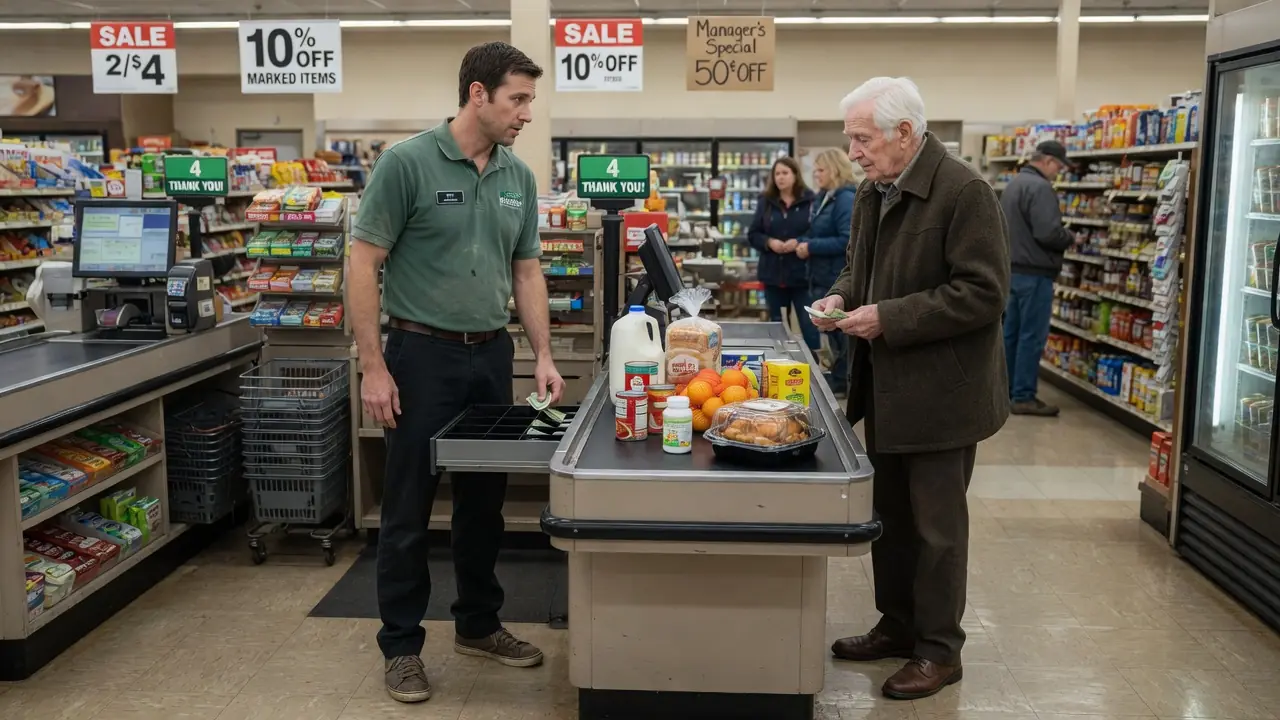
“The truth,” Sophia said. “And then, perhaps, a conversation about work.”
The word work landed harder than thanks would have.
That afternoon, Matthew met Sophia Hartwell and her legal counsel, Charles Renner, at a coffee shop two blocks from his building.
Charles was lean, silver-templed, and precise. He ordered black coffee, opened a folder, and wasted no words.
Hartwell Capital, he explained, was conducting due diligence on both Dalton Fresh Market and Barrow & Klein Logistics.
The two companies shared several regional distribution contracts, and both were under review as part of a possible restructuring plan.
Barrow & Klein’s leadership had been under pressure for months.
The acquisition was not final.
There were competing investment groups.
There were consultants.
There were quiet evaluations of personnel efficiency, operating margins, and management culture.
The old man Matthew helped, Arthur Hartwell, had once founded Hartwell Capital with his late wife. He no longer ran it, but his name still mattered. His presence at Dalton Fresh Market had been unplanned, but not unnoticed.
A private investigator working for a competing group had followed him.
Their goal was to document failure.
A confused elderly man unable to afford groceries in a store tied to Hartwell’s acquisition interests would have made a useful image, if framed properly.
Neglect.
Poor community relations.
Operational embarrassment.
Instead, Matthew had quietly paid the difference.
The footage had become useless for their intended purpose.
So the investigator called a contact at Barrow & Klein and reported that Matthew had been seen giving money to Arthur Hartwell during an active acquisition review.
Richard had acted quickly.
Too quickly.
Sophia said little while Charles explained.
She watched Matthew instead.
Matthew listened, hands around his coffee cup.
“So I was fired because I saw too much,” he said.
Charles did not deny it.
“You were fired because someone found it useful to remove you before anyone asked what you saw.”
Matthew gave a humorless laugh.
“I saw an old man short on groceries.”
Sophia’s expression softened.
“That is why this matters.”
Matthew looked at her.
“You understand that sounds strange?”
“Yes.”
“Good.”
Charles slid a folder across the table.
“There may be grounds for wrongful termination, depending on documentation, internal communications, and company policy. But Miss Hartwell also asked me to review your employment record.”
Matthew’s shoulders tightened.
“Why?”
Sophia answered this time.
“Because my father described you as careful.”
“That’s not much of a reference.”
“It is from him.”
Matthew looked down.
Careful.
He had been called dependable, quiet, overqualified for some tasks and underqualified for better ones. But careful felt different.
Careful was not small.
Careful was discipline.
Charles continued.
“Your personnel file shows repeated commendations for error detection, invoice corrections, and process reliability.”
Sophia leaned forward slightly.
“Do you have experience in operational analysis?”
Matthew almost said no.
Then he thought of the notebook in the kitchen drawer.
“I have experience noticing where money leaks,” he said.
Sophia’s eyes sharpened.
“Tell me.”
So he did.
Not everything.
Not at first.
But enough.
He told her about repeated invoice discrepancies. Rush fees. Warehouse overordering. Delivery delays caused by reporting structure rather than actual logistics. He explained how Barrow & Klein treated errors as isolated events when they were actually patterns.
Sophia listened with complete attention.
No polite nodding.
No checking her phone.
No impatience.
When he finished, she said, “Have you written any of this down?”
Matthew hesitated.
“Yes.”
“May I see it?”
“Not today.”
Sophia nodded once.
“Fair.”
That answer surprised him.
Most people with power did not respond well to being told no.
Sophia seemed to respect it.
Two days later, Matthew requested a formal meeting with Barrow & Klein’s human resources department to obtain a written explanation for the grounds of his termination.
He did not go alone.
He brought Grace Nolan, a coworker from accounts payable who had seen Richard receive the call before the termination meeting. She had printed the internal office call log before access was revoked because she had what she called “a bad feeling and a printer code.”
He also brought Charles, who remained in the lobby visible through the glass wall, reading from his phone with the unhurried composure of a man who did not need to prove he belonged.
The meeting included Richard and an HR officer named Renata Vale, who wore wire-rimmed glasses and a professionally managed expression.
Matthew did not ask for his job back.
He placed a document on the desk.
A timestamped call log.
An email from Richard to HR sent twelve minutes before Matthew had been called into the office, describing a “serious conflict-of-interest breach” before anyone had spoken to Matthew.
A still image from Dalton Fresh Market’s security footage, obtained by Charles through formal request, showing the private investigator standing near the register and filming.
Matthew looked at Richard.
“Who called you?”
Richard’s face changed.
Renata looked at him.
That was the moment the room shifted.
“I’m not here to reclaim a desk,” Matthew said. “I’m here to understand why a man paying five dollars toward groceries became a conflict of interest before anyone asked him what happened.”
Richard stood.
“This meeting is over.”
Renata said, “Sit down, Richard.”
He sat.
For the first time since he had walked out of the office with a cardboard box, Matthew did not feel like the smallest person in the room.
The investigation that followed moved quietly at first.
Then quickly.
The call log led to a consulting firm registered through a Delaware holding company. The firm traced back to the competing acquisition group. The investigator was identified. He had been contracted to monitor Hartwell-linked activity in Columbus and gather evidence that could damage valuation and leverage negotiations.
Richard was not fired immediately.
He was suspended.
Then transferred.
Then resigned.
The official statement cited violations of internal process, failure to properly investigate employee conduct, and inappropriate reliance on external pressure.
Matthew received a formal apology from Barrow & Klein.
He also received an offer to return.
He did not accept it.
Instead, he went to Hartwell Capital’s temporary Columbus office on a Tuesday morning, thirteen days after losing his job.
Sophia met him in a conference room overlooking the river.
He wore the same button-down shirt he had worn to his termination meeting. He had considered buying a new one, then decided that pretending would cost him more than honesty.
Sophia noticed.
She did not comment.
She offered him a position.
Not charity.
Not a ceremonial title.
A real job.
Operations analyst.
Reviewing branch-level financial performance, identifying cost and inventory inefficiencies, and reporting directly to Hartwell’s regional operations director.
The salary was more than double what he had made at Barrow & Klein.
The benefits were better.
The hours were flexible enough for school pickup.
There was a ninety-day evaluation.
Matthew did not say yes immediately.
“Why me?” he asked. “You could hire someone with a degree and ten years of experience by this afternoon.”
Sophia answered with the directness he was beginning to understand was her particular form of respect.
“Because I need people who make the right call when no one is watching. That does not show up on a resume. It shows up at a grocery register when there are five dollars between a right decision and a convenient one.”
Matthew was quiet.
Then he asked, “Did you choose me because of what happened with your father, or because I am useful in a legal process?”
Sophia did not look away.
“By the time I stood at your door, it was both. I am telling you that so you can decide what to do with the honesty.”
Matthew looked out the window.
The Columbus skyline was gray and low and unremarkable. He had spent most of his adult life inside it. It looked like home in the way unbeautiful things sometimes do, not because it is perfect, but because it is yours.
He reached into his bag and took out the small spiral notebook.
He placed it on the table between them.
“I don’t have a degree,” he said. “I have two years of cost-structure analysis in pencil after my son goes to sleep. That’s what I know.”
Sophia picked it up.
She turned through the pages without hurrying.
Columns.
Margin notes.
Flagged anomalies.
Questions written to himself and never answered.
She closed it.
Set it back on the table.
Then she nodded.
The same kind of nod her father had given at the grocery register.
The nod of someone making a thing permanent in memory.
Matthew said yes.
Not because Sophia was wealthy.
Not because the salary solved everything in one turn.
He said yes because, for the first time in longer than he could accurately measure, someone had looked at work he had done in the dark and recognized it as work.
Not a hobby.
Not the harmless pastime of a tired man with nowhere else to put his energy.
Work.
Three months passed.
On a Thursday afternoon in February, Matthew walked Theodore home from school.
Theodore talked about a water cycle project, about a classmate who had built a model from aluminum foil and gotten a key element slightly wrong, about how he had wanted to say something and had decided it wasn’t his business.
At the bottom of the front steps, Theodore looked up at him.
“Do you like the new job?”
Matthew thought about it honestly, the way he had been thinking about things lately, with more patience for process than outcome.
“I’m not sure yet,” he said. “But I don’t dread going in anymore. That’s new.”
Theodore accepted this with the seriousness of someone for whom an honest, incomplete answer was more satisfying than a confident lie.
“That’s good enough for now,” he said.
Matthew smiled.
“It is.”
Arthur Hartwell came to the Columbus office one morning in late March.
No one told Matthew he was coming.
Matthew was at his desk reviewing a cost report when the elevator doors opened and he looked up.
He saw the brown overcoat first.
Then the thin white hair.
The polished shoes.
The careful posture.
Arthur Hartwell walked beside Sophia, moving more slowly than she did, but with dignity still intact.
They passed Matthew’s desk.
Sophia paused.
Arthur turned.
For four seconds, no one spoke.
No explanation was offered.
None was necessary.
The four seconds were their own complete sentence.
Two people who had briefly and genuinely altered each other’s lives stood in an office hallway, recognizing that fact without needing to name it.
Arthur reached into his coat pocket.
Matthew almost smiled.
“No,” Matthew said gently. “Please don’t.”
Arthur’s hand stopped.
Then the old man smiled.
“I was not reaching for money.”
He removed a folded paper.
It was the receipt from Dalton Fresh Market.
The one from that evening.
The ink was slightly faded, but the total remained visible.
Arthur had kept it.
“I wanted you to know,” Arthur said, “that I remember the exact amount.”
Matthew swallowed.
“Five dollars and seventeen cents.”
“Yes.”
Arthur folded the receipt again with careful hands.
“It was never about the amount.”
“No,” Matthew said. “It wasn’t.”
Sophia looked between them, her expression unreadable at first.
Then softer.
Something between gratitude and grief moved across her face.
Arthur touched Matthew’s arm lightly before continuing toward the conference room.
Sophia remained behind for a moment.
“He talks about you often,” she said.
Matthew looked after the old man.
“He looked like he needed groceries.”
“He needed dignity,” Sophia said. “You let him keep it.”
That stayed with Matthew.
More than the job.
More than the salary.
More than the formal apology from the company that had thrown him out so easily.
You let him keep it.
Over the next year, Matthew grew into the role in ways he did not fully expect.
At first, he was cautious.
He checked every report twice, then a third time. He waited for someone to discover that he did not belong there. He waited for the title to evaporate, for the office badge to stop opening doors, for the salary to prove temporary.
But the work steadied him.
Numbers made sense.
Patterns revealed themselves if he waited long enough.
He found inefficiencies Hartwell’s consultants had missed because they were too far from the floor. He spoke to warehouse staff, delivery clerks, janitors, cashiers, drivers, and night supervisors. He asked questions other analysts skipped because those questions were not elegant.
Where does time get wasted?
Which process makes people lie on forms because the truth takes too long?
What error happens so often everyone has stopped calling it an error?
Sophia began bringing him into higher-level meetings.
At first, the senior analysts looked past him.
Then they stopped.
Not because he became louder.
Because he was usually right.
One afternoon, during a tense review of Dalton Fresh Market’s failing branch operations, Matthew said, “You’re measuring loss at the register, but the problem starts in ordering. Managers are overcompensating for delivery uncertainty by overstocking perishables. Then they pressure cashiers to push items close to expiration. Customers notice. Trust drops. You call it shrink. It’s actually system anxiety.”
The room went silent.
Sophia looked at him from the head of the table.
“System anxiety,” she repeated.
Matthew shifted slightly.
“It’s not a technical term.”
“No,” she said. “It is a useful one.”
The phrase entered the report.
Then the strategy.
Then the restructuring plan.
Months later, Dalton Fresh Market changed its ordering system, delivery timing, perishables rotation, and frontline employee discretion policy.
Cashiers were given a small dignity fund, five hundred dollars per store per month, to cover minor customer shortfalls without punishment or humiliation.
The policy was named internally after Arthur Hartwell.
Arthur hated that.
Matthew loved it.
Theodore’s life changed too, though Matthew tried to keep the changes gentle.
A better winter coat.
A bed frame instead of a mattress on a box spring.
Fresh fruit without calculation.
A plain white shirt that fit before the school presentation.
Then another for backup.
They moved to a better apartment six months later, still modest, still close to school, but with reliable heat and windows that did not rattle in the wind.
Margaret cried when Matthew told her they were moving.
Then she packed them soup for the first week.
“You’ll still do my groceries?” she asked.
“Every Saturday,” Matthew said.
Theodore looked around the new apartment the first night, standing in the middle of his room with his hands on his hips.
“It’s too quiet.”
Matthew laughed.
“You’ll get used to it.”
“Maybe.”
Then Theodore turned serious.
“Dad?”
“Yeah?”
“When you helped that old man, did you know it would fix everything?”
Matthew sat on the edge of the bed.
“It didn’t fix everything.”
“It fixed a lot.”
“That’s not why I did it.”
“I know.”
Theodore climbed onto the bed beside him.
“But would you still do it if you knew you’d get fired?”
Matthew thought of the office, the cardboard box, the fear that had sat like a stone in his stomach.
He thought of Arthur counting coins.
He thought of the rotisserie chicken returning to the bag instead of being left behind.
Then he said, “Yes.”
Theodore nodded, as if that answer confirmed something important.
“Good.”
In time, Sophia became more than his employer.
Not quickly.
Not carelessly.
There were boundaries at first, and both of them respected them.
She was the CEO of a private investment firm.
He was an analyst still learning how to trust the ground beneath him.
She came from a world of private schools, boardrooms, and old family names.
He came from rent calculations, after-school arrangements, and shirts dried with a hair dryer.
But respect came first.
Then familiarity.
Then the strange, quiet comfort of being understood without having to explain everything.
Sophia was not warm in the easy way people expected women to be. She was precise, controlled, sometimes intimidating, and often too honest for comfort.
Matthew found that restful.
She did not waste words.
She did not flatter.
When she praised him, he believed it because she had no habit of saying things she did not mean.
She met Theodore at a company family event in early summer.
Theodore asked her if CEOs had homework.
Sophia considered the question seriously.
“Yes,” she said. “But mine is usually done in spreadsheets.”
“That sounds worse than spelling.”
“It often is.”
Theodore liked her immediately.
That surprised Matthew.
It did not surprise Sophia.
“Children know when adults are pretending,” she said later.
“And you don’t pretend?”
“I negotiate. Different thing.”
Matthew laughed, and Sophia looked pleased in a quiet way, as if his laughter had become something she noticed.
Their friendship deepened slowly.
She called him after difficult meetings, not because she needed advice exactly, but because he asked different questions. He told her when her plans sounded detached from real people. She told him when his instincts were good but his presentations needed cleaner structure.
He helped her speak more plainly.
She helped him stop apologizing before offering useful ideas.
One evening, after a long review session, Sophia drove him home because his bus route had been delayed.
They sat outside his building for several minutes after the engine stopped.
Rain tapped lightly against the windshield.
Not a storm.
Only rain.
Sophia looked at the wet street.
“My father has bad days now,” she said.
Matthew stayed quiet.
“He knows he is forgetting. That is the cruelty of it. Some people decline without awareness. He is aware enough to grieve each loss.”
“I’m sorry.”
“He was a difficult father,” she said. “Brilliant. Demanding. Often absent. But never small. Watching him become uncertain inside his own life has been…”
She stopped.
Matthew understood enough not to finish for her.
After a moment, Sophia said, “That day at the grocery store frightened me because I realized I had been managing him instead of seeing him.”
Matthew looked at her.
“You were trying to keep him safe.”
“Yes. But safety can become a cage if you make it without asking the person inside.”
The rain softened.
Matthew said, “My son asked me what I’d buy first if I had a lot of money. I said clothes for him. He told me that was the wrong answer.”
Sophia turned to him.
“What was the right answer?”
“I still don’t know.”
She looked at him for a long moment.
“Something for yourself, Matthew.”
His name in her voice landed with unexpected force.
Not flirtation.
Not yet.
But tenderness, restrained and startling.
He did not answer.
Neither did she.
Sometimes the heart shifts quietly, and the mind notices later.
Two years after the grocery store incident, Matthew became director of operational integrity for Hartwell’s regional holdings.
The title embarrassed him.
The work did not.
He built systems that gave frontline employees discretion without fear. He pushed for transparent manager reviews, fair scheduling practices, emergency employee assistance funds, and customer dignity policies that prevented small humiliations from becoming public wounds.
He did not frame it as kindness.
He framed it as operational resilience.
Sophia understood that this was partly strategy and partly mercy.
She approved every proposal that made sense.
Most did.
Arthur Hartwell declined steadily, but not cruelly. He had good days and difficult ones. On good days, he visited the office, told stories from Hartwell’s early years, and insisted Matthew join him for tea. On difficult days, he forgot names but remembered feelings.
He did not always remember Matthew’s job title.
He always remembered the groceries.
“Five dollars and seventeen cents,” he would say sometimes, smiling faintly.
Matthew would answer, “It was never about the amount.”
Arthur would nod.
“No. It was not.”
When Arthur passed away three winters later, the funeral was private but crowded.
Former employees came.
Drivers.
Secretaries.
Investment partners.
Warehouse managers.
A cashier from Dalton Fresh Market whom Arthur had helped through a medical bill years before.
Matthew stood near the back with Theodore.
Sophia delivered the eulogy.
Her voice remained steady until the end.
“My father believed that money was useful only when it protected human dignity,” she said. “He did not always live perfectly by that belief. None of us do. But near the end of his life, a stranger reminded him of it with a gesture so small it would have been easy for the world to miss.”
Her eyes found Matthew’s.
“Five dollars and seventeen cents. That was the amount. But the value of dignity cannot be measured by the size of the gap it closes.”
After the service, Sophia stood alone beneath a bare tree outside the chapel.
Matthew approached slowly.
She looked tired in a way he had never seen before.
Not executive tired.
Daughter tired.
He did not offer advice.
He did not tell her grief would pass.
He knew better.
He simply stood beside her.
After a while, she reached for his hand.
He held it.
That was how it began, though perhaps it had begun long before.
With groceries.
With a hallway.
With coffee left on a desk.
With honesty.
With grief recognized and not rushed.
Their love grew carefully, shaped by the knowledge that both had responsibilities larger than their own loneliness.
Matthew had Theodore.
Sophia had a company, a legacy, a father’s memory, and a life built around control.
Neither wanted a love that arrived like rescue.
They wanted something steadier.
Something chosen.
When Matthew finally told Theodore that he and Sophia were seeing each other, Theodore took a long bite of cereal and thought about it.
“Does she like board games?”
“Yes.”
“Does she let people win?”
“No.”
“Good,” Theodore said. “Then she can come over Friday.”
Sophia came.
She lost one game honestly and won two without apology.
Theodore respected that deeply.
A year later, Matthew proposed in the least dramatic way possible.
No restaurant.
No orchestra.
No hidden photographer.
Just the three of them in the kitchen of Matthew’s apartment after a dinner of roast chicken, green beans, and bread.
Theodore knew in advance and was almost vibrating with the effort of keeping the secret.
Matthew turned to Sophia and said, “I don’t know if I can offer you a life that looks impressive to the people who expect impressive things from you.”
Sophia looked at him.
“I have had impressive.”
“I can offer honest.”
“I prefer honest.”
“I can offer Theodore.”
“Theodore is already negotiating terms with me.”
“I can offer myself. Fully. Carefully. Without pretending I’m less afraid than I am.”
Sophia’s eyes softened.
“That is the only way I would want you.”
Matthew took out the ring.
It was not large.
It was not meant to compete with anything Sophia could have bought herself.
It had belonged to Dana.
Matthew had spoken to Theodore about it first. Then to Dana’s mother. Then, finally, he had carried it for three weeks, waiting for courage to become action.
Sophia understood what it meant the moment she saw it.
Tears filled her eyes.
“Matthew.”
“It doesn’t erase anything,” he said quietly. “It adds. If you’ll let it.”
Sophia reached for him.
“Yes.”
Theodore shouted before she finished the word.
At their wedding, held in a small garden behind the Hartwell Columbus office, Matthew did not speak about fate.
He did not speak about miracles.
He spoke about attention.
“I used to think life changed because of large decisions,” he said, standing beside Sophia with Theodore at his side. “Jobs. Moves. Contracts. Losses. The obvious things. But I have learned that life often changes in the smallest spaces. A grocery line. A question. A five-dollar gap. A moment when you decide whether someone else’s dignity is worth your inconvenience.”
He looked at Sophia.
“I helped your father because he needed help. You changed my life because you were willing to see the work I had been doing before anyone paid me for it. And somewhere between those two acts of seeing, we built a family.”
Sophia’s vows were shorter.
Very Sophia.
“I do not love carelessly,” she said. “I do not trust easily. You have never asked me to do either. You have only shown up, again and again, with honesty, patience, and courage. I choose you, Matthew. I choose Theodore. I choose the life we will build with clear eyes and open hands.”
Years later, Hartwell’s operational integrity model became a national case study.
Companies copied the dignity fund.
Industry journals wrote about frontline discretion, employee trust, and ethical intervention. Executives praised the model because it improved customer loyalty and reduced turnover.
Matthew let them use whatever language made them comfortable.
He knew what it really was.
It was a way of making sure no cashier got fired for helping someone buy groceries.
It was a way of making sure no elderly man had to choose between vitamins and dinner while strangers watched.
It was a way of making sure dignity had a line in the budget.
Theodore, now older, wrote his college essay about the grocery store story.
“My father once lost his job because he helped an old man pay for groceries,” he wrote. “At the time, he had almost nothing to spare. I used to think the lesson was that kindness comes back to you. But that is too simple. Sometimes kindness costs you before it changes anything. Sometimes it never comes back at all. The real lesson is that my father did the right thing before he knew the ending. That is the kind of person I want to become.”
Matthew kept a copy of that essay in his desk.
Beside it, he kept the old spiral notebook.
And tucked inside the notebook was a faded Dalton Fresh Market receipt Arthur Hartwell had left him in his will.
At the bottom, in Arthur’s shaky handwriting, were the words:
It was never about the amount.
Sometimes, late in the evening, when the office was quiet and Sophia was finishing one last call, Matthew would open the notebook and look at that receipt.
Five dollars and seventeen cents.
A small amount.
A dangerous amount, once.
A life-changing amount, though no one could have known it at the time.
He would think of the man he had been that day, tired, worried, counting every dollar, buying milk and bread and a too-expensive white shirt he had to put back.
He would think of the old man counting coins.
He would think of Theodore asking what he would buy first if he had a lot of money.
Now Matthew knew the answer.
He would buy nothing first.
He would pause.
He would look around.
He would see who needed the five dollars more.
And then he would decide.
Not because he was noble.
Not because he was certain the world would reward him.
But because some choices tell you who you are before life tells you what they cost.
The five dollars he set down at that grocery register had not been a loss.
It had not been naive.
It had not been foolish.
It had been the only decision he made that evening without calculating the cost first.
And somehow, that was the decision that gave him everything.