The first thing Mason Reed noticed was the way the woman stood in the parking lot.
Not the car.
Not the expensive black suitcase beside her.
Not the rain soaking through her pale beige coat.
The way she stood.
Straight-backed, chin lifted, shoulders held with practiced control, as if she had spent her whole life teaching herself not to look afraid in front of people who wanted her to be.
It was almost midnight outside the old Lakeside Conference Center in Madison, Wisconsin, and most of the building had gone quiet. The charity business gala had ended an hour ago.
The last caterers were loading silver trays into white vans. A few event staff dragged trash bags toward the dumpsters near the rear entrance.
Mason should have been home already.
At thirty-three years old, he had become very good at counting time.
Every hour mattered.
Every late shift meant paying Mrs. Donnelly extra to watch his eight-year-old daughter, Ava. Every unexpected delay meant Ava would fall asleep on the couch waiting for him, one sock missing, a book open on her chest.
He hated that.
But he also needed the work.
Mason Reed was a single father, a part-time security supervisor, and the owner of a small handyman repair business that never seemed to grow fast enough to stop him from needing side jobs.
He fixed fences, patched roofs, repaired porch steps, unclogged sinks, and installed shelves in houses owned by people who often treated him like furniture.
He did not complain.
Complaining had never paid rent.
His wife, Lauren, had died four years ago after a sudden illness that took her from “tired” to “gone” before Mason could understand what was happening. Since then, he had built his life around two things: keeping Ava safe and never letting her feel like love had left the house when her mother did.
That meant working late.
That meant saying yes when the conference center called and asked him to cover security for a high-end gala because their regular night supervisor had canceled.
It should have been simple.
Stand near the entrance. Watch the guests. Keep the lobby clear. Make sure no one wandered into restricted areas.
But then he saw her.
The woman in the rain.
She stood near a silver Lexus with the driver’s door open, one hand pressed to her forehead, the other holding a phone that looked dead. Her long chestnut-brown hair had slipped from its elegant low bun and now clung damply to her cheeks.
She wore a cream silk blouse beneath her coat, dark tailored trousers, and black heels that had no business standing in puddles beside a nearly empty building at midnight.
Mason recognized her from the stage.
Everyone at the gala had.
Vivian Hartwell.
Twenty-eight years old.
Founder and CEO of Hartwell & Bloom, a luxury interior design and hospitality firm that had recently expanded across the Midwest. She had been honored that night for donating renovation services to women’s shelters and children’s centers.
On stage, she had looked calm, polished, untouchable.
Now she looked alone.
Mason watched as a man in a dark suit stepped out from behind a nearby SUV.
Something about him immediately put Mason on alert.
The man was smiling, but it was the wrong kind of smile. Too familiar. Too confident. The smile of someone who believed politeness was permission.
Vivian stiffened when she saw him.
Mason moved closer, stopping near the edge of the covered walkway.
He could not hear every word over the rain, but he heard enough.
“Vivian,” the man said, spreading his hands. “You’re making this harder than it needs to be.”
“I told you inside,” Vivian replied, voice controlled. “The answer is no.”
“You didn’t even read the revised offer.”
“I read enough.”
“You’re emotional tonight.”
“I’m perfectly clear.”
The man stepped closer.
Vivian did not step back, but Mason saw her fingers tighten around the handle of her suitcase.
“Your company needs protection,” the man said. “You need protection. You’re young. You’re alone. And your board is losing patience.”
“My board is not your concern, Preston.”
Preston.
Mason remembered the name from some overheard conversation near the coat check. Preston Vale, investor, developer, and apparently the kind of man who waited for women in parking lots after midnight.
Preston’s voice lowered.
“Don’t be stubborn. Sign the acquisition agreement before the emergency vote tomorrow, and I’ll make sure you walk away respected.”
Vivian gave a short laugh, sharp and tired.
“You mean quiet.”
“I mean rich.”
“I already have money.”
“Not for long if your board removes you.”
That was when Mason stepped forward.
He did not rush. He did not shout. He simply walked into the light spilling from the conference center entrance and stopped a few feet away.
“Everything all right here, ma’am?”
Both of them turned.
Preston looked him up and down quickly, taking in the security jacket, the broad shoulders, the work-worn hands, the calm face that did not invite argument.
Vivian looked at him differently.
Not relieved exactly.
Not yet.
But aware.
Preston smiled. “Private conversation.”
Mason kept his eyes on Vivian.
“Ma’am?”
Vivian’s lips parted slightly. For one second, Mason could see the decision happening behind her eyes. Pride told her not to need help. Instinct told her to accept it.
Then she said, “No. Everything is not all right.”
Preston’s smile vanished.
Mason nodded once. “Would you like me to call someone?”
“My phone is dead,” Vivian said. “And my driver canceled.”
“I can call you a cab from inside.”
Preston scoffed. “This is unnecessary.”
Mason finally looked at him. “She said it isn’t all right.”
“It’s a business matter.”
“At midnight in a parking lot, it became a security matter.”
The words were calm.
That made them heavier.
Preston’s jaw tightened.
“You have no idea who I am.”
“No,” Mason said. “But I know who asked for help.”
For a moment, the rain was the only sound.
Vivian looked down, and Mason saw something flicker across her face.
Not weakness.
Exhaustion.
Preston adjusted his cuffs, recovering his polished smile.
“This isn’t over, Vivian.”
“It is for tonight,” she said.
Preston walked away, his shoes splashing through shallow water, his anger hidden beneath expensive fabric.
Mason waited until the SUV pulled out of the lot before turning back to her.
“You okay?”
Vivian nodded too fast.
“Yes. Thank you. I’m fine.”
People who said they were fine that quickly usually weren’t.
Mason glanced toward the Lexus. “Car trouble?”
“No. The car belongs to my driver. He left after a disagreement with my assistant, apparently. My phone died. My hotel is twenty minutes away, and every rideshare app in the city seems to be unavailable or surging into insanity.”
Mason almost smiled.
“Surging into insanity sounds about right for gala night.”
Vivian looked at him for the first time with full attention.
“You worked inside.”
“Yes, ma’am.”
“Mason, right?”
He was surprised. “You remember?”
“You helped one of the servers when the display wall nearly tipped over.”
“That was nothing.”
“It was not nothing. It would have crushed three auction pieces and possibly a donor.”
“They were very expensive-looking lamps.”
Despite herself, Vivian smiled faintly.
It changed her face.
On stage, she had been beautiful in a distant, polished way. Here, in the rain, exhausted and trying not to shake, she looked more human. Still elegant, still graceful, but softer around the edges.
Mason looked away before he noticed too much.
“I’ll call a cab from the front desk,” he said.
“There’s no need. I can wait.”
“In the rain?”
“I’ve had worse evenings.”
“I believe you. Doesn’t mean you need another one.”
Vivian studied him.
Then she gave a small nod. “All right.”
Inside the conference center, the lobby lights were still bright. The marble floors shone with reflections from the chandeliers, and the smell of flowers, perfume, and leftover champagne lingered in the air.
Mason called two cab companies.
No answer from the first.
Forty-five-minute wait from the second.
Vivian stood near the reception desk, her suitcase beside her, coat dripping lightly onto the floor.
Mason hung up.
“Not good?” she asked.
“Forty-five minutes at best.”
She closed her eyes briefly.
“I have a board meeting at seven-thirty.”
“Tomorrow morning?”
“Yes.”
“You should be sleeping.”
“I don’t do much of that anymore.”
The honesty slipped out before she could stop it.
Mason pretended not to notice how vulnerable it sounded.
He checked his watch.
12:11 a.m.
Mrs. Donnelly would be irritated, but awake. Ava would be asleep. His old pickup was parked outside, and the hotel district wasn’t far out of his route home.
“I can drive you,” he said.
Vivian looked up immediately. “No.”
“Okay.”
He did not argue.
That seemed to surprise her.
Mason reached for the phone again. “Then we’ll keep trying.”
Vivian watched him for a moment.
“You’re not offended?”
“No.”
“Most men would be.”
“I’m not most men.”
The words were simple, without pride.
Vivian’s expression shifted again.
Mason added, “You don’t know me. Saying no is smart.”
She looked at the dead phone in her hand, then toward the rain-streaked doors.
“What if we call the hotel first,” he said, “tell them my name, my license plate, and the time we leave? You can sit in the back. I won’t make conversation unless you want it. If that still feels wrong, we wait.”
Vivian studied him for several long seconds.
Then she said, “You have a daughter.”
Mason glanced down and realized she was looking at the bracelet on his wrist.
Ava had made it from blue and yellow beads. Some letters had faded, but it still read DAD in uneven plastic blocks.
“Yes.”
“How old?”
“Eight.”
“What’s her name?”
“Ava.”
The name softened the space between them.
Vivian took a quiet breath.
“All right,” she said. “But we call the hotel first.”
“Good.”
He smiled slightly. “That was the right answer.”
Twenty minutes later, Vivian Hartwell sat in the back seat of Mason Reed’s aging pickup truck, wrapped in silence and the faint smell of sawdust, coffee, and peppermint gum.
The truck was clean but worn. There was a child’s pink hair tie near the cup holder, a folded school newsletter tucked into the sun visor, and a small stuffed rabbit on the passenger seat.
Vivian looked at the rabbit.
Mason noticed in the rearview mirror.
“That’s Daisy,” he said. “Ava says she protects the truck.”
Vivian touched the edge of her damp coat.
“She must be very brave.”
“She’s been through three juice spills and a mechanic shop. So yes.”
Vivian smiled to herself.
For the first few minutes, neither of them spoke.
Rain streaked the windows. Madison’s downtown lights blurred past them, bright and distant. Vivian leaned her head back against the seat, exhaustion finally pulling at her polished mask.
“Did he hurt you?” Mason asked quietly.
Her eyes opened.
“No.”
Mason nodded. “Good.”
“He used to be my fiancé.”
Mason did not respond immediately.
That kind of confession needed space.
Finally, he said, “I’m sorry.”
“Don’t be. I’m the one who said yes.”
“That doesn’t make what he did tonight your fault.”
Vivian looked toward the window.
The city lights slid across her face.
“He wants my company,” she said. “He wanted it before he wanted me. I just took too long to see it.”
Mason kept his eyes on the road.
“People are good at hiding the part they’re selling.”
She turned toward him slightly.
“That sounds like experience.”
“My wife left when our daughter was four months away from turning five.”
Vivian’s face softened. “Left?”
“She wanted a different life. She said motherhood made her feel trapped. Marriage made her feel smaller. I don’t think she meant to be cruel. But she was.”
“Does Ava see her?”
“Video calls sometimes. Birthday gifts. Postcards from cities she can’t pronounce.”
Vivian was quiet.
“I’m sorry,” she said.
Mason shrugged, though the old ache still lived beneath the movement.
“Ava and I do okay.”
“That’s not what I said.”
He glanced at her in the mirror.
She looked back, steady and kind.
For some reason, that kindness made him more uncomfortable than pity would have.
He pulled up in front of the elegant hotel where Vivian was staying. A doorman hurried forward with an umbrella.
Vivian opened the door, then paused.
“How much do I owe you?”
Mason almost laughed.
“Nothing.”
“Please don’t say that.”
“Okay. You owe me nothing.”
Her mouth tightened, but there was amusement behind it.
“Mason.”
“Vivian.”
It was the first time he said her name.
Something quiet passed between them.
She looked down, reached into her bag, and pulled out a business card. It was white with raised lettering, clean and expensive.
Vivian Hartwell
Founder & CEO
Hartwell & Bloom
She wrote a number on the back.
“My personal number,” she said. “If you ever need anything.”
Mason took it carefully.
“I probably won’t.”
“I know,” she said. “That’s why I’m giving it to you.”
Then she stepped out into the rain and disappeared beneath the hotel lights.
Mason drove home telling himself he would never see her again.
He was wrong.
The next morning, Vivian walked into her board meeting with four hours of sleep, damp hair hidden in a neat twist, and the memory of a security guard’s calm voice still holding her steady.
Preston was there.
Of course he was.
He sat beside two board members who had once smiled at her father across dinner tables and now spoke of “strategic restructuring” as if they weren’t sharpening knives under the table.
The meeting lasted three hours.
They questioned her judgment. Her expansion strategy. Her refusal to sell. Her emotional attachment to community-based projects. Her youth. Her leadership style.
They did not mention Preston waiting for her in the rain.
Men like Preston understood which threats left no paperwork.
Vivian held her ground.
Barely.
When the meeting ended, the board delayed the vote by thirty days. Not a victory. Not a defeat. Just a stay of execution.
That afternoon, she sat alone in her office, staring at a spreadsheet while Mason’s business card rested beside her laptop.
She had asked the conference center manager for his full name before leaving.
Mason Reed.
Independent handyman. Part-time security contractor. Widowed father. Owner of Reed Home Repair.
She told herself she wanted to thank him properly.
That was all.
But three days later, when she drove past a neighborhood in Verona and saw his name on the side of a white work van parked outside a small brick house, her heart moved in a way that had nothing to do with gratitude.
Mason was repairing a porch railing when she arrived.
A little girl with curly light-brown hair sat on the front steps, reading a book with a purple cover. She looked up first.
“Dad,” the girl called. “There’s a fancy lady.”
Mason turned.
For one second, he looked genuinely stunned.
Vivian suddenly felt ridiculous.
She was wearing a soft camel coat over a navy dress, with pearl earrings and low heels. She had brought a thank-you basket from one of her company’s gift vendors, which now felt absurdly formal in front of a man holding a drill.
“Miss Hartwell,” he said.
“Vivian,” she corrected, then smiled at the little girl. “And you must be Ava.”
Ava narrowed her eyes with cheerful suspicion. “How do you know that?”
“Your dad told me your name when I met Daisy.”
Ava gasped. “You met Truck Daisy?”
“She seemed very responsible.”
Ava closed her book and stood. “She is. She watches Dad’s driving.”
Mason stepped down from the porch. “What are you doing here?”
The question was not rude, just surprised.
Vivian lifted the basket.
“I came to say thank you.”
“You already did.”
“Not properly.”
“I drove you twenty minutes.”
“You also stepped in when you didn’t have to.”
Mason’s expression shifted.
He glanced toward Ava.
Vivian understood and lowered her voice.
“I won’t take much of your time.”
Ava, however, had other plans.
“What’s in the basket?”
“Ava,” Mason said.
Vivian smiled. “Cookies, jam, coffee, and some fancy crackers no child has ever been excited about.”
“I’m excited about cookies.”
“That seems reasonable.”
Mason looked like he wanted the porch to swallow him.
Vivian found herself enjoying that more than she should.
Over the next fifteen minutes, what was supposed to be a brief thank-you became coffee on the front porch with Ava asking Vivian questions at a speed no board member had ever dared attempt.
“Do you live in a mansion?”
“No.”
“Do you have a driver?”
“Sometimes for work.”
“Do you have kids?”
“No.”
“Do you want kids?”
Mason choked on his coffee.
“Ava.”
“What? It’s a normal question.”
Vivian laughed softly, though something tender moved behind her ribs.
“I think children are wonderful,” she said carefully. “But my life has been very busy.”
Ava nodded wisely. “That means yes but complicated.”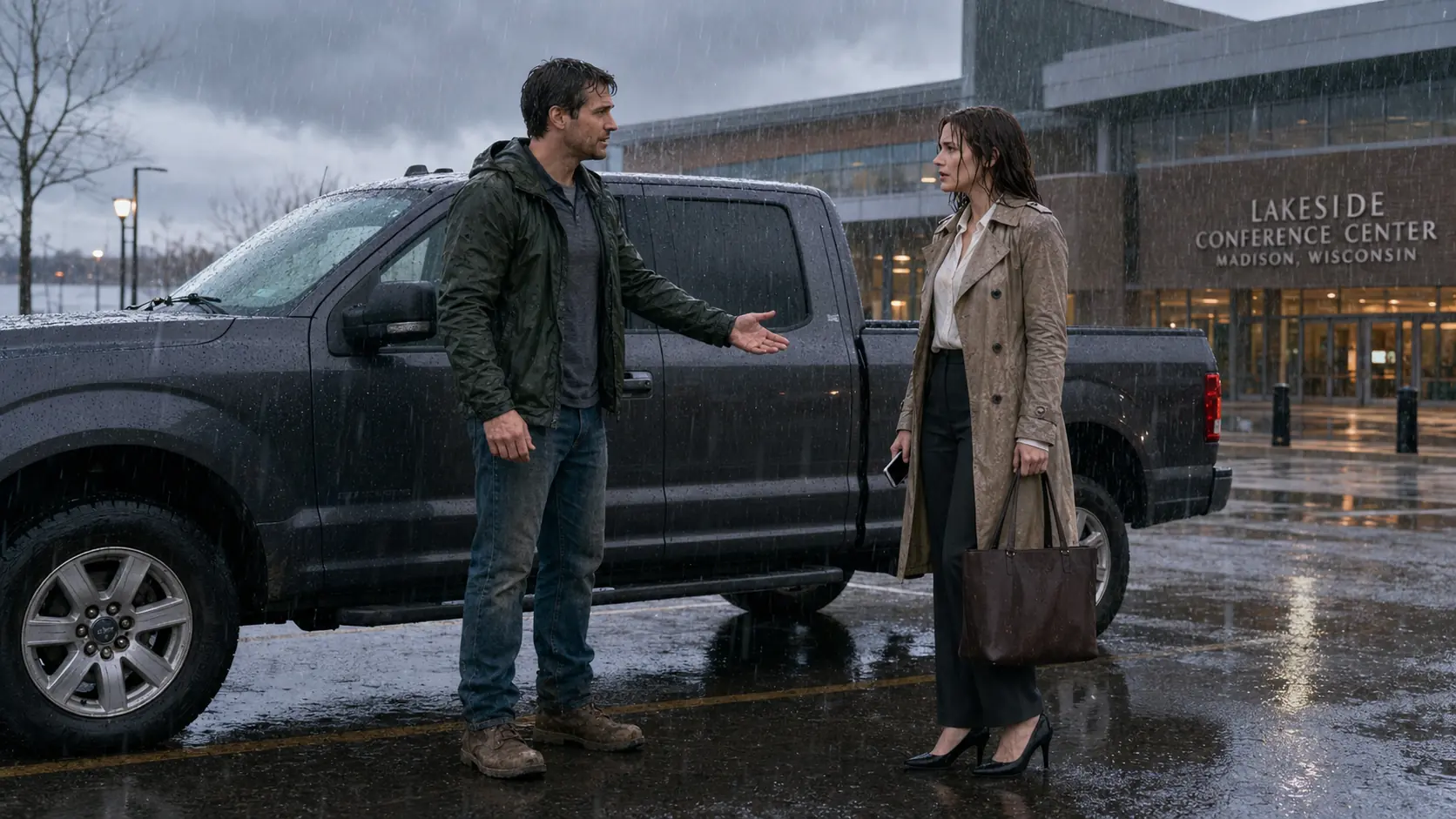
Mason closed his eyes.
Vivian looked at him. “She’s very perceptive.”
“She’s very dangerous.”
Ava smiled proudly.
That visit should have been the end of it.
Instead, Vivian called Mason two weeks later.
Not for personal reasons.
At least, that was what she told herself.
Hartwell & Bloom had acquired an old boutique inn outside Madison as part of a restoration project. The building needed practical repair assessments before Vivian could present the plan to her board. The contractors her company usually hired were polished, expensive, and too willing to tell executives what they wanted to hear.
She wanted someone honest.
So she called Mason.
He did not answer the first time.
Or the second.
The third time, he texted.
Sorry. Under a sink. Emergency pipe situation.
Vivian stared at the message and laughed for the first time that day.
She replied.
This is Vivian Hartwell. I have a restoration project and need an honest repair assessment. Not urgent enough to interrupt plumbing heroics.
Ten minutes later, he called.
“Plumbing heroics is generous,” he said. “I’m losing.”
“Should I call someone else?”
“For the pipe or your project?”
“The pipe sounds emotionally unavailable.”
He laughed.
It was low, surprised, and warm.
Vivian felt it long after the call ended.
Mason agreed to inspect the inn.
The building sat near Lake Mendota, a three-story structure with faded blue shutters, a wraparound porch, and enough hidden problems to frighten a wealthy investor and excite a practical repairman.
Mason walked through it slowly, taking notes in a cheap spiral notebook while Vivian followed with architectural plans.
“You don’t like the rear staircase,” she said.
“I don’t trust it.”
“That sounds worse.”
“It is worse.”
“How bad?”
“Bad enough that if one of your usual contractors said it only needs paint, you should never hire him again.”
Vivian wrote that down.
Mason glanced over. “You’re actually noting that?”
“Yes.”
“I was being sarcastic.”
“I know. It was still useful.”
He looked at her, and for a second, the old inn seemed very quiet around them.
Working together changed things.
Not quickly.
Not dramatically.
But steadily.
Vivian learned that Mason was not merely handy. He was thoughtful. He saw buildings the way some people saw wounded animals—not as broken things to discard, but as structures with history, weakness, and potential.
Mason learned that Vivian was not the cold businesswoman some people assumed her to be. She was precise because people looked for mistakes. She dressed elegantly because armor could be made of silk. She spoke calmly because anger from a young woman in a boardroom was always remembered longer than the insult that caused it.
They argued sometimes.
Usually about money.
“You need to charge more,” Vivian told him after reviewing his estimate.
“I charge fairly.”
“You charge like guilt is your accountant.”
Mason looked offended. “That is weirdly specific.”
“It is also correct.”
“I don’t overcharge people.”
“I’m not people. I’m a company hiring a professional.”
He folded his arms. “You always this bossy?”
“Yes.”
“At least you’re honest.”
“My board calls it difficult.”
“Your board sounds exhausting.”
“You have no idea.”
Little by little, he did.
Over lunch breaks in the empty inn kitchen, Vivian told him about her father, Charles Hartwell, who had started the business by restoring one old bed-and-breakfast with her mother before expanding into design and hospitality. Her mother died when Vivian was sixteen. Her father poured grief into work and taught Vivian everything he knew.
When he passed away two years earlier, Vivian inherited not only his company but also every person who thought she was too young, too pretty, too emotional, or too inexperienced to lead it.
Mason listened more than he spoke.
Vivian appreciated that.
Most people listened only long enough to decide what advice they wanted to give.
Mason listened like the truth had weight.
In return, he told her about Lauren, though not all at once. How they had married young. How Ava had been born during a thunderstorm. How Lauren had cried for months in ways Mason did not understand then. How she left a note saying she needed to find herself before she disappeared into everyone else’s needs.
“I was angry for a long time,” Mason said one afternoon, tightening a loose window latch in the second-floor hallway. “Then I felt guilty for being angry. Then I got tired of both.”
Vivian stood beside him, holding a box of screws.
“And now?”
“Now I try to make sure Ava never thinks she was the reason.”
Vivian’s eyes softened.
“She’s lucky to have you.”
Mason shook his head. “I’m lucky to have her.”
“That too.”
He looked at Vivian then.
The sunlight through the dusty window touched her brown hair, turning it soft around her face. She wore a pale blue blouse, fitted trousers, and a delicate gold watch. Beautiful, yes. But what struck him most was the gentleness in her expression.
He had not expected gentleness from her.
Maybe because he had mistaken polish for distance.
Maybe because he had forgotten people could be many things at once.
One Saturday, Vivian came to the inn expecting a short meeting and found Ava sitting cross-legged on the floor of the empty dining room, coloring paint samples with crayons.
Mason looked apologetic.
“Mrs. Donnelly had a family thing. I can reschedule.”
Vivian looked down at Ava.
Ava held up two paint cards. “Which one looks more like happy rain?”
Vivian removed her coat and sat on the floor without hesitation.
“This one,” she said, pointing to a soft pale blue. “It feels like rain after something good happens.”
Ava considered that.
“You understand colors.”
“It’s my job.”
“Cool. Dad understands leaks.”
Mason muttered, “An impressive legacy.”
Vivian smiled and helped Ava build a color board for the inn’s future children’s reading corner. By the end of the afternoon, Ava had decided Vivian was the only adult in the world who understood “cozy but not boring.”
That evening, after Vivian left, Ava sat in Mason’s van with the seatbelt across her chest and a thoughtful frown on her face.
“Dad.”
“Yeah?”
“I like her.”
Mason kept his eyes on the road. “She’s nice.”
“No. I like-like her for us.”
His hands tightened on the steering wheel.
“Ava.”
“What?”
“That’s not something you need to think about.”
“I think about everything.”
“I know. It’s terrifying.”
Ava looked out the window.
“Mom didn’t like being with us,” she said quietly.
Mason’s chest tightened.
“That wasn’t because of you.”
“I know because you say it. But sometimes my heart forgets.”
Mason pulled into their driveway and turned off the engine.
He sat there for a moment, then turned toward his daughter.
“Your mom loved you the best way she knew how. But she wasn’t able to stay. That is not your fault. Not even a tiny bit.”
Ava nodded, but her eyes were wet.
Mason reached back and took her hand.
“And Vivian being kind doesn’t mean she’s replacing anyone.”
“I know.”
“Do you?”
Ava wiped her cheek with her sleeve.
“I just think maybe our house has been quiet a long time.”
Mason closed his eyes briefly.
Children had a way of opening doors adults leaned their whole weight against.
The problem was, Vivian had doors too.
And hers were guarded.
The more time she spent with Mason and Ava, the more she felt both drawn in and afraid.
She liked their small kitchen with the yellow curtains Ava had chosen. She liked the way Mason made grilled cheese with too much butter because Ava insisted that was “restaurant style.” She liked the sound of Ava reading aloud from the couch while Mason washed dishes.
It was dangerous.
Not because they asked anything from her.
Because they didn’t.
Preston had wanted her company.
Her board wanted her compliance.
Investors wanted returns.
Clients wanted beauty on deadline.
But Mason and Ava simply made room for her.
That was harder to resist than pressure.
One evening in late September, Vivian stayed for dinner after a long day at the inn. Rain tapped against the windows. Ava fell asleep halfway through a movie, curled under a blanket.
Mason carried her upstairs, then returned to find Vivian standing near the kitchen sink, staring at the family photos on the wall.
There were pictures of Ava as a toddler, Mason holding her at a pumpkin patch, Lauren smiling beside them in a summer dress.
Vivian stepped back quickly.
“I’m sorry. I didn’t mean to stare.”
“It’s okay.”
“She was beautiful,” Vivian said softly.
“She was.”
“You still love her.”
Mason took a quiet breath.
“Yes,” he said. “Part of me always will.”
Vivian nodded, but he saw the uncertainty in her face.
He moved closer, not touching her.
“That doesn’t mean there isn’t room for someone else.”
She looked up at him.
“I don’t know if I’m good at being someone’s room,” she whispered.
The sentence was strange, but he understood exactly what she meant.
“You don’t have to know tonight.”
Her eyes glistened.
“I don’t want to hurt Ava.”
“Neither do I.”
“I don’t want to hurt you.”
“You might.”
She flinched slightly.
He smiled, gentle and sad.
“That’s what happens when people matter. They can hurt each other. The goal isn’t to make that impossible. Just to be careful with the power.”
Vivian looked at him for a long moment.
Then she whispered, “You’re very easy to love, Mason Reed.”
His breath caught.
She seemed shocked by her own words.
“I should go,” she said quickly.
He did not stop her.
But at the door, she turned back.
“I’m scared.”
“So am I,” he admitted.
That was all they said.
For two weeks, Vivian kept distance.
She answered work messages. She attended meetings at the inn only when necessary. She sent her assistant once instead of coming herself.
Mason did not chase her.
Not because he didn’t care.
Because he did.
And caring meant respecting fear instead of forcing it to move faster.
Ava noticed, of course.
“Vivian doesn’t come anymore,” she said one night.
“She’s busy.”
“That’s grown-up code for sad.”
Mason sighed. “Sometimes.”
“Did you mess it up?”
“Maybe.”
“Did she?”
“Maybe.”
Ava thought about that.
“Maybe both of you are just scaredy-cats.”
“Thank you for the emotional analysis.”
“You’re welcome.”
Then, in October, everything broke open.
Vivian’s board scheduled a final vote to remove her as CEO and approve the acquisition offer from Preston’s group. The reason was simple: the inn restoration had gone over budget due to structural repairs.
Repairs Mason had warned about.
Repairs Vivian had documented.
Repairs the board had approved.
But Preston had influence, and influence had a way of rewriting memory.
The night before the vote, Mason found Vivian alone at the inn.
She sat on the unfinished staircase in a charcoal coat, hair loose around her shoulders, face pale with exhaustion.
The building was quiet around her.
He stopped at the foot of the stairs.
“Vivian.”
She looked down at him.
“I think I’m going to lose.”
He climbed slowly and sat beside her, leaving space.
She laughed once, bitterly.
“My father built this company from one broken inn and a secondhand truck. I spent my childhood sleeping on rolled carpets during renovations. I learned fabric grades before I learned algebra. And tomorrow, people who never cared about any of it may hand everything to Preston because he makes greed sound professional.”
Mason said nothing.
Vivian pressed her palms against her eyes.
“I’m so tired of fighting to keep what should already be mine.”
Mason looked across the unfinished lobby.
The old inn had come alive under her care. Fresh plaster. Restored windows. Repaired floors. Not perfect yet, but becoming.
“You have records?” he asked.
She dropped her hands. “What?”
“Of the repairs. The approvals. The budget changes.”
“Yes.”
“And the safety issues we found?”
“Of course.”
“Did the board know ignoring them would risk public occupancy permits?”
“Yes, but—”
“And Preston’s offer. Does it mention fast reopening?”
Vivian stared at him.
Slowly, the CEO returned to her eyes.
“Yes.”
Mason leaned forward.
“Then maybe this isn’t just about money. Maybe he needs the board to believe the cost overruns are your fault so he can buy the project cheap, skip proper restoration, and flip it.”
Vivian stood so quickly her coat shifted.
“If he ignored safety repairs…”
“He wouldn’t be the first developer to call danger an efficiency problem.”
She was already reaching for her phone.
By morning, Vivian walked into the boardroom with more than emotion.
She had documents.
Emails.
Approval records.
Independent inspection notes.
And Mason’s signed repair assessment showing that every major cost increase came from structural safety issues the board had previously acknowledged.
Then her lawyer presented something Vivian had not expected.
A conflict-of-interest trail connecting Preston’s acquisition group to two board members who had pushed hardest for her removal.
The room changed.
Not with shouting.
With silence.
Heavy, expensive silence.
The vote was canceled.
An investigation began.
Two board members resigned within the week.
Preston disappeared from Vivian’s professional life with the speed of a man who preferred shadows until lights turned on.
Vivian remained CEO.
The inn project survived.
When she called Mason afterward, she did not speak for several seconds.
Then she said, “We won.”
Mason closed his eyes.
Ava, sitting at the kitchen table, looked up from her homework.
He smiled.
“You won.”
“No,” Vivian said softly. “We.”
The inn opened in December.
Hartwell House at Mendota Lake became the most talked-about small hotel in the region, not because it was flashy, but because it felt sincere. Every room carried touches Vivian had chosen with care: soft colors, restored wood, local art, window seats with lake views.
In the children’s reading corner, a framed color board hung near the shelves.
Designed with help from Ava Reed.
Ava told everyone.
Even strangers.
Especially strangers.
At the opening reception, Vivian wore an elegant emerald dress, her chestnut hair swept over one shoulder. Mason wore the one suit he owned, and Ava wore a pale blue dress she had chosen because it looked like “happy rain.”
Mason stood near the edge of the crowd, watching Vivian give a speech.
She thanked her team, the restoration crew, local partners, and the community. Then her eyes found Mason and Ava.
“And I want to thank the people who reminded me that restoration is not only about buildings,” she said. “Sometimes it is about trust. Sometimes it is about courage. Sometimes it is about finding a place where you are welcomed before you are perfect.”
Ava whispered, “She’s talking about us.”
Mason swallowed hard. “I know.”
After the speech, Vivian led them upstairs to a small room overlooking the lake.
It had a desk, shelves, a cozy chair by the window, and a brass plaque beside the door.
Mason read it slowly.
The Ava Reed Creative Scholarship Fund
For Children Building Beautiful Futures From Brave Beginnings
He turned to Vivian.
She looked nervous.
“I established it through Hartwell & Bloom,” she said. “Every year, it will support children from single-parent families who want to study design, trades, architecture, art, or any kind of creative building. Ava is the first honorary recipient, but not the only one. I wanted your daughter’s name attached to something that helps children feel seen.”
Mason could not speak.
Ava looked from the plaque to Vivian.
“My name is on a fund?”
Vivian knelt carefully in her emerald dress so she was eye level with Ava.
“Yes. Because you helped me choose colors when I had forgotten how to make something feel joyful.”
Ava’s lips trembled.
Then she threw her arms around Vivian.
Mason turned toward the window, blinking hard.
He had received payment for his work.
He had received respect.
But this was different.
This was someone seeing his daughter not as an extra part of his life, not as a complication, but as a person worthy of honor.
Vivian stood slowly after Ava released her.
Mason looked at her.
“I don’t know what to say.”
She smiled softly. “You don’t have to say anything.”
“Yes,” he said. “I do.”
He stepped closer.
Ava looked between them with wide, hopeful eyes.
Mason took Vivian’s hand.
“You once said you didn’t know if you were good at being someone’s room.”
Vivian’s eyes filled.
“I remember.”
He looked at Ava, then back at Vivian.
“You are. You made room for both of us.”
A tear slipped down her cheek.
“I love you,” she whispered.
The words did not feel sudden.
They had been built slowly, like the inn itself.
Through trust.
Fear.
Distance.
Return.
Care.
Mason touched her face gently.
“I love you too.”
Ava gasped. “Finally!”
Vivian laughed through tears.
Mason pulled them both into his arms, and for one clear moment, the room felt full of every good thing he had stopped expecting.
One year later, Hartwell House stood bright beside the lake.
Mason’s repair business had grown into a small restoration company, with three employees and more work than he could have imagined. He no longer took late-night security shifts unless he wanted to. Ava spent Saturday mornings in art classes funded by the scholarship bearing her name, then insisted on helping Mason label toolboxes in the afternoon.
Vivian still led Hartwell & Bloom, stronger than before. She no longer apologized for protecting the human parts of business. She no longer mistook loneliness for strength.
And every Friday evening, she came to Mason’s house for dinner.
Not as a guest anymore.
As family slowly becoming official in all the ways that mattered.
On a quiet spring night, Mason found her standing in the kitchen, watching Ava set the table with dramatic concentration.
“She puts the forks on the wrong side every time,” Mason said.
Vivian smiled. “Maybe she’s redesigning dinner.”
Ava looked up. “Exactly.”
Mason leaned against the counter beside Vivian.
The house smelled of roasted chicken and lemon soap. Rain tapped lightly against the windows, soft and peaceful.
Vivian slipped her hand into his.
“Do you ever think about that night at the conference center?” she asked.
“All the time.”
“You could have ignored me.”
“No,” he said. “I couldn’t.”
She looked up at him.
“Why?”
Mason watched Ava place three napkins on the table, humming to herself.
“Because you looked like someone trying very hard not to need help,” he said. “And I knew what that felt like.”
Vivian rested her head against his shoulder.
“I thought you protected me from Preston that night,” she said. “But really, you protected the part of me that still wanted to believe good people existed.”
Mason kissed the top of her head.
“And you gave my daughter a future with her name on it.”
Vivian smiled.
“She gave me colors.”
Ava turned around. “Are you two being emotional again?”
“Yes,” Mason said.
“Okay. But don’t forget dinner.”
Vivian laughed.
Mason looked at the woman beside him, the daughter across the room, and the small, imperfect house that no longer felt quiet in the same way.
He had once believed love was something life had given him and then taken away.
But now he understood something different.
Love could return.
Not as a replacement.
Not as a miracle that erased pain.
But as a new room built carefully inside the heart.
And sometimes, it began with a rainy parking lot, a stranger brave enough to ask for help, and a tired single father who chose not to walk away.