Snow pressed against the tall diner windows as Amelia Stone walked through the front door carrying a legal envelope in one hand and a white YSL handbag in the other. She wore a fitted white blazer over a matching dress, polished heels, and the controlled expression of a woman who had spent years refusing to look uncertain in public. The roadside diner outside Aspen, Colorado, was nearly empty except for a waitress refilling sugar jars and a rugged man sitting alone in the corner booth. Amelia had traveled from Denver that morning to close the place before another dollar disappeared from her late mother’s estate.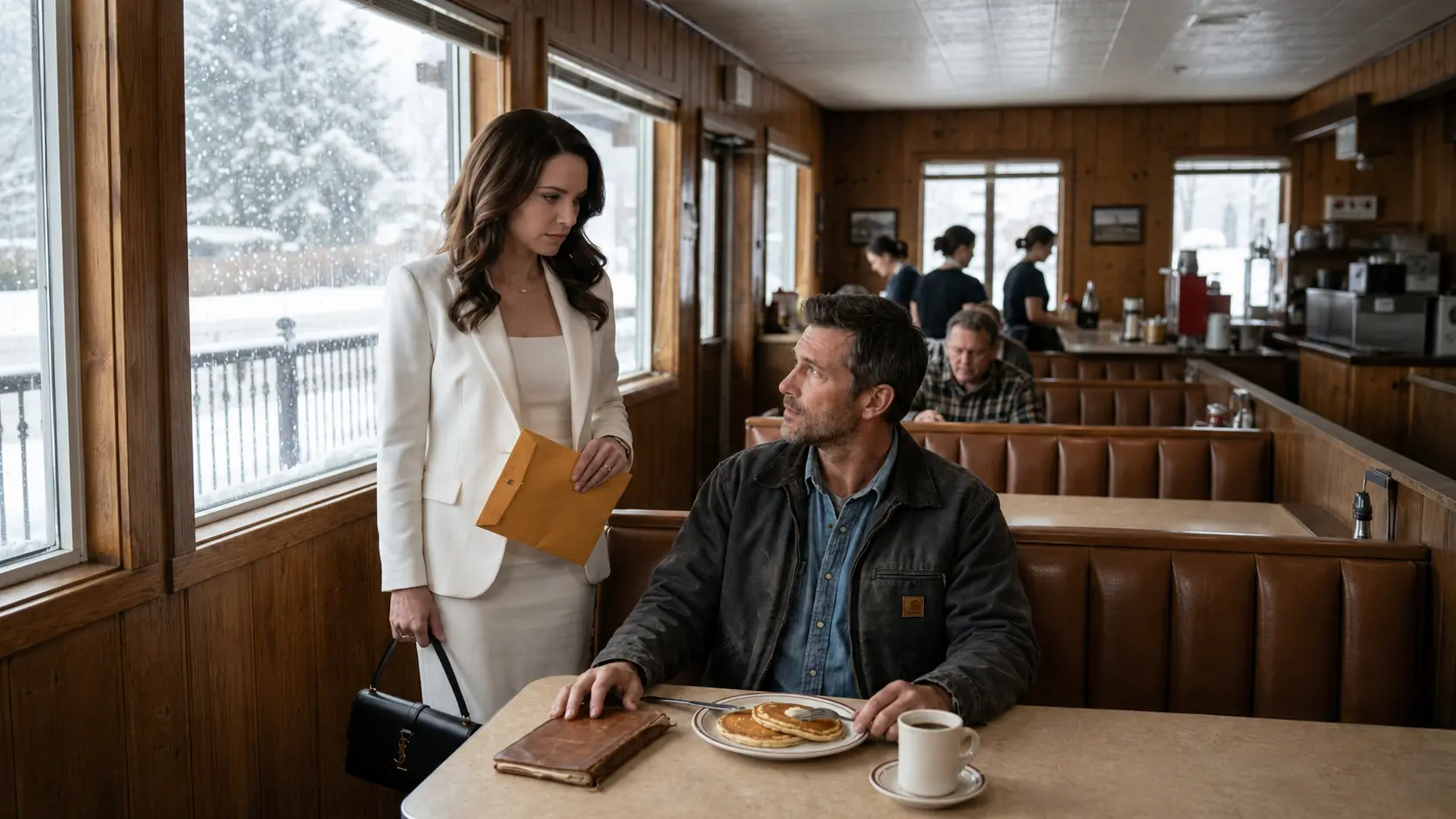
The man did not stand when she approached. Luke Mercer was forty-one, broad-shouldered, and dressed in a worn dark work jacket over a faded blue denim shirt. Gray touched the sides of his short brown hair, and rough beard stubble covered a face that looked older than it should have. He held a fork above a plate of pancakes, but the food had gone cold while he studied a thick handwritten ledger beside his coffee.
Amelia dropped the termination agreement onto the table.
“Sign it and leave,” she said. “I’m done paying for a diner that should’ve closed months ago.”
Luke slowly raised his hazel eyes.
“Then read the ledger first. Your mother kept this place open for a reason.”
“One more lie, and I’ll have you thrown out before breakfast ends.”
Luke pushed the book across the table.
“Do that after you see whose signature has been stealing from you.”
Amelia looked down but did not touch it. The leather cover was faded, the corners softened from years of use, and her mother’s initials had been written in gold near the spine. Eleanor Stone had carried similar books everywhere, even after the family corporation moved entirely to digital accounting. Amelia remembered seeing one beside her hospital bed three days before she died.
“You took this from my mother’s office,” Amelia said.
“She gave it to me.”
“My mother barely knew you.”
Luke placed his fork on the plate.
“She knew me for eleven years.”
The answer stopped Amelia more effectively than an argument would have. Eleanor had never mentioned Luke Mercer, and Amelia had reviewed every employee file connected to the diner. Luke was listed only as a maintenance contractor who repaired kitchen equipment, cleared snow, and handled overnight emergencies. His invoices were modest, irregular, and far below what a skilled contractor could have charged in Aspen.
“You expect me to believe she trusted a mechanic with her private records?”
“I’m not a mechanic.”
“You repaired her freezer.”
“I repair whatever keeps this place open.”
Luke opened the ledger to a page marked with a strip of blue cloth. Neat columns filled both sides, written in Eleanor’s unmistakable handwriting. Alongside food expenses, payroll, and utility payments were repeated transfers from the diner’s account into something called Alpine Community Services.
Amelia recognized the company name.
It was a financial-management subsidiary controlled by Grant Whitmore, her fiancé.
“That account handles vendor payments,” she said.
“No,” Luke replied. “It collects them.”
He showed her twenty-three transfers made over fourteen months. Each payment ranged from $18,000 to $47,000, and every one carried Amelia’s electronic authorization. The total exceeded $690,000. According to the ledger, none of the money had purchased food, equipment, insurance, or services for the diner.
Amelia’s expression remained still, but her heartbeat quickened.
“My signature is on hundreds of company transactions.”
“Were you in Denver on March sixth?”
“Yes.”
“According to the authorization log, you approved forty-one thousand dollars from this office at 3:14 that morning.”
“I could have approved it remotely.”
“You were speaking at a conference.”
Luke turned the page and showed her a printed program from the event. Amelia had delivered the opening keynote at 3:00 p.m. on March sixth, not in the middle of the night. The financial system used mountain time, and the conference took place in New York.
She looked closer.
The transfer had occurred while she was onstage.
“This proves someone used my credentials,” she said.
“It proves more than that.”
Luke removed a small envelope from beneath the ledger. Inside were copies of bank records, internal emails, and payment instructions carrying Grant’s signature. Several transactions had been routed through three consulting companies that shared the same mailing address. That address belonged to a private office suite leased by Grant’s brother.
Amelia closed the envelope.
“Where did you get these?”
“Your mother.”
“My mother was dying.”
“She was investigating.”
Anger rose in Amelia, partly because she believed him and partly because she hated that a stranger knew something her mother had hidden from her. Eleanor had been diagnosed with pancreatic cancer nine months before her death. During that time, Amelia managed the family’s hotel division while Grant gradually took control of the estate’s legal and financial work.
He had seemed indispensable.
He attended every medical appointment, arranged private nurses, and handled difficult calls when Eleanor became too weak to speak. He also comforted Amelia during the nights when she sat outside the hospital room pretending not to cry. Their engagement had come two months after the funeral, though Grant insisted there was no reason to wait simply because grief made happiness feel inappropriate.
“You’re accusing the man I’m marrying of stealing from my mother.”
“I’m showing you what she found.”
“Why didn’t she tell me?”
Luke’s eyes shifted toward the snowy window.
“She tried.”
Amelia sat across from him.
The waitress approached with a coffee pot, but Luke shook his head. Amelia had not eaten since the previous evening, yet the smell of pancakes suddenly made her nauseated. She placed her handbag beside her and opened the ledger again.
Eleanor’s notes became more personal near the final pages.
Grant knows Amelia trusts him.
Do not confront him until copies are secured.
The diner account is only one route.
Luke has the original invoices.
Amelia read the last line twice.
“What original invoices?”
Luke nodded toward the kitchen.
“Not here.”
“Then where?”
“At my house.”
Amelia’s eyes narrowed.
“You carried my mother’s financial records into your home?”
“She asked me to keep them away from everyone connected to the estate.”
“That includes me.”
“At the time, yes.”
Her hand closed around the termination agreement.
“You expect me to trust you after admitting that?”
“No.”
His answer was immediate.
“I expect you to verify everything.”
Luke explained that Eleanor first contacted him eleven years earlier after his wife, Hannah, began working at the diner. Hannah was a bookkeeper raising a newborn daughter while Luke worked construction jobs across Colorado. When the diner’s manager discovered that Hannah had corrected years of inaccurate payroll deductions, he tried to fire her.
Eleanor intervened.
She reviewed the records herself, restored the missing wages, and promoted Hannah to office manager. After Hannah died in a winter highway accident six years later, Eleanor kept Luke and his daughter, Sophie, close. Luke began repairing the diner at night because the flexible schedule allowed him to care for Sophie during the day.
“My mother never told me any of this,” Amelia said.
“She didn’t tell people every good thing she did.”
“She told me almost nothing about the diner.”
“That was intentional.”
The diner had never been merely a roadside business. Eleanor used it as an unofficial support system for employees across the Stone hospitality group. Workers facing eviction received emergency cash from a fund hidden inside the diner’s operating budget. Single parents were allowed to collect prepared meals after closing, and employees escaping abusive homes could stay temporarily in two small apartments above the kitchen.
The program was quiet because Eleanor believed public charity often became advertising.
Grant viewed it differently.
Once he gained access to the estate, he classified the emergency payments as unexplained losses. He then redirected large amounts from the diner into his own companies, making the business appear unsustainable. By the time Amelia inherited control, financial reports showed that the diner was losing nearly $1 million a year.
That was why Amelia had come to close it.
Not because she hated the place, but because Grant had convinced her it threatened hundreds of jobs across the wider company.
“How much did my mother know?” Amelia asked.
“Enough to be afraid.”
“Of Grant?”
“Of what he would do if he realized she had proof.”
Amelia stood and looked toward the windows. Outside, snow covered the highway and softened the outlines of the surrounding mountains. Her reflection hovered in the glass: white suit, expensive bag, perfect hair, and a face trained never to reveal panic.
Grant had chosen the suit that morning.
He often selected what she wore for important meetings, claiming presentation influenced negotiation. He had also reminded her to collect Luke’s signature before returning to Denver. According to Grant, closing the diner was the final step required before the estate could be consolidated into a new investment trust.
Amelia took out her phone.
Grant had sent seven messages in the past hour.
Is it done?
Do not let Mercer manipulate you.
He has a history of instability.
Call me before signing anything.
Amelia turned the screen toward Luke.
“He warned me about you.”
“I assumed he would.”
“He says you threatened him.”
“I told him I had copies of the invoices.”
“When?”
“Three weeks before your mother died.”
“And what did he say?”
“That a widowed handyman accusing a respected attorney would sound desperate.”
Luke’s tone remained calm, but his jaw tightened. Amelia understood that Grant had not merely dismissed him. He had studied Luke’s grief, income, and social position, then decided they made him easy to discredit.
“What happened after you confronted him?”
“My truck was searched. My house alarm failed twice. Someone tried to access Sophie’s school records.”
Amelia sat down again.
“You should have gone to the police.”
“With copies of invoices I couldn’t fully trace?”
“You had my mother’s ledger.”
“Your mother asked me to protect it until you came here alone.”
Amelia looked at him sharply.
“She knew I would come?”
“She believed Grant would eventually pressure you to close the diner personally. She said you wouldn’t sign away the last place she loved without seeing it once.”
For the first time, Amelia’s composure cracked.
Her mother had been right.
Amelia had spent years treating the diner as an inconvenient piece of the family portfolio. She had visited only twice as a teenager and once during college. Eleanor never forced her to return, but she continued sending photographs of remodeled booths, holiday decorations, and employees Amelia barely recognized.
Amelia assumed those messages were nostalgia.
Now she understood that Eleanor had been leaving a trail.
“When can we go to your house?” Amelia asked.
Luke looked toward the clock above the counter.
“After I pick up Sophie.”
“How old is she?”
“Ten.”
“And she knows about this?”
“She knows I’m helping someone finish important work.”
“Does Grant know where you live?”
“Yes.”
“Then we go now.”
Luke glanced at the termination agreement.
“What about the diner?”
“It remains open until I know the truth.”
Amelia called her driver and learned that Grant had dismissed him after dropping her off. A replacement car was supposedly on the way, but no driver had contacted her. Luke offered to take her in his pickup, though he warned that the heater worked only when the truck was moving.
Five minutes later, Amelia climbed into an old blue Ford wearing black heels and carrying a handbag worth more than the vehicle. The contrast might have embarrassed her once. Now she was too focused on the possibility that Grant had deliberately left her stranded.
Luke drove through the snow toward a modest neighborhood outside town. He spoke little, and Amelia used the silence to search corporate records from her phone. She found that Grant had submitted documents that morning requesting expanded authority over Eleanor’s estate.
The request required Amelia’s signature.
She had signed it the previous night without reading the entire attachment.
Grant claimed it was routine authorization to close the diner.
“What happens if I signed over control?” Amelia asked.
Luke kept his eyes on the road.
“I don’t know.”
“I may have given him authority to sell estate property.”
“Including this place?”
“Including every property held through my mother’s trust.”
Luke’s house stood at the end of a narrow street lined with snow-covered pines. It was small but carefully maintained, with a child’s red bicycle leaning beneath the porch roof. Inside, Amelia saw school photographs, construction tools, and framed pictures of a dark-haired woman holding a baby.
Hannah.
Luke led Amelia into the basement. Behind stacked paint cans and an old furnace panel sat a fireproof document case. He unlocked it with a key he wore beneath his shirt.
The case contained five years of invoices.
Amelia spread them across a worktable. She had spent her professional life evaluating hotel contracts and acquisition records, and within minutes she identified the pattern. Grant’s companies billed the diner for maintenance never performed, food never delivered, and consulting services no employee remembered receiving.
The forged transactions extended far beyond the diner.
Mountain resorts, conference centers, and three Stone hotels had made similar payments. The total exceeded $14 million.
Amelia found another folder bearing her name.
Inside were copies of letters supposedly written by her to several banks. They requested private loans secured against her future inheritance. The signatures looked perfect, but Amelia knew she had never seen the documents.
One loan had defaulted two weeks earlier.
Grant had concealed the notice.
“He isn’t just stealing,” Amelia whispered. “He’s creating debts in my name.”
Luke stood beside her.
“Your mother believed he wanted the estate forced into liquidation.”
“Then he could buy the properties through another company.”
“Or someone connected to him could.”
Amelia checked the corporate registration for the investment trust Grant wanted her to approve. The official owners were hidden behind layered holding companies, but one listed address matched the office suite used by his brother.
Her phone rang.
Grant.
She answered without putting the call on speaker.
“Amelia, where are you?”
“At the diner.”
“That shouldn’t take three hours.”
“Luke refused to sign.”
“I warned you.”
“He claims my mother gave him a ledger.”
Silence lasted less than a second, but it was enough.
Grant recovered.
“Your mother was heavily medicated during her final months. Mercer exploited her confusion.”
“He showed me transfers with my authorization.”
“Then he forged them.”
“He also has vendor invoices.”
Grant’s voice changed.
The warmth disappeared, leaving something cold and precise.
“Do not leave with him.”
“I already did.”
“Where are you?”
Amelia looked at Luke.
“At his house.”
Grant exhaled slowly.
“You have no idea what kind of man you’re dealing with.”
“No, Grant. I’m beginning to understand exactly what kind of man I’m dealing with.”
She ended the call.
Luke moved toward the front window.
A black SUV had stopped across the street.
Amelia recognized the vehicle as one used by Grant’s private security firm. Two men remained inside, watching the house through the falling snow.
“They followed us,” Luke said.
“No. They knew where you lived.”
Amelia photographed every document on the table, uploaded the images to three secure accounts, and sent copies to the chief financial officer of Stone Hospitality. She then called the company’s outside auditor and requested an emergency fraud review. Both calls went unanswered.
Grant controlled more people than she realized.
Luke suggested contacting local police, but Amelia hesitated. Grant’s law firm represented the county on several property matters, and one of his closest friends served on the sheriff’s campaign committee. She needed an investigator who could not be pressured locally.
Her mother had anticipated that too.
Inside the document case was a sealed envelope addressed to Amelia. The letter contained a name and phone number: Special Agent Rebecca Hale, Federal Bureau of Investigation, Denver field office.
Amelia called.
Agent Hale answered on the second ring.
“I wondered when you would find the number,” she said.
Eleanor had contacted Hale shortly before entering hospice. She lacked enough complete evidence to begin a federal case, but she provided an outline of the suspected fraud and arranged for Amelia to call once she located the original records. Hale instructed Amelia not to confront Grant and promised agents were already being dispatched.
Amelia looked through the basement window.
The black SUV remained outside.
“We may not have time,” she said.
Luke’s phone rang.
Sophie’s school appeared on the screen.
A receptionist informed him that a man claiming to be Sophie’s uncle had arrived with signed permission to collect her early. Luke had no brother, and he had authorized no one.
His face went pale.
“Keep her inside,” he ordered. “Lock the office and call the police.”
The receptionist hesitated.
“The man has legal identification and a letter from your employer.”
“I don’t have an employer.”
Amelia took the phone.
“This is Amelia Stone. No one removes that child. Tell your principal federal agents are responding to a fraud investigation, and lock every exterior door.”
Her voice carried the authority Grant had spent years using for himself.
The school complied.
Luke grabbed his truck keys, but Amelia blocked the basement stairs.
“The men outside want you to panic.”
“My daughter is at that school.”
“And Grant expects you to drive straight there.”
“I’m going.”
“Then we go together, but not through the front.”
Luke knew a narrow service path behind the house that led to another street. They placed the most important documents inside Eleanor’s fireproof case and slipped through the back door while the SUV remained parked out front. A neighbor lent them an old minivan after Luke explained that Sophie might be in danger.
They reached the school twelve minutes later.
Police vehicles blocked the entrance, and a man in a dark coat was being questioned beside a silver sedan. Luke ran inside and found Sophie safe in the principal’s office. She threw her arms around him while Amelia remained near the doorway, relieved by a child she had never met.
The man outside carried forged authorization papers bearing Luke’s signature. He claimed a security company had hired him to transport Sophie to her father’s workplace. The contact number on his instructions belonged to a temporary phone purchased that morning.
Grant’s name appeared nowhere.
But his fear was visible in every precaution he had taken.
Federal agents arrived before the local officers released the man. Agent Hale met Amelia in a private school office and reviewed the documents. She confirmed that the transactions, forged loans, and attempted removal of Sophie supported an immediate investigation.
“Where is Grant now?” Hale asked.
Amelia checked the location-sharing application they had both installed during their engagement.
His phone showed him at the Stone Hospitality headquarters in Denver.
“He’s at my office.”
“Why?”
Amelia understood before answering.
“The trust transfer.”
Grant intended to complete the consolidation before anyone could suspend his authority. Once the properties moved into the new trust, money and ownership could be transferred beyond the estate’s reach.
Agent Hale contacted federal prosecutors while Amelia called an emergency meeting of the Stone Hospitality board. Three directors tried to delay the session, claiming they needed Grant’s approval. Amelia sent them photographs of the forged loans and warned that anyone obstructing the review would be identified in the federal report.
The meeting began twenty minutes later.
Amelia joined from the school conference room with Luke seated near Sophie across the hall. She displayed Eleanor’s ledger, the original invoices, and the false loan documents. Grant entered the virtual meeting from Amelia’s own executive office.
He looked calm.
“This is an emotional misunderstanding,” he said. “Amelia has been manipulated by an unstable contractor.”
Amelia stared at the man she had planned to marry in six weeks.
“Did you move money from the diner into Alpine Community Services?”
“The company provided legitimate consulting.”
“Name one service.”
“Our teams handled compliance, vendor negotiations, and property strategy.”
“The diner manager never met them.”
“That proves poor communication, not fraud.”
Amelia held up one of the forged letters.
“Did you arrange this loan in my name?”
Grant’s expression tightened.
“You authorized a broader financing strategy.”
“I was in Paris on the date this was signed.”
“You use electronic signatures.”
“The bank recorded an in-person witness.”
Grant looked toward someone beyond his camera.
Amelia knew he was searching for an escape.
“Your mother trusted me,” he said. “She knew the estate required discipline you were not prepared to provide.”
“My mother trusted you long enough to discover what you were doing.”
“She was dying, Amelia.”
The cruelty of the sentence silenced the meeting.
Grant realized his mistake too late.
Amelia opened Eleanor’s ledger to the final page and read her mother’s last entry aloud.
Grant believes grief will make Amelia surrender control. He has mistaken her kindness for weakness. When she sees the truth, he will learn the difference.
Grant’s face lost its color.
Agent Hale entered the room behind Amelia and identified herself. She informed the directors that federal warrants were being executed at Alpine Community Services, Grant’s law office, and several connected properties. The proposed trust transfer was frozen, along with every account named in Eleanor’s records.
Grant stood abruptly.
“This meeting is over.”
“No,” Amelia said. “Your control is.”
Federal agents entered the executive office moments later. The board watched as Grant stepped away from the camera and demanded to speak with an attorney. Before the connection ended, Amelia saw him remove their engagement ring from his pocket and place it on her desk.
He had apparently planned to use it as part of his performance after the transfer was complete.
Instead, it became another object left behind.
The investigation lasted nine months.
Auditors eventually traced more than $21 million through Grant’s consulting companies, private loans, and hidden property investments. Two executives cooperated with prosecutors, admitting they helped exaggerate the diner’s losses so Amelia would approve its closure. Grant had intended to purchase the land through a concealed company and sell it to a luxury developer.
The diner sat on twenty-two acres near a planned mountain transit route.
Its real value had nothing to do with pancakes.
Grant pleaded guilty to wire fraud, identity theft, and conspiracy after investigators recovered emails connecting him directly to the forged transactions. His security contractor admitted that the attempt to collect Sophie was designed to frighten Luke into surrendering the documents. No physical harm had been ordered, but the threat was clear enough.
Amelia did not attend Grant’s sentencing.
She spent that morning at the diner.
The building remained open, though Amelia changed nearly everything about its accounting. Every charitable payment now required documented approval, independent review, and protection from executive interference. The employee-support program became an official nonprofit named the Eleanor Stone Kitchen Fund.
It provided meals, temporary housing, emergency wages, and legal assistance to hospitality workers across Colorado.
Amelia refused to use her mother’s face in the advertising.
“She wouldn’t have wanted to become a logo,” she told the board.
Luke joined the nonprofit as facilities director and financial-control supervisor. He still repaired ovens and cleared snow when necessary, but he also trained managers to recognize false invoices and protect employee funds. He accepted the position only after Amelia promised that Sophie could continue spending afternoons in the diner office.
A year after Amelia arrived with the termination agreement, she returned during another snowstorm. She wore a simple white sweater, dark trousers, and carried the same YSL handbag, though it now held nonprofit reports instead of closure papers.
Luke sat in the corner booth eating pancakes.
Sophie sat across from him finishing homework.
“You’re in my seat,” Amelia said.
Luke looked around the mostly empty diner.
“You have thirty other choices.”
“This one has the best view.”
“Of the parking lot?”
“Of people who tell me the truth.”
Sophie rolled her eyes and moved to another booth.
Amelia sat down.
Luke placed a second plate of pancakes between them. He had ordered before she arrived, apparently certain she would come. She poured maple syrup over the stack and looked toward the snow-covered highway.
“My mother knew you would protect the ledger,” she said.
“She knew I owed her.”
“You didn’t owe her anything.”
“Neither did she when she helped Hannah.”
Amelia considered that.
Perhaps kindness was never a debt. Perhaps it was a responsibility passed from one person to another until someone finally broke the chain or chose to continue it.
She opened her handbag and removed the original termination agreement. Luke had never signed it, and Amelia had kept it throughout the investigation.
“Still planning to throw me out?” he asked.
Amelia tore the document in half.
“No.”
“Good. My pancakes are getting cold.”
She placed the pieces beside the empty plate.
The diner had once looked like a failing business, Luke had looked like an angry contractor, and Grant had looked like the safest person in her life. Amelia had nearly destroyed the one place preserving her mother’s work because she trusted polished reports more than inconvenient evidence.
Now she understood why Eleanor had hidden the truth inside an old handwritten ledger.
Digital signatures could be stolen.
Companies could be invented.
Authority could be performed.
But the truth remained in the details someone had taken the time to preserve.
Amelia looked across the booth at Luke, then toward Sophie working beneath the warm diner lights. Outside, snow continued falling over the mountains, covering the road that had brought her there with an order to close everything.
She had arrived believing the diner was draining her inheritance.
Instead, it had saved what her mother truly intended to leave behind.