Rain tapped against the kitchen window while Emily Carter stood close enough to hear Michael Harris breathing. His rough hand rested beside hers on the counter, marked by years of engines, rusted bolts, and repairs nobody else wanted to attempt. Her fingers still circled his wrist, though neither of them seemed willing to acknowledge that she had stopped him from stepping away.
For the first time since arriving at his house six weeks earlier, Emily did not look frightened of being wanted. She wore a fitted white blouse over a black lace camisole, a short plaid skirt, sheer tights, and ankle boots still damp from the storm. Her long chestnut hair fell over one shoulder, and the faint color in her cheeks deepened when Michael’s eyes remained on hers.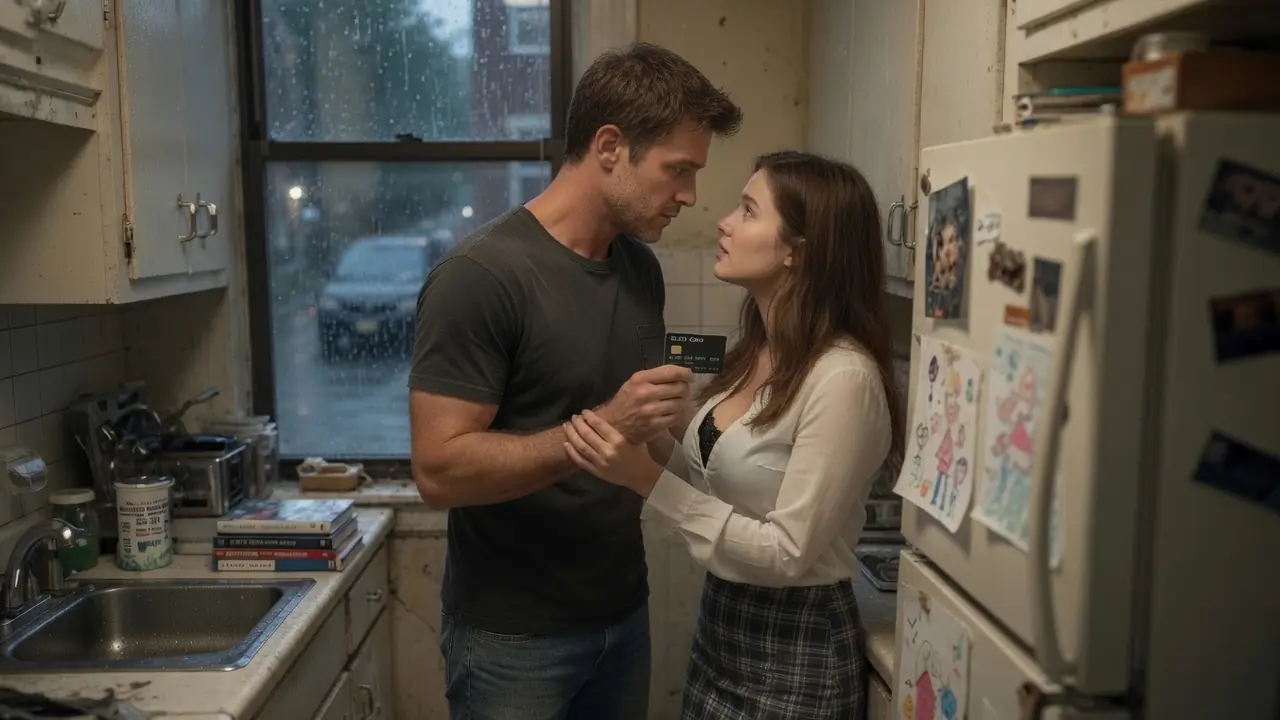
Then headlights swept across the wet window.
Emily released him immediately.
At the end of the narrow Boston street, a black SUV waited with its engine running. Its windows were too dark to reveal the driver, but Emily did not need to see inside. She already knew who had sent it.
Michael followed her gaze. “That’s the third time this week.”
“It’s probably nothing.”
“Nothing doesn’t sit outside my house at midnight.”
She turned away and began gathering her textbooks from the kitchen table. Her hands moved too quickly, knocking a pen onto the floor. Michael bent to pick it up and noticed a small gold crest pressed into the leather cover of one book.
It was not a college emblem.
The crest showed a falcon above the letter C.
Emily took the book from him and held it against her chest. “I have an early class.”
“You always say that when you don’t want to answer.”
“And you always ask questions like you’re trying to fix an engine.”
“Engines are easier.”
A reluctant smile touched her lips. “Why?”
“They don’t lie because they’re afraid you’ll stop caring.”
Her smile disappeared.
Michael immediately regretted the words. He knew fear when he saw it, and Emily carried it everywhere, folded neatly beneath politeness and silence. She apologized before using the stove, asked permission to sit in rooms she paid rent to enter, and never left the house without checking the street twice.
She had arrived on a rainy Thursday carrying one backpack, two textbooks, and six hundred dollars in cash. Michael should have requested identification, references, and a proper lease. Instead, his eight-year-old daughter Lily had pulled Emily inside and asked whether she liked dinosaurs.
Emily answered that triceratops were unfairly underrated.
That was enough for Lily.
For Michael, it had taken longer.
He was thirty-seven, widowed for four years, and raising Lily above the small auto shop he owned on the ground floor. His wife, Sarah, had died after a long illness that consumed their savings before taking her life. Since then, Michael had learned to cook badly, braid hair unevenly, and survive on five hours of sleep without complaining where Lily could hear him.
Renting the spare room had been Lily’s idea.
“You look lonely when you think I’m not watching,” she told him.
Michael posted a handwritten notice at the neighborhood grocery store. He expected a construction worker, a divorced father, or another mechanic. He did not expect Emily.
She was twenty-two and claimed to study social policy at a nearby community college. She spoke softly, kept her bedroom immaculate, and owned almost nothing she displayed openly. Yet Michael noticed contradictions almost immediately.
Her inexpensive-looking clothes were made from fabrics he had only seen in luxury vehicles owned by wealthy clients. Her phone cost more than the engine lift in his shop. Once, while buying groceries, she accidentally pulled out a heavy black credit card before replacing it with cash.
Michael never asked where the money came from.
Emily never offered.
Instead, she became part of their routines. She helped Lily with homework, packed lunches, and learned how to change brake pads in exchange for Michael learning how to cook something other than pasta. Their evenings became louder, warmer, and less careful.
Michael noticed when she began waiting for him to return from the garage. Emily noticed when he started bringing home her favorite tea without being asked. Neither mentioned the way their conversations continued after Lily went to sleep.
That night in the kitchen, they had almost crossed the distance between them.
Then the SUV appeared.
“Emily,” Michael said, “are you in trouble?”
Her eyes lowered. “Not the kind you can fix.”
“Try me.”
“You have Lily to protect.”
“That’s why I need to know who’s watching my house.”
She opened her mouth, but the sound of tires interrupted her. The SUV pulled away slowly, disappearing through the rain.
Michael walked to the front door.
Emily caught his arm. “Don’t go outside.”
The fear in her voice stopped him.
“Who is in that vehicle?”
She shook her head.
“Does he want to hurt you?”
“I don’t know anymore.”
Michael locked the door and checked every window. When he returned to the kitchen, Emily had gathered all her books and placed them inside her backpack.
“You’re leaving,” he said.
“It’s safer.”
“For whom?”
“For you and Lily.”
Michael stepped between her and the hallway. “You don’t get to make that choice alone.”
“I brought this here.”
“You came here asking for a room.”
“I came here because I thought nobody would look for me in a house like this.”
The words escaped before she could stop them.
Michael stared at her. “A house like this?”
Emily’s face tightened. “I didn’t mean it that way.”
“What did you mean?”
“A place that feels real.”
She sat slowly at the kitchen table. For several seconds, only the rain filled the room. Michael remained standing, waiting for the truth she still could not give him.
“My family has people who watch me,” she said finally. “Drivers. Assistants. Security.”
“What kind of family needs security?”
“The kind that thinks privacy is dangerous.”
“Why are you hiding from them?”
“Because when they know where I am, they decide where I go next.”
Michael sat across from her. “Are you escaping abuse?”
Emily hesitated. “Control can look respectable from the outside.”
He understood enough not to press further. Michael had met men who shouted and men who controlled through silence. He had seen wealthy customers threaten wives without raising their voices.
“You can stay tonight,” he said. “Tomorrow, we figure out what’s real and what’s fear.”
Emily looked toward the hallway leading to Lily’s room. “And if the people watching me come back?”
“They’ll meet me first.”
“You can’t stand against them.”
“Maybe not.”
“Then why would you try?”
Michael reached across the table and covered her hand. “Because this is your home until you decide it isn’t.”
She looked at their joined hands as though nobody had ever offered her protection without attaching a price. Then she leaned forward and rested her forehead briefly against his shoulder.
Michael did not move.
He simply stayed there until her breathing steadied.
The next morning, Emily was gone.
Her bed was made, her books had disappeared, and the spare-room key sat on the dresser beside an envelope containing six hundred dollars. Michael opened the note with hands already tightening in anger.
I’m sorry. You gave me something I didn’t know how to keep. Please tell Lily I didn’t leave because of her.
Lily stood in the doorway wearing dinosaur pajamas. “Where’s Emily?”
Michael folded the note before his daughter could read it. “She had to go somewhere.”
“Did she say goodbye?”
“No.”
Lily’s face crumpled. “Then she didn’t want to leave.”
Michael knew his daughter was right.
He went downstairs and opened the garage late. Every time a vehicle slowed outside, he looked up. By noon, he had repaired nothing and dropped the same wrench three times.
At one, a black SUV stopped directly in front of the shop.
Two men in dark suits stepped out.
Michael moved toward the bay entrance before they reached the sidewalk. “You were watching my house.”
The older man produced identification from a private security company. “We’re looking for Emily.”
“She isn’t here.”
“We know she rented a room from you.”
“How?”
The man ignored the question. “Did she leave any property?”
“No.”
“Did she tell you where she was going?”
“No.”
The younger man looked toward the apartment windows. “We need to search the residence.”
“You need a warrant.”
“This is not a police matter.”
“Then get off my property.”
The older man studied him. “Mr. Harris, you don’t understand who you’re protecting.”
“I understand she was scared of you.”
“We were assigned to keep her safe.”
“She didn’t feel safe.”
“That is not your concern.”
Michael stepped closer. “It became my concern when you followed her to my daughter’s home.”
The men exchanged a glance. Neither expected the mechanic to challenge them, but neither could force entry without creating attention.
The older man handed Michael a business card.
The silver lettering read Carter Global Protection Division.
Michael stared at the name.
Carter Global was one of the largest technology and infrastructure corporations in the United States. Its founder, Richard Carter, appeared regularly on business networks discussing artificial intelligence, energy grids, and billion-dollar acquisitions.
Michael turned the card over.
A handwritten number appeared on the back beneath one sentence.
Her father wants to speak with you.
That evening, Michael searched Emily’s name online.
The first result showed a photograph taken at a charity gala three years earlier. Emily stood beside Richard Carter wearing a silver gown and diamonds, her posture perfect, her smile empty.
The headline identified her as Aurelia Emily Carter, the billionaire’s only daughter and designated heir.
She had been missing from public life for four months.
Michael sat in front of the old laptop until the screen blurred. Every memory shifted beneath the new information: the expensive phone, the guarded windows, the metal card, and the cruelty from well-dressed students at her college.
Emily had not been exaggerating.
She had been hiding from an empire.
The business card’s number rang only once before a man answered.
“Mr. Carter’s office.”
“This is Michael Harris.”
Silence followed.
Then another voice came onto the line.
“Mr. Harris,” Richard Carter said. “Where is my daughter?”
“I don’t know.”
“You housed her for six weeks.”
“She paid rent.”
“You expect me to believe you accepted six hundred dollars while hiding the heir to Carter Global?”
“I didn’t know who she was.”
Richard’s voice turned colder. “Everyone has access to the internet.”
“She gave me a different version of her name.”
“A small difference.”
“I wasn’t investigating my tenant.”
“She is not a tenant. She is a vulnerable young woman experiencing a prolonged emotional crisis.”
Michael felt anger rise. “She seemed clear about not wanting to return.”
“My daughter has obligations she does not understand.”
“She understands enough to run.”
The line became quiet.
Richard spoke again with less patience. “Mr. Harris, you are a mechanic raising a child alone. Your mortgage is overdue, your business insurance renews next month, and your daughter attends a school you can barely afford.”
Michael looked toward the apartment ceiling.
“You researched me.”
“I research anyone close to my daughter.”
“That doesn’t give you the right to threaten Lily.”
“It is not a threat. It is an offer.”
“I’m not selling information.”
“Ten million dollars.”
Michael almost laughed, though nothing felt funny.
“You think I know where she is.”
“I think loyalty becomes flexible when weighed against reality.”
“You don’t know anything about loyalty.”
Richard’s breath sharpened. “Be careful.”
“No. You be careful. Emily lived in my house for six weeks, and she spent every day afraid someone would drag her back to you. Ask yourself why.”
Michael ended the call.
Twenty minutes later, Lily found him sitting at the kitchen table with Emily’s empty chair across from him.
“Are we going to find her?” she asked.
Michael looked at the note again.
“Yes.”
He began with the college. Emily had missed every class that day, but a bookstore employee remembered seeing her near the bus terminal. Another student mentioned that Emily sometimes volunteered at a women’s shelter across the river.
Michael drove there through evening traffic.
The shelter director refused to confirm whether Emily was inside until Lily produced a folded drawing. It showed three people holding hands beneath a crooked blue roof.
“I made it for her,” Lily said.
The director’s expression softened.
Emily appeared in the doorway five minutes later.
She wore jeans, an oversized sweater, and no makeup. Relief crossed her face when she saw Lily, followed immediately by fear when she noticed Michael.
“You shouldn’t be here.”
Lily ran into her arms.
Emily dropped to her knees and held the child tightly. “I’m sorry.”
“You left your room key.”
“I thought I had to.”
“You didn’t say goodbye.”
Emily closed her eyes. “I didn’t know how.”
Michael waited until Lily stepped back. “Your father offered me ten million dollars.”
All color left Emily’s face.
“For what?”
“For you.”
“I knew he would do this.”
“I said no.”
She searched his expression. “Why?”
“Because you’re not something he can purchase back.”
Emily stood slowly. “You know who I am now.”
“I know your last name.”
“That changes everything.”
“It explains things.”
“I lied to you.”
“You were afraid.”
“My family could destroy your business.”
“They already tried to buy me.”
“You should have taken the money.”
Michael stepped closer. “Would you have wanted me to?”
Her answer took too long.
“No,” she whispered.
“Then stop telling me to become someone you wouldn’t trust.”
The shelter director offered them a private office. There, Emily finally explained why she ran.
Richard planned to merge Carter Global with a defense-technology company called Nexora Systems. The deal required Emily’s voting shares because her late mother placed thirty percent of the family trust in her name.
Richard wanted her signature.
Emily discovered that Nexora had used Carter Foundation scholarships to recruit vulnerable students into unpaid research programs. Their work was patented, sold, and erased from official records. Several students who complained lost financial aid.
One student attempted to expose the scheme and disappeared from school.
Emily refused to approve the merger.
Her father restricted her accounts, increased security around her, and arranged for doctors to declare her emotionally unstable. She escaped before a board hearing that would have transferred temporary control of her trust.
“The SUV isn’t protecting me,” she said. “It’s making sure I don’t speak to the board.”
Michael looked at the worn backpack beside her chair. “Do you have proof?”
Emily removed a flash drive from the lining.
“Enough to stop the merger. Not enough to survive what happens after.”
“You don’t have to survive it alone.”
She looked at him with tears gathering in her eyes. “Michael, you have Lily.”
“And she loves you.”
“That’s why I can’t let them hurt her.”
Lily, sitting outside the office, opened the door.
“You keep saying you’re protecting me,” she said. “But nobody asked what I want.”
Emily wiped her face.
Lily walked over and placed the drawing in her hands. “I want you to come home.”
That night, they returned together.
Michael installed new locks and cameras. Emily slept in the spare room, though neither of them pretended the relationship between them was merely landlord and tenant.
Three days later, Richard Carter arrived with two attorneys and six security officers.
His convoy filled the narrow street.
Neighbors opened curtains while Michael stood in the driveway wearing oil-stained jeans and an old flannel shirt. Emily emerged behind him, dressed in a simple black skirt, fitted cream blouse, and the quiet confidence of someone who had finally chosen which life belonged to her.
Richard stepped forward. He was fifty-seven, silver-haired, and controlled in the way only powerful men could afford to be.
“Emily,” he said. “Come home.”
“I am home.”
His eyes moved to Michael. “This man has manipulated you.”
“He didn’t know who I was.”
“He knows now.”
“And he still refused your money.”
Richard’s jaw tightened. “You told him?”
“You did.”
One attorney raised a folder. “We have an emergency order authorizing medical evaluation and temporary family supervision.”
Emily removed her phone. “And I have a live connection to three Carter Global board members, two federal investigators, and a reporter.”
The attorney lowered the folder.
Emily continued. “The Nexora files have already been distributed. If anyone removes me from this property, the full archive becomes public.”
Richard looked at his daughter differently.
Not as a frightened runaway.
As an opponent.
“You would destroy your mother’s company,” he said.
“No. I’m stopping you from selling what she built to people who exploit students.”
“You do not understand business.”
“I understand theft.”
Richard took another step. Michael moved between them.
The security guards tensed.
Richard looked at Michael with disgust. “What exactly do you think you are to her?”
Michael did not answer.
Emily did.
“He is the first man who gave me a place to stay without deciding what I owed him for it.”
The sentence struck harder than anger.
Richard’s expression shifted for the first time. Beneath the authority, Michael saw something like shame.
“You are my daughter,” Richard said.
“Then speak to me like one.”
The board suspended the Nexora merger the next morning. An independent investigation confirmed that scholarship students had been exploited and their work stolen. Several executives were dismissed, and federal authorities opened cases against the program’s directors.
Richard was not charged, but the board removed him from direct control of the Carter Foundation while investigators examined what he had ignored.
Emily retained her shares.
She also retained the spare room.
Months passed before Richard visited without lawyers or security. He arrived alone, carrying a small box of photographs that belonged to Emily’s mother. Lily made him sit at the kitchen table and drink hot chocolate from a mug shaped like a dinosaur.
He looked profoundly uncomfortable.
That pleased her.
Michael never asked Emily to choose between her family name and the life she found with him. He understood that love built on rescue could become another cage if he was not careful.
So he waited.
Emily completed her degree, testified before the board, and established an independent legal fund for students whose work had been stolen. She paid her own rent from a job at the bookstore, even after regaining access to her fortune.
One spring evening, she found Michael repainting the spare bedroom.
“Why are you changing the color?” she asked.
“Lily said the gray looked sad.”
“And what happens when the tenant moves out?”
He paused with the roller against the wall. “That depends.”
“On what?”
“Whether she’s still a tenant.”
Emily stepped into the room.
She wore a fitted blue blouse, a short black skirt, and the silver locket that once remained hidden beneath every collar. Michael had learned the photograph inside showed Emily with her mother before wealth turned their home into a boardroom.
“You told me once you didn’t want this room to be temporary,” she said.
“I remember.”
“I stayed until morning.”
“You stayed longer.”
“Was that enough time to show me?”
Michael set down the paint roller.
“Show you what?”
“Why you wanted me here.”
He moved toward her slowly, giving her every opportunity to step away.
She did not.
“This house felt empty before you arrived,” he said. “Lily laughed, but I was surviving one day at a time. Then you came in carrying one backpack and more secrets than clothes.”
Emily smiled softly.
“You made breakfast burn less often,” he continued. “You turned homework into something Lily stopped fighting. You waited for me at night even when you pretended you were studying.”
“I was studying.”
“You read the same page for forty minutes.”
“You noticed?”
“I noticed everything.”
Her smile faded into something more vulnerable. “What happens if I’m not quiet, easy, or grateful anymore?”
“Then you’re real.”
“What if my life stays complicated?”
“So does mine.”
“What if my father never approves?”
Michael reached for her hand. “I’m too old to build my life around another man’s approval.”
Emily laughed through sudden tears.
“And Lily?” she asked.
A small voice came from the hallway.
“I already approve.”
They turned.
Lily stood holding the paint tray, clearly having listened to everything.
“Were you spying?” Michael asked.
“No. I was supervising.”
Emily opened her arms, and Lily ran into them.
That evening, the three of them ate dinner in the kitchen where Michael and Emily had almost confessed their feelings months earlier. Rain began tapping against the window, gentle and familiar.
No SUV waited at the end of the street.
No security officer watched the house.
After Lily went to bed, Emily returned to the kitchen and found Michael washing dishes. She stood beside him without speaking until he turned.
“Are you staying?” he asked.
Emily took the spare-room key from her pocket and placed it on the counter.
Michael looked at it.
Then she lifted the house key he had given her that morning.
“I’m done renting a room,” she said. “I’d rather build a home.”
He touched her face carefully, as though the moment might disappear if held too tightly.
Emily closed the distance and kissed him.
For most of her life, love had been presented as an agreement between families, companies, or names. Michael showed her something smaller and therefore more valuable: lunch packed before class, a porch light left on, a child waiting with a dinosaur book, and a man who refused ten million dollars because she was never his to sell.
She had been born inside one of the richest families in America.
Yet the first place she ever felt wealthy was a modest house above a repair shop, where the paint was uneven, the bills arrived too quickly, and nobody asked her to become anything before letting her belong.