Under the freezing snow, a young single father trudged back toward his small rented apartment, exhausted, hungry, and carrying the weight of raising a little daughter all on his own.
At his lowest moment, he found the wallet of a wealthy elderly woman with more than $4,500 inside.
Enough to feed him and his little girl for weeks, maybe even help him finally get ahead.
But even when faced with such temptation, he chose honesty and ran after the woman to return it.
What he didn’t know was that this simple act would change his life—and his daughter’s future—forever.
The snow came down hard over Detroit, turning the streets into a white blur.
Daniel Carter, a 27-year-old single father, pulled his thin jacket tighter as he balanced a worn backpack on one shoulder and a small plastic bag of groceries in the other hand.
Inside that bag was dinner for him and his 5-year-old daughter, Emma—just bread, milk, and a small packet of noodles split into two meals.
He hadn’t eaten properly in two days so she could have more.
That was his life now.
Surviving not for himself, but for her.
Emma’s laugh, her tiny hands, her sleepy voice calling “Daddy” in the morning—that was all that kept him going.
He looked at the glowing windows of restaurants along the street, people inside laughing, warm, safe, untouched by the storm.
It felt like another world.
A world he used to belong to before everything fell apart.
Now it was just him and Emma.
No partner.
No family support.
No safety net.
Just responsibility.
Just love.
And fear.
Because in a few months, the rent would rise again.
And he didn’t know how he would manage.
“Just get home,” he whispered, tightening his grip on the grocery bag.
That was when he saw her.
An elderly white woman, maybe in her mid-70s, standing near the curb in an expensive coat, holding a leather handbag that looked like it belonged in a glass case.
She was talking on her phone, distracted, frustrated, completely unaware of the icy sidewalk beneath her feet.
Then she stepped forward.
Her heel slipped.
Her bag swung open.
A wallet fell out, hit the ground, and slid directly toward a storm drain.
Daniel reacted instantly.
He dropped the groceries into the snow and sprinted forward.
His shoes slipped.
His body almost fell.
But he reached it just in time.
His fingers closed around the wallet right before it disappeared into the drain.
He stayed kneeling for a moment, snow soaking through his jeans, breathing hard.
Inside the wallet, he found cash.
A lot of it.
$4,500.
His mind immediately went to Emma.
Warm food.
A proper winter coat for her.
Medicine.
Rent.
Stability.
A life where he didn’t have to panic every night.
He could change everything.
Just a few bills gone.
She’d never notice.
She had too much anyway.
But then he looked at Emma’s face in his mind.
Waiting at home.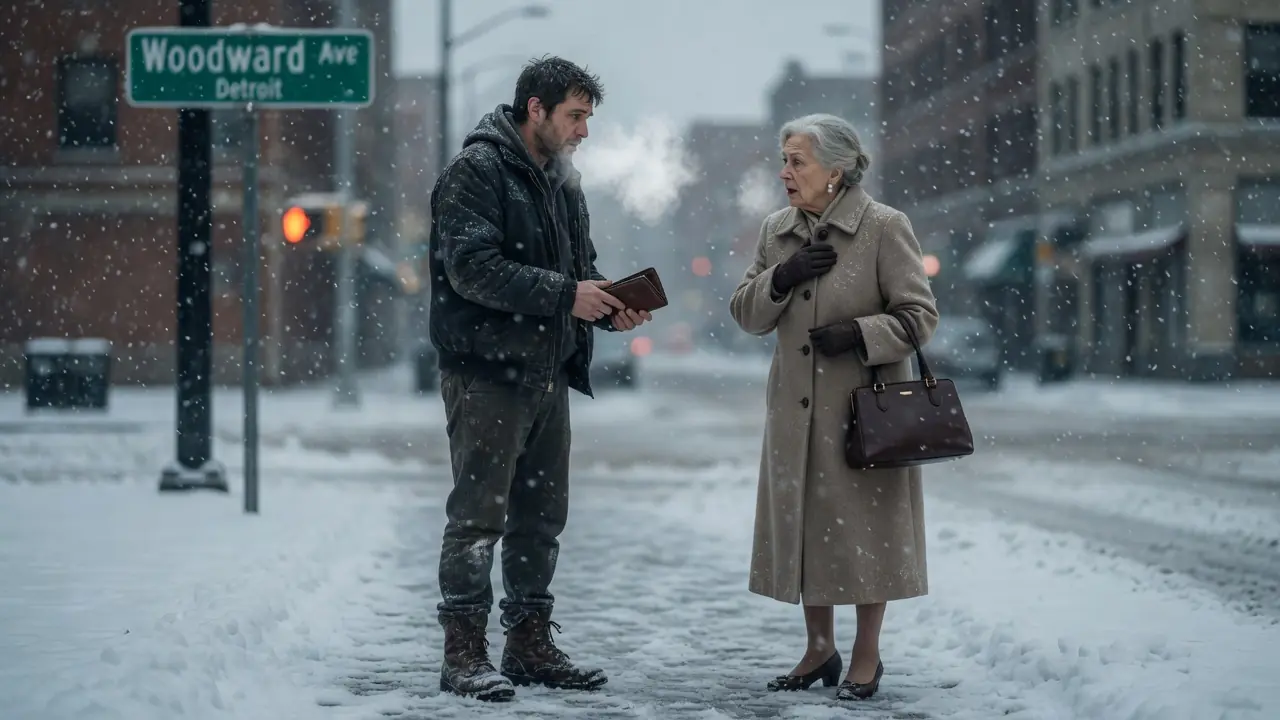
Trusting him.
Calling him “Daddy” like he was her whole world.
And something inside him broke through the desperation.
He closed the wallet.
“I can’t,” he whispered.
He stood up and ran after the woman.
“Ma’am! You dropped something!”
She turned, startled, immediately clutching her phone tighter as she saw a young man running toward her in the snow.
Fear crossed her face instantly.
Daniel noticed.
He slowed down, holding the wallet with both hands.
“I think this is yours,” he said, breathless. “It fell near the drain.”
She hesitated, then took it quickly, opening it, checking every bill like she didn’t believe him.
“You didn’t take anything?” she asked sharply.
Daniel shook his head.
“No, ma’am.”
A pause.
Then silence.
Something in her expression shifted—confusion, then discomfort, then quiet shame.
Because she realized what she had assumed about him.
And realized she had been wrong.
She looked at his soaked clothes, his trembling hands, the exhaustion on his face.
“You ran after me… in this weather?”
“Yes, ma’am.”
She lowered her voice slightly.
“Why?”
Daniel looked down for a moment.
Then said simply:
“Because it wasn’t mine.”
That sentence hung in the cold air longer than the snow itself.
She didn’t know what to say.
For the first time, she really looked at him.
Not as a stranger.
Not as a threat.
But as a father trying to survive.
Finally, she spoke again.
“You must be freezing.”
Daniel shook his head lightly.
“I’m okay. I just need to get home to my daughter.”
That changed everything.
Her expression softened immediately.
“You have a child?”
“Yes. A little girl. Emma. She’s waiting for me.”
Something in her face shifted completely.
“Then come with me,” she said. “Please. At least let me get you both something warm to eat.”
Daniel hesitated.
Pride told him no.
Cold told him yes.
But hunger for Emma made the decision.
“…Okay. Just for a moment.”
They went to a small café nearby.
Warm light spilled onto the snowy street.
Inside, everything felt like another world—safe, warm, unreachable.
The woman ordered food without asking too many questions this time.
Hot soup.
Fresh bread.
A full meal for him.
And a box of pastries for his daughter.
When Daniel tried to refuse, she simply said:
“A child should never go hungry in winter.”
That sentence hit him harder than the cold ever could.
As they ate, she studied him quietly.
“What’s your name?”
“Daniel Carter.”
“And your daughter?”
“Emma. She’s five.”
“And her mother?”
Daniel hesitated.
“She’s not in the picture.”
The woman nodded slowly, not pressing further.
But something in her eyes changed again—this time softer, heavier.
As if she understood loss in ways she hadn’t expected.
When they finished, she handed him a card.
“If you ever need help—anything—call me.”
Daniel looked at it.
Catherine Whitmore.
He didn’t recognize the name.
But he nodded politely anyway.
“Thank you… for the food.”
She smiled faintly.
“Thank you… for reminding me not everyone would have done what you did.”
Then she paused.
“And Daniel?”
“Yes?”
“You’re a good father.”
That was the first time anyone had said that to him in a long time.
Outside, snow was still falling.
But something inside him felt warmer than the café ever could be.