The Gulfstream descended toward Denver Centennial Airport with one landing-gear warning flashing red and the hydraulic alarm screaming through the control tower frequency. Inside the cockpit, two experienced pilots fought a jet worth more than sixty million dollars while the port elevator remained frozen in a degraded position. They had less than three minutes before the aircraft lost enough control authority to strike the runway nose-first. On the tarmac below, a widowed single father in oil-stained coveralls quietly set down his clipboard and walked toward an abandoned maintenance shack no one else remembered existed.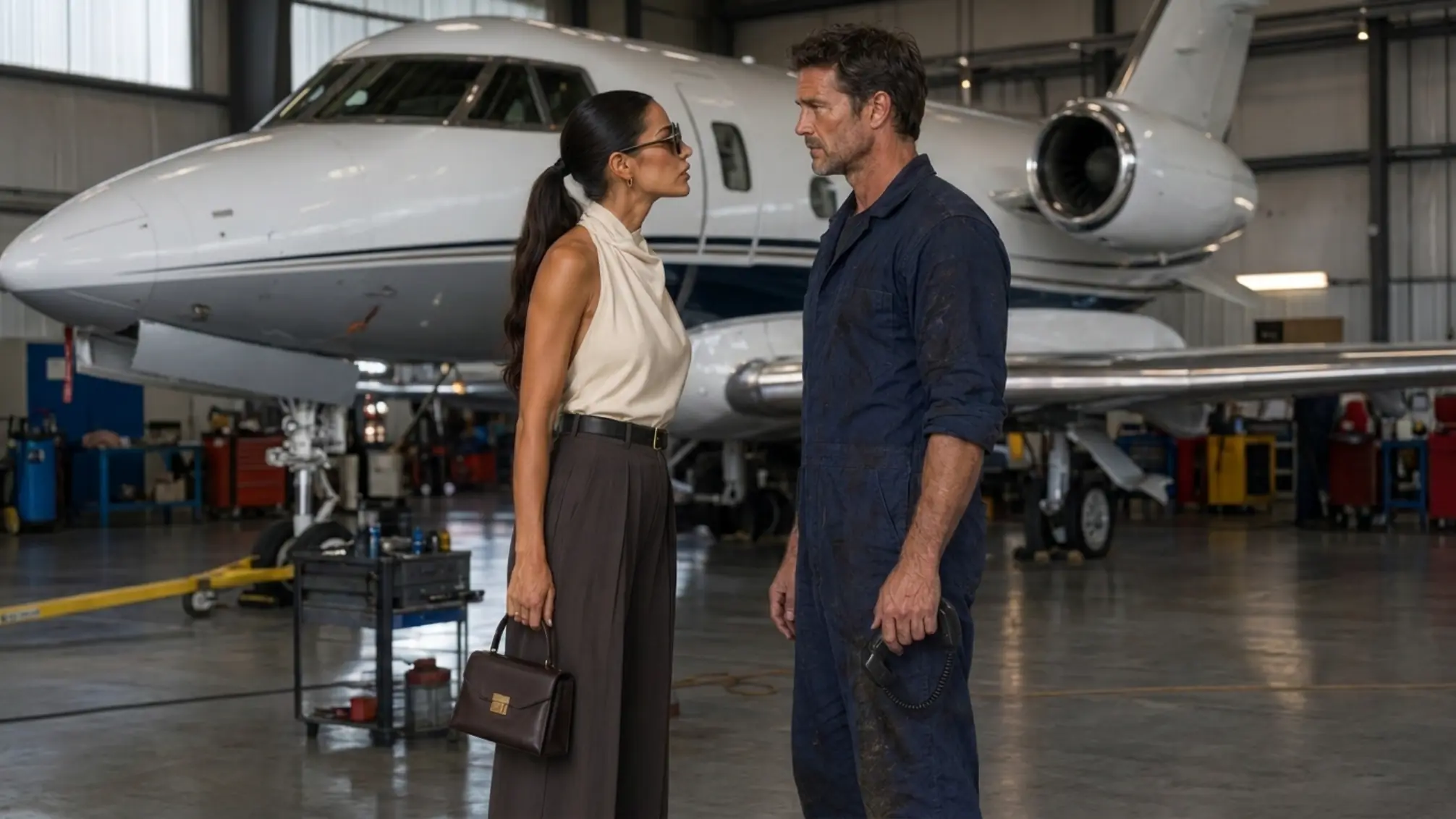
Declan Ror was thirty-eight years old, tall and athletic, with weathered lightly tanned skin, steady gray-blue eyes, short dark-brown hair, and rugged stubble. To everyone at the airport, he was a low-paid refueling technician who arrived before sunrise, completed every task without complaint, and left precisely at five to collect his eight-year-old son. No one knew that Declan could read a failing aircraft by the change in its engine pitch before the diagnostic consoles even sounded an alarm. No one knew that he had once designed the emergency protocol now buried inside the dying jet’s software.
Twenty meters above the runway, billionaire CEO Adrienne Vance watched the demonstration collapse from a private observation deck. She was thirty-four, breathtakingly beautiful, with lightly tanned skin, piercing hazel-green eyes, sculpted features, and long glossy dark-brown hair swept into a sleek low ponytail. She wore an elegant ivory halter-neck blouse tucked into charcoal wide-leg trousers, pointed black heels, narrow sunglasses, and a slim leather belt with a polished gold buckle. Minutes earlier, the Pentagon representatives beside her had been preparing to approve a four-hundred-million-dollar aviation contract.
Now every person on the deck watched a white Gulfstream falling toward the runway.
“Authorize emergency override,” Adrienne ordered.
Her chief operating officer, Marshall Crane, remained beside the diagnostic console. At forty-five, he was polished, silver-haired, and so deeply woven into the Vance family that Adrienne had trusted him since childhood. He had worked beside her late father for seventeen years, comforted her at the funeral, and helped her inherit a company filled with older men waiting for her to fail.
“It may only be a sensor fault,” Marshall said. “Activating the override during a Pentagon demonstration could destroy the contract.”
“The pilots have lost their port elevator.”
“We need confirmation.”
Adrienne turned toward him, disbelief hardening her face. “The aircraft is dropping. What confirmation do you need?”
Marshall did not answer.
Below them, Declan entered the neglected maintenance shack and flipped a breaker on a dust-covered communications panel. The equipment was nearly twenty years old, and the green emergency handset had not been used since the airport’s military test program ended. Declan knew the frequency remained active because he had personally requested that engineers preserve it years earlier. He lifted the receiver as the Gulfstream banked dangerously over the northern runway.
His voice entered the cockpit through a channel absent from the observation deck’s official system.
“Gulfstream, disengage autothrottle. Reset breaker C4 beneath the copilot’s left knee—now.”
The two pilots exchanged a startled glance. They did not recognize the voice, but its calm authority left no room for debate. The copilot reached beneath the panel and found the hidden breaker by touch. When he reset it, the first warning tone stopped.
Declan continued before anyone could interrupt him.
“Bypass mode Alpha Two. Lift the red cover left of the standby compass.”
The pilot flipped the protected switch.
“Pressure returns in twelve seconds. Keep your hands light and let her settle.”
For twelve unbearable seconds, the aircraft continued sinking.
Then the hydraulic pressure climbed.
The Gulfstream’s nose leveled, and the frozen elevator moved several degrees. Amber warnings disappeared from the observation-deck screens one after another. Adrienne stared at the numbers, realizing that the stranger on the auxiliary frequency had activated a protocol known only to a handful of people.
Declan delivered his final instruction.
“Flaps fifteen, airspeed one-forty. Bring her home.”
The pilots followed him.
Twenty seconds later, the Gulfstream struck the runway hard but level, bounced once, and settled onto its landing gear. It rolled toward the emergency vehicles waiting at the far end and finally stopped with both engines running. The tower confirmed that the crew was alive.
No one on the observation deck celebrated.
The Pentagon observers stared at the aircraft. The public-relations photographer had lowered his camera. Adrienne removed her sunglasses and looked directly at Marshall.
“Who used that channel?”
Marshall’s mouth tightened. “An unauthorized technician. We’ll identify and dismiss him immediately.”
Adrienne studied the man she had trusted most of her life. “You want to fire the person who saved the pilots?”
“He violated flight protocol and interfered with a classified demonstration.”
“He knew a bypass my father created.”
“That makes him a security risk.”
Adrienne turned away before Marshall could say more. She descended the metal stairs and crossed the tarmac, her heels striking the pavement with sharp, determined steps. Wind from the runway pulled several dark strands loose from her ponytail.
Declan had already returned the handset to the shack and was walking toward his fuel cart when she reached him. He still wore stained navy coveralls and heavy steel-toe boots. His face held no pride, panic, or expectation of praise.
Marshall arrived behind Adrienne with two security officers.
“Remove him,” Marshall ordered. “He accessed a restricted frequency.”
Adrienne lifted one hand without looking back. “Stand where you are.”
Everyone stopped.
She faced Declan from six feet away as the rescued jet cooled behind him. “You were hired to fuel my aircraft, not hijack its emergency channel.”
Declan’s gray-blue eyes remained steady. “Then your pilots would be dead.”
The security officers exchanged an uncomfortable glance.
Adrienne stepped closer. “Alpha Two died with my father. Three people in this company know it exists. Tell me how you knew it.”
Declan raised the abandoned handset still hanging from its cord beside him. “I helped your father build it.”
Marshall gave a short, contemptuous laugh. “He is a ground technician.”
Declan finally looked at him. “Check line 742 before you decide what I am.”
The color left Marshall’s face for less than a second, but Adrienne saw it.
She ordered Declan into a private briefing room at the back of the executive hangar. The room contained a long table, a whiteboard covered with old maintenance equations, and several photographs from Vance Aerodynamics’ earliest military partnerships. Declan remained standing near the door while Adrienne placed her handbag on the table.
“I interviewed you six months ago,” she said.
“I remember.”
“You applied for a systems-engineering position. Your résumé showed a seven-year gap, and you refused to explain it.”
“The work was classified.”
“I asked whether you could verify it.”
“You said verification was required before I could enter your company.”
“And now you’re fueling aircraft on my runway.”
Declan looked toward the equations on the whiteboard. “Nobody guards secrets from the man carrying the fuel hose.”
Adrienne folded her arms. “Give me your full history.”
He hesitated, not from fear but from long practice protecting information. “Navy test-pilot engineer. Joint DARPA aviation program. Systems architect for fault-tolerant flight controls. I worked with your father for three years.”
“My father never mentioned you.”
“He wasn’t allowed to.”
“You helped develop Alpha Two?”
“In October 2015. We debugged the final sequence in his garage because the secure laboratory lost power during a storm.”
Adrienne’s controlled expression weakened. “My father hated working at home.”
“He made spaghetti that night.”
Her eyes narrowed. “He couldn’t cook.”
“No,” Declan said. “He couldn’t.”
The smallest trace of memory passed between them, too precise to have been invented.
Before Adrienne could respond, a young avionics engineer named Yousef Park entered carrying a black flash drive. His face was pale, and his hand trembled slightly.
“I checked the hydraulic module,” Yousef said. “Line 742 was changed three weeks ago.”
Adrienne held out her palm.
Yousef placed the drive in it. “The original code transferred pressure authority to the backup actuator after one second. The new version waits three seconds, removes the manual flag, and locks the control surface before failover.”
“Who authorized the change?”
“There’s no author signature.”
“Then find the terminal.”
“I did. Internal terminal seven, Vance Tower. The commit happened at 2:14 in the morning.”
Adrienne glanced toward Declan. “Why would anyone create a three-second delay?”
Declan’s jaw tightened. “Because it doesn’t look like sabotage. It looks like a tuning error until the pressure drops under flight load.”
Yousef swallowed. “There’s more. Only one badge entered the building that night.”
Adrienne looked at the drive in her hand. “Whose?”
Yousef’s eyes moved toward the closed door behind which Marshall waited.
Declan answered for him.
“Marshall Crane.”
The name struck Adrienne harder than the aircraft emergency. Marshall had been present at family holidays, company milestones, and her father’s final days. When board members questioned whether a young woman could run Vance Aerodynamics, Marshall defended her publicly. He had become the voice she trusted whenever fear threatened to overpower judgment.
“No,” she said instinctively.
Declan did not argue.
His silence forced her to hear her own denial.
“Why were you expecting the code to return?” she asked.
Declan’s expression changed for the first time. The cold control in his face fractured around an older pain.
“My wife was a test pilot.”
Adrienne slowly lowered the flash drive.
“Her name was Naomi. In 2018, she flew an aircraft using an early Vance Seven module. She returned from one test and reported that the hydraulic failover logic had been altered. She filed the warning on Monday.”
He stopped.
Adrienne already understood what came next.
“She died on Thursday,” Declan said. “Same control failure. Same locked elevator. The official investigation blamed pilot error.”
“I remember that accident.”
“You remember the report your company released.”
Adrienne’s throat tightened. “You believe Marshall killed her?”
“I believe someone accessed her report, changed the system, and ensured the evidence disappeared. I spent four years trying to reopen the investigation. The aircraft was destroyed, the records sealed, and my access revoked.”
“Then why come here?”
“To wait.”
“For seven years?”
“For as long as it took.”
Adrienne stared at him. “You accepted humiliation, low wages, and being treated like you knew nothing just to watch our systems?”
“My son lost his mother. I wasn’t going to chase revenge across the country and make him lose his father too. Ground work gave me ordinary hours, a predictable paycheck, and access to the one place the code might appear again.”
A knock sounded at the door.
Marshall entered without permission.
“This has gone far enough,” he said. “The Pentagon representatives are waiting, and you are allowing an unstable employee with a personal grievance to control the narrative.”
Declan remained still.
Adrienne held up the flash drive. “Where were you three weeks ago at 2:14 in the morning?”
Marshall’s gaze flickered toward Yousef.
“At home.”
“Your badge entered Vance Tower.”
“Badges can be duplicated.”
“The commit came from internal terminal seven.”
“So someone is framing me.”
Adrienne took one step toward him. “Why did you refuse the override while my pilots were falling?”
“I was protecting the demonstration.”
“You were protecting the failure.”
Marshall’s face hardened. “Be careful, Adrienne. You are emotional, frightened, and relying on a man who lied about his identity.”
Declan’s eyes turned cold.
Adrienne did not raise her voice. “Leave the hangar. Security will escort you to your office, where you will surrender every company device.”
“You cannot suspend me based on this.”
“I can suspend anyone who allows two pilots to die rather than expose a software change.”
Marshall looked at the officers. “I am the chief operating officer.”
One officer stepped forward. “Not at the moment, sir.”
The emergency board meeting began the next morning on the forty-second floor of Vance Tower. Lockheed Martin sent a vice president and attorney. The Pentagon sent two observers, including Colonel Raymond Hale from defense acquisitions. Eleven Vance board members filled the remaining seats.
Marshall sat at Adrienne’s right as if nothing had changed.
He presented a carefully constructed explanation blaming a Phoenix sensor supplier for the hydraulic event. According to him, a defective pressure sensor triggered incorrect readings while the core Vance software functioned properly. He recommended replacing the part, issuing a controlled statement, and rescheduling the demonstration within seven days.
When he finished, several board members nodded with visible relief.
Adrienne placed both hands flat on the table.
“Before accepting that explanation, I want you to hear from the person who landed the aircraft.”
The doors opened.
Declan entered wearing the same navy coveralls he wore on the tarmac. Marshall rose halfway from his chair.
“This is outrageous. He has no clearance to enter this meeting.”
“Sit down,” Adrienne said.
Declan connected a laptop to the conference-room screen. Two versions of line 742 appeared side by side: the original code and the altered function.
“This is not a sensor failure,” he said. “The modified code prevents hydraulic authority from transferring to the backup actuator. It was designed to create a control loss that would resemble an unpredictable mechanical event.”
Colonel Hale leaned forward.
Declan displayed the access log. “The change occurred at 2:14 a.m. from terminal seven. One badge entered the building at 1:52 and departed at 2:33.”
Marshall laughed, but the sound was thin. “A technician with stolen data and a dead wife has constructed a conspiracy.”
Declan looked directly at him. “The same function killed Naomi Ror in 2018.”
Several people turned toward Marshall.
He lifted both hands. “This man has spent years searching for someone to blame.”
Declan’s voice remained level. “That wasn’t a fault, Marshall. It was a signature.”
The room fell silent.
Adrienne looked at the man who had once promised her everything would be fine.
“You have served this family for seventeen years,” she said. “I will give you one opportunity to answer clearly. Where were you between 1:52 and 2:33 that morning?”
Marshall opened his mouth.
No words came.
Colonel Hale placed his pen on the table and reached for his phone.
By afternoon, federal investigators had entered Vance Tower with a search warrant. They copied security records, workstation logs, encrypted communications, and classified archives. Terminal seven was only the beginning.
Investigators discovered foreign payments routed through intermediary accounts and communications with a private defense broker. They also recovered Naomi’s original safety report from 2018. Marshall had accessed it seventy-two hours before her fatal flight and deleted the internal recommendation to suspend testing.
The report had warned specifically about line 742.
Adrienne sat alone in her office that night, reading the recovered document beneath a single desk lamp. Her father’s photograph stood beside the file. In it, he posed in a California hangar with a younger Declan and a sandy-haired woman holding a flight helmet.
Naomi.
Declan entered quietly after Adrienne called him.
She pointed toward the photograph. “She worked with my father?”
“She trusted him.”
“And my father trusted Marshall.”
“We all did.”
Adrienne pressed one hand against her mouth. “My company blamed her.”
“Marshall wrote the report.”
“My signature approved its release.”
“You were not CEO then.”
“I was on the board.”
“You were given falsified evidence.”
“I still helped bury her name.”
Declan looked at Naomi’s photograph. “Then help restore it.”
The following morning, federal agents arrested Marshall Crane. He was escorted toward the elevators without handcuffs because the company attorneys negotiated a voluntary surrender. Declan stood near the corridor speaking with Yousef when Marshall saw him.
He stopped.
“Who are you?” Marshall asked.
Declan’s face showed no triumph.
“I’m her husband.”
Marshall stared at him, finally understanding that the quiet refueling technician had not appeared by accident. Then the elevator doors closed between them.
The Pentagon contract was temporarily suspended but later restored under strict independent oversight. Vance Aerodynamics publicly corrected Naomi’s accident report, cleared her of pilot error, and created a flight-safety foundation in her name. Adrienne required independent audits of every flight-critical software change and promoted Yousef to lead integrity engineer.
She offered Declan the role of chief systems architect, a private office, and a salary large enough to secure his son’s future permanently.
Declan declined.
“I already lost years to this,” he said. “Sawyer doesn’t deserve to lose more.”
Adrienne refused to let him disappear again. “Two days a week. Your hours. No office unless you ask for one.”
He considered the offer.
“Full authority over safety decisions?”
“Yes.”
“No executive can suppress a report?”
“Not even me.”
Declan extended his hand. “Then I accept.”
Several weeks later, Adrienne drove alone to Declan’s small home in Highlands Ranch. She wore no sunglasses and carried a box of professional art supplies for Sawyer. The eight-year-old opened the door, studied her for several seconds, and ran toward his bedroom.
He returned with a sketchbook.
The drawing showed Declan standing beside an aircraft. Behind him was a woman whose face had been left unfinished.
“You look like her,” Sawyer said.
Adrienne knelt. “Who is she?”
“I didn’t know when I drew it.”
Declan appeared in the kitchen doorway, holding a dish towel. His eyes met Adrienne’s, and neither spoke.
Sawyer answered for them.
“She’s the person who means Dad isn’t standing alone anymore.”
Adrienne looked down at the unfinished woman in the drawing. She had once closed Declan’s employment folder because his life contained truths he was forbidden to explain. Now the same man had saved her pilots, protected her company, exposed her father’s betrayer, and restored the name of the wife he still loved.
She did not try to replace Naomi.
She simply stayed for dinner.
That evening, the three of them stood beside the public viewing fence at Denver Centennial Airport. A Gulfstream taxied toward the runway beneath a fading orange sky. Sawyer held his father’s hand, while Adrienne stood half a step behind them—close enough to belong, careful enough not to claim more than they were ready to give.
The jet accelerated and lifted above the mountains.
Declan watched until its landing gear disappeared.
For seven years, everyone had seen only oil-stained coveralls, a fuel hose, and a silent man who left work early for his son. Adrienne had once made the same mistake.
Now she understood that the most important man on her runway had never needed her company to give him value.
He had only needed someone courageous enough to open the folder again—and finally read the truth inside.