Claire Whitmore stared at the blackened wire between Garrett Morrison’s gloved fingers while snow whipped across the open hood. Ten minutes earlier, she had believed the stranger beside her car was an unqualified local mechanic looking for easy money from a stranded traveler. Now the smell of scorched insulation drifted through the freezing air, and a thin line of melted plastic marked the electrical housing inches from the fuel system. Garrett had not exaggerated the danger.
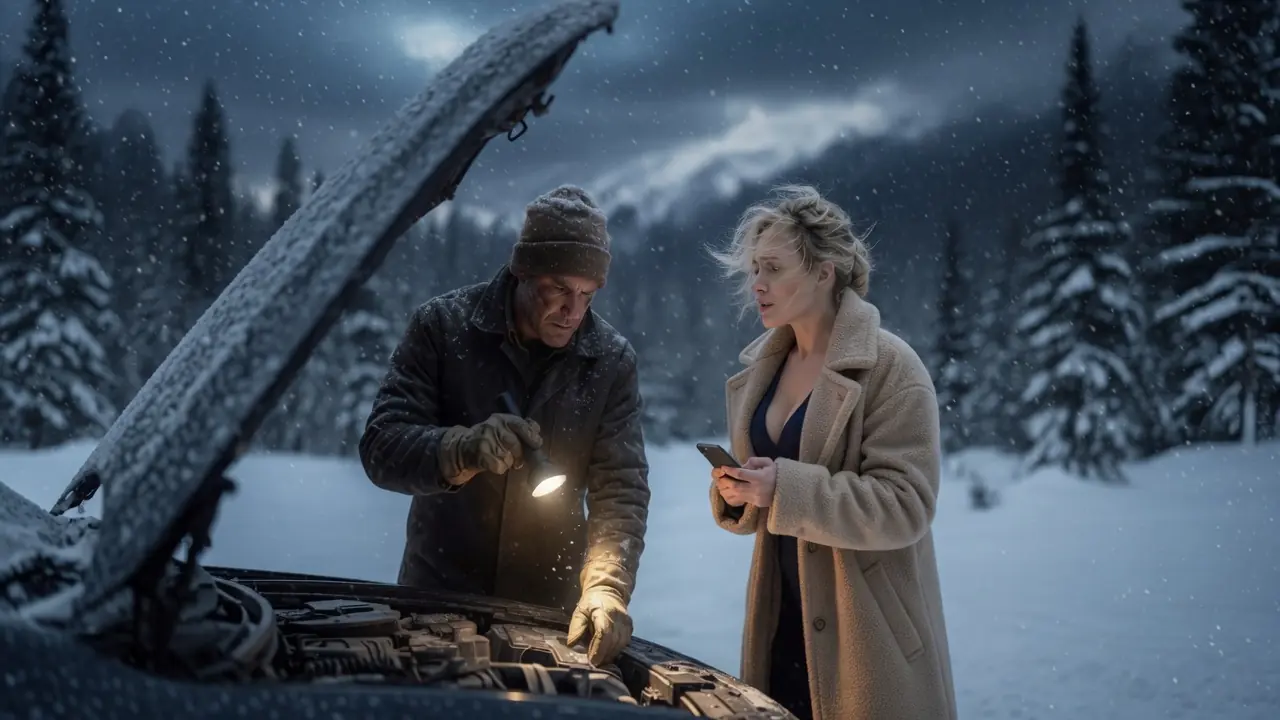
The storm had swallowed the Vermont mountain road before sunset. Snow erased the lane markings, buried the shoulders, and turned every curve into a white wall. Claire’s navigation system had failed shortly after she left the interstate, followed by the dashboard, headlights, and engine. Her luxury sedan died near a steep drop with no cellular signal and no buildings visible through the blizzard.
Garrett found her standing beside the vehicle in a black leather jacket completely unsuited for the weather. She held her phone above her head as though one additional inch might produce a signal. Her blonde hair had torn loose from its pins, and fear hid beneath the irritated expression she used in boardrooms whenever circumstances refused to obey her. Garrett stopped his battered pickup because leaving her there was never an option.
He had asked her to sit inside his truck while he inspected the engine. Claire refused at first, unwilling to leave confidential documents inside the sedan with a stranger. Garrett did not argue. He removed a portable work light, insulated gloves, and a compact diagnostic meter from behind his seat, then walked into the storm as though repairing cars on frozen mountain roads was an ordinary New Year’s Eve task.
Claire followed him to the hood.
She watched him examine the battery, fuse box, and wiring harness without introducing himself beyond the name stitched faintly into his jacket. His tools were worn, his pickup carried rust along both wheel wells, and the beam from his flashlight shook only when the wind struck his arm. None of it resembled the polished roadside service Claire expected for an executive vehicle worth more than Garrett’s truck and garage combined.
That was when she insulted him.
Garrett answered by pulling the burned wire free.
The damage had not come from age, road salt, or an ordinary electrical failure. Someone had installed a bypass connector that allowed excessive current to travel around the vehicle’s thermal protection system. The modification was hidden beneath factory wrapping, positioned where a regular technician might replace the battery and send the customer away.
“If the engine restarted, how long before the fire?” Claire asked.
“Could be thirty seconds. Could be ten minutes.”
“Can you repair it?”
“I can make it safe enough to move.”
“That is not what I asked.”
Garrett turned toward her. Snow had collected along his knit cap and rough stubble, but his blue-gray eyes remained calm. “I can repair what failed. I cannot promise there isn’t another hidden bypass somewhere I can’t reach on the side of a mountain.”
Claire looked toward the dark road.
“What do you recommend?”
“You sit in my truck. I disconnect the dangerous circuit, restore basic power, and follow you to my garage. You do not drive faster than thirty.”
“I have an investor meeting tonight.”
“You have a car that almost burned with you inside.”
The directness irritated her, but it also ended the argument.
Garrett spent forty minutes working beneath the hood while Claire waited inside his pickup. A faded photograph was clipped above the dashboard. It showed Garrett beside a smiling girl of about twelve, both of them covered in grease as they held a rebuilt carburetor between them.
A handwritten note beneath the photograph read:
Dad, stop fixing everyone else’s problems for free. — Lily
Claire smiled despite herself.
Garrett returned with frozen shoulders and a temporary wiring bridge protected by two additional fuses. He explained exactly what he had changed, what warning lights would remain active, and what Claire must do if she smelled heat or saw smoke. He asked for no payment and refused the cash she offered.
“You spent nearly an hour outside in this storm.”
“I stopped because you were stranded.”
“I can compensate you.”
“My daughter might need help on a road someday.”
“That does not pay your bills.”
“No,” Garrett said. “But it lets me sleep.”
The sedan started.
Garrett followed Claire through the storm until they reached Morrison Auto and Farm Repair, a weathered two-bay garage outside the small town of Hollow Creek. One overhead door had been patched with mismatched metal, and the sign above the entrance had lost several letters. The heated office contained a woodstove, two chairs, a coffee machine, and a row of invoices held together by clothespins.
Lily Morrison was waiting inside.
She stood the moment Garrett entered, relief flashing across her face before annoyance replaced it. At thirteen, she had inherited her father’s dark hair, careful eyes, and habit of hiding worry behind practical questions.
“You said one roadside call.”
“It became complicated.”
“The pancakes became cold.”
“I can fix pancakes.”
“You can burn pancakes.”
Claire watched their exchange from the doorway. Garrett introduced her only as a stranded driver, never mentioning her title or the value of the car. Lily brought Claire a blanket, heated soup on the small stove, and placed dry gloves beside her without being asked.
Garrett raised the sedan and inspected it beneath brighter lights.
The temporary repair was only the beginning.
Two additional protection circuits had been bypassed inside the main harness. The work was precise enough to resemble a factory modification but crude enough to create dangerous heat after prolonged driving. Each connector carried a tiny production code associated with Whitmore Mobility Systems, the automotive technology company Claire had inherited from her father and transformed into a major supplier.
Claire moved closer to the workbench.
“That code belongs to one of our approved manufacturers.”
Garrett nodded. “I know.”
“How?”
“Because I warned your company about this design nine years ago.”
The garage became quiet.
Garrett had once worked as a senior electrical systems engineer for Vale Automotive Technologies, a supplier later purchased by Whitmore Mobility. His team developed a compact current-management module intended for luxury vehicles and delivery fleets. During testing, Garrett discovered that a specific relay could overheat when exposed to repeated cold starts.
The solution required a redesigned thermal fuse and a stronger connector.
The correction cost less than eighteen dollars per vehicle.
Vale’s leadership rejected it because thousands of modules had already been manufactured. Garrett documented the danger, copied test results into the official safety system, and refused to sign a report classifying the failure as harmless.
Three weeks later, someone accused him of removing proprietary files.
He was dismissed.
The company threatened legal action if he discussed the defect, and every major supplier that previously praised his work suddenly stopped returning calls. Garrett’s wife, Emily, became ill during the same year. By the time she died, he had an infant daughter, no engineering career, and medical debt large enough to destroy whatever pride remained.
He opened the garage with borrowed tools.
Claire listened without interrupting.
“My company purchased Vale six years ago,” she said.
“The defect is older than your ownership.”
“But the car carrying it was built last year.”
Garrett placed the damaged connector beneath a magnifying lamp. “That means someone kept the design alive.”
Claire asked for copies of his original reports.
Garrett shook his head. “They accused me of stealing files. I left with nothing.”
“You remembered every detail?”
“I watched it fail enough times.”
The investor meeting no longer mattered.
Claire spent the night at a nearby inn while Garrett worked until dawn documenting the sedan. He photographed every bypass, recorded resistance measurements, and sealed the burned components in evidence bags. Claire returned the next morning wearing borrowed winter clothes and carrying coffee for all three of them.
Lily studied her carefully.
“You were mean to my dad yesterday?”
Garrett nearly dropped his cup.
Claire answered honestly. “Yes.”
“Did you apologize?”
“Not properly.”
Lily waited.
Claire turned toward Garrett. “I judged you before I understood what you knew. You saved my life after I treated you as though your garage determined your intelligence. I am sorry.”
Garrett looked uncomfortable with the attention. “You were freezing and frightened.”
“That explains my behavior. It does not improve it.”
Lily nodded approvingly and returned to her schoolbook.
Claire requested permission to take the damaged components to Whitmore Mobility’s independent laboratory. Garrett agreed only if the evidence remained traceable and he received duplicate reports. He had already lost one career because powerful people controlled the records.
Claire accepted every condition.
Before leaving, she noticed a certified letter on the office counter. It was a final notice from Hollow Creek Community Bank. Morrison Auto owed forty-seven thousand dollars, and the lender planned to foreclose in thirty days unless Garrett paid the overdue balance.
Claire touched the envelope.
Garrett removed it from beneath her hand. “That is not part of the repair.”
“It may become part of the offer.”
“I am not accepting charity.”
“I did not offer any.”
She drove away before he could answer.
At Whitmore headquarters, Claire ordered a confidential audit of every current and historic component derived from Vale’s electrical module. She limited access to five people and required all data to be copied outside the company’s normal engineering servers.
The first results arrived within forty-eight hours.
The dangerous relay appeared in more than three thousand executive sedans, two hundred delivery vans, and forty-six company fleet vehicles. Most contained the proper thermal fuse, but seventy-eight units included the bypass configuration found in Claire’s car.
Those vehicles had one thing in common.
All had undergone “performance optimization” at a service division controlled by Whitmore’s chief operating officer, Nolan Pierce.
Nolan dismissed the issue as an isolated supplier mistake. He argued that Garrett’s history made him an unreliable source and warned Claire against trusting a mechanic carrying a professional grievance. When she requested the original Vale reports, Nolan said the files had been destroyed during the acquisition.
Claire had already found them.
A retired systems analyst kept backup copies inside an archived insurance folder. Garrett’s report appeared exactly as he described it, complete with laboratory photographs, recommended modifications, and a warning that bypassing the protection circuit could cause fire.
The final page had been altered.
Garrett’s original conclusion called for an immediate production halt.
The stored version claimed the risk was negligible.
Digital records showed the change had been authorized through an account belonging to Nolan, who had served as Vale’s legal and compliance director before joining Whitmore Mobility. He had protected the defective product nine years earlier and continued installing bypasses in selected vehicles whenever the improved system interfered with performance targets.
Claire’s sedan had not been sabotaged to kill her.
The truth was almost worse.
Nolan knew the defect existed and considered the risk acceptable.
He had approved a modification that made the car faster and cheaper while silently removing the system designed to stop an electrical fire. Executives, drivers, and customers were expected to carry the danger because replacing the modules might damage quarterly earnings.
Claire suspended him.
Nolan responded by contacting board members and accusing her of allowing a resentful former employee to manipulate company safety policy. He argued that Garrett intended to force a settlement by exploiting an ordinary winter breakdown.
The board demanded proof.
Claire returned to Vermont three weeks after the storm.
This time, twelve black fleet vehicles followed her into Hollow Creek.
Garrett stood beneath the garage sign as the convoy filled the gravel lot. Lily watched from the office window, certain her father was either about to become rich or get arrested.
Claire stepped from the lead vehicle carrying a thick contract.
Garrett looked at the line of cars. “You brought every problem you own?”
“Only the vehicles scheduled for immediate inspection.”
“My garage has two bays.”
“The fleet contract includes an expansion advance.”
He did not touch the document.
“How much?”
“Three hundred and twenty thousand dollars for the first year.”
Garrett stared at her.
The agreement appointed Morrison Auto as Whitmore Mobility’s independent cold-weather electrical inspection center. Garrett would examine company fleets, train technicians, and develop new diagnostic standards based on the defect he had identified years earlier.
The contract paid enough to clear the bank debt, repair the garage, hire two mechanics, and create an education fund for Lily.
Garrett still hesitated.
“You need a large service center,” he said.
“I need someone willing to stop a production line when the evidence says stop.”
“You could hire me at headquarters.”
“You would hate headquarters.”
“That obvious?”
“You keep invoices on clothespins.”
“They’re organized.”
“They’re hanging above a coffee pot.”
Garrett almost smiled.
Claire placed a second document on his workbench. It formally restored his professional engineering record and acknowledged that his termination from Vale had been based on false allegations. Whitmore Mobility agreed to compensate him for lost earnings and transfer ownership of several safety patents that used his original research without credit.
Garrett read the first page slowly.
His hands began to shake.
For years, he had told himself that losing the career no longer mattered. He had Lily, the garage, and a town that trusted him with tractors, snowplows, and old cars. Yet seeing his name restored opened a wound he had never allowed himself to examine.
“They called me a thief,” he said.
“I know.”
“Emily believed me.”
“She was right.”
“She died believing nobody else ever would.”
Claire stepped closer but did not touch him. “The board meeting is Friday. Nolan will challenge every finding. I need you there.”
“I am not a boardroom man.”
“You are the man who found the defect.”
“I found it nine years ago.”
“Friday is when they finally listen.”
Garrett signed the fleet contract.
He did not sign the settlement until his attorney reviewed it, which made Claire respect him more.
The board meeting began with Nolan presenting charts about cost, probability, and reputational risk. He argued that recalling the affected vehicles could trigger panic and lawsuits. The number of documented fires remained low, he said, and Garrett’s roadside discovery did not prove a widespread danger.
Claire allowed him to finish.
Garrett entered wearing a clean work shirt rather than a suit. He placed the burned wire from her sedan on the table and connected a salvaged module to a transparent testing box. Every board member could see the relay, fuse, and temperature sensors.
He reproduced the cold-start sequence.
For several minutes, nothing happened.
Nolan smiled.
The temperature climbed gradually. The bypass connector began discoloring, followed by the smell Claire remembered from the mountain road. Seconds later, insulation melted and a small flame appeared inside the sealed chamber.
The fire-suppression system activated automatically.
Garrett turned toward the board.
“Your drivers will not be inside a sealed test box.”
Nolan claimed the conditions had been manipulated.
Claire displayed the original Vale records and digital authorization showing he had altered Garrett’s conclusion. She also presented emails proving Nolan continued approving bypass installations after Whitmore acquired the supplier.
One message read:
The cold-weather risk remains statistically tolerable. Do not elevate it to executive review.
Claire looked at him.
“My car was executive review.”
The board terminated Nolan and referred the evidence to regulators. Whitmore Mobility announced a voluntary recall before any government agency forced it. The company replaced every affected module, compensated customers, and hired an outside group to review safety reporting.
The recall cost millions.
It also prevented injuries no quarterly report could calculate.
Morrison Auto became the center of the repair program.
Garrett hired two experienced mechanics and a young technical-school graduate who reminded him of himself before the industry taught him how easily honesty could become expensive. He replaced the roof, installed proper lifts, and added a classroom where technicians learned to diagnose electrical faults without relying blindly on manufacturer codes.
The old sign remained.
Lily refused to let him replace it entirely.
They repainted the missing letters together.
Claire visited more often than the contract required.
At first, she arrived for inspections, reports, and safety meetings. Later, her reasons became weaker. She drove three hours to ask whether a dashboard vibration required immediate attention. Garrett listened for five seconds and told her a water bottle was rattling inside the cup holder.
“You could have called,” he said.
“I wanted a professional opinion.”
“You own an automotive company.”
“I trust this garage.”
Lily watched from the office and whispered loudly, “She likes you.”
Garrett pretended not to hear.
Claire heard perfectly.
Their relationship developed carefully. Garrett was a widower who still kept Emily’s photograph beside the register. Claire had spent most of her adult life protecting a company large enough to consume every personal relationship she attempted.
Neither wanted gratitude confused with love.
Claire never treated the contract as leverage. Garrett never allowed pride to turn every kindness into an insult. They argued about work, safety deadlines, and his habit of refusing help until exhaustion made the decision for him.
They also learned one another slowly.
Claire discovered Garrett sang badly while repairing transmissions.
Garrett learned that Claire feared mountain roads after the blizzard but drove them anyway because refusing would let fear choose her destinations. Lily taught Claire how to rebuild a carburetor, though modern cars no longer needed one.
On the anniversary of the storm, Claire returned during another snowfall.
This time, her sedan was functioning perfectly.
Garrett stood beneath the repaired garage awning while she approached carrying three containers of soup. Lily opened the office door and announced that dinner would become cold if they continued staring at each other in the snow.
Claire looked toward the garage.
The second bay had been expanded, the lights were bright, and four Whitmore fleet vehicles waited for inspection. The bank notice was gone from the counter. Garrett’s restored engineering certificate hung beside Emily’s photograph.
“You saved this place,” he said.
“No.”
“The contract did.”
“The contract paid for work your garage was already qualified to do.”
“You could have chosen anyone.”
“I chose the mechanic who stopped during a blizzard after the person he rescued insulted him.”
Garrett smiled faintly. “That does sound impressive.”
Claire stepped closer. “You refused my money because you hoped someone would protect Lily if she were ever stranded.”
“Yes.”
“I want you to know someone will.”
Garrett’s expression changed.
Claire did not make a grand promise or ask him to forget the woman he had lost. She simply reached for his hand beneath the falling snow.
He allowed her to take it.
Inside the office, Lily watched through the window and immediately texted her aunt:
Finally.
Morrison Auto survived because of the fleet contract, but it grew because Garrett never allowed desperation to weaken his standards. He remained independent, rejected unsafe deadlines, and stopped work whenever evidence required another test.
Whitmore Mobility became stronger for the same reason.
Claire established a protected reporting system allowing any engineer or technician to halt production without approval from management. The policy was named the Morrison Safety Hold, though Garrett protested until Lily told him to stop pretending he disliked recognition.
Years later, one damaged connector remained inside a glass case near the garage entrance.
Beneath it was a small card:
The defect was inexpensive to repair. Ignoring it almost cost everything.
Visitors often assumed the sentence referred only to the car.
Garrett understood it differently.
Claire had mistaken a weathered jacket for ignorance. Whitmore Mobility had mistaken one engineer’s integrity for disobedience. Garrett had mistaken accepting help for surrendering independence, while Claire once believed leadership required carrying every burden alone.
The storm exposed each mistake.
On another New Year’s Eve, Garrett closed the garage early and drove Claire and Lily toward the mountain cabin where they planned to celebrate. Snow began falling near the same curve where the luxury sedan had failed years before.
Claire became quiet.
Garrett slowed the truck and rested one hand near hers.
“The road is clear,” he said.
“I know.”
“The engine is fine.”
“I know.”
“You designed the latest electrical inspection yourself.”
“I know that too.”
He smiled. “What are you worried about?”
Claire looked toward him, then toward Lily sleeping in the back seat.
“Nothing,” she said. “I’m remembering what I found here.”
Garrett glanced at the snow-covered shoulder.
“You found a burned wire.”
“I found a man who stopped.”
The truck continued through the storm.
Years earlier, Claire offered to pay whatever Garrett’s little garage was worth. She eventually learned its value had never been measured by the building, equipment, or overdue bank balance.
Its value lived in the mechanic who refused to let a frightened stranger drive into danger, even after she treated him as though he had nothing important to offer.
Garrett fixed her car that night.
The truth he uncovered saved her company.
The offer she carried back saved his garage.
What they built afterward saved something quieter in both of them—the belief that being underestimated did not reduce a person’s worth, and accepting another person’s hand did not make anyone less strong.